
Instrumentation Power Electronics Lecture 15 16 D C


- Slides: 32
Instrumentation & Power Electronics Lecture 15 & 16 D. C to D. C Converters
Introduction • DC to DC converters are important in portable electronic devices such as cellular phones and laptop computers, which are supplied with power from batteries primarily. • Such electronic devices often contain several sub-circuits, each with its own voltage level requirement different from that supplied by the battery or an external supply. • They are also widely used in dc-motor drive applications. • Often input to these converters is an unregulated dc voltage, which is obtained by rectifying the line voltage.
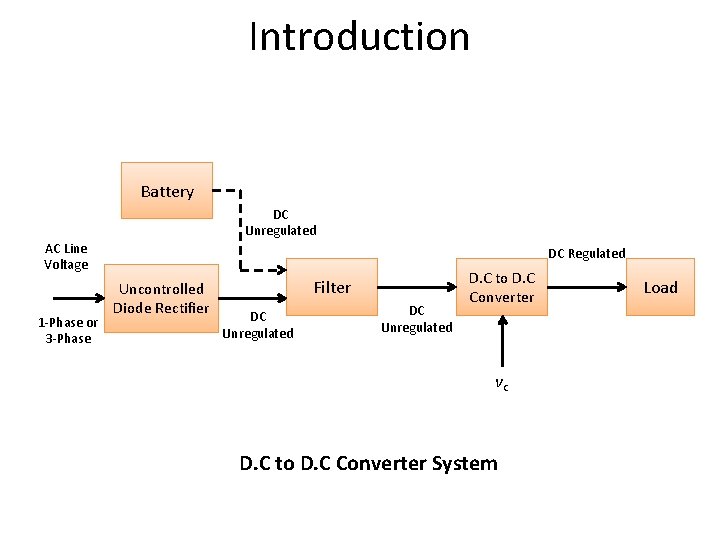
Introduction Battery DC Unregulated AC Line Voltage 1 -Phase or 3 -Phase DC Regulated Uncontrolled Diode Rectifier Filter DC Unregulated D. C to D. C Converter vc D. C to D. C Converter System Load
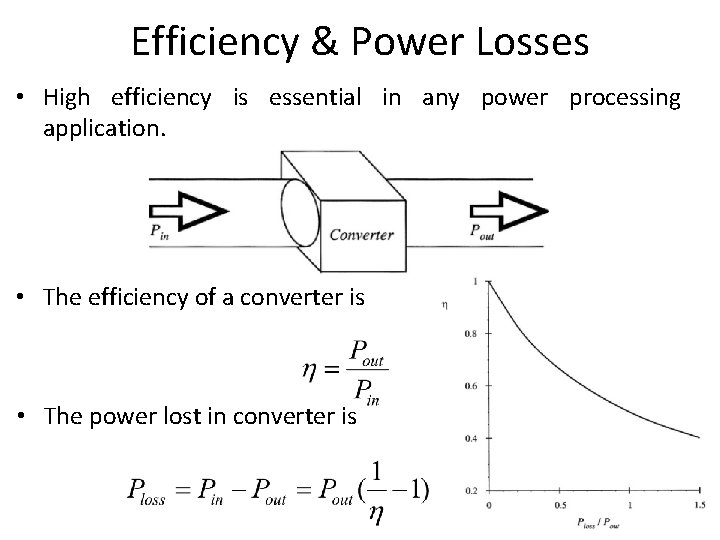
Efficiency & Power Losses • High efficiency is essential in any power processing application. • The efficiency of a converter is • The power lost in converter is
Efficiency & Power Losses • Efficiency is a good measure of the success of a given converter technology. • With very small amount of power lost, the converter elements can be packaged with high density, leading to a converter of small size and weight, and of low temperature rise. • How can we build a circuit that changes the voltage, yet dissipates negligible power?
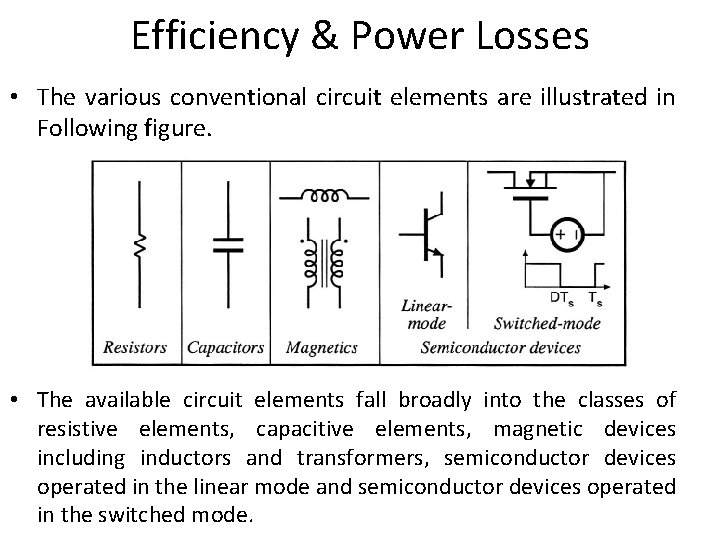
Efficiency & Power Losses • The various conventional circuit elements are illustrated in Following figure. • The available circuit elements fall broadly into the classes of resistive elements, capacitive elements, magnetic devices including inductors and transformers, semiconductor devices operated in the linear mode and semiconductor devices operated in the switched mode.
Types of dc-dc Converters • Types of D. C to D. C converters – Linear Converters (7805) – Switch Mode – Magnetic – E. t. c
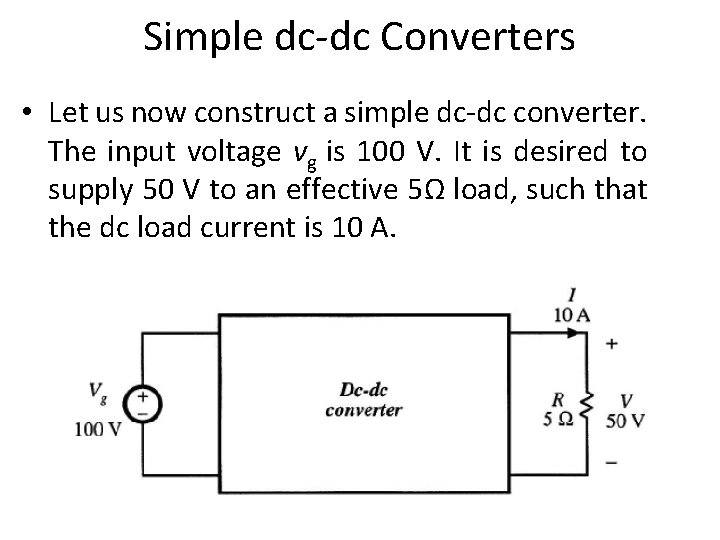
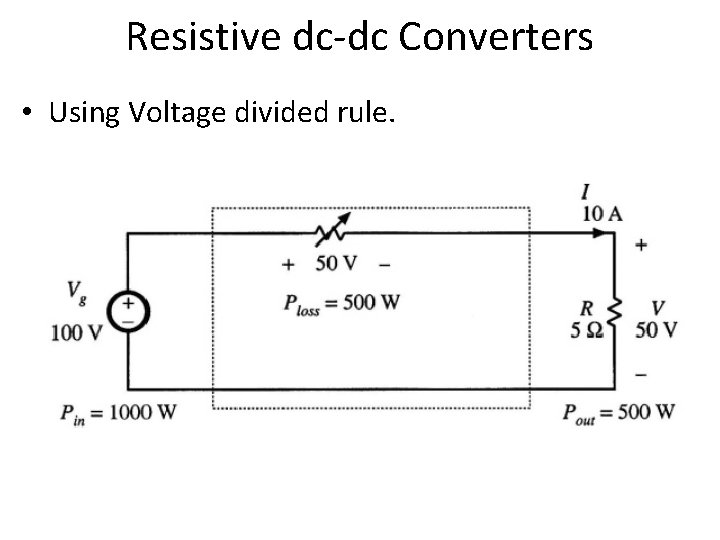
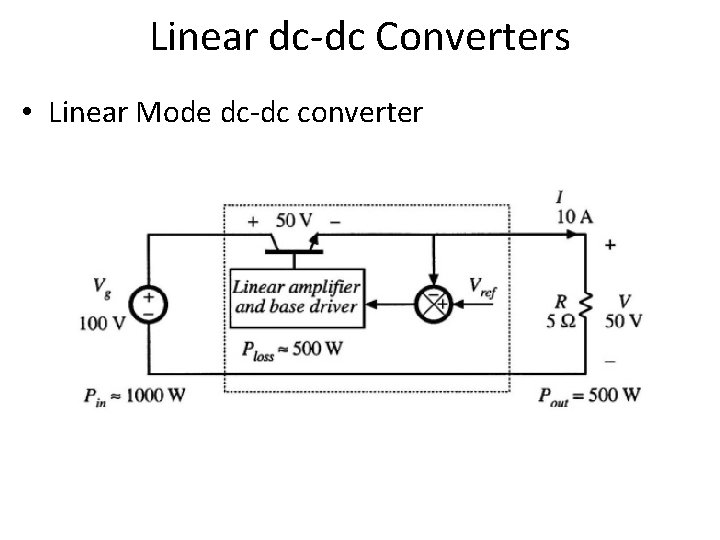
Simple dc-dc Converters • Let us now construct a simple dc-dc converter. The input voltage vg is 100 V. It is desired to supply 50 V to an effective 5Ω load, such that the dc load current is 10 A.
Resistive dc-dc Converters • Using Voltage divided rule.
Linear dc-dc Converters • Linear Mode dc-dc converter
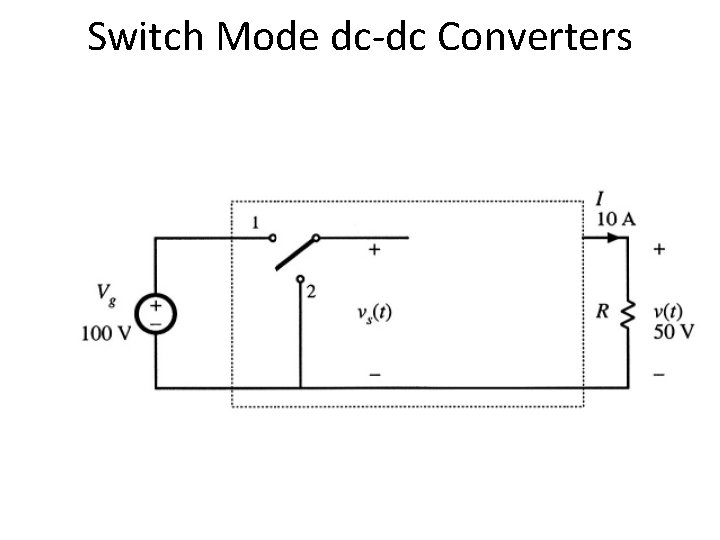
Switch Mode dc-dc Converters
Conclusion • Capacitors and magnetic devices are important elements of switching converters, because ideally they do not consume power. • It is the resistive element, as well as the linear-mode semiconductor device, that is avoided. • When a semiconductor device operates in the off state, its current is zero and hence its power dissipation is zero. • When the semiconductor device operates in the on (saturated) state, its voltage drop is small and hence its power dissipation is also small. • In either event, the power dissipated by the semiconductor device is low. • So capacitive and inductive elements, as well as switchedmode semiconductor devices, are available for synthesis of high-efficiency converters.
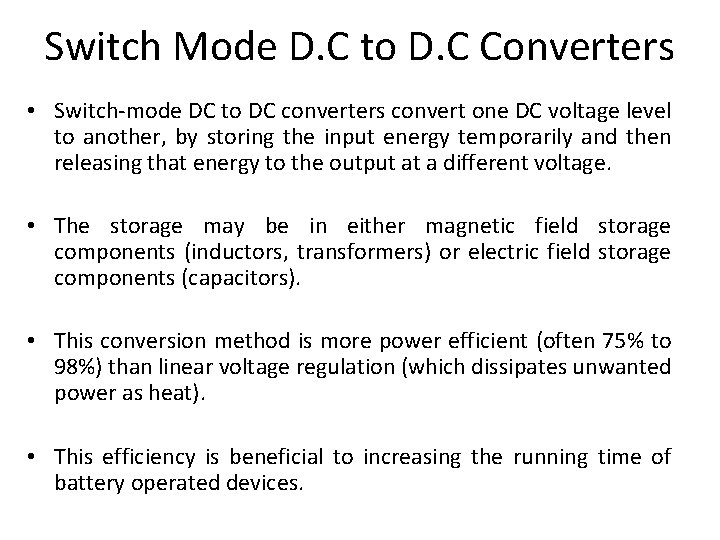
Switch Mode D. C to D. C Converters • Switch-mode DC to DC converters convert one DC voltage level to another, by storing the input energy temporarily and then releasing that energy to the output at a different voltage. • The storage may be in either magnetic field storage components (inductors, transformers) or electric field storage components (capacitors). • This conversion method is more power efficient (often 75% to 98%) than linear voltage regulation (which dissipates unwanted power as heat). • This efficiency is beneficial to increasing the running time of battery operated devices.
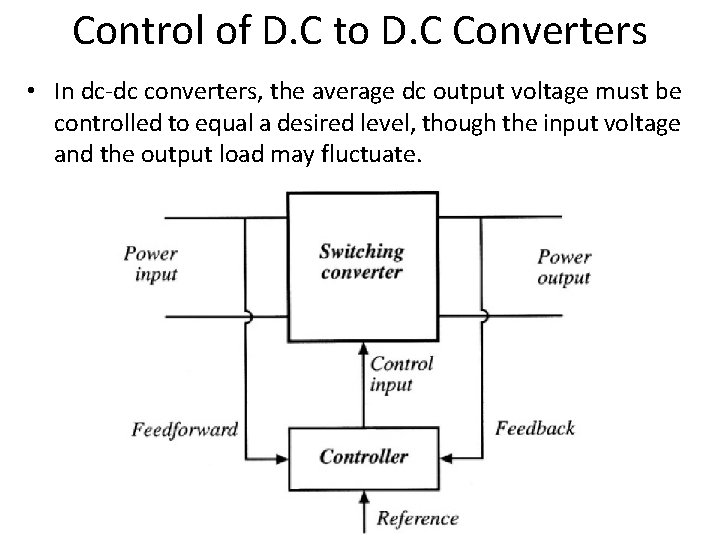
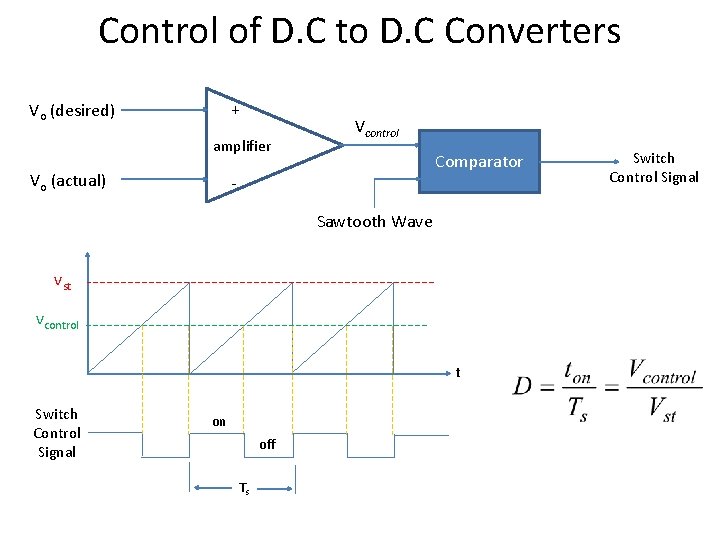
Control of D. C to D. C Converters • In dc-dc converters, the average dc output voltage must be controlled to equal a desired level, though the input voltage and the output load may fluctuate.
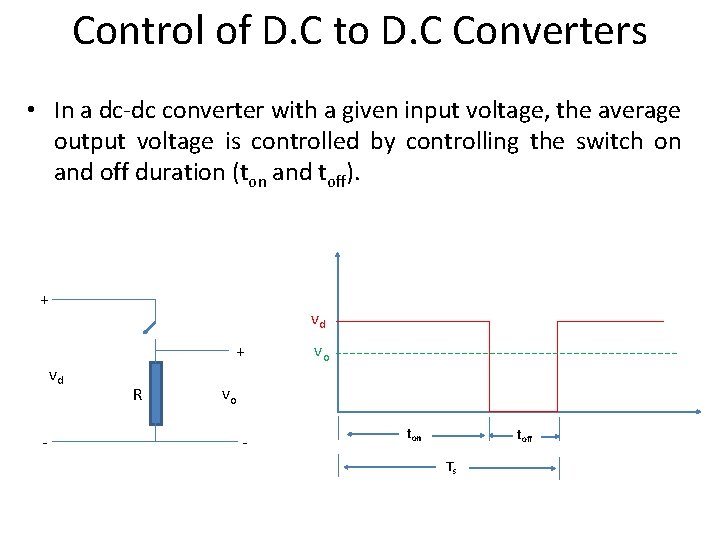
Control of D. C to D. C Converters • In a dc-dc converter with a given input voltage, the average output voltage is controlled by controlling the switch on and off duration (ton and toff). + vd - R vo vo - ton toff Ts
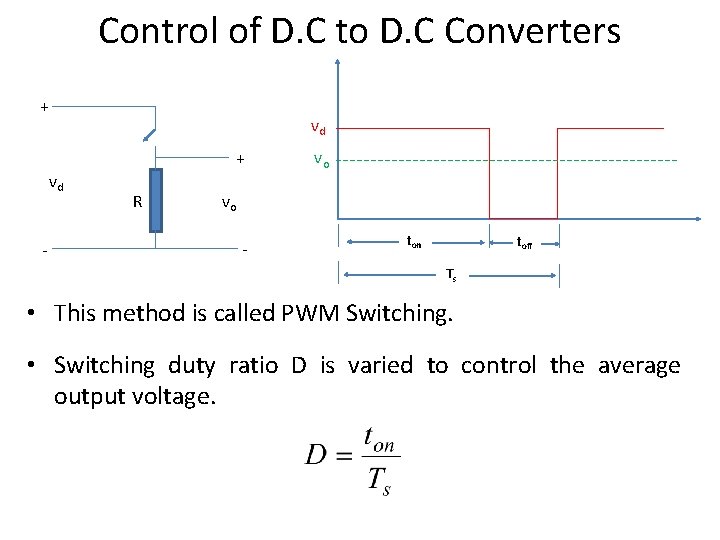
Control of D. C to D. C Converters + vd - R vo vo - ton toff Ts • This method is called PWM Switching. • Switching duty ratio D is varied to control the average output voltage.
Control of D. C to D. C Converters + Vo (desired) amplifier Vo (actual) Vcontrol Comparator Sawtooth Wave vst vcontrol t Switch Control Signal on off Ts Switch Control Signal
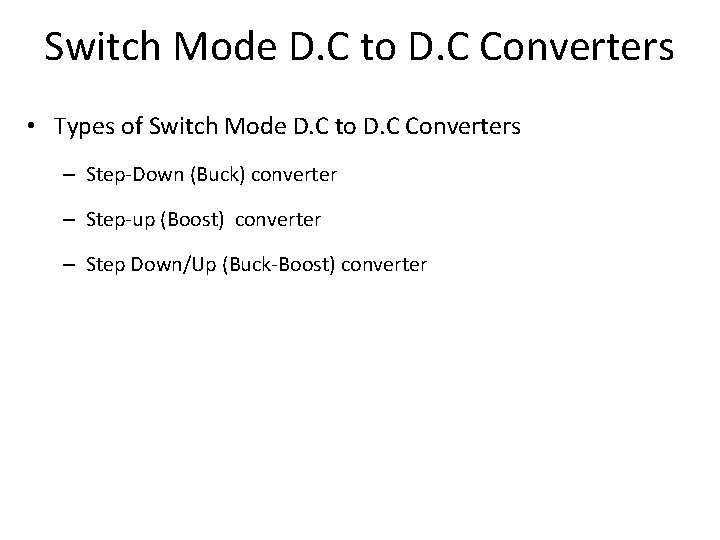
Switch Mode D. C to D. C Converters • Types of Switch Mode D. C to D. C Converters – Step-Down (Buck) converter – Step-up (Boost) converter – Step Down/Up (Buck-Boost) converter
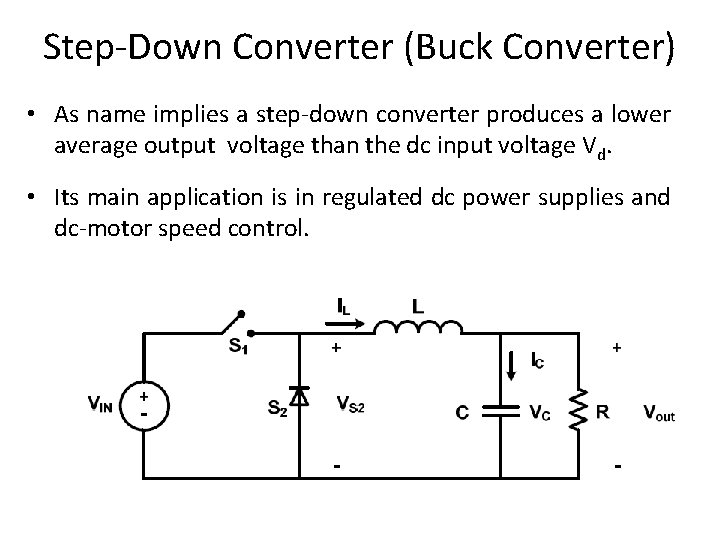
Step-Down Converter (Buck Converter) • As name implies a step-down converter produces a lower average output voltage than the dc input voltage Vd. • Its main application is in regulated dc power supplies and dc-motor speed control.
Step-Down Converter (Buck Converter) • Low Pass Filter – At low frequencies the inductor appears as a short and the capacitor is an open and the input passes through to the output. – At high frequencies the inductor looks like an open and the capacitor a short and the input is blocked from the output.
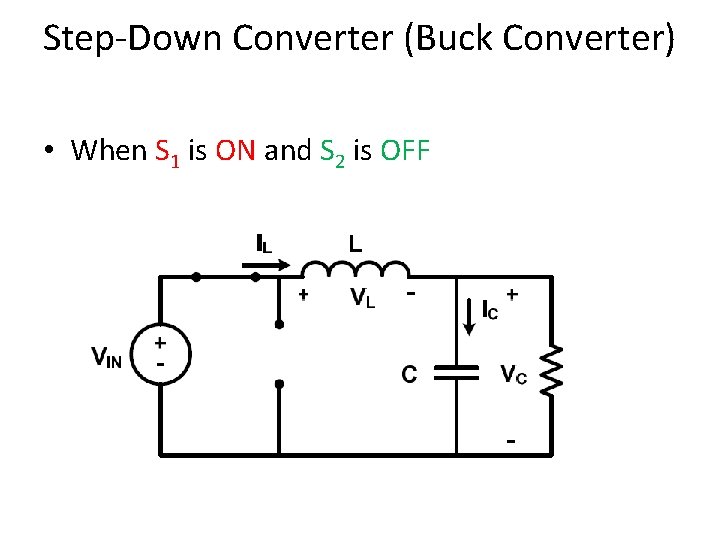
Step-Down Converter (Buck Converter) • When S 1 is ON and S 2 is OFF
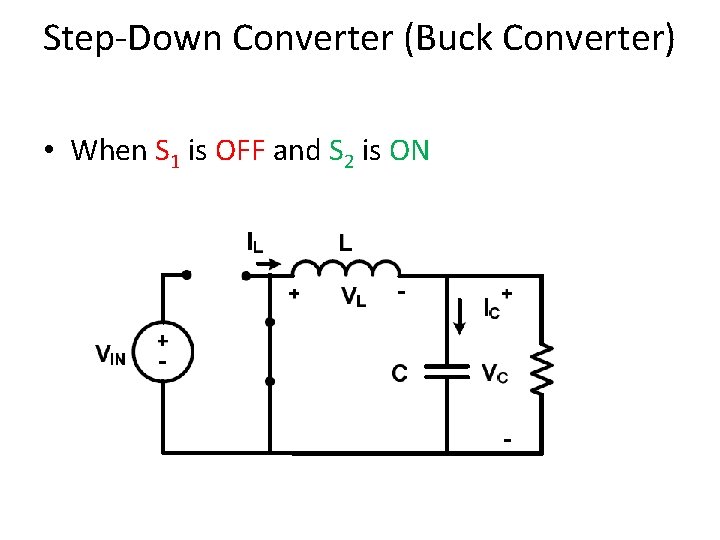
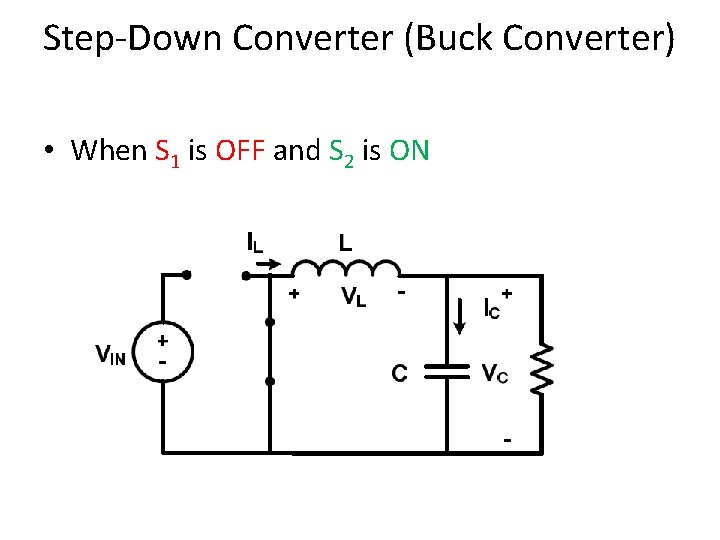
Step-Down Converter (Buck Converter) • When S 1 is OFF and S 2 is ON
Step-Down Converter (Buck Converter) • When S 1 is OFF and S 2 is ON
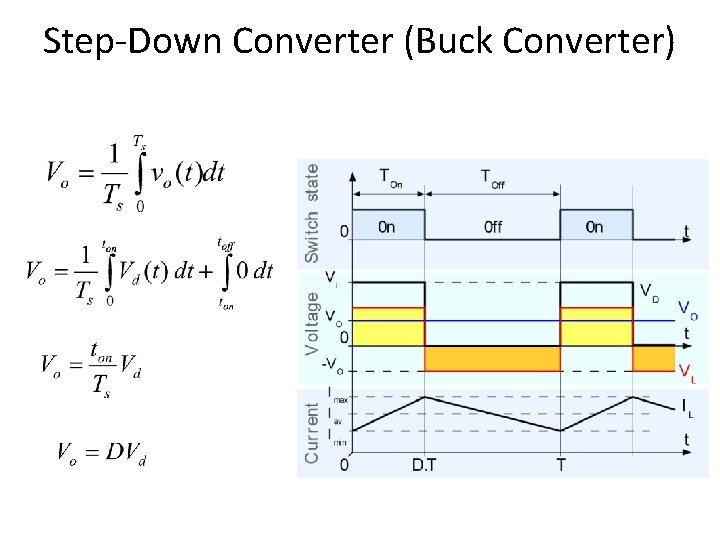
Step-Down Converter (Buck Converter)
Step-Down Converter (Buck Converter) • Continuous conduction mode – A buck converter operates in continuous mode if the current through the inductor (IL) never falls to zero during the commutation cycle. – In this mode, the operating principle is described by the plots in figure.
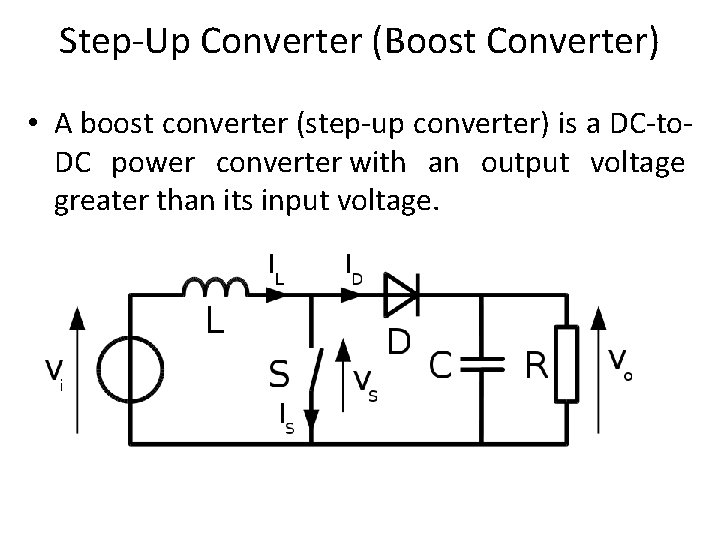
Step-Up Converter (Boost Converter) • A boost converter (step-up converter) is a DC-to. DC power converter with an output voltage greater than its input voltage.
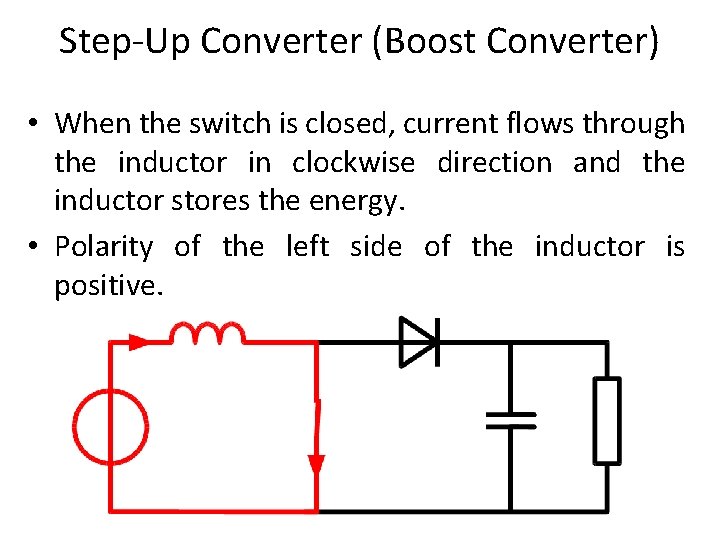
Step-Up Converter (Boost Converter) • When the switch is closed, current flows through the inductor in clockwise direction and the inductor stores the energy. • Polarity of the left side of the inductor is positive.
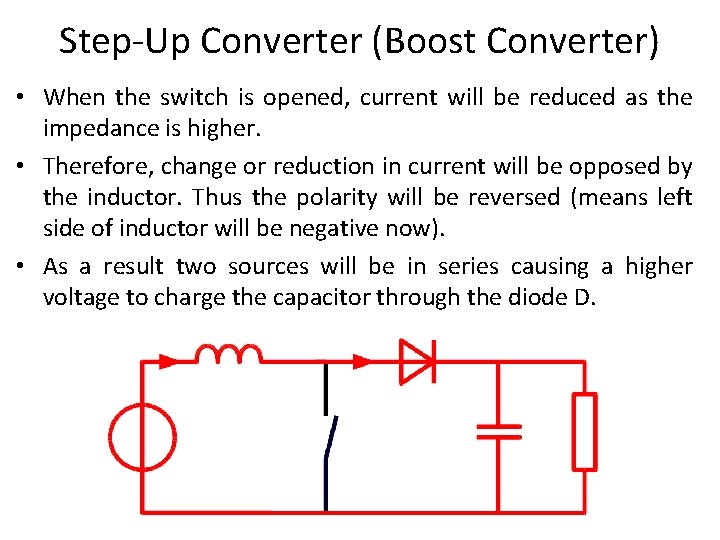
Step-Up Converter (Boost Converter) • When the switch is opened, current will be reduced as the impedance is higher. • Therefore, change or reduction in current will be opposed by the inductor. Thus the polarity will be reversed (means left side of inductor will be negative now). • As a result two sources will be in series causing a higher voltage to charge the capacitor through the diode D.
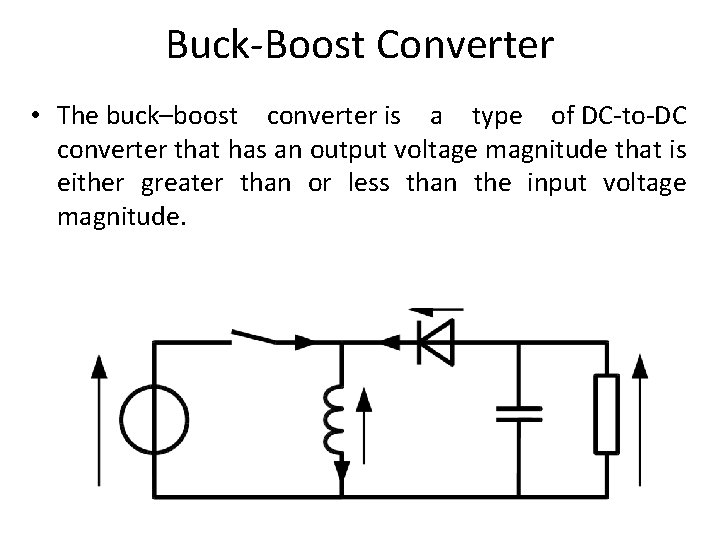
Buck-Boost Converter • The buck–boost converter is a type of DC-to-DC converter that has an output voltage magnitude that is either greater than or less than the input voltage magnitude.
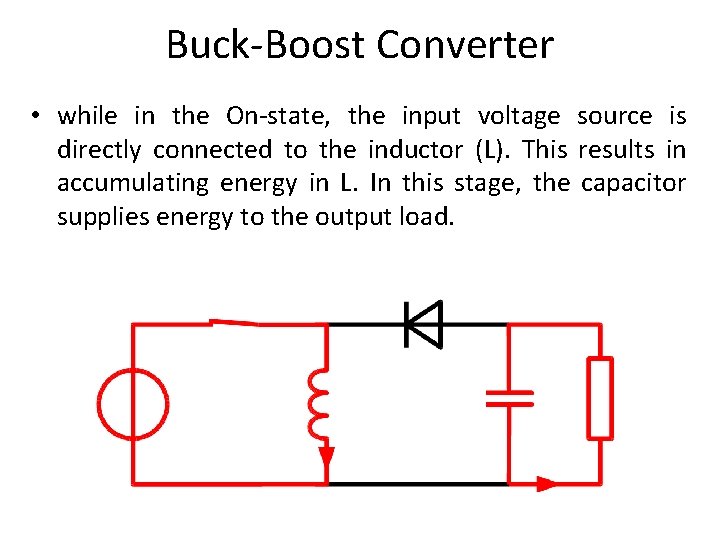
Buck-Boost Converter • while in the On-state, the input voltage source is directly connected to the inductor (L). This results in accumulating energy in L. In this stage, the capacitor supplies energy to the output load.
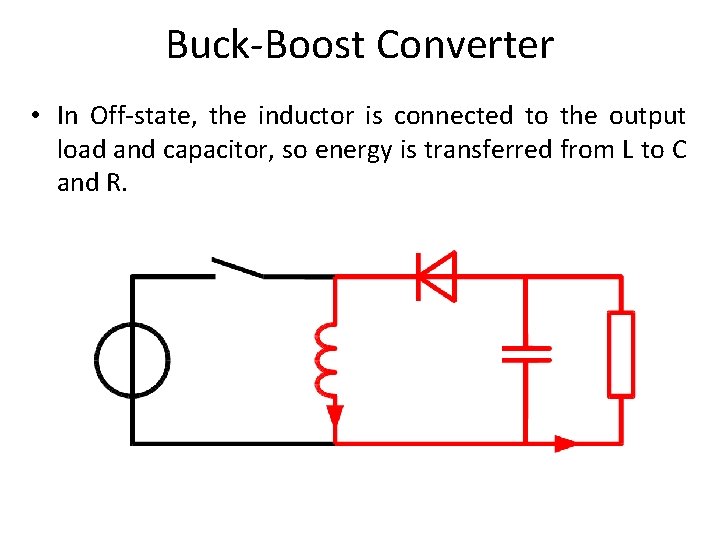
Buck-Boost Converter • In Off-state, the inductor is connected to the output load and capacitor, so energy is transferred from L to C and R.
To download this lecture visit http: //imtiazhussainkalwar. weebly. com/ END OF LECTURES-13 -14