
Instrumentation Concepts Groundbased Optical Telescopes Keith Taylor IAGUSP
Instrumentation Concepts Ground-based Optical Telescopes Keith Taylor (IAG/USP) Aug-Nov, 2008 Aug-Sep, 2008 IAG-USP (Keith Taylor)
Imaging considerations Trading field of view vs. angular resolution A large field at coarse spatial resolution or smaller field of view at high fidelity? Constraints also driven by seeing and pixel scale (or camera f-ratio) Photometric accuracy Generally detector defines fixed pixel format Simple morphological discrimination or accurate flux measures as well? Definition of passbands and central wavelengths Multiple simultaneous passbands?
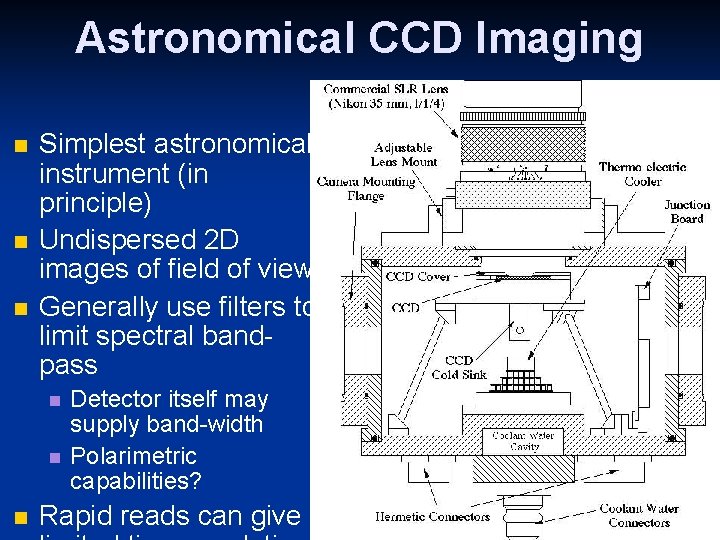
Astronomical CCD Imaging Simplest astronomical instrument (in principle) Undispersed 2 D images of field of view Generally use filters to limit spectral bandpass Detector itself may supply band-width Polarimetric capabilities? Rapid reads can give
Standardized Filter Systems Variety of different filter systems prevalent in optical/IR domain. eg: UBVRI / JHKLM – Johnson/Cousins (UV/optical) (NIR) u g r i z - Sloan Digital Sky Survey (SDSS) optical bands Extras and modifications y - UKIDSS IR band K’ and K* - modifications to K to avoid thermal radiation HST, Spitzer etc. defined by wavelength rather
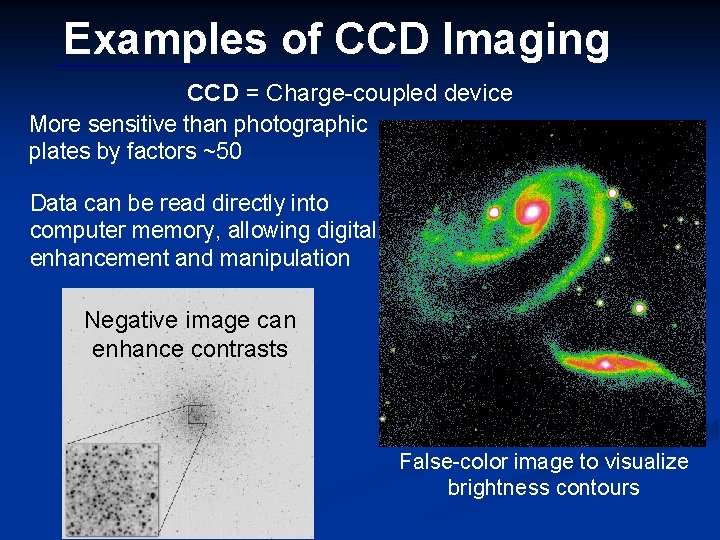
Examples of CCD Imaging CCD = Charge-coupled device More sensitive than photographic plates by factors ~50 Data can be read directly into computer memory, allowing digital enhancement and manipulation Negative image can enhance contrasts False-color image to visualize brightness contours
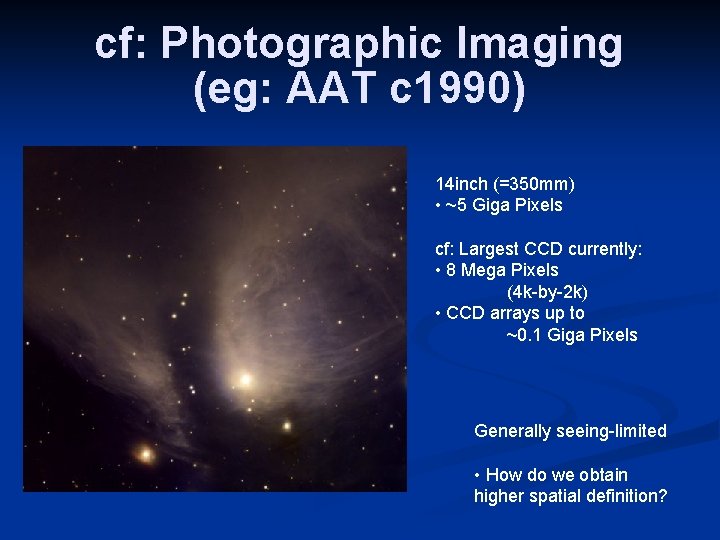
cf: Photographic Imaging (eg: AAT c 1990) 14 inch (=350 mm) • ~5 Giga Pixels cf: Largest CCD currently: • 8 Mega Pixels (4 k-by-2 k) • CCD arrays up to ~0. 1 Giga Pixels Generally seeing-limited • How do we obtain higher spatial definition?
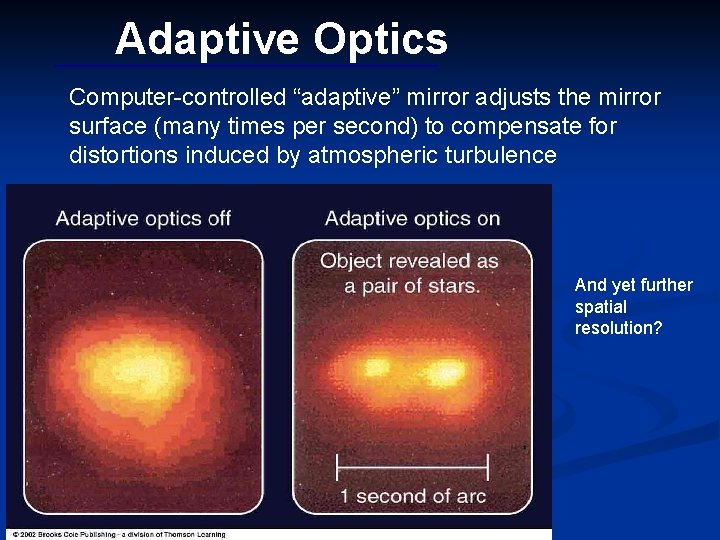
Adaptive Optics Computer-controlled “adaptive” mirror adjusts the mirror surface (many times per second) to compensate for distortions induced by atmospheric turbulence And yet further spatial resolution?
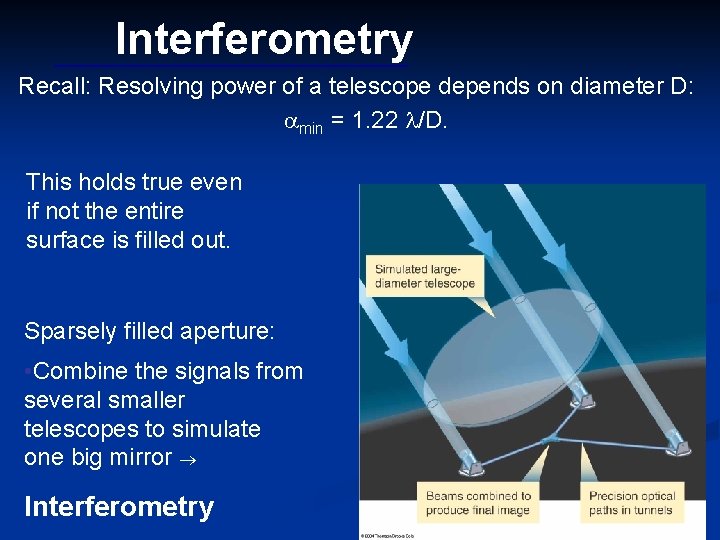
Interferometry Recall: Resolving power of a telescope depends on diameter D: min = 1. 22 /D. This holds true even if not the entire surface is filled out. Sparsely filled aperture: • Combine the signals from several smaller telescopes to simulate one big mirror Interferometry
Spectroscopic considerations What kind of spectral feature are of interest? Emission or absorption lines; continuum shapes Broad, narrow or spectrally unresolved Low or high contrast with continuum Spectral Energy Distributions (SEDs) Line centres ; equivalent widths ; line shapes ; kinematic mapping? and/or precise spectrophotometry? One or many targets simultaneously?
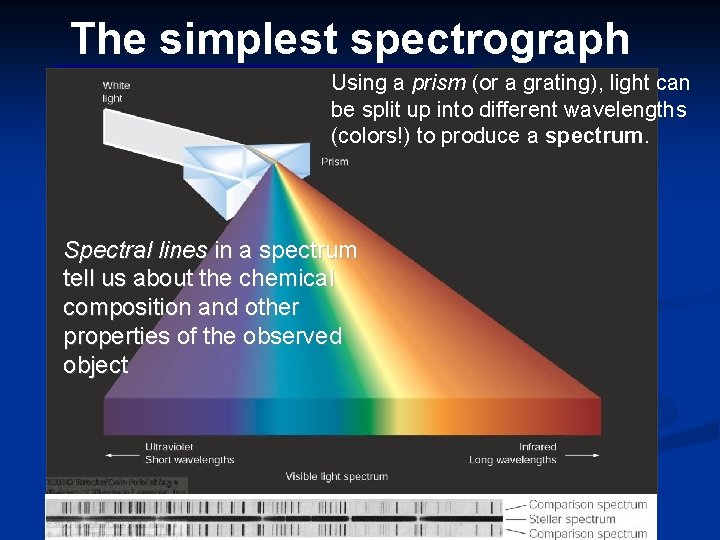
The simplest spectrograph Using a prism (or a grating), light can be split up into different wavelengths (colors!) to produce a spectrum. Spectral lines in a spectrum tell us about the chemical composition and other properties of the observed object
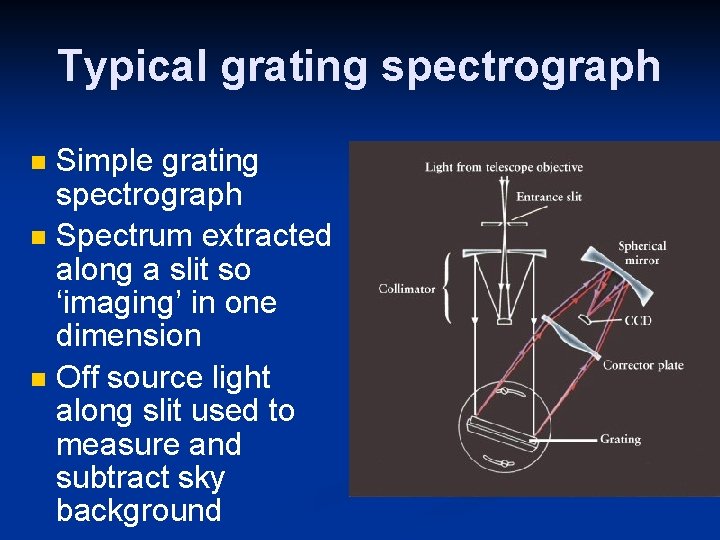
Typical grating spectrograph Simple grating spectrograph Spectrum extracted along a slit so ‘imaging’ in one dimension Off source light along slit used to measure and subtract sky background
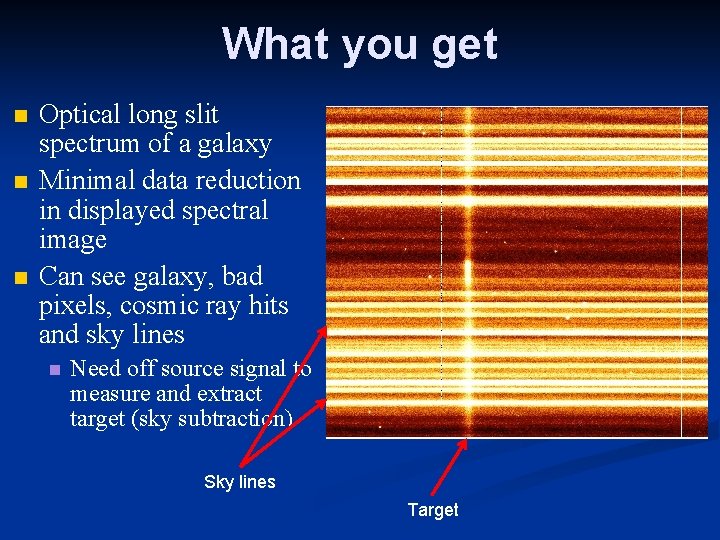
What you get Optical long slit spectrum of a galaxy Minimal data reduction in displayed spectral image Can see galaxy, bad pixels, cosmic ray hits and sky lines Need off source signal to measure and extract target (sky subtraction) Sky lines Target
Considerations for Spectroscopy Basic parameters - resolution and central wavelength for spectrum Slit width (if selectable) affects resolution Wavelength range Set by combination of detector geometry and spectral resolution Some spectrographs provide large -range at low. R; others provide only a few 1, 000 kms-1 range, so centering on a critical line of interest (eg: H ) But, what if you need both high-R and large -range?
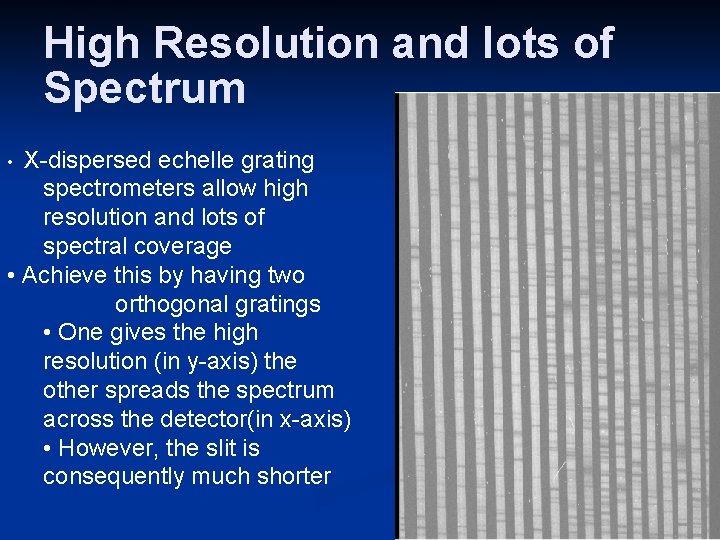
High Resolution and lots of Spectrum X-dispersed echelle grating spectrometers allow high resolution and lots of spectral coverage • Achieve this by having two orthogonal gratings • One gives the high resolution (in y-axis) the other spreads the spectrum across the detector(in x-axis) • However, the slit is consequently much shorter •
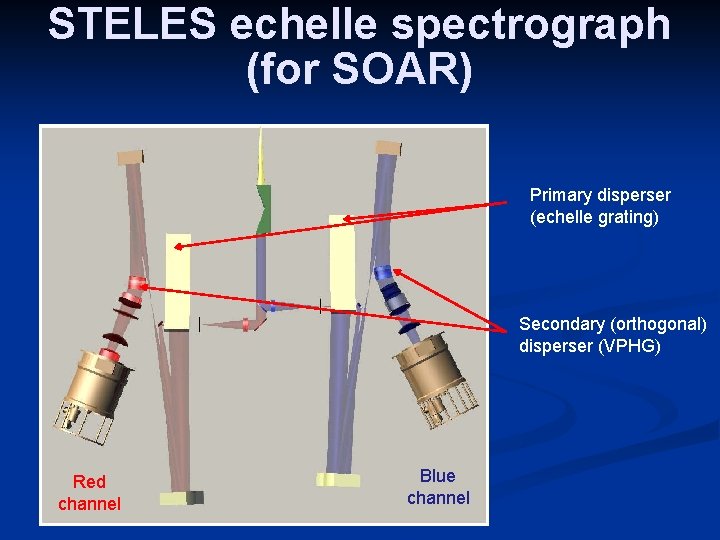
STELES echelle spectrograph (for SOAR) Primary disperser (echelle grating) Secondary (orthogonal) disperser (VPHG) Red channel Blue channel
Multiobject Spectroscopy To get spectra for lots of objects at once. Can use two approaches Multislit - have several slits in the image plane and get spectra for all of them Use fibres to pipe light from different parts of the focal plane while reformatting them along the spectrograph slit Both techniques were developed in the 80 s and perfected in the 90 s
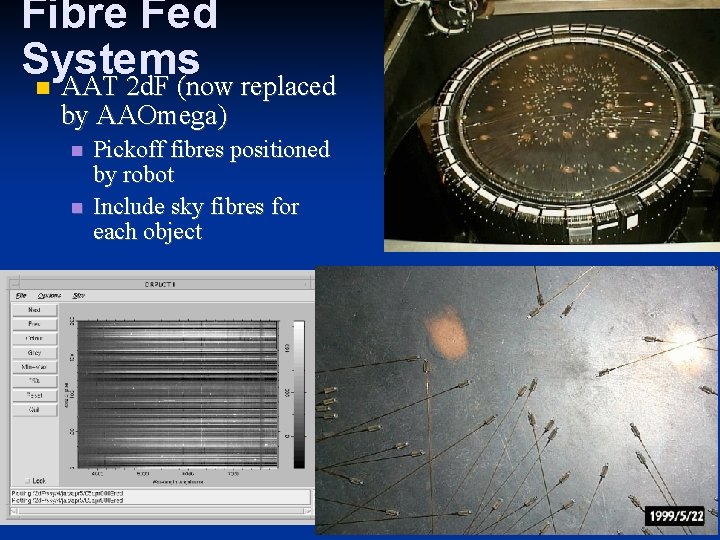
Fibre Fed Systems AAT 2 d. F (now replaced by AAOmega) Pickoff fibres positioned by robot Include sky fibres for each object
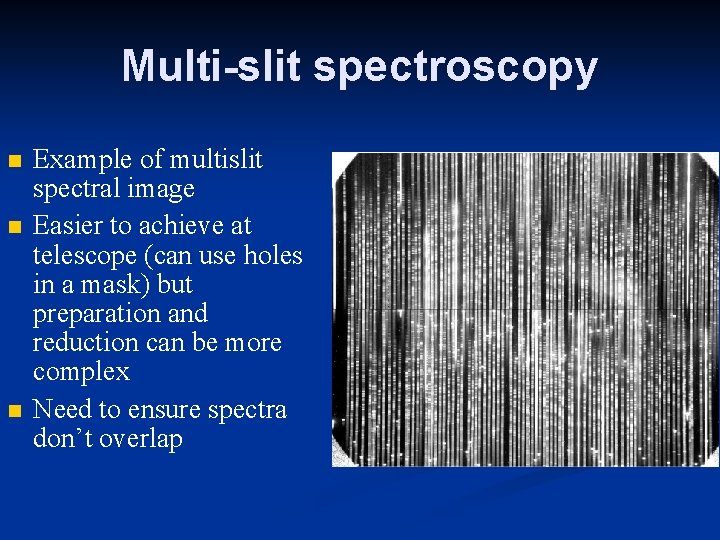
Multi-slit spectroscopy Example of multislit spectral image Easier to achieve at telescope (can use holes in a mask) but preparation and reduction can be more complex Need to ensure spectra don’t overlap
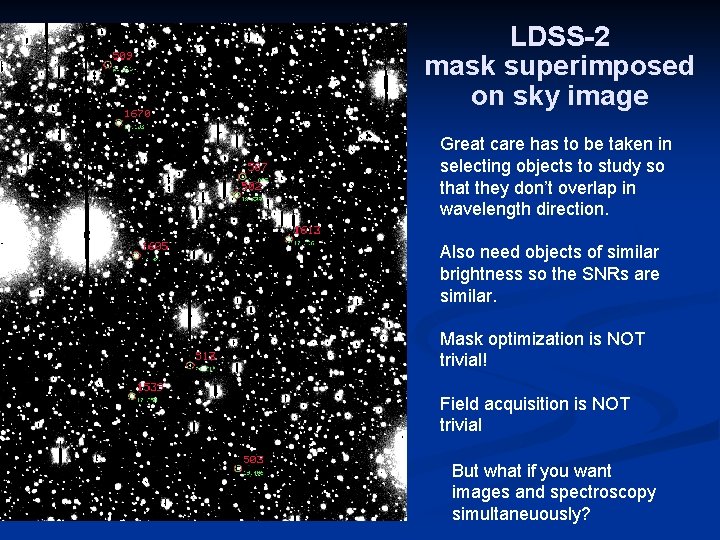
LDSS-2 mask superimposed on sky image Great care has to be taken in selecting objects to study so that they don’t overlap in wavelength direction. Also need objects of similar brightness so the SNRs are similar. Mask optimization is NOT trivial! Field acquisition is NOT trivial But what if you want images and spectroscopy simultaneuously?
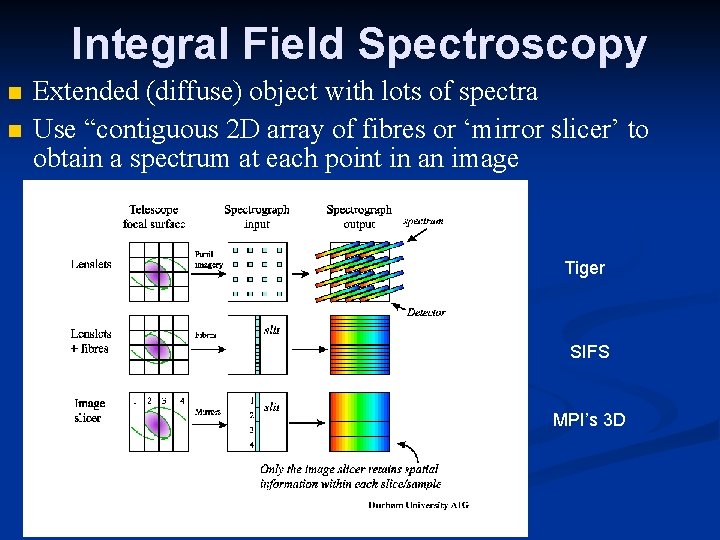
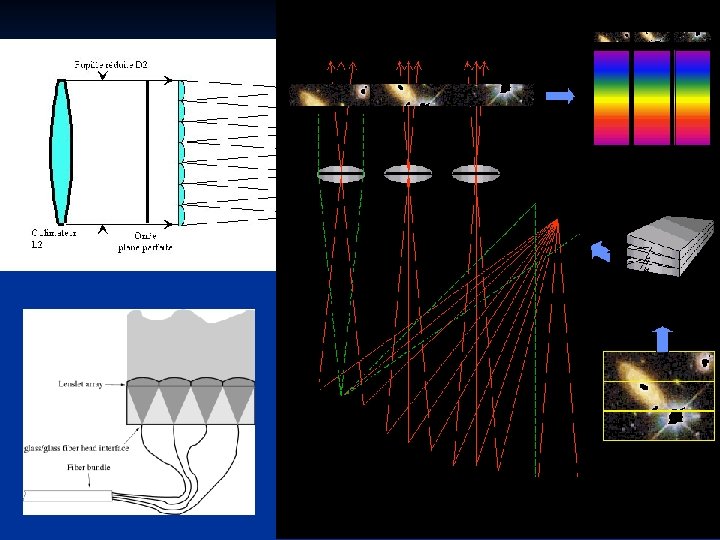
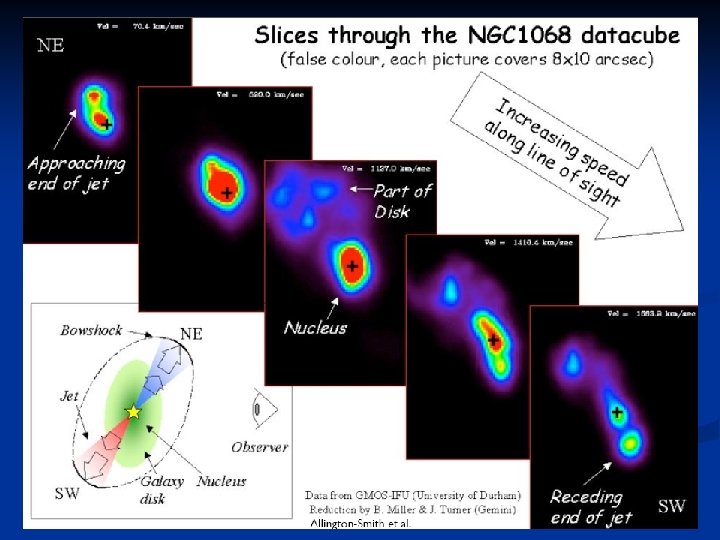
Integral Field Spectroscopy Extended (diffuse) object with lots of spectra Use “contiguous 2 D array of fibres or ‘mirror slicer’ to obtain a spectrum at each point in an image Tiger SIFS MPI’s 3 D
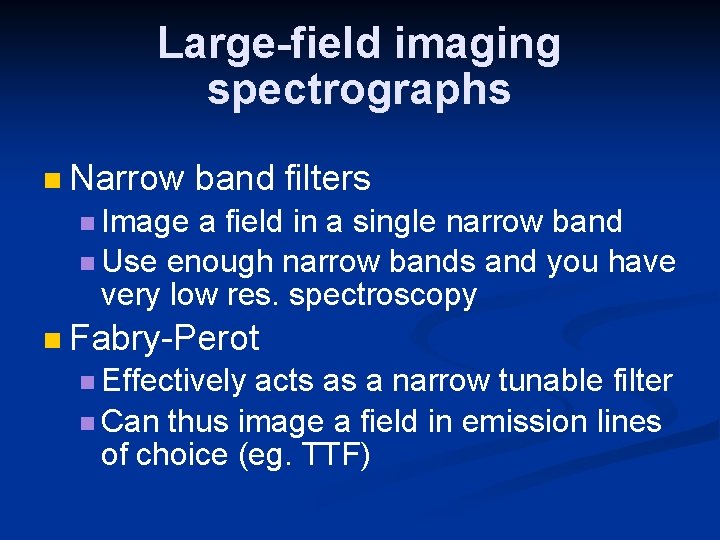
Large-field imaging spectrographs Narrow band filters Image a field in a single narrow band Use enough narrow bands and you have very low res. spectroscopy Fabry-Perot Effectively acts as a narrow tunable filter Can thus image a field in emission lines of choice (eg. TTF)
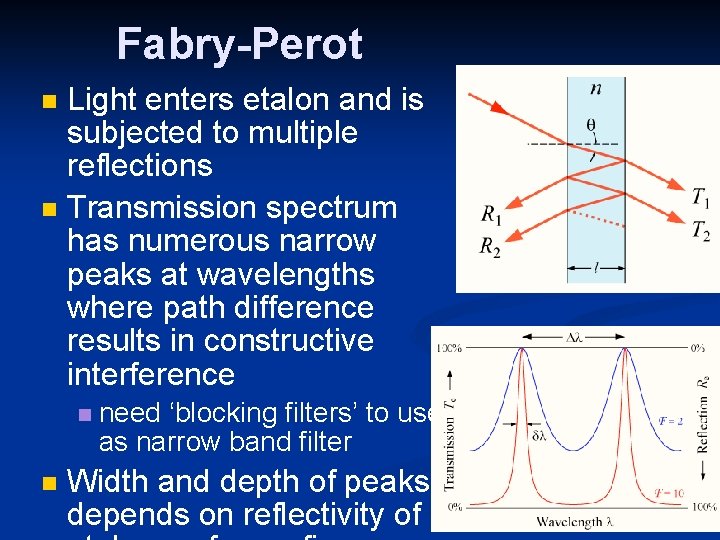
Fabry-Perot Light enters etalon and is subjected to multiple reflections Transmission spectrum has numerous narrow peaks at wavelengths where path difference results in constructive interference need ‘blocking filters’ to use as narrow band filter Width and depth of peaks depends on reflectivity of
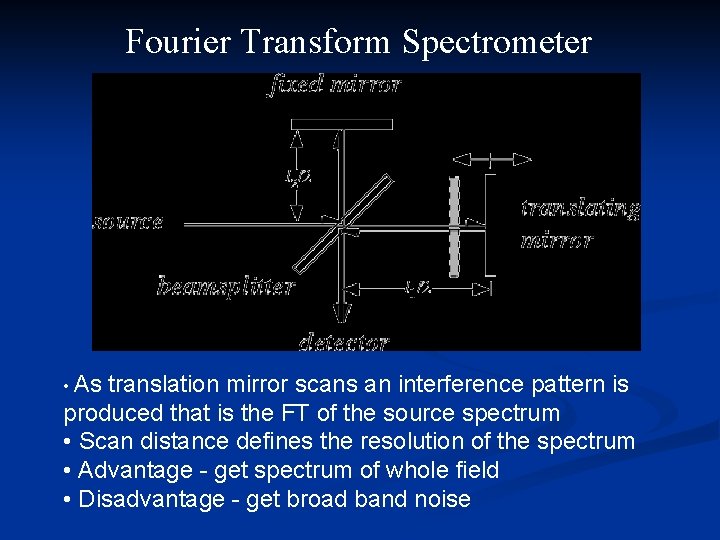
Fourier Transform Spectrometer • As translation mirror scans an interference pattern is produced that is the FT of the source spectrum • Scan distance defines the resolution of the spectrum • Advantage - get spectrum of whole field • Disadvantage - get broad band noise
IFTS for NGST
Detectors for Opical/near-IR (current) Photon Counters: Image tube + TV camera + real-time discrimination (not solid state) eg: IPCS - c 70 s to c 80 s CCDs now dominate - Hi QE but … Integrate signal on detector – no time resolution Finite read-noise Finite read-time EMCCDs – new generation of Photon Counters
DQE - the key to good detectors Detector quantum efficiency - the fraction of incident photons detected - is the key measure for the effectiveness of a detector; Traditional photographic plates, while large in size, have DQE of only about 10% CCDs and similar semiconductor devices can have DQE as high as 90% (though wavelength dependent) Like having a telescope with 9 times the collecting area
CCDs combine photon detection with integration and multiplexing Incident photons excite charge carriers which are stored and integrated in a capacitor CCDs are also uniquely effective in transferring charge from 2 D to 1 D charge ‘clocked’ from pixel to pixel and read out at fixed point ideal for multiplexing
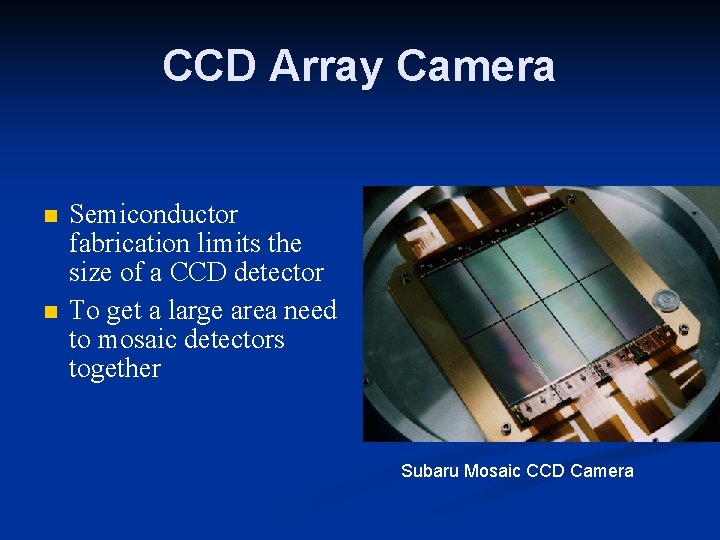
CCD Array Camera Semiconductor fabrication limits the size of a CCD detector To get a large area need to mosaic detectors together Subaru Mosaic CCD Camera
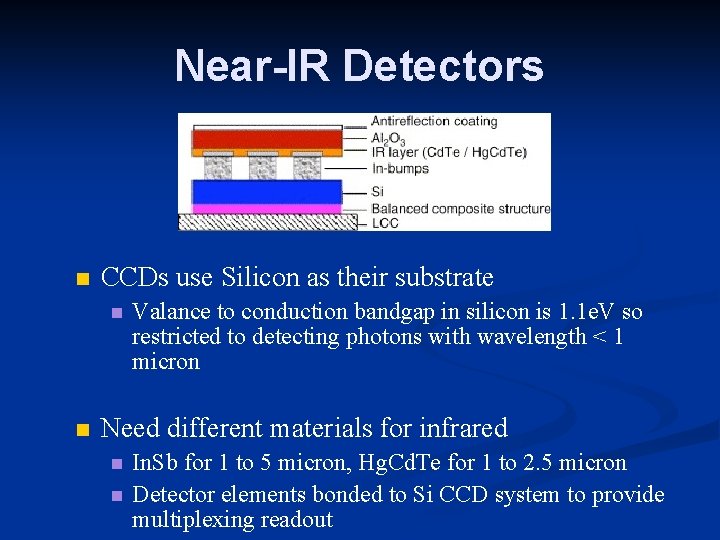
Near-IR Detectors CCDs use Silicon as their substrate Valance to conduction bandgap in silicon is 1. 1 e. V so restricted to detecting photons with wavelength < 1 micron Need different materials for infrared In. Sb for 1 to 5 micron, Hg. Cd. Te for 1 to 2. 5 micron Detector elements bonded to Si CCD system to provide multiplexing readout
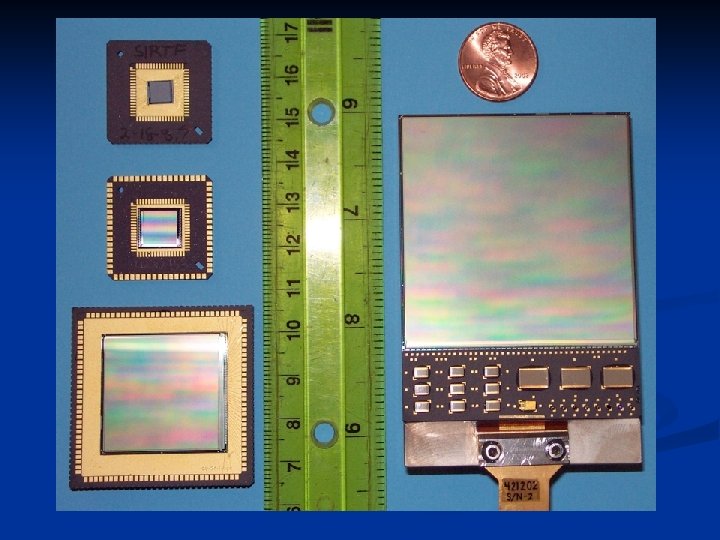
IR Arrays vs. Optical IR arrays are smaller, more expensive (by factor of ~10/pixel) Readout has to be faster because of higher backgrounds Use of different materials can push to longer wavelengths More difficult to work with, less helpful characteristics, more expensive At longest wavelengths have to stress the detector to produce lower energy band gaps
Lecture 1 (2 sessions) Synopsis Fundamental Principles Introduction Information Theory Seeing-limited observations Diffraction-limited observations Signal-to-noise estimates

Lecture 2 Fundamentals Aug-Nov, 2008 IAG/USP (Keith Taylor)
UVOIR Astronomy Definition: UVOIR = the "UV, Optical, Near-Infrared" region of EM spectrum Shortest wavelength: 912 Å (or 91. 2 nm) --Lyman edge of H I; interstellar medium is opaque for hundreds of Å below here Longest wavelength: ~3µm (or 3000 nm) --serious H 2 O absorption in Earth's atmosphere above here Ground-based UVOIR: 0. 3µm (or 300 nm) < < 2. 5µm (or 2, 500 nm)
UVOIR Astronomy Uniqueness: Best developed instrumentation; Best understood astrophysically; Highest density of astrophysical information; Provides prime diagnostics on the two most important physical tracers. ===> UVOIR observations/identifications are almost always prerequisites to a thorough understanding of cosmic sources in other EM bands.
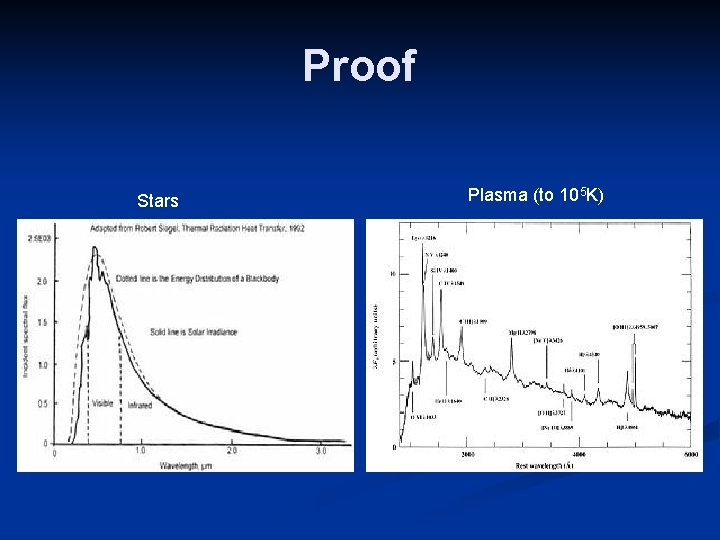
Proof Stars Plasma (to 105 K)
Observational Priorities Astronomy driven by discoveries rather than theoretical insights Direction of field shaped by observations in about 3/4 of instances. Few important astronomical discoveries were predicted; many were actually accidental
Accidental Discoveries Uranus Expanding universe Pulsars Supermassive black holes/AGN‘s Large scale structure Dark matter in spiral galaxies X-ray emitting gas in clusters of galaxies Gamma ray bursts Extra-solar planets High redshift evolution of galaxies HST contributions were actually hindered by theoretical prejudice. A deep pencil-beam survey was delayed by 5 years.
Counterexamples: theorydriven discoveries Neptune General relativistic distortion of spacetime near Sun 21 cm line of HI Helioseismology Cosmic microwave background Conclusions Is Observational Astronomy a Science? (Build, don’t Think)
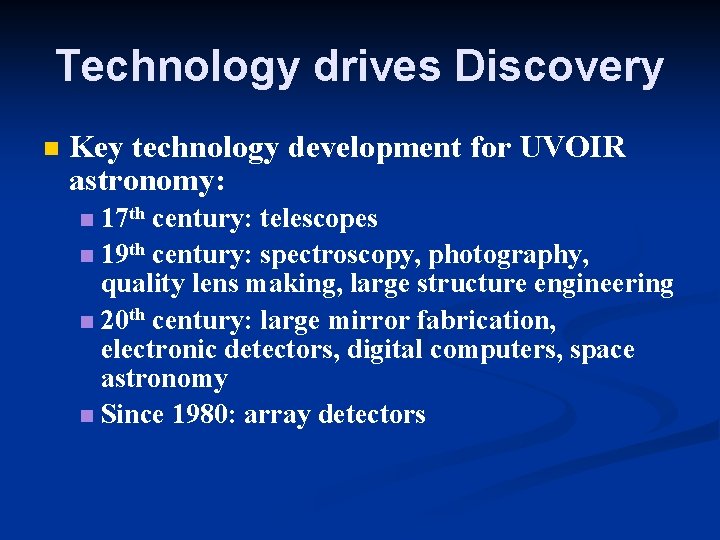
Technology drives Discovery Key technology development for UVOIR astronomy: 17 th century: telescopes 19 th century: spectroscopy, photography, quality lens making, large structure engineering 20 th century: large mirror fabrication, electronic detectors, digital computers, space astronomy Since 1980: array detectors
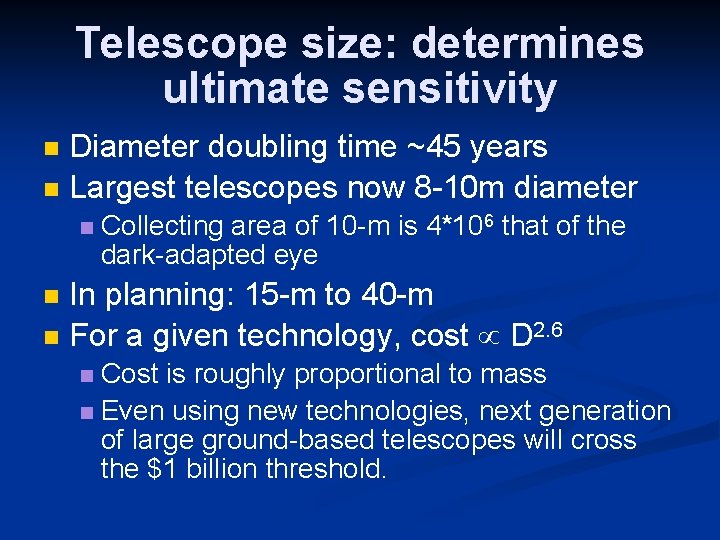
Telescope size: determines ultimate sensitivity Diameter doubling time ~45 years Largest telescopes now 8 -10 m diameter Collecting area of 10 -m is 4*106 that of the dark-adapted eye In planning: 15 -m to 40 -m For a given technology, cost D 2. 6 Cost is roughly proportional to mass Even using new technologies, next generation of large ground-based telescopes will cross the $1 billion threshold.
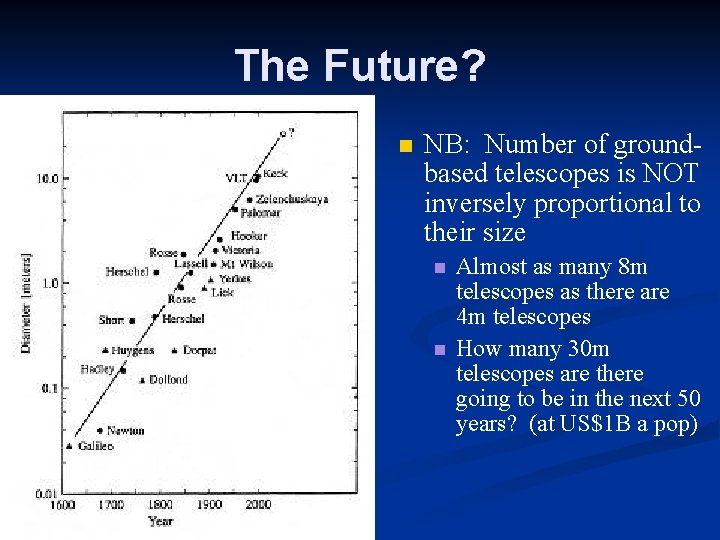
The Future? NB: Number of groundbased telescopes is NOT inversely proportional to their size Almost as many 8 m telescopes as there are 4 m telescopes How many 30 m telescopes are there going to be in the next 50 years? (at US$1 B a pop)
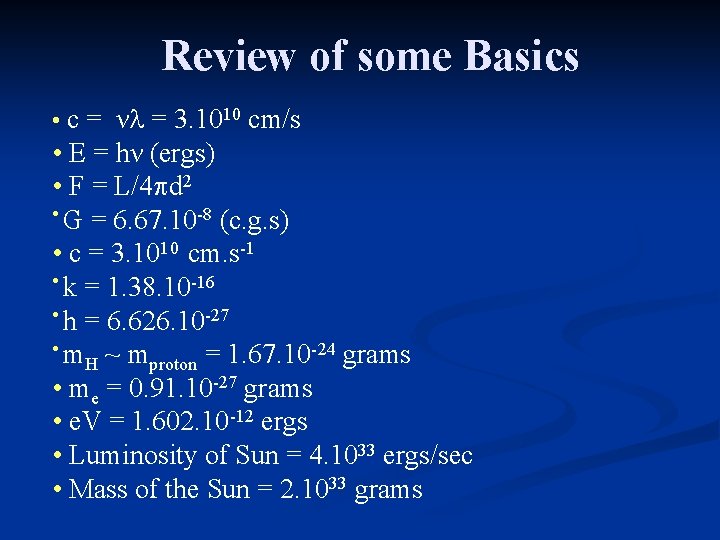
Review of some Basics • c = ν = 3. 1010 cm/s • E = hν (ergs) • F = L/4 d 2 • G = 6. 67. 10 -8 (c. g. s) • c = 3. 1010 cm. s-1 • k = 1. 38. 10 -16 • h = 6. 626. 10 -27 • m ~ m -24 grams = 1. 67. 10 H proton • me = 0. 91. 10 -27 grams • e. V = 1. 602. 10 -12 ergs • Luminosity of Sun = 4. 1033 ergs/sec • Mass of the Sun = 2. 1033 grams
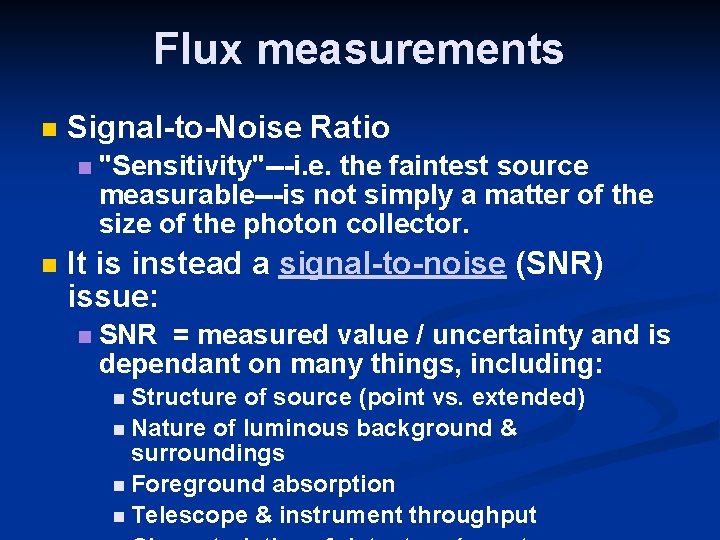
Flux measurements Signal-to-Noise Ratio "Sensitivity"---i. e. the faintest source measurable---is not simply a matter of the size of the photon collector. It is instead a signal-to-noise (SNR) issue: SNR = measured value / uncertainty and is dependant on many things, including: Structure of source (point vs. extended) Nature of luminous background & surroundings Foreground absorption Telescope & instrument throughput
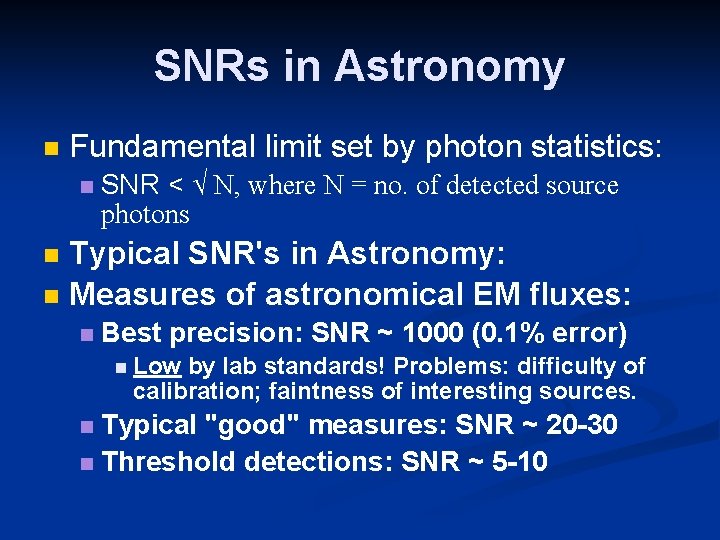
SNRs in Astronomy Fundamental limit set by photon statistics: SNR < √ N, where N = no. of detected source photons Typical SNR's in Astronomy: Measures of astronomical EM fluxes: Best precision: SNR ~ 1000 (0. 1% error) Low by lab standards! Problems: difficulty of calibration; faintness of interesting sources. Typical "good" measures: SNR ~ 20 -30 Threshold detections: SNR ~ 5 -10
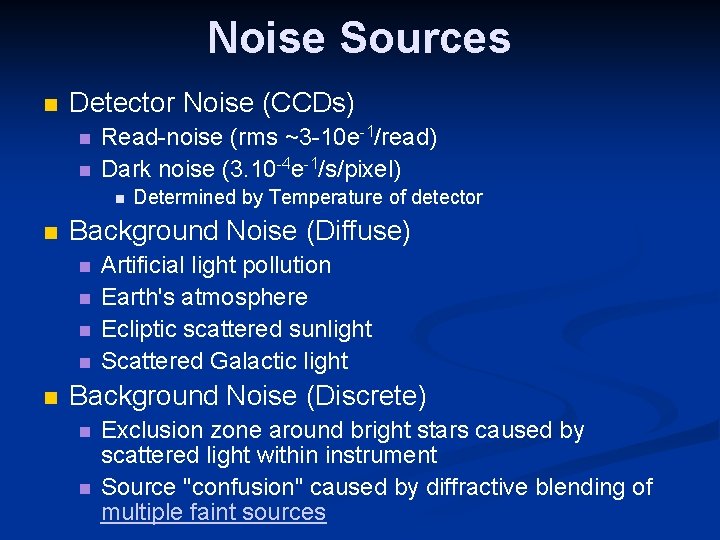
Noise Sources Detector Noise (CCDs) Read-noise (rms ~3 -10 e-1/read) Dark noise (3. 10 -4 e-1/s/pixel) Background Noise (Diffuse) Determined by Temperature of detector Artificial light pollution Earth's atmosphere Ecliptic scattered sunlight Scattered Galactic light Background Noise (Discrete) Exclusion zone around bright stars caused by scattered light within instrument Source "confusion" caused by diffractive blending of multiple faint sources
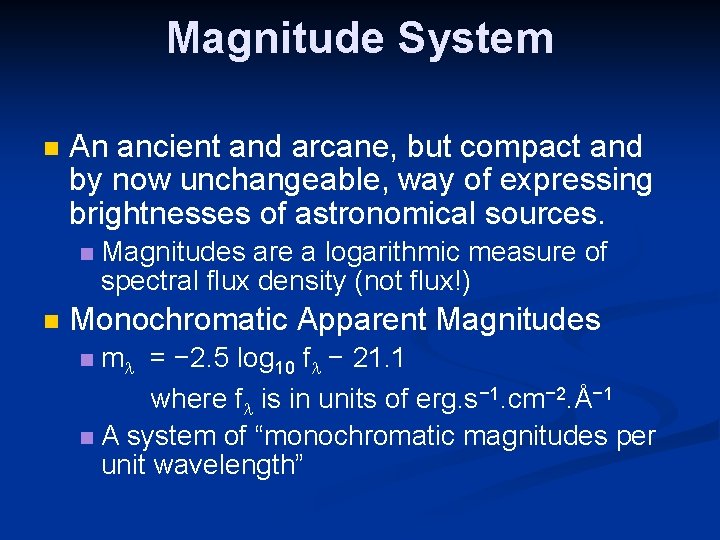
Magnitude System An ancient and arcane, but compact and by now unchangeable, way of expressing brightnesses of astronomical sources. Magnitudes are a logarithmic measure of spectral flux density (not flux!) Monochromatic Apparent Magnitudes m = − 2. 5 log 10 f − 21. 1 where f is in units of erg. s− 1. cm− 2. Å− 1 A system of “monochromatic magnitudes per unit wavelength”
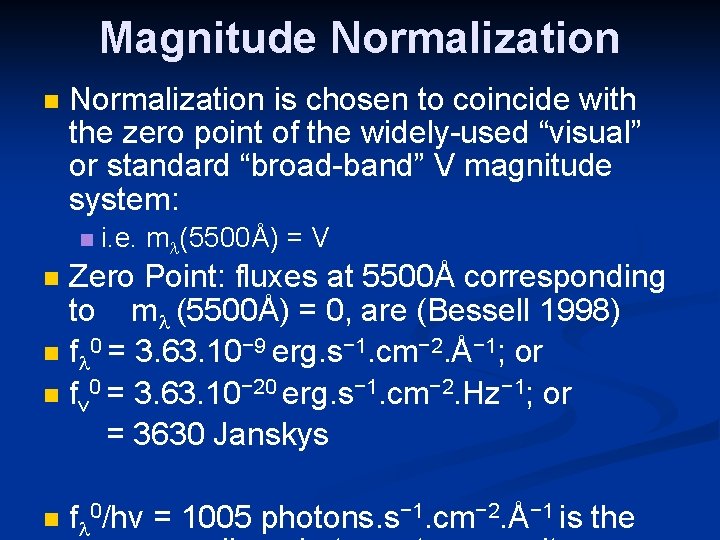
Magnitude Normalization is chosen to coincide with the zero point of the widely-used “visual” or standard “broad-band” V magnitude system: i. e. m (5500Å) = V Zero Point: fluxes at 5500Å corresponding to m (5500Å) = 0, are (Bessell 1998) f 0 = 3. 63. 10− 9 erg. s− 1. cm− 2. Å− 1; or fν 0 = 3. 63. 10− 20 erg. s− 1. cm− 2. Hz− 1; or = 3630 Janskys f 0/hν = 1005 photons. s− 1. cm− 2. Å− 1 is the
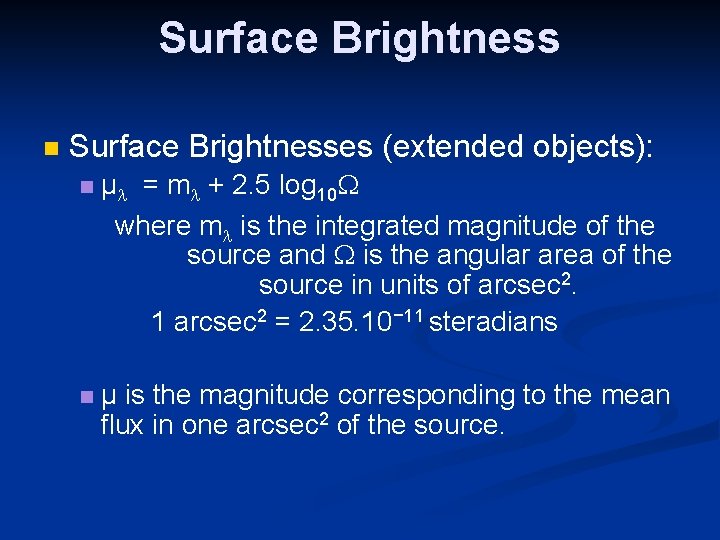
Surface Brightness Surface Brightnesses (extended objects): μ = m + 2. 5 log 10 where m is the integrated magnitude of the source and is the angular area of the source in units of arcsec 2. 1 arcsec 2 = 2. 35. 10− 11 steradians μ is the magnitude corresponding to the mean flux in one arcsec 2 of the source.
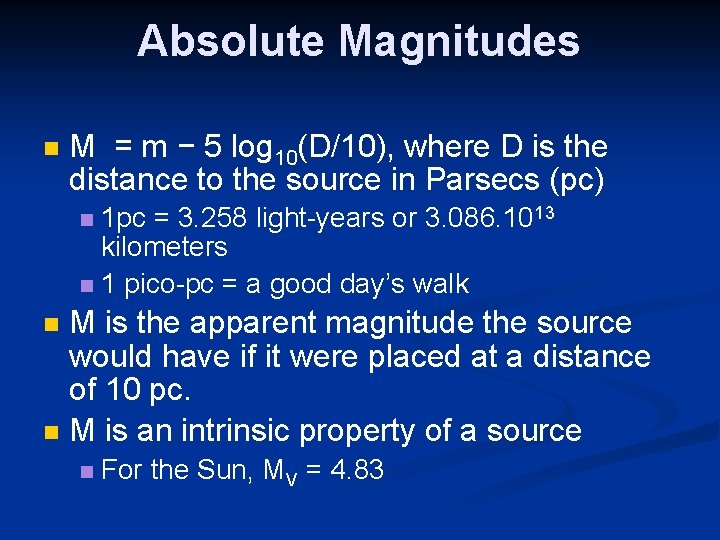
Absolute Magnitudes M = m − 5 log 10(D/10), where D is the distance to the source in Parsecs (pc) 1 pc = 3. 258 light-years or 3. 086. 1013 kilometers 1 pico-pc = a good day’s walk M is the apparent magnitude the source would have if it were placed at a distance of 10 pc. M is an intrinsic property of a source For the Sun, MV = 4. 83
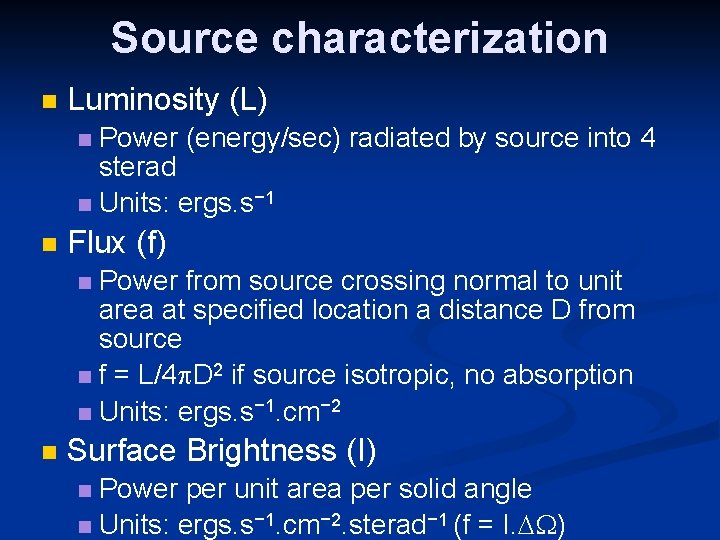
Source characterization Luminosity (L) Power (energy/sec) radiated by source into 4 sterad Units: ergs. s− 1 Flux (f) Power from source crossing normal to unit area at specified location a distance D from source f = L/4 D 2 if source isotropic, no absorption Units: ergs. s− 1. cm− 2 Surface Brightness (I) Power per unit area per solid angle Units: ergs. s− 1. cm− 2. sterad− 1 (f = I. )
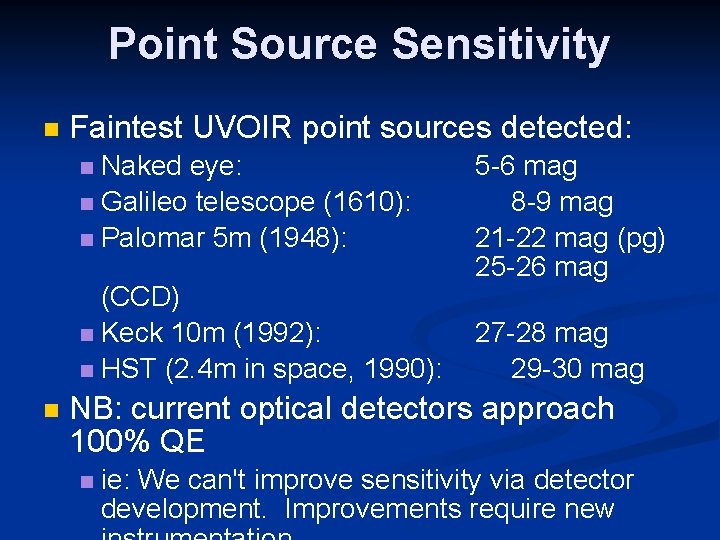
Point Source Sensitivity Faintest UVOIR point sources detected: Naked eye: Galileo telescope (1610): Palomar 5 m (1948): (CCD) Keck 10 m (1992): HST (2. 4 m in space, 1990): 5 -6 mag 8 -9 mag 21 -22 mag (pg) 25 -26 mag 27 -28 mag 29 -30 mag NB: current optical detectors approach 100% QE ie: We can't improve sensitivity via detector development. Improvements require new
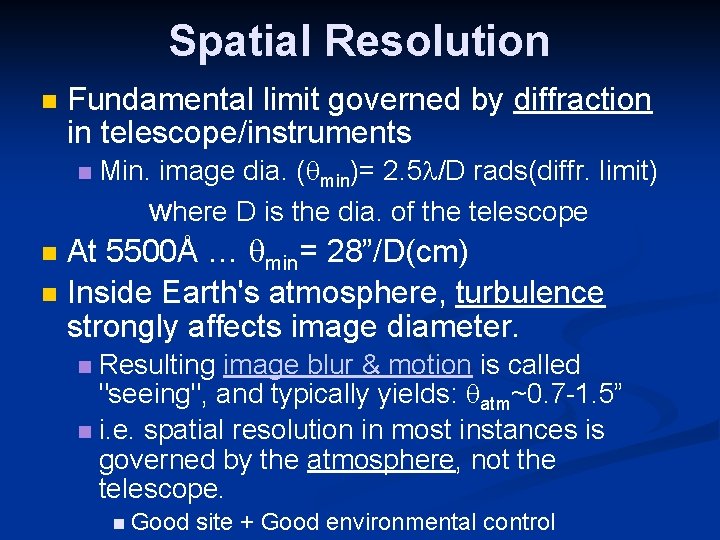
Spatial Resolution Fundamental limit governed by diffraction in telescope/instruments Min. image dia. ( min)= 2. 5 /D rads(diffr. limit) where D is the dia. of the telescope At 5500Å … min= 28”/D(cm) Inside Earth's atmosphere, turbulence strongly affects image diameter. Resulting image blur & motion is called "seeing", and typically yields: atm~0. 7 -1. 5” i. e. spatial resolution in most instances is governed by the atmosphere, not the telescope. Good site + Good environmental control
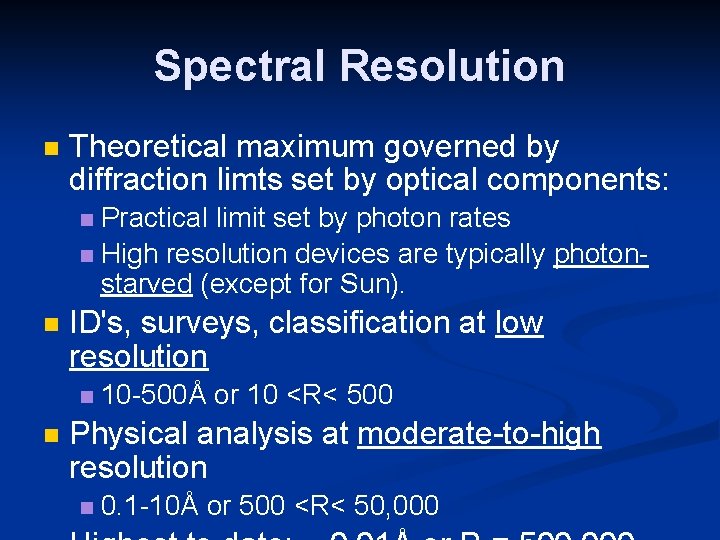
Spectral Resolution Theoretical maximum governed by diffraction limts set by optical components: Practical limit set by photon rates High resolution devices are typically photonstarved (except for Sun). ID's, surveys, classification at low resolution 10 -500Å or 10 <R< 500 Physical analysis at moderate-to-high resolution 0. 1 -10Å or 500 <R< 50, 000
Basic Lens formulae
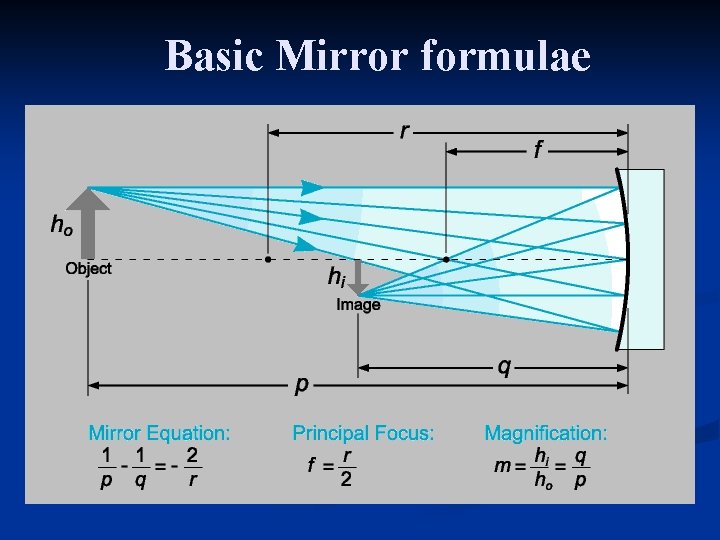
Basic Mirror formulae
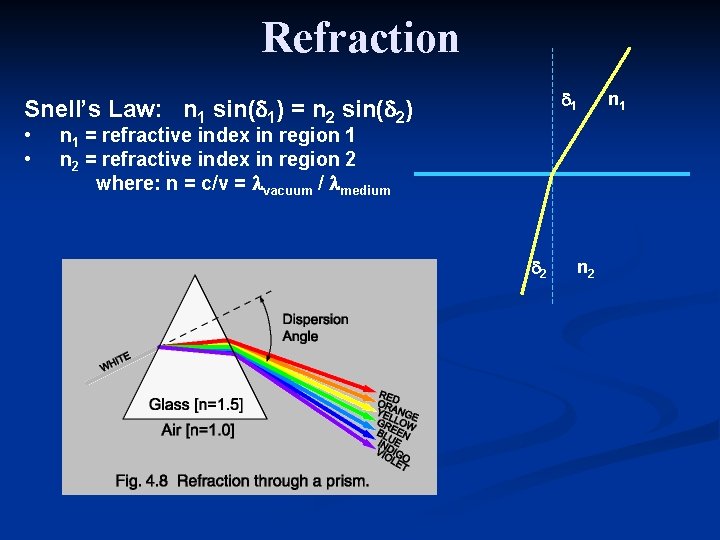
Refraction 1 Snell’s Law: n 1 sin( 1) = n 2 sin( 2) • • n 1 = refractive index in region 1 n 2 = refractive index in region 2 where: n = c/v = vacuum / medium 2 n 1
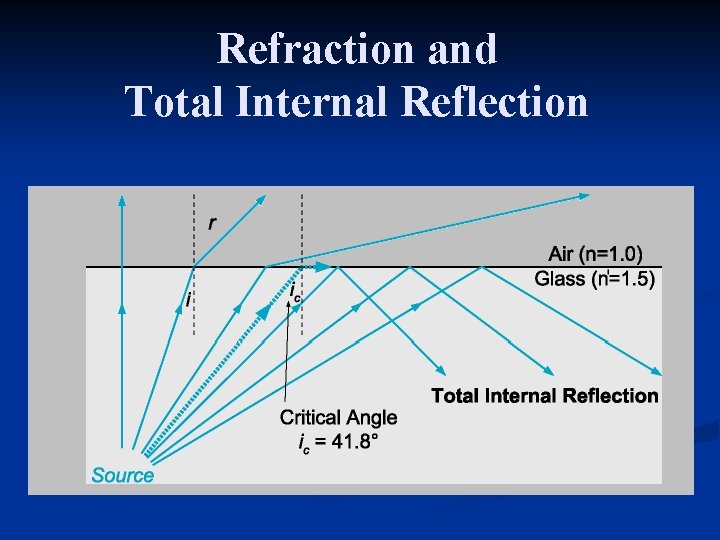
Refraction and Total Internal Reflection
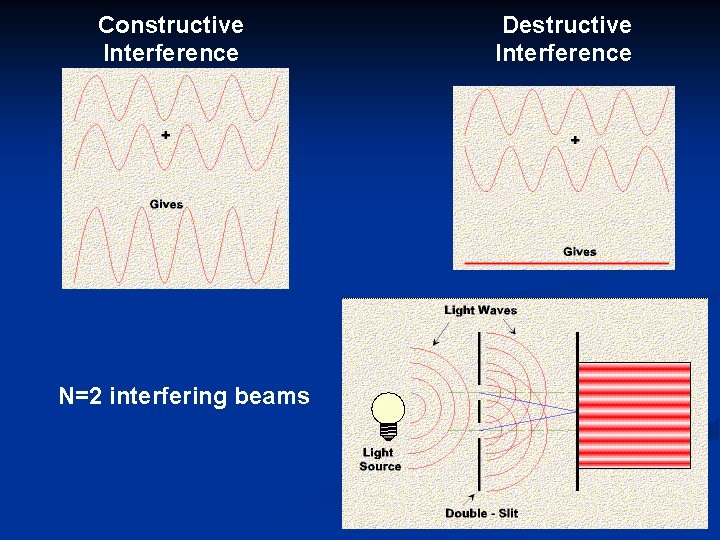
Constructive Interference N=2 interfering beams Destructive Interference
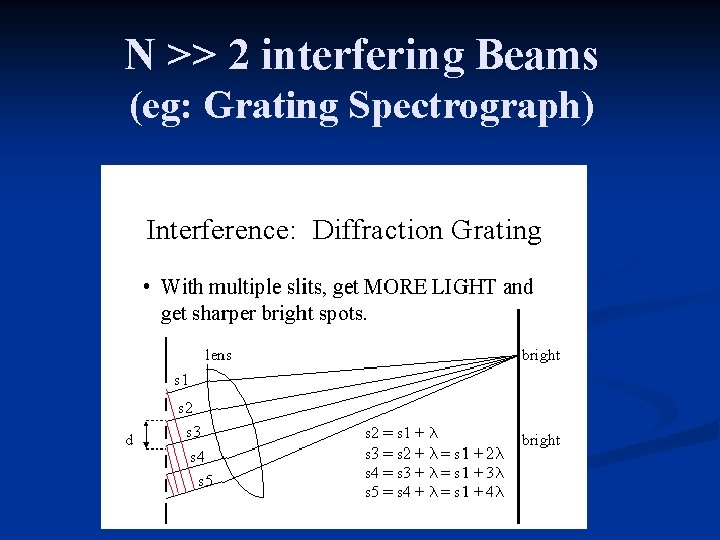
N >> 2 interfering Beams (eg: Grating Spectrograph)
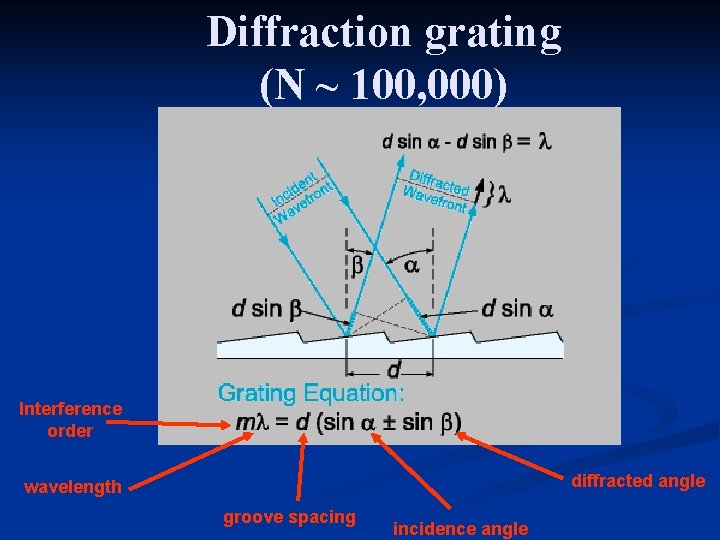
Diffraction grating (N ~ 100, 000) Interference order diffracted angle wavelength groove spacing incidence angle
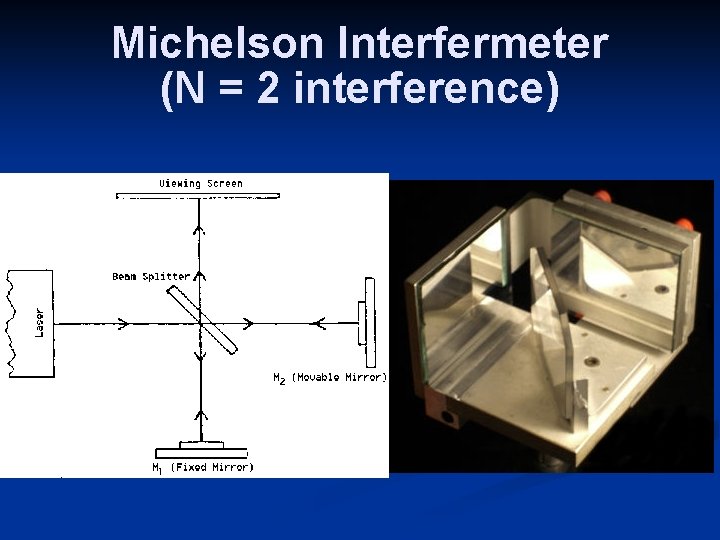
Michelson Interfermeter (N = 2 interference)
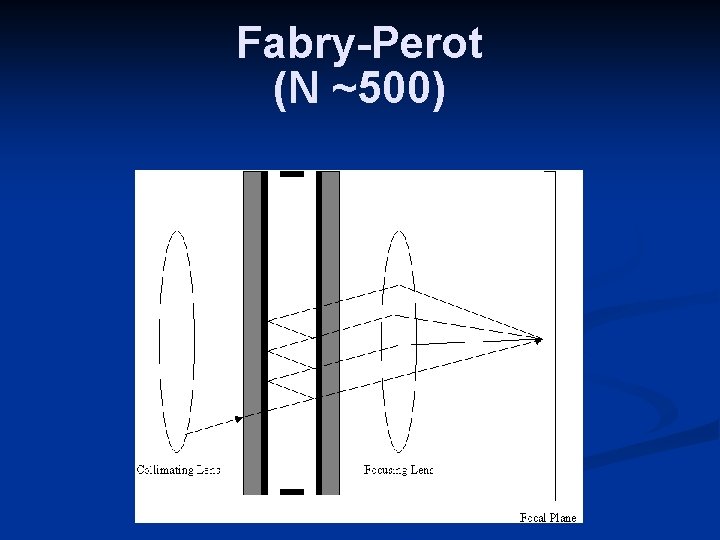
Fabry-Perot (N ~500)
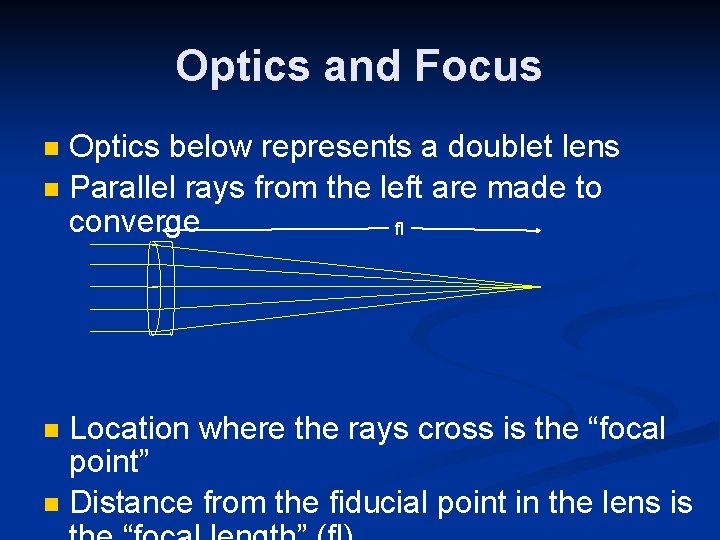
Optics and Focus Optics below represents a doublet lens Parallel rays from the left are made to converge fl Location where the rays cross is the “focal point” Distance from the fiducial point in the lens is
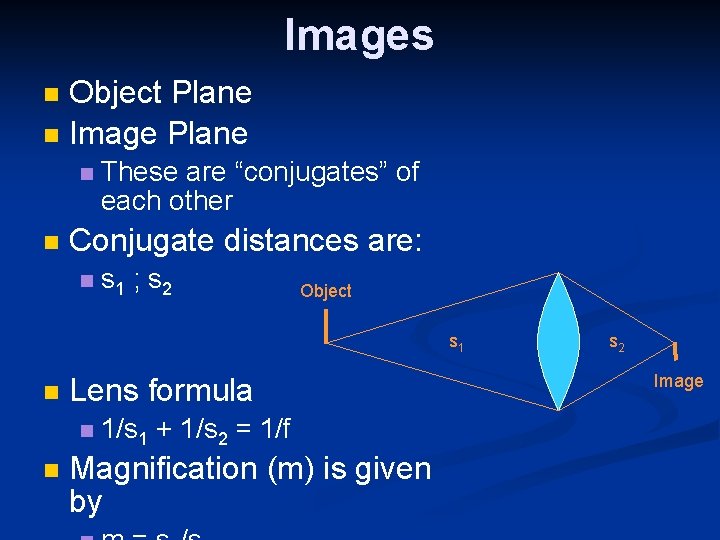
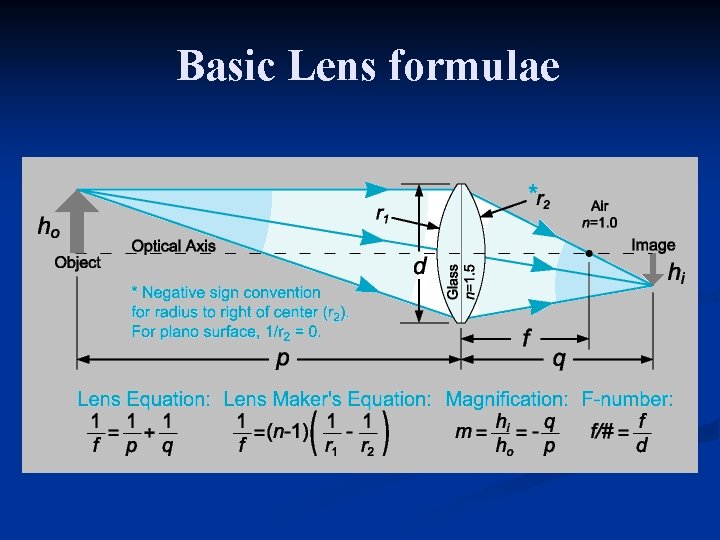
Images Object Plane Image Plane These are “conjugates” of each other Conjugate distances are: s 1 ; s 2 Object s 1 Lens formula 1/s 1 + 1/s 2 = 1/f Magnification (m) is given by s 2 Image
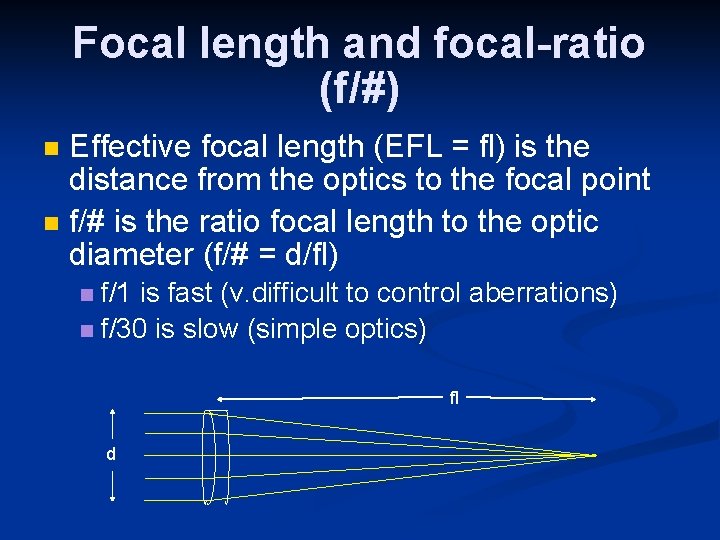
Focal length and focal-ratio (f/#) Effective focal length (EFL = fl) is the distance from the optics to the focal point f/# is the ratio focal length to the optic diameter (f/# = d/fl) f/1 is fast (v. difficult to control aberrations) f/30 is slow (simple optics) fl d
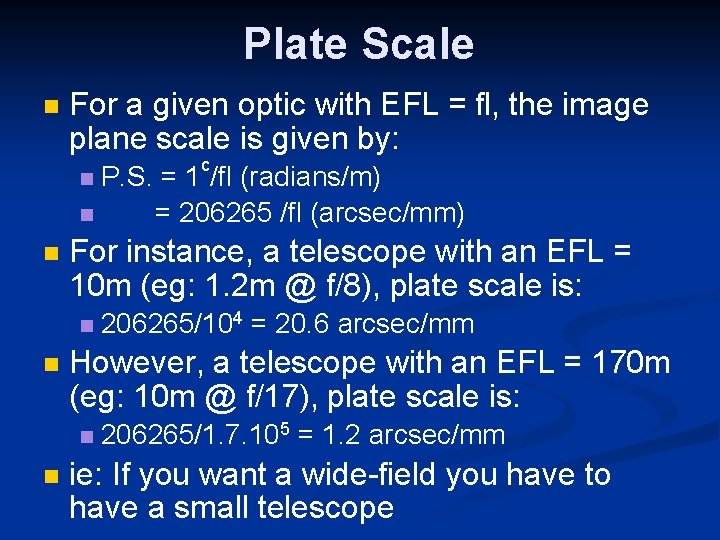
Plate Scale For a given optic with EFL = fl, the image plane scale is given by: c P. S. = 1 /fl (radians/m) = 206265 /fl (arcsec/mm) For instance, a telescope with an EFL = 10 m (eg: 1. 2 m @ f/8), plate scale is: However, a telescope with an EFL = 170 m (eg: 10 m @ f/17), plate scale is: 206265/104 = 20. 6 arcsec/mm 206265/1. 7. 105 = 1. 2 arcsec/mm ie: If you want a wide-field you have to have a small telescope
Entendu = A (area * solid angle) Entendu is conserved for any optical system ie: Conservation of Energy However, entendu can be lost in fibre systems High entendu is a figure of merit for an optical system Equivalent to more energy (or information) transport Telescope have generally to trade: High A with High
- Slides: 70