
INSTRUMENTASI INDUSTRI Instrumentation System v A Measuring system








- Slides: 40
INSTRUMENTASI INDUSTRI
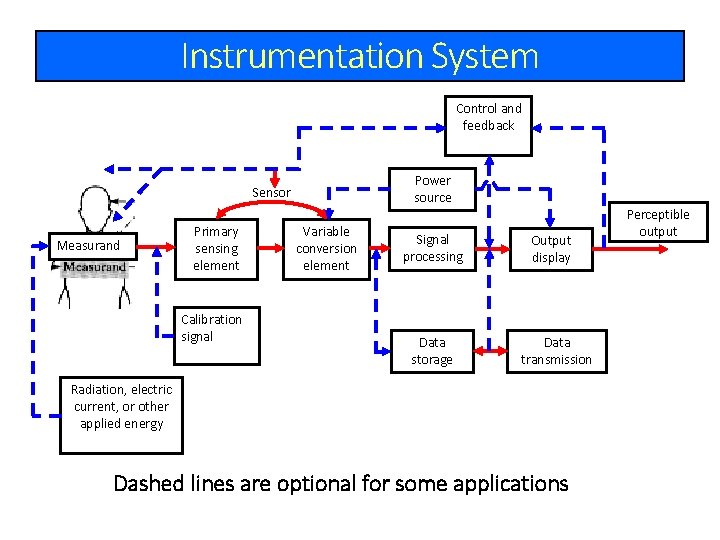
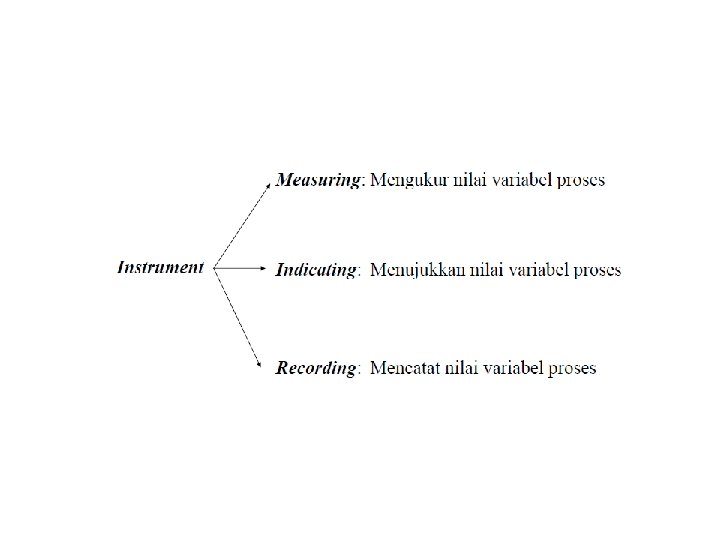
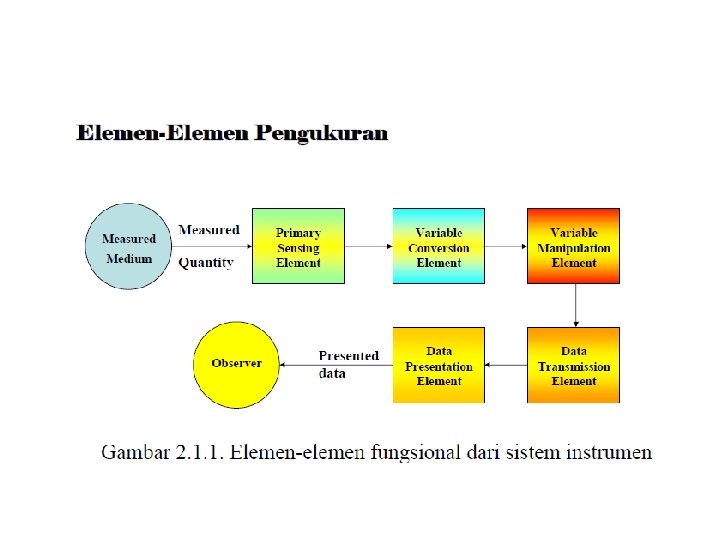
Instrumentation System v. A Measuring system is required to compare a quantity with a standard or to provide an output that can be related to the quantity being measured v. The quantity to be measured is detected by an input transducer or sensor. v. The detected quantity may be converted to a mechanical or electrical form of energy Output Input Sensor Measurand Signal conditioner Display Recorder
Instrumentation System Control and feedback Power source Sensor Measurand Primary sensing element Calibration signal Variable conversion element Signal processing Data storage Output display Data transmission Radiation, electric current, or other applied energy Dashed lines are optional for some applications Perceptible output
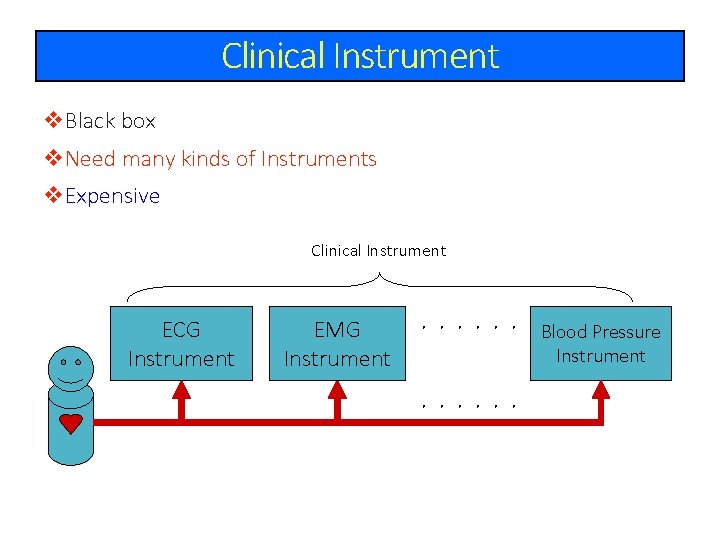
Clinical Instrument v. Black box v. Need many kinds of Instruments v. Expensive Clinical Instrument ECG Instrument EMG Instrument ...... Blood Pressure Instrument ......
Clinical Instrument (cont. ) PC surface electrode pressure transducer photocoupler temperature sensor pressure gauge strain gauge : Sensor A/D Converter Process Circuit LCD Oscilloscope
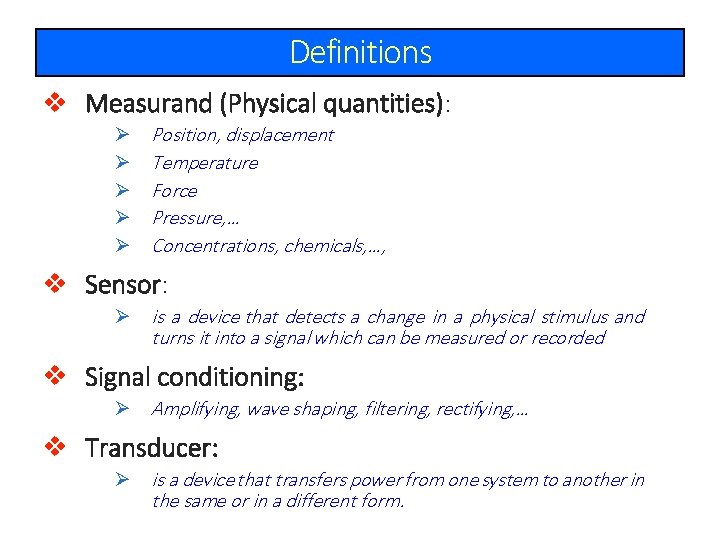
Definitions v Measurand (Physical quantities): Ø Ø Ø Position, displacement Temperature Force Pressure, … Concentrations, chemicals, …, v Sensor: Ø is a device that detects a change in a physical stimulus and turns it into a signal which can be measured or recorded v Signal conditioning: Ø Amplifying, wave shaping, filtering, rectifying, … v Transducer: Ø is a device that transfers power from one system to another in the same or in a different form.
Purpose of Measurement Systems Input True value of variables Measurement System Measured value of variables Observer Process, machine or system being measured 11/28/2020 Output LECTURE 2 7
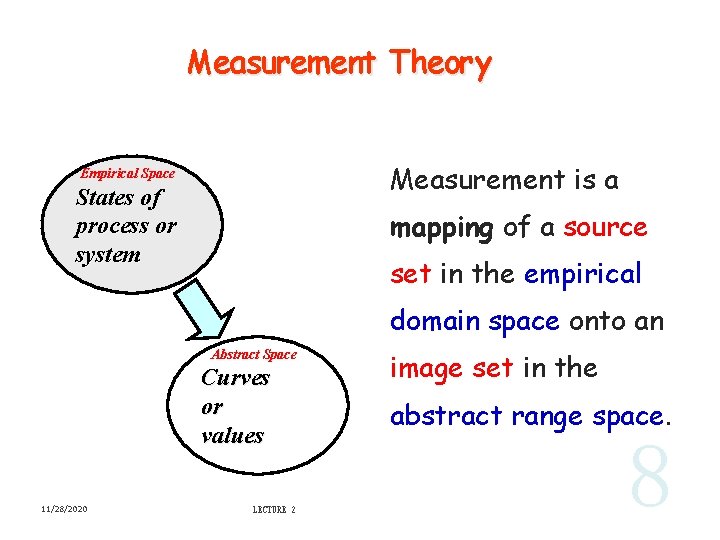
Measurement Theory Measurement is a Empirical Space States of process or system mapping of a source set in the empirical domain space onto an Abstract Space Curves or values 11/28/2020 LECTURE 2 image set in the abstract range space. 8
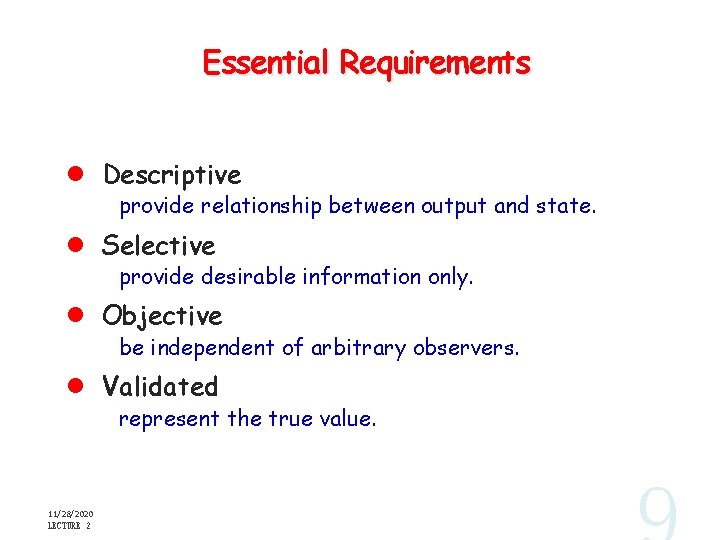
Essential Requirements l Descriptive provide relationship between output and state. l Selective provide desirable information only. l Objective be independent of arbitrary observers. l Validated represent the true value. 11/28/2020 LECTURE 2
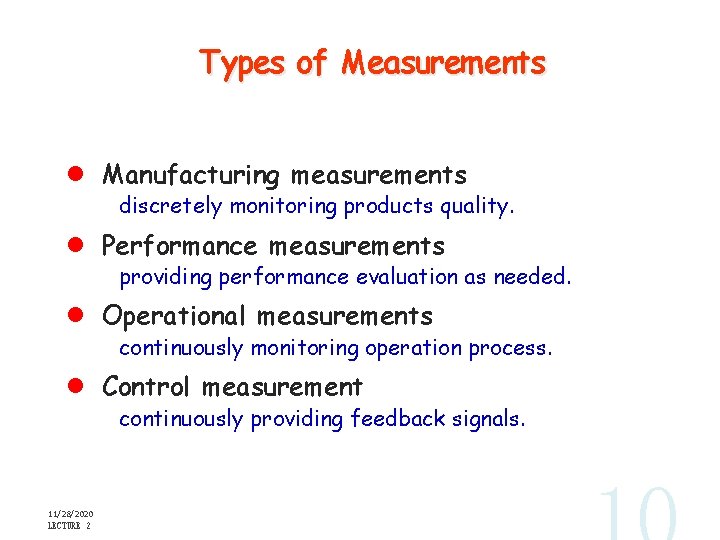
Types of Measurements l Manufacturing measurements discretely monitoring products quality. l Performance measurements providing performance evaluation as needed. l Operational measurements continuously monitoring operation process. l Control measurement continuously providing feedback signals. 11/28/2020 LECTURE 2
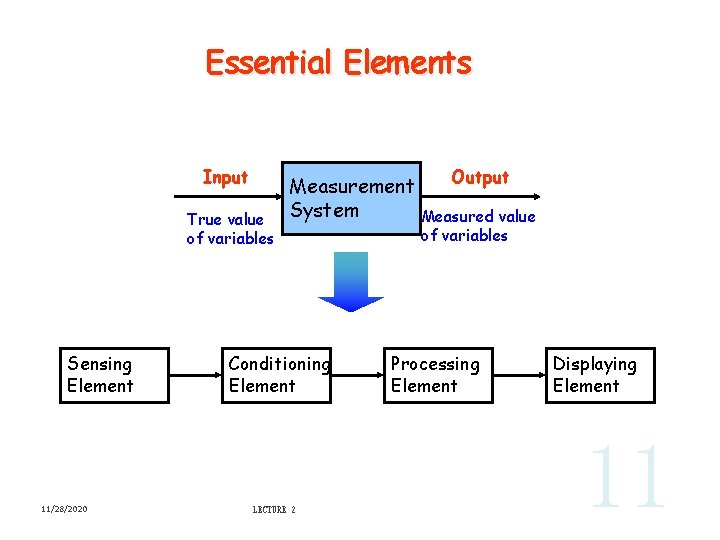
Essential Elements Input True value of variables Sensing Element 11/28/2020 Measurement System Conditioning Element LECTURE 2 Output Measured value of variables Processing Element Displaying Element 11
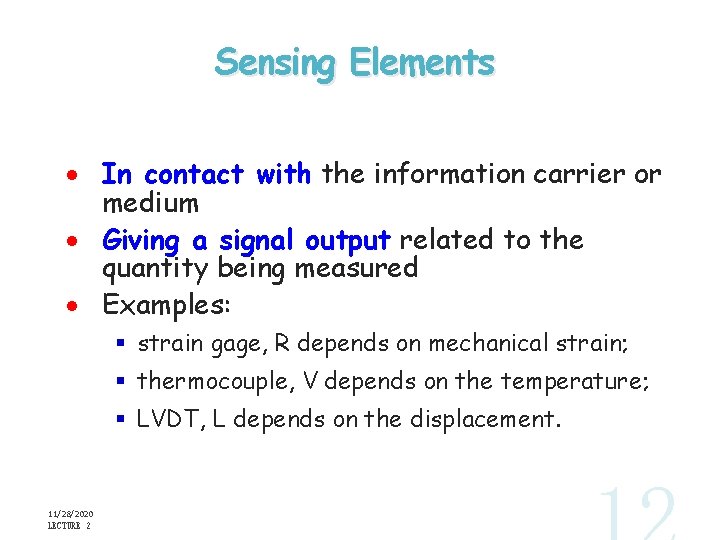
Sensing Elements · In contact with the information carrier or medium · Giving a signal output related to the quantity being measured · Examples: § strain gage, R depends on mechanical strain; § thermocouple, V depends on the temperature; § LVDT, L depends on the displacement. 11/28/2020 LECTURE 2
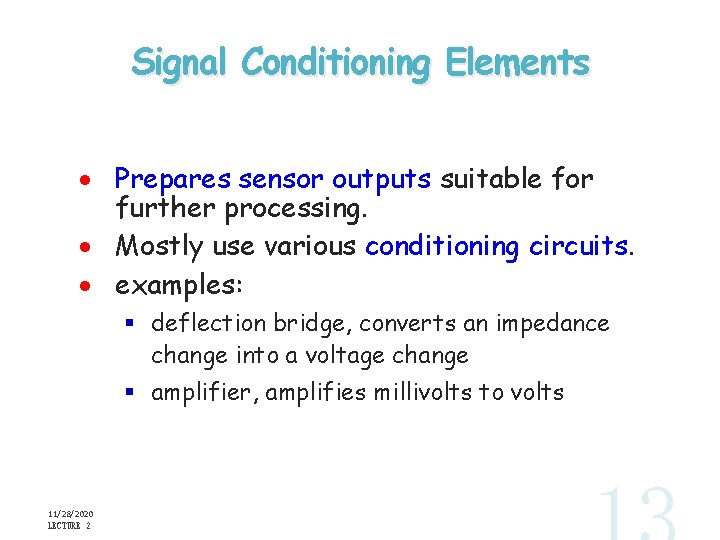
Signal Conditioning Elements · Prepares sensor outputs suitable for further processing. · Mostly use various conditioning circuits. · examples: § deflection bridge, converts an impedance change into a voltage change § amplifier, amplifies millivolts to volts 11/28/2020 LECTURE 2
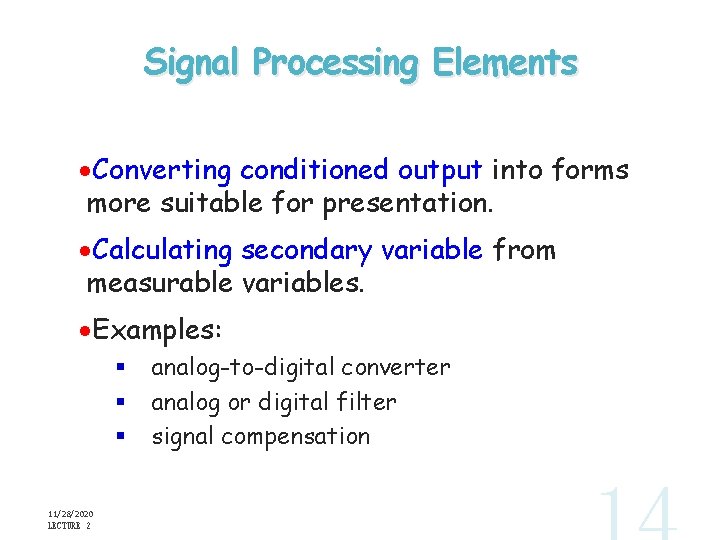
Signal Processing Elements ·Converting conditioned output into forms more suitable for presentation. ·Calculating secondary variable from measurable variables. ·Examples: § § § 11/28/2020 LECTURE 2 analog-to-digital converter analog or digital filter signal compensation
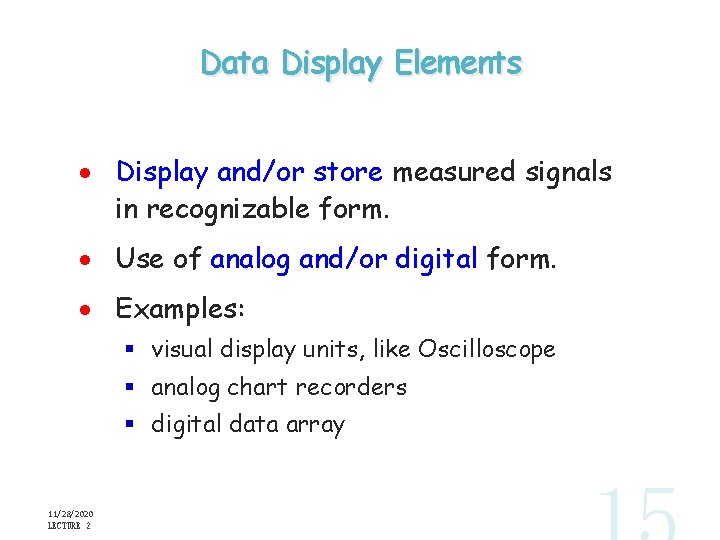
Data Display Elements · Display and/or store measured signals in recognizable form. · Use of analog and/or digital form. · Examples: § visual display units, like Oscilloscope § analog chart recorders § digital data array 11/28/2020 LECTURE 2
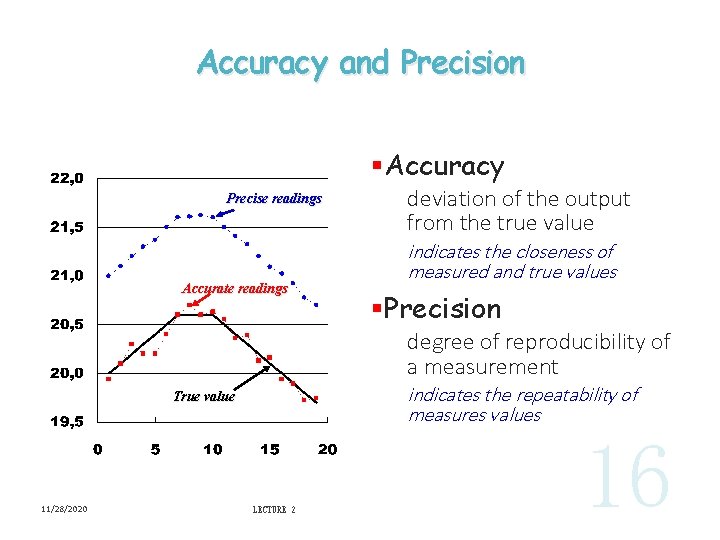
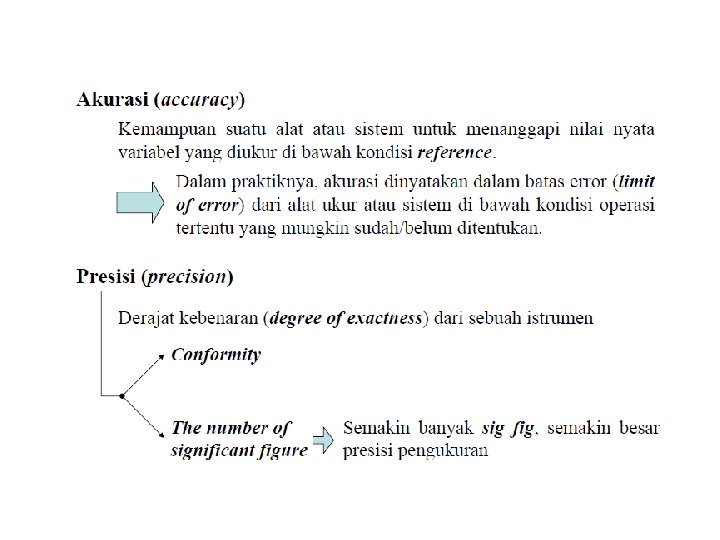
Accuracy and Precision §Accuracy Precise readings Accurate readings deviation of the output from the true value indicates the closeness of measured and true values §Precision degree of reproducibility of a measurement indicates the repeatability of measures values True value 11/28/2020 LECTURE 2 16
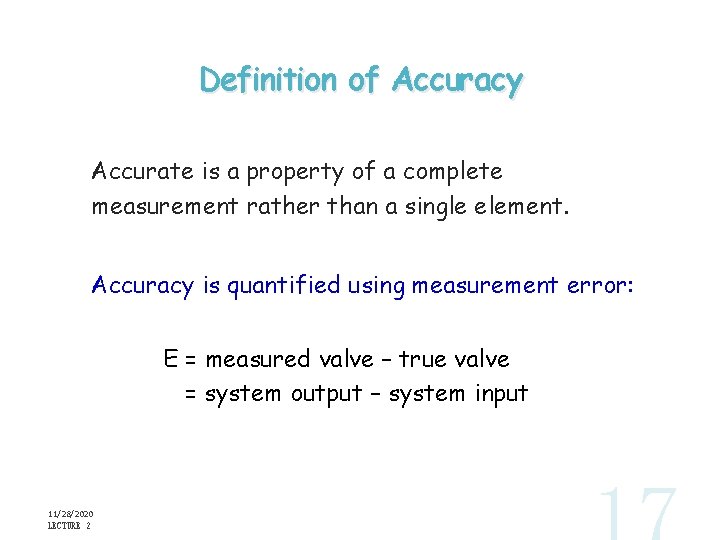
Definition of Accuracy Accurate is a property of a complete measurement rather than a single element. Accuracy is quantified using measurement error: E = measured valve – true valve = system output – system input 11/28/2020 LECTURE 2
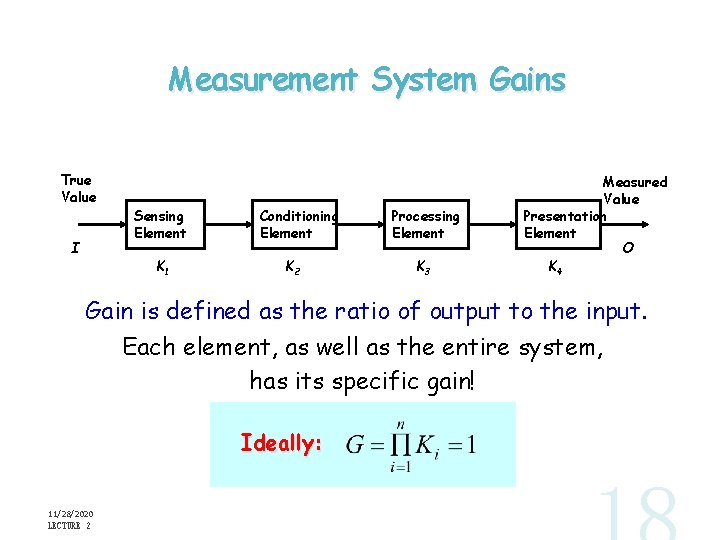
Measurement System Gains True Value I Sensing Element K 1 Conditioning Element K 2 Processing Element K 3 Measured Value Presentation Element O K 4 Gain is defined as the ratio of output to the input. Each element, as well as the entire system, has its specific gain! Ideally: 11/28/2020 LECTURE 2
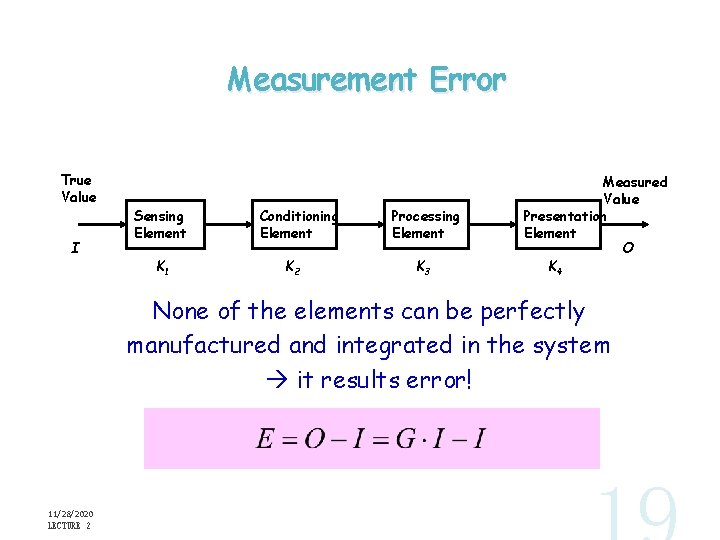
Measurement Error True Value I Sensing Element K 1 Conditioning Element K 2 Processing Element K 3 Measured Value Presentation Element O K 4 None of the elements can be perfectly manufactured and integrated in the system it results error! 11/28/2020 LECTURE 2
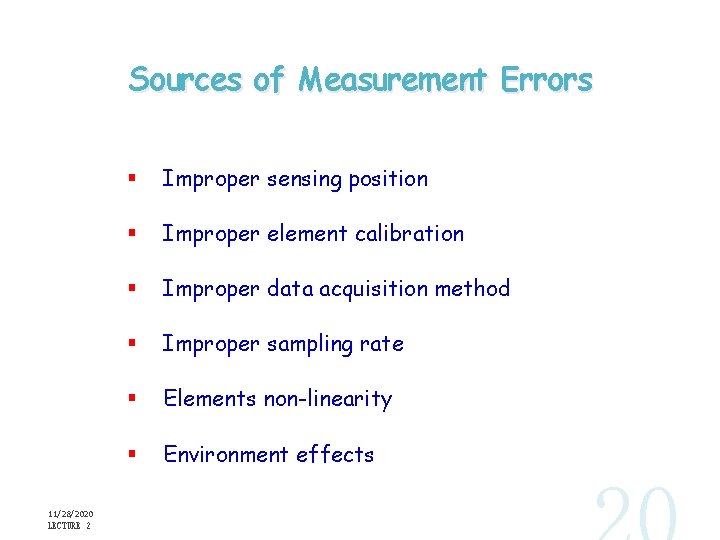
Sources of Measurement Errors 11/28/2020 LECTURE 2 § Improper sensing position § Improper element calibration § Improper data acquisition method § Improper sampling rate § Elements non-linearity § Environment effects
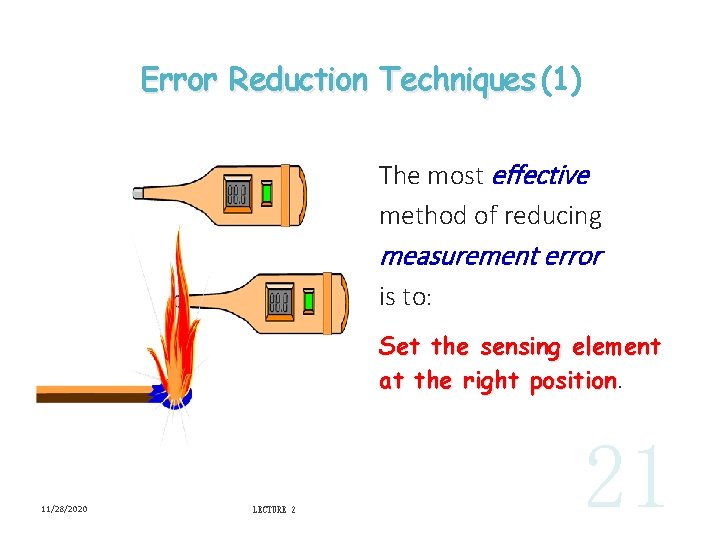
Error Reduction Techniques (1) The most effective method of reducing measurement error is to: Set the sensing element at the right position 11/28/2020 LECTURE 2 21
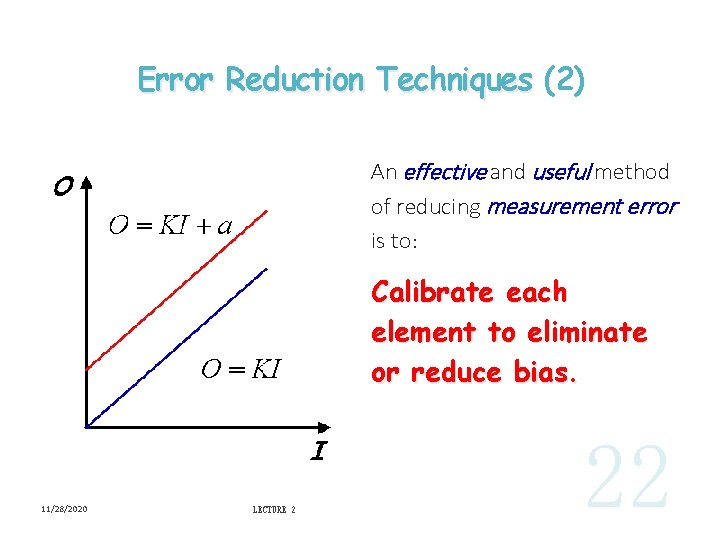
Error Reduction Techniques (2) An effective and useful method of reducing measurement error is to: Calibrate each element to eliminate or reduce bias. 11/28/2020 LECTURE 2 22
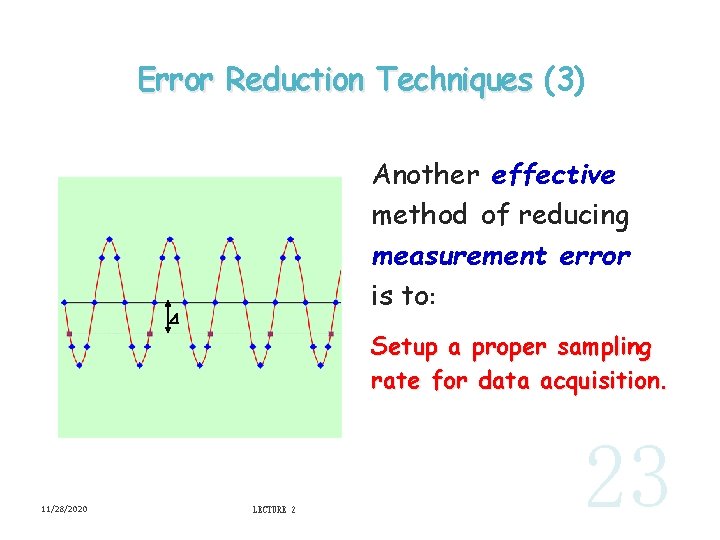
Error Reduction Techniques (3) Another effective method of reducing measurement error is to: D Setup a proper sampling rate for data acquisition. 11/28/2020 LECTURE 2 23
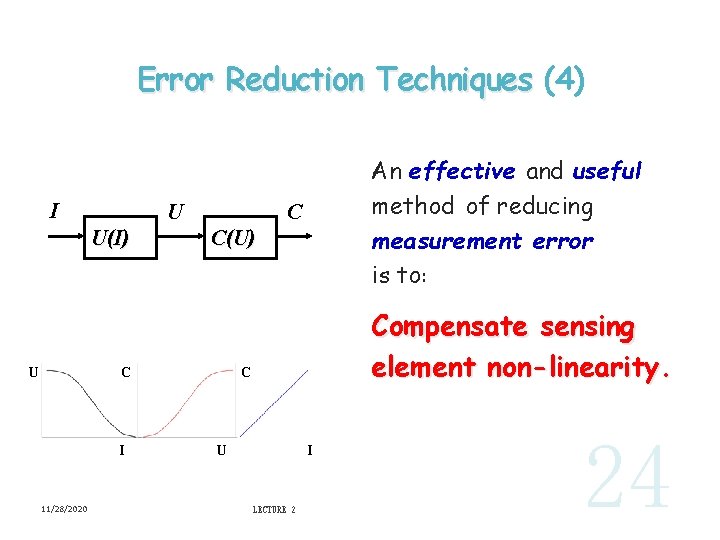
Error Reduction Techniques (4) I U U(I) U C C(U) C I 11/28/2020 An effective and useful method of reducing measurement error is to: Compensate sensing element non-linearity. C U I LECTURE 2 24
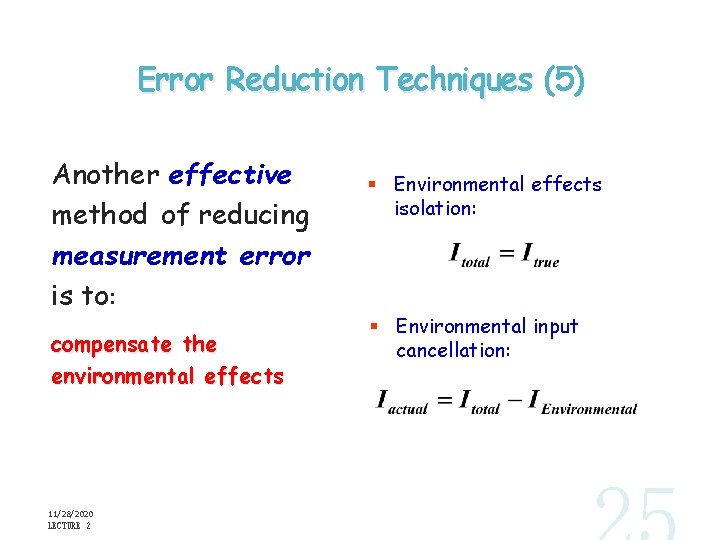
Error Reduction Techniques (5) Another effective method of reducing measurement error is to: compensate the environmental effects 11/28/2020 LECTURE 2 § Environmental effects isolation: § Environmental input cancellation:
Part II: Learn from Example Assume a temperature measurement system was used to monitor the temperature in this classroom. This measurement system uses a thermocouple (gain: 40 V/ C) as its sensing element, a signal amplifier (gain: 1 V/m. V) as its signal conditioning element, and a visual indicator (gain: 25 C/V) as its display element. Please try to: 1. Design the measurement system, and present the design using a system block diagram. 2. Determine the gain of the measurement system. 3. Estimate the measurement error if thermocouple gain is 40. 04 V/ C, the amplifier gain is 0. 999 V/m. V, and the indicator gain is 25. 025 C /V. 11/28/2020 LECTURE 2
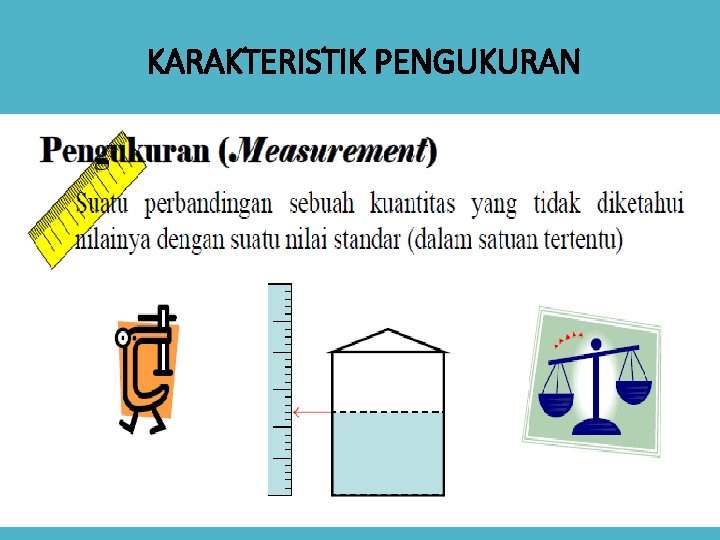
KARAKTERISTIK PENGUKURAN