
Instrumental Music Instruments q Haut and bas high
Instrumental Music

Instruments q Haut and bas (high and low) are also designations for loud and soft q Consorts q Instrument families built in sets of different sizes, covering a wide range
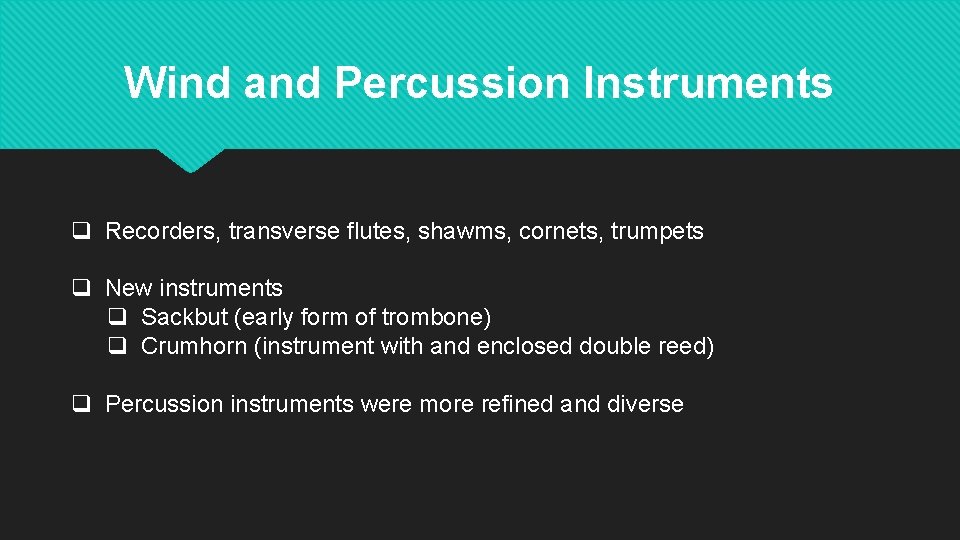
Wind and Percussion Instruments q Recorders, transverse flutes, shawms, cornets, trumpets q New instruments q Sackbut (early form of trombone) q Crumhorn (instrument with and enclosed double reed) q Percussion instruments were more refined and diverse
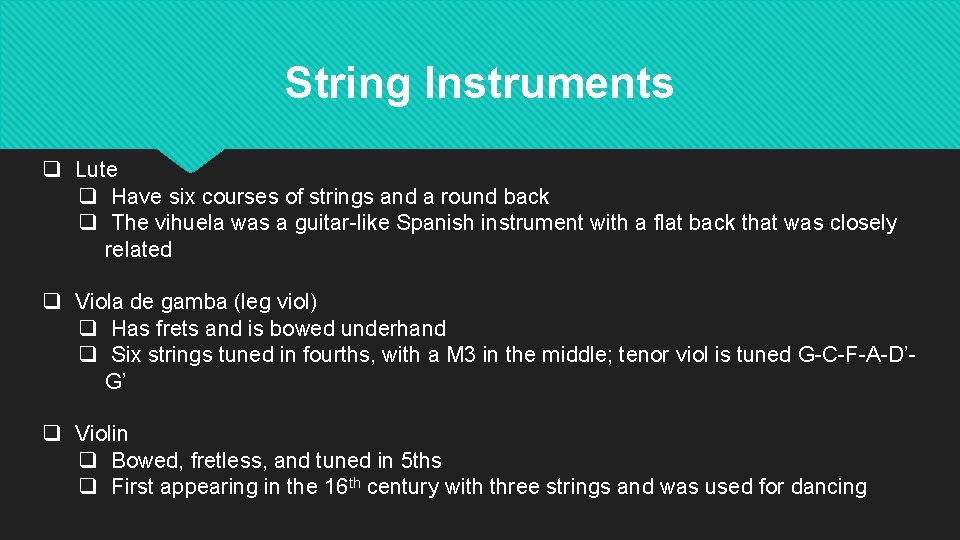
String Instruments q Lute q Have six courses of strings and a round back q The vihuela was a guitar-like Spanish instrument with a flat back that was closely related q Viola de gamba (leg viol) q Has frets and is bowed underhand q Six strings tuned in fourths, with a M 3 in the middle; tenor viol is tuned G-C-F-A-D’G’ q Violin q Bowed, fretless, and tuned in 5 ths q First appearing in the 16 th century with three strings and was used for dancing
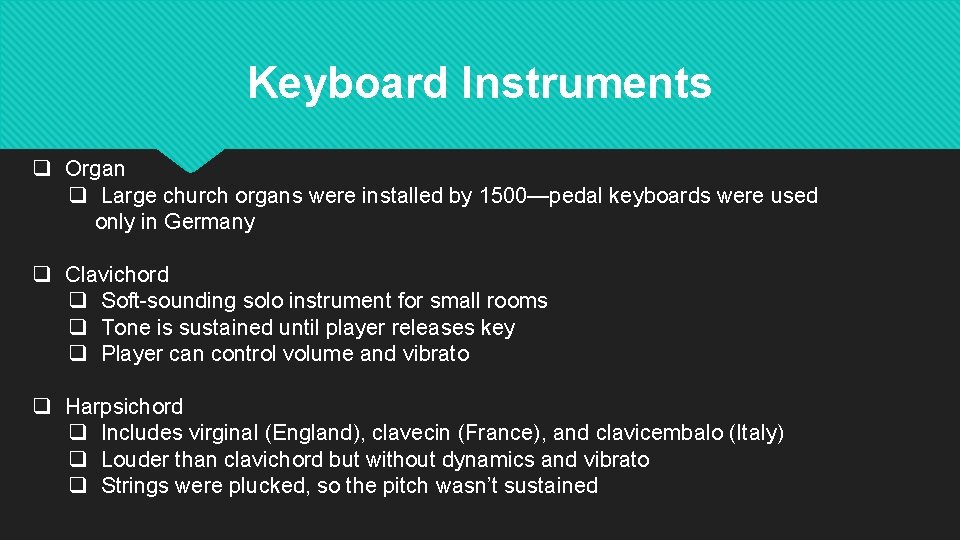
Keyboard Instruments q Organ q Large church organs were installed by 1500—pedal keyboards were used only in Germany q Clavichord q Soft-sounding solo instrument for small rooms q Tone is sustained until player releases key q Player can control volume and vibrato q Harpsichord q Includes virginal (England), clavecin (France), and clavicembalo (Italy) q Louder than clavichord but without dynamics and vibrato q Strings were plucked, so the pitch wasn’t sustained
Types of Instrumental Music q Dance music q Social dancing was important for people of breeding q Musicians improvised but composed music in the improvisational style was printed in books q Each dance has a unique character, defined by meter, tempo, rhythmic pattern, and form
Dance Music continued q Basse dance (low dance) q Stately couple dance marked by gracefully raising and lowering the body q Featured five different kinds of steps in various combos q Dance pairs q Often grouped in pairs or threes q Favorite combo: slow duple and fast triple q The two dances were often on the same theme—the second a variation of the first
English Virginalists q Parthenia (1613) q First published book for the virginal q Contains music by William Byrd, John Bull (c. 1562 -1628), and Orlando Gibbons (1583 -1625) q Variation techniques q Themes could remain intact throughout the set q More commonly theme was broken up by decorative figurations q Pavana Lachrymae q Composed by William Byrd (c. 1540 -1623) q Based on Dowland’s Flow, my tears q Second of each pair of phrases is more active
Abstract Instrumental Music q Introductory and improvisatory pieces q Keyboard and lute players often improved the intro to a song q Titles varied: prelude, fantasia ricercare q Toccata q Chief improv keyboard genre q Ricercare q Evolved into a motetlike succession of imitative sections q Successive themes, each developing imitatively and overlapping q Canzona q Original compositions in this style appeared in 1580 q They were light, fast moving, strongly rhythmic pieces q Typical opening rhythmic figure was half note followed by two quarter notes
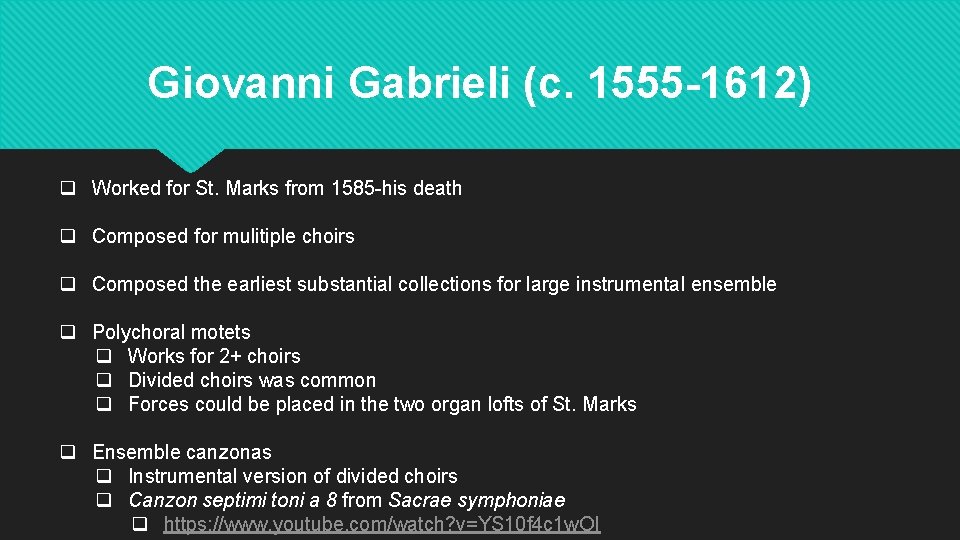
Giovanni Gabrieli (c. 1555 -1612) q Worked for St. Marks from 1585 -his death q Composed for mulitiple choirs q Composed the earliest substantial collections for large instrumental ensemble q Polychoral motets q Works for 2+ choirs q Divided choirs was common q Forces could be placed in the two organ lofts of St. Marks q Ensemble canzonas q Instrumental version of divided choirs q Canzon septimi toni a 8 from Sacrae symphoniae q https: //www. youtube. com/watch? v=YS 10 f 4 c 1 w. OI
- Slides: 10