
Instrumental Chemistry Chapter 6 Introduction to Spectroscopic Methods
- Slides: 9
Instrumental Chemistry Chapter 6 Introduction to Spectroscopic Methods
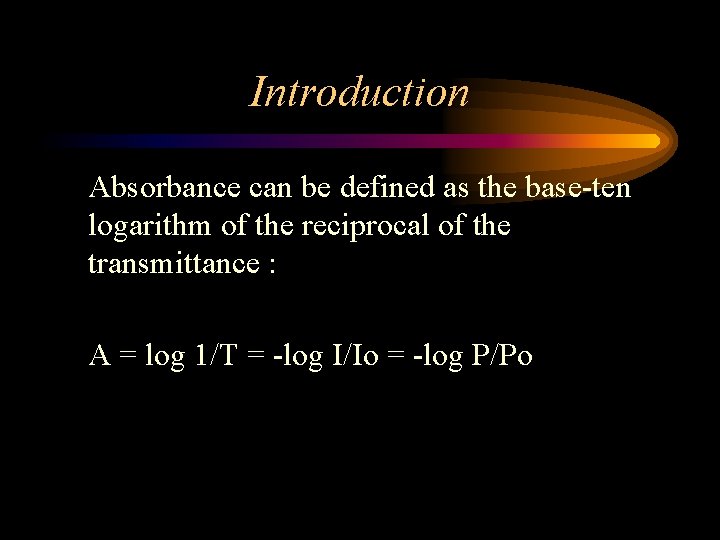
Introduction Absorbance can be defined as the base-ten logarithm of the reciprocal of the transmittance : A = log 1/T = -log I/Io = -log P/Po
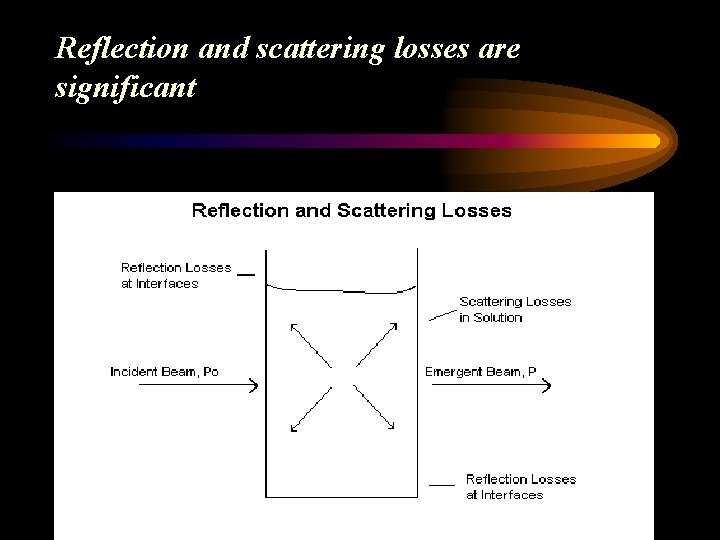
Reflection and scattering losses are significant
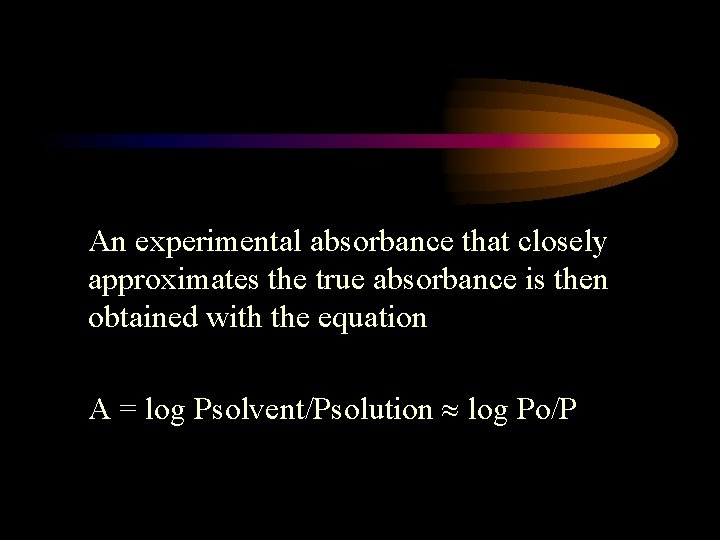
An experimental absorbance that closely approximates the true absorbance is then obtained with the equation A = log Psolvent/Psolution » log Po/P
Beer’s Law The fraction of the energy, or the intensity, of radiation absorbed in a thin layer of material depends on the absorbing substance and on the frequency of the incident radiation, and is proportional to the thickness of the layer.
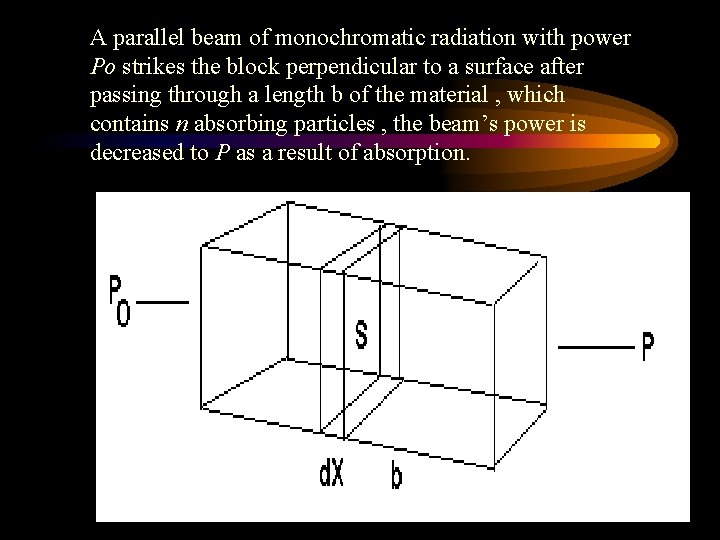
A parallel beam of monochromatic radiation with power Po strikes the block perpendicular to a surface after passing through a length b of the material , which contains n absorbing particles , the beam’s power is decreased to P as a result of absorption.
Chemical Deviations: Chemical deviations from Beer’s law are caused by shifts in the position of a chemical or physical equilibrium involving the absorbing species. A common example of this behavior is found with acid/base indicators. Deviations arising from chemical factors can only be observed when concentrations are changed.
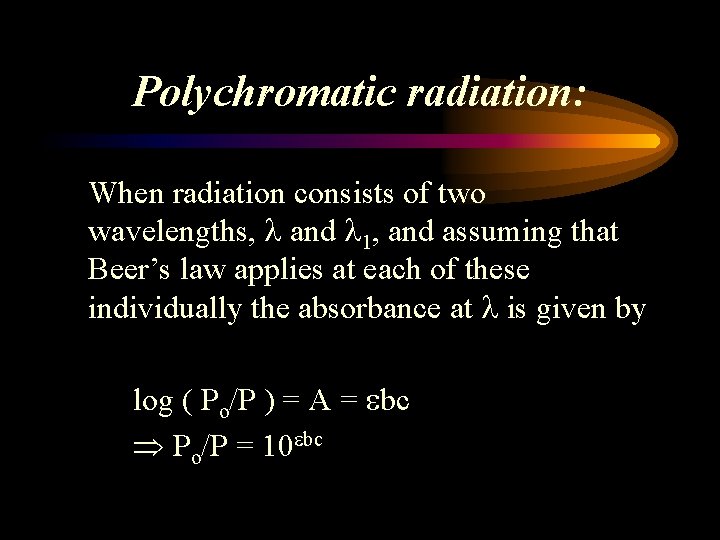
Polychromatic radiation: When radiation consists of two wavelengths, l and l 1, and assuming that Beer’s law applies at each of these individually the absorbance at l is given by log ( Po/P ) = A = ebc Þ Po/P = 10 ebc
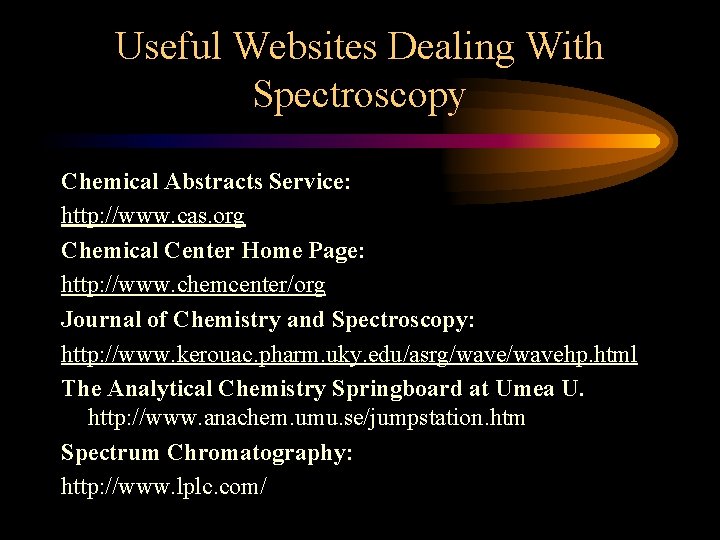
Useful Websites Dealing With Spectroscopy Chemical Abstracts Service: http: //www. cas. org Chemical Center Home Page: http: //www. chemcenter/org Journal of Chemistry and Spectroscopy: http: //www. kerouac. pharm. uky. edu/asrg/wavehp. html The Analytical Chemistry Springboard at Umea U. http: //www. anachem. umu. se/jumpstation. htm Spectrum Chromatography: http: //www. lplc. com/