
Instrument labs ventilation and sample handling Monika Hartl
Instrument labs, ventilation and sample handling Monika Hartl Melissa Sharp, Katrin Michel, Athanasios Stathis Scientific Activities Division www. europeanspallationsource. se
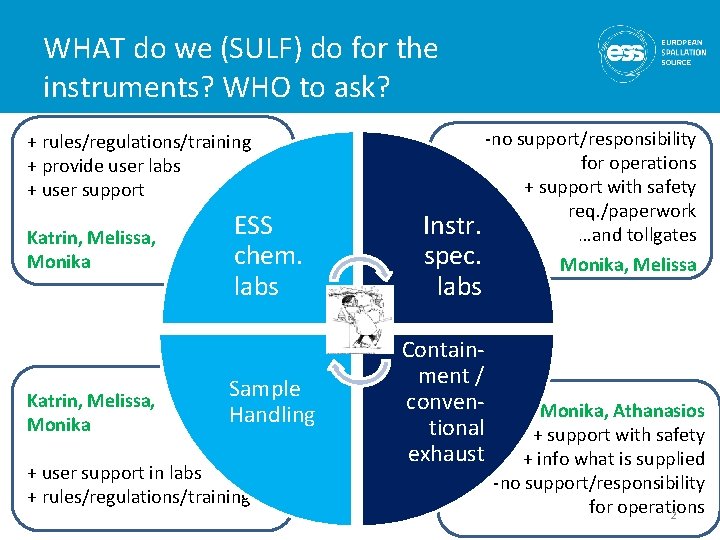
WHAT do we (SULF) do for the instruments? WHO to ask? + rules/regulations/training + provide user labs + user support Katrin, Melissa, Monika ESS chem. labs Sample Handling + user support in labs + rules/regulations/training -no support/responsibility for operations + support with safety req. /paperwork Instr. …and tollgates spec. Monika, Melissa labs Containment / conventional exhaust Monika, Athanasios + support with safety + info what is supplied -no support/responsibility for operations 2
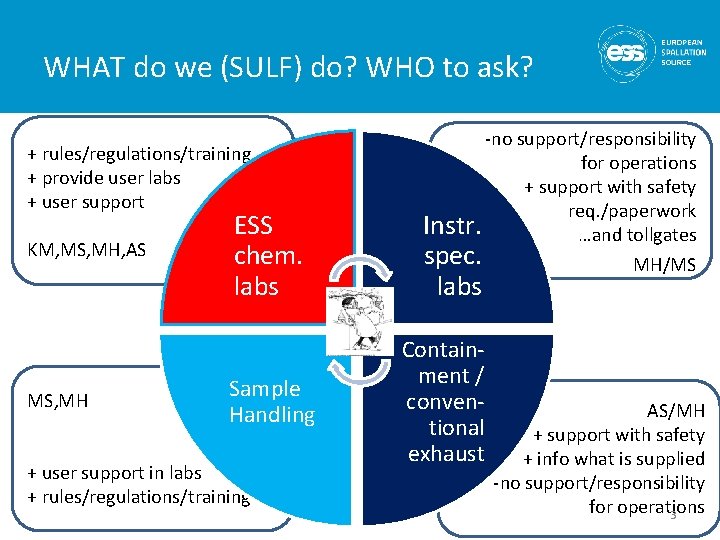
WHAT do we (SULF) do? WHO to ask? + rules/regulations/training + provide user labs + user support KM, MS, MH, AS MS, MH ESS chem. labs Sample Handling + user support in labs + rules/regulations/training -no support/responsibility for operations + support with safety req. /paperwork Instr. …and tollgates spec. MH/MS labs Containment / conventional exhaust AS/MH + support with safety + info what is supplied -no support/responsibility for operations 3
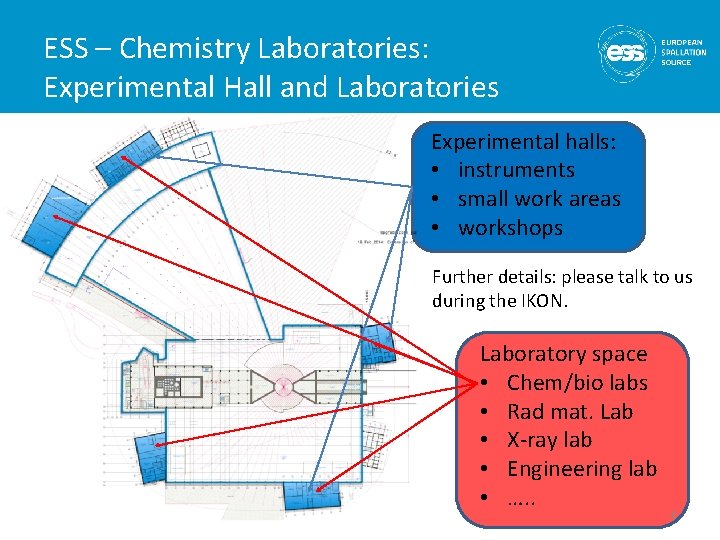
ESS – Chemistry Laboratories: Experimental Hall and Laboratories Experimental halls: • instruments • small work areas • workshops Further details: please talk to us during the IKON. Laboratory space • Chem/bio labs • Rad mat. Lab • X-ray lab • Engineering lab • …. . 4
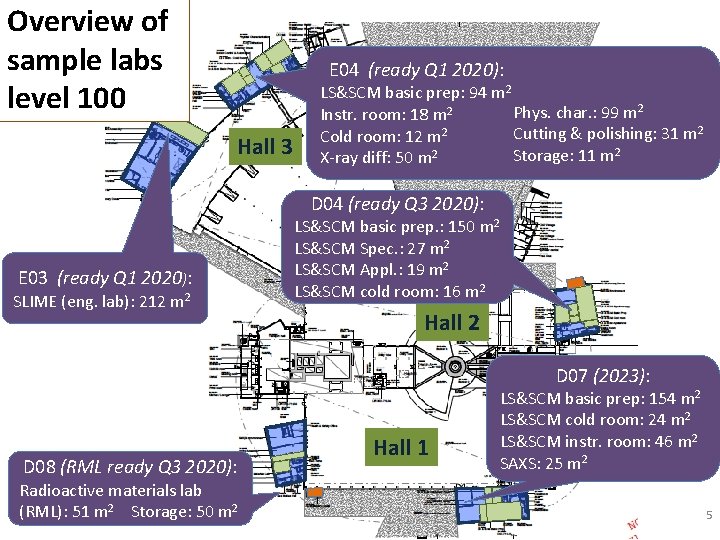
Overview of sample labs level 100 E 04 (ready Q 1 2020): Hall 3 LS&SCM basic prep: 94 m 2 Phys. char. : 99 m 2 Instr. room: 18 m 2 Cutting & polishing: 31 m 2 Cold room: 12 m 2 Storage: 11 m 2 X-ray diff: 50 m 2 D 04 (ready Q 3 2020): E 03 (ready Q 1 2020): SLIME (eng. lab): 212 m 2 LS&SCM basic prep. : 150 m 2 LS&SCM Spec. : 27 m 2 LS&SCM Appl. : 19 m 2 LS&SCM cold room: 16 m 2 Hall 2 D 07 (2023): D 08 (RML ready Q 3 2020): Radioactive materials lab (RML): 51 m 2 Storage: 50 m 2 Hall 1 LS&SCM basic prep: 154 m 2 LS&SCM cold room: 24 m 2 LS&SCM instr. room: 46 m 2 SAXS: 25 m 2 5
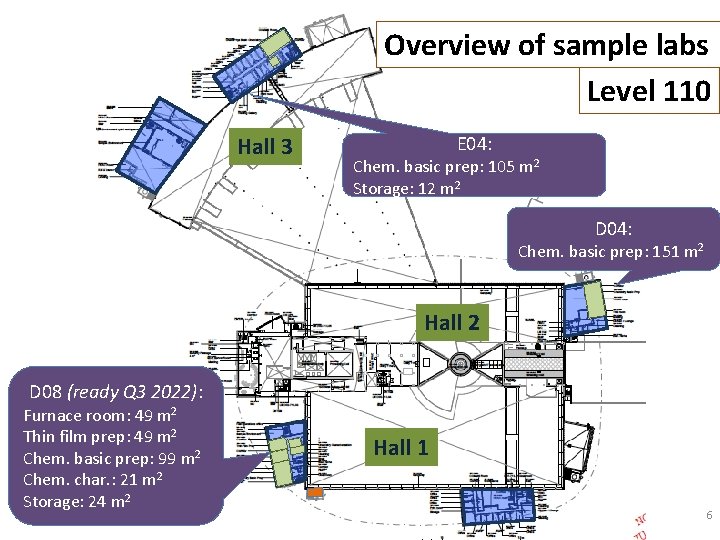
Overview of sample labs Level 110 Hall 3 E 04: Chem. basic prep: 105 m 2 Storage: 12 m 2 D 04: Chem. basic prep: 151 m 2 Hall 2 D 08 (ready Q 3 2022): Furnace room: 49 m 2 Thin film prep: 49 m 2 Chem. basic prep: 99 m 2 Chem. char. : 21 m 2 Storage: 24 m 2 Hall 1 6
ESS – Chemistry Laboratories: What we provide • 8 large general user preparation labs covering chemistry, soft matter and life science situated in D 04, D 07, D 08, E 03, E 04 support buildings • 15 specialized labs for sample characterization, furnace room, thin film, X-rays, cold rooms, etc. • E-labs to commence furnishing in early 2020, on schedule, RML still on track for BOT • General user labs on schedule to be completed in time for nearby instruments starting hot commissioning • earliest labs ready for use in mid- 2020 (E 04) 10/3/2020 7
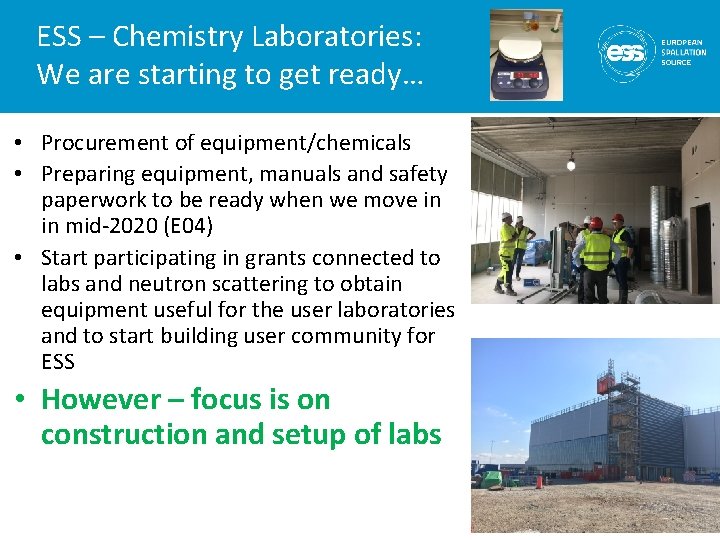
ESS – Chemistry Laboratories: We are starting to get ready… • Procurement of equipment/chemicals • Preparing equipment, manuals and safety paperwork to be ready when we move in in mid-2020 (E 04) • Start participating in grants connected to labs and neutron scattering to obtain equipment useful for the user laboratories and to start building user community for ESS • However – focus is on construction and setup of labs 8
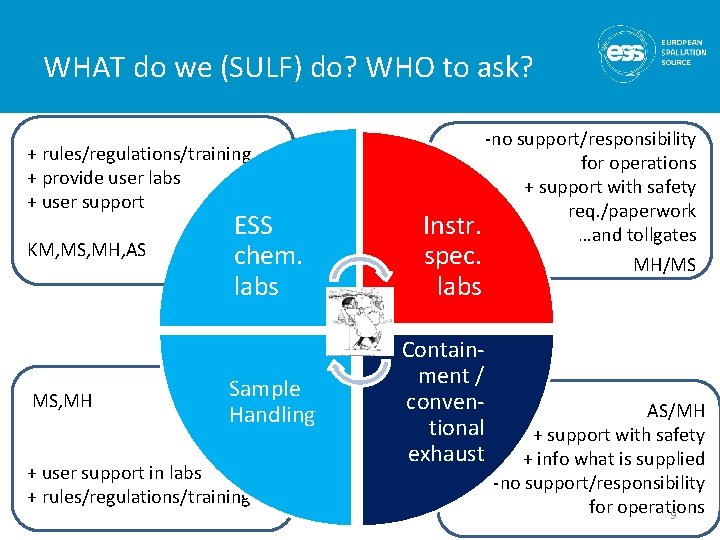
WHAT do we (SULF) do? WHO to ask? + rules/regulations/training + provide user labs + user support KM, MS, MH, AS MS, MH ESS chem. labs Sample Handling + user support in labs + rules/regulations/training -no support/responsibility for operations + support with safety req. /paperwork Instr. …and tollgates spec. MH/MS labs Containment / conventional exhaust AS/MH + support with safety + info what is supplied -no support/responsibility for operations 9

Instrument Specific Laboratories (IS labs): What is it? = Area on each instrument used for handling samples • Design of area is responsibility of instrument team • rules/regulations are responsibility of ESS • Operation of IS labs is responsibility of instr. team (staffing/equipment/enforcement of safety) SULF will assist in assuring the design/proposed work aligns with the safety requirements (TOLLGATE documents…). Potential restrictions for IS labs: • Fire load (flammable solvents & gases) • Health hazards (toxicity, nanoparticles, …) • Radioactivity (maximum inventory/ shielded cabinets/…) 10/3/2020 10
Instrument Specific Laboratories (IS labs): sample handling • Whether or not sample can be handled on the instrument will depend on experiment safety review AND provision on instrument (Sample management procedures: ESS-0024107, ESS-0024109, ESS-0024112) • REMEMBER: the nearest user lab is not far from you and there we take the responsibility and make provisions for hazardous samples and user support! 11 10/3/2020
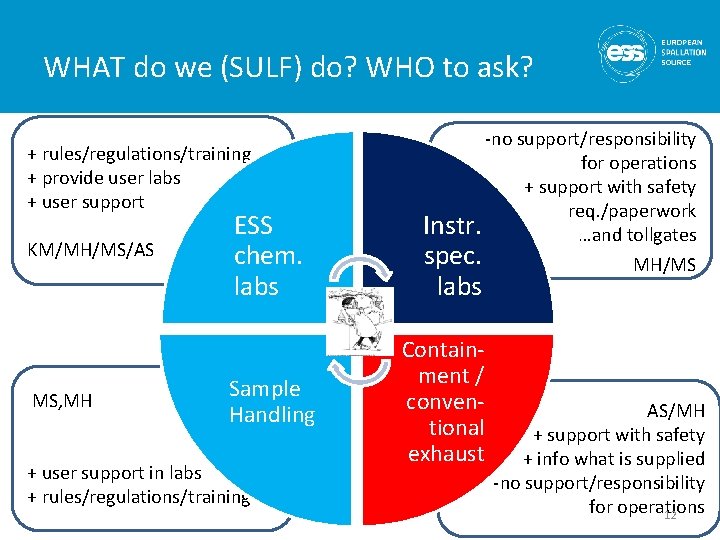
WHAT do we (SULF) do? WHO to ask? + rules/regulations/training + provide user labs + user support KM/MH/MS/AS MS, MH ESS chem. labs Sample Handling + user support in labs + rules/regulations/training -no support/responsibility for operations + support with safety req. /paperwork Instr. …and tollgates spec. MH/MS labs Containment / conventional exhaust AS/MH + support with safety + info what is supplied -no support/responsibility for operations 12
Containment vs conventional exhaust • Containment exhaust: goes to the main stack of ESS, can be used on sample area even if materials are radioactive typical use: pump exhaust in experimental cave to provide containment for radioactive material or for gas flow experiments • Conventional ventilation: goes to a regular exhaust (NO radioactive fumes are allowed!) typical use: fume hood in instrument area for preparing samples or exhaust for flammable solvent/gas cylinder cabinet 10/3/2020 13
Containment exhaust • Containment exhaust => inner diameter 250 mm • usable for: – vacuum pump exhaust from sample area – slow gas flow over sample Þ Needed from the instrument teams: Þrun pipe to the experimental cave area of instrument, Þinstall HEPA filter to catch particles, ÞKeep line closed when not in use Þ Provided by ESS: ESS-0040840 (will be updated) ÞSpecifications for HEPA filters ÞSpecify restrictions for use (e. g. no large amount of undiluted corrosives…. ) 10/3/2020 14
Conventional exhaust • Conventional exhaust => inner diameter 315 mm • usable for: – Fume hoods/overhead extraction for IS labs – Cabinets with flammable/toxic liquids/gases – Sample storage cabinets Þ Needed from the instrument teams: Þ run pipe to the IS lab area Þ add damper/filter for fume hoods/overhead extraction Þ Cover end flange if not in use Þ Provided by ESS: ESS-0040840 (needs update) Þ Specification for damper/filter to the extent of our knowledge: (= we can specify one model and facilitate contact to builder to see if other models might work) 10/3/2020 15
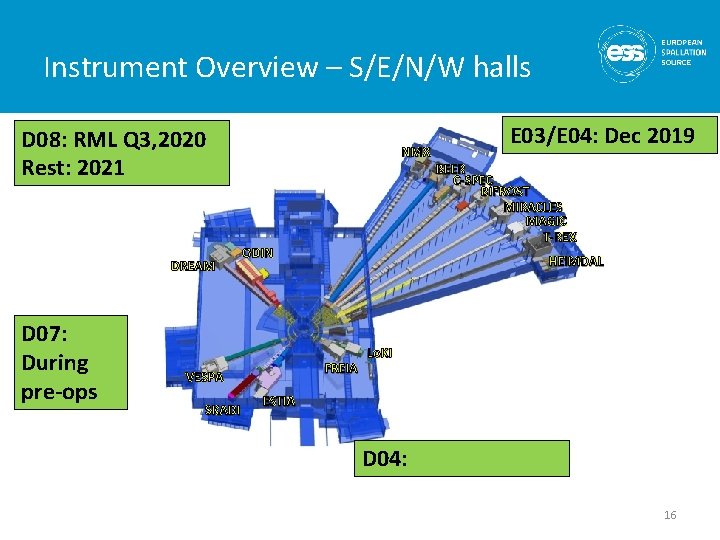
Instrument Overview – S/E/N/W halls D 08: RML Q 3, 2020 Rest: 2021 DREAM D 07: During pre-ops NMX ODIN SKADI BEER C-SPEC BIFROST MIRACLES MAGIC T-REX HEIMDAL FREIA VESPA E 03/E 04: Dec 2019 Lo. KI ESTIA D 04: 16
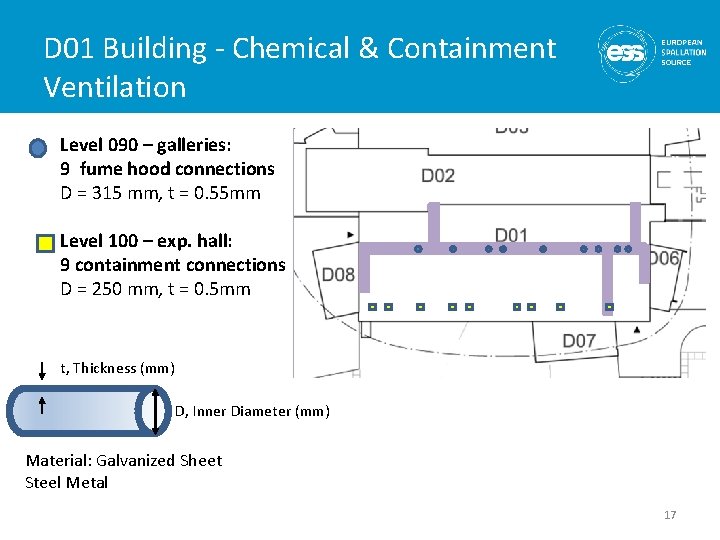
D 01 Building - Chemical & Containment Ventilation Level 090 – galleries: 9 fume hood connections D = 315 mm, t = 0. 55 mm Level 100 – exp. hall: 9 containment connections D = 250 mm, t = 0. 5 mm t, Thickness (mm) D, Inner Diameter (mm) Material: Galvanized Sheet Steel Metal 17
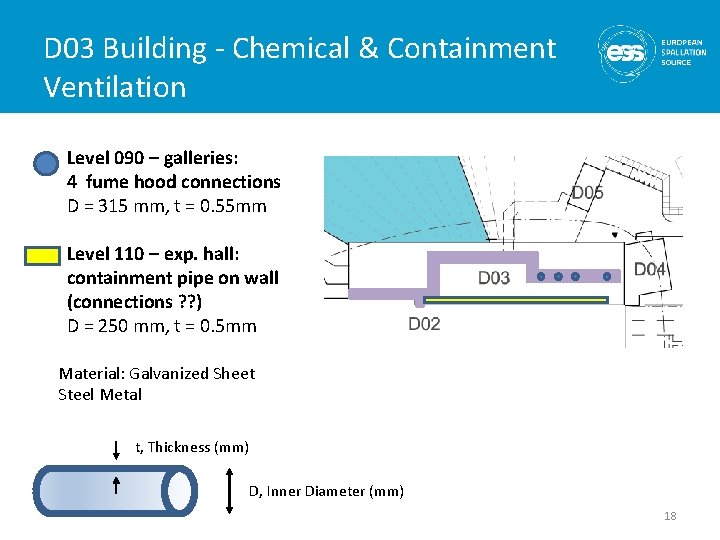
D 03 Building - Chemical & Containment Ventilation Level 090 – galleries: 4 fume hood connections D = 315 mm, t = 0. 55 mm Level 110 – exp. hall: containment pipe on wall (connections ? ? ) D = 250 mm, t = 0. 5 mm Material: Galvanized Sheet Steel Metal t, Thickness (mm) D, Inner Diameter (mm) 18
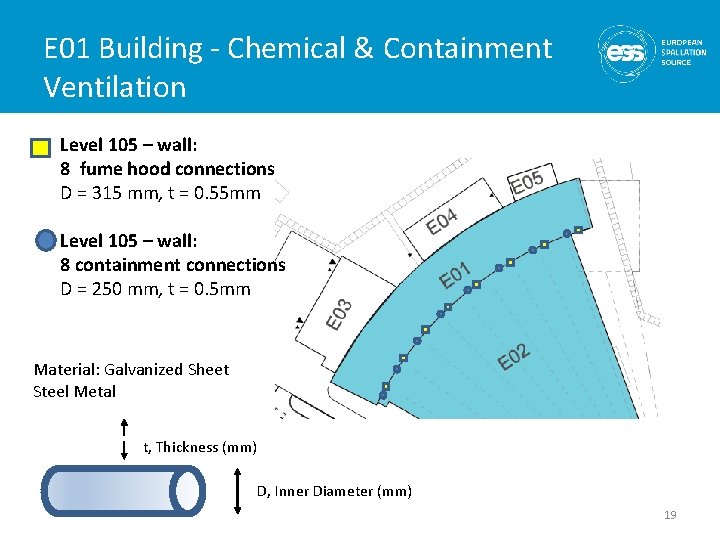
E 01 Building - Chemical & Containment Ventilation Level 105 – wall: 8 fume hood connections D = 315 mm, t = 0. 55 mm Level 105 – wall: 8 containment connections D = 250 mm, t = 0. 5 mm Material: Galvanized Sheet Steel Metal t, Thickness (mm) D, Inner Diameter (mm) 19
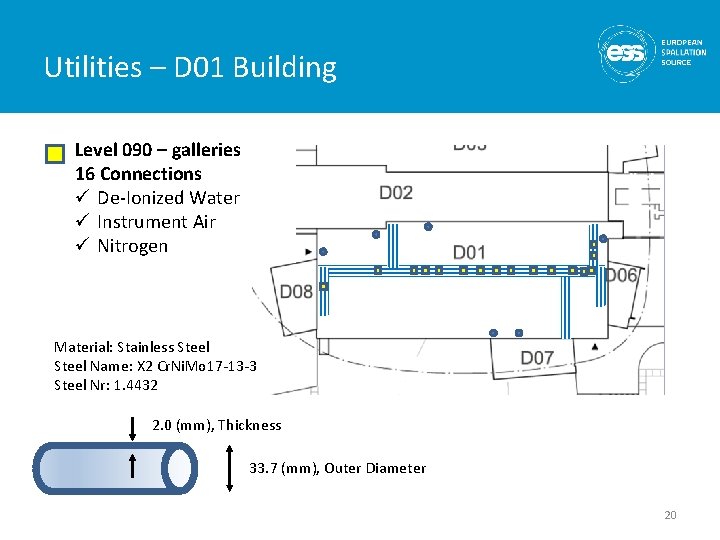
Utilities – D 01 Building Level 090 – galleries 16 Connections ü De-Ionized Water ü Instrument Air ü Nitrogen Material: Stainless Steel Name: X 2 Cr. Ni. Mo 17 -13 -3 Steel Nr: 1. 4432 2. 0 (mm), Thickness 33. 7 (mm), Outer Diameter 20
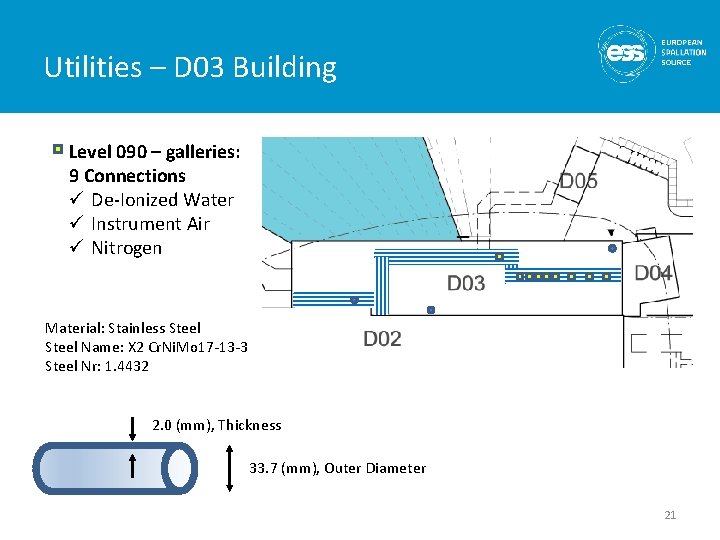
Utilities – D 03 Building Level 090 – galleries: 9 Connections ü De-Ionized Water ü Instrument Air ü Nitrogen Material: Stainless Steel Name: X 2 Cr. Ni. Mo 17 -13 -3 Steel Nr: 1. 4432 2. 0 (mm), Thickness 33. 7 (mm), Outer Diameter 21
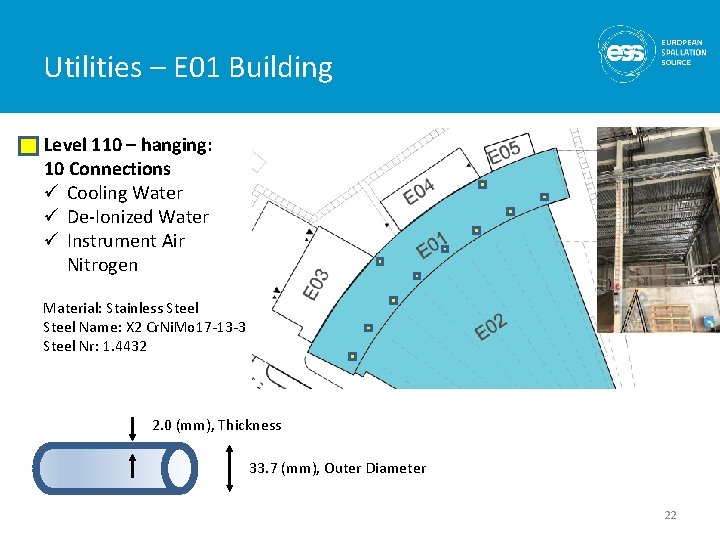
Utilities – E 01 Building Level 110 – hanging: 10 Connections ü Cooling Water ü De-Ionized Water ü Instrument Air Nitrogen Material: Stainless Steel Name: X 2 Cr. Ni. Mo 17 -13 -3 Steel Nr: 1. 4432 2. 0 (mm), Thickness 33. 7 (mm), Outer Diameter 22
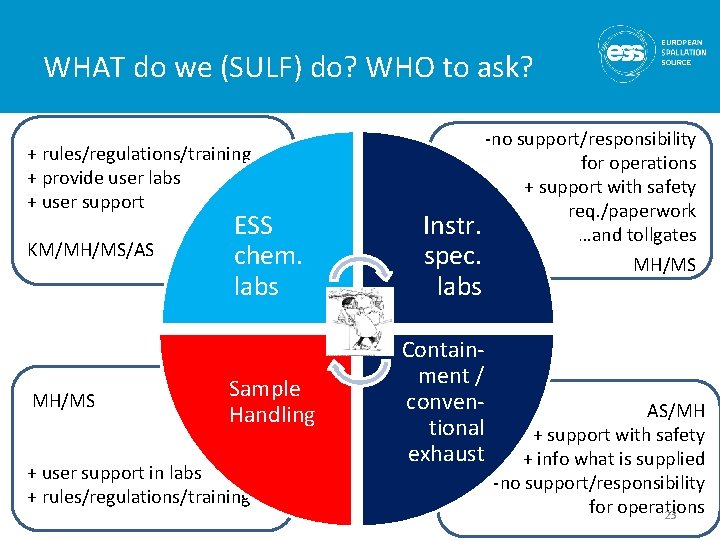
WHAT do we (SULF) do? WHO to ask? + rules/regulations/training + provide user labs + user support KM/MH/MS/AS MH/MS ESS chem. labs Sample Handling + user support in labs + rules/regulations/training -no support/responsibility for operations + support with safety req. /paperwork Instr. …and tollgates spec. MH/MS labs Containment / conventional exhaust AS/MH + support with safety + info what is supplied -no support/responsibility for operations 23
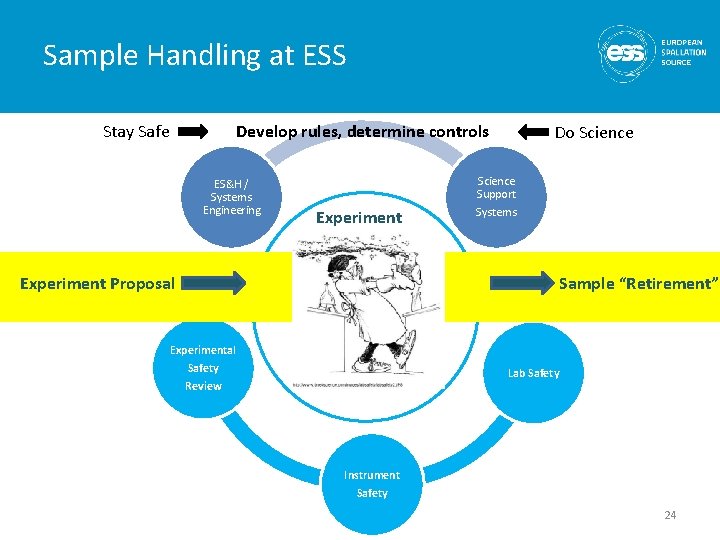
Sample Handling at ESS Stay Safe Develop rules, determine controls ES&H / Systems Engineering Do Science Support Experiment Systems Experiment Proposal Sample “Retirement” Experimental Safety Review Lab Safety Instrument Safety 24
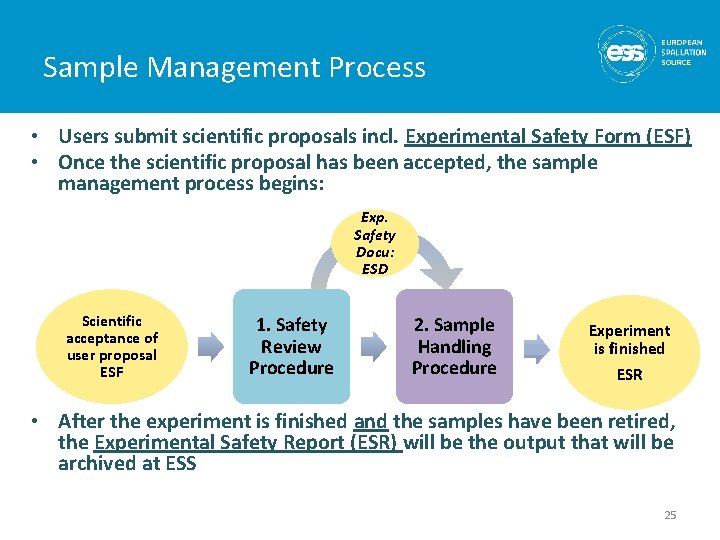
Sample Management Process • Users submit scientific proposals incl. Experimental Safety Form (ESF) • Once the scientific proposal has been accepted, the sample management process begins: Exp. Safety Docu: ESD Scientific acceptance of user proposal ESF 1. Safety Review Procedure 2. Sample Handling Procedure Experiment is finished ESR • After the experiment is finished and the samples have been retired, the Experimental Safety Report (ESR) will be the output that will be archived at ESS 25
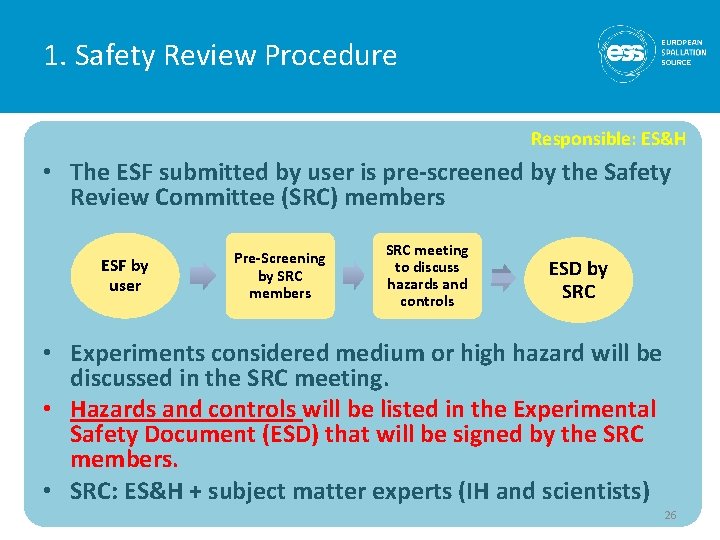
1. Safety Review Procedure Responsible: ES&H • The ESF submitted by user is pre-screened by the Safety Review Committee (SRC) members ESF by user Pre-Screening by SRC members SRC meeting to discuss hazards and controls ESD by SRC • Experiments considered medium or high hazard will be discussed in the SRC meeting. • Hazards and controls will be listed in the Experimental Safety Document (ESD) that will be signed by the SRC members. • SRC: ES&H + subject matter experts (IH and scientists) 26
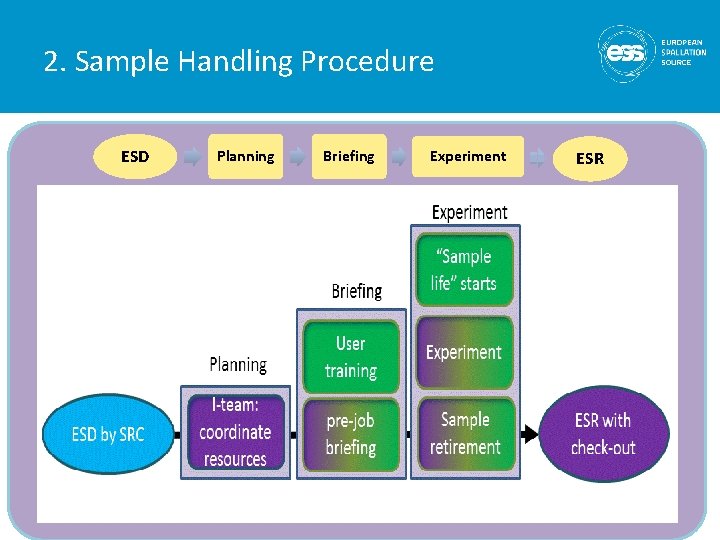
2. Sample Handling Procedure ESD Planning Briefing Experiment ESR 27
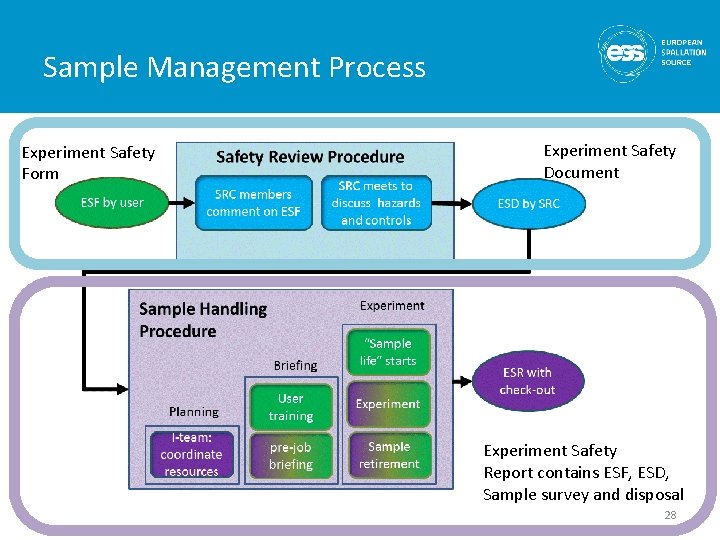
Sample Management Process Experiment Safety Form Experiment Safety Document Experiment Safety Report contains ESF, ESD, Sample survey and disposal 28
Conclusions: • Sample Handling at ESS including safety – Sample management procedure (this should be referenced during your TGs) – no need to do a hazard analysis on sample handling • Instrument Laboratories -available: chemical ventilation, containment ventilation -not available: sinks and drains -> need to use closed-cycle cooling and collect liquids -if you have special needs, we will support you, e. g. either in the lab or in developing an IS (e. g. nanopowder box for diffractometer, sample loading station for SANS/reflectometry) • Generic instrument hazard analysis: sample environment and samples not part of generic instrument hazard analysis EXCEPT if constantly on instrument (e. g. robot arms NMX, CCR for VESPA)- see https: //confluence. esss. lu. se/display/SD/Instrument+Hazard+ Analysis • Documentation – chem vent/containment vent: ESS-004084030
Lab support We realize instrument specific labs can be very useful and will support you in providing them ! We are also convinced that more hazardous handling of chemicals can be much better done in the fully equipped user laboratories. Questions to: Monika. Hartl@esss. se & Melissa. Sharp@esss. se 31
- Slides: 30