
Instructor Terry Wiseth Start Lab WHAT DO I

Instructor Terry Wiseth Start Lab
WHAT DO I NEED TO HAND IN FOR THIS LAB? 1) Data Table for Brain Waves 2) Answers to Questions Monitor DATA ACQUISITION UNIT Stimulator Recording Outputs Inputs + 1 Power Stop Recording 2 Start Recording Click here to view a printable DATA TABLE for Brain Waves Click here to begin collecting data for this lab Next Previous Skip Intro End Lab EEG Sensor Click here to view a printable list of QUESTIONS for Brain Waves Click here to view the INTRODUCTION
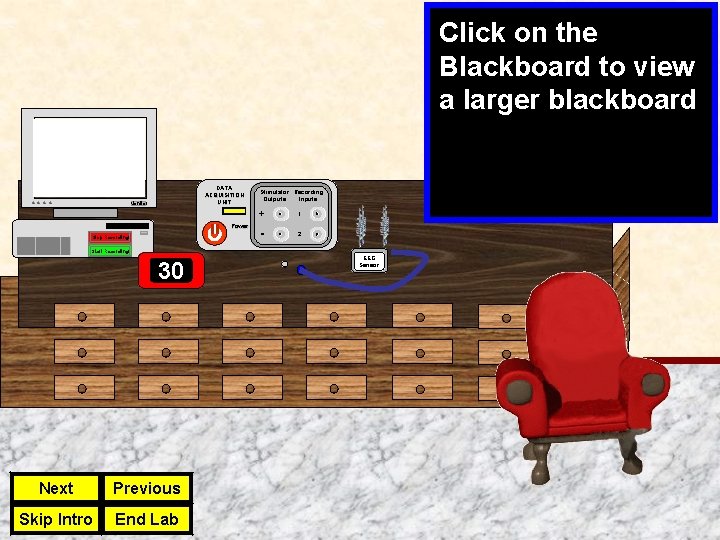
Click on the Blackboard to view a larger blackboard DATA ACQUISITION UNIT Monitor Power Stop Recording Stimulator Recording Outputs Inputs + 1 2 Start Recording 30 Next Previous Skip Intro End Lab EEG Sensor
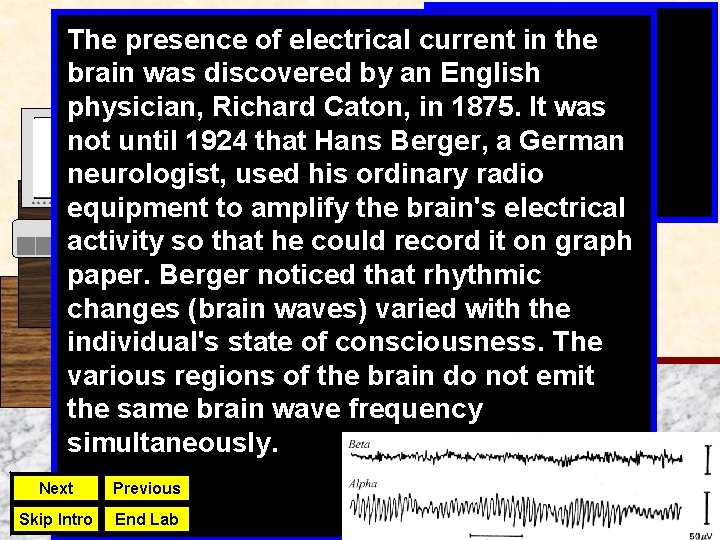
The presence of electrical current in the brain was discovered by an English physician, Richard Caton, in 1875. It was not until 1924 that Hans Berger, a German neurologist, used his ordinary radio equipment to amplify the brain's electrical activity so that he could record it on graph paper. Berger noticed that rhythmic changes (brain waves) varied with the individual's state of consciousness. The various regions of the brain do not emit the same brain wave frequency simultaneously. Monitor DATA ACQUISITION UNIT Stimulator Recording Outputs Inputs + 1 Power Stop Recording 2 Start Recording EEG Sensor Next Previous Skip Intro End Lab
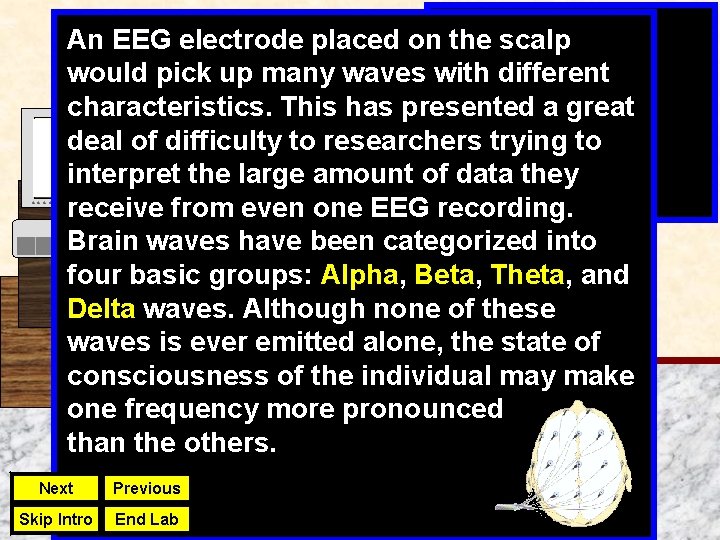
An EEG electrode placed on the scalp would pick up many waves with different characteristics. This has presented a great deal of difficulty to researchers trying to interpret the large amount of data they receive from even one EEG recording. Brain waves have been categorized into four basic groups: Alpha, Beta, Theta, and Delta waves. Although none of these waves is ever emitted alone, the state of consciousness of the individual may make one frequency more pronounced than the others. Monitor DATA ACQUISITION UNIT Stimulator Recording Outputs Inputs + 1 Power Stop Recording 2 Start Recording EEG Sensor Next Previous Skip Intro End Lab
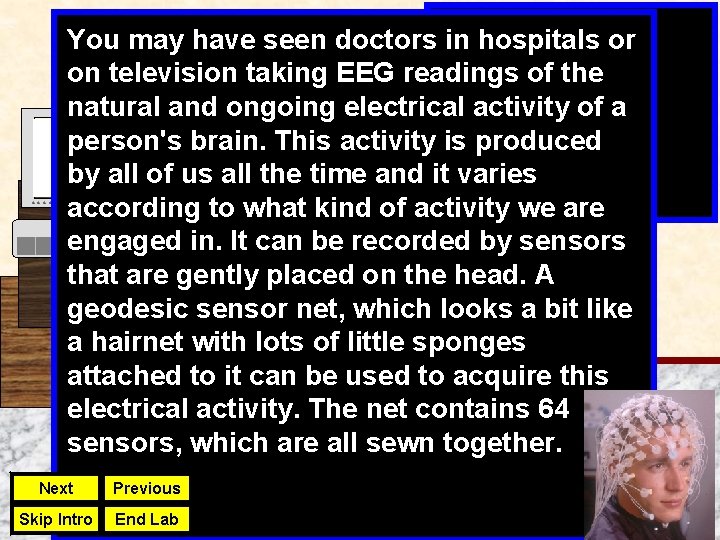
You may have seen doctors in hospitals or on television taking EEG readings of the natural and ongoing electrical activity of a person's brain. This activity is produced by all of us all the time and it varies according to what kind of activity we are engaged in. It can be recorded by sensors that are gently placed on the head. A geodesic sensor net, which looks a bit like a hairnet with lots of little sponges attached to it can be used to acquire this electrical activity. The net contains 64 sensors, which are all sewn together. Monitor DATA ACQUISITION UNIT Stimulator Recording Outputs Inputs + 1 Power Stop Recording 2 Start Recording EEG Sensor Next Previous Skip Intro End Lab
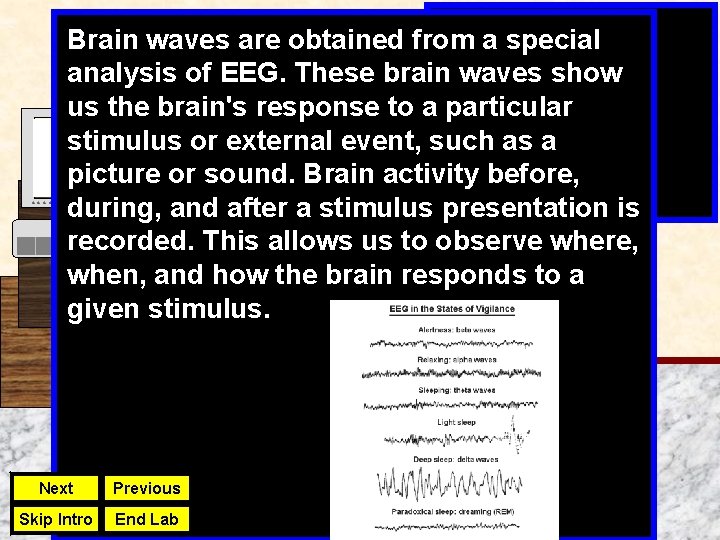
Brain waves are obtained from a special analysis of EEG. These brain waves show us the brain's response to a particular stimulus or external event, such as a picture or sound. Brain activity before, during, and after a stimulus presentation is recorded. This allows us to observe where, when, and how the brain responds to a given stimulus. Monitor DATA ACQUISITION UNIT Stimulator Recording Outputs Inputs + 1 Power Stop Recording 2 Start Recording EEG Sensor Next Previous Skip Intro End Lab
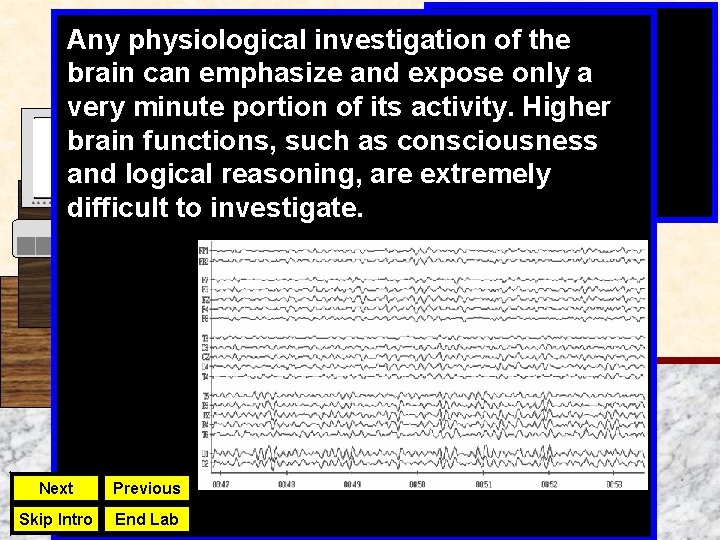
Any physiological investigation of the brain can emphasize and expose only a very minute portion of its activity. Higher brain functions, such as consciousness and logical reasoning, are extremely difficult to investigate. Monitor DATA ACQUISITION UNIT Power Stop Recording Stimulator Recording Outputs Inputs + 1 2 Start Recording EEG Sensor Next Previous Skip Intro End Lab
It is obviously much easier to do experiments on the brain’s input output functions, some of which can be detected with appropriate recording equipment. Still, the ability to record brain activity does not necessarily guarantee an understanding of the brain. Certain characteristics of brain waves are known. They have a frequency of 1 to 30 hertz (Hz) or cycles per second, a dominant rhythm of 10 Hz and an average amplitude (voltage) of 20 to 100 microvolts (u. V). Monitor DATA ACQUISITION UNIT Stimulator Recording Outputs Inputs + 1 Power Stop Recording 2 Start Recording EEG Sensor Next Previous Skip Intro End Lab
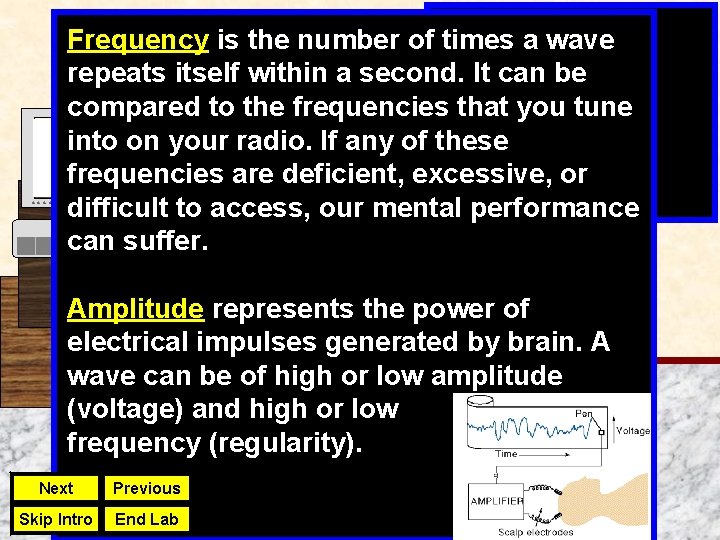
Frequency is the number of times a wave repeats itself within a second. It can be compared to the frequencies that you tune into on your radio. If any of these frequencies are deficient, excessive, or difficult to access, our mental performance can suffer. Monitor DATA ACQUISITION UNIT Stimulator Recording Outputs Inputs + 1 Power Stop Recording 2 Start Recording EEG Sensor Amplitude represents the power of electrical impulses generated by brain. A wave can be of high or low amplitude (voltage) and high or low frequency (regularity). Next Previous Skip Intro End Lab
The first of the brain waves to be described by scientists were the Alpha Waves (or alpha rhythm). Alpha waves have an average frequency range of 8 to 13 Hz and are produced when the individual is in a relaxed state with the eyes closed. Alpha block, suppression of the alpha rhythm, occurs if the eyes are opened or if the individual begins to concentrate on some mental problem or visual stimulus. Under these conditions, the waves decrease in amplitude but increase in frequency. Under conditions of fright or excitement, the frequency Next Previous increases still more. Skip Intro End Lab Monitor DATA ACQUISITION UNIT Stimulator Recording Outputs Inputs + 1 Power Stop Recording 2 Start Recording EEG Sensor
Beta Waves, closely related to alpha waves, are faster, 14 to 30 Hz and have a lower amplitude. They are typical of the attentive or alert state. DATA ACQUISITION UNIT Stimulator Recording Outputs Inputs Very large (high amplitude) waves with a frequency of less than 4 Hz that are seen in deep sleep are Delta Waves. Monitor + 1 Power Stop Recording 2 Start Recording EEG Sensor Next Previous Skip Intro End Lab
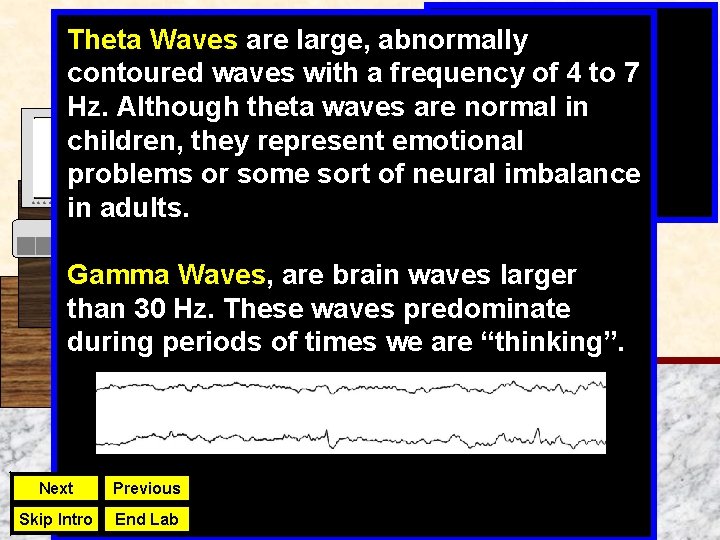
Theta Waves are large, abnormally contoured waves with a frequency of 4 to 7 Hz. Although theta waves are normal in children, they represent emotional problems or some sort of neural imbalance in adults. Monitor DATA ACQUISITION UNIT Power Stop Recording Stimulator Recording Outputs Inputs + 1 2 Start Recording EEG Sensor Gamma Waves, are brain waves larger than 30 Hz. These waves predominate during periods of times we are “thinking”. Next Previous Skip Intro End Lab
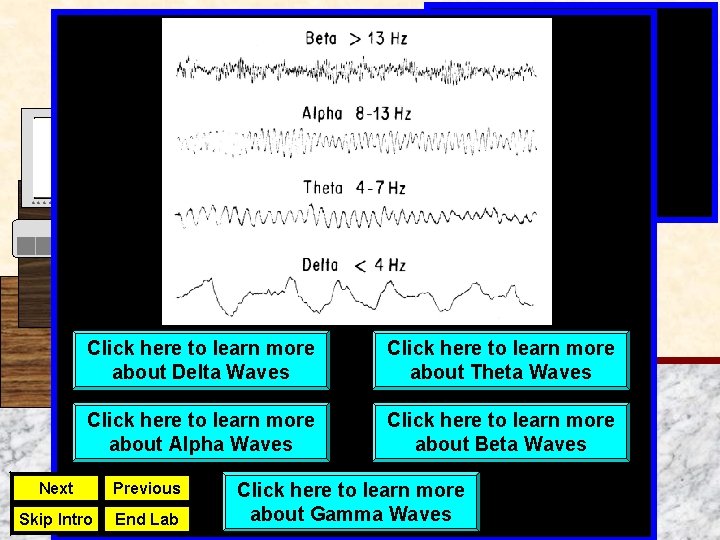
Monitor DATA ACQUISITION UNIT Power Stop Recording Stimulator Recording Outputs Inputs + 1 2 Start Recording EEG Sensor Click here to learn more about Delta Waves Click here to learn more about Theta Waves Click here to learn more about Alpha Waves Click here to learn more about Beta Waves Next Previous Skip Intro End Lab Click here to learn more about Gamma Waves
In normal adults who are awake, the EEG shows mostly Alpha waves and Beta waves. In abnormal adults the EEG shows sudden bursts of electrical activity (spikes) or sudden slowing of brain waves. These abnormal discharges may be caused by a brain tumor, infection, injury, stroke, or epilepsy. When a person has epilepsy, the location and exact pattern of the abnormal brain waves may help determine what type of epilepsy or seizures the person has. Keep in mind that in many people with epilepsy, the EEG may appear completely normal Next Previous seizures. Skip Intro Endbetween Lab Monitor DATA ACQUISITION UNIT Stimulator Recording Outputs Inputs + 1 Power Stop Recording 2 Start Recording EEG Sensor
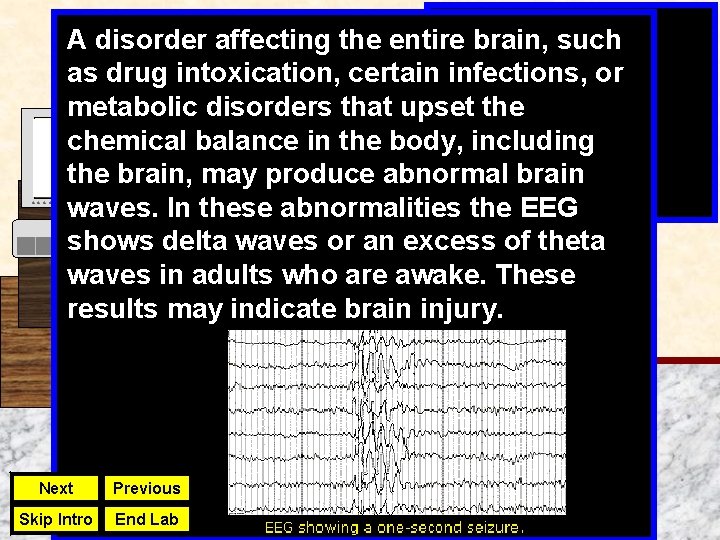
A disorder affecting the entire brain, such as drug intoxication, certain infections, or metabolic disorders that upset the chemical balance in the body, including the brain, may produce abnormal brain waves. In these abnormalities the EEG shows delta waves or an excess of theta waves in adults who are awake. These results may indicate brain injury. Monitor DATA ACQUISITION UNIT Stimulator Recording Outputs Inputs + 1 Power Stop Recording 2 Start Recording EEG Sensor Next Previous Skip Intro End Lab
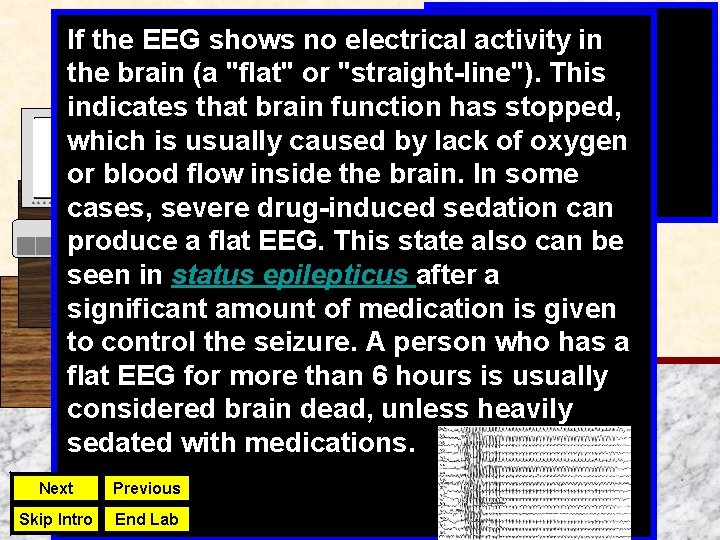
If the EEG shows no electrical activity in the brain (a "flat" or "straight line"). This indicates that brain function has stopped, which is usually caused by lack of oxygen or blood flow inside the brain. In some cases, severe drug induced sedation can produce a flat EEG. This state also can be seen in status epilepticus after a significant amount of medication is given to control the seizure. A person who has a flat EEG for more than 6 hours is usually considered brain dead, unless heavily sedated with medications. Monitor DATA ACQUISITION UNIT Stimulator Recording Outputs Inputs + 1 Power Stop Recording 2 Start Recording EEG Sensor Next Previous Skip Intro End Lab
Brain waves change with age, sensory stimuli, brain pathology or disease. Glucose deprivation, oxygen poisoning and sedatives all interfere with the rhythmic activity of brain output by disturbing the metabolism of the neurons. Sleeping individuals and patients in a coma have EEGs that are slower (or lower frequency) than the alpha rhythm of normal adults. Fright, epileptic seizures, and various types of drug intoxication are associated with faster brain activity. Impairment of brain function is indicated by neuronal activity that is Next Previous either too fast or too slow. Skip Intro End Lab Monitor DATA ACQUISITION UNIT Stimulator Recording Outputs Inputs + 1 Power Stop Recording 2 Start Recording EEG Sensor
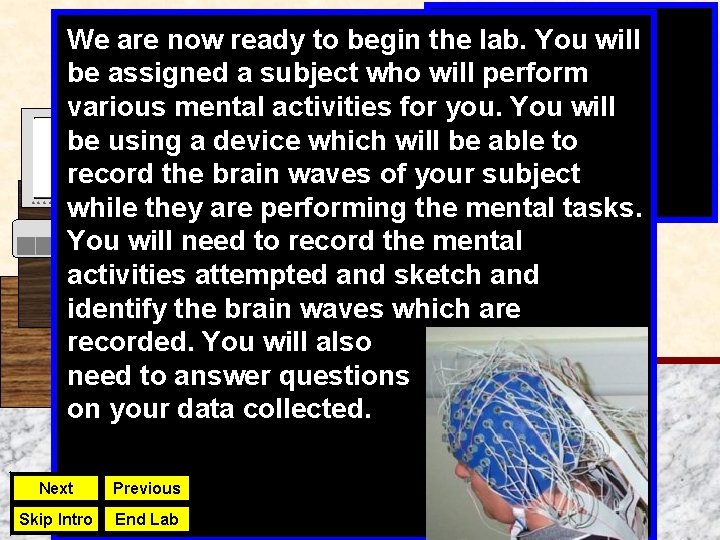
We are now ready to begin the lab. You will be assigned a subject who will perform various mental activities for you. You will be using a device which will be able to record the brain waves of your subject while they are performing the mental tasks. You will need to record the mental activities attempted and sketch and identify the brain waves which are recorded. You will also need to answer questions on your data collected. Monitor DATA ACQUISITION UNIT Stimulator Recording Outputs Inputs + 1 Power Stop Recording 2 Start Recording EEG Sensor Next Previous Skip Intro End Lab
WHAT DO I NEED TO HAND IN FOR THIS LAB? 1) Data Table for Brain Waves 2) Answers to Questions Monitor DATA ACQUISITION UNIT Stimulator Recording Outputs Inputs + 1 Power Stop Recording 2 Start Recording Click here to view a printable DATA TABLE for Brain Waves Click here to begin collecting data for this lab Next Previous Skip Intro End Lab EEG Sensor Click here to view a printable list of QUESTIONS for Brain Waves Click here to view the INTRODUCTION again
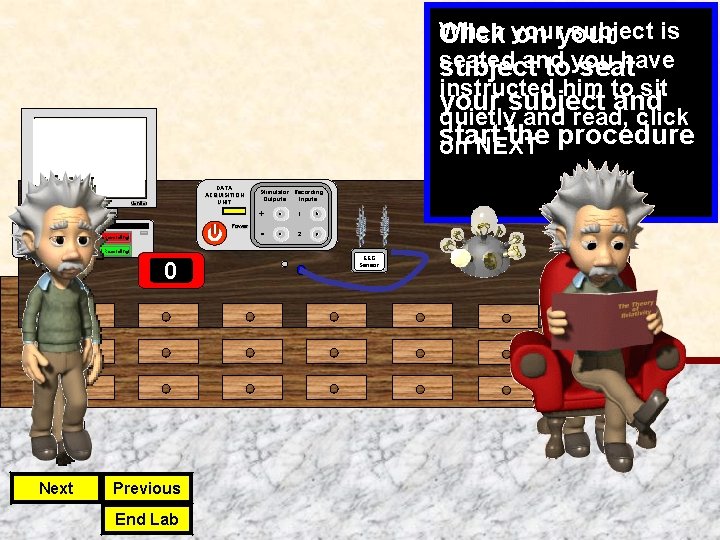
When subject is Click your on your seated and have subject toyou seat instructed him to sit your subject and quietly and read, click start the procedure on NEXT DATA ACQUISITION UNIT Monitor Power Stop Recording Stimulator Recording Outputs Inputs + 1 2 Start Recording 0 Next Previous End Lab EEG Sensor
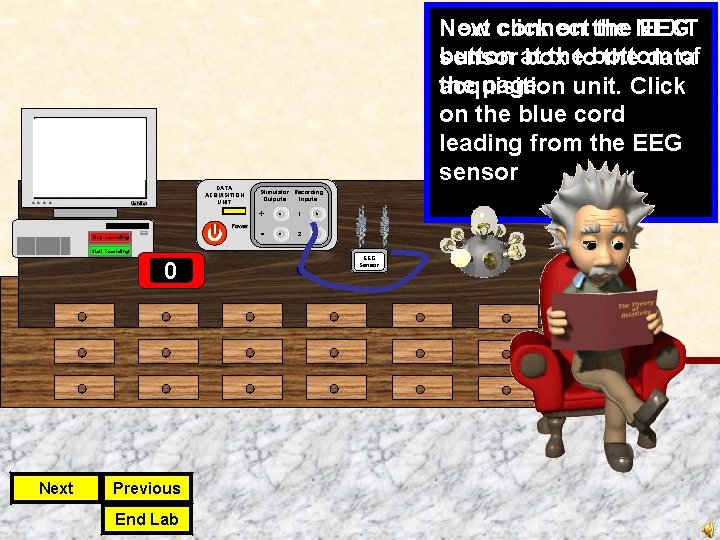
DATA ACQUISITION UNIT Monitor Power Stop Recording Now on the Next click connect the NEXT EEG button thetobottom of sensor at box the data the page unit. Click acquisition on the blue cord leading from the EEG sensor Stimulator Recording Outputs Inputs + 1 2 Start Recording 0 Next Previous End Lab EEG Sensor
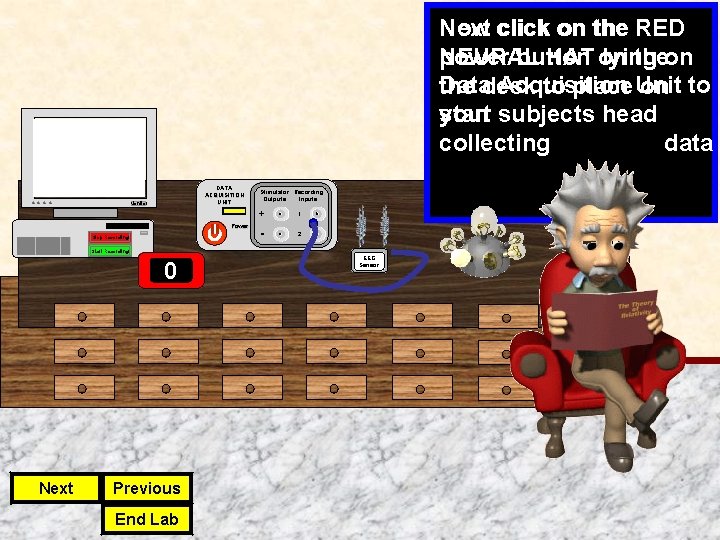
Now Next click on the RED power button theon NEURAL HAT on lying Data Acquisition the desk to place Unit on to start your subjects head collecting data DATA ACQUISITION UNIT Monitor Power Stop Recording Stimulator Recording Outputs Inputs + 1 2 Start Recording 0 Next Previous End Lab EEG Sensor
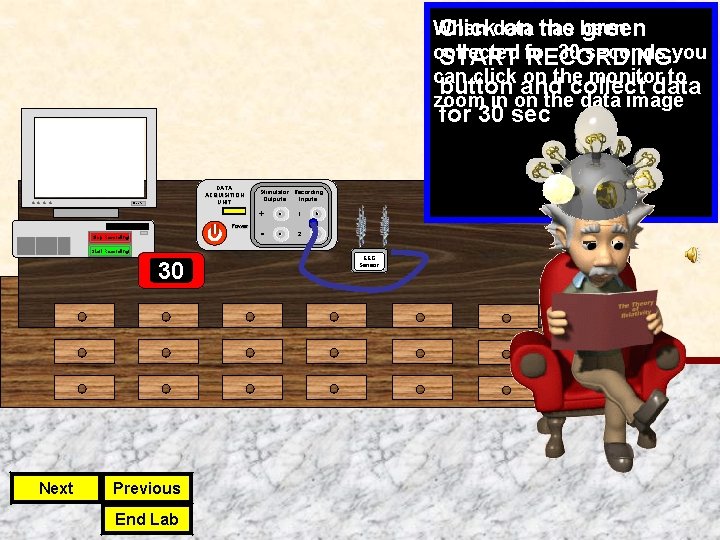
When has been Clickdata on the green collected 30 seconds you START for RECORDING can click on the monitor to button and collect data zoom in on the data image for 30 sec DATA ACQUISITION UNIT Monitor Power Stop Recording Stimulator Recording Outputs Inputs + 1 2 Start Recording 30 25 20 15 10 5 0 Next Previous End Lab EEG Sensor
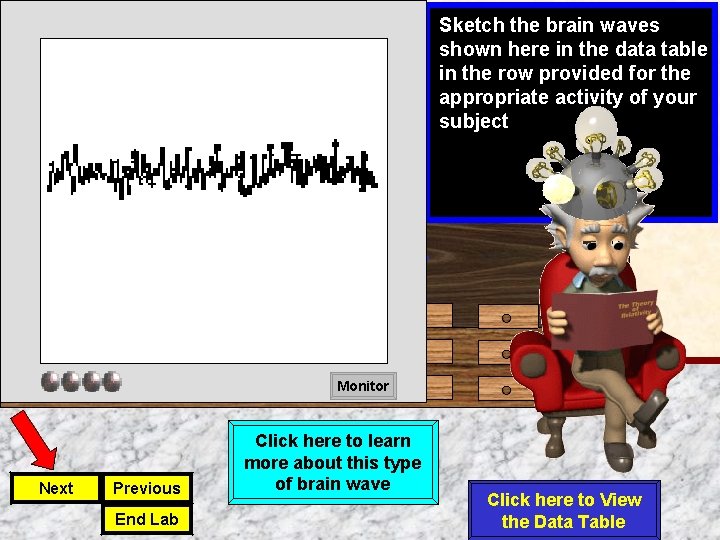
Sketch the brain waves shown here in the data table in the row provided for the appropriate activity of your subject Monitor DATA ACQUISITION UNIT Stimulator Recording Outputs Inputs Power Stop Recording + 1 2 Start Recording EEG Sensor Monitor Next Previous End Lab Click here to learn more about this type of brain wave Click here to View the Data Table
For the next part of the lab we will collect data when our subject has their eyes closed and is relaxed. Click on NEXT DATA ACQUISITION UNIT Monitor Power Stop Recording Stimulator Recording Outputs Inputs + 1 2 Start Recording 30 25 20 15 10 5 0 Next Previous End Lab EEG Sensor
Instruct Next click your on the RED Now Click on subject NEXT attopower the close their button on eyes Data and relax. bottom of the page You can do this Acquisition Unit by clicking on the subject DATA ACQUISITION UNIT Monitor Power Stop Recording Stimulator Recording Outputs Inputs + 1 2 Start Recording 30 25 20 15 10 5 0 Next Previous End Lab EEG Sensor
When has been Clickdata on the green collected 30 seconds you START for RECORDING can click on the monitor to button and collect data zoom in on the data image for 30 sec DATA ACQUISITION UNIT Monitor Power Stop Recording Stimulator Recording Outputs Inputs + 1 2 Start Recording 30 25 20 15 10 5 0 Next Previous End Lab EEG Sensor
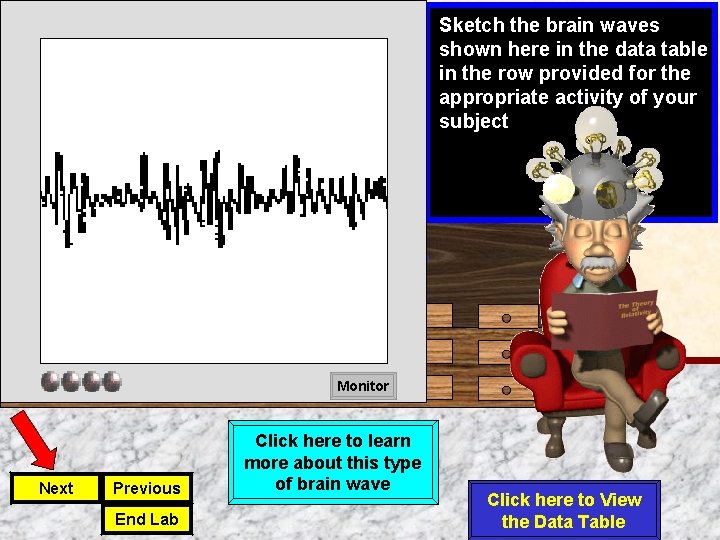
Sketch the brain waves shown here in the data table in the row provided for the appropriate activity of your subject Monitor DATA ACQUISITION UNIT Stimulator Recording Outputs Inputs Power Stop Recording + 1 2 Start Recording EEG Sensor Monitor Next Previous End Lab Click here to learn more about this type of brain wave Click here to View the Data Table
For the next part of the lab we will collect data when our subject is given a very complex problem. Click on NEXT DATA ACQUISITION UNIT Monitor Power Stop Recording Stimulator Recording Outputs Inputs + 1 2 Start Recording 30 25 20 15 10 5 0 Next Previous End Lab EEG Sensor
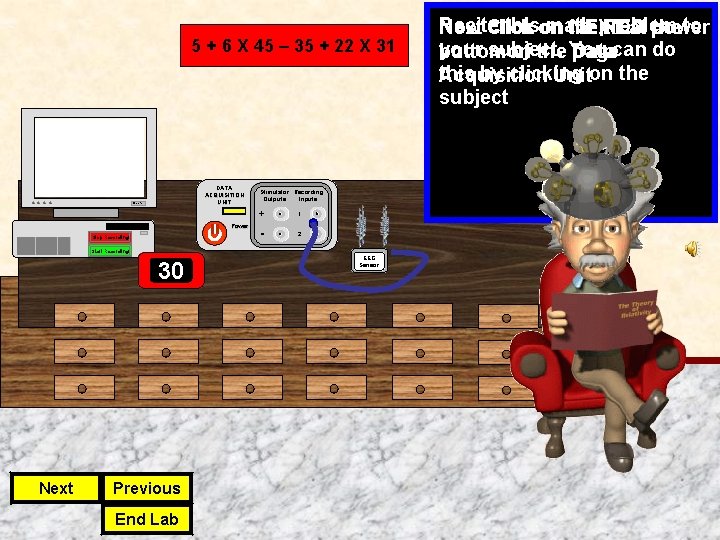
5 + 6 X 45 – 35 + 22 X 31 DATA ACQUISITION UNIT Monitor Power Stop Recording Stimulator Recording Outputs Inputs + 1 2 Start Recording 30 25 20 15 10 5 0 Next Previous End Lab EEG Sensor Recite thison math problem Next click the RED Now Click on NEXT at power the to your subject. button on Data bottom of the You pagecan do this by clicking Acquisition Uniton the subject
When has been Clickdata on the green collected 30 seconds you START for RECORDING can click on the monitor to button and collect data zoom in on the data image for 30 sec DATA ACQUISITION UNIT Monitor Power Stop Recording Stimulator Recording Outputs Inputs + 1 2 Start Recording 30 25 20 15 10 5 0 Next Previous End Lab EEG Sensor
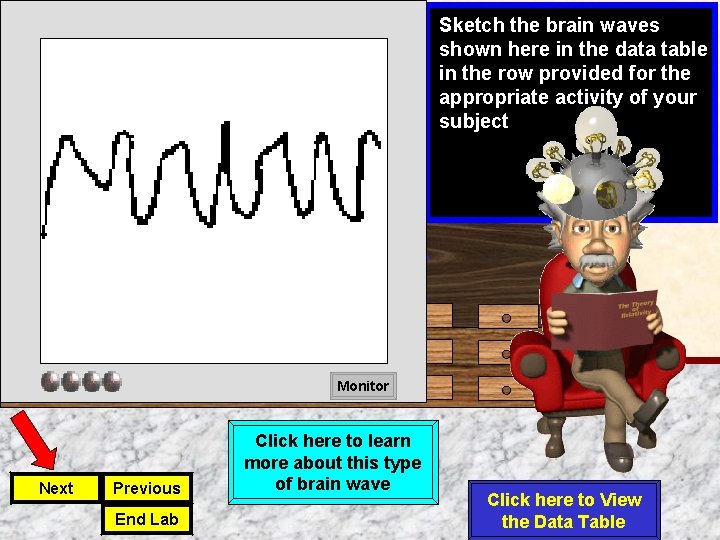
Sketch the brain waves shown here in the data table in the row provided for the appropriate activity of your subject Monitor DATA ACQUISITION UNIT Stimulator Recording Outputs Inputs Power Stop Recording + 1 2 Start Recording EEG Sensor Monitor Next Previous End Lab Click here to learn more about this type of brain wave Click here to View the Data Table
For the next part of the lab we will collect data when our subject is given an emotionally distressing note. Click on NEXT DATA ACQUISITION UNIT Monitor Power Stop Recording Stimulator Recording Outputs Inputs + 1 2 Start Recording 30 25 20 15 10 5 0 Next Previous End Lab EEG Sensor
Give Click your a at the Next click subject on RED Now on the NEXT distressing note. You. Data can power button on the bottom of the page do this by clicking Acquisition Unit on the subject DATA ACQUISITION UNIT Monitor Power Stop Recording Stimulator Recording Outputs Inputs + 1 2 Start Recording 30 25 20 15 10 5 0 Next Previous End Lab EEG Sensor
When has been Clickdata on the green collected 30 seconds you START for RECORDING can click on the monitor to button and collect data zoom in on the data image for 30 sec DATA ACQUISITION UNIT Monitor Power Stop Recording Stimulator Recording Outputs Inputs + 1 2 Start Recording 30 25 20 15 10 5 0 EEG Sensor BAD NEWS Next Previous End Lab
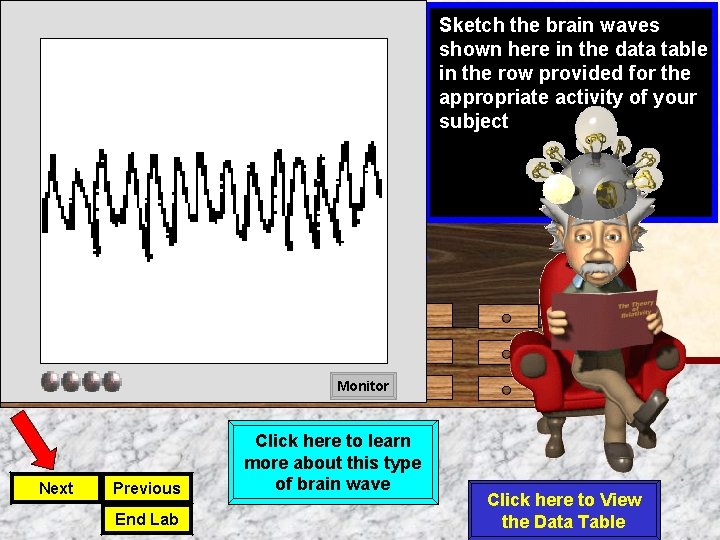
Sketch the brain waves shown here in the data table in the row provided for the appropriate activity of your subject Monitor DATA ACQUISITION UNIT Stimulator Recording Outputs Inputs Power Stop Recording + 1 2 Start Recording EEG Sensor Monitor Next Previous End Lab Click here to learn more about this type of brain wave Click here to View the Data Table
This is the end of the BRAIN WAVE LAB. Be sure that you include in your lab report the following listed items. 1) Brain Wave Data Table 2) Answers to Questions Monitor DATA ACQUISITION UNIT Stimulator Recording Outputs Inputs Power Stop Recording + 1 2 Start Recording Click here to view a printable DATA TABLE for Brain Waves Click here if you would like to review the INTRODUCTION Next Previous End Lab EEG Sensor Click here to view a printable list of QUESTIONS for Brain Waves If you are finished with this lab you can click here to END the lab Click here to start the DATA COLLECTION again

END LAB
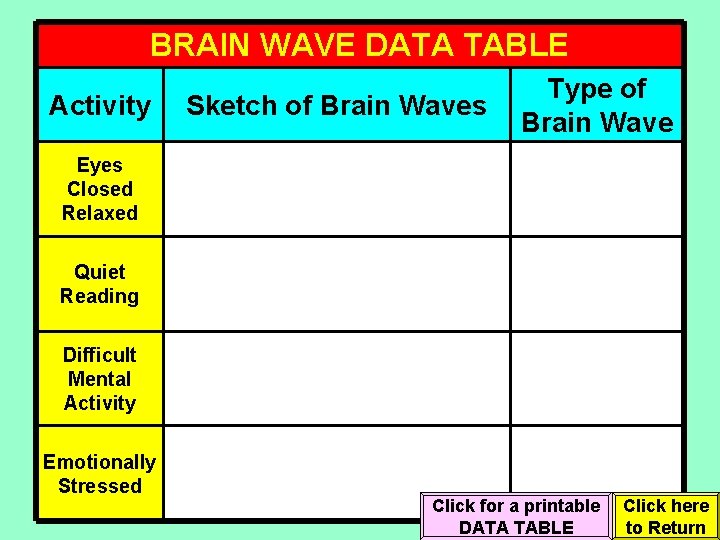
BRAIN WAVE DATA TABLE Activity Sketch of Brain Waves Type of Brain Wave Eyes Closed Relaxed Quiet Reading Difficult Mental Activity Emotionally Stressed Click for a printable DATA TABLE Click here to Return
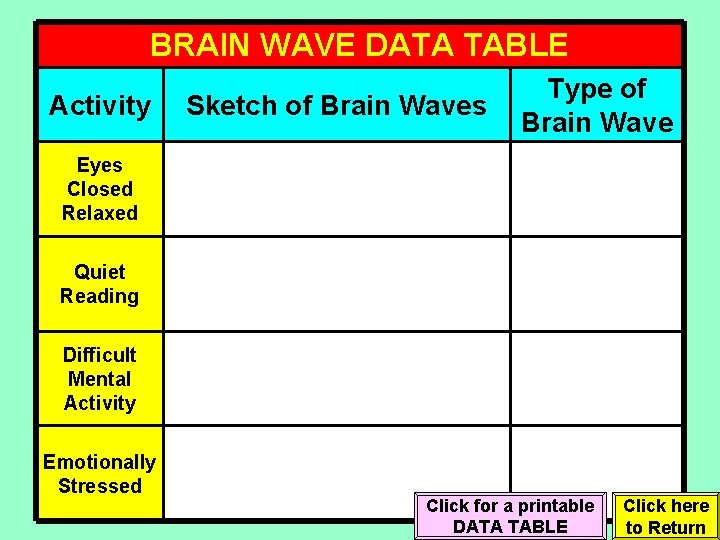
BRAIN WAVE DATA TABLE Activity Sketch of Brain Waves Type of Brain Wave Eyes Closed Relaxed Quiet Reading Difficult Mental Activity Emotionally Stressed Click for a printable DATA TABLE Click here to Return
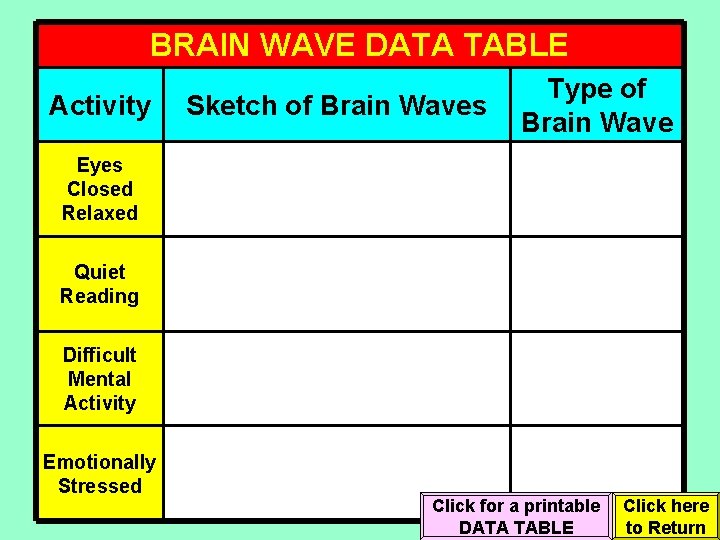
BRAIN WAVE DATA TABLE Activity Sketch of Brain Waves Type of Brain Wave Eyes Closed Relaxed Quiet Reading Difficult Mental Activity Emotionally Stressed Click for a printable DATA TABLE Click here to Return
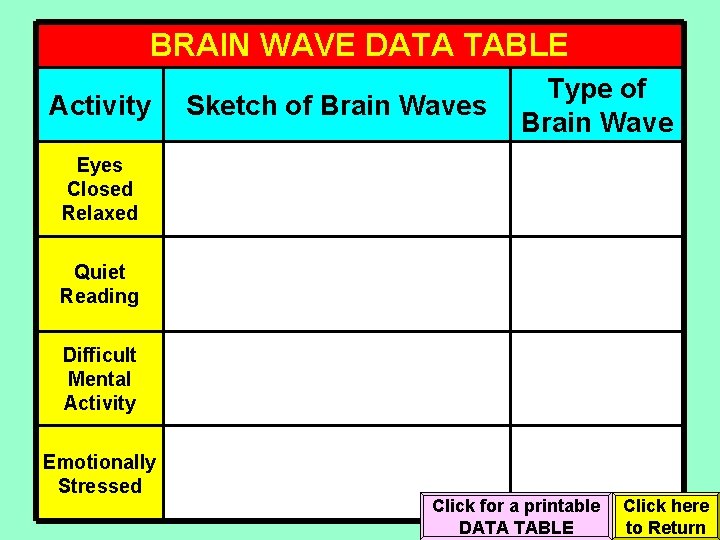
BRAIN WAVE DATA TABLE Activity Sketch of Brain Waves Type of Brain Wave Eyes Closed Relaxed Quiet Reading Difficult Mental Activity Emotionally Stressed Click for a printable DATA TABLE Click here to Return
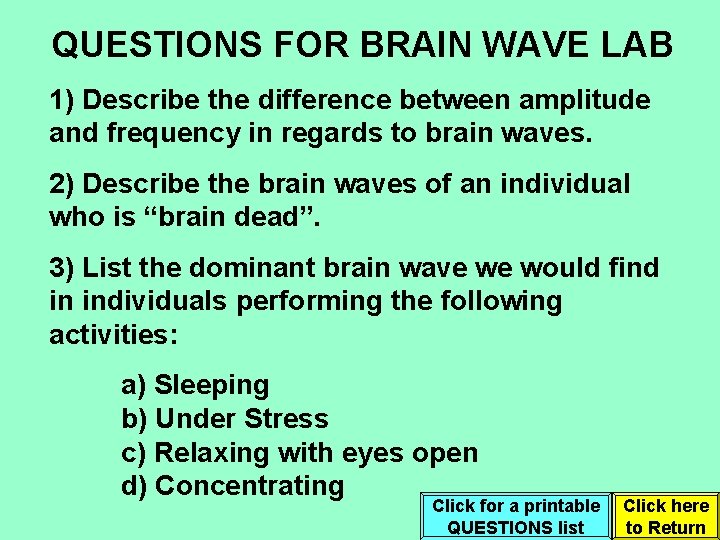
QUESTIONS FOR BRAIN WAVE LAB 1) Describe the difference between amplitude and frequency in regards to brain waves. 2) Describe the brain waves of an individual who is “brain dead”. 3) List the dominant brain wave we would find in individuals performing the following activities: a) Sleeping b) Under Stress c) Relaxing with eyes open d) Concentrating Click for a printable QUESTIONS list Click here to Return

INTRO WAVE INFO
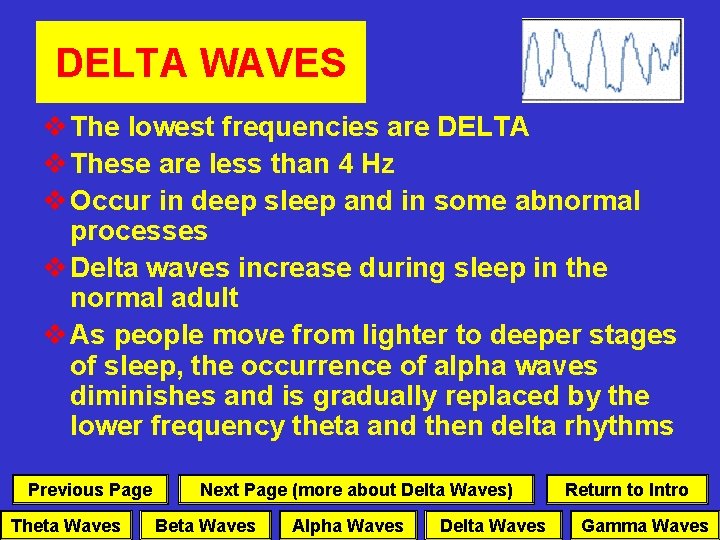
DELTA WAVES v The lowest frequencies are DELTA v These are less than 4 Hz v Occur in deep sleep and in some abnormal processes v Delta waves increase during sleep in the normal adult v As people move from lighter to deeper stages of sleep, the occurrence of alpha waves diminishes and is gradually replaced by the lower frequency theta and then delta rhythms Previous Page Theta Waves Next Page (more about Delta Waves) Beta Waves Alpha Waves Delta Waves Return to Intro Gamma Waves
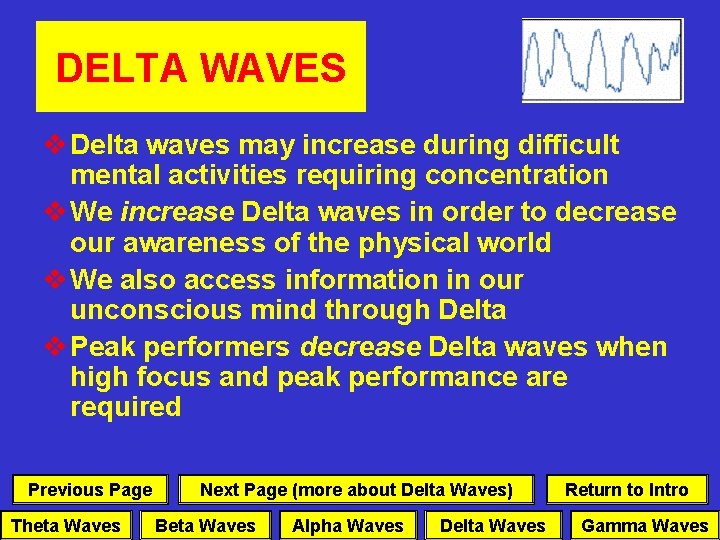
DELTA WAVES v Delta waves may increase during difficult mental activities requiring concentration v We increase Delta waves in order to decrease our awareness of the physical world v We also access information in our unconscious mind through Delta v Peak performers decrease Delta waves when high focus and peak performance are required Previous Page Theta Waves Next Page (more about Delta Waves) Beta Waves Alpha Waves Delta Waves Return to Intro Gamma Waves
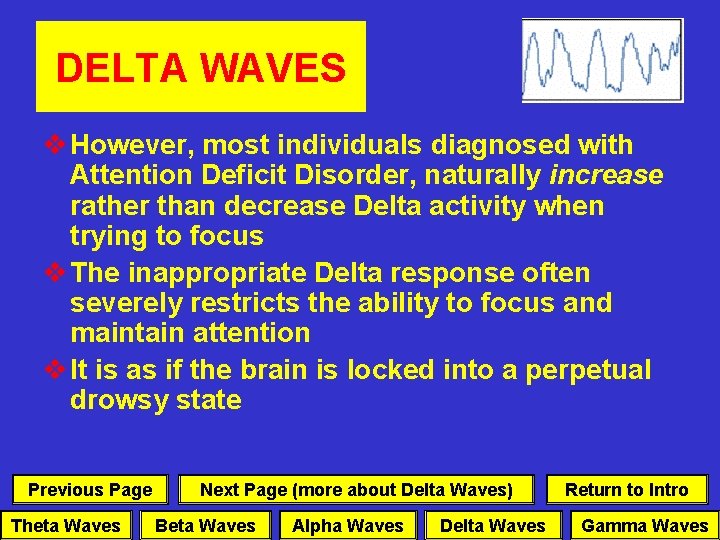
DELTA WAVES v However, most individuals diagnosed with Attention Deficit Disorder, naturally increase rather than decrease Delta activity when trying to focus v The inappropriate Delta response often severely restricts the ability to focus and maintain attention v It is as if the brain is locked into a perpetual drowsy state Previous Page Theta Waves Next Page (more about Delta Waves) Beta Waves Alpha Waves Delta Waves Return to Intro Gamma Waves
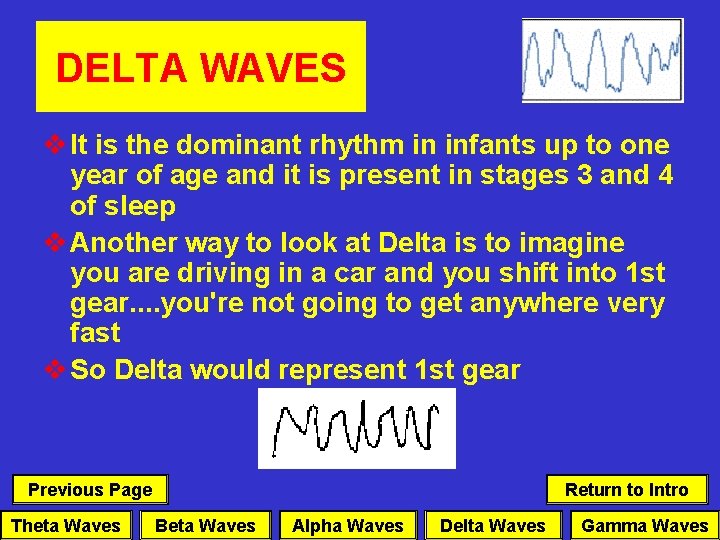
DELTA WAVES v It is the dominant rhythm in infants up to one year of age and it is present in stages 3 and 4 of sleep v Another way to look at Delta is to imagine you are driving in a car and you shift into 1 st gear. . you're not going to get anywhere very fast v So Delta would represent 1 st gear Previous Page Theta Waves Return to Intro Beta Waves Alpha Waves Delta Waves Gamma Waves
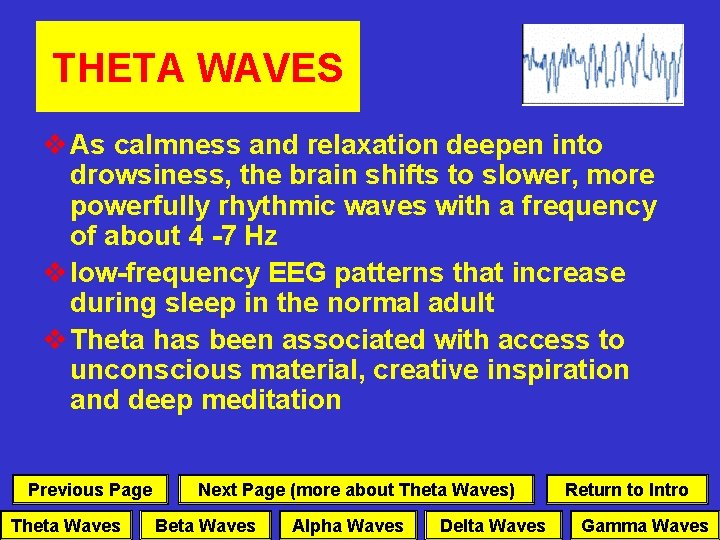
THETA WAVES v As calmness and relaxation deepen into drowsiness, the brain shifts to slower, more powerfully rhythmic waves with a frequency of about 4 7 Hz v low frequency EEG patterns that increase during sleep in the normal adult v Theta has been associated with access to unconscious material, creative inspiration and deep meditation Previous Page Theta Waves Next Page (more about Theta Waves) Beta Waves Alpha Waves Delta Waves Return to Intro Gamma Waves
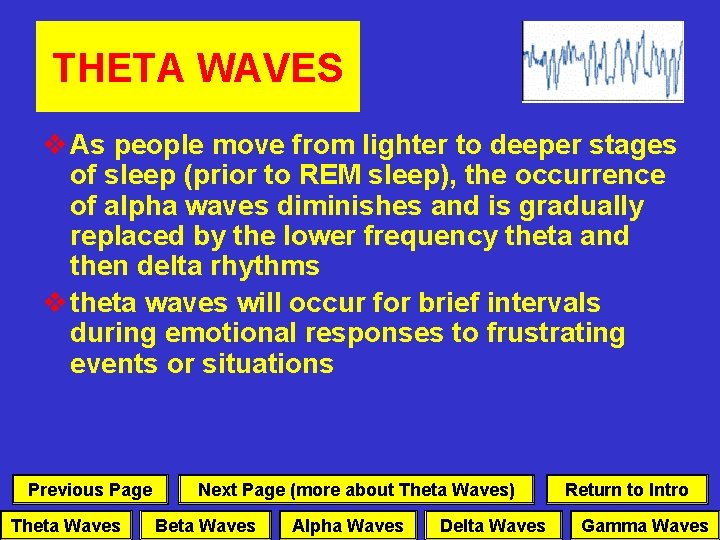
THETA WAVES v As people move from lighter to deeper stages of sleep (prior to REM sleep), the occurrence of alpha waves diminishes and is gradually replaced by the lower frequency theta and then delta rhythms v theta waves will occur for brief intervals during emotional responses to frustrating events or situations Previous Page Theta Waves Next Page (more about Theta Waves) Beta Waves Alpha Waves Delta Waves Return to Intro Gamma Waves
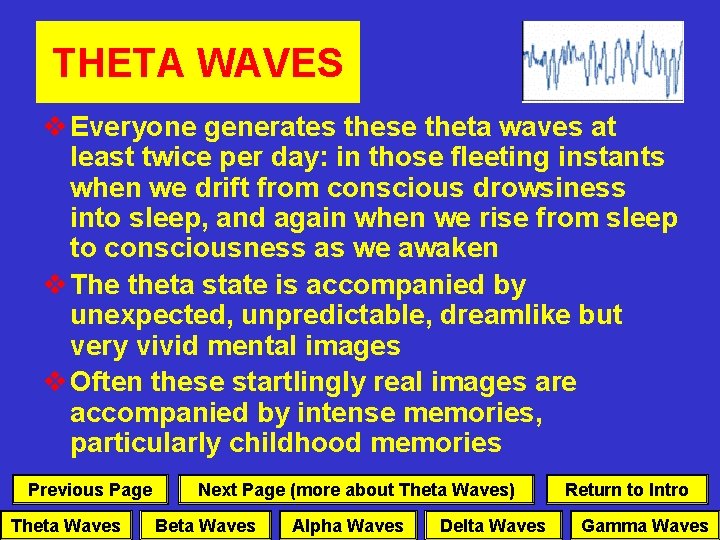
THETA WAVES v Everyone generates these theta waves at least twice per day: in those fleeting instants when we drift from conscious drowsiness into sleep, and again when we rise from sleep to consciousness as we awaken v The theta state is accompanied by unexpected, unpredictable, dreamlike but very vivid mental images v Often these startlingly real images are accompanied by intense memories, particularly childhood memories Previous Page Theta Waves Next Page (more about Theta Waves) Beta Waves Alpha Waves Delta Waves Return to Intro Gamma Waves
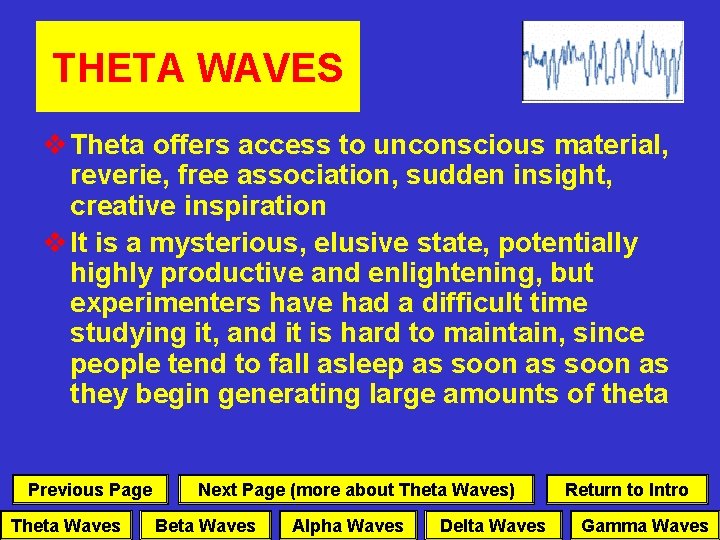
THETA WAVES v Theta offers access to unconscious material, reverie, free association, sudden insight, creative inspiration v It is a mysterious, elusive state, potentially highly productive and enlightening, but experimenters have had a difficult time studying it, and it is hard to maintain, since people tend to fall asleep as soon as they begin generating large amounts of theta Previous Page Theta Waves Next Page (more about Theta Waves) Beta Waves Alpha Waves Delta Waves Return to Intro Gamma Waves
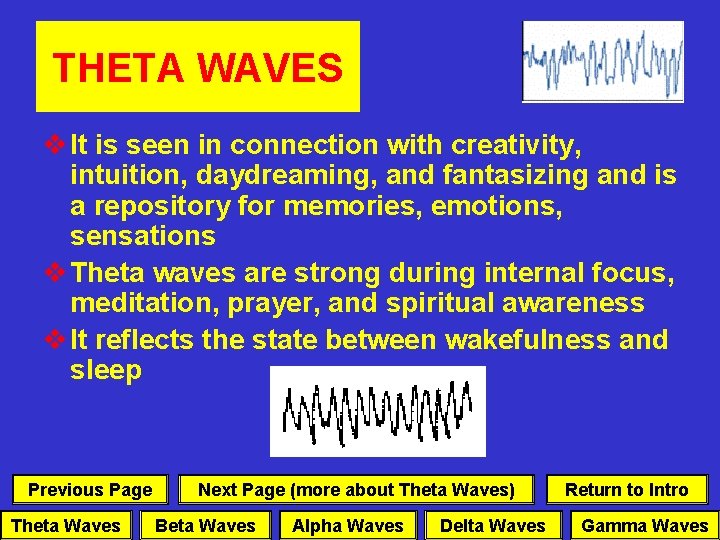
THETA WAVES v It is seen in connection with creativity, intuition, daydreaming, and fantasizing and is a repository for memories, emotions, sensations v Theta waves are strong during internal focus, meditation, prayer, and spiritual awareness v It reflects the state between wakefulness and sleep Previous Page Theta Waves Next Page (more about Theta Waves) Beta Waves Alpha Waves Delta Waves Return to Intro Gamma Waves
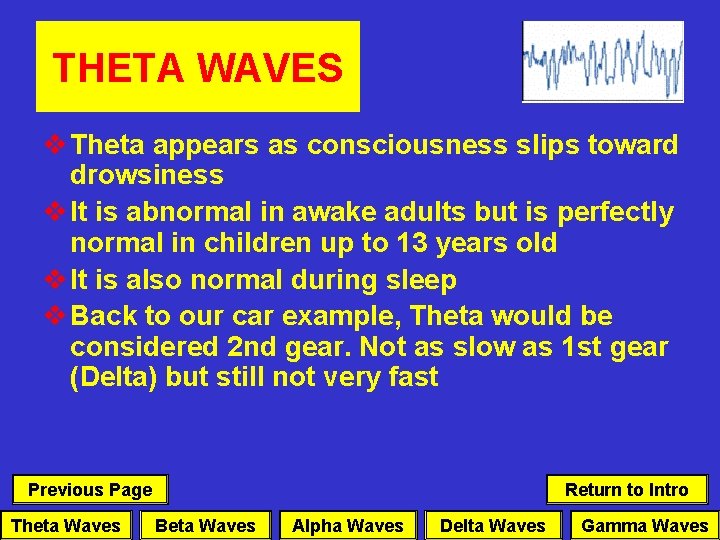
THETA WAVES v Theta appears as consciousness slips toward drowsiness v It is abnormal in awake adults but is perfectly normal in children up to 13 years old v It is also normal during sleep v Back to our car example, Theta would be considered 2 nd gear. Not as slow as 1 st gear (Delta) but still not very fast Previous Page Theta Waves Return to Intro Beta Waves Alpha Waves Delta Waves Gamma Waves
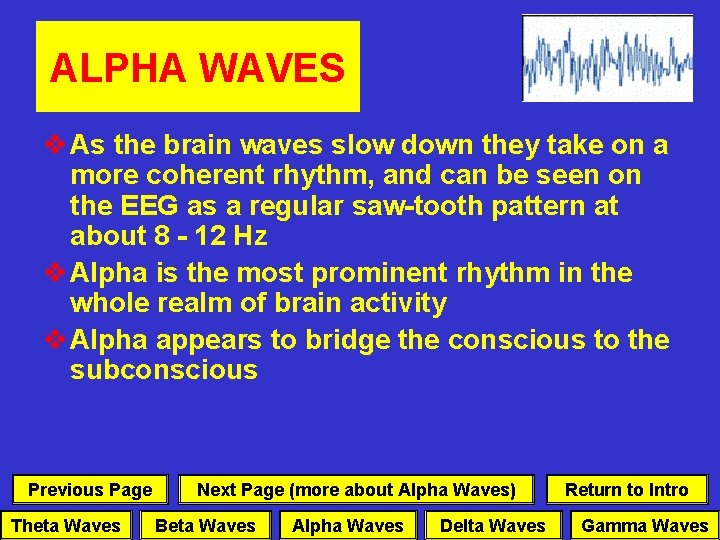
ALPHA WAVES v As the brain waves slow down they take on a more coherent rhythm, and can be seen on the EEG as a regular saw tooth pattern at about 8 12 Hz v Alpha is the most prominent rhythm in the whole realm of brain activity v Alpha appears to bridge the conscious to the subconscious Previous Page Theta Waves Next Page (more about Alpha Waves) Beta Waves Alpha Waves Delta Waves Return to Intro Gamma Waves
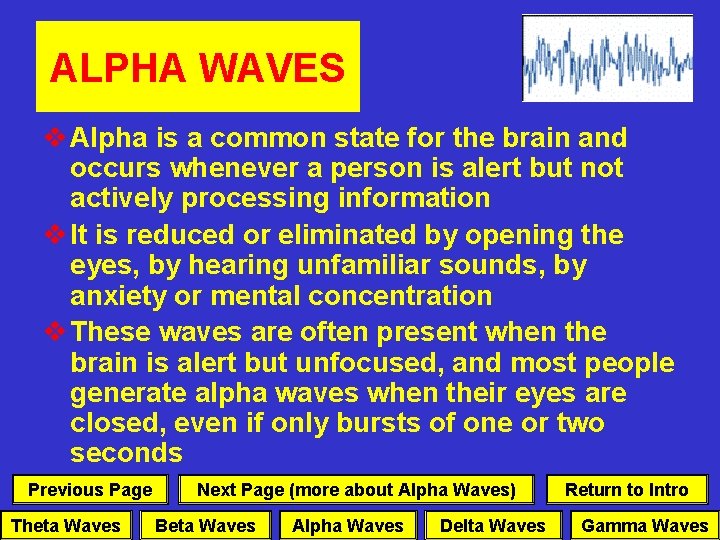
ALPHA WAVES v Alpha is a common state for the brain and occurs whenever a person is alert but not actively processing information v It is reduced or eliminated by opening the eyes, by hearing unfamiliar sounds, by anxiety or mental concentration v These waves are often present when the brain is alert but unfocused, and most people generate alpha waves when their eyes are closed, even if only bursts of one or two seconds Previous Page Theta Waves Next Page (more about Alpha Waves) Beta Waves Alpha Waves Delta Waves Return to Intro Gamma Waves
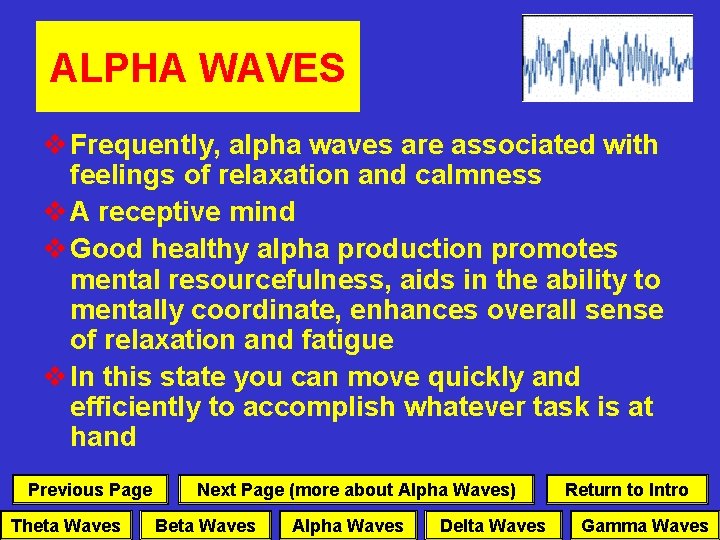
ALPHA WAVES v Frequently, alpha waves are associated with feelings of relaxation and calmness v A receptive mind v Good healthy alpha production promotes mental resourcefulness, aids in the ability to mentally coordinate, enhances overall sense of relaxation and fatigue v In this state you can move quickly and efficiently to accomplish whatever task is at hand Previous Page Theta Waves Next Page (more about Alpha Waves) Beta Waves Alpha Waves Delta Waves Return to Intro Gamma Waves
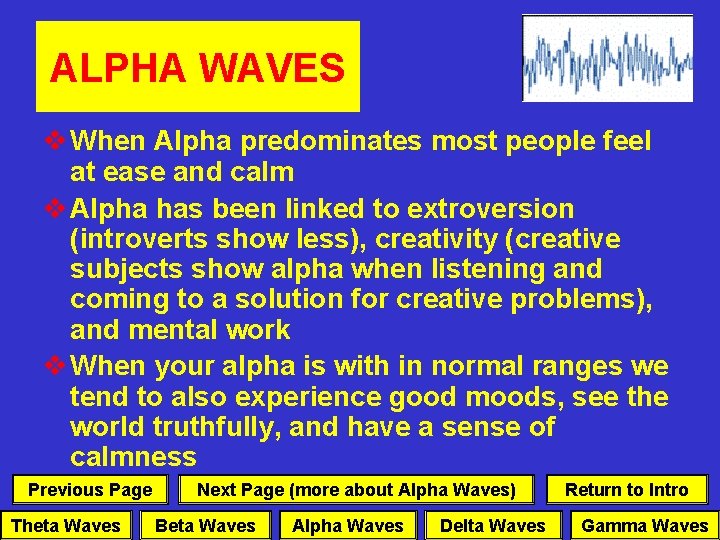
ALPHA WAVES v When Alpha predominates most people feel at ease and calm v Alpha has been linked to extroversion (introverts show less), creativity (creative subjects show alpha when listening and coming to a solution for creative problems), and mental work v When your alpha is with in normal ranges we tend to also experience good moods, see the world truthfully, and have a sense of calmness Previous Page Theta Waves Next Page (more about Alpha Waves) Beta Waves Alpha Waves Delta Waves Return to Intro Gamma Waves
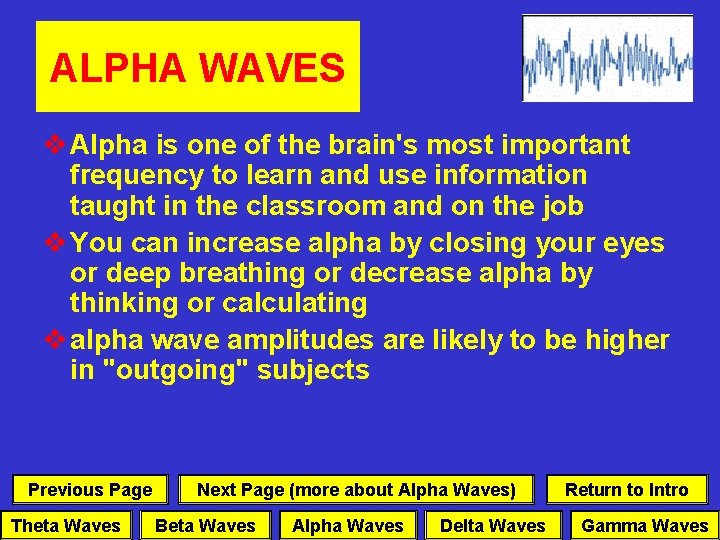
ALPHA WAVES v Alpha is one of the brain's most important frequency to learn and use information taught in the classroom and on the job v You can increase alpha by closing your eyes or deep breathing or decrease alpha by thinking or calculating v alpha wave amplitudes are likely to be higher in "outgoing" subjects Previous Page Theta Waves Next Page (more about Alpha Waves) Beta Waves Alpha Waves Delta Waves Return to Intro Gamma Waves
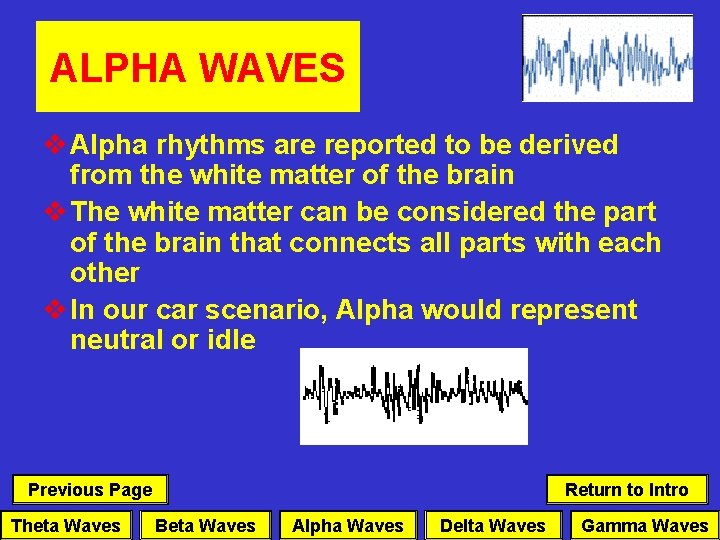
ALPHA WAVES v Alpha rhythms are reported to be derived from the white matter of the brain v The white matter can be considered the part of the brain that connects all parts with each other v In our car scenario, Alpha would represent neutral or idle Previous Page Theta Waves Return to Intro Beta Waves Alpha Waves Delta Waves Gamma Waves
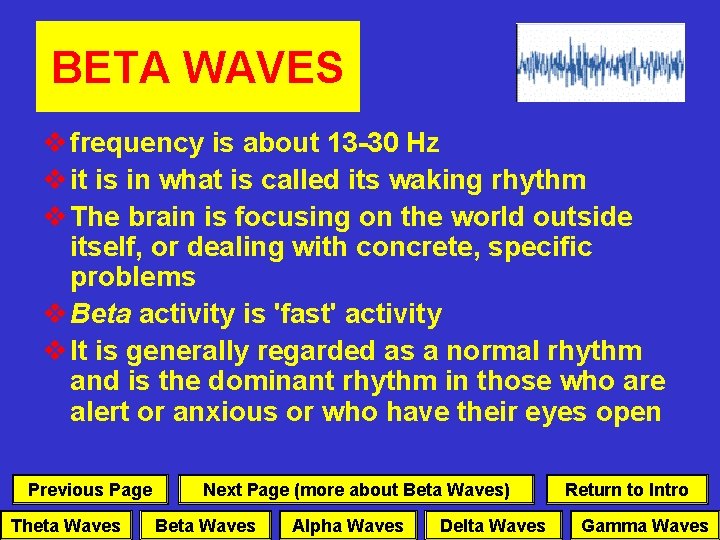
BETA WAVES v frequency is about 13 30 Hz v it is in what is called its waking rhythm v The brain is focusing on the world outside itself, or dealing with concrete, specific problems v Beta activity is 'fast' activity v It is generally regarded as a normal rhythm and is the dominant rhythm in those who are alert or anxious or who have their eyes open Previous Page Theta Waves Next Page (more about Beta Waves) Beta Waves Alpha Waves Delta Waves Return to Intro Gamma Waves
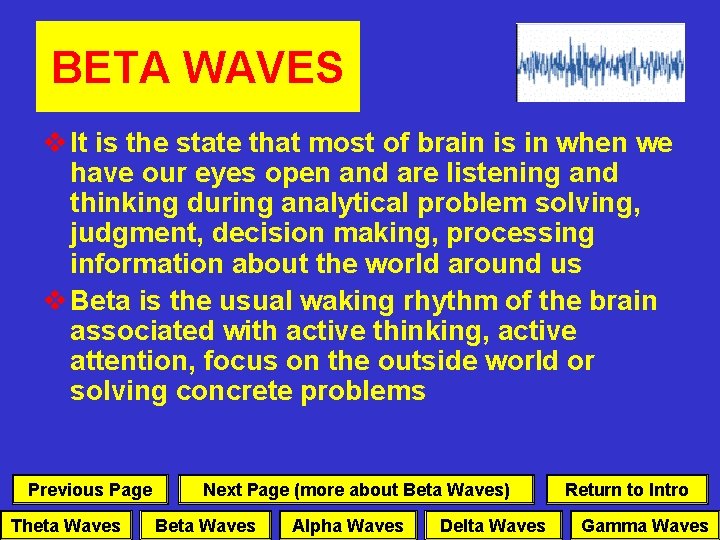
BETA WAVES v It is the state that most of brain is in when we have our eyes open and are listening and thinking during analytical problem solving, judgment, decision making, processing information about the world around us v Beta is the usual waking rhythm of the brain associated with active thinking, active attention, focus on the outside world or solving concrete problems Previous Page Theta Waves Next Page (more about Beta Waves) Beta Waves Alpha Waves Delta Waves Return to Intro Gamma Waves
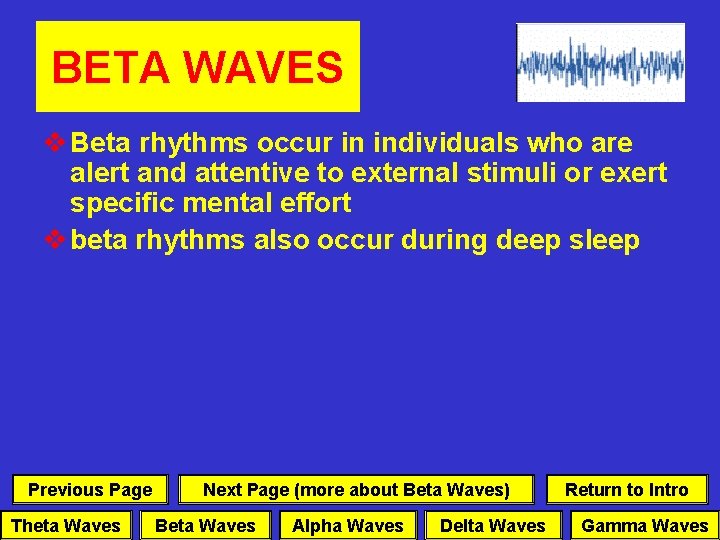
BETA WAVES v Beta rhythms occur in individuals who are alert and attentive to external stimuli or exert specific mental effort v beta rhythms also occur during deep sleep Previous Page Theta Waves Next Page (more about Beta Waves) Beta Waves Alpha Waves Delta Waves Return to Intro Gamma Waves
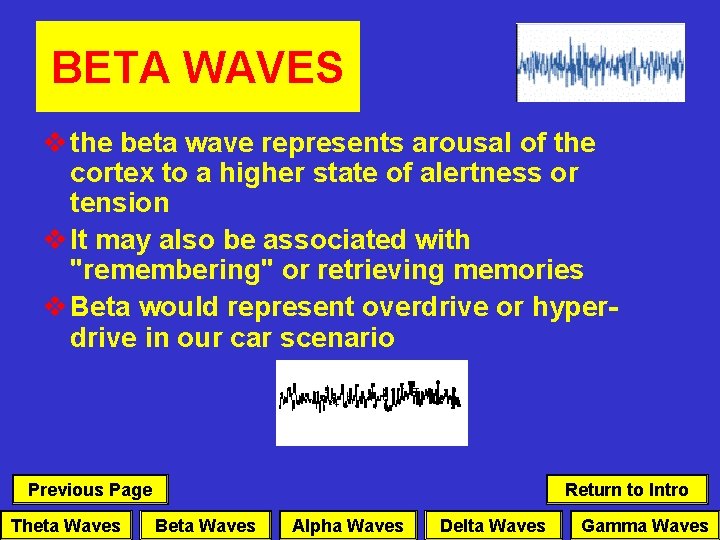
BETA WAVES v the beta wave represents arousal of the cortex to a higher state of alertness or tension v It may also be associated with "remembering" or retrieving memories v Beta would represent overdrive or hyper drive in our car scenario Previous Page Theta Waves Return to Intro Beta Waves Alpha Waves Delta Waves Gamma Waves
GAMMA WAVES v Gamma is measured between 36 44 (Hz) v When the brain needs to simultaneously process information from different areas, its hypothesized that Gamma wave activity consolidates the required areas for simultaneous processing Previous Page Theta Waves Next Page (more about Gamma Waves) Beta Waves Alpha Waves Delta Waves Return to Intro Gamma Waves
GAMMA WAVES v A good memory is associated with well regulated and efficient Gamma waves v whereas Gamma wave deficiency creates learning disabilities v Gamma waves predominate when we are “thinking” Previous Page Theta Waves Return to Intro Beta Waves Alpha Waves Delta Waves Gamma Waves

LAB WAVE INFO
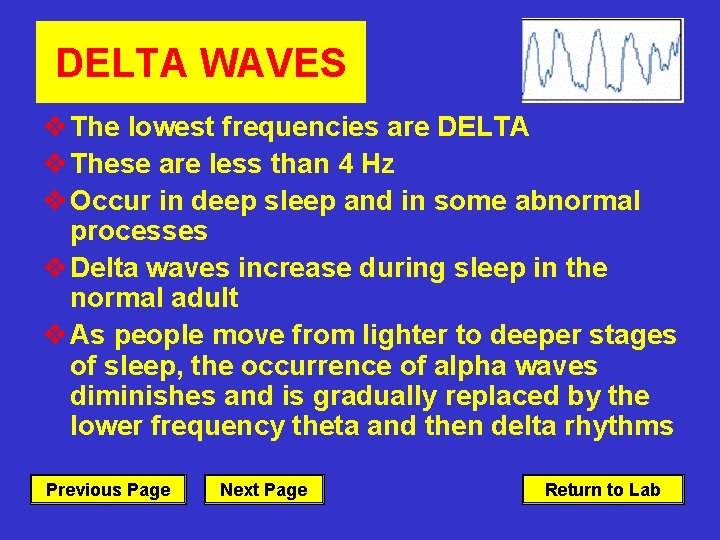
DELTA WAVES v The lowest frequencies are DELTA v These are less than 4 Hz v Occur in deep sleep and in some abnormal processes v Delta waves increase during sleep in the normal adult v As people move from lighter to deeper stages of sleep, the occurrence of alpha waves diminishes and is gradually replaced by the lower frequency theta and then delta rhythms Previous Page Next Page Return to Lab
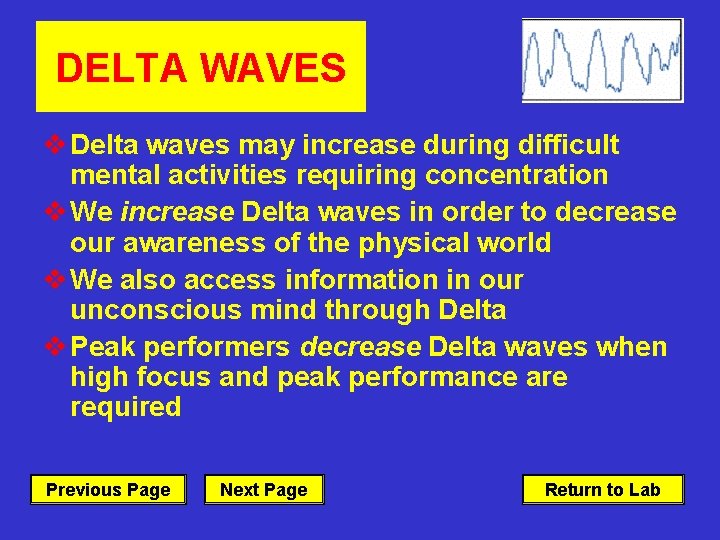
DELTA WAVES v Delta waves may increase during difficult mental activities requiring concentration v We increase Delta waves in order to decrease our awareness of the physical world v We also access information in our unconscious mind through Delta v Peak performers decrease Delta waves when high focus and peak performance are required Previous Page Next Page Return to Lab
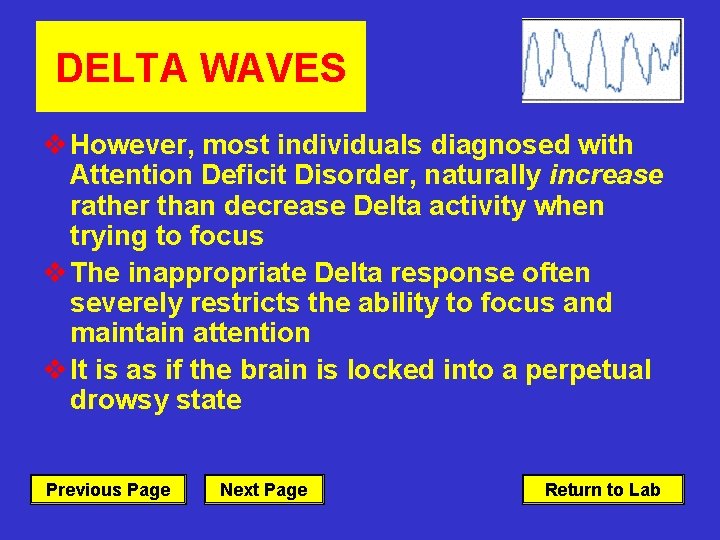
DELTA WAVES v However, most individuals diagnosed with Attention Deficit Disorder, naturally increase rather than decrease Delta activity when trying to focus v The inappropriate Delta response often severely restricts the ability to focus and maintain attention v It is as if the brain is locked into a perpetual drowsy state Previous Page Next Page Return to Lab
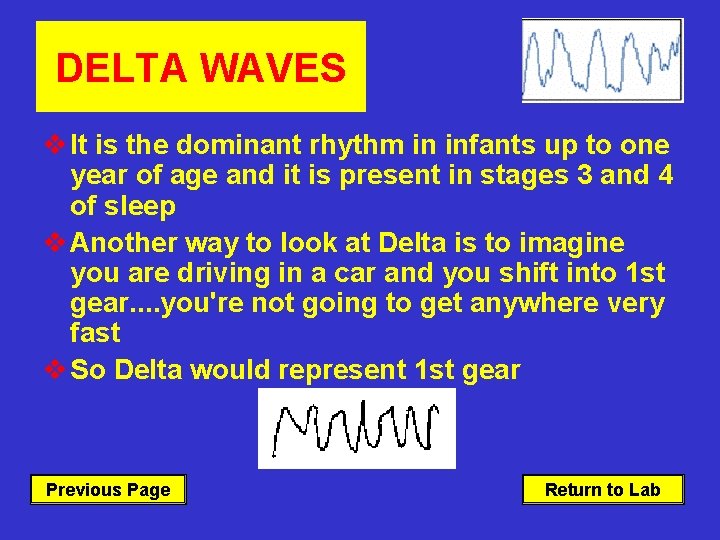
DELTA WAVES v It is the dominant rhythm in infants up to one year of age and it is present in stages 3 and 4 of sleep v Another way to look at Delta is to imagine you are driving in a car and you shift into 1 st gear. . you're not going to get anywhere very fast v So Delta would represent 1 st gear Previous Page Return to Lab
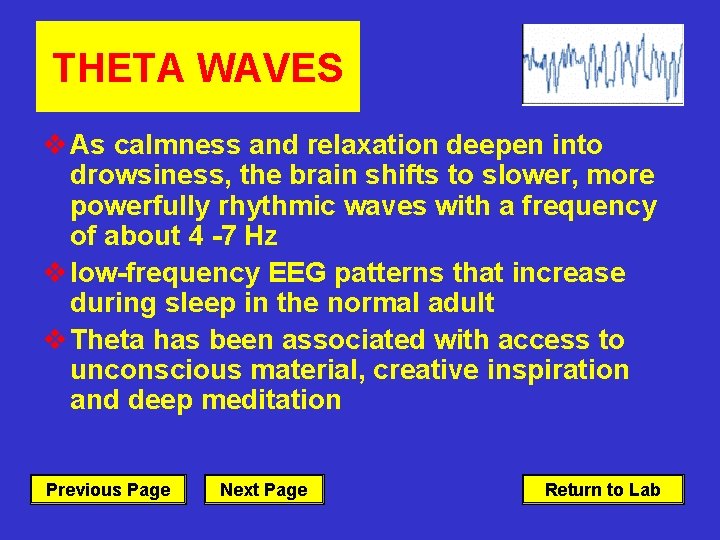
THETA WAVES v As calmness and relaxation deepen into drowsiness, the brain shifts to slower, more powerfully rhythmic waves with a frequency of about 4 7 Hz v low frequency EEG patterns that increase during sleep in the normal adult v Theta has been associated with access to unconscious material, creative inspiration and deep meditation Previous Page Next Page Return to Lab
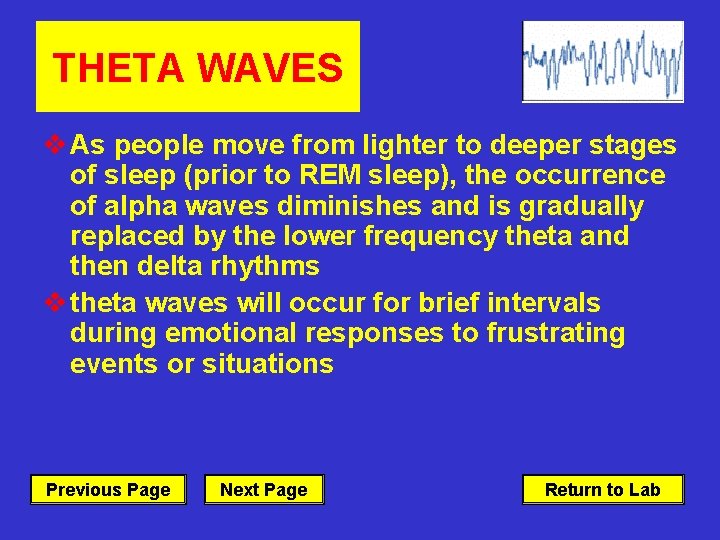
THETA WAVES v As people move from lighter to deeper stages of sleep (prior to REM sleep), the occurrence of alpha waves diminishes and is gradually replaced by the lower frequency theta and then delta rhythms v theta waves will occur for brief intervals during emotional responses to frustrating events or situations Previous Page Next Page Return to Lab
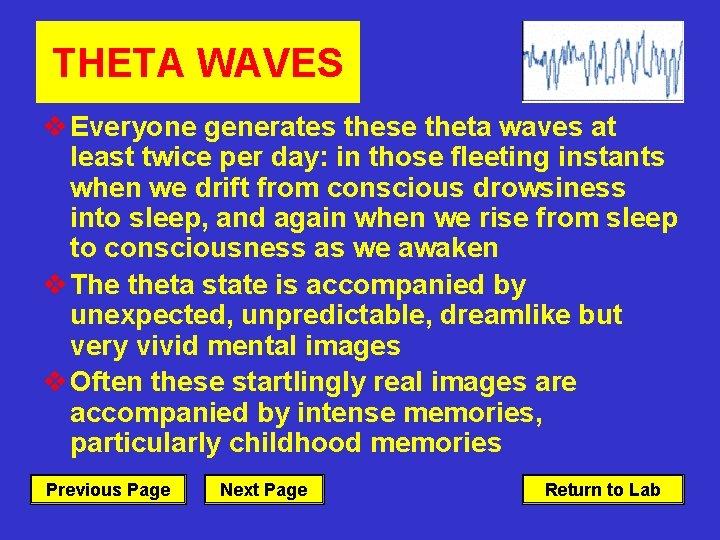
THETA WAVES v Everyone generates these theta waves at least twice per day: in those fleeting instants when we drift from conscious drowsiness into sleep, and again when we rise from sleep to consciousness as we awaken v The theta state is accompanied by unexpected, unpredictable, dreamlike but very vivid mental images v Often these startlingly real images are accompanied by intense memories, particularly childhood memories Previous Page Next Page Return to Lab
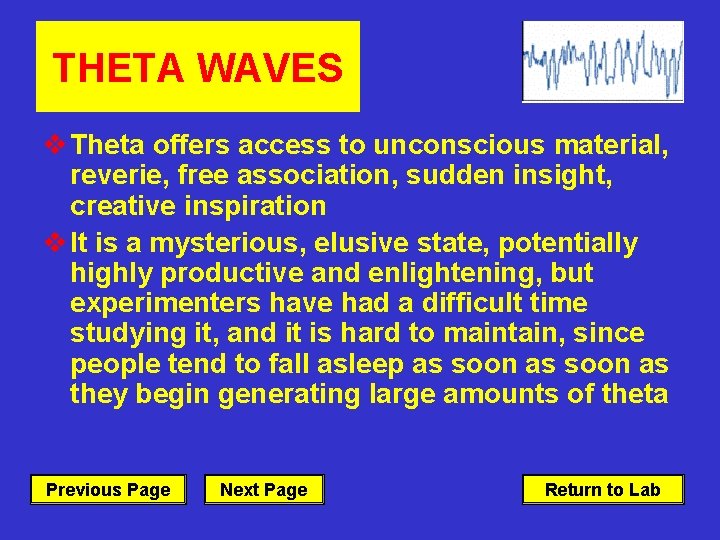
THETA WAVES v Theta offers access to unconscious material, reverie, free association, sudden insight, creative inspiration v It is a mysterious, elusive state, potentially highly productive and enlightening, but experimenters have had a difficult time studying it, and it is hard to maintain, since people tend to fall asleep as soon as they begin generating large amounts of theta Previous Page Next Page Return to Lab
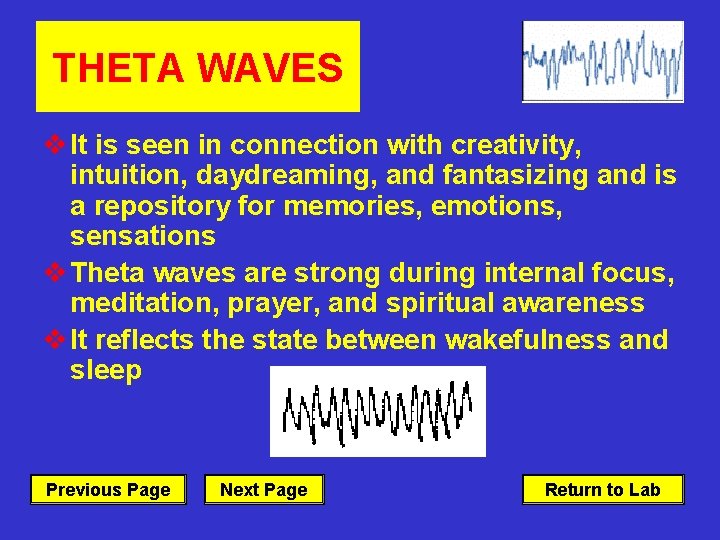
THETA WAVES v It is seen in connection with creativity, intuition, daydreaming, and fantasizing and is a repository for memories, emotions, sensations v Theta waves are strong during internal focus, meditation, prayer, and spiritual awareness v It reflects the state between wakefulness and sleep Previous Page Next Page Return to Lab
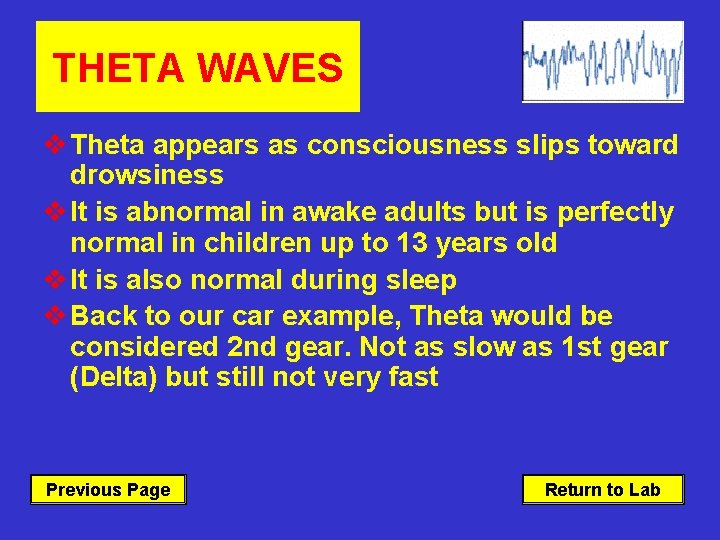
THETA WAVES v Theta appears as consciousness slips toward drowsiness v It is abnormal in awake adults but is perfectly normal in children up to 13 years old v It is also normal during sleep v Back to our car example, Theta would be considered 2 nd gear. Not as slow as 1 st gear (Delta) but still not very fast Previous Page Return to Lab
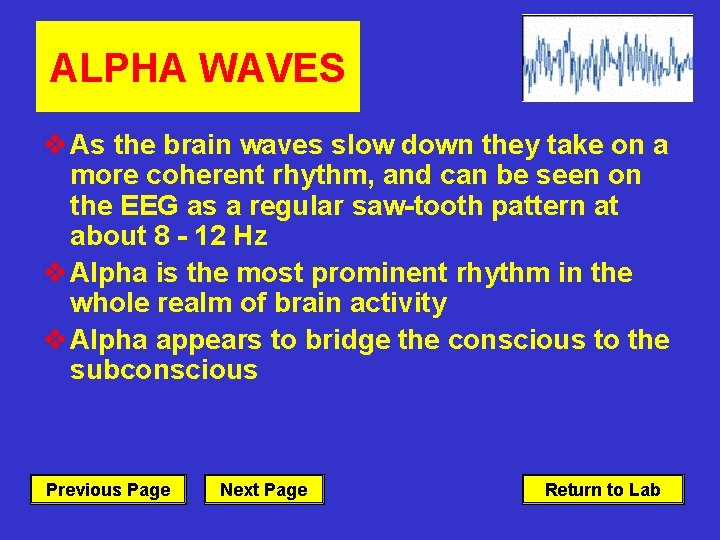
ALPHA WAVES v As the brain waves slow down they take on a more coherent rhythm, and can be seen on the EEG as a regular saw tooth pattern at about 8 12 Hz v Alpha is the most prominent rhythm in the whole realm of brain activity v Alpha appears to bridge the conscious to the subconscious Previous Page Next Page Return to Lab
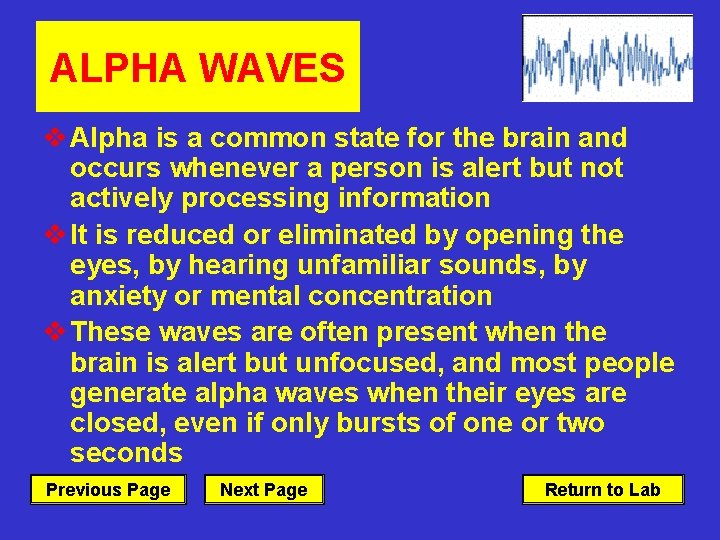
ALPHA WAVES v Alpha is a common state for the brain and occurs whenever a person is alert but not actively processing information v It is reduced or eliminated by opening the eyes, by hearing unfamiliar sounds, by anxiety or mental concentration v These waves are often present when the brain is alert but unfocused, and most people generate alpha waves when their eyes are closed, even if only bursts of one or two seconds Previous Page Next Page Return to Lab
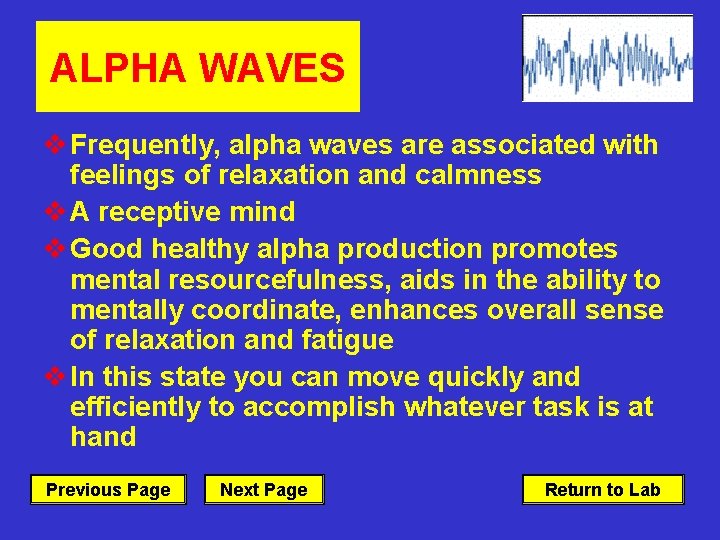
ALPHA WAVES v Frequently, alpha waves are associated with feelings of relaxation and calmness v A receptive mind v Good healthy alpha production promotes mental resourcefulness, aids in the ability to mentally coordinate, enhances overall sense of relaxation and fatigue v In this state you can move quickly and efficiently to accomplish whatever task is at hand Previous Page Next Page Return to Lab
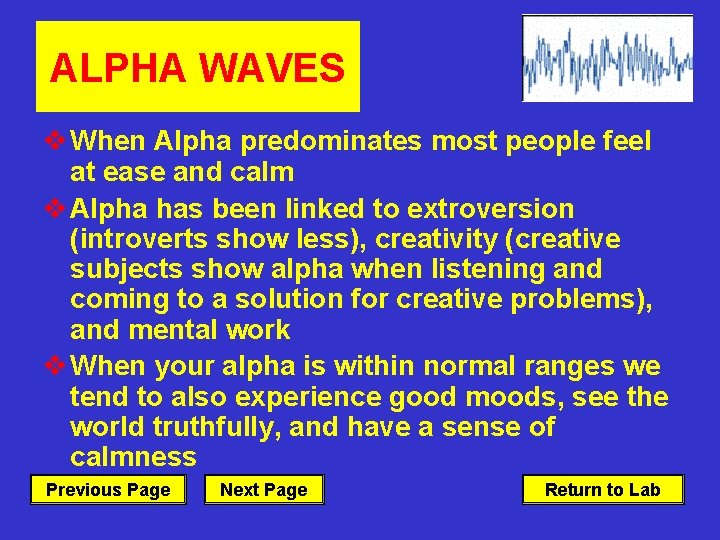
ALPHA WAVES v When Alpha predominates most people feel at ease and calm v Alpha has been linked to extroversion (introverts show less), creativity (creative subjects show alpha when listening and coming to a solution for creative problems), and mental work v When your alpha is within normal ranges we tend to also experience good moods, see the world truthfully, and have a sense of calmness Previous Page Next Page Return to Lab
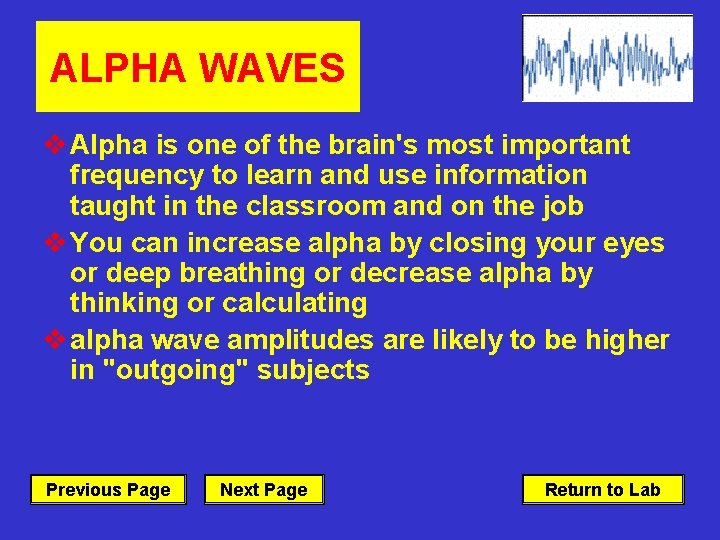
ALPHA WAVES v Alpha is one of the brain's most important frequency to learn and use information taught in the classroom and on the job v You can increase alpha by closing your eyes or deep breathing or decrease alpha by thinking or calculating v alpha wave amplitudes are likely to be higher in "outgoing" subjects Previous Page Next Page Return to Lab
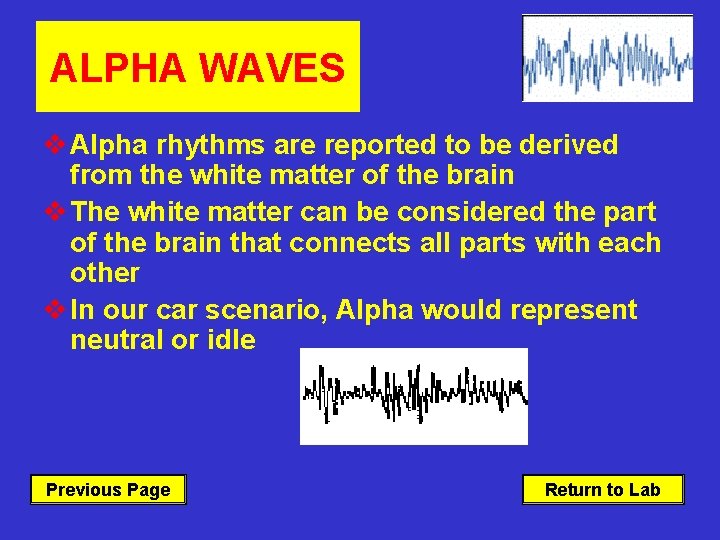
ALPHA WAVES v Alpha rhythms are reported to be derived from the white matter of the brain v The white matter can be considered the part of the brain that connects all parts with each other v In our car scenario, Alpha would represent neutral or idle Previous Page Return to Lab
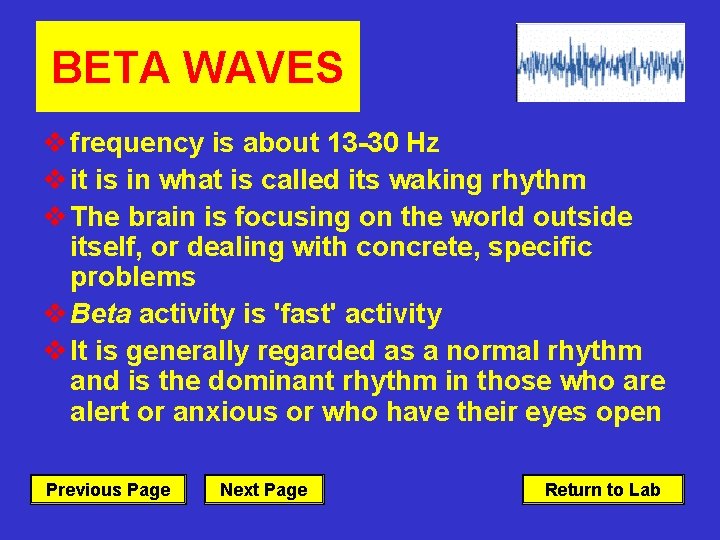
BETA WAVES v frequency is about 13 30 Hz v it is in what is called its waking rhythm v The brain is focusing on the world outside itself, or dealing with concrete, specific problems v Beta activity is 'fast' activity v It is generally regarded as a normal rhythm and is the dominant rhythm in those who are alert or anxious or who have their eyes open Previous Page Next Page Return to Lab
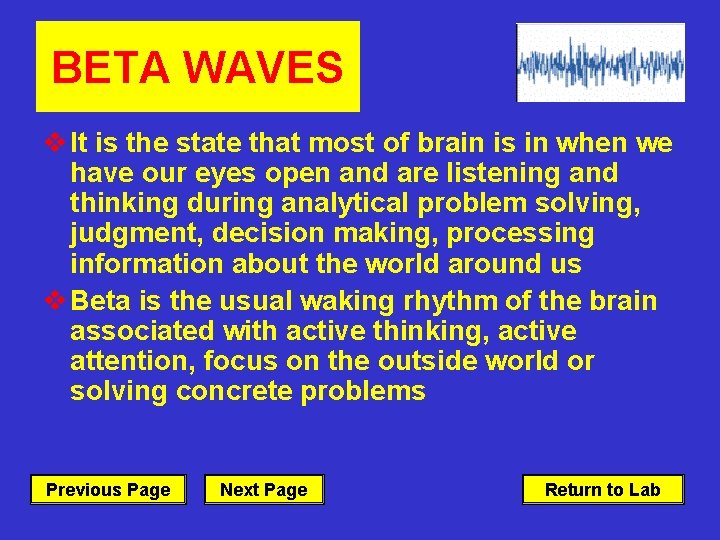
BETA WAVES v It is the state that most of brain is in when we have our eyes open and are listening and thinking during analytical problem solving, judgment, decision making, processing information about the world around us v Beta is the usual waking rhythm of the brain associated with active thinking, active attention, focus on the outside world or solving concrete problems Previous Page Next Page Return to Lab
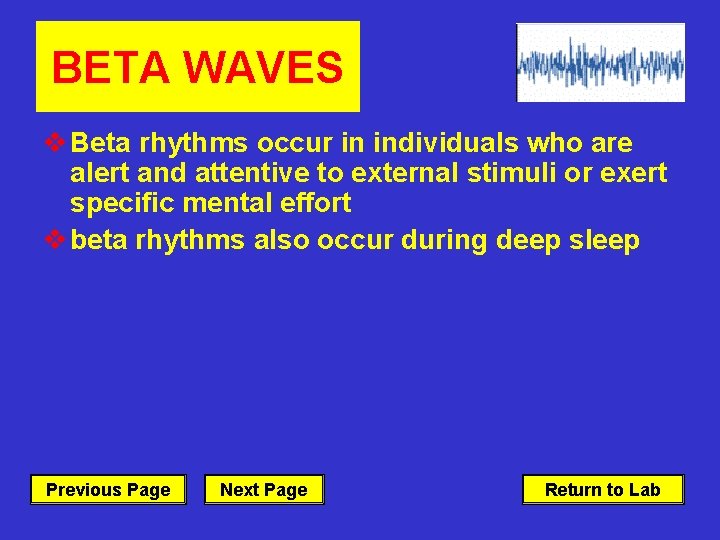
BETA WAVES v Beta rhythms occur in individuals who are alert and attentive to external stimuli or exert specific mental effort v beta rhythms also occur during deep sleep Previous Page Next Page Return to Lab
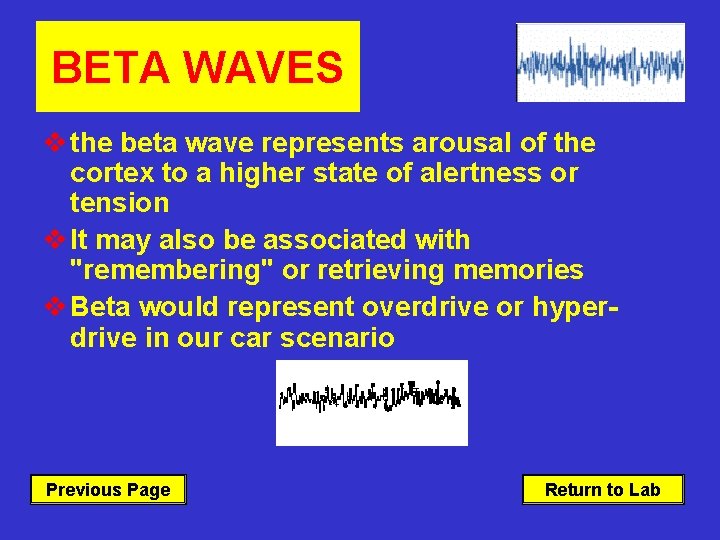
BETA WAVES v the beta wave represents arousal of the cortex to a higher state of alertness or tension v It may also be associated with "remembering" or retrieving memories v Beta would represent overdrive or hyper drive in our car scenario Previous Page Return to Lab
- Slides: 88