
Instructor Morteza Maleki Minbash Razgah The Value of

Instructor Morteza Maleki Minbash. Razgah
The Value of Secondary Data � Given the levels of Info Technology available, firms are now using a variety of techniques to collect, store, & categorize customer data for future marketing decisions. � Such info are gathered from; 1. 2. 3. 4. Electronic customer councils, Customer usability labs, Email comments, & Chat sessions � Data of such nature are 1. 2. 3. More readily available Often more highly valid, and Usually less expensive to secure than company gathered primary data 3
The Nature & Scope of Secondary Data Focusing on a particular marketing problem to be analyzed, the researchers need to determine; 1. 2. 3. Whether useful info already exists, How relevant the info is, & How should it be obtained 4
The Nature & Scope of Secondary Data Secondary Dada Data not gathered for the immediate study at hand, but for some other purpose 1. Internal Secondary Data � 2. Data collected by the individual company for accounting purposes or marketing activity reports. Customer Knowledge Information � � It is volunteered by customers for purposes other than the marketing function of an org. Info of this type may be provided to engineers, logistical support personnel, or IT departments for issues relating to product improvement, packaging or web registration. 5
The Nature & Scope of Secondary Data 3. External Secondary Data � Consist of data collected by outside agencies such as the federal govrnt, trade associations, or periodicals. � They may also be available through standardized marketing research services. 4. Computerized secondary data sources � Designed by specific companies and include internal and external data combined with online information sources �They may include; 1. 2. 3. 4. Information vendors, Private websites Mailing lists, or Direct marketing clearing and fulfillment services 6
The Role of Secondary Data in Marketing Research �Secondary data research is gaining importance in the marketing research process due to the � Increased emphasis on business & competitive intelligence, & � The ever-increasing availability of info from proprietary online databases. �Secondary research tasks are applied more often to specific marketing problems than are primary techniques due to the Relative speed and � Cost-effectiveness of gathering data � 7
The Role of Secondary Data in Marketing Research Secondary Data & Customer Relationship Management (CRM) � A process used to learn more about customer's needs & behaviors. It uses a combination of � Technology resources � Human resources � The aim is to gain insights to the behaviors of customers & the value those customers hold to the org. �For CRM to be effective, firms must; � Decide what kind of customer info it is looking for, � What it intends to do with that info 8
The Role of Secondary Data in Marketing Research ü The CRM process links all sources of secondary data. � It provides the nucleus for the CRM process. ü Yet, the complete CRM process is indeed complemented with primary data. � However, the emphasis on primary data is limited by the vast network of data collection & storage points in the CRM system. 9
The Role of Secondary Data in Marketing Research Secondary Data Research Tasks & the Marketing Research Process �In many areas of marketing research, secondary research will always play subordinate role in primary research. � In product & concept testing, focus groups, & customer satisfaction surveys, only primary data can answer the marketing problems. 10
The Role of Secondary Data in Marketing Research �Yet, in may instances, secondary data can be used to directly assess the research problem at hand. 1. 2. 3. In many research situations, secondary data collection is the starting point of defining the actual research that needs to be conducted. If the problem is solved, then the company can save time, money & effort. If it is not sufficient, then the primary data collection need to be considered. 11
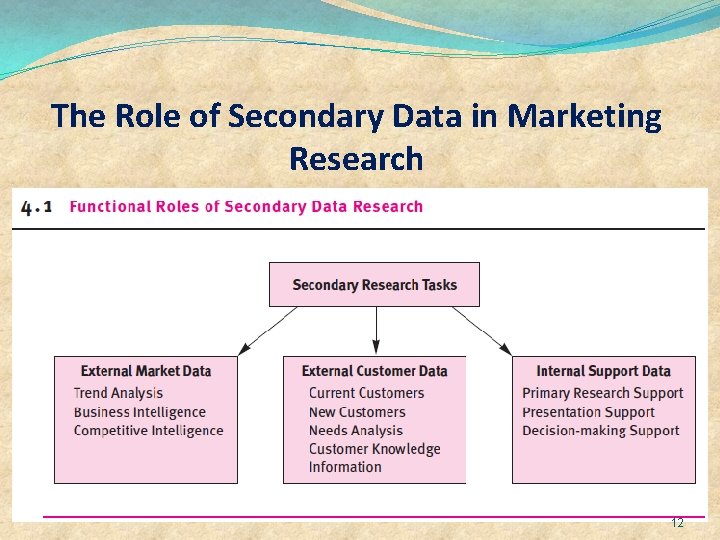
The Role of Secondary Data in Marketing Research 12
Use & Evaluation of Secondary Data Sources �Secondary data collection involves 1. 2. 3. Locating the appropriate source or sources Extracting the necessary data Recording the data relative to the research purpose in question �The scope & magnitude of the research study play significant roles in the fee a firm levies on a project. � Yet, with any primary data collection project, it is difficult to avoid wages & expenses, transportation & data collection costs, & clerical & field services charges. 13
Use & Evaluation of Secondary Data Sources �Expenses associated with secondary data are usually, Either incurred by the original data source, as with published secondary data sources, � Or shared between user & the commercial provider of the data � 14
Use & Evaluation of Secondary Data Sources If secondary data are to be used to assist in a decision process, they should be assessed according to six fundamental principles 1. Purpose � Since most secondary data are collected for purposes other than the one at hand, the data must be carefully evaluated on how they relate to the current research objectives. 2. Accuracy � When assessing secondary data, researchers need to keep in mind what was actually measured, & when the data were collected. � The data were collected to answer a completely different set of research question; hence, they may not accurately address all the aspects of the research issues. 15
Use & Evaluation of Secondary Data Sources 3. Consistency � When evaluating any source of secondary data, a good strategy is to seek out multiple sources of the same data to assure consistency. 4. Credibility � Technical competence, service quality, reputation & training & experience of personnel representing the org are some of the measures of credibility. 16
Use & Evaluation of Secondary Data Sources 5. Methodology � The researcher must evaluate the size & description of the sample, the response rate, the questionnaire, & the overall procedure for collecting the data. 6. Biases � Researchers must try to determine the underlying motivation or hidden agenda behind secondary data, like the interest of commercial, political, or other special interest groups. 17

18
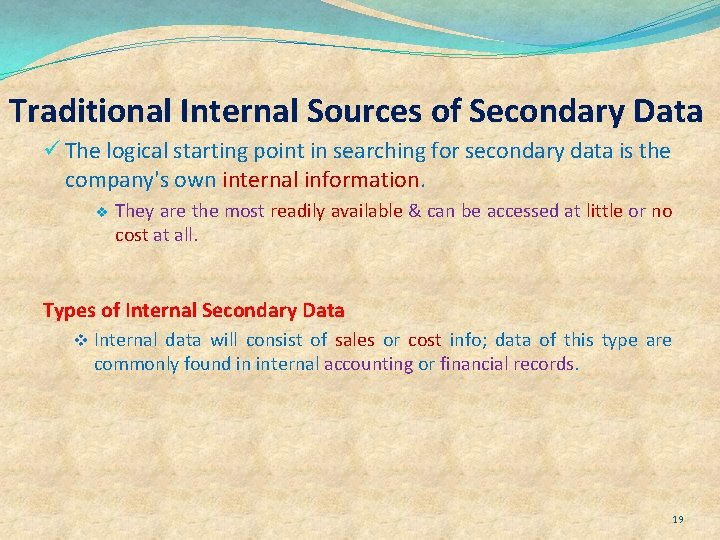
Traditional Internal Sources of Secondary Data ü The logical starting point in searching for secondary data is the company's own internal information. v They are the most readily available & can be accessed at little or no cost at all. Types of Internal Secondary Data v Internal data will consist of sales or cost info; data of this type are commonly found in internal accounting or financial records. 19
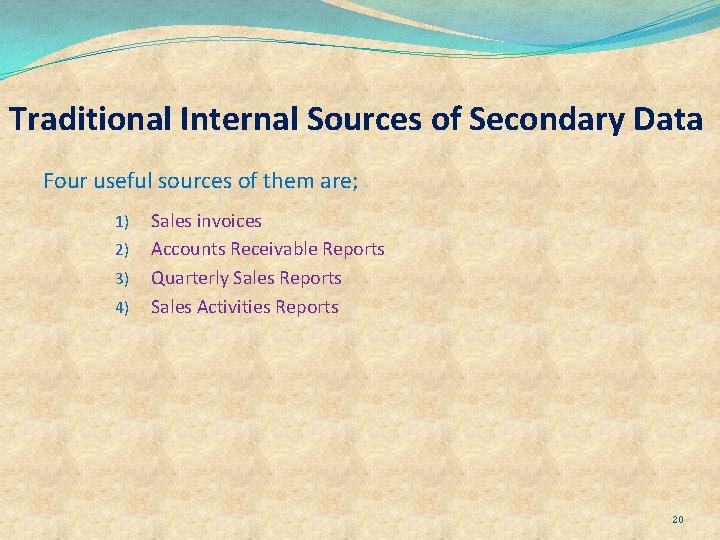
Traditional Internal Sources of Secondary Data Four useful sources of them are; 1) 2) 3) 4) Sales invoices Accounts Receivable Reports Quarterly Sales Reports Sales Activities Reports 20
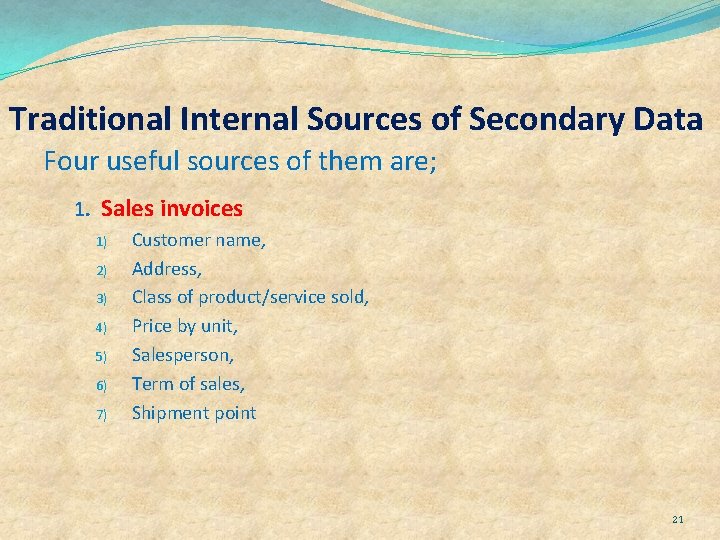
Traditional Internal Sources of Secondary Data Four useful sources of them are; 1. Sales invoices 1) 2) 3) 4) 5) 6) 7) Customer name, Address, Class of product/service sold, Price by unit, Salesperson, Term of sales, Shipment point 21
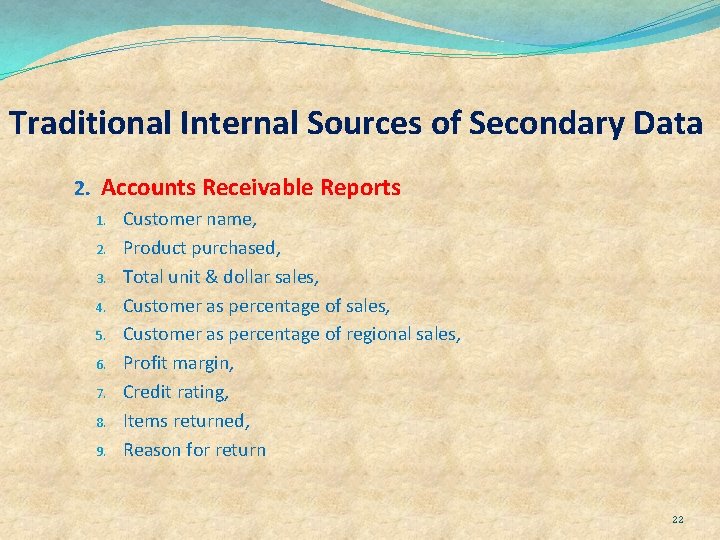
Traditional Internal Sources of Secondary Data 2. Accounts Receivable Reports 1. 2. 3. 4. 5. 6. 7. 8. 9. Customer name, Product purchased, Total unit & dollar sales, Customer as percentage of regional sales, Profit margin, Credit rating, Items returned, Reason for return 22
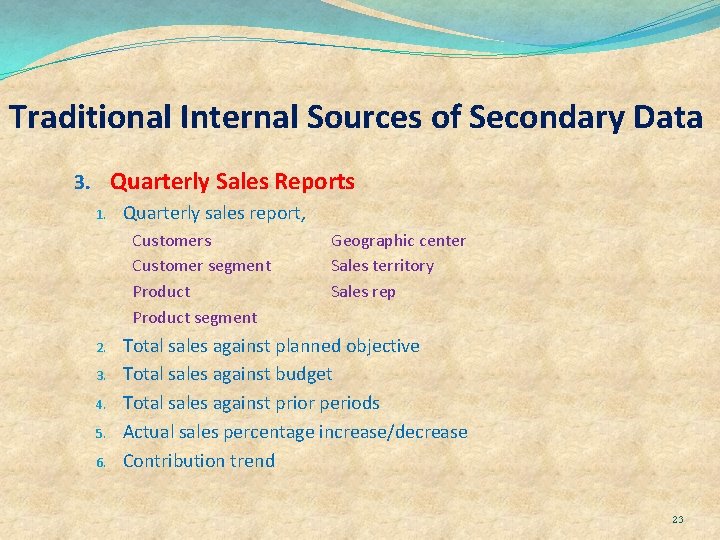
Traditional Internal Sources of Secondary Data 3. Quarterly Sales Reports 1. Quarterly sales report, Customers Customer segment Product segment 2. 3. 4. 5. 6. Geographic center Sales territory Sales rep Total sales against planned objective Total sales against budget Total sales against prior periods Actual sales percentage increase/decrease Contribution trend 23
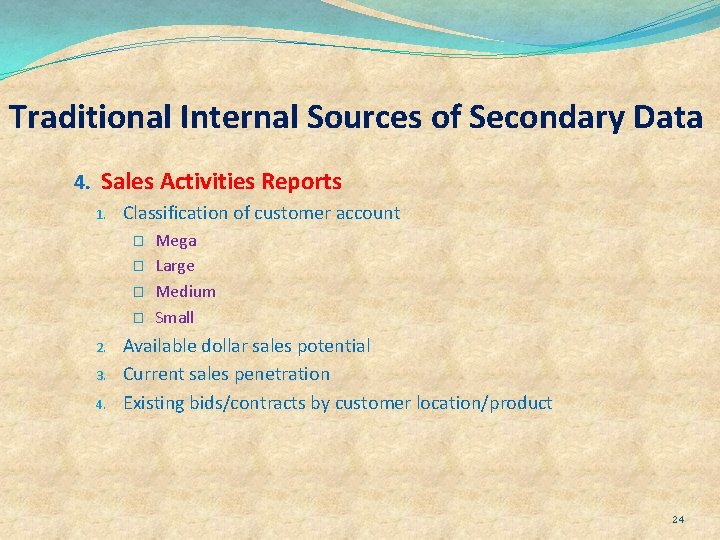
Traditional Internal Sources of Secondary Data 4. Sales Activities Reports 1. Classification of customer account � � 2. 3. 4. Mega Large Medium Small Available dollar sales potential Current sales penetration Existing bids/contracts by customer location/product 24
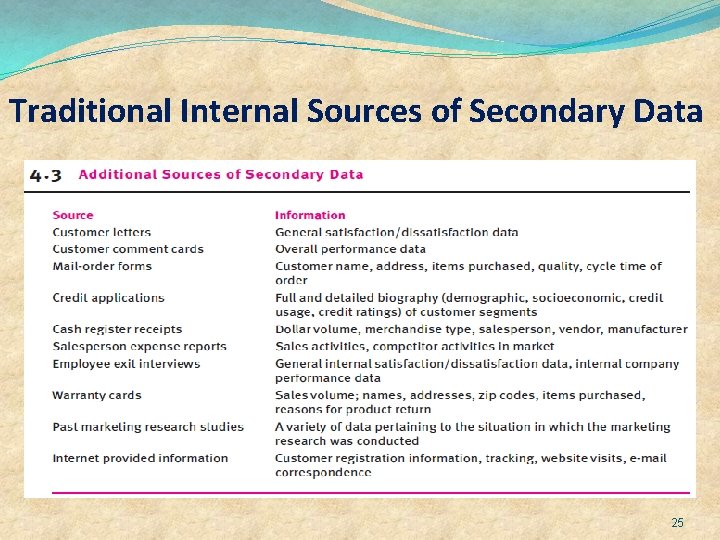
Traditional Internal Sources of Secondary Data 25

26
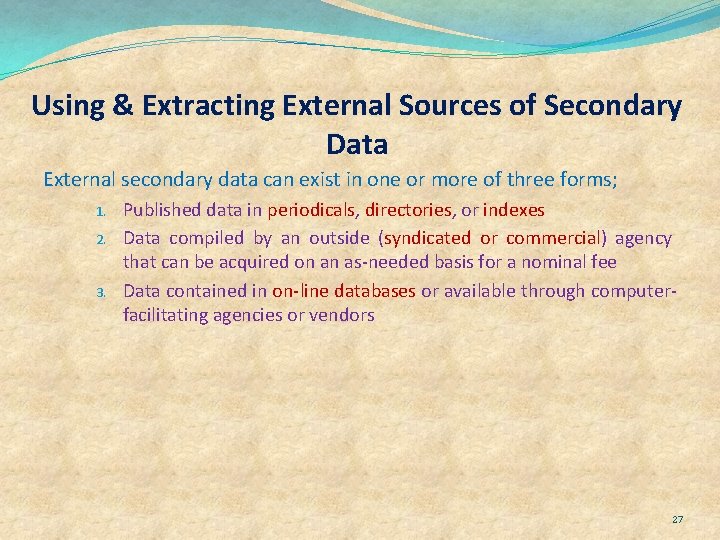
Using & Extracting External Sources of Secondary Data External secondary data can exist in one or more of three forms; 1. 2. 3. Published data in periodicals, directories, or indexes Data compiled by an outside (syndicated or commercial) agency that can be acquired on an as-needed basis for a nominal fee Data contained in on-line databases or available through computerfacilitating agencies or vendors 27
Using & Extracting External Sources of Secondary Data Planning for the External Secondary Data Search v The major challenge associated with external data sources is not finding the right data to assist in the research process, but rather finding and securing the appropriate sources for extracting the data. v The problem is not finding out whether info exists; it is finding out where the info resides. ü Hence, the researcher should follow some sort of plan or strategy in seeking out secondary sources of data. 28
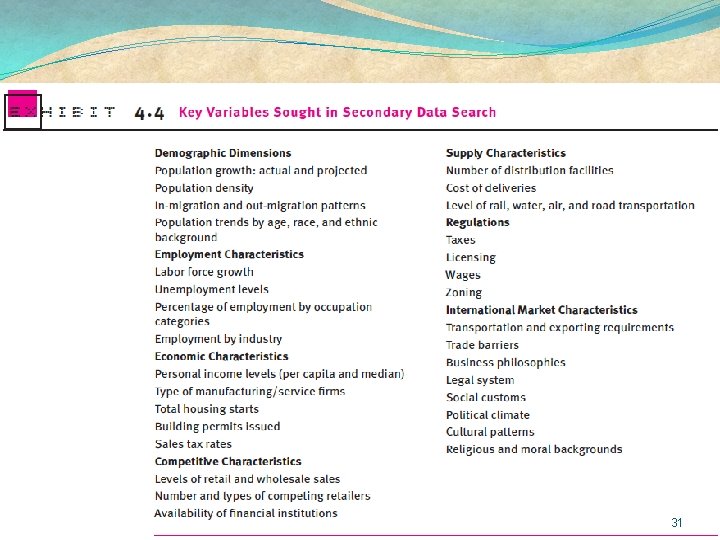
Using & Extracting External Sources of Secondary Data The GO-CART Approach in Searching the Secondary Data (for goals, objectives, characteristics, activities, reliability, & tabulation) 1. Goals Focus your information search on topics and concepts relevant to the specific research question at hand 2. Objectives Seek out as much information as you can on the topic, then check all the references and citations that may allow you to address more specific topics 3. Characteristics Always define the specific characteristics of information you are 29 seeking.
Using & Extracting External Sources of Secondary Data 4. Activities Specifically outline the places, events, and tasks that will be part of the secondary data search. 5. Reliability Try to find several data sources on the same topic. 6. Tabulation Document all sources of the data search. 30
31
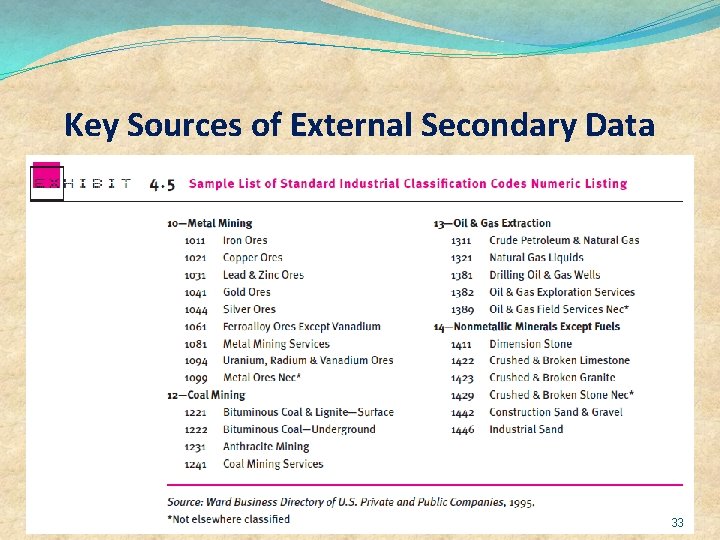
Key Sources of External Secondary Data ü Several key sources of secondary data allow the researcher to create a hierarchy of information sources to guide a secondary data search, regardless of the variables sought. 1. Standard Industrial Classification (SIC) Codes � SIC codes were designed to promote uniformity in data reporting by federal and state government sources and private business. � � The federal government assigns every industry an SIC code. Businesses within each industry report all activities (sales, payrolls, taxation) according to their code. � Presently, there are 99 two-digit industry codes; � Within each two-digit industry classification code is a four-digit industry group code representing specific industry groups. � It is at the four-digit level where the researcher will concentrate the data search. 32
Key Sources of External Secondary Data 33
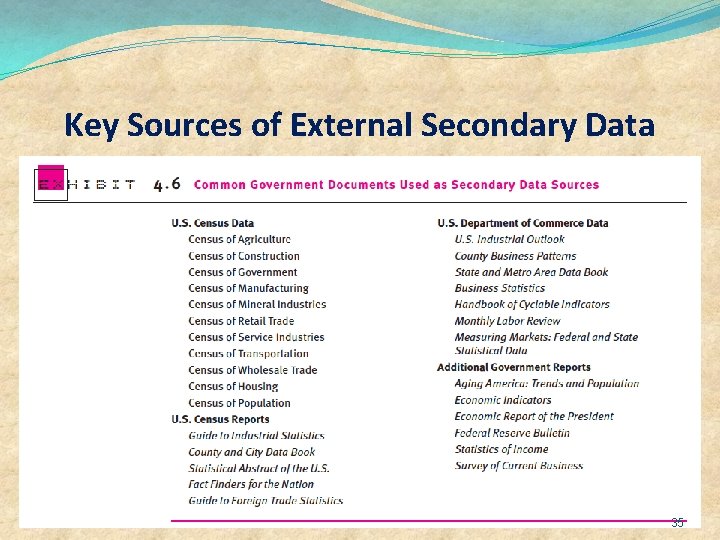
Key Sources of External Secondary Data 2. Government Documents v Detail, completeness, & consistency are reasons for using U. S. Government documents. ü The U. S. Bureau of the Census reports are the statistical foundation for most of the information available on U. S. population and economic activities. 34
Key Sources of External Secondary Data 35
Key Sources of External Secondary Data 3. Secondary Sources of Business Information 1. Sales and Marketing Management’s Survey of Buying Power ü Published annually, the survey covers all metropolitan statistical areas (MSA), counties, cities, and states in the United States. v It provides data on retail sales by merchandise categories, total retail sales by area, population projections, and effective buying income. 36
Key Sources of External Secondary Data v Effective buying income (EBI) is a measure of personal income (wages, salaries, interest, dividends, and profits) less federal, state, and local taxes. v When EBI is combined with retail sales and population size, the EBI is an overall indicator of an area’s buying power, known as the buying power index (BPI) 37
Key Sources of External Secondary Data Editors and Publishers Market Guide ü It provides much the same information as the Survey of Buying Power, plus some unique city-by-city variables useful in making comparisons. 2. v Some other sources include as follows: 3. 4. 5. Source Book of Demographics and Buying Power for Every Zip Code in the U. S. A. Statistical Sources of Information Commercial Publications and Newspapers 38

39
Syndicate Sources of Secondary Data v Companies can obtain a wealth of information across a variety of industries at a relatively low costs. ü Data obtained in these sources are collected at the point of purchase, they represent actual purchase behavior rather than purchase intentions. Characteristics of Syndicated Data Sources v These data are collected for a particular business or company, with a specific reason or purpose driving the data collection procedure. ü This information is then sold to different client companies in the form of tabulated results or reports communicated specifically for a client’s research needs. 40
Syndicate Sources of Secondary Data Consumer Panels 1) They consist of large samples of households that have agreed to provide specific detailed data for an extended period of time. 1. 2. Product purchase information Media habits Store Audits Store audits consist of formal examination and verification of how much of a particular product or brand has been sold at the retail level. 1) ü Based on a collection of participating retailers (normally discount, supermarket, and drugstore retailers), audits are performed on product or brand movement in return for detailed activity reports and cash compensation to the retailer. 41
Syndicate Sources of Secondary Data gathering in the store audit 1) 2) 3) 4) 5) 6) 7) Product/brand sales in relation to competition Direct sales and inventory levels at retail Effectiveness of shelf space and POP displays Sales at various price points and levels Effectiveness of in-store promotions and point-of-sale coupons Competitive marketing practices Direct sales by store type, product location, territory, and region. 42


The End 44
- Slides: 44