
Instructor Materials Chapter 8 Subnetting IP Networks CCNA
Instructor Materials Chapter 8: Subnetting IP Networks CCNA Routing and Switching Introduction to Networks v 6. 0 Presentation_ID © 2008 Cisco Systems, Inc. All rights reserved. Cisco Confidential 1
Chapter 8 - Sections & Objectives 8. 0 Introduction 8. 1 Subnetting an IPv 4 Network • Explain how subnetting segments a network to enable better communication. • Explain how to calculate IPv 4 subnets for a /24 prefix. • Explain how to calculate IPv 4 subnets for a /16 and /8 prefix. • Given a set of requirements for subnetting, implement an IPv 4 addressing scheme. • Explain how to create a flexible addressing scheme using variable length subnet masking (VLSM). 8. 2 Addressing Schemes • Implement a VLSM addressing scheme. 8. 3 Design Considerations for IPv 6 • Explain how to implement IPv 6 address assignments in a business network. 8. 4 Summary Presentation_ID © 2008 Cisco Systems, Inc. All rights reserved. Cisco Confidential 2
8. 1 Network Layer Protocols Presentation_ID © 2008 Cisco Systems, Inc. All rights reserved. Cisco Confidential 3

Subnetting an IPv 4 Network Segmentation § Broadcast Domains • Each router interface connects a broadcast domain. • Broadcasts are only propagated within its broadcast domain. § Problems with Large Broadcast Domains • Slow network operations due to the significant amount of broadcast traffic. • Slow device operations because a device must accept and process each broadcast packet. § Reasons for Subnetting • Solution: reduce the size of the network to create smaller broadcast domains. • Because each broadcast domain connects to a different router interface, each domain needs its own network address space. • The process of breaking an address range into smaller address spaces is called subnetting. • Network administrators can group devices into subnets that are determined by location, organizational unit or device type. Presentation_ID © 2008 Cisco Systems, Inc. All rights reserved. Cisco Confidential 4
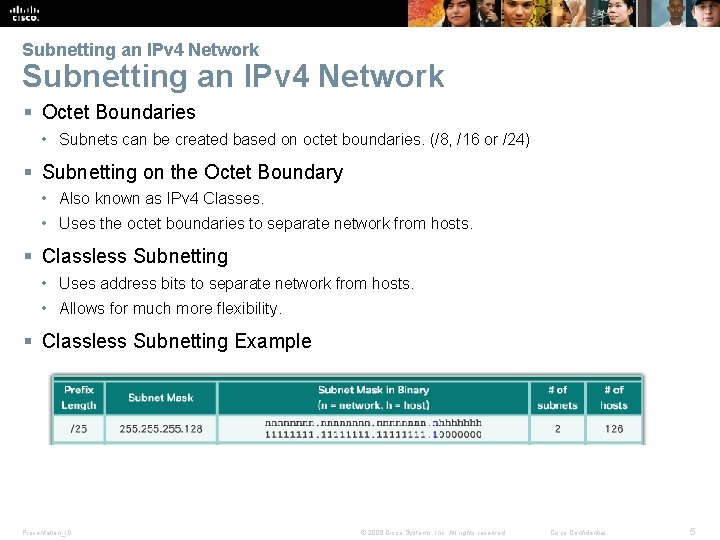
Subnetting an IPv 4 Network § Octet Boundaries • Subnets can be created based on octet boundaries. (/8, /16 or /24) § Subnetting on the Octet Boundary • Also known as IPv 4 Classes. • Uses the octet boundaries to separate network from hosts. § Classless Subnetting • Uses address bits to separate network from hosts. • Allows for much more flexibility. § Classless Subnetting Example Presentation_ID © 2008 Cisco Systems, Inc. All rights reserved. Cisco Confidential 5
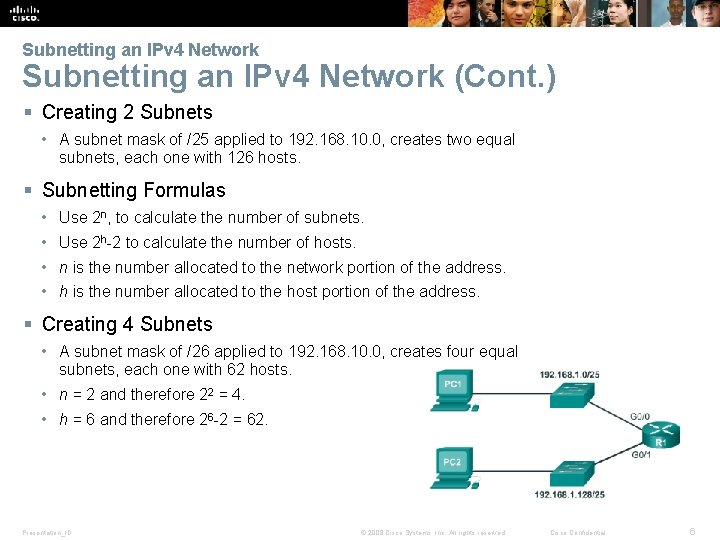
Subnetting an IPv 4 Network (Cont. ) § Creating 2 Subnets • A subnet mask of /25 applied to 192. 168. 10. 0, creates two equal subnets, each one with 126 hosts. § Subnetting Formulas • Use 2 n, to calculate the number of subnets. • Use 2 h-2 to calculate the number of hosts. • n is the number allocated to the network portion of the address. • h is the number allocated to the host portion of the address. § Creating 4 Subnets • A subnet mask of /26 applied to 192. 168. 10. 0, creates four equal subnets, each one with 62 hosts. • n = 2 and therefore 22 = 4. • h = 6 and therefore 26 -2 = 62. Presentation_ID © 2008 Cisco Systems, Inc. All rights reserved. Cisco Confidential 6
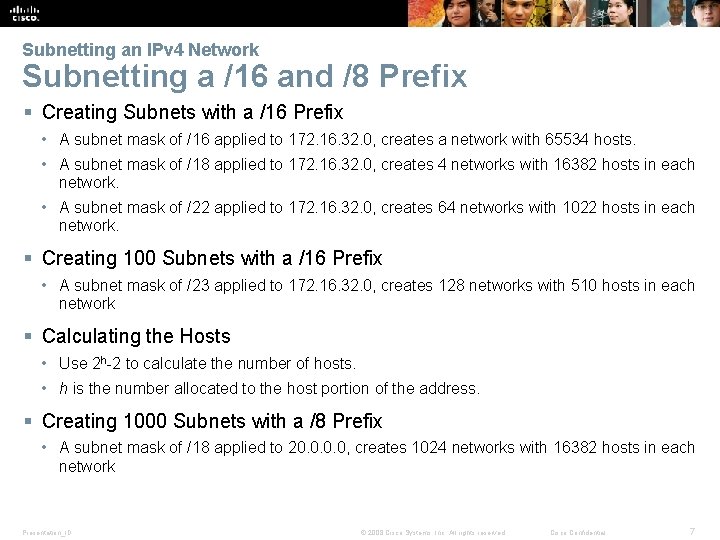
Subnetting an IPv 4 Network Subnetting a /16 and /8 Prefix § Creating Subnets with a /16 Prefix • A subnet mask of /16 applied to 172. 16. 32. 0, creates a network with 65534 hosts. • A subnet mask of /18 applied to 172. 16. 32. 0, creates 4 networks with 16382 hosts in each network. • A subnet mask of /22 applied to 172. 16. 32. 0, creates 64 networks with 1022 hosts in each network. § Creating 100 Subnets with a /16 Prefix • A subnet mask of /23 applied to 172. 16. 32. 0, creates 128 networks with 510 hosts in each network § Calculating the Hosts • Use 2 h-2 to calculate the number of hosts. • h is the number allocated to the host portion of the address. § Creating 1000 Subnets with a /8 Prefix • A subnet mask of /18 applied to 20. 0, creates 1024 networks with 16382 hosts in each network Presentation_ID © 2008 Cisco Systems, Inc. All rights reserved. Cisco Confidential 7
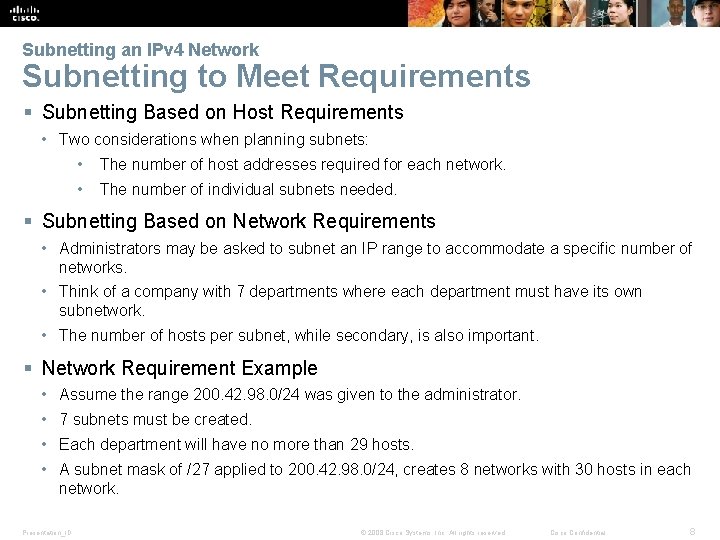
Subnetting an IPv 4 Network Subnetting to Meet Requirements § Subnetting Based on Host Requirements • Two considerations when planning subnets: • The number of host addresses required for each network. • The number of individual subnets needed. § Subnetting Based on Network Requirements • Administrators may be asked to subnet an IP range to accommodate a specific number of networks. • Think of a company with 7 departments where each department must have its own subnetwork. • The number of hosts per subnet, while secondary, is also important. § Network Requirement Example • Assume the range 200. 42. 98. 0/24 was given to the administrator. • 7 subnets must be created. • Each department will have no more than 29 hosts. • A subnet mask of /27 applied to 200. 42. 98. 0/24, creates 8 networks with 30 hosts in each network. Presentation_ID © 2008 Cisco Systems, Inc. All rights reserved. Cisco Confidential 8
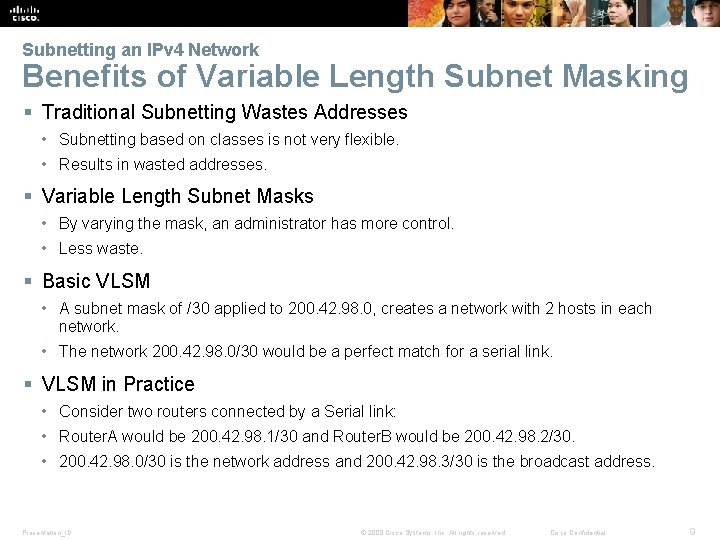
Subnetting an IPv 4 Network Benefits of Variable Length Subnet Masking § Traditional Subnetting Wastes Addresses • Subnetting based on classes is not very flexible. • Results in wasted addresses. § Variable Length Subnet Masks • By varying the mask, an administrator has more control. • Less waste. § Basic VLSM • A subnet mask of /30 applied to 200. 42. 98. 0, creates a network with 2 hosts in each network. • The network 200. 42. 98. 0/30 would be a perfect match for a serial link. § VLSM in Practice • Consider two routers connected by a Serial link: • Router. A would be 200. 42. 98. 1/30 and Router. B would be 200. 42. 98. 2/30. • 200. 42. 98. 0/30 is the network address and 200. 42. 98. 3/30 is the broadcast address. Presentation_ID © 2008 Cisco Systems, Inc. All rights reserved. Cisco Confidential 9
8. 2 Addressing Schemes Presentation_ID © 2008 Cisco Systems, Inc. All rights reserved. Cisco Confidential 10
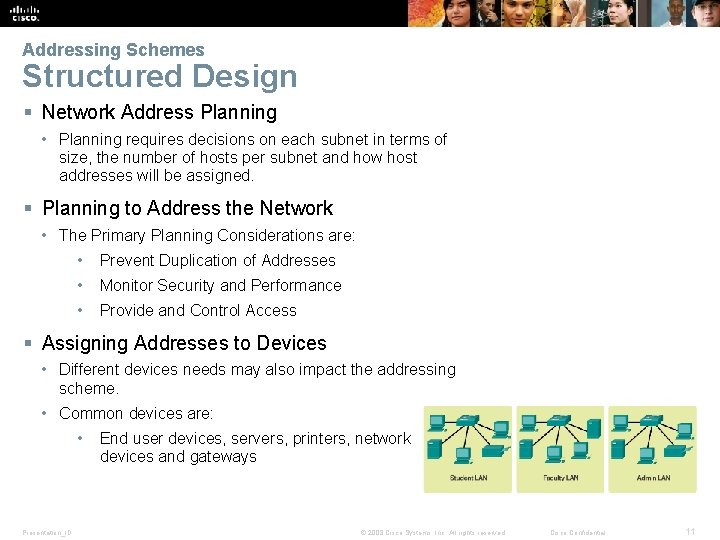
Addressing Schemes Structured Design § Network Address Planning • Planning requires decisions on each subnet in terms of size, the number of hosts per subnet and how host addresses will be assigned. § Planning to Address the Network • The Primary Planning Considerations are: • Prevent Duplication of Addresses • Monitor Security and Performance • Provide and Control Access § Assigning Addresses to Devices • Different devices needs may also impact the addressing scheme. • Common devices are: • Presentation_ID End user devices, servers, printers, network devices and gateways © 2008 Cisco Systems, Inc. All rights reserved. Cisco Confidential 11
8. 3 Design Considerations for IPv 6 Presentation_ID © 2008 Cisco Systems, Inc. All rights reserved. Cisco Confidential 12
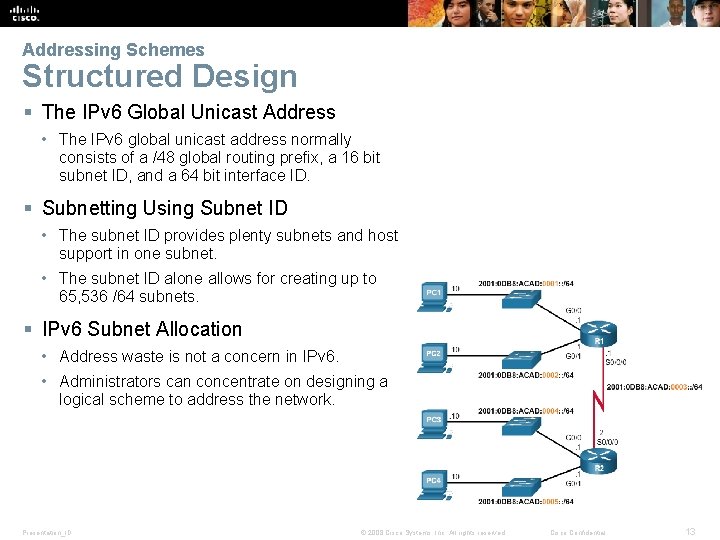
Addressing Schemes Structured Design § The IPv 6 Global Unicast Address • The IPv 6 global unicast address normally consists of a /48 global routing prefix, a 16 bit subnet ID, and a 64 bit interface ID. § Subnetting Using Subnet ID • The subnet ID provides plenty subnets and host support in one subnet. • The subnet ID alone allows for creating up to 65, 536 /64 subnets. § IPv 6 Subnet Allocation • Address waste is not a concern in IPv 6. • Administrators can concentrate on designing a logical scheme to address the network. Presentation_ID © 2008 Cisco Systems, Inc. All rights reserved. Cisco Confidential 13
8. 4 Chapter Summary Presentation_ID © 2008 Cisco Systems, Inc. All rights reserved. Cisco Confidential 14
Chapter Summary § Implement an IPv 4 addressing scheme to enable end-to-end connectivity in a small to medium-sized business network. § Given a set of requirements, implement a VLSM addressing scheme to provide connectivity to end users in a small to medium-sized network. § Explain design considerations for implementing IPv 6 in a business network. Presentation_ID © 2008 Cisco Systems, Inc. All rights reserved. Cisco Confidential 15
Presentation_ID © 2008 Cisco Systems, Inc. All rights reserved. Cisco Confidential 17

Presentation_ID © 2008 Cisco Systems, Inc. All rights reserved. Cisco Confidential 18
- Slides: 17