
Instructor Guide to Post Course Reports Military Training







- Slides: 36
Instructor Guide to Post Course Reports Military Training Network January 2015
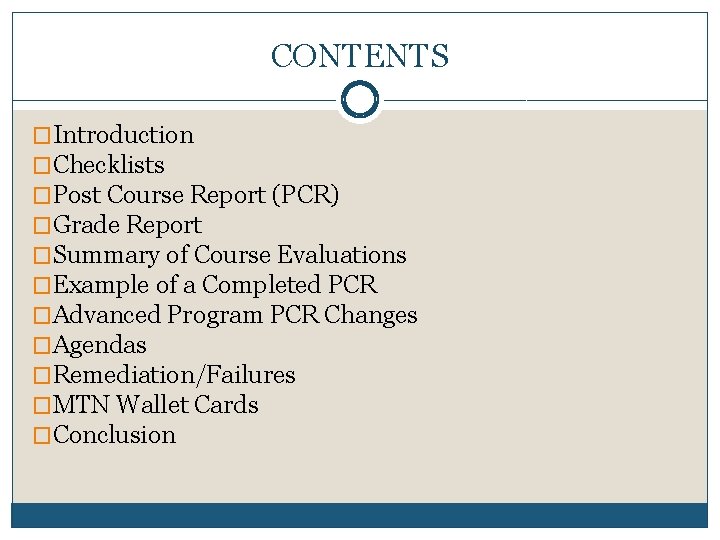
CONTENTS �Introduction �Checklists �Post Course Report (PCR) �Grade Report �Summary of Course Evaluations �Example of a Completed PCR �Advanced Program PCR Changes �Agendas �Remediation/Failures �MTN Wallet Cards �Conclusion
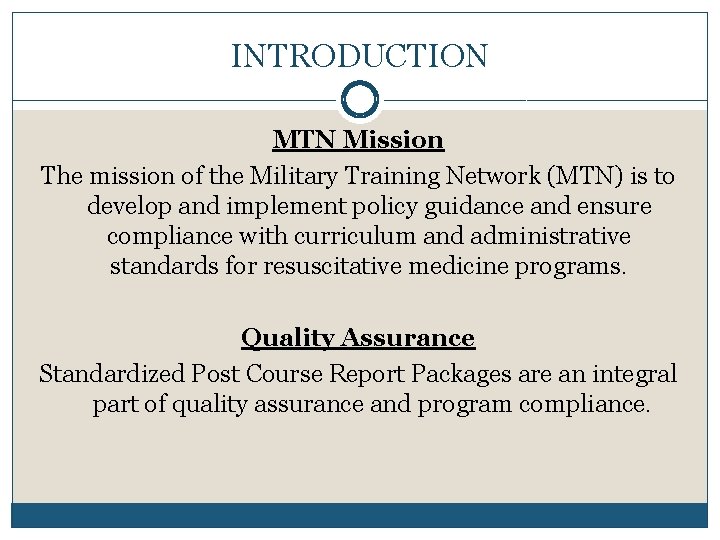
INTRODUCTION MTN Mission The mission of the Military Training Network (MTN) is to develop and implement policy guidance and ensure compliance with curriculum and administrative standards for resuscitative medicine programs. Quality Assurance Standardized Post Course Report Packages are an integral part of quality assurance and program compliance.
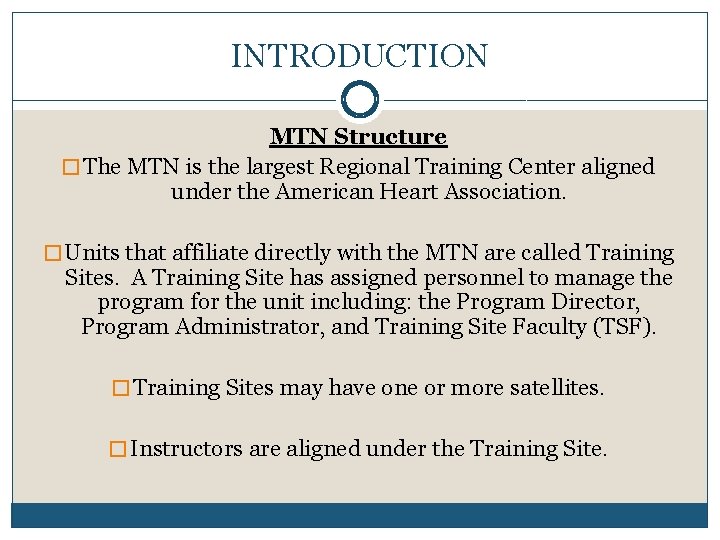
INTRODUCTION MTN Structure � The MTN is the largest Regional Training Center aligned under the American Heart Association. � Units that affiliate directly with the MTN are called Training Sites. A Training Site has assigned personnel to manage the program for the unit including: the Program Director, Program Administrator, and Training Site Faculty (TSF). � Training Sites may have one or more satellites. � Instructors are aligned under the Training Site.
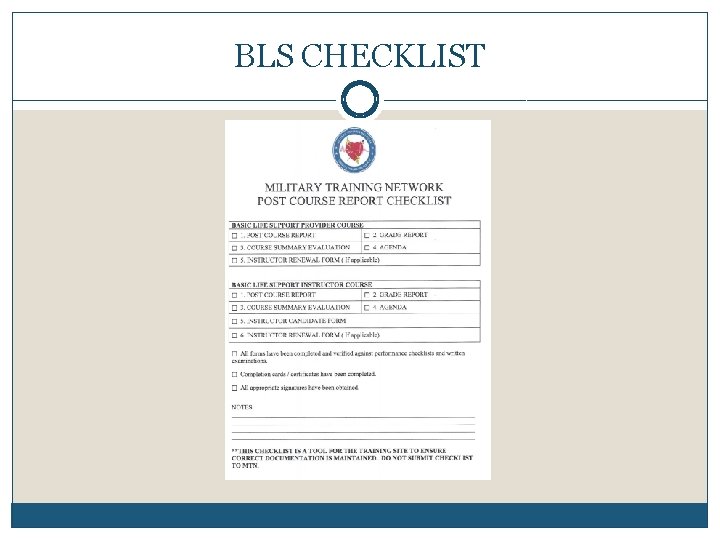
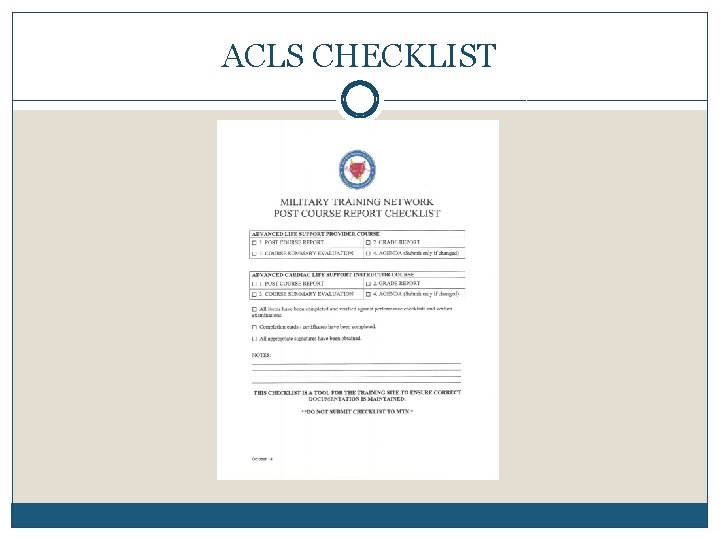
CHECKLISTS �MTN has developed a PCR Package for each discipline: BLS ACLS PALS/PEARS �The checklist page is the Instructor’s tool to make sure you have turned in everything needed to the Training Site. Instructors are responsible for completing the PCR and Grade Report correctly.
BLS CHECKLIST
ACLS CHECKLIST
PALS/PEARS CHECKLIST
Post Course Report Packages �MTN staff commonly refer to the Post Course Report Package as a PCR. �The PCR Package includes: Post Course Report page Grade Report page Summary of all Course Evaluations �All PCRs must be typed. This will reduce clerical errors and increase efficiency of processing wallet cards by the Training Site staff.
PCRs �Training Sites are required to maintain a completed PCR Package for every course taught for three years. �Program Directors/Administrators are required to review PCRs for quality assurance. �If an error is made or documentation is missing, the Training Site Program Director/Administrator will ask the Instructor to correct the error.
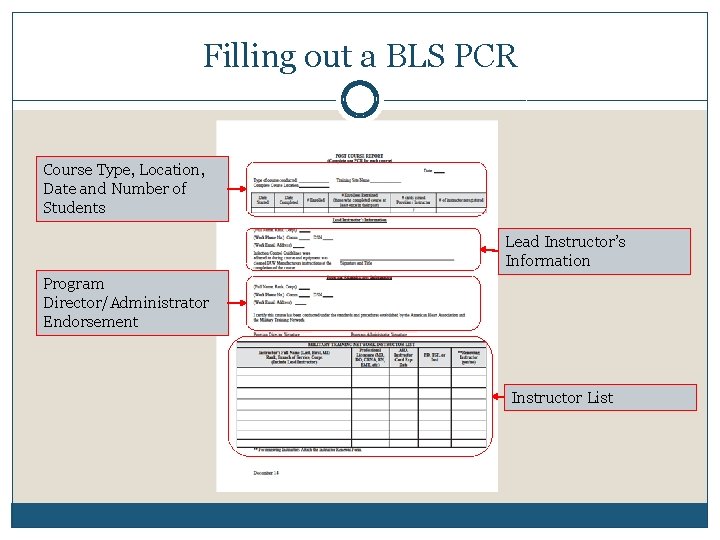
Filling out a BLS PCR Course Type, Location, Date and Number of Students Lead Instructor’s Information Program Director/Administrator Endorsement Instructor List
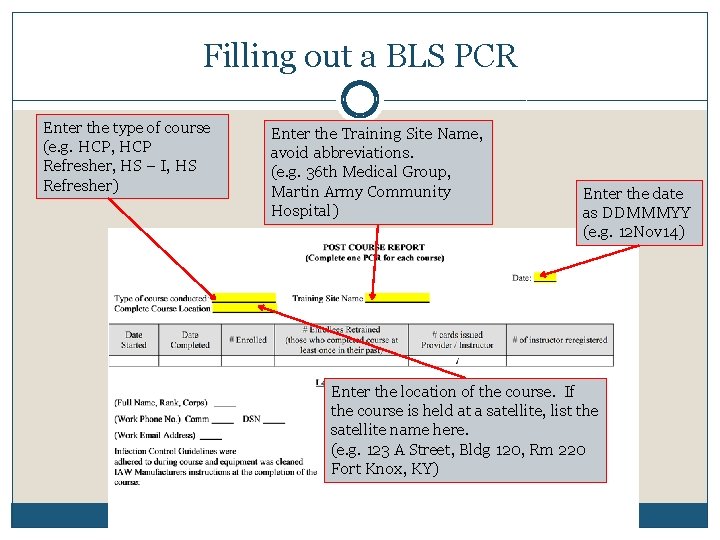
Filling out a BLS PCR Enter the type of course (e. g. HCP, HCP Refresher, HS – I, HS Refresher) Enter the Training Site Name, avoid abbreviations. (e. g. 36 th Medical Group, Martin Army Community Hospital) Enter the date as DDMMMYY (e. g. 12 Nov 14) Enter the location of the course. If the course is held at a satellite, list the satellite name here. (e. g. 123 A Street, Bldg 120, Rm 220 Fort Knox, KY)
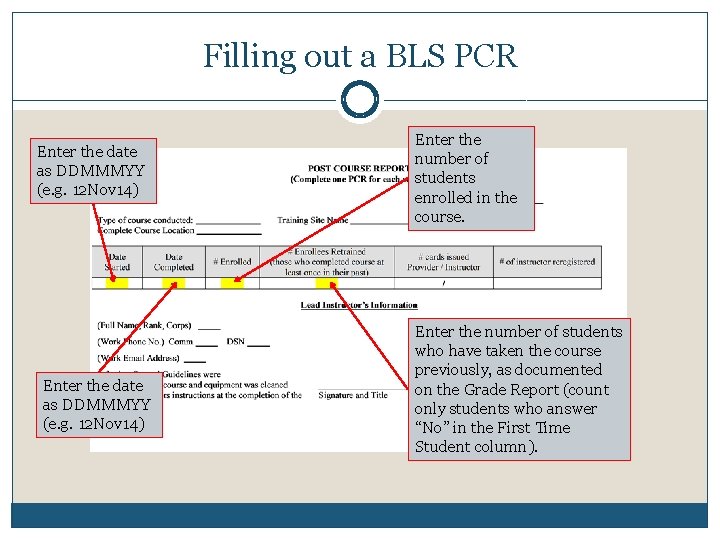
Filling out a BLS PCR Enter the date as DDMMMYY (e. g. 12 Nov 14) Enter the number of students enrolled in the course. Enter the number of students who have taken the course previously, as documented on the Grade Report (count only students who answer “No” in the First Time Student column).
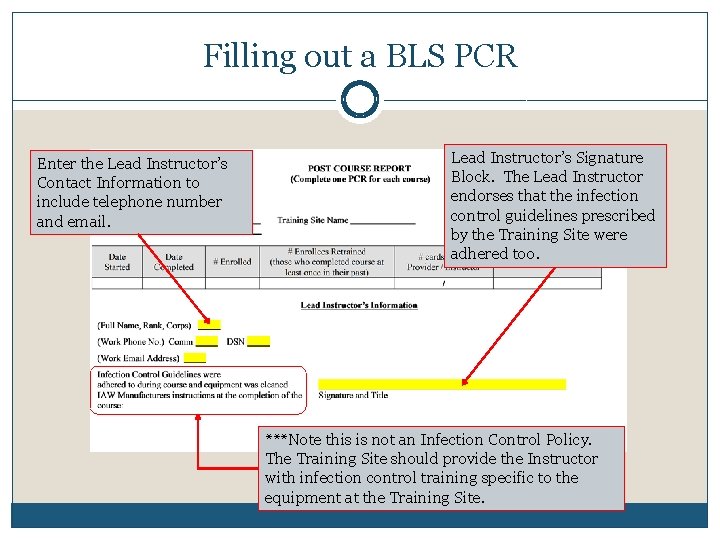
Filling out a BLS PCR Enter the Lead Instructor’s Contact Information to include telephone number and email. Lead Instructor’s Signature Block. The Lead Instructor endorses that the infection control guidelines prescribed by the Training Site were adhered too. ***Note this is not an Infection Control Policy. The Training Site should provide the Instructor with infection control training specific to the equipment at the Training Site.
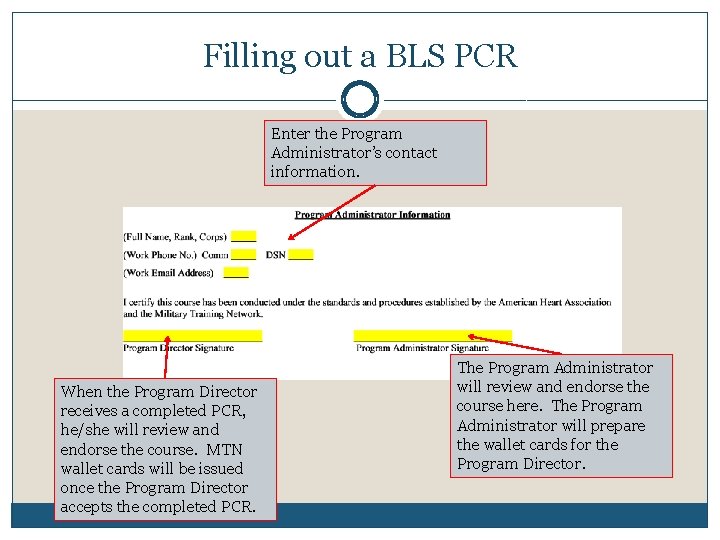
Filling out a BLS PCR Enter the Program Administrator’s contact information. When the Program Director receives a completed PCR, he/she will review and endorse the course. MTN wallet cards will be issued once the Program Director accepts the completed PCR. The Program Administrator will review and endorse the course here. The Program Administrator will prepare the wallet cards for the Program Director.
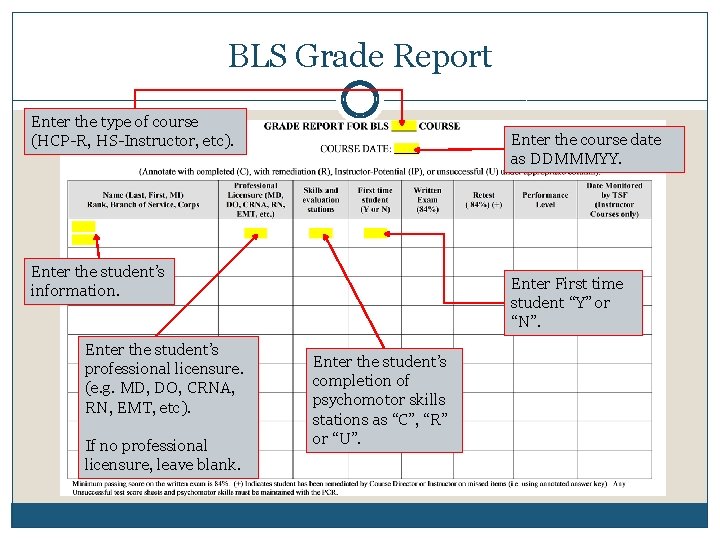
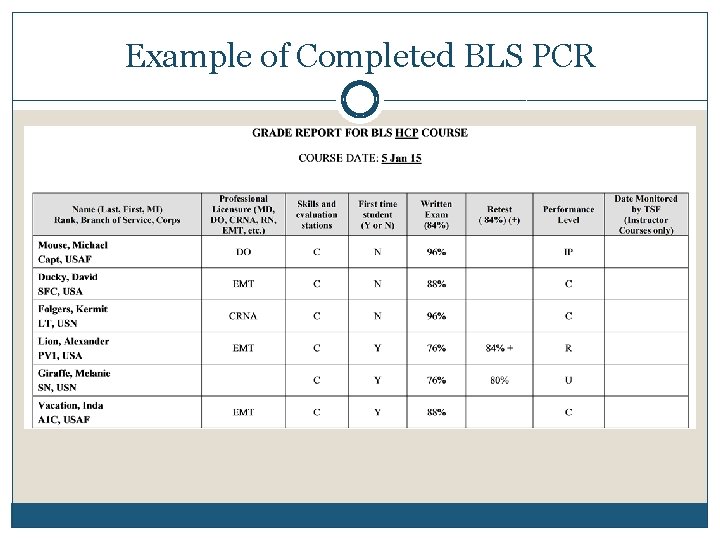
BLS Grade Report Enter the type of course (HCP-R, HS-Instructor, etc). Enter the course date as DDMMMYY. Enter the student’s information. Enter the student’s professional licensure. (e. g. MD, DO, CRNA, RN, EMT, etc). If no professional licensure, leave blank. Enter First time student “Y” or “N”. Enter the student’s completion of psychomotor skills stations as “C”, “R” or “U”.
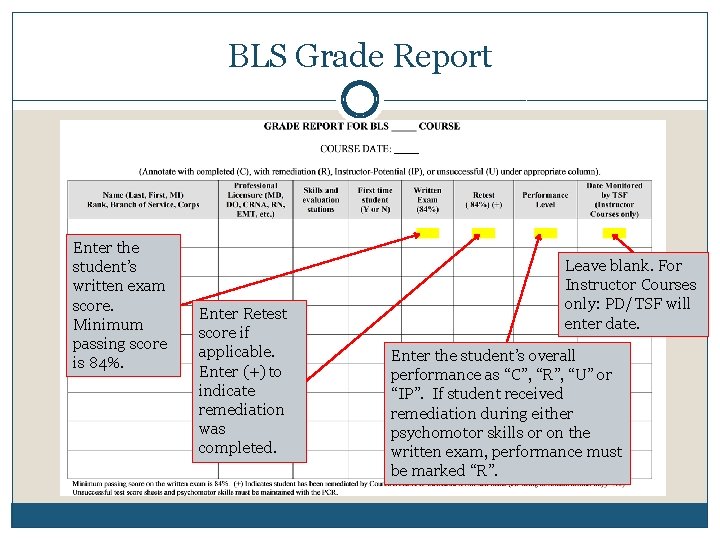
BLS Grade Report Enter the student’s written exam score. Minimum passing score is 84%. Enter Retest score if applicable. Enter (+) to indicate remediation was completed. Leave blank. For Instructor Courses only: PD/TSF will enter date. Enter the student’s overall performance as “C”, “R”, “U” or “IP”. If student received remediation during either psychomotor skills or on the written exam, performance must be marked “R”.
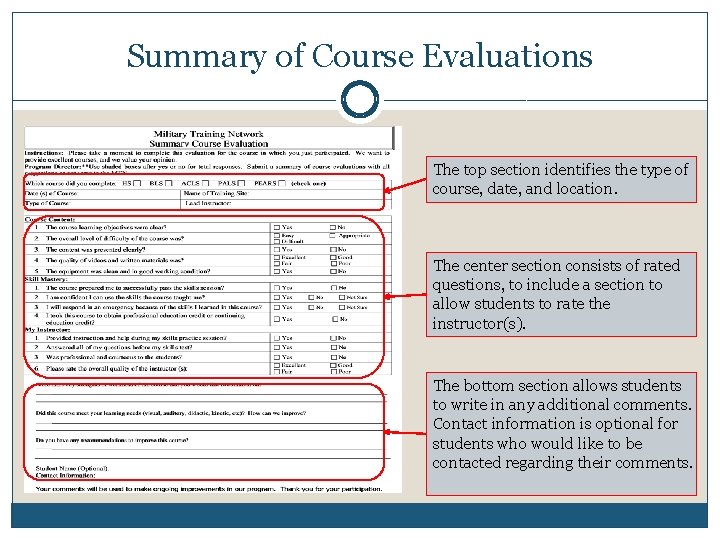
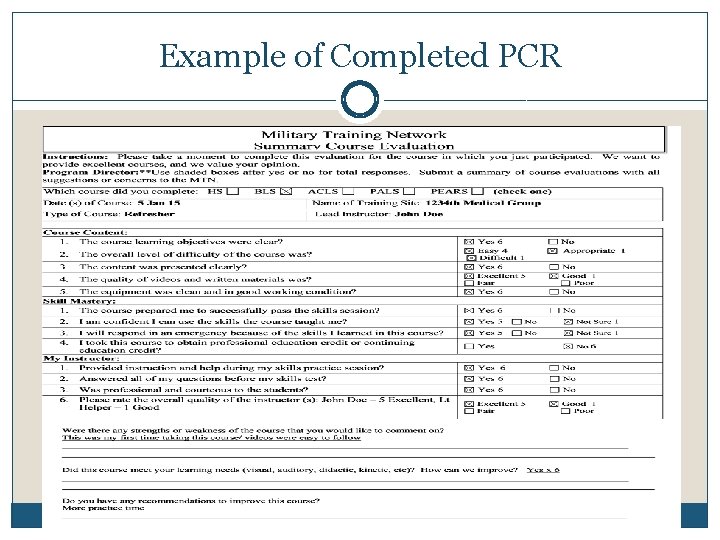
Summary of Course Evaluations AHA and MTN requires a summary of all course evaluations to be maintained with the PCR. Each student must be given an opportunity to provide feedback on AHA courses. Instructors must also inform students that they can provide feedback directly to AHA contact information is found each Instructor Manual.
Summary of Course Evaluations The top section identifies the type of course, date, and location. The center section consists of rated questions, to include a section to allow students to rate the instructor(s). The bottom section allows students to write in any additional comments. Contact information is optional for students who would like to be contacted regarding their comments.
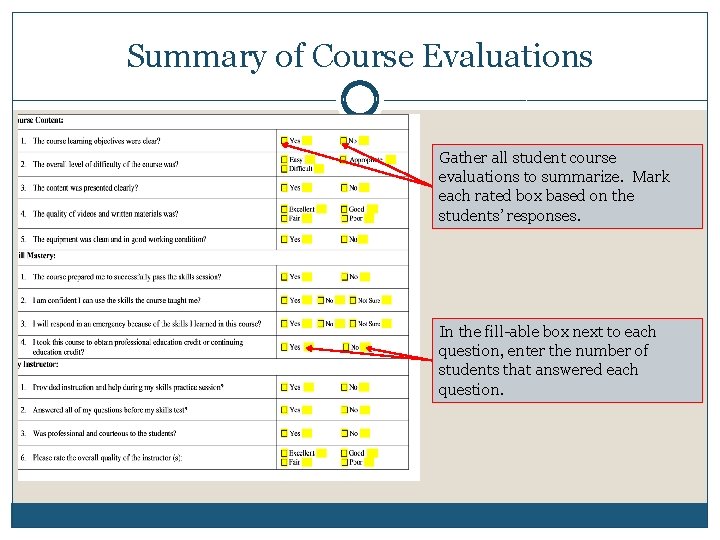
Summary of Course Evaluations Gather all student course evaluations to summarize. Mark each rated box based on the students’ responses. In the fill-able box next to each question, enter the number of students that answered each question.
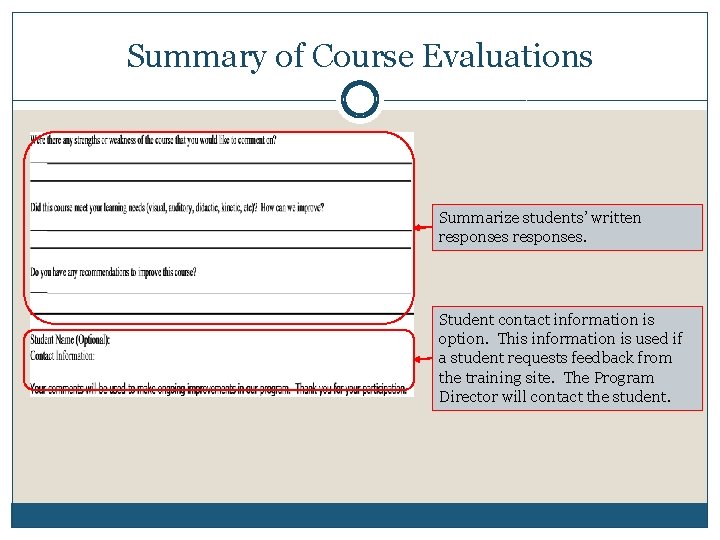
Summary of Course Evaluations Summarize students’ written responses. Student contact information is option. This information is used if a student requests feedback from the training site. The Program Director will contact the student.
Example of Completed BLS PCR
Example of Completed BLS PCR
Example of Completed PCR
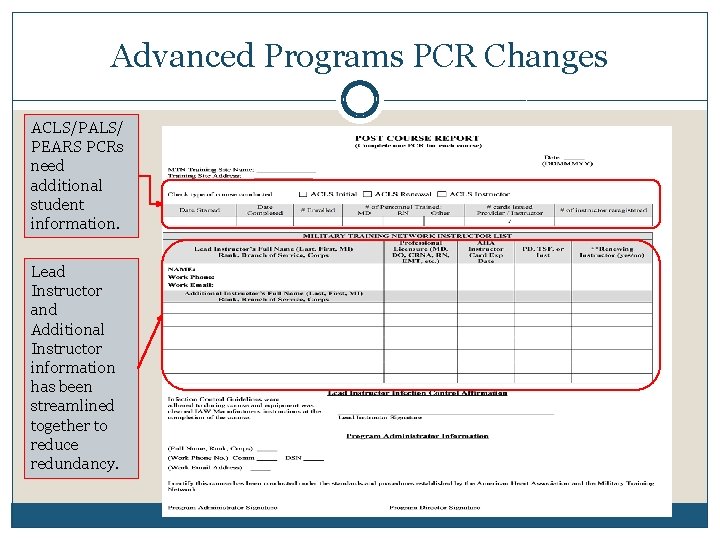
Advanced Programs PCR Changes ACLS/PALS/ PEARS PCRs need additional student information. Lead Instructor and Additional Instructor information has been streamlined together to reduce redundancy.
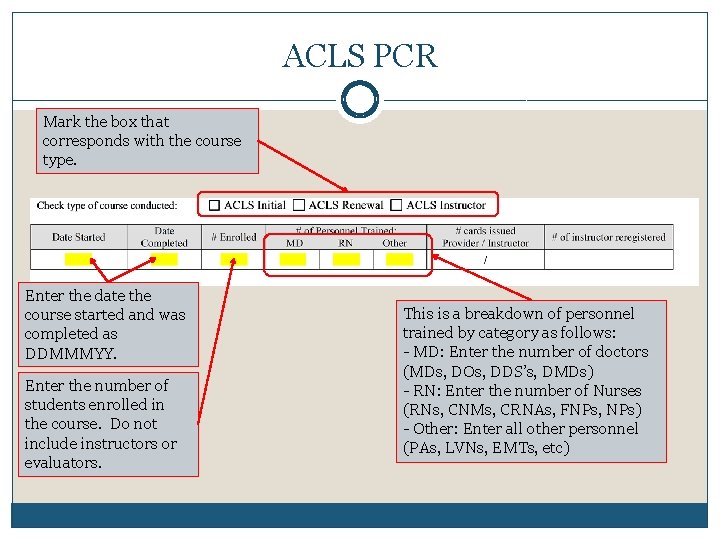
ACLS PCR Mark the box that corresponds with the course type. Enter the date the course started and was completed as DDMMMYY. Enter the number of students enrolled in the course. Do not include instructors or evaluators. This is a breakdown of personnel trained by category as follows: - MD: Enter the number of doctors (MDs, DOs, DDS’s, DMDs) - RN: Enter the number of Nurses (RNs, CNMs, CRNAs, FNPs, NPs) - Other: Enter all other personnel (PAs, LVNs, EMTs, etc)
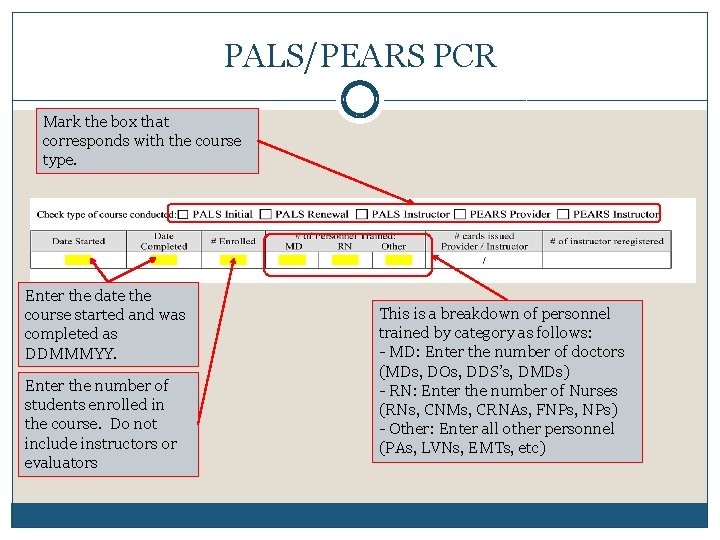
PALS/PEARS PCR Mark the box that corresponds with the course type. Enter the date the course started and was completed as DDMMMYY. Enter the number of students enrolled in the course. Do not include instructors or evaluators This is a breakdown of personnel trained by category as follows: - MD: Enter the number of doctors (MDs, DOs, DDS’s, DMDs) - RN: Enter the number of Nurses (RNs, CNMs, CRNAs, FNPs, NPs) - Other: Enter all other personnel (PAs, LVNs, EMTs, etc)
ACLS and PALS/PEARS Grade Report Mark the box that corresponds with the course type.
Agendas �Whenever possible, a standard agenda should be followed. Training Sites will maintain copies of the agendas. Standardized agendas are available on the MTN website at: http: //www. usuhs. edu/mtnprogramstools. html �Instructors should provide the course agenda to students two weeks in advance of the course whenever possible. �If a change is made to the agenda, you must submit the agenda change with the PCR package to your Training Site.
Remediation/Failures �If a student does not successfully complete the psychomotor skills evaluation or the written exam, the instructor should provide remediation in accordance with the AHA Instructor Course guidelines. After remediation, the student is re-tested. �If the student is successful on the second attempt, the student’s performance is marked as “R” for remediation.
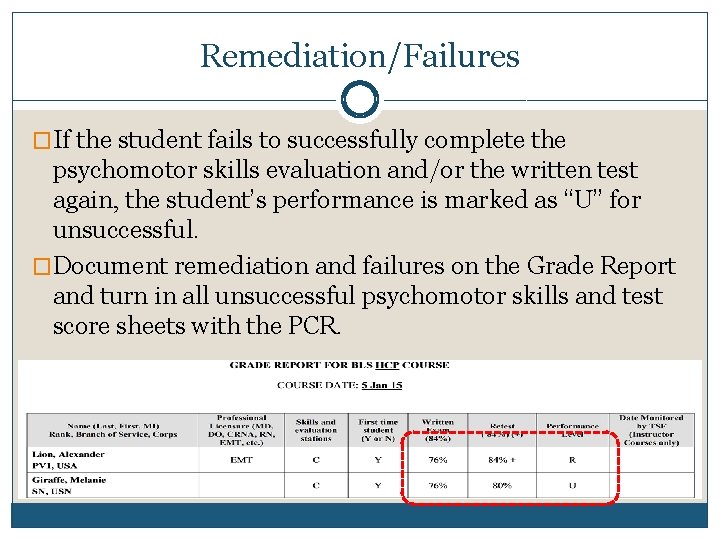
Remediation/Failures �If the student fails to successfully complete the psychomotor skills evaluation and/or the written test again, the student’s performance is marked as “U” for unsuccessful. �Document remediation and failures on the Grade Report and turn in all unsuccessful psychomotor skills and test score sheets with the PCR.
ACLS/PALS/PEARS Grade Report For advanced programs, document student completion of Skills Stations, Written test, Re-test and Megacode. Documentation of Written Exam remediation will include the initial Written Test score and the Re-test score.
MTN Wallet Cards �MTN Wallet Cards are issued to the instructor for dispersal to students when the Program Director accepts a completed PCR package. �The MTN Wallet Cards should be stamped, typed, or computer printed. �Reference the Emergency Cardiovascular Care Course Card Reference Guide and the AHA Training Memo dated 29 May 2013 for further guidance.
Conclusion If you have any questions, please contact the Training Site Program Director.
References � Military Training Network Administrative Handbook, 6 th Edition, January 2014 � The American Heart Association Program Administration (PAM) Manual, 5 th Edition, February 1, 2013 (U. S. Version) � American Heart Association Training Memo dated 29 May 2013 � The American Heart Association Advanced Cardiovascular Life Support Instructor Course Faculty Guide May 2013 � The American Heart Association Instructor Manual for Advanced Cardiac Life Support (ACLS), 2011 � The American Heart Association Basic Life Support Instructor Course Faculty Guide May 28, 2013 � The American Heart Association (AHA) Instructor Manual for Basic Life Support (BLS), 2011
References � The American Heart Association Heartsaver Instructor Course Faculty Guide May 28, 2013 � The American Heart Association Instructor Manual for Heartsaver First Aid CPR AED (HS CPR AED), 2011 � The American Heart Association Pediatric Advanced Life Support Instructor Course Faculty Guide May 2013 � The American Heart Association Instructor Manual for Pediatric Advanced Life Support (PALS), 2012 � The American Heart Association Pediatric Emergency Assessment, Recognition, and Stabilization Instructor Course Faculty Guide May 2013 � The American Heart Association Instructor Manual for Pediatric Emergency Assessment, Recognition, and Stabilization (PEARS), 2012 � Emergency Cardiovascular Care Course Card Reference Guide June 2014