
Instructions for Completing the Quarterly CACFP Financial Report
- Slides: 39
Instructions for Completing the Quarterly CACFP Financial Report for Sponsors of Centers
Quarterly CACFP Financial Report Due Dates • Required for all For-profit, Non-profit, and Public sites operating two or more sites on the food program. • Reports how much it cost your agency to operate the Child and Adult Care Food Program over the past three months and how your agency funded the program. • Forms and Instructions can be found on DPI website – Guidance Memo #11 – Link found on this presentation • Sent via the online reporting system 2
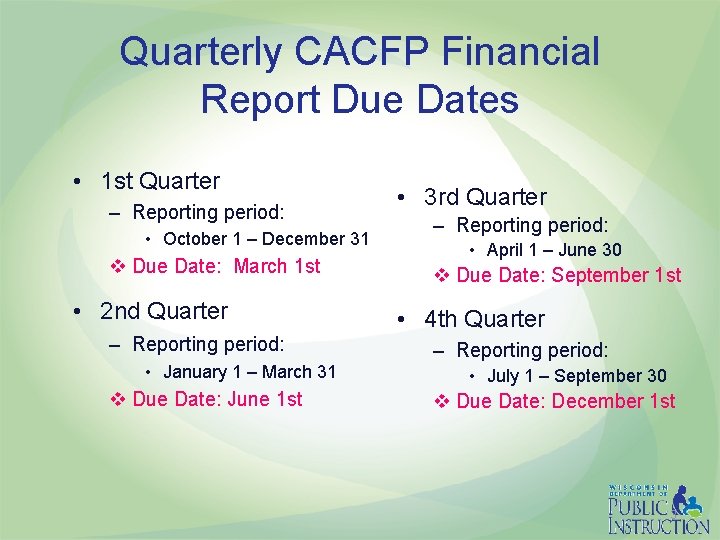
Quarterly CACFP Financial Report Due Dates • 1 st Quarter – Reporting period: • October 1 – December 31 v Due Date: March 1 st • 2 nd Quarter – Reporting period: • January 1 – March 31 v Due Date: June 1 st • 3 rd Quarter – Reporting period: • April 1 – June 30 v Due Date: September 1 st • 4 th Quarter – Reporting period: • July 1 – September 30 v Due Date: December 1 st 3
Completing the Quarterly CACFP Financial Report • Tools you will need to complete the annual CACFP financial report: – General ledger, check register, accounting records, receipts that outline the food program costs. – Quarterly CACFP Financial Report reporting form (PI-1463 -A) – to use as your working paper. • CACFP Reimbursement will be automatically reported after the payment of your last claim of the program quarter. • Only CACFP costs approved in the budget are allowed. 4
Sample - DPI Reimbursement Information 5
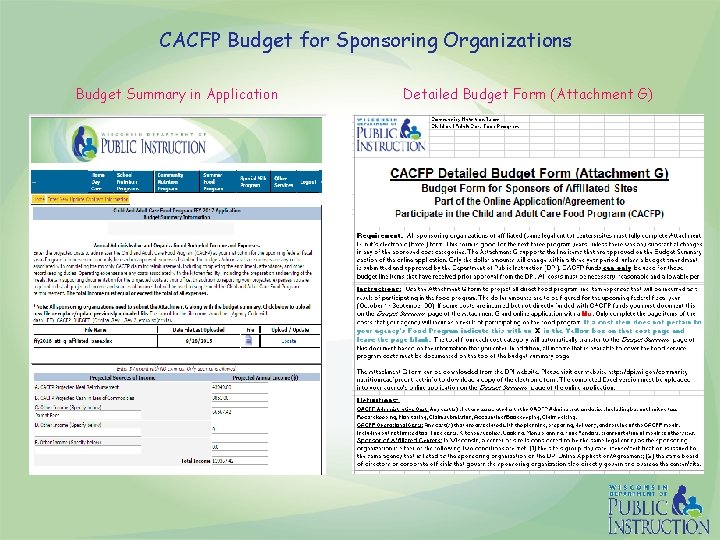
CACFP Budget for Sponsoring Organizations Budget Summary in Application Detailed Budget Form (Attachment G)
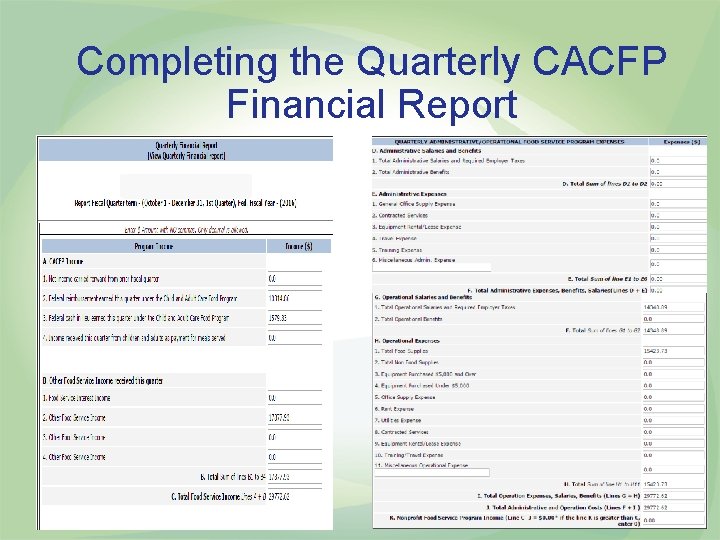
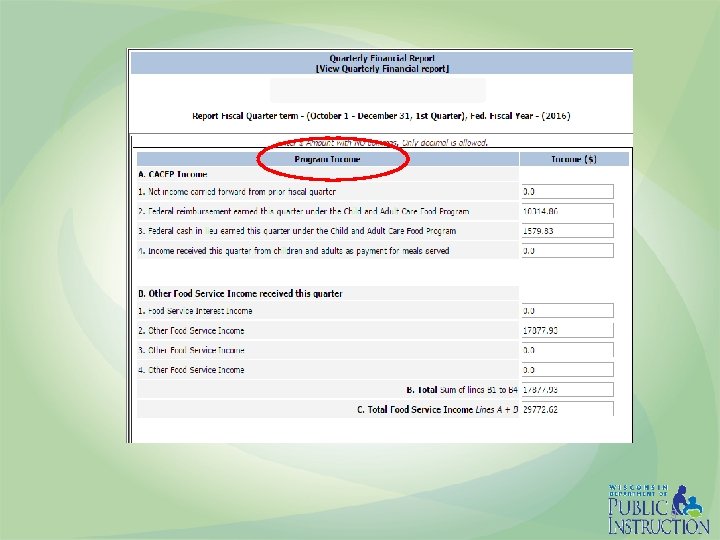
Completing the Quarterly CACFP Financial Report 7
8
9
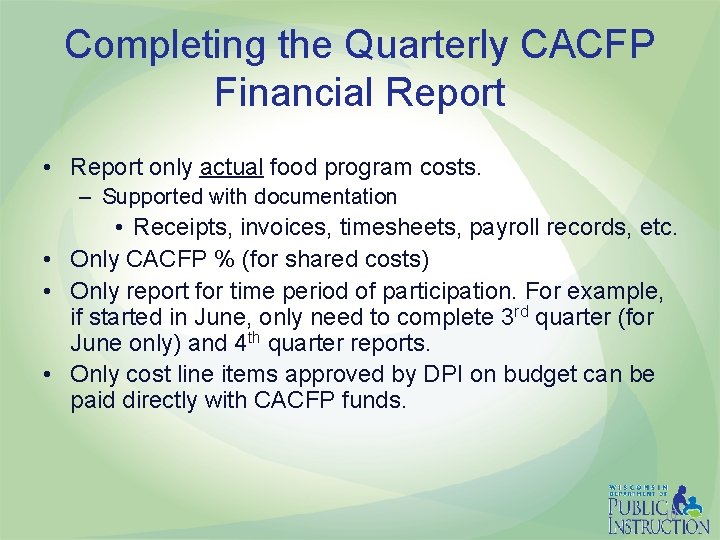
Completing the Quarterly CACFP Financial Report • Report only actual food program costs. – Supported with documentation • Receipts, invoices, timesheets, payroll records, etc. • Only CACFP % (for shared costs) • Only report for time period of participation. For example, if started in June, only need to complete 3 rd quarter (for June only) and 4 th quarter reports. • Only cost line items approved by DPI on budget can be paid directly with CACFP funds. 10
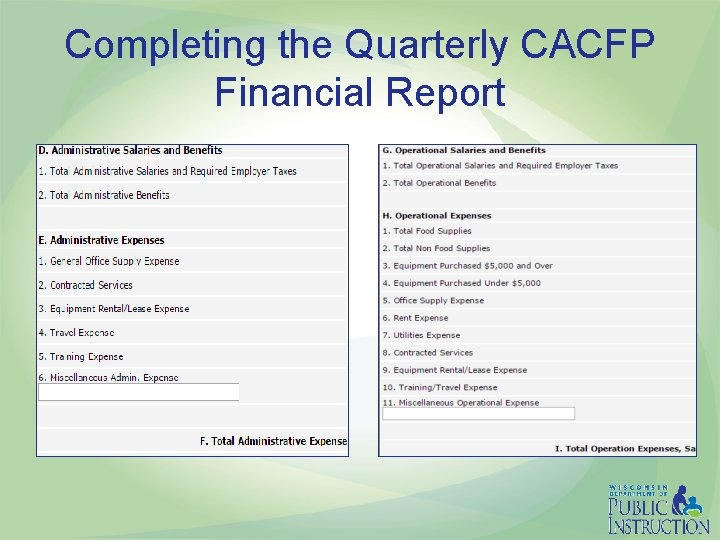
Completing the Quarterly CACFP Financial Report
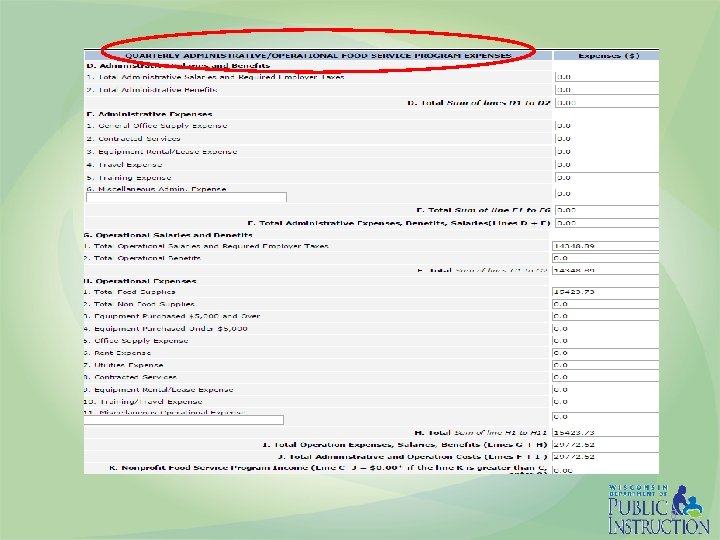
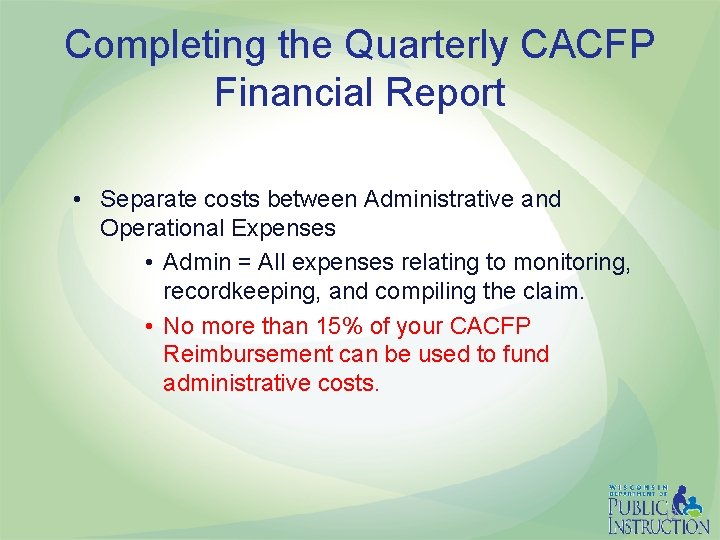
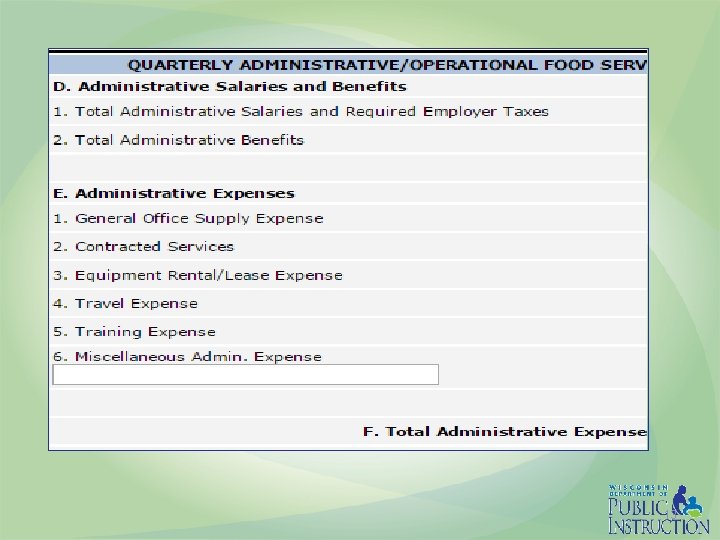
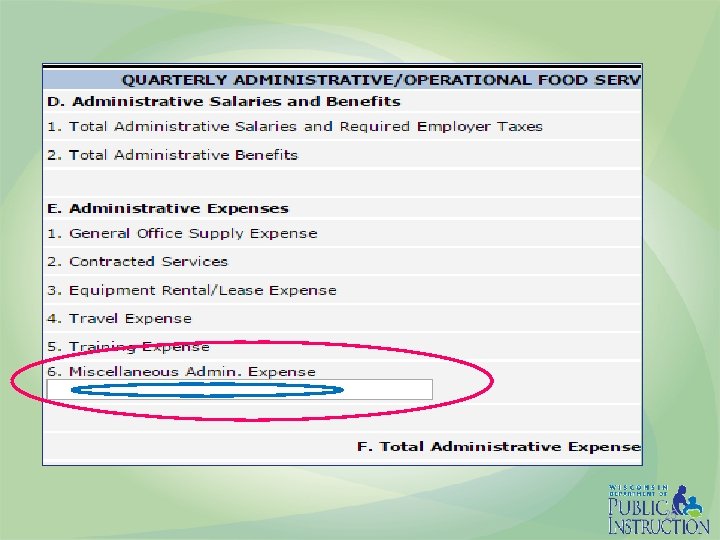
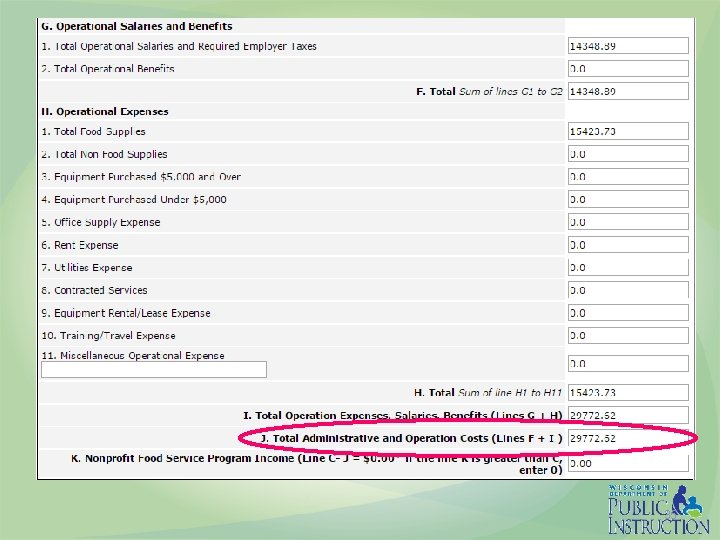
Completing the Quarterly CACFP Financial Report • Separate costs between Administrative and Operational Expenses • Admin = All expenses relating to monitoring, recordkeeping, and compiling the claim. • No more than 15% of your CACFP Reimbursement can be used to fund administrative costs. 12
13
Completing the Quarterly CACFP Financial Report • Separate costs between Administrative and Operational Expenses • Admin = All expenses relating to monitoring, recordkeeping, and compiling the claim. – Example: Salary, benefits and travel costs of the Center Director who completes the claim and conducts the monitoring visits of the sites. » Only Actual Costs (NO ESTIMATES) » Only CACFP % » Only line items approved on DPI Budget 14
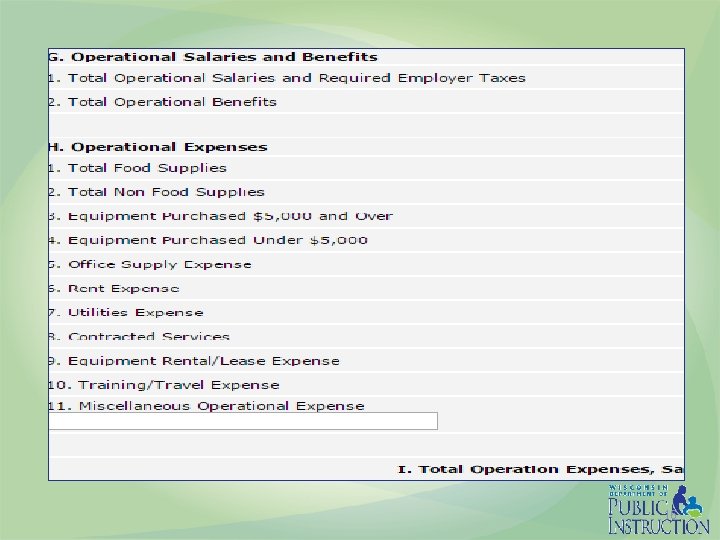
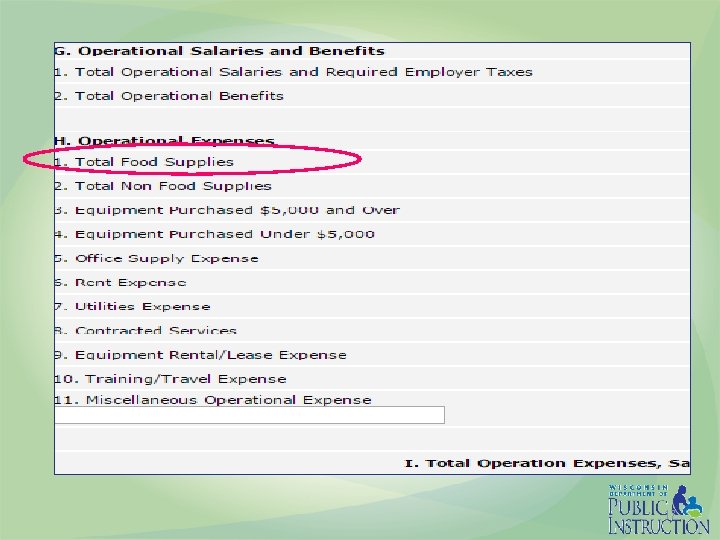
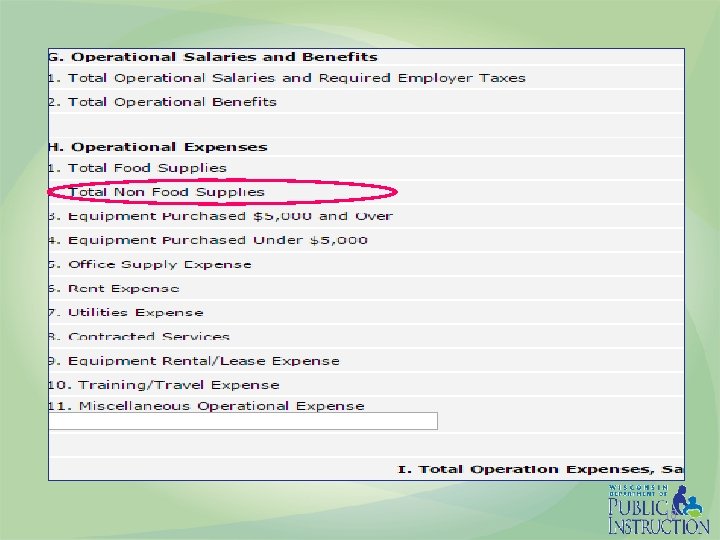
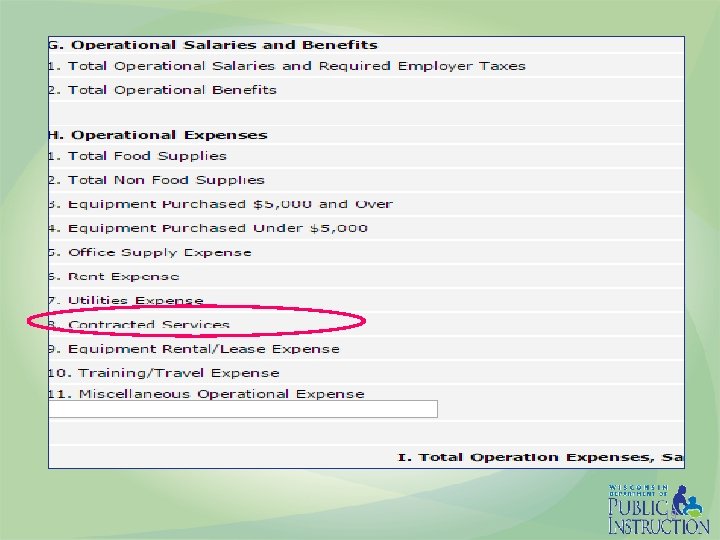
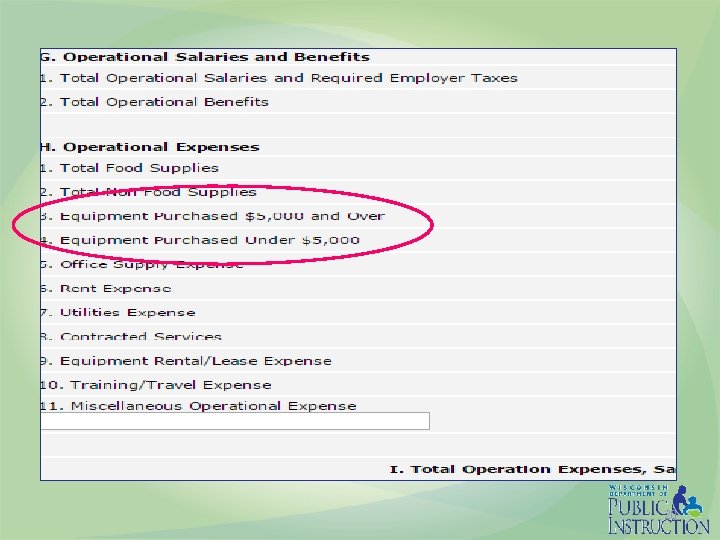
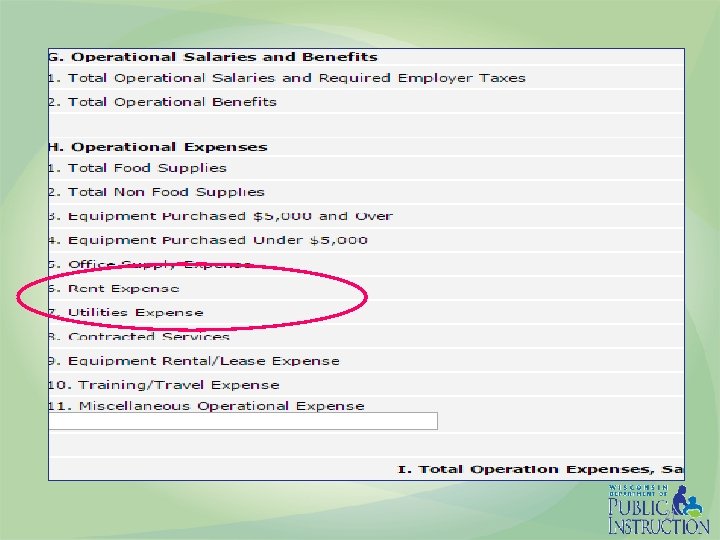
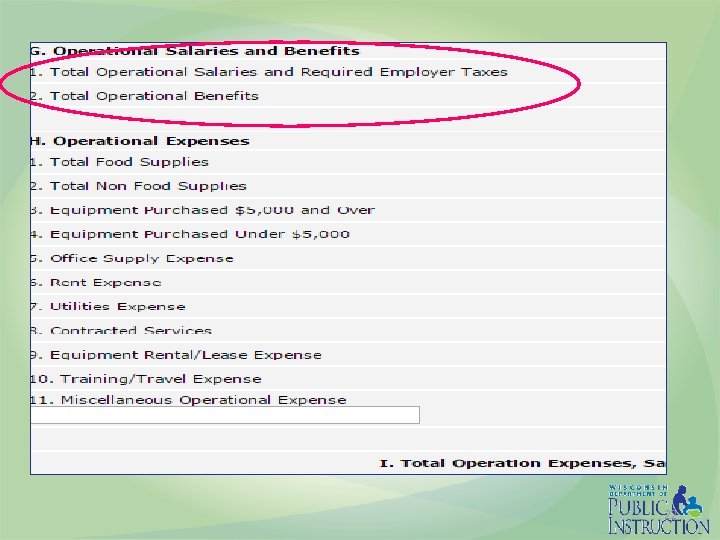
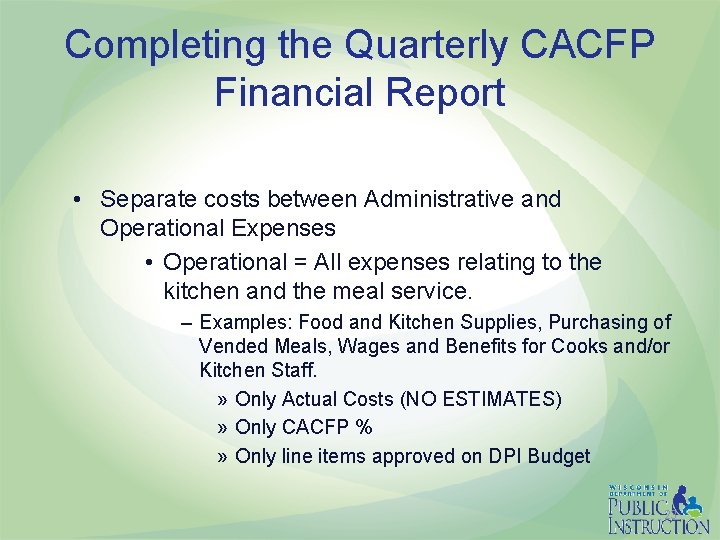
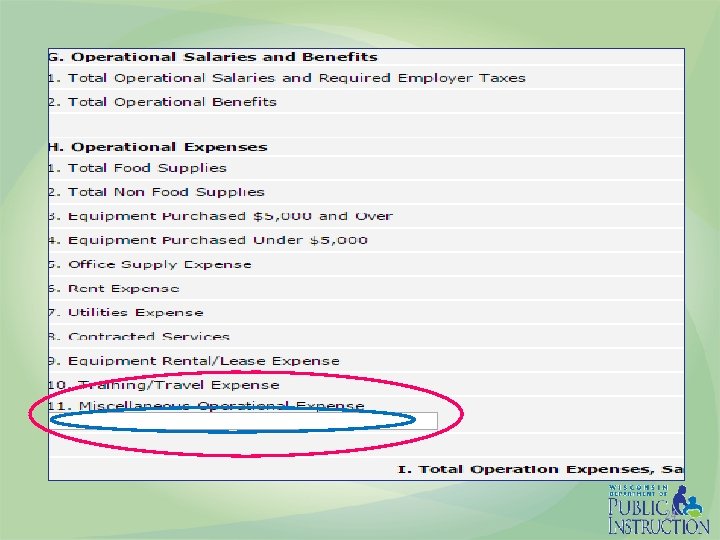
Completing the Quarterly CACFP Financial Report • Separate costs between Administrative and Operational Expenses • Operational = All expenses relating to the kitchen and the meal service. 15
16
17
18
19
20
21
22
Completing the Quarterly CACFP Financial Report • Separate costs between Administrative and Operational Expenses • Operational = All expenses relating to the kitchen and the meal service. – Examples: Food and Kitchen Supplies, Purchasing of Vended Meals, Wages and Benefits for Cooks and/or Kitchen Staff. » Only Actual Costs (NO ESTIMATES) » Only CACFP % » Only line items approved on DPI Budget 23
24
25
26
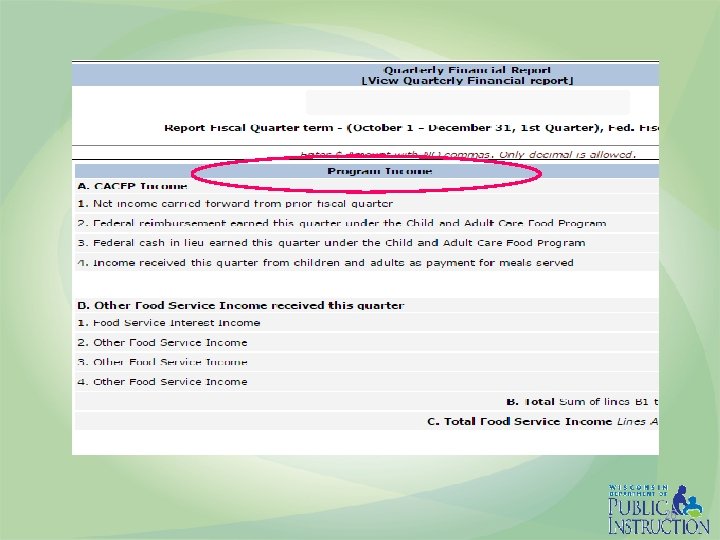
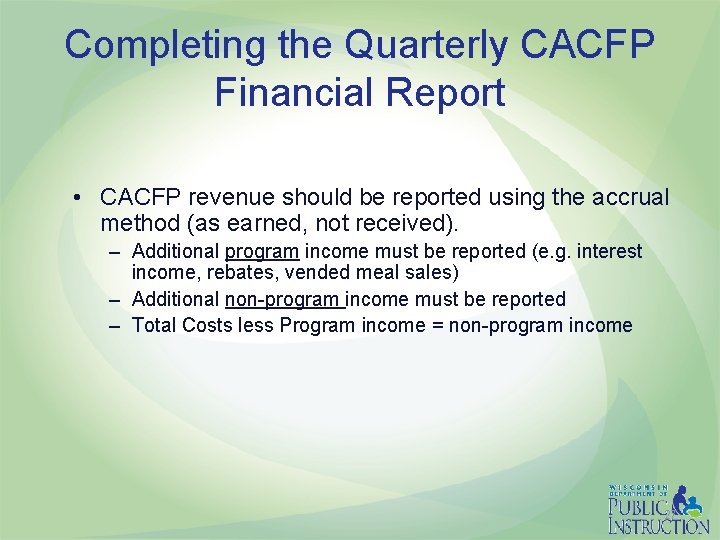
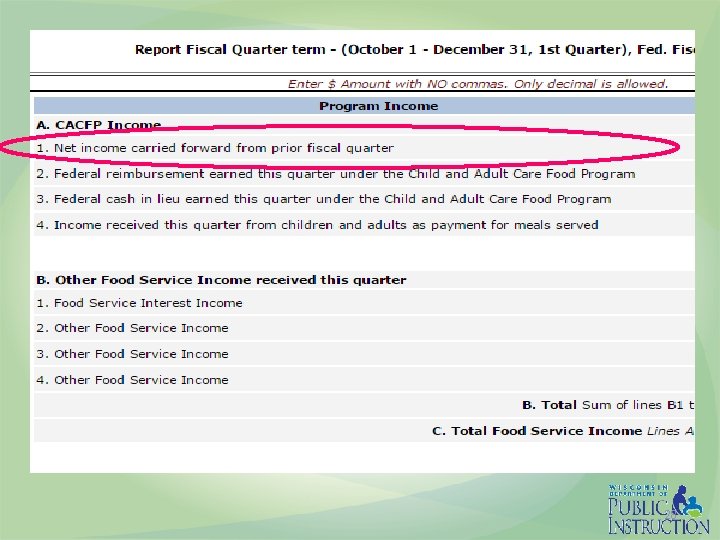
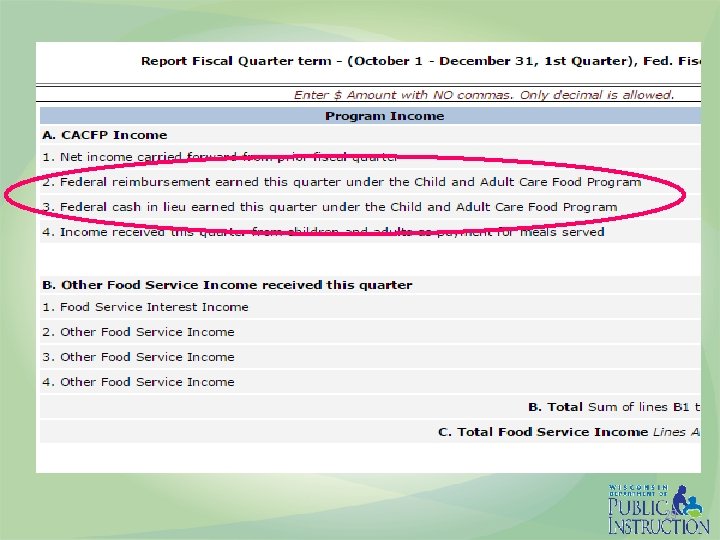
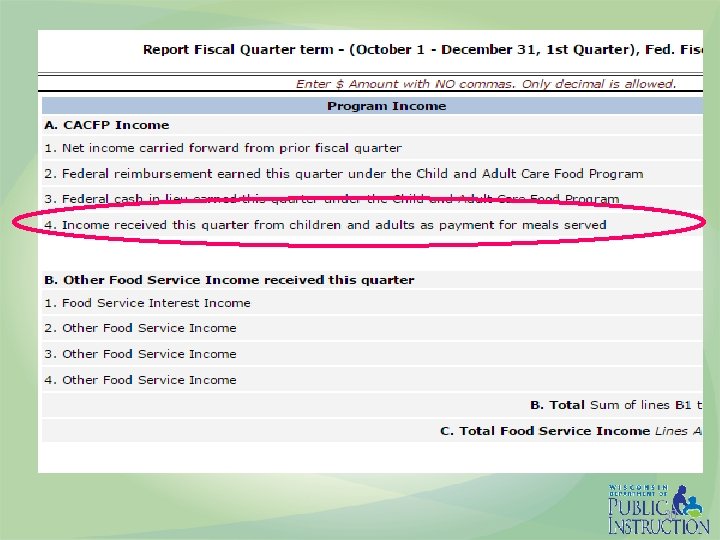
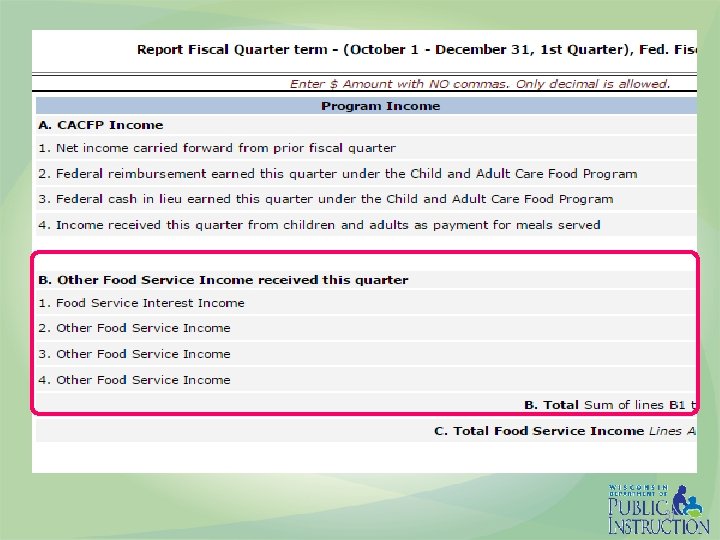
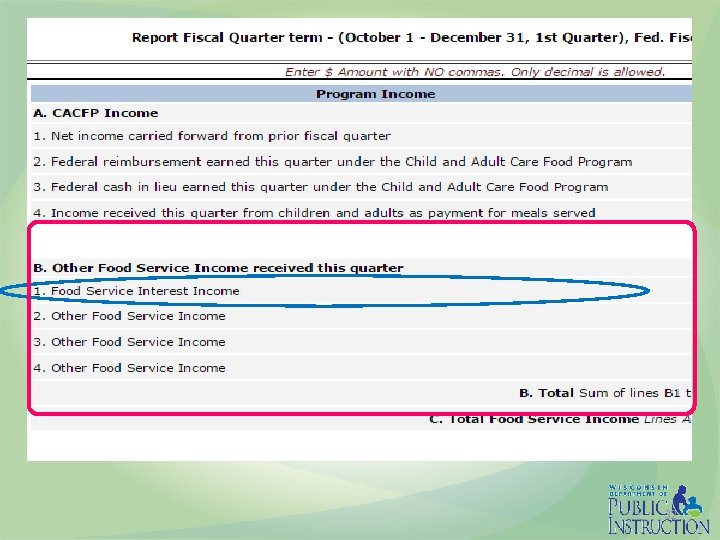
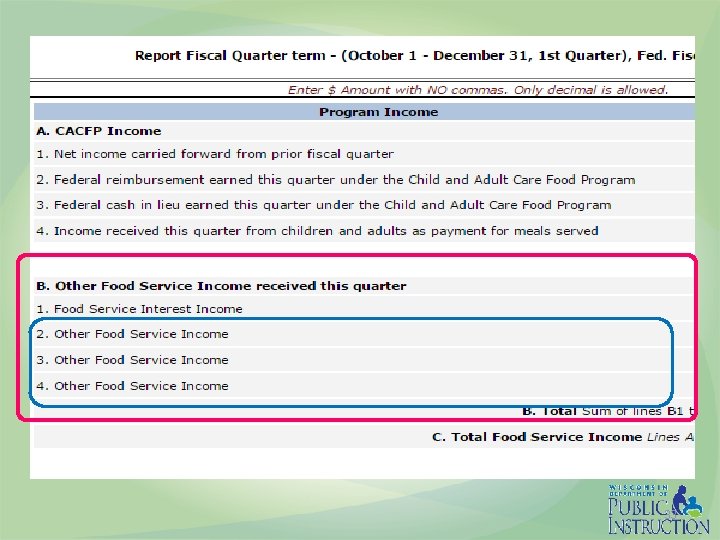
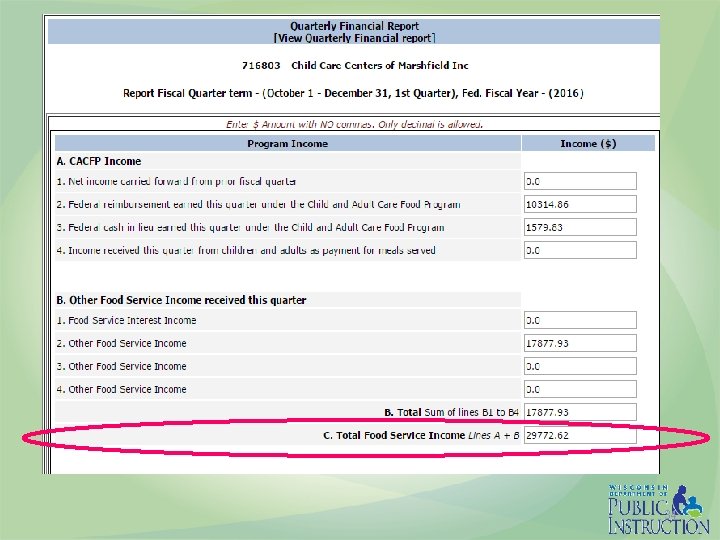
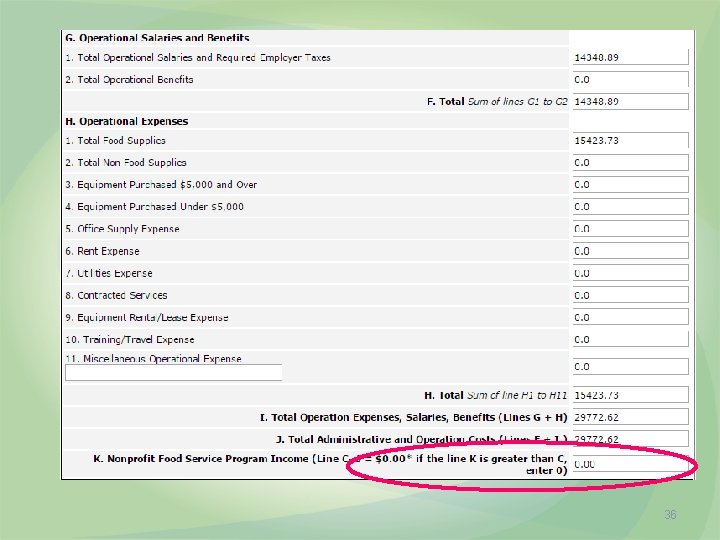
Completing the Quarterly CACFP Financial Report • CACFP revenue should be reported using the accrual method (as earned, not received). – Additional program income must be reported (e. g. interest income, rebates, vended meal sales) – Additional non-program income must be reported – Total Costs less Program income = non-program income 27
28
29
30
31
32
33
34
35
36
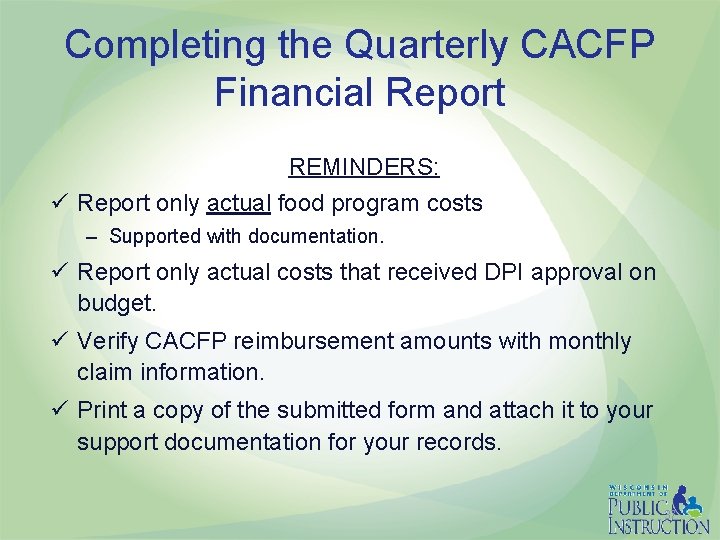
Completing the Quarterly CACFP Financial Report REMINDERS: ü Report only actual food program costs – Supported with documentation. ü Report only actual costs that received DPI approval on budget. ü Verify CACFP reimbursement amounts with monthly claim information. ü Print a copy of the submitted form and attach it to your support documentation for your records. 37
Financial Management Resources • Guidance Memo 11 – State agency Financial Management policy for participants in the Child and Adult Care Food Program – Website: http: //dpi. wi. gov/community-nutrition/cacfp/guidance-memo • FNS Instruction 796 -2 (rev. 4) – Abbreviated version – User Friendly – Available Electronically • 7 CFR 226 and 2 CFR 200 • Cari Ann Muggenburg – Phone: 608 -264 -9551 – E-mail: cari. muggenburg@dpi. wi. gov 38
In accordance with Federal civil rights law and U. S. Department of Agriculture (USDA) civil rights regulations and policies, the USDA, its Agencies, offices, and employees, and institutions participating in or administering USDA programs are prohibited from discriminating based on race, color, national origin, sex, disability, age, or reprisal or retaliation for prior civil rights activity in any program or activity conducted or funded by USDA. Persons with disabilities who require alternative means of communication for program information (e. g. Braille, large print, audiotape, American Sign Language, etc. ), should contact the Agency (State or local) where they applied for benefits. Individuals who are deaf, hard of hearing or have speech disabilities may contact USDA through the Federal Relay Service at (800) 877 -8339. Additionally, program information may be made available in languages other than English. To file a program complaint of discrimination, complete the USDA Program Discrimination Complaint Form, (AD-3027) found online at: http: //www. ascr. usda. gov/complaint_filing_cust. html, and at any USDA office, or write a letter addressed to USDA and provide in the letter all of the information requested in the form. To request a copy of the complaint form, call (866) 632 -9992. Submit your completed form or letter to USDA by: (1) mail: U. S. Department of Agriculture Office of the Assistant Secretary for Civil Rights 1400 Independence Avenue, SW Washington, D. C. 20250 -9410; (2) fax: (202) 690 -7442; or (3) email: program. intake@usda. gov. This institution is an equal opportunity provider.