
Instructional Systems Development HUMAN PERFORMANCE TECHNOLOGY LEARNING Training


- Slides: 31
Instructional Systems Development & HUMAN PERFORMANCE TECHNOLOGY LEARNING Training & Development Session for President University May 02, 2013 By Herry Suryawan
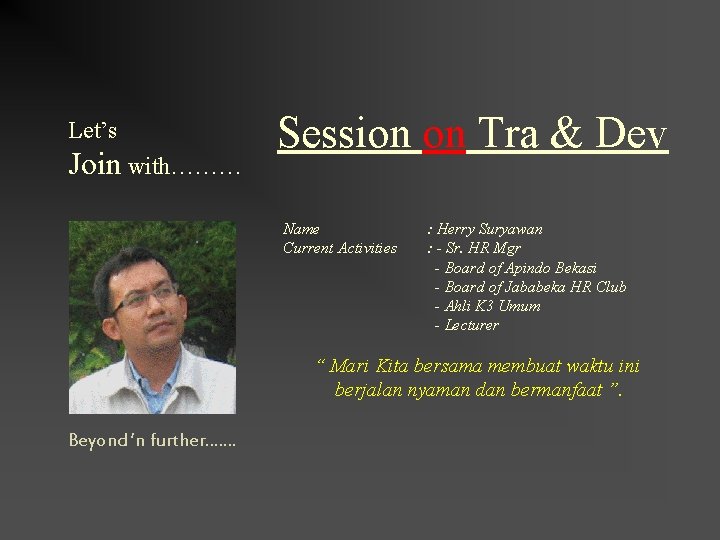
Let’s Join with……… Session on Tra & Dev Name Current Activities : Herry Suryawan : - Sr. HR Mgr - Board of Apindo Bekasi - Board of Jababeka HR Club - Ahli K 3 Umum - Lecturer “ Mari Kita bersama membuat waktu ini berjalan nyaman dan bermanfaat ”. Beyond ‘n further…. .
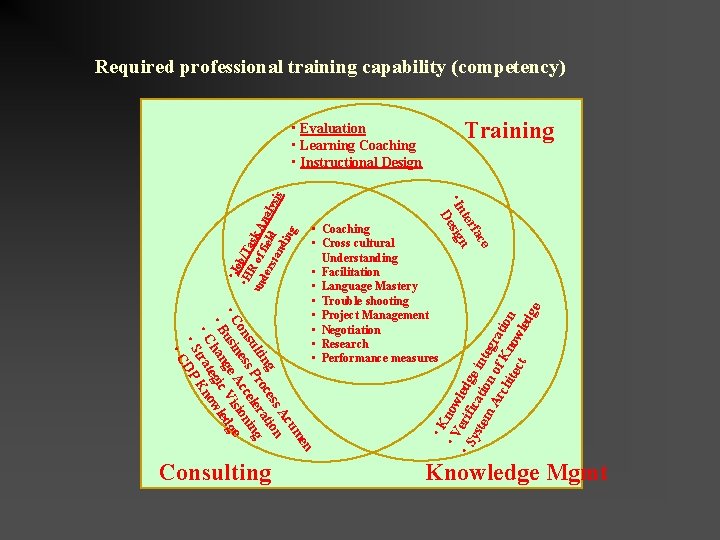
Required professional training capability (competency) Training e fac ter n • In esig D • Jo • H b/Ta un R of sk A der fie na lys sta ld is nd ing • Evaluation • Learning Coaching • Instructional Design Consulting • K • V now • S erifi ledg yst ca e in em tion te Ar of grat ch Kn ion ite ct owle dg e n e um Ac ss on ng ce ti lti ro ra g su s P ele in on es cc ion • C usin ge A Vis dge • B han egic owle • C trat Kn • S DP • Coaching • Cross cultural Understanding • Facilitation • Language Mastery • Trouble shooting • Project Management • Negotiation • Research • Performance measures Knowledge Mgmt
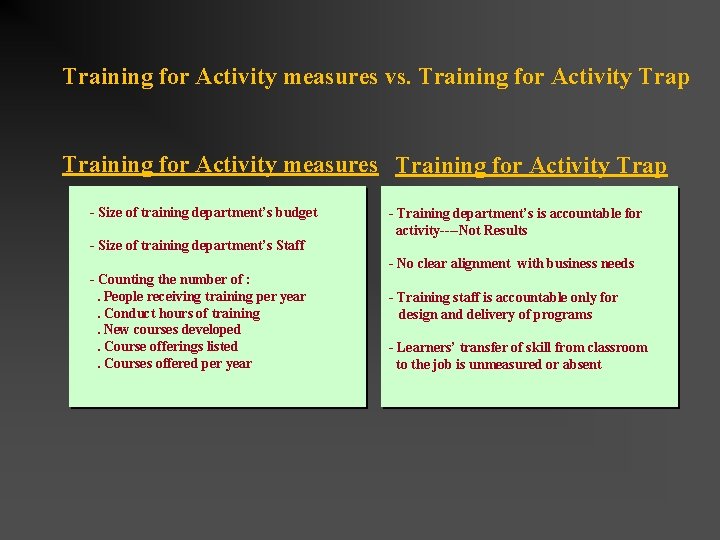
Training for Activity measures vs. Training for Activity Trap Training for Activity measures Training for Activity Trap - Size of training department’s budget - Training department’s is accountable for activity----Not Results - Size of training department’s Staff - No clear alignment with business needs - Counting the number of : . People receiving training per year. Conduct hours of training. New courses developed. Course offerings listed. Courses offered per year - Training staff is accountable only for design and delivery of programs - Learners’ transfer of skill from classroom to the job is unmeasured or absent
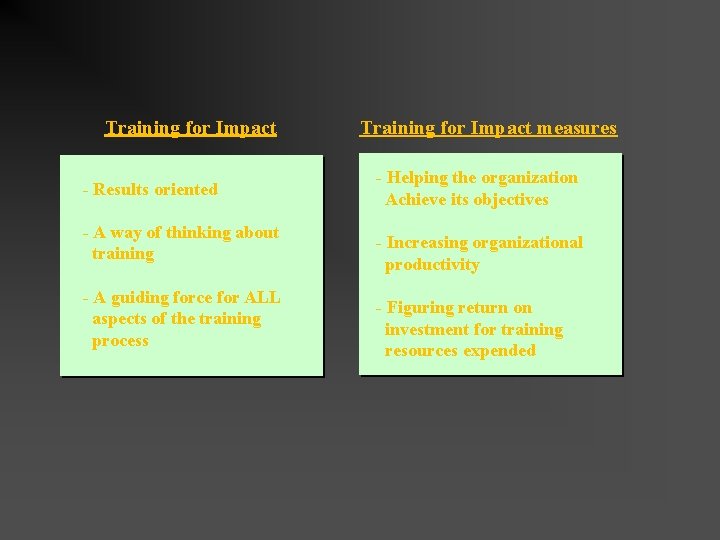
Training for Impact - Results oriented - A way of thinking about training - A guiding force for ALL aspects of the training process Training for Impact measures - Helping the organization Achieve its objectives - Increasing organizational productivity - Figuring return on investment for training resources expended
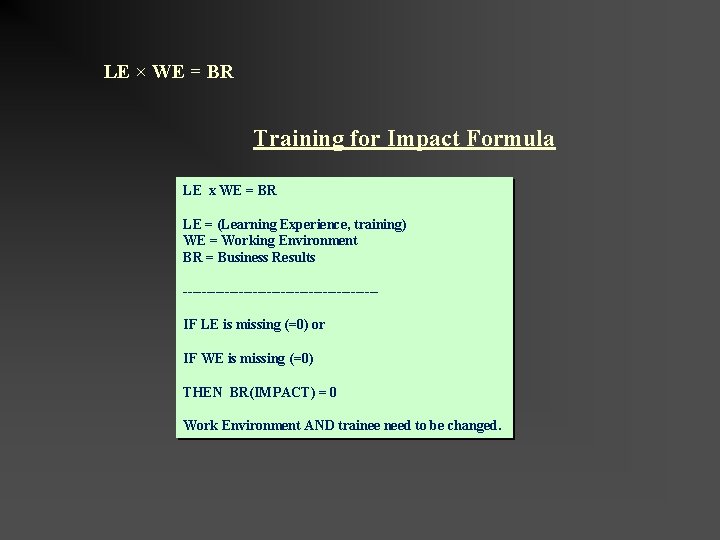
LE × WE = BR Training for Impact Formula LE x WE = BR LE = (Learning Experience, training) WE = Working Environment BR = Business Results ---------------------IF LE is missing (=0) or IF WE is missing (=0) THEN BR(IMPACT) = 0 Work Environment AND trainee need to be changed.
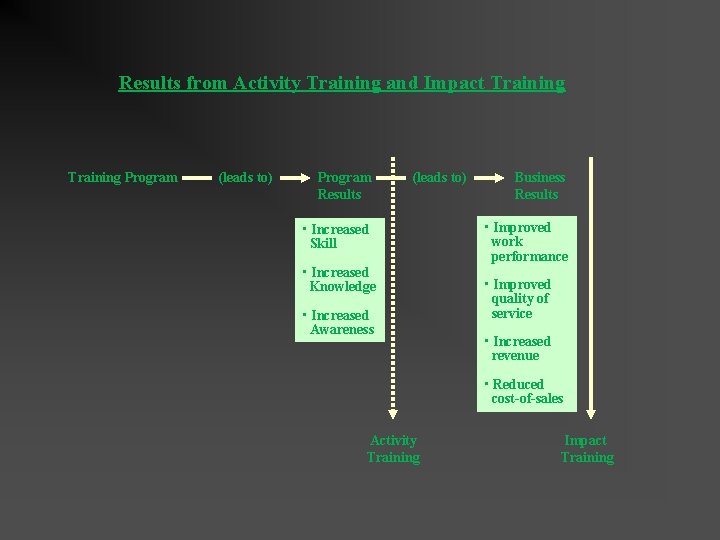
Results from Activity Training and Impact Training Program (leads to) Program Results (leads to) • Increased Skill • Increased Knowledge • Increased Awareness Business Results • Improved work performance • Improved quality of service • Increased revenue • Reduced cost-of-sales Activity Training Impact Training
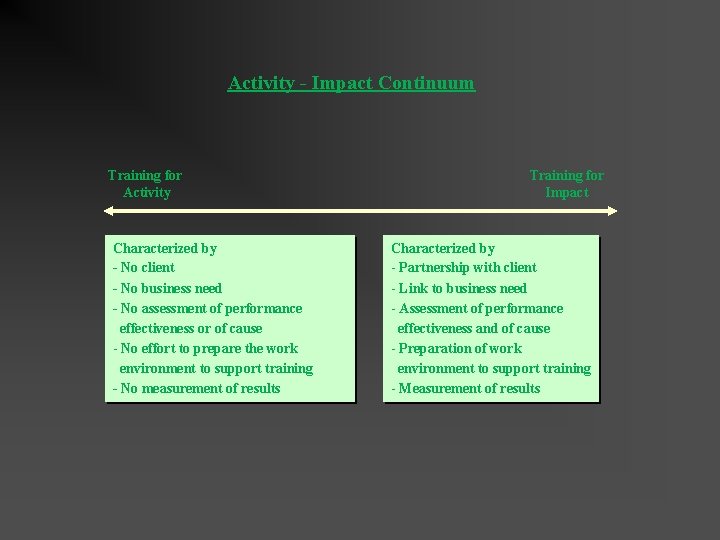
Activity - Impact Continuum Training for Activity Characterized by - No client - No business need - No assessment of performance effectiveness or of cause - No effort to prepare the work environment to support training - No measurement of results Training for Impact Characterized by - Partnership with client - Link to business need - Assessment of performance effectiveness and of cause - Preparation of work environment to support training - Measurement of results
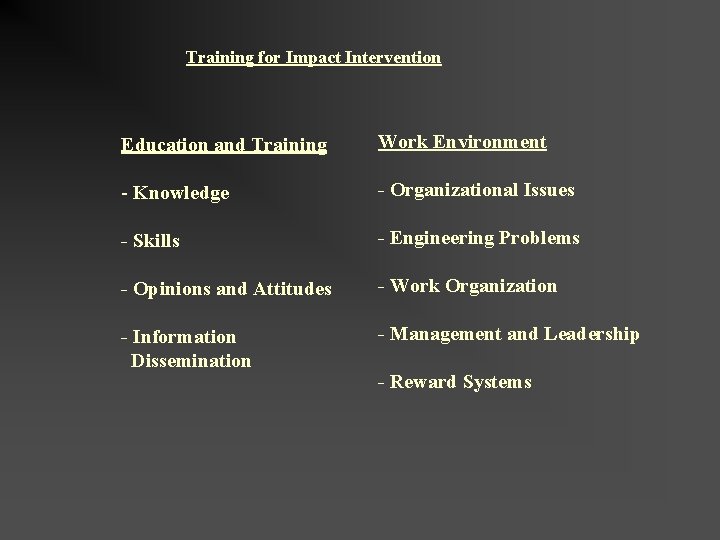
Training for Impact Intervention Education and Training Work Environment - Knowledge - Organizational Issues - Skills - Engineering Problems - Opinions and Attitudes - Work Organization - Information Dissemination - Management and Leadership - Reward Systems
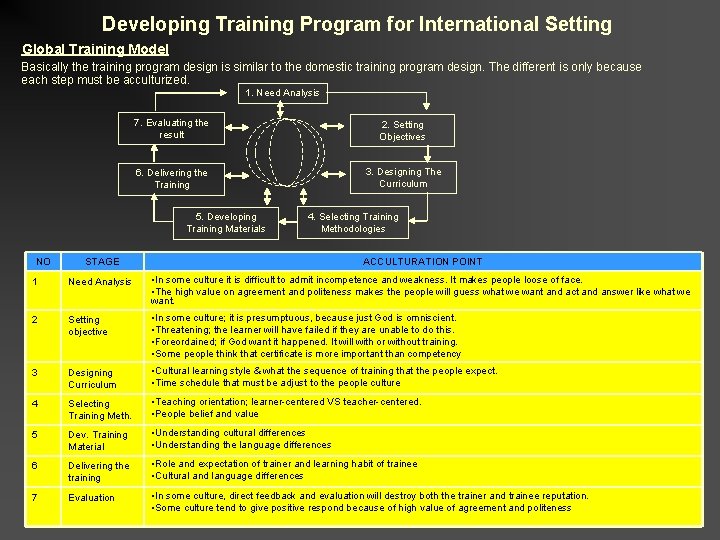
Developing Training Program for International Setting Global Training Model Basically the training program design is similar to the domestic training program design. The different is only because each step must be acculturized. 1. Need Analysis 7. Evaluating the result 2. Setting Objectives 6. Delivering the Training 3. Designing The Curriculum 5. Developing Training Materials NO 4. Selecting Training Methodologies STAGE ACCULTURATION POINT 1 Need Analysis • In some culture it is difficult to admit incompetence and weakness. It makes people loose of face. • The high value on agreement and politeness makes the people will guess what we want and act and answer like what we want. 2 Setting objective • In some culture; it is presumptuous, because just God is omniscient. • Threatening; the learner will have failed if they are unable to do this. • Foreordained; if God want it happened. It will with or without training. • Some people think that certificate is more important than competency 3 Designing Curriculum • Cultural learning style & what the sequence of training that the people expect. • Time schedule that must be adjust to the people culture 4 Selecting Training Meth. • Teaching orientation; learner-centered VS teacher-centered. • People belief and value 5 Dev. Training Material • Understanding cultural differences • Understanding the language differences 6 Delivering the training • Role and expectation of trainer and learning habit of trainee • Cultural and language differences 7 Evaluation • In some culture, direct feedback and evaluation will destroy both the trainer and trainee reputation. • Some culture tend to give positive respond because of high value of agreement and politeness
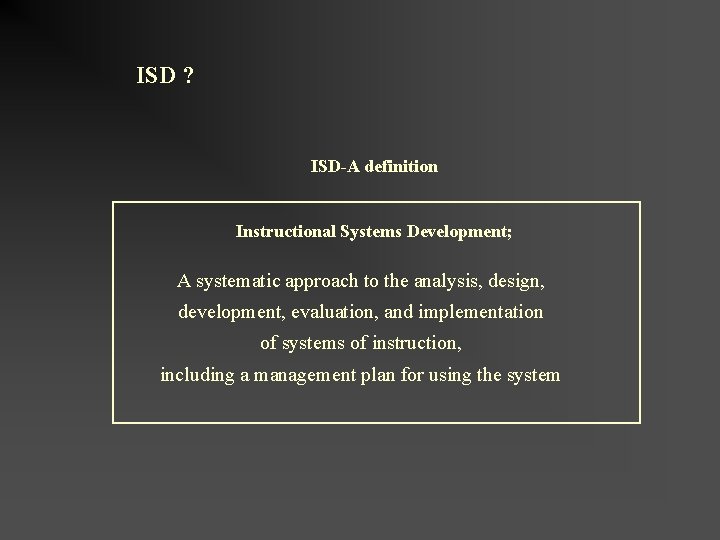
ISD ? ISD-A definition Instructional Systems Development; A systematic approach to the analysis, design, development, evaluation, and implementation of systems of instruction, including a management plan for using the system
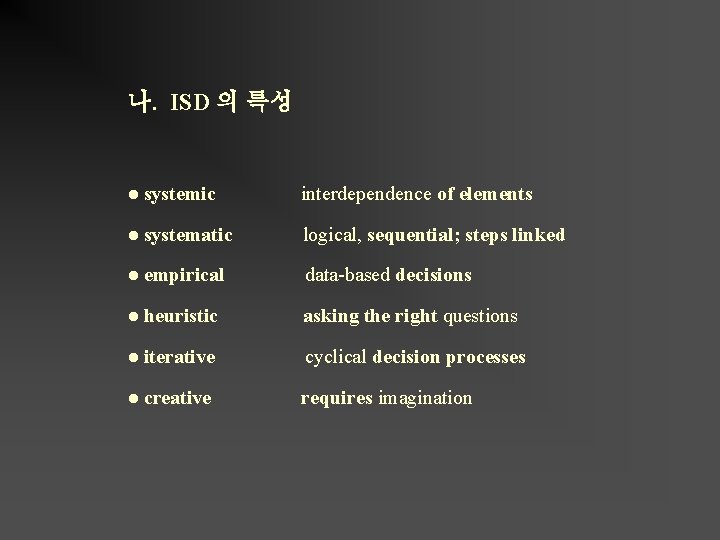
나. ISD 의 특성 ● systemic interdependence of elements ● systematic logical, sequential; steps linked ● empirical data-based decisions ● heuristic asking the right questions ● iterative cyclical decision processes ● creative requires imagination
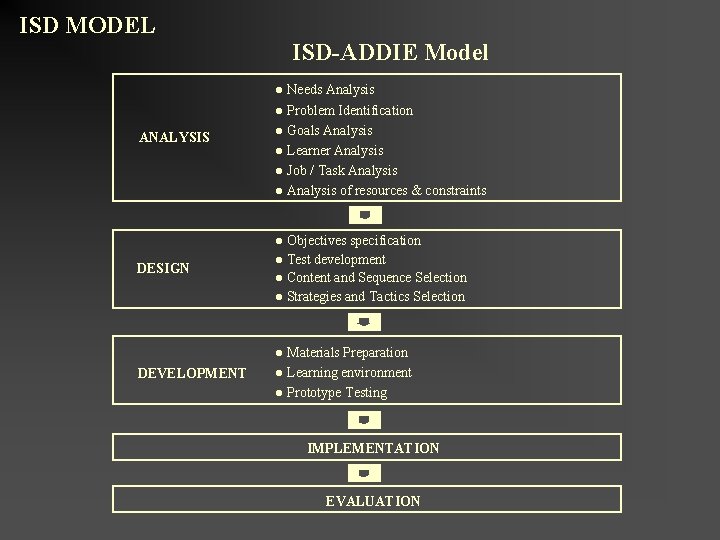
ISD MODEL ISD-ADDIE Model ANALYSIS ● Needs Analysis ● Problem Identification ● Goals Analysis ● Learner Analysis ● Job / Task Analysis ● Analysis of resources & constraints DESIGN ● Objectives specification ● Test development ● Content and Sequence Selection ● Strategies and Tactics Selection DEVELOPMENT ● Materials Preparation ● Learning environment ● Prototype Testing IMPLEMENTATION EVALUATION
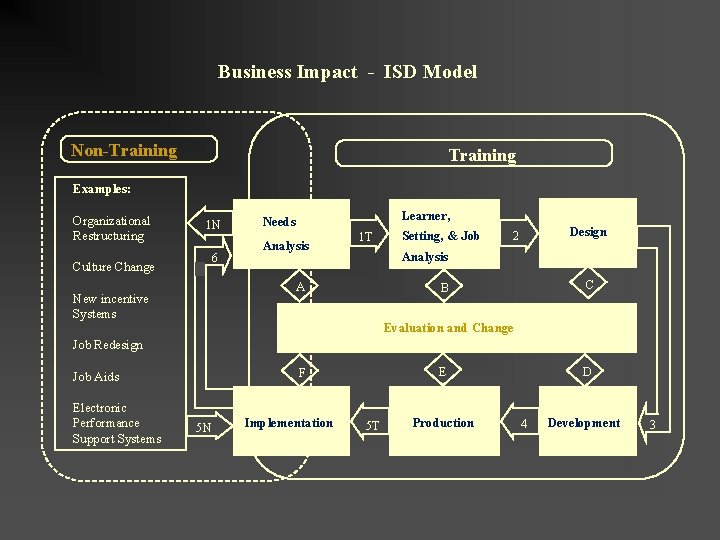
Business Impact - ISD Model Non-Training Examples: Organizational Restructuring Culture Change 1 N 6 Learner, Needs Analysis 1 T Design 2 Analysis A New incentive Systems Setting, & Job C B Evaluation and Change Job Redesign Electronic Performance Support Systems 5 N Implementation D E F Job Aids 5 T Production 4 Development 3
라. ISD 장단점 Advantages of ISD Limitations of ISD
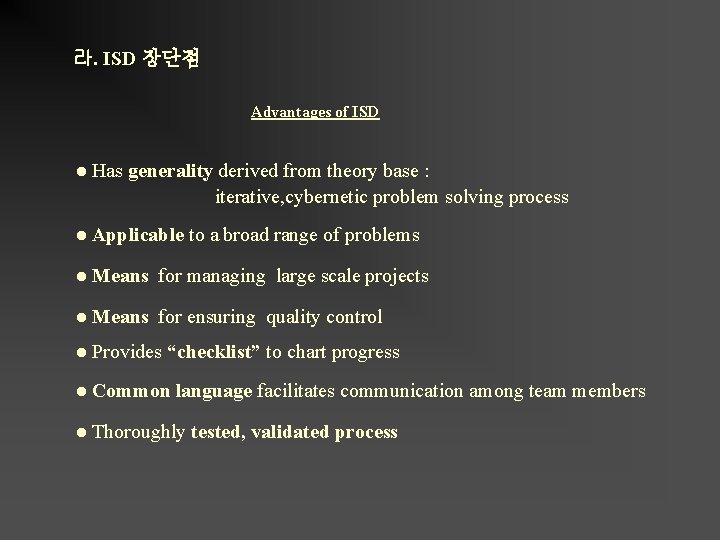
라. ISD 장단점 Advantages of ISD ● Has generality derived from theory base : iterative, cybernetic problem solving process ● Applicable to a broad range of problems ● Means for managing large scale projects ● Means for ensuring quality control ● Provides “checklist” to chart progress ● Common language facilitates communication among team members ● Thoroughly tested, validated process
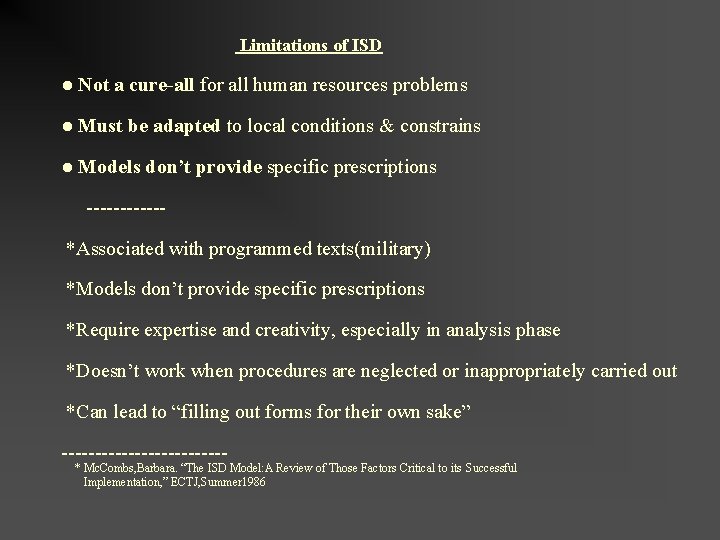
Limitations of ISD ● Not a cure-all for all human resources problems ● Must be adapted to local conditions & constrains ● Models don’t provide specific prescriptions ------*Associated with programmed texts(military) *Models don’t provide specific prescriptions *Require expertise and creativity, especially in analysis phase *Doesn’t work when procedures are neglected or inappropriately carried out *Can lead to “filling out forms for their own sake” ------------- * Mc. Combs, Barbara. “The ISD Model: A Review of Those Factors Critical to its Successful Implementation, ” ECTJ, Summer 1986
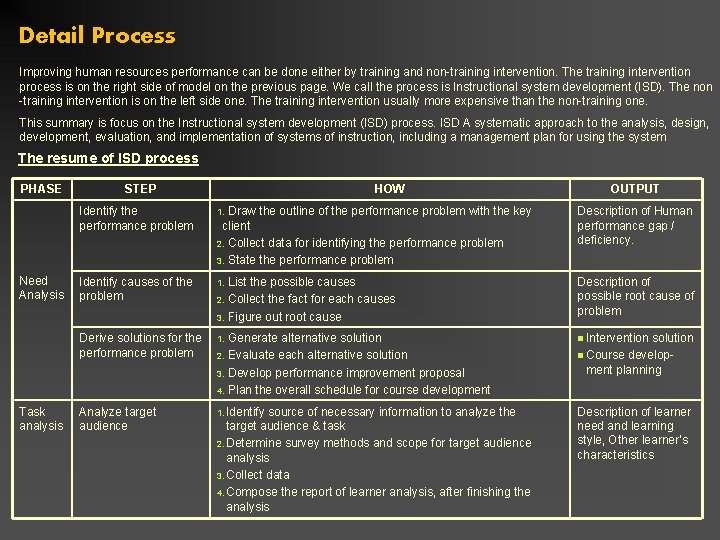
Detail Process Improving human resources performance can be done either by training and non-training intervention. The training intervention process is on the right side of model on the previous page. We call the process is Instructional system development (ISD). The non -training intervention is on the left side one. The training intervention usually more expensive than the non-training one. This summary is focus on the Instructional system development (ISD) process. ISD A systematic approach to the analysis, design, development, evaluation, and implementation of systems of instruction, including a management plan for using the system The resume of ISD process PHASE Need Analysis Task analysis STEP HOW OUTPUT Identify the performance problem 1. Draw the outline of the performance problem with the key client 2. Collect data for identifying the performance problem 3. State the performance problem Description of Human performance gap / deficiency. Identify causes of the problem 1. List the possible causes 2. Collect the fact for each causes 3. Figure out root cause Description of possible root cause of problem Derive solutions for the performance problem 1. Generate alternative solution 2. Evaluate each alternative solution 3. Develop performance improvement proposal 4. Plan the overall schedule for course development n Intervention Analyze target audience 1. Identify Description of learner need and learning style, Other learner’s characteristics source of necessary information to analyze the target audience & task 2. Determine survey methods and scope for target audience analysis 3. Collect data 4. Compose the report of learner analysis, after finishing the analysis solution n Course development planning
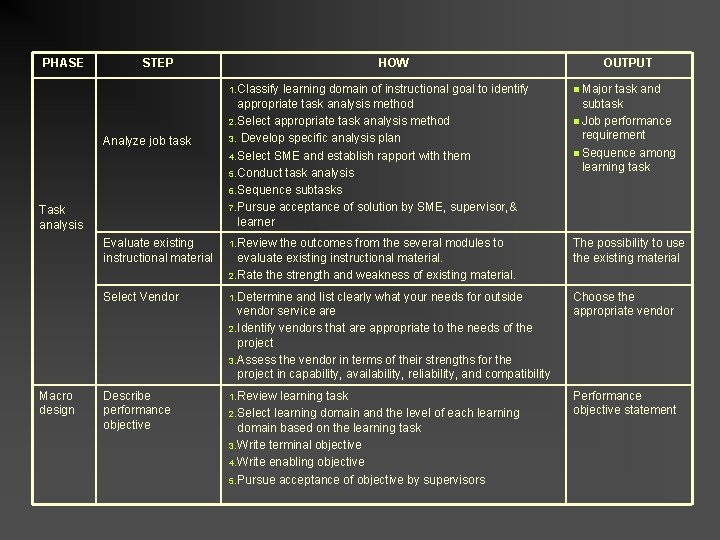
PHASE STEP OUTPUT 1. Classify learning domain of instructional goal to identify appropriate task analysis method 2. Select appropriate task analysis method 3. Develop specific analysis plan 4. Select SME and establish rapport with them 5. Conduct task analysis 6. Sequence subtasks 7. Pursue acceptance of solution by SME, supervisor, & learner n Major Evaluate existing instructional material 1. Review the outcomes from the several modules to evaluate existing instructional material. 2. Rate the strength and weakness of existing material. The possibility to use the existing material Select Vendor 1. Determine and list clearly what your needs for outside vendor service are 2. Identify vendors that are appropriate to the needs of the project 3. Assess the vendor in terms of their strengths for the project in capability, availability, reliability, and compatibility Choose the appropriate vendor Describe performance objective 1. Review Performance objective statement Analyze job task Task analysis Macro design HOW learning task 2. Select learning domain and the level of each learning domain based on the learning task 3. Write terminal objective 4. Write enabling objective 5. Pursue acceptance of objective by supervisors task and subtask n Job performance requirement n Sequence among learning task
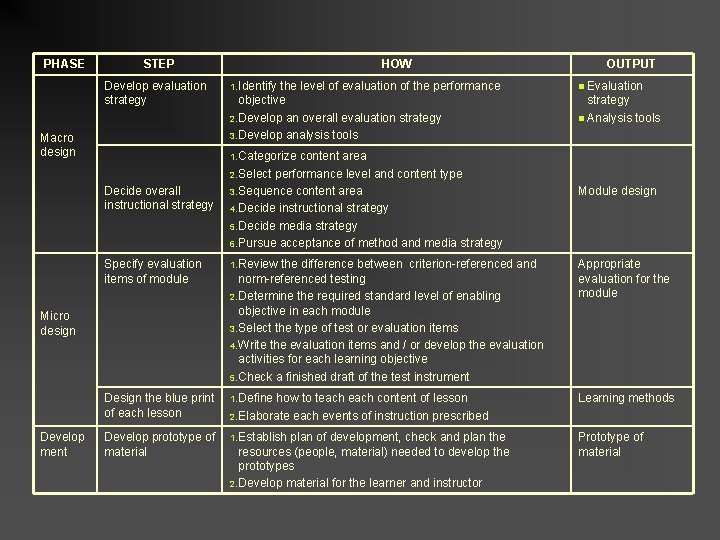
PHASE STEP Develop evaluation strategy Macro design 1. Identify the level of evaluation of the performance objective 2. Develop an overall evaluation strategy 3. Develop analysis tools content area 2. Select performance level and content type 3. Sequence content area 4. Decide instructional strategy 5. Decide media strategy 6. Pursue acceptance of method and media strategy OUTPUT n Evaluation strategy n Analysis tools 1. Categorize Decide overall instructional strategy Module design Specify evaluation items of module 1. Review the difference between criterion-referenced and norm-referenced testing 2. Determine the required standard level of enabling objective in each module 3. Select the type of test or evaluation items 4. Write the evaluation items and / or develop the evaluation activities for each learning objective 5. Check a finished draft of the test instrument Appropriate evaluation for the module Design the blue print of each lesson 1. Define how to teach content of lesson 2. Elaborate each events of instruction prescribed Learning methods Develop prototype of material 1. Establish Prototype of material Micro design Develop ment HOW plan of development, check and plan the resources (people, material) needed to develop the prototypes 2. Develop material for the learner and instructor
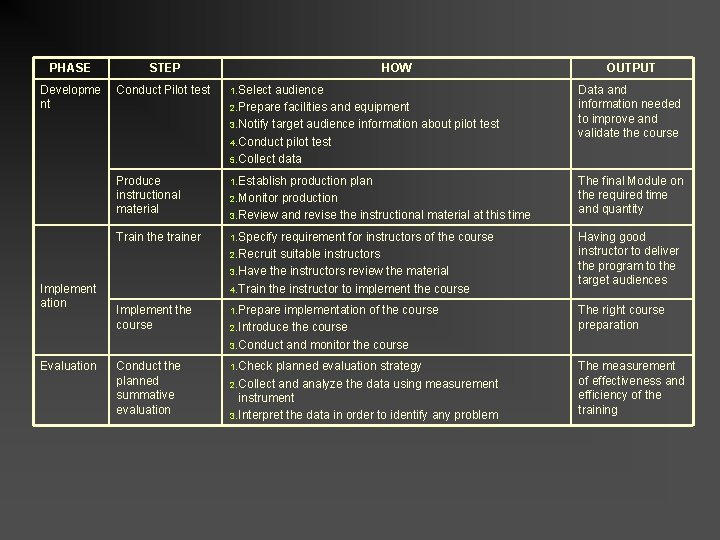
PHASE STEP Developme nt Conduct Pilot test 1. Select audience 2. Prepare facilities and equipment 3. Notify target audience information about pilot test 4. Conduct pilot test 5. Collect data Data and information needed to improve and validate the course Produce instructional material 1. Establish production plan 2. Monitor production 3. Review and revise the instructional material at this time The final Module on the required time and quantity Train the trainer 1. Specify requirement for instructors of the course 2. Recruit suitable instructors 3. Have the instructors review the material 4. Train the instructor to implement the course Having good instructor to deliver the program to the target audiences Implement the course 1. Prepare implementation of the course 2. Introduce the course 3. Conduct and monitor the course The right course preparation Conduct the planned summative evaluation 1. Check The measurement of effectiveness and efficiency of the training Implement ation Evaluation HOW planned evaluation strategy 2. Collect and analyze the data using measurement instrument 3. Interpret the data in order to identify any problem OUTPUT
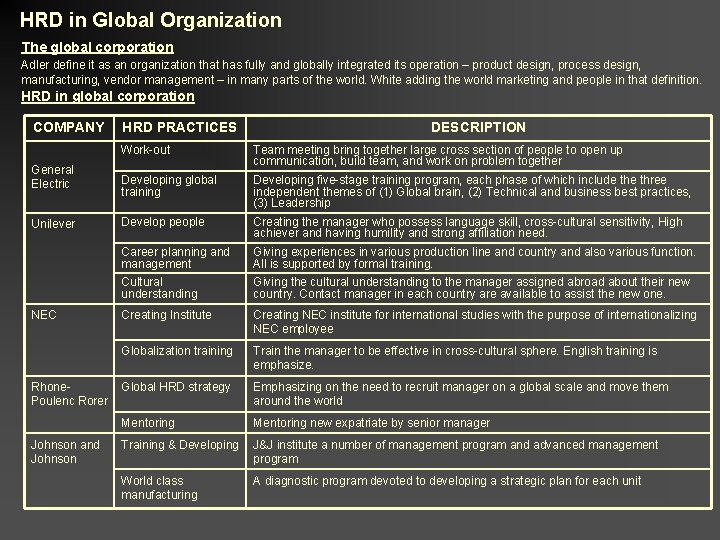
HRD in Global Organization The global corporation Adler define it as an organization that has fully and globally integrated its operation – product design, process design, manufacturing, vendor management – in many parts of the world. White adding the world marketing and people in that definition. HRD in global corporation COMPANY General Electric Unilever NEC Rhone. Poulenc Rorer Johnson and Johnson HRD PRACTICES DESCRIPTION Work-out Team meeting bring together large cross section of people to open up communication, build team, and work on problem together Developing global training Developing five-stage training program, each phase of which include three independent themes of (1) Global brain, (2) Technical and business best practices, (3) Leadership Develop people Creating the manager who possess language skill, cross-cultural sensitivity, High achiever and having humility and strong affiliation need. Career planning and management Giving experiences in various production line and country and also various function. All is supported by formal training. Cultural understanding Giving the cultural understanding to the manager assigned abroad about their new country. Contact manager in each country are available to assist the new one. Creating Institute Creating NEC institute for international studies with the purpose of internationalizing NEC employee Globalization training Train the manager to be effective in cross-cultural sphere. English training is emphasize. Global HRD strategy Emphasizing on the need to recruit manager on a global scale and move them around the world Mentoring new expatriate by senior manager Training & Developing J&J institute a number of management program and advanced management program World class manufacturing A diagnostic program devoted to developing a strategic plan for each unit
Public and Nonprofit Global Organization The goal of Public and Nonprofit Global Organization Focusing on the development of people and nation around the world, especially the developing countries of Asia, Africa, and Latin America. Public Global Organization ORNANIZATION HRD PRACTICES United Nation Development Program Delivering training and technical assistance program to develop nation’s capability in 6 specific areas: Poverty eradication, Environmental protection, Management development, Technical cooperation among developing countries, Technology country, Promotion of woman in development International Labor Office Providing the training to Improve working condition and promote full employment, Occupational safety and health, labormanagement relation, woman and migrant workers. This organization also providing various vocational training World Bank Providing training to the leader of government and non-government, so they are able to make better plan and mage their economic and social development program Food and Agriculture Organization Providing technical assistance to improve the production and distribution of food and agricultural products and to raise the level of nutrition and standard of living of people in developing nation United Nation Indus-trial Development Organization Providing technical assistance in global, regional, national, and sectoral level to promote and accelerate industrial around the world Nonprofit development global organization ORGANIZATION HRD PRACTICES Organization for Educational Resources & Tech. Training Providing training that will lead toward employment and technical assistance leading toward sustainable growth for vocational education institutions International Red Cross Training to whom who carry out the rehabilitative as well as the emergency work. World Rehabilitation Fund Train the disable people World Education Training low-income people for skill which will increase their incomes & improve communities Global HRD Association ORGANIZATION HRD PRACTICES Int. Federation of Training & Development Organization Improving HRD through holding annual world training & Development congress, Assisting in the formation of new national HRD organizations, and Encouraging worldwide cooperation and assistance among global HRD practitioner Interman Research on global management issue and publish technical guides and policy paper and hold regional conference. Int. Society for intercultural education, training& research Development and application of knowledge, values and skill which enable effective intercultural, interracial, and interethnic action of individual, group, organization and community levels Society for Int. development Technical workgroup in many areas, annual conferences, monthly luncheons, and int. development forum
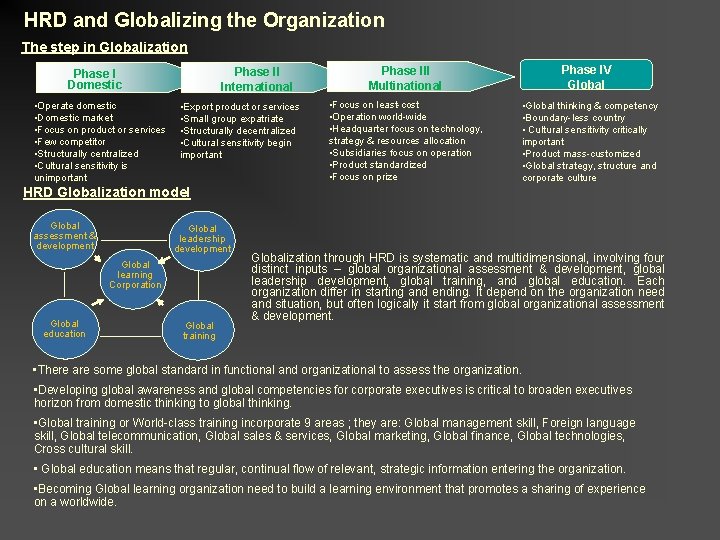
HRD and Globalizing the Organization The step in Globalization Phase II International Phase I Domestic • Operate domestic • Domestic market • Focus on product or services • Few competitor • Structurally centralized • Cultural sensitivity is unimportant • Export product or services • Small group expatriate • Structurally decentralized • Cultural sensitivity begin important Phase III Multinational Phase IV Global • Focus on least-cost • Operation world-wide • Headquarter focus on technology, strategy & resources allocation • Subsidiaries focus on operation • Product standardized • Focus on prize • Global thinking & competency • Boundary-less country • Cultural sensitivity critically important • Product mass-customized • Global strategy, structure and corporate culture HRD Globalization model Global assessment & development Global leadership development Global learning Corporation Global education Global training Globalization through HRD is systematic and multidimensional, involving four distinct inputs – global organizational assessment & development, global leadership development, global training, and global education. Each organization differ in starting and ending. It depend on the organization need and situation, but often logically it start from global organizational assessment & development. • There are some global standard in functional and organizational to assess the organization. • Developing global awareness and global competencies for corporate executives is critical to broaden executives horizon from domestic thinking to global thinking. • Global training or World-class training incorporate 9 areas ; they are: Global management skill, Foreign language skill, Global telecommunication, Global sales & services, Global marketing, Global finance, Global technologies, Cross cultural skill. • Global education means that regular, continual flow of relevant, strategic information entering the organization. • Becoming Global learning organization need to build a learning environment that promotes a sharing of experience on a worldwide.
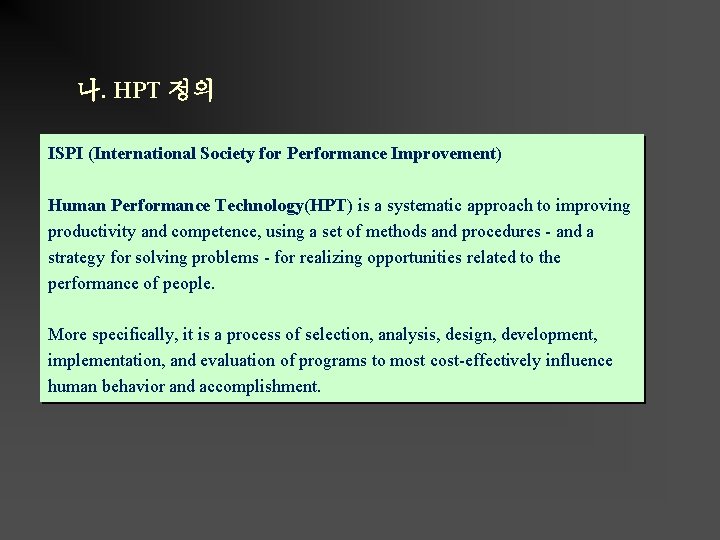
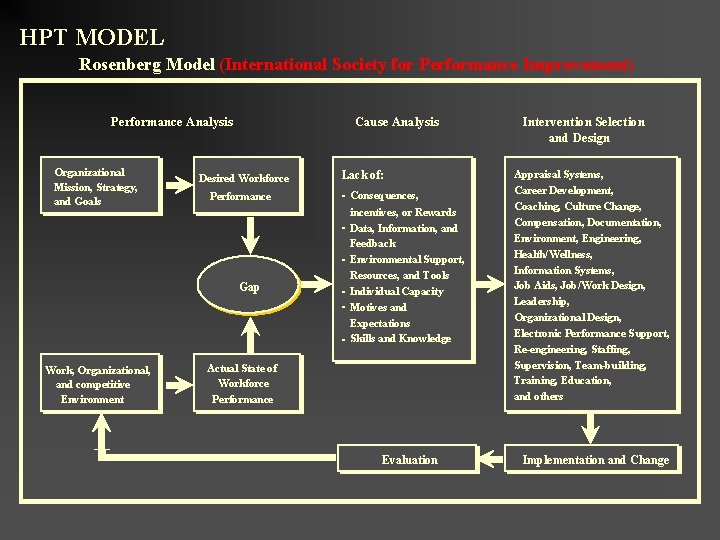
나. HPT 정의 ISPI (International Society for Performance Improvement) Human Performance Technology(HPT) is a systematic approach to improving productivity and competence, using a set of methods and procedures - and a strategy for solving problems - for realizing opportunities related to the performance of people. More specifically, it is a process of selection, analysis, design, development, implementation, and evaluation of programs to most cost-effectively influence human behavior and accomplishment.
HPT MODEL Rosenberg Model (International Society for Performance Improvement) Performance Analysis Organizational Mission, Strategy, and Goals Cause Analysis Desired Workforce Performance Lack of: ● ● ● Gap ● ● ● Work, Organizational, and competitive Environment Consequences, incentives, or Rewards Data, Information, and Feedback Environmental Support, Resources, and Tools Individual Capacity Motives and Expectations Skills and Knowledge Actual State of Workforce Performance Evaluation Intervention Selection and Design Appraisal Systems, Career Development, Coaching, Culture Change, Compensation, Documentation, Environment, Engineering, Health/Wellness, Information Systems, Job Aids, Job/Work Design, Leadership, Organizational Design, Electronic Performance Support, Re-engineering, Staffing, Supervision, Team-building, Training, Education, and others Implementation and Change
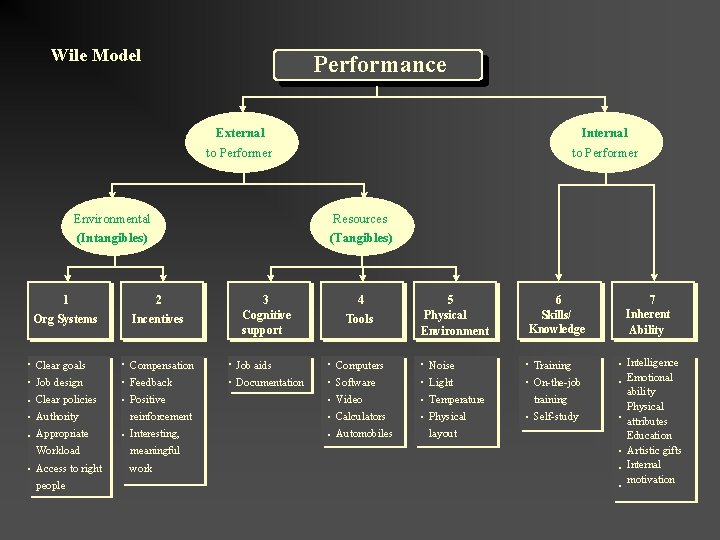
Wile Model Performance External Internal to Performer Environmental (Intangibles) Resources (Tangibles) 1 2 Org Systems Incentives 3 Cognitive support 4 Tools 5 Physical Environment 6 Skills/ Knowledge 7 Inherent Ability ● Clear goals ● Compensation ● Job aids ● Computers ● Noise ● Training ● ● Job design ● Feedback ● Documentation ● Software ● Light ● On-the-job ● ● Clear policies ● Positive ● Video ● Temperature ● Authority reinforcement ● Calculators ● Physical ● Appropriate Interesting, ● Automobiles ● ● training ● Self-study ● layout Workload meaningful ● Access to right work ● people ● Intelligence Emotional ability Physical attributes Education Artistic gifts Internal motivation
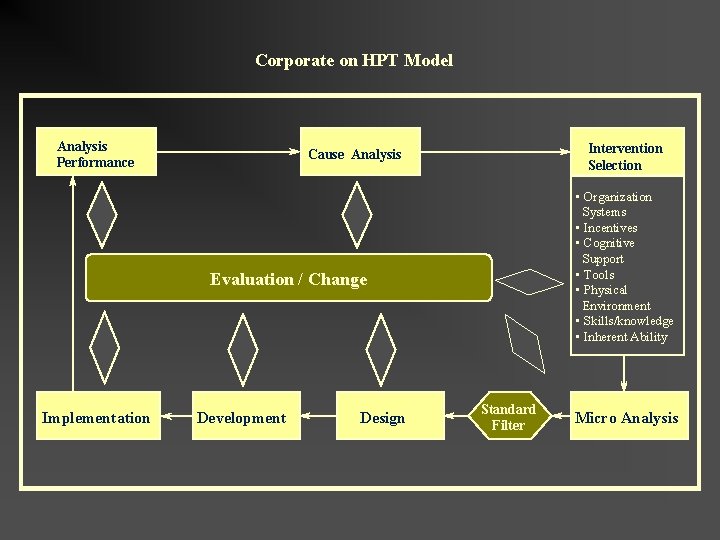
Corporate on HPT Model Analysis Performance Intervention Selection Cause Analysis • Organization Systems • Incentives • Cognitive Support • Tools • Physical Environment • Skills/knowledge • Inherent Ability Evaluation / Change Implementation Development Design Standard Filter Micro Analysis
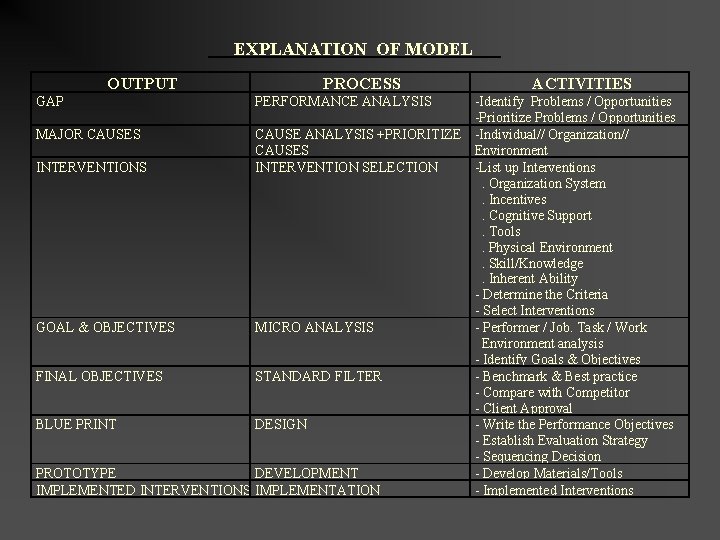
EXPLANATION OF MODEL OUTPUT GAP PROCESS PERFORMANCE ANALYSIS ACTIVITIES -Identify Problems / Opportunities -Prioritize Problems / Opportunities MAJOR CAUSES CAUSE ANALYSIS +PRIORITIZE -Individual// Organization// CAUSES Environment INTERVENTIONS INTERVENTION SELECTION -List up Interventions. Organization System. Incentives. Cognitive Support. Tools. Physical Environment. Skill/Knowledge. Inherent Ability - Determine the Criteria - Select Interventions GOAL & OBJECTIVES MICRO ANALYSIS - Performer / Job. Task / Work Environment analysis - Identify Goals & Objectives FINAL OBJECTIVES STANDARD FILTER - Benchmark & Best practice - Compare with Competitor - Client Approval BLUE PRINT DESIGN - Write the Performance Objectives - Establish Evaluation Strategy - Sequencing Decision PROTOTYPE DEVELOPMENT - Develop Materials/Tools IMPLEMENTED INTERVENTIONS IMPLEMENTATION - Implemented Interventions
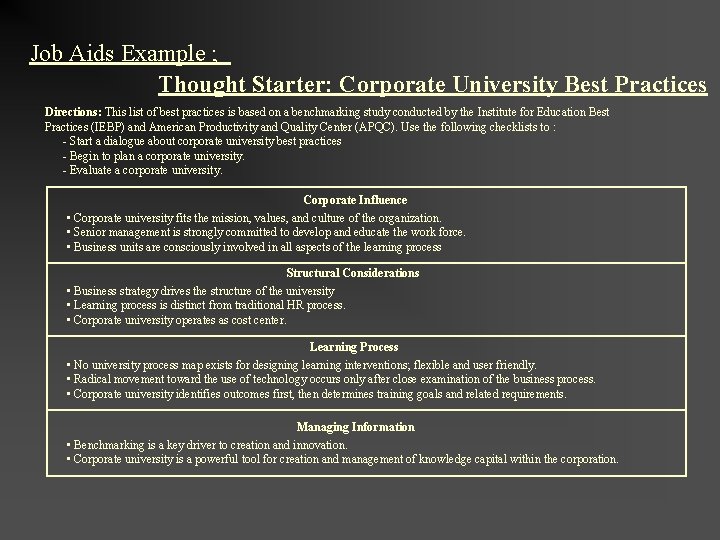
Job Aids Example ; Thought Starter: Corporate University Best Practices Directions: This list of best practices is based on a benchmarking study conducted by the Institute for Education Best Practices (IEBP) and American Productivity and Quality Center (APQC). Use the following checklists to : - Start a dialogue about corporate university best practices - Begin to plan a corporate university. - Evaluate a corporate university. Corporate Influence • Corporate university fits the mission, values, and culture of the organization. • Senior management is strongly committed to develop and educate the work force. • Business units are consciously involved in all aspects of the learning process Structural Considerations • Business strategy drives the structure of the university • Learning process is distinct from traditional HR process. • Corporate university operates as cost center. Learning Process • No university process map exists for designing learning interventions; flexible and user friendly. • Radical movement toward the use of technology occurs only after close examination of the business process. • Corporate university identifies outcomes first, then determines training goals and related requirements. Managing Information • Benchmarking is a key driver to creation and innovation. • Corporate university is a powerful tool for creation and management of knowledge capital within the corporation.
Thank you Training & Development Session for President University Copyright © 2013 By Herry Suryawan