
Instructional Objectives Problem Solving PreCourse Assignment 2 of

Instructional Objectives: Problem Solving Pre-Course Assignment 2 of 2
Action A: Read two articles located in the CON 360 Virtual Campus under “Student Materials/Pre-course/Assignment #2”: • • “Basic Guidelines to Problem Solving and Decision Making”, by Carter Mc. Namara “What You Don’t Know About Making Decisions, ” by David Garvin and Michael Roberto Note: There will be a quiz on the readings from each of the two pre-course assignments in Week 2 of the resident portion of the class. 3
Action B – Prepare a Problem Statement • Action B initiates the Rational Problem Solving model we use during CON 360 (slide 22). • Identify (in collaboration with your supervisor) a local agency problem that is focused on a current complex contract, acquisition or business related issue. • The local problem must be an issue relevant to you and your supervisor. The goal is to enable you to implement your recommendation(s) when you return to your organization. 4
• Action B – Prepare a Problem Statement Your problem should be: – Complex and require you to examine the issues, processes, and root cause(s) that created the problem. – A systemic and/or recurring issue. – One that affects your operation, your agency, or your acquisition community at the local or regional level. – Something that you can control or influence • It must not be: – A personal problem that is non-work related. – A personnel problem that involves a human resources issue like shortage of personnel, employee morale or non-contracting issues e. g. parking availability. – Something that has previously been identified and resolved within your organization. Do not do a problem with a solution already in place. – An issue that has only one potential alternative/solution. – A non-complex, short-term issue. 5
Action B – Prepare a Problem Statement – continued – • Once you identify a local agency problem, write your Problem Statement, as follows: a) Current State: In one sentence, describe the current state of your problem. b) Impact Statement: In one sentence, describe the impact the current state is having on your organization or work. c) Desired End-State: In one sentence, restate your current state modified to reflect what your situation should look like when your problem is solved. BEFORE you start, review slides 7 through 12 showing a problem statement development example. Then, complete Action B on slides 14 through 18. 6
Three-Sentence Problem Statement Writing Example Small Arms Lead to Big Issues 7

Step 1: Draft problem statement Write your Problem Statement • Current State: Due to poor planning, as well as employee turnover, our customers have complained about a huge shortage in timely availability of small arms to the field. • Impact: As a direct impact, the contract specialist has to get with the customer for the necessary paperwork and this increases our workload. • Desired End State: ABC Arsenal is currently 8
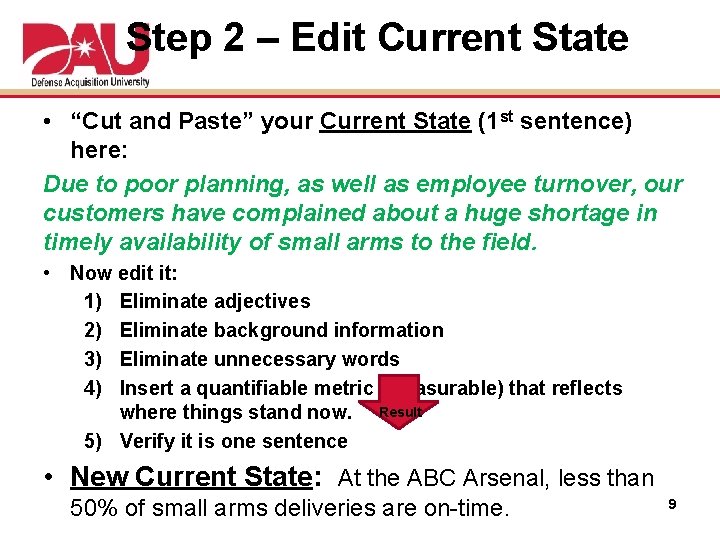
Step 2 – Edit Current State • “Cut and Paste” your Current State (1 st sentence) here: Due to poor planning, as well as employee turnover, our customers have complained about a huge shortage in timely availability of small arms to the field. • Now edit it: 1) Eliminate adjectives 2) Eliminate background information 3) Eliminate unnecessary words 4) Insert a quantifiable metric (measurable) that reflects where things stand now. Result 5) Verify it is one sentence • New Current State: At the ABC Arsenal, less than 50% of small arms deliveries are on-time. 9
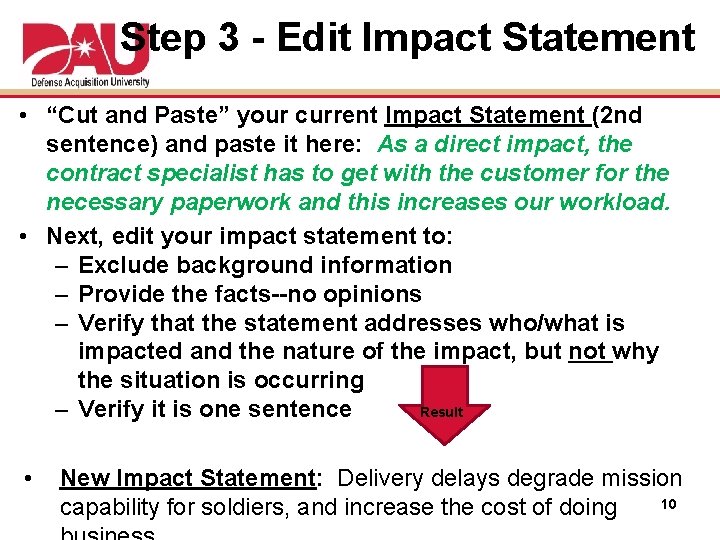
Step 3 - Edit Impact Statement • “Cut and Paste” your current Impact Statement (2 nd sentence) and paste it here: As a direct impact, the contract specialist has to get with the customer for the necessary paperwork and this increases our workload. • Next, edit your impact statement to: – Exclude background information – Provide the facts--no opinions – Verify that the statement addresses who/what is impacted and the nature of the impact, but not why the situation is occurring – Verify it is one sentence Result • New Impact Statement: Delivery delays degrade mission 10 capability for soldiers, and increase the cost of doing
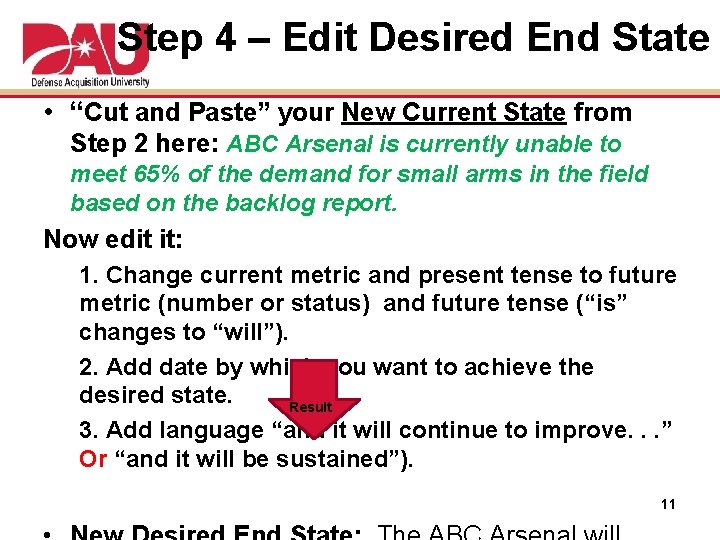
Step 4 – Edit Desired End State • “Cut and Paste” your New Current State from Step 2 here: ABC Arsenal is currently unable to meet 65% of the demand for small arms in the field based on the backlog report. Now edit it: 1. Change current metric and present tense to future metric (number or status) and future tense (“is” changes to “will”). 2. Add date by which you want to achieve the desired state. Result 3. Add language “and it will continue to improve. . . ” Or “and it will be sustained”). 11
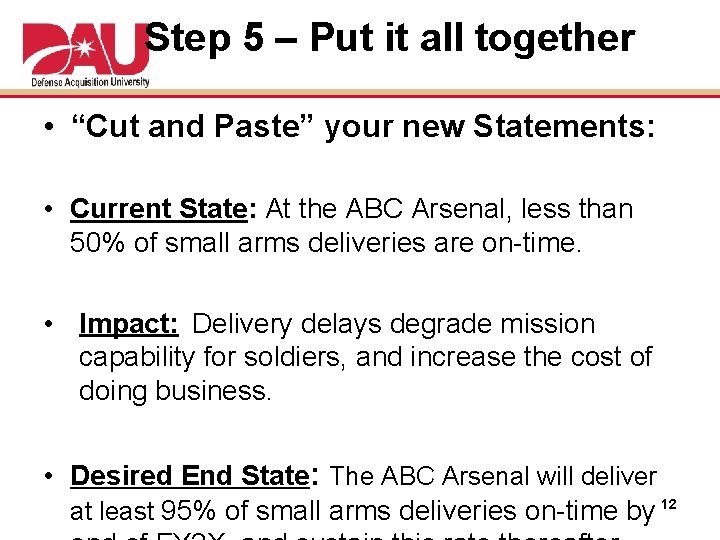
Step 5 – Put it all together • “Cut and Paste” your new Statements: • Current State: At the ABC Arsenal, less than 50% of small arms deliveries are on-time. • Impact: Delivery delays degrade mission capability for soldiers, and increase the cost of doing business. • Desired End State: The ABC Arsenal will deliver at least 95% of small arms deliveries on-time by 12
Now it’s your turn … 13
Step 1: Draft problem statement Write your Problem Statement • Current State: • Impact: • Desired End State: 14
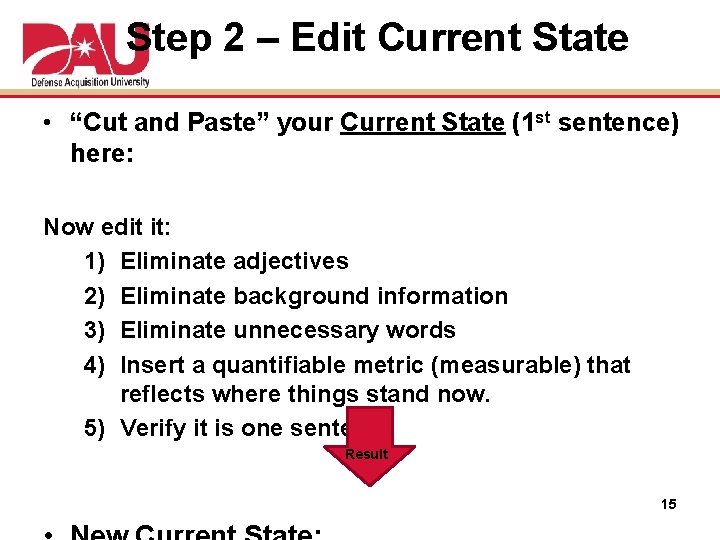
Step 2 – Edit Current State • “Cut and Paste” your Current State (1 st sentence) here: Now edit it: 1) Eliminate adjectives 2) Eliminate background information 3) Eliminate unnecessary words 4) Insert a quantifiable metric (measurable) that reflects where things stand now. 5) Verify it is one sentence Result 15
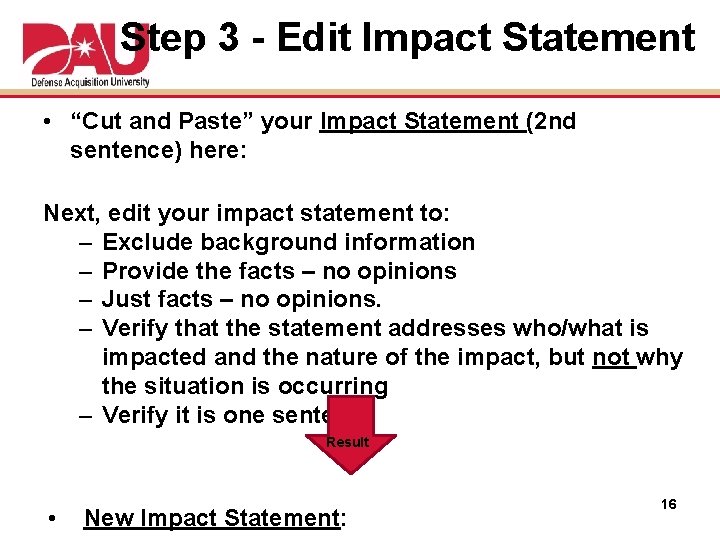
Step 3 - Edit Impact Statement • “Cut and Paste” your Impact Statement (2 nd sentence) here: Next, edit your impact statement to: – Exclude background information – Provide the facts – no opinions – Just facts – no opinions. – Verify that the statement addresses who/what is impacted and the nature of the impact, but not why the situation is occurring – Verify it is one sentence Result • New Impact Statement: 16
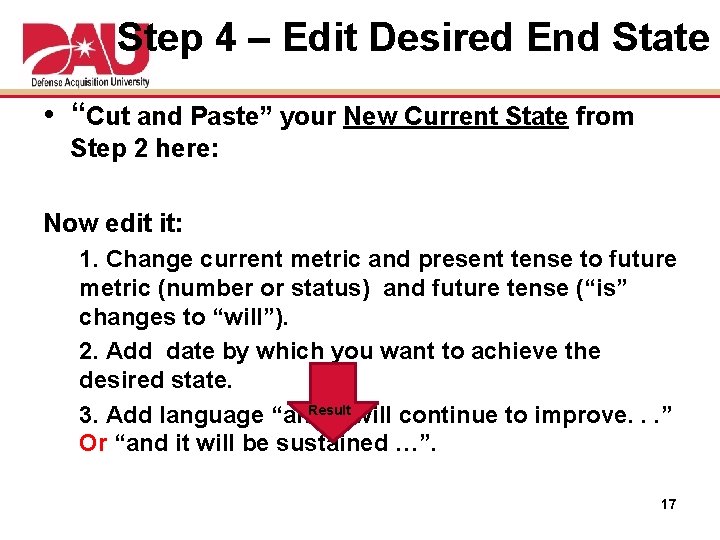
Step 4 – Edit Desired End State • “Cut and Paste” your New Current State from Step 2 here: Now edit it: 1. Change current metric and present tense to future metric (number or status) and future tense (“is” changes to “will”). 2. Add date by which you want to achieve the desired state. Result 3. Add language “and it will continue to improve. . . ” Or “and it will be sustained …”. 17
Step 5 – Put it all together • Cut and Paste your new Statements: – Current State: – Impact: – Desired End State: 18
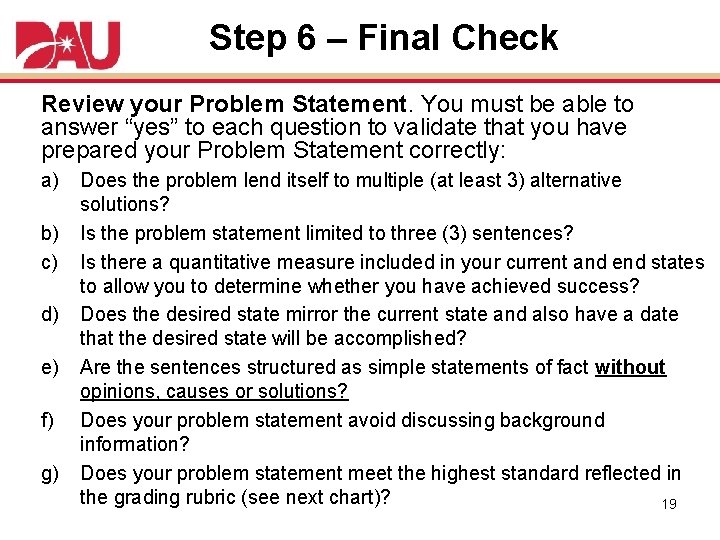
Step 6 – Final Check Review your Problem Statement. You must be able to answer “yes” to each question to validate that you have prepared your Problem Statement correctly: a) b) c) d) e) f) g) Does the problem lend itself to multiple (at least 3) alternative solutions? Is the problem statement limited to three (3) sentences? Is there a quantitative measure included in your current and end states to allow you to determine whether you have achieved success? Does the desired state mirror the current state and also have a date that the desired state will be accomplished? Are the sentences structured as simple statements of fact without opinions, causes or solutions? Does your problem statement avoid discussing background information? Does your problem statement meet the highest standard reflected in the grading rubric (see next chart)? 19
Action C – Save and Upload the Problem Statement 1. For Residence Students only: - Uploading the Assignment Product: This is an individual assignment that you will save in an MS Power. Point file and attach via the "browse" link at Step 3 of Assignment 2 in the Pre-Course portion of the Virtual Campus. - ONLY submit final Problem Statement version (1 slide) of chart 18 - Use the following naming convention for your document: last name first initial_problemstatement. ppt - Example: doej_problemstatement. ppt) - Additional Instructions: prior to attending class, gather background data, information, and relevant artifacts (references) related to your problem statement to support preparing your in class paper and presentation. 2. For Walk-in Students only: - For all walk-in students (on the wait-list, or not on the wait-list): “ontime” delivery means completed and hand-carried to class on at the beginning of Day 1. If you do not have it completed when you arrive before class begins on Day 1, you will not be allowed to walk-in. 20
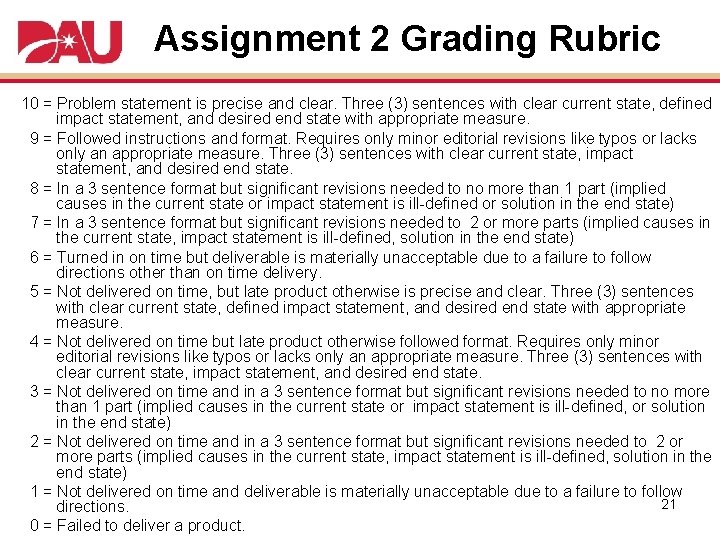
Assignment 2 Grading Rubric 10 = Problem statement is precise and clear. Three (3) sentences with clear current state, defined impact statement, and desired end state with appropriate measure. 9 = Followed instructions and format. Requires only minor editorial revisions like typos or lacks only an appropriate measure. Three (3) sentences with clear current state, impact statement, and desired end state. 8 = In a 3 sentence format but significant revisions needed to no more than 1 part (implied causes in the current state or impact statement is ill-defined or solution in the end state) 7 = In a 3 sentence format but significant revisions needed to 2 or more parts (implied causes in the current state, impact statement is ill-defined, solution in the end state) 6 = Turned in on time but deliverable is materially unacceptable due to a failure to follow directions other than on time delivery. 5 = Not delivered on time, but late product otherwise is precise and clear. Three (3) sentences with clear current state, defined impact statement, and desired end state with appropriate measure. 4 = Not delivered on time but late product otherwise followed format. Requires only minor editorial revisions like typos or lacks only an appropriate measure. Three (3) sentences with clear current state, impact statement, and desired end state. 3 = Not delivered on time and in a 3 sentence format but significant revisions needed to no more than 1 part (implied causes in the current state or impact statement is ill-defined, or solution in the end state) 2 = Not delivered on time and in a 3 sentence format but significant revisions needed to 2 or more parts (implied causes in the current state, impact statement is ill-defined, solution in the end state) 1 = Not delivered on time and deliverable is materially unacceptable due to a failure to follow 21 directions. 0 = Failed to deliver a product.
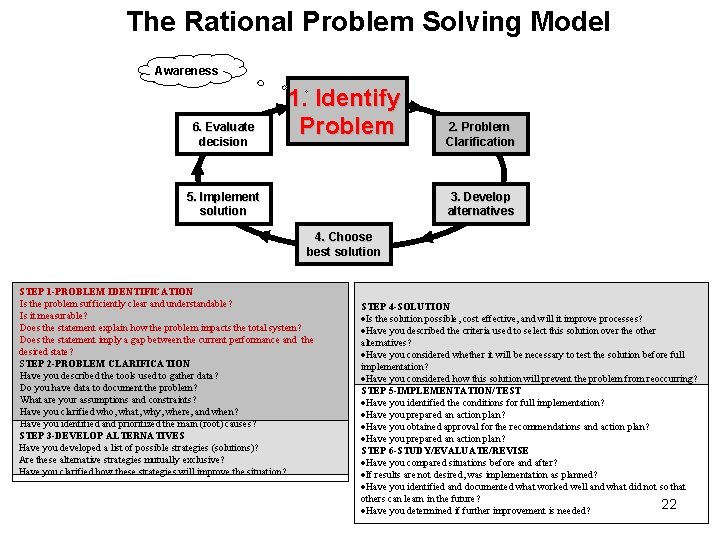
The Rational Problem Solving Model Awareness 6. Evaluate decision 1. Identify Problem 5. Implement solution 2. Problem Clarification 3. Develop alternatives 4. Choose best solution STEP 1 -PROBLEM IDENTIFICATION Is the problem sufficiently clear and understandable? Is it measurable? Does the statement explain how the problem impacts the total system? Does the statement imply a gap between the current performance and the desired state? STEP 2 -PROBLEM CLARIFICATION Have you described the tools used to gather data? Do you have data to document the problem? What are your assumptions and constraints? Have you clarified who, what, why, where, and when? Have you identified and prioritized the main (root) causes? STEP 3 -DEVELOP ALTERNATIVES Have you developed a list of possible strategies (solutions)? Are these alternative strategies mutually exclusive? Have you clarified how these strategies will improve the situation? • • • STEP 4 -SOLUTION Is the solution possible, cost effective, and will it improve processes? Have you described the criteria used to select this solution over the other alternatives? Have you considered whether it will be necessary to test the solution before full implementation? Have you considered how this solution will prevent the problem from reoccurring? STEP 5 -IMPLEMENTATION/TEST Have you identified the conditions for full implementation? Have you prepared an action plan? Have you obtained approval for the recommendations and action plan? Have you prepared an action plan? STEP 6 -STUDY/EVALUATE/REVISE Have you compared situations before and after? If results are not desired, was implementation as planned? Have you identified and documented what worked well and what did not so that others can learn in the future? 22 Have you determined if further improvement is needed?
- Slides: 21