
Instructional Leadership Teams Statewide System of Support 2017

























- Slides: 57
Instructional Leadership Teams Statewide System of Support 2017 -2018 Massachusetts Department of Elementary & Secondary Education
Module 1: Instructional Leadership Teams Why? Purpose? Work? 2 Massachusetts Department of Elementary & Secondary Education
Introductions and Connection q Getting to Know Each Other • Introduce yourself. • State your role within the school • Discuss what you love most about your work q Answer one of the following: • Which color best would best describe you and why? • The person that had the greatest impact on my becoming an educator was …because… • Something interesting you might not know about me is. . . 3 Massachusetts Department of Elementary & Secondary Education
Theory of Action If by the end of this professional learning session, ILT members will be able to… q Analyze and discuss the importance of shared and distributed leadership in improving student achievement while implementing the Massachusetts Frameworks and q Identify the foundational work of an ILT Then we will build the capacity of our leaders and teachers to achieve targeted areas of improvement and develop continuous improvement planning and school based improvement planning. 4 Massachusetts Department of Elementary & Secondary Education
Instructional Leadership Teams: Why? Purpose? Work? Why? Highly effective schools foster and support distributed leadership, shared responsibility, and time for professional collaboration all focused on improving student achievement. Purpose? Shared leadership through the empowering of teacher leaders build opportunities for feedback, growth, retain teachers, and drive increased student achievement. Work? Shared decision making, focus on instruction and continuous improvement through professional learning, guides, supports and monitors PLCs, makes instructional decisions based on internal and external data. 5 Massachusetts Department of Elementary & Secondary Education
Reflection “Leadership acts like a “driver, ” in building a school’s academic capacity, and research has found a more team- oriented and collaborative approach to school leadership is directly linked with improving teaching and learning. ” (Hallinger and Heck, , 2010) What parts of this quote resonate with you? Why? 6 Massachusetts Department of Elementary & Secondary Education
Compass Points Personal Work Style Inventory for Group / Team Work Step 1 Determine the compass point that best describes how you work when in a group. Process Step 2 Join the others who share your compass point. Step 3 Discuss the characteristics of your compass point and the characteristics of others. 7 Massachusetts Department of Elementary & Secondary Education
North / South / East / West WEST A careful thinker; Qualitycentered; Analytical; Organized; Logical; Focused; Exact; Perfectionist; Industrious; Structured; Detailed NORTH A leader; Goal-centered; Fastpaced; Taskoriented; Assertive; Decisive; Confident; Determined; Competitive; Independent EAST A speculative thinker; Ideacentered; Creative; Innovative; Flexible; Vi. SOUTH sionary; Spontaneous; A team player; Process-oriented; Enthusiastic; Free. Slow-paced; Good listener; Nonspirited confrontational; Sensitive; Patient; Understanding; Generous; Helpful Which of these best describes how you work in a GROUP? 8 Massachusetts Department of Elementary & Secondary Education
Regroup in Your Compass Point Answer the following questions as a group. Chart your responses. Be prepared to share your responses. q What are the strengths of our style? (4 adj. ) q What are the limitations of our style? (4 adj. ) q What style do we find the most difficult to work with and why? q What do we need from others so that we can make our work together more successful? 9 Massachusetts Department of Elementary & Secondary Education
Shared Leadership Framework: Professional Reading Discussion Guiding question: What is shared leadership and how do we cultivate it in our school? First: Instructional Leadership Teams: Leading the Way to Successful Common Core State Standards Implementation Then: Protocol: Example - Save the Last Word for Me 10 Massachusetts Department of Elementary & Secondary Education
11 Massachusetts Department of Elementary & Secondary Education
Thank you! 12 Massachusetts Department of Elementary & Secondary Education
Modules 2: Instructional Leadership Teams Membership and Meeting Logistics 13 Massachusetts Department of Elementary & Secondary Education
Theory of Action If by the end of this professional learning session, ILT members will be able to… q identify and discuss the importance of shared and distributed leadership in improving student achievement while implementing the Massachusetts Frameworks and q Identify the roles and responsibilities as well as meeting logistics of a high functioning instructional leadership team. Then we will build the capacity of our leaders and teachers to achieve targeted areas of improvement and develop continuous improvement planning and school based improvement planning. 14 Massachusetts Department of Elementary & Secondary Education
Instructional Leadership Teams q. Membership, Roles and Responsibilities q. Meeting Logistics 15 Massachusetts Department of Elementary & Secondary Education
Is and Is Not An ILT is: q q q Focused on student achievement for all. Committed to school-wide change. Models shared and distributed leadership Models and works as a professional learning community. Knowledgeable about the content and rigor expected in the MA Curriculum Frameworks. q Knowledgeable about how students learn. q Willing to provide professional learning. q Communicates information from ILT school-wide so everyone feels a part of school improvement efforts. 16 Massachusetts Department of Elementary & Secondary Education
Is and Is Not An ILT is NOT: q q Additional responsibilities for an existing committee. Composed of only staff haphazardly. An elite group. The school improvement council however some staff may serve on both teams q School managers q Dominated by one person or group. 17 Massachusetts Department of Elementary & Secondary Education
Instructional Leadership Framework: Professional Reading Discussion Guiding question: What is instructional leadership and how do we improve student learning by all staff in a teaming approach? First: Read an article on Instructional Leadership Then: Protocol of Choice 18 Massachusetts Department of Elementary & Secondary Education
Instructional Leadership Framework Video: ILT at Condon School, Boston, MA Protocol TBD 19 Massachusetts Department of Elementary & Secondary Education
Leaders Buffalos vs. Geese 20 Massachusetts Department of Elementary & Secondary Education
Video: Morale Lessons from Geese 21 Massachusetts Department of Elementary & Secondary Education
22 Massachusetts Department of Elementary & Secondary Education
Thank you! 23 Massachusetts Department of Elementary & Secondary Education
Module 3: Stakeholder Communication 24 Massachusetts Department of Elementary & Secondary Education
Theory of Action If by the end of this professional learning session, ILT members will be able to… q identify and discuss the importance of shared and distributed leadership in improving student achievement while implementing the Massachusetts Frameworks and q Identify the importance of two-way communication among all school stakeholders as a responsibility and function of a high functioning instructional leadership team. Then we will build the capacity of our leaders and teachers to achieve targeted areas of improvement and develop continuous improvement planning and school based improvement planning. 25 Massachusetts Department of Elementary & Secondary Education
Instructional Leadership Communication: Professional Reading Discussion Guiding question: Why do high-functioning teams welcome disagreement as a way to bring about the best results? First: Read ASCD article Making Team Differences Work Then: Protocol of Choice such as Save the Last Word for Me 26 Massachusetts Department of Elementary & Secondary Education
Instructional Leadership Communication Choose one quote and write a brief reflection on how this quote can support student achievement as a member of an ILT. 27 Massachusetts Department of Elementary & Secondary Education
Member Communication continued Communication Items for Meetings: q Agenda q Review of team norms q Minutes from previous meeting q Related documents that may be referenced and/or used at meeting such as data, surveys, or resources for planning professional development 28 Massachusetts Department of Elementary & Secondary Education
Member Communication continued Communication Items Outside of Meetings q Agendas q Send out 2 days before meeting q Hard copies, if need be q Minutes q Distribute digitally within two days after the meeting q Determine if your team wants minutes sent to members only to edit before sharing with staff q Store minutes electronically q Electronically Post ILT Folder for All Staff q Meeting dates for year and update any changes q Post all forms of data once analyzed by team including surveys, learning walk results, articles, etc. 29 Massachusetts Department of Elementary & Secondary Education
School-wide Communication Communicating with Faculty q Strive for transparency with faculty q Explain the ILT to faculty: what it is, and what it’s not q Develop a consistent system for communicating with school community on current work (i. e. faculty meetings, weekly communication, grade level teams) q Share findings generated from a learning walk within 2 days q Invite interested faculty to attend a portion of an ILT meeting 30 Massachusetts Department of Elementary & Secondary Education
Clarity in Communication Turn and talk with a team member about a time you felt you were misunderstood and the impact it made on you at the time. 31 Massachusetts Department of Elementary & Secondary Education
School-wide Communication Communicating with Students q Consider including student leaders at one of your ILT meetings when appropriate q Share relevant information with the student council and other cocurricular groups q Share student survey findings with students q Invite students to share ideas with ILT regarding student-related initiatives Communicating with Whole School Community q Parent surveys--share results with parents q Take a role as an ILT member at your school’s open house q Choose members to present current work to district and at School Committee meetings 32 Massachusetts Department of Elementary & Secondary Education
Communication With a partner pick one of the following activities that supports communication with the school community and be prepared to share your idea using pictures, words and/or both on chart paper. Be creative! Create an activity for the whole staff that reminds teachers of the importance of building relationships with students. Develop a presentation of data to the entire school in order to create a shared understanding of the data and do so in an interactive manner. Develop a plan that would support twoway communication with school stakeholders throughout the school year. 33 Massachusetts Department of Elementary & Secondary Education
Miscommunication Happens 34 Massachusetts Department of Elementary & Secondary Education
35 Massachusetts Department of Elementary & Secondary Education
Thank you! 36 Massachusetts Department of Elementary & Secondary Education
Module 4: Examining Instructional Practice Strategies 37 Massachusetts Department of Elementary & Secondary Education
Theory of Action If by the end of this professional learning session, ILT members will be able to… q identify and discuss the importance of shared and distributed leadership in improving student achievement while implementing the Massachusetts Frameworks and q Identify and understand varied ways of examining effective and researched based instructional practices. Then we will build the capacity of our leaders and teachers to achieve targeted areas of improvement and develop continuous improvement planning and school based improvement planning. 38 Massachusetts Department of Elementary & Secondary Education
Role of the Instructional Leader in Leading Pedagogical Improvement? q Developing a shared vision of high quality teaching and learning and provides on-going open communication about such practices and expectations. q Communicating the vision and associated action steps to all stakeholders q Leading a dialogue on equity and diversity school-wide q Using data to make informed decisions regarding school and district goals with clear expectations for all stakeholders as well as a process to monitor effectiveness of all decisions and actions q Supporting and providing feedback for teacher growth based on evidence of student learning 39 Massachusetts Department of Elementary & Secondary Education
Role of the Instructional Leader in Leading Pedagogical Improvement? q Allocating and deploying resources based on data q Focusing on the continuous learning of staff by examining data q Scheduling adequate time and space for collaboration q Managing school wide systems and processes critical to teaching and learning q Build and calibrate capacity of teacher leaders in examining instructional practice through leading learning walks, peer observations, lesson study, looking at student work and video analysis 40 Massachusetts Department of Elementary & Secondary Education
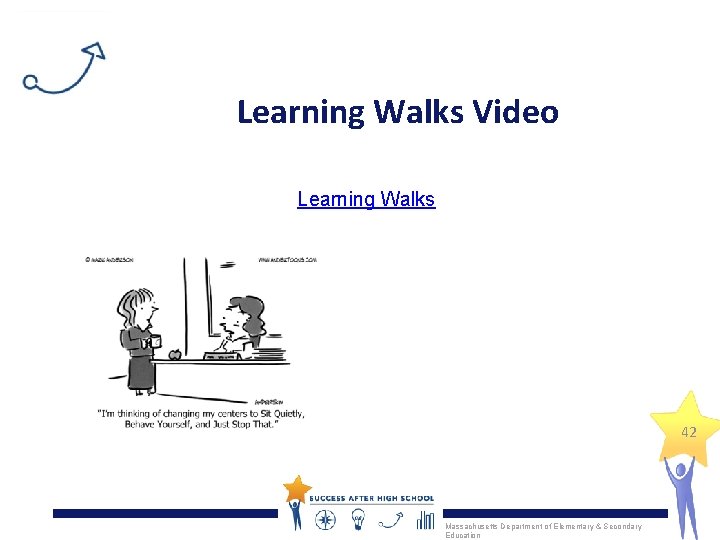
Learning Walks q Learning walks allow a building administrator or team leader to lead a group of teachers into a variety of classrooms to examine one focused area of instructional practice. q Participants collect data based on a designed rubric through written observations about a teacher’s instructional practice and evidence of student learning. q After collecting the information, the group engages in a robust discussion about what was seen, its implications for improving instruction and learning, and how it relates to school improvement or district goals. q Observations are not evaluative in nature, but instead allow participants identify patterns or trends to deepen their understanding of what is required to engage in school wide improvement. 41 Massachusetts Department of Elementary & Secondary Education
Learning Walks Video Learning Walks 42 Massachusetts Department of Elementary & Secondary Education
Learning Walks Turn and talk to a partner about how you would proceed to communicate to your colleagues about what Learning Walks are. Then make two columns on a piece of paper and list the strengths and areas of concern as they relate to the implementation of Learning Walks in this school. Be prepared to share out. 43 Massachusetts Department of Elementary & Secondary Education
Peer Observation q Peer observations allow teachers to observe each other during the school day and provide an opportunity to have meaningful conversation about their instructional practice. q Participants build common understanding about what strong instructional practice looks like, try out new instructional practices or curriculum in a low-risk environment, and makes the work of teaching and learning more public. q All teachers have the opportunity to observe instruction and to receive and give generative feedback on instructional practice. q Peer observations align with a more traditional evaluation cycle as there is time for a pre-and post-conference, observation, and follow up regarding changes made based on the observation. 44 Massachusetts Department of Elementary & Secondary Education
Peer Observation Introduction by Teachers to Peer Observation Guiding question: Why does Peer Observation improve student achievement school wide? Read the ASCD Article: Peer-to. Peer Observation: Five Questions for Making It Work: http: //inservice. ascd. org/peer-topeer-observation-five-questions-formaking-it-work/ Then: Protocol of Choice such as Save the Last Word for Me 45 Massachusetts Department of Elementary & Secondary Education
Lesson Study q Lesson study is a long term professional development practice rooted in inquiry and problem solving that allows a team of teachers (who typically teach the same subject) to collaboratively design a research-based lesson reflective of effective instructional practices that are aligned to curriculum frameworks. q A teacher volunteers to teach the research lesson in front of their team to get and give feedback on the lesson’s design, and reflect on the outcomes to better understand student learning and improve the lesson. q This practice makes student learning a focus of the lesson. Lesson study allows teachers to be the driver of instructional change, promotes data driven decision making and creates a sense of ownership for all involved 46 Massachusetts Department of Elementary & Secondary Education
Lesson Study After viewing the video on lesson study use the Chalk Talk Protocol with the heading on the chart paper: “What did you learn from the video? ” Chalk Talk Protocol Link 47 Massachusetts Department of Elementary & Secondary Education
Looking at Student Work Guiding question: How does Looking at Student Work by high-functioning teams bring about teaching and learning to a more robust level? First: Read an article Looking at Student Work by Georgea M. Langer and Amy B. Colton in EL Then: Protocol of Choice such as Save the Last Word for Me 48 Massachusetts Department of Elementary & Secondary Education
Calibration q Calibration activities focus professional development on developing a shared understanding of high-quality instruction, rigor, and student engagement and is a critical professional development goal for leadership teams and faculty. q Examples of calibration activities include: observing instruction through direct study or through video examples, looking at student work using a common rubric, or developing common assessments. q Calibration practices help build the coherence and coordination necessary for rapid improvement and eliminates variance in instructional quality that so commonly impedes higher performance. 49 Massachusetts Department of Elementary & Secondary Education
MA ESE Exemplar Videos Pick an area of interest from the URL above and watch a calibration video. While watching the video please refer to the “What to Look for” document from the Inclusive Guidebook. Please be prepared to share out your observations referencing the “What to Look for”! Inclusive Guide What to Look For 50 Massachusetts Department of Elementary & Secondary Education
51 Massachusetts Department of Elementary & Secondary Education
52 Massachusetts Department of Elementary & Secondary Education
Thank you! 53 Massachusetts Department of Elementary & Secondary Education
Module 5: Using and Understanding Data – Tom? 54 Massachusetts Department of Elementary & Secondary Education
Theory of Action If by the end of this professional learning session, ILT members will be able to… q identify and discuss the importance of shared and distributed leadership in improving student achievement while implementing the Massachusetts Frameworks and q TBD Then we will build the capacity of our leaders and teachers to achieve targeted areas of improvement and develop continuous improvement planning and school based improvement planning. 55 Massachusetts Department of Elementary & Secondary Education
56 Massachusetts Department of Elementary & Secondary Education
Thank you! 57 Massachusetts Department of Elementary & Secondary Education