
INSTRUCTIONAL DESIGN AND LEARNING ACTIVITIES FOR FACE TOFACE









- Slides: 32
INSTRUCTIONAL DESIGN AND LEARNING ACTIVITIES FOR FACE -TO-FACE INSTRUCTION
WHAT IS ‘INSTRUCTIONAL DESIGN’? Instructional design involves creation of instructional materials and educational resources General use of ‘instructional design’: § Indicate the process by which educational materials and resources are developed § Refer to a process for accomplishing design work does not refer directly to learning theory or instructional strategies Specific use of ‘instructional design’: § Indicate theories of learning, principles of teaching, and the pedagogical strategies that should be used in creating those educational materials and resources § Emphasize the responsibility of the instructional designer to choose, or help choose, the right way to teach the content that has been selected.
THREE CONTEMPORARY THREADS IN INSTRUCTIONAL DESIGN Traditional ID Scholarship The Design-Based Research (DBR) Movement Constructivist-ID Models (C-ID)
DIFFERENCES BETWEEN TRADITIONAL ID MODELS AND C-ID MODELS Traditional ID Models C-ID Models Process Sequential and linear Recursive, nonlinear, and sometimes chaotic Planning Top down and systematic Organic, developmental, reflective and collaborative Objectives guide development. Objectives do not guide development but emerge from design and development work. Experts who have special knowledge are critical. General ID experts do not exist. Emphasis Delivery of pre-selected knowledge such as facts and enhancement of skills Learning in meaningful context/personal understanding within meaningful contexts Evaluation Summative evaluation is critical. Formative evaluation is critical. Data Objective data are critical. Subjective data may be the most valuable
TYPES OF LEARNING ACTIVITIES FOR FACE-TO-FACE INSTRUCTION
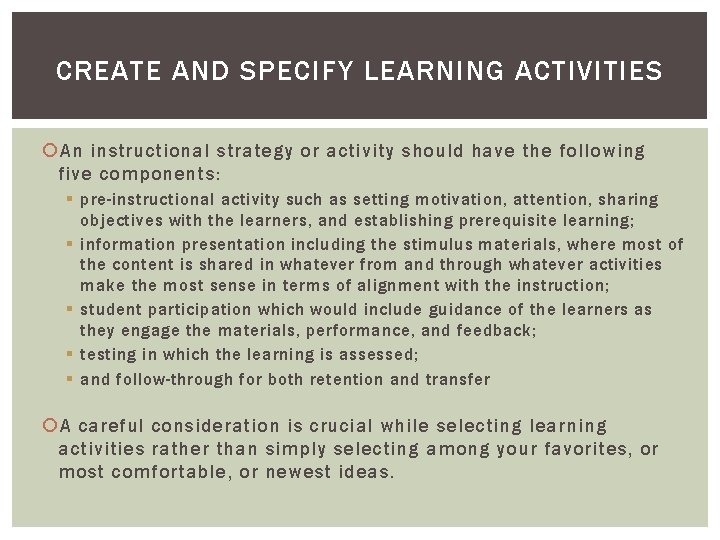
CREATE AND SPECIFY LEARNING ACTIVITIES An instructional strategy or activity should have the following five components: § pre-instructional activity such as setting motivation, attention, sharing objectives with the learners, and establishing prerequisite learning; § information presentation including the stimulus materials, where most of the content is shared in whatever from and through whatever activities make the most sense in terms of alignment with the instruction; § student participation which would include guidance of the learners as they engage the materials, performance, and feedback; § testing in which the learning is assessed; § and follow-through for both retention and transfer A careful consideration is crucial while selecting learning activities rather than simply selecting among your favorites, or most comfortable, or newest ideas.
LECTURE I.
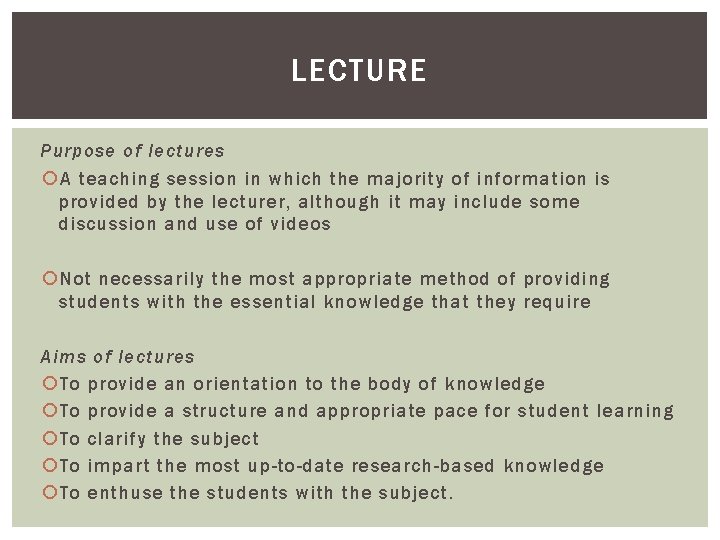
LECTURE Purpose of lectures A teaching session in which the majority of information is provided by the lecturer, although it may include some discussion and use of videos Not necessarily the most appropriate method of providing students with the essential knowledge that they require Aims of lectures To provide an orientation to the body of knowledge To provide a structure and appropriate pace for student learning To clarify the subject To impart the most up-to-date research-based knowledge To enthuse the students with the subject.
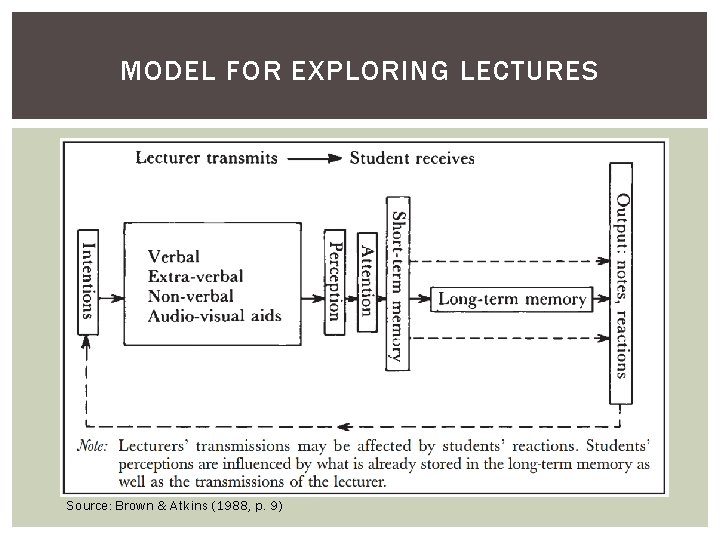
MODEL FOR EXPLORING LECTURES Source: Brown & Atkins (1988, p. 9)
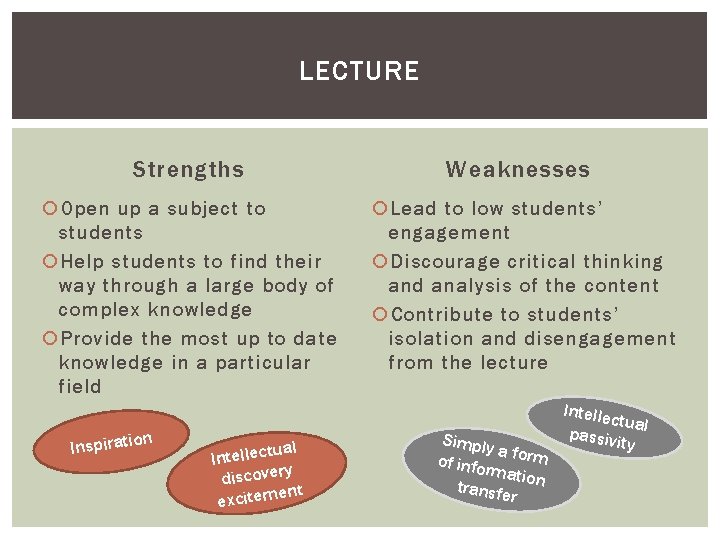
LECTURE Strengths Weaknesses Open up a subject to students Help students to find their way through a large body of complex knowledge Provide the most up to date knowledge in a particular field Lead to low students’ engagement Discourage critical thinking and analysis of the content Contribute to students’ isolation and disengagement from the lecture n Inspiratio ual Intellect y discover nt exciteme Simply a of info form rmatio transfe n r Intelle ctual passiv ity
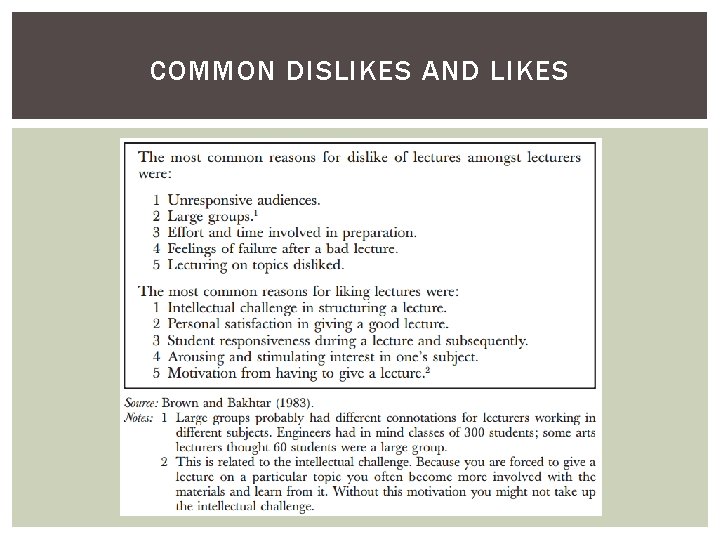
COMMON DISLIKES AND LIKES
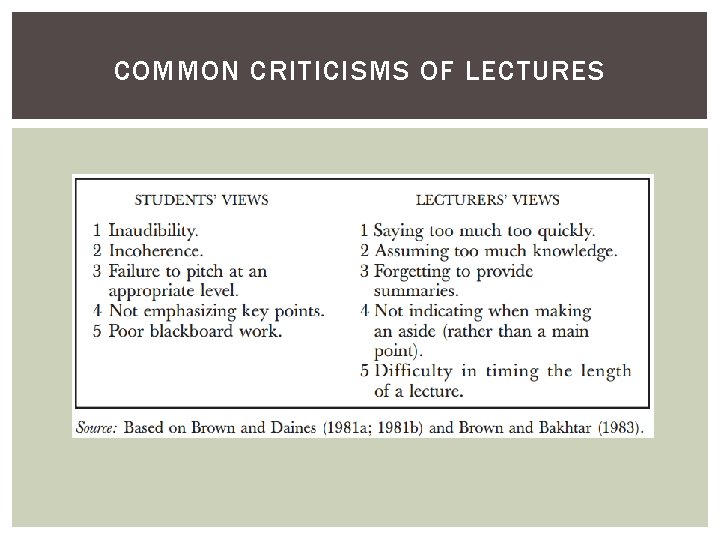
COMMON CRITICISMS OF LECTURES
SMALL-GROUP TEACHING/DISCUSSION II.
SMALL-GROUP TEACHING Purpose of small-group teaching Small-group teaching/discussion involves the division of a class into small groups which work relatively independently to achieve a goal. Aims of small-group teaching Immediate goals of small group teaching are to get students to talk and to think. The long-term goals are personal growth and competence. These goals may be expressed in the form: The development of communication skills The development of intellectual and professional competencies The personal growth of students
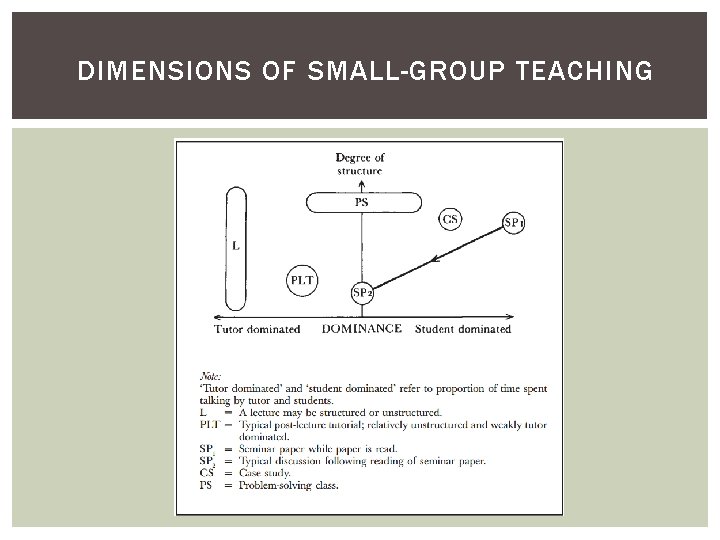
DIMENSIONS OF SMALL-GROUP TEACHING
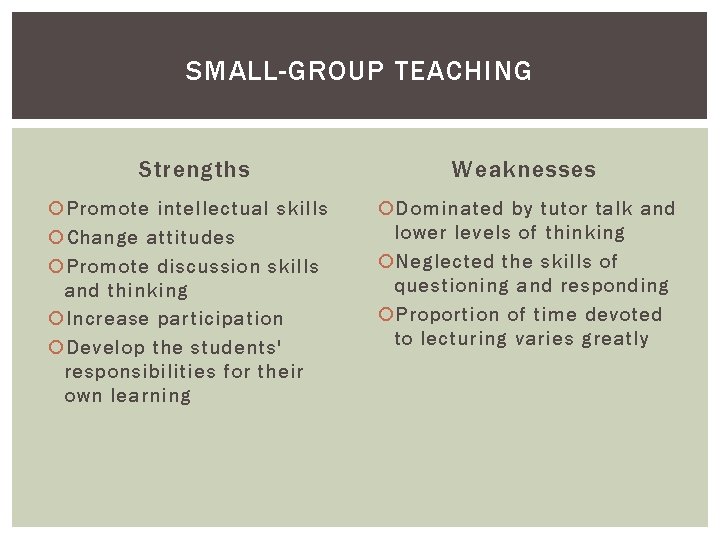
SMALL-GROUP TEACHING Strengths Promote intellectual skills Change attitudes Promote discussion skills and thinking Increase participation Develop the students' responsibilities for their own learning Weaknesses Dominated by tutor talk and lower levels of thinking Neglected the skills of questioning and responding Proportion of time devoted to lecturing varies greatly
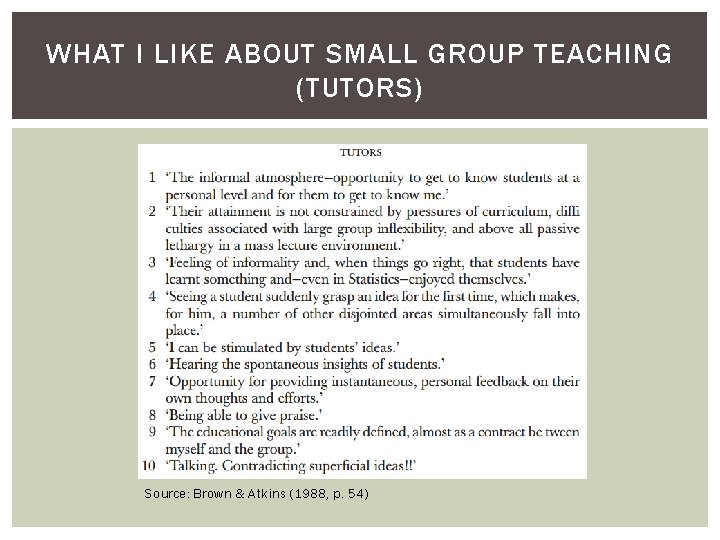
WHAT I LIKE ABOUT SMALL GROUP TEACHING (TUTORS) Source: Brown & Atkins (1988, p. 54)
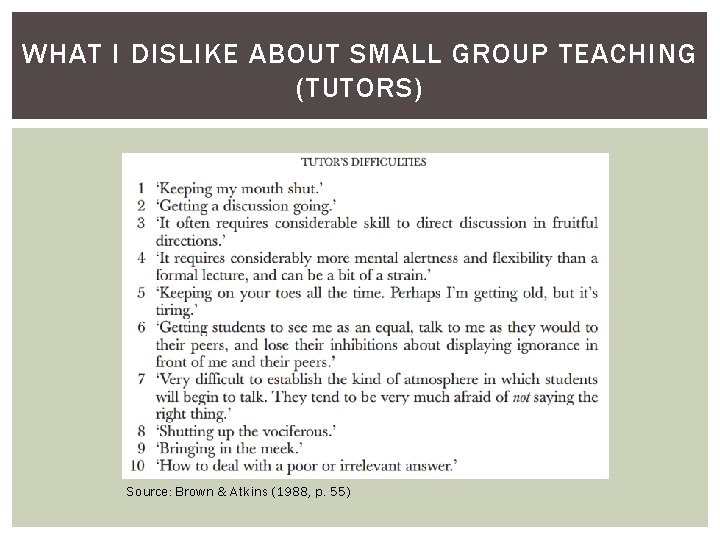
WHAT I DISLIKE ABOUT SMALL GROUP TEACHING (TUTORS) Source: Brown & Atkins (1988, p. 55)
WHAT I LIKE ABOUT SMALL GROUP TEACHING (STUDENTS) Source: Brown & Atkins (1988, p. 54)
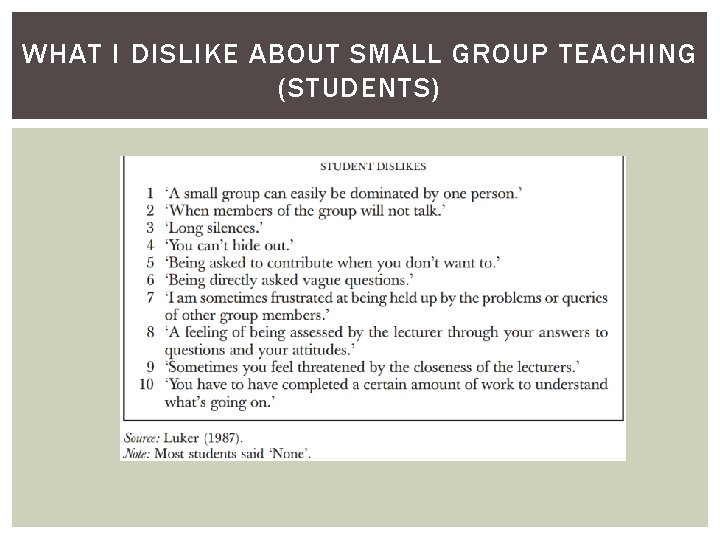
WHAT I DISLIKE ABOUT SMALL GROUP TEACHING (STUDENTS)
CASE STUDY III.
CASE STUDY Purpose of case study A mean of teaching that compels students to analyze and discuss a contextual and complex situation, often in addition to involvement with a dilemma or a problem requiring students to apply theoretical principles to consider possible solutions Strength More engaging than lectures in teaching abstract concepts Weakness Need to be designed appropriately and be instructed cautiously along with proper learning activities
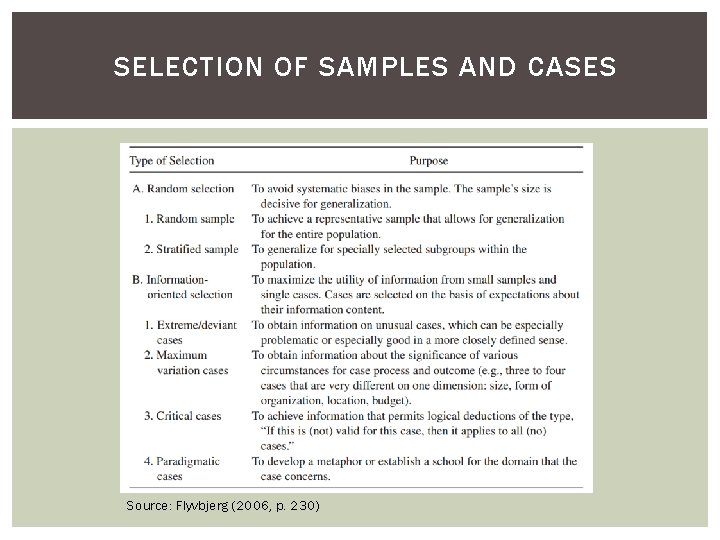
SELECTION OF SAMPLES AND CASES Source: Flyvbjerg (2006, p. 230)
GROUP LEARNING ACTIVITIES IV.
GROUP LEARNING ACTIVITIES Purposes of group learning activities Activities during the learning process in which students collaborate in small groups to contribute to the attainment of mutual goals Aims of group learning activities Foster higher-order skills Share knowledge construction
GROUP LEARNING ACTIVITIES Possible contributions Factors decreasing the likelihood of desired learning outcomes Students' engagement in learning Students' improvement in higher-order thinking skills Resistance of students and teachers Problems with the use of technology to support GLAs Designs of GLAs are not grounded in theories on teaching and learning Design components are not aligned
LABORATORY TEACHING V.
LABORATORY TEACHING Purposes of laboratory teaching The main principle underlying laboratory work is that students learn effectively through doing practical tasks. Two points should be borne in mind when designing laboratory courses and marking laboratory work: § The tasks have to be perceived as relevant and meaningful by the students—otherwise interest may be minimal § Students (and lecturers too) have to receive constructive feedback on their performance—otherwise learning may be minimal. Practice does not itself make perfect but practice with feedback almost always improves performance. Aims of laboratory teaching Teaching manual and observational skills relevant to the subject Improving understanding of methods of scientific enquiry Developing problem solving skills Nurturing professional attitudes
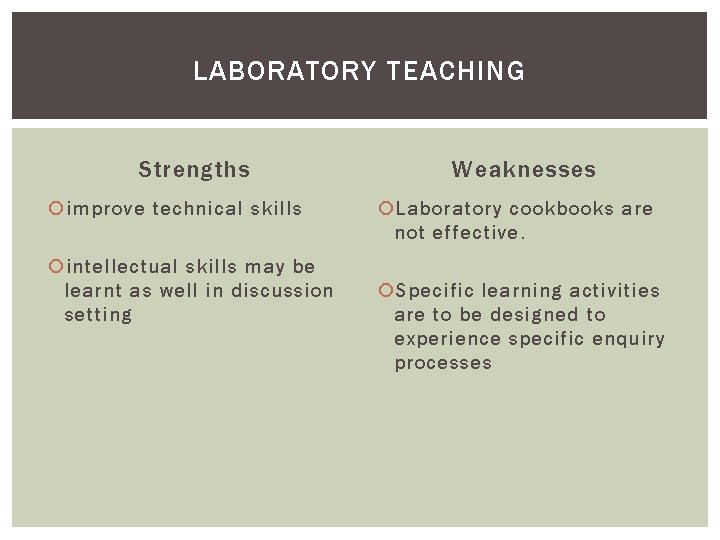
LABORATORY TEACHING Strengths improve technical skills intellectual skills may be learnt as well in discussion setting Weaknesses Laboratory cookbooks are not effective. Specific learning activities are to be designed to experience specific enquiry processes
RESEARCH PROJECTS VI.
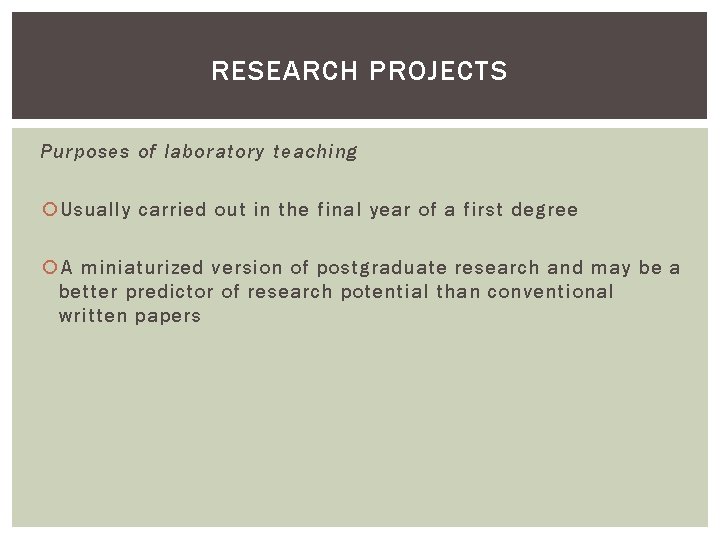
RESEARCH PROJECTS Purposes of laboratory teaching Usually carried out in the final year of a first degree A miniaturized version of postgraduate research and may be a better predictor of research potential than conventional written papers
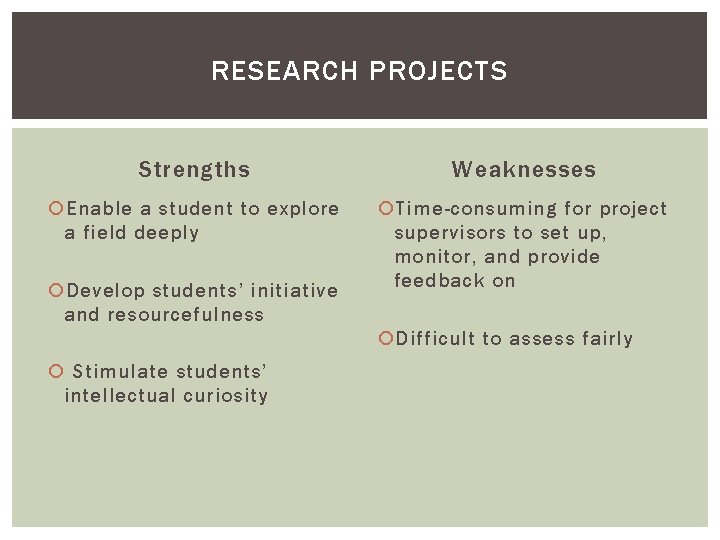
RESEARCH PROJECTS Strengths Weaknesses Enable a student to explore a field deeply Time-consuming for project supervisors to set up, monitor, and provide feedback on Develop students’ initiative and resourcefulness Difficult to assess fairly Stimulate students’ intellectual curiosity