
Instructional Approaches for Discouraging Inappropriate Student Behavior Barbara
Instructional Approaches for Discouraging Inappropriate Student Behavior Barbara Mitchell, Ph. D. University of Missouri August, 2016
Attention Signal • I say, “Aussie, Aussie” • You say, “Oy, Oy” • This means: time to get quiet, be ready for the next topic
Introductions • Name & position in your educational setting. • Why you are attending the summit. • Why you selected this session. *Listen for the attention signal
School Climate & Transformation • Office of Safe & Healthy Students in the U. S. Department of Education • Funding for 12 states & 72 districts (over 5 years) • Goal - Build capacity for implementing a sustained, school-wide, multi-tiered behavioral framework *Des Moines Public Schools Receives Award!
Session Outcomes By the end of the session, you will be able to… • Explain the role of teaching in response to social/behavioral errors (problem behavior). • Recognize instructional strategies for discouraging inappropriate behavior. • Indirect Strategies • Direct Strategies • Additional Consequences • Access resources for supporting teacher use of effective practices.
What Do We Know? • Research literature consistently demonstrates there is a relationship between academic failure and problem behavior. • Students who are not successful socially & behaviorally may have great difficulty being academically successful. (Sutherland, Lewis-Palmer, Stichter, & Morgan, 2008)
What Do We Know? • Teachers typically receive little pre- or inservice training in classroom management. • Enter the field with limited skills for addressing challenging behavior. (Begeny & Martens, 2006; Markow, Moessner, & Horowitz, 2006; Special Education Elementary Longitudinal Study, 2001, 2002, 2004; Wei, Darling-Hammond, & Adomson, 2010)
Starting Point… If a child doesn’t know how to read, we teach. If a child doesn’t know how to swim, we teach. If a child doesn’t know how to multiply, we teach. If a child doesn’t know how to drive, we teach. If a child doesn’t know how to behave, we…teach? Or we…punish? Why can’t we finish the last sentence as automatically as we do the others? T. Herner
What We Do… “Unfortunately, most of the practical techniques used by teachers to respond to acting-out children are only of limited effectiveness and some, such as reprimands, arguing, and escalated hostile interactions, can actually strengthen the behaviors they are intended to suppress or terminate. ” Hill Walker, 1995 The Acting-Out Child: Coping With Classroom Disruption
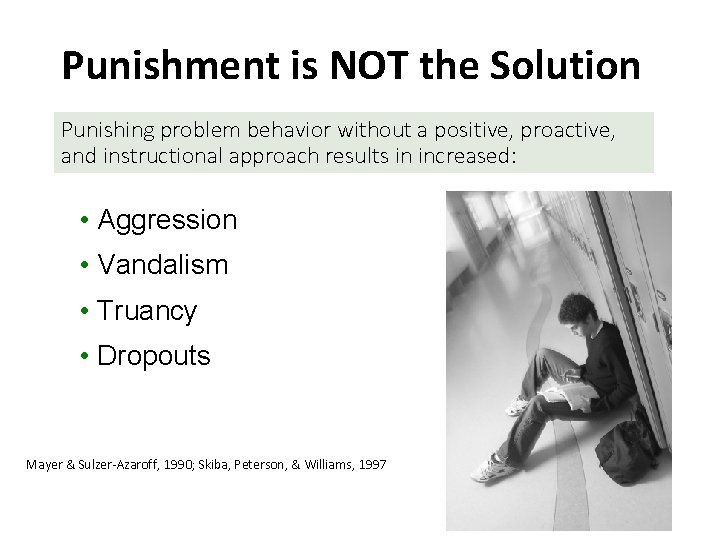
Punishment is NOT the Solution Punishing problem behavior without a positive, proactive, and instructional approach results in increased: • Aggression • Vandalism • Truancy • Dropouts Mayer & Sulzer-Azaroff, 1990; Skiba, Peterson, & Williams, 1997
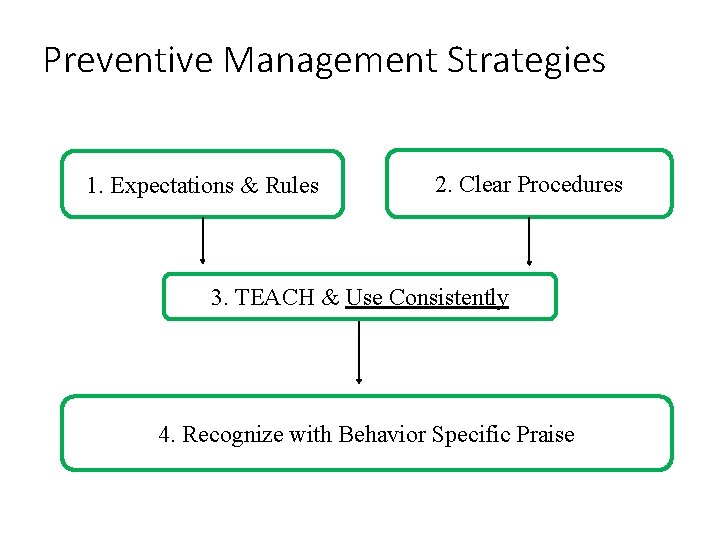
Preventive Management Strategies 1. Expectations & Rules 2. Clear Procedures 3. TEACH & Use Consistently 4. Recognize with Behavior Specific Praise
Prevention is Key • When inappropriate behaviors occur, consider: • Do we have clear expectations? • Have they been thoroughly taught? • Are we consistently using strategies to encourage desired behaviors? The best defense is always a great offense.
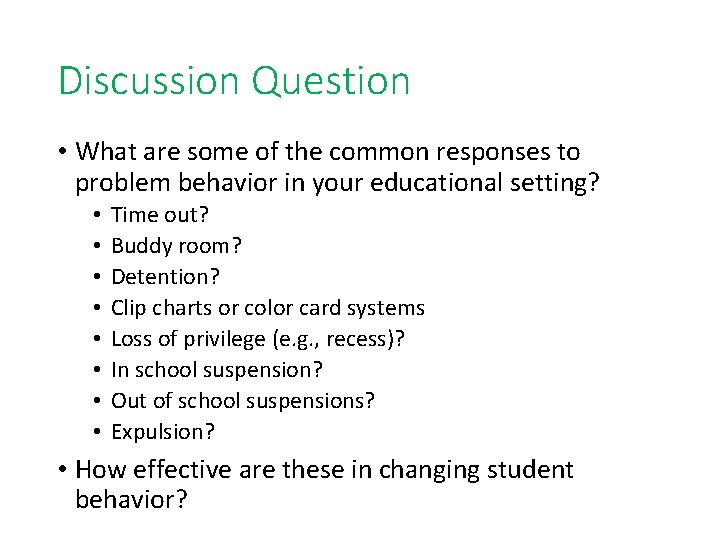
Discussion Question • What are some of the common responses to problem behavior in your educational setting? • • Time out? Buddy room? Detention? Clip charts or color card systems Loss of privilege (e. g. , recess)? In school suspension? Out of school suspensions? Expulsion? • How effective are these in changing student behavior?
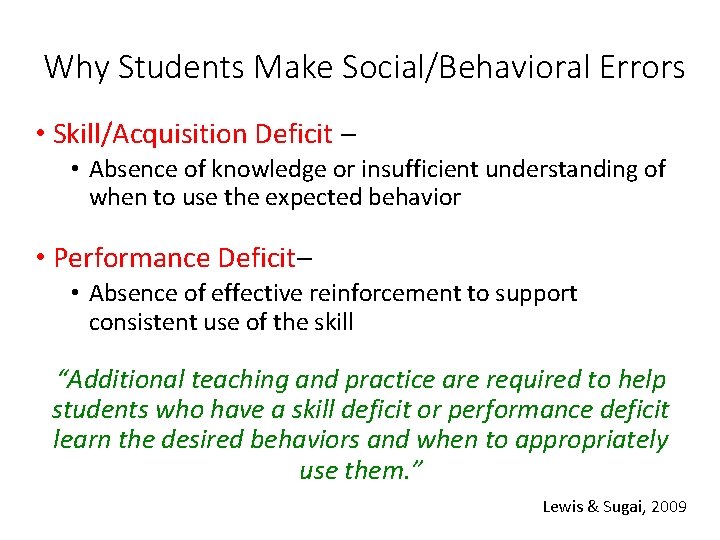
Why Students Make Social/Behavioral Errors • Skill/Acquisition Deficit – • Absence of knowledge or insufficient understanding of when to use the expected behavior • Performance Deficit– • Absence of effective reinforcement to support consistent use of the skill “Additional teaching and practice are required to help students who have a skill deficit or performance deficit learn the desired behaviors and when to appropriately use them. ” Lewis & Sugai, 2009
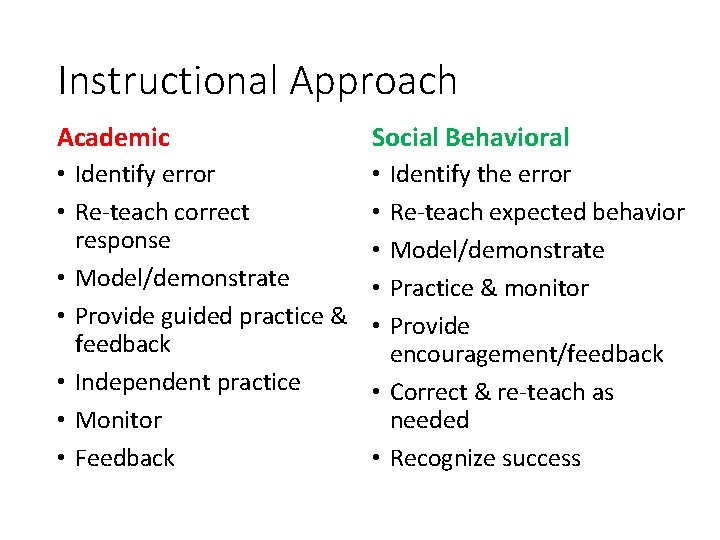
Instructional Approach Academic Social Behavioral • Identify error • Re-teach correct response • Model/demonstrate • Provide guided practice & feedback • Independent practice • Monitor • Feedback • • • Identify the error Re-teach expected behavior Model/demonstrate Practice & monitor Provide encouragement/feedback • Correct & re-teach as needed • Recognize success
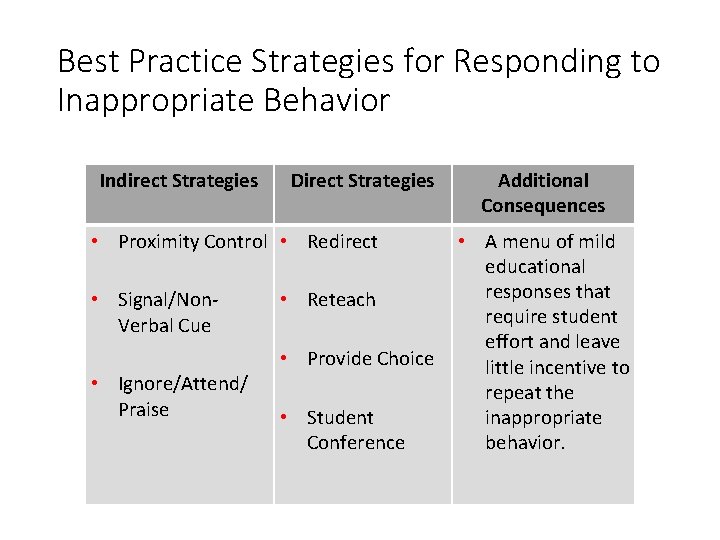
Best Practice Strategies for Responding to Inappropriate Behavior Indirect Strategies Direct Strategies • Proximity Control • Redirect • Signal/Non. Verbal Cue • Ignore/Attend/ Praise • Reteach • Provide Choice • Student Conference Additional Consequences • A menu of mild educational responses that require student effort and leave little incentive to repeat the inappropriate behavior.
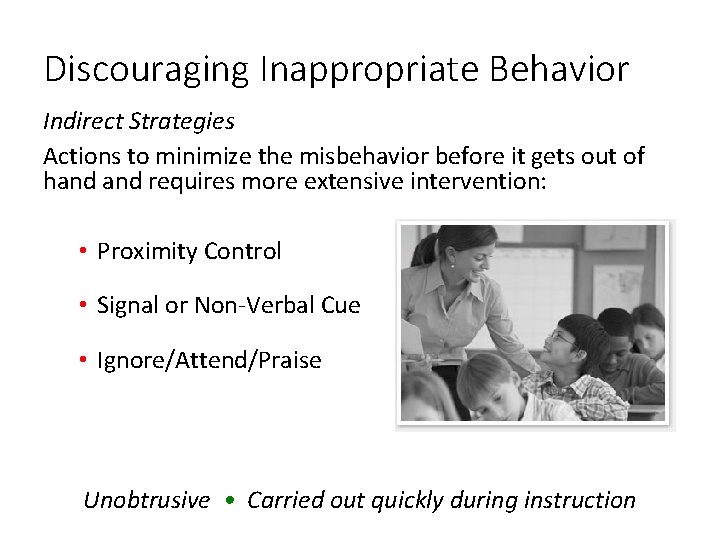
Discouraging Inappropriate Behavior Indirect Strategies Actions to minimize the misbehavior before it gets out of hand requires more extensive intervention: • Proximity Control • Signal or Non-Verbal Cue • Ignore/Attend/Praise Unobtrusive • Carried out quickly during instruction
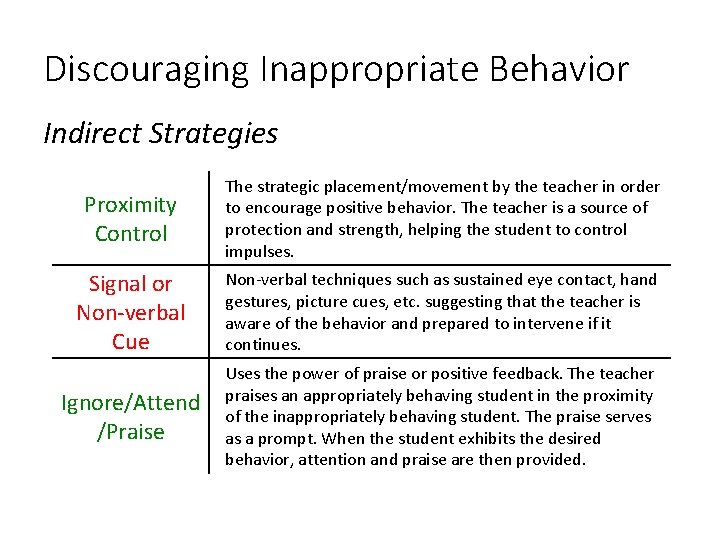
Discouraging Inappropriate Behavior Indirect Strategies Proximity Control The strategic placement/movement by the teacher in order to encourage positive behavior. The teacher is a source of protection and strength, helping the student to control impulses. Signal or Non-verbal Cue Non-verbal techniques such as sustained eye contact, hand gestures, picture cues, etc. suggesting that the teacher is aware of the behavior and prepared to intervene if it continues. Ignore/Attend /Praise Uses the power of praise or positive feedback. The teacher praises an appropriately behaving student in the proximity of the inappropriately behaving student. The praise serves as a prompt. When the student exhibits the desired behavior, attention and praise are then provided.
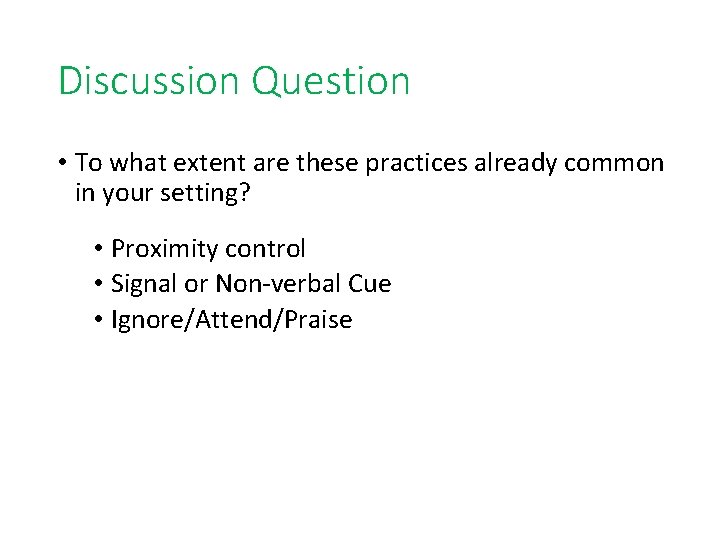
Discussion Question • To what extent are these practices already common in your setting? • Proximity control • Signal or Non-verbal Cue • Ignore/Attend/Praise
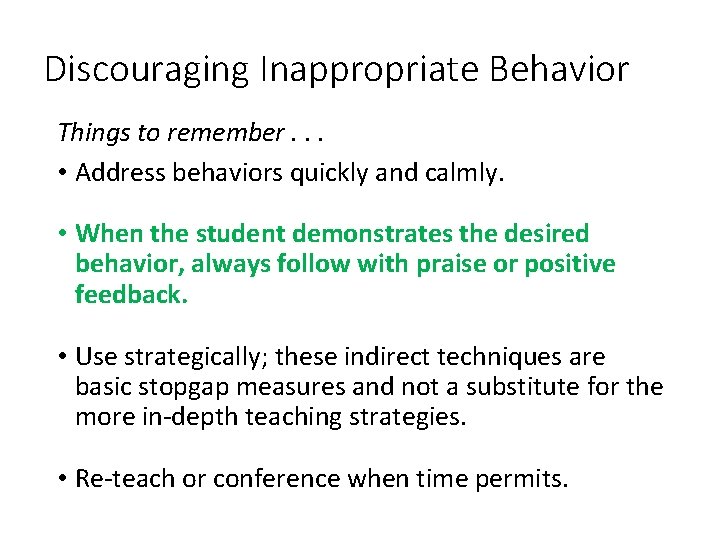
Discouraging Inappropriate Behavior Things to remember. . . • Address behaviors quickly and calmly. • When the student demonstrates the desired behavior, always follow with praise or positive feedback. • Use strategically; these indirect techniques are basic stopgap measures and not a substitute for the more in-depth teaching strategies. • Re-teach or conference when time permits.
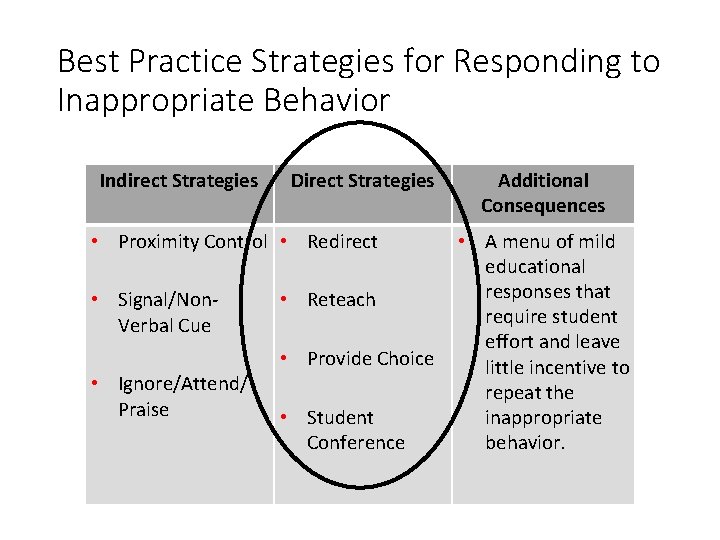
Best Practice Strategies for Responding to Inappropriate Behavior Indirect Strategies Direct Strategies • Proximity Control • Redirect • Signal/Non. Verbal Cue • Ignore/Attend/ Praise • Reteach • Provide Choice • Student Conference Additional Consequences • A menu of mild educational responses that require student effort and leave little incentive to repeat the inappropriate behavior.
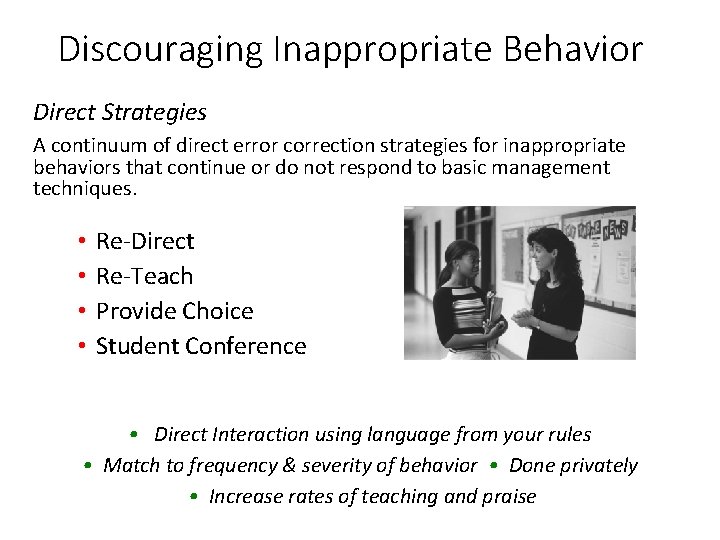
Discouraging Inappropriate Behavior Direct Strategies A continuum of direct error correction strategies for inappropriate behaviors that continue or do not respond to basic management techniques. • • Re-Direct Re-Teach Provide Choice Student Conference • Direct Interaction using language from your rules • Match to frequency & severity of behavior • Done privately • Increase rates of teaching and praise
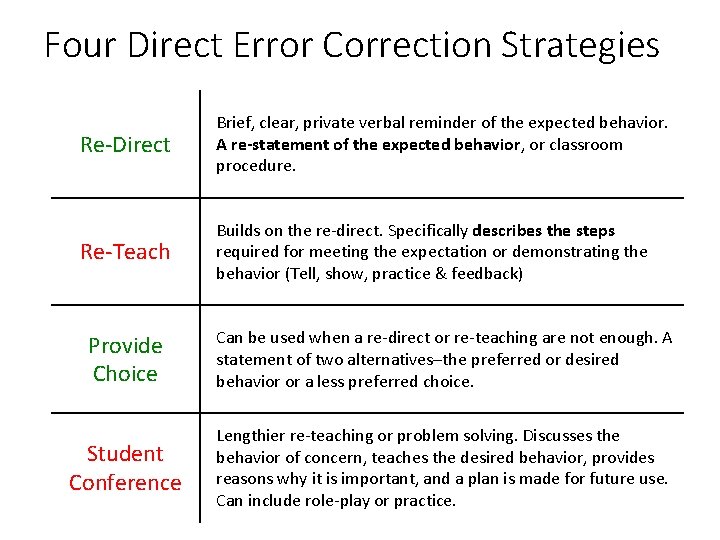
Four Direct Error Correction Strategies Re-Direct Brief, clear, private verbal reminder of the expected behavior. A re-statement of the expected behavior, or classroom procedure. Re-Teach Builds on the re-direct. Specifically describes the steps required for meeting the expectation or demonstrating the behavior (Tell, show, practice & feedback) Provide Choice Can be used when a re-direct or re-teaching are not enough. A statement of two alternatives–the preferred or desired behavior or a less preferred choice. Student Conference Lengthier re-teaching or problem solving. Discusses the behavior of concern, teaches the desired behavior, provides reasons why it is important, and a plan is made for future use. Can include role-play or practice.
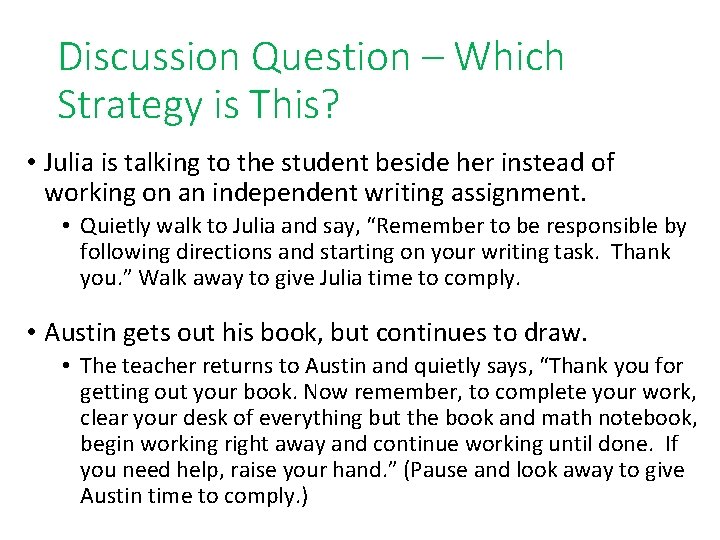
Discussion Question – Which Strategy is This? • Julia is talking to the student beside her instead of working on an independent writing assignment. • Quietly walk to Julia and say, “Remember to be responsible by following directions and starting on your writing task. Thank you. ” Walk away to give Julia time to comply. • Austin gets out his book, but continues to draw. • The teacher returns to Austin and quietly says, “Thank you for getting out your book. Now remember, to complete your work, clear your desk of everything but the book and math notebook, begin working right away and continue working until done. If you need help, raise your hand. ” (Pause and look away to give Austin time to comply. )
Video Example - Mr. Hester 9 th Grade English • Academic procedure/routine • K-W-L • What I know • What I want to know • What I learned • Procedure for dismissal • Instructional Approach for Problem Behavior (15 min)
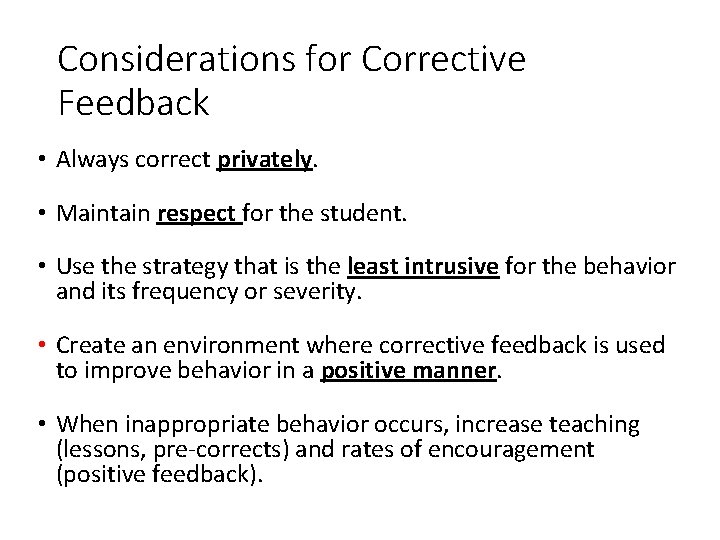
Considerations for Corrective Feedback • Always correct privately. • Maintain respect for the student. • Use the strategy that is the least intrusive for the behavior and its frequency or severity. • Create an environment where corrective feedback is used to improve behavior in a positive manner. • When inappropriate behavior occurs, increase teaching (lessons, pre-corrects) and rates of encouragement (positive feedback).
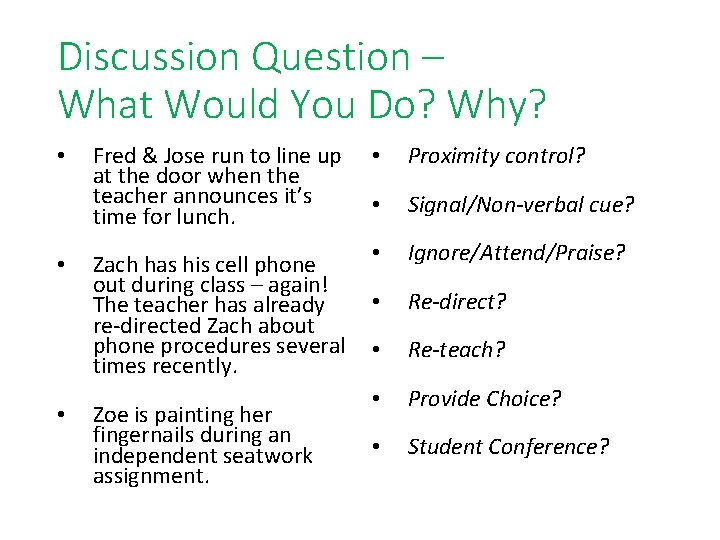
Discussion Question – What Would You Do? Why? • • • Fred & Jose run to line up at the door when the teacher announces it’s time for lunch. • Proximity control? • Signal/Non-verbal cue? Zach has his cell phone out during class – again! The teacher has already re-directed Zach about phone procedures several times recently. • Ignore/Attend/Praise? • Re-direct? • Re-teach? • Provide Choice? • Student Conference? Zoe is painting her fingernails during an independent seatwork assignment.

Best Practice Strategies for Responding to Inappropriate Behavior Indirect Strategies Direct Strategies • Proximity Control • Redirect • Signal/Non. Verbal Cue • Ignore/Attend/ Praise • Reteach • Provide Choice • Student Conference Additional Consequences • A menu of mild educational responses that require student effort and leave little incentive to repeat the inappropriate behavior.
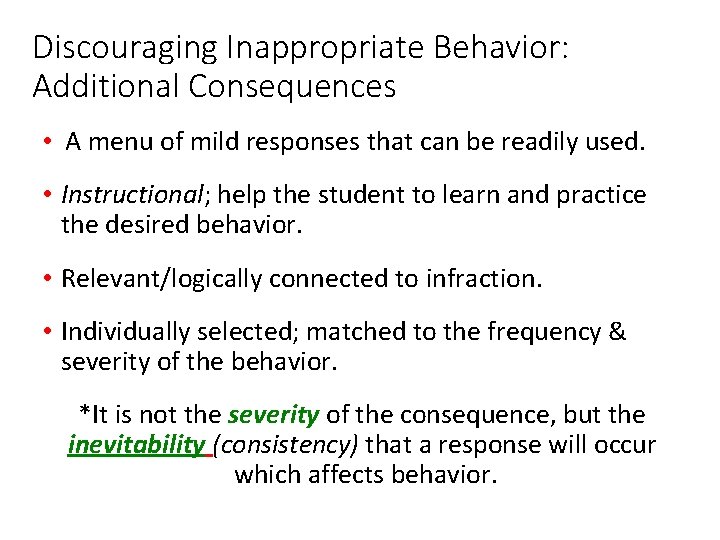
Discouraging Inappropriate Behavior: Additional Consequences • A menu of mild responses that can be readily used. • Instructional; help the student to learn and practice the desired behavior. • Relevant/logically connected to infraction. • Individually selected; matched to the frequency & severity of the behavior. *It is not the severity of the consequence, but the inevitability (consistency) that a response will occur which affects behavior.
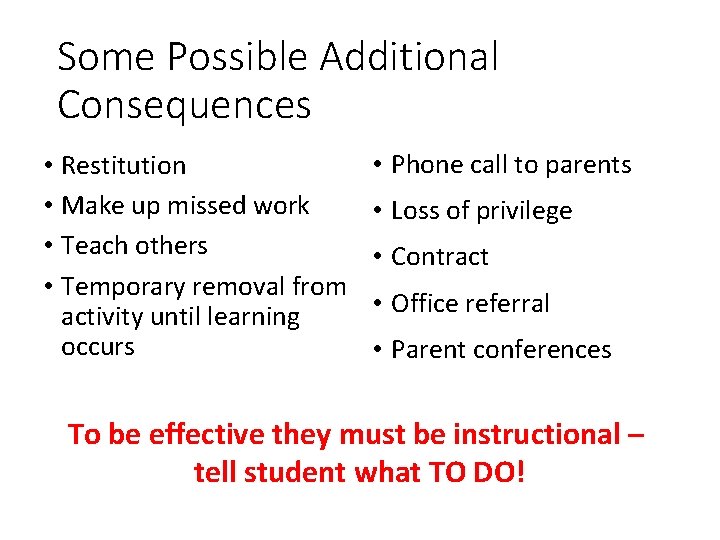
Some Possible Additional Consequences • Restitution • Make up missed work • Teach others • Temporary removal from activity until learning occurs • Phone call to parents • Loss of privilege • Contract • Office referral • Parent conferences To be effective they must be instructional – tell student what TO DO!
Discussion Question – Using Additional Consequences • With someone near you discuss the following: • What current practices used in your school need to be changed or adjusted? • How can you help staff to re-think their use of additional consequences?
Session Outcomes By the end of the session, you will be able to… • Explain the role of teaching in response to social/behavioral errors. • Recognize instructional strategies for discouraging inappropriate behavior. • Indirect Strategies • Direct Strategies • Additional Consequences • Access resources for supporting teacher use of effective practices.
Resource • Classroom Management Strategies • Supporting & Responding to Behavior: Evidence-Based Classroom Management Strategies for Teachers • www. pbis. org
Questions & Comments Barbara Mitchell University of Missouri 303 Townsend Hall Columbia, MO 65211 (573)-882 -1152 mitchellbs@missouri. edu
- Slides: 34