
Instruction Fetch Unit Using Icache ITLB Branch Decoder
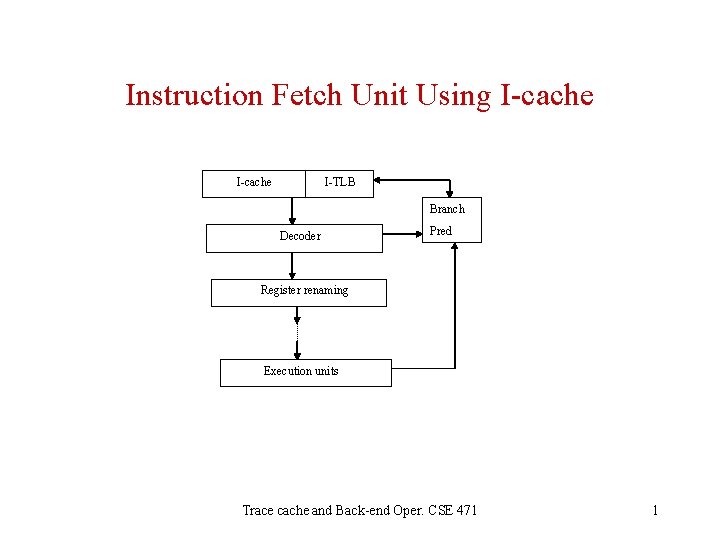
Instruction Fetch Unit Using I-cache I-TLB Branch Decoder Pred Register renaming Execution units Trace cache and Back-end Oper. CSE 471 1

Instruction Fetch Unit Using Trace Cache Fill Unit Icache Trace Branch Predictor I-TLB Decoder Register renaming Execution units Trace cache and Back-end Oper. CSE 471 2
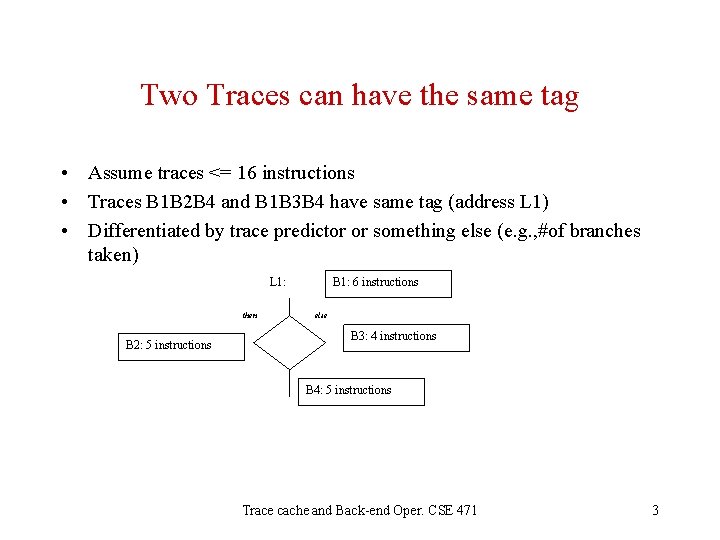
Two Traces can have the same tag • Assume traces <= 16 instructions • Traces B 1 B 2 B 4 and B 1 B 3 B 4 have same tag (address L 1) • Differentiated by trace predictor or something else (e. g. , #of branches taken) L 1: then B 2: 5 instructions B 1: 6 instructions else B 3: 4 instructions B 4: 5 instructions Trace cache and Back-end Oper. CSE 471 3
Back-end Operations (OOO) • Instruction scheduling – Detecting a ready instruction: wake-up – Maybe more than m ready instructions in an m-way superscalar: need to select • An often “important“ instruction” is load – Load dependencies are bottlenecks – Load latencies are variable – Does a given load conflict with previous store? Load speculation • Other optimizations – Value prediction? ? ? Critical instructions? ? ? Clustering of functional units? ? ? Trace cache and Back-end Oper. CSE 471 4
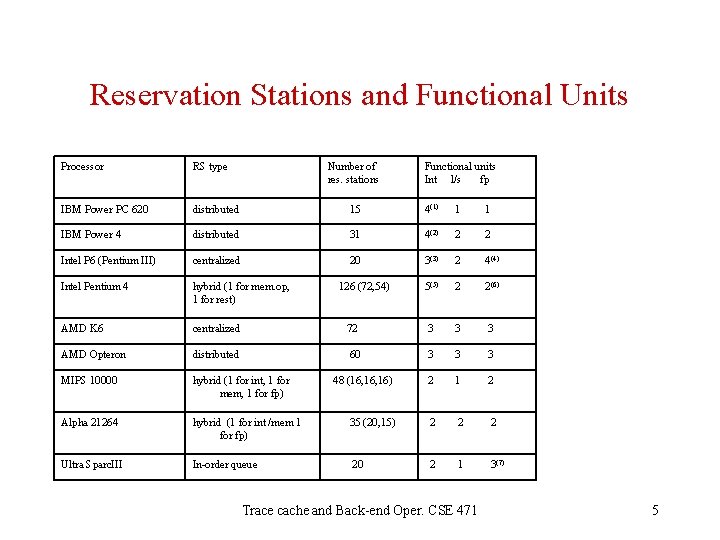
Reservation Stations and Functional Units Processor RS type Number of res. stations IBM Power PC 620 distributed 15 4(1) 1 1 IBM Power 4 distributed 31 4(2) 2 2 Intel P 6 (Pentium III) centralized 20 3(3) 2 4(4) Intel Pentium 4 hybrid (1 for mem. op, 1 for rest) 5(5) 2 2(6) AMD K 6 centralized 72 3 3 3 AMD Opteron distributed 60 3 3 3 MIPS 10000 hybrid (1 for int, 1 for mem, 1 for fp) 48 (16, 16) 2 1 2 Alpha 21264 hybrid (1 for int /mem 1 for fp) 35 (20, 15) 2 2 2 Ultra Sparc. III In-order queue 20 2 1 3(7) 126 (72, 54) Functional units Int l/s fp Trace cache and Back-end Oper. CSE 471 5
Wake-up • If f functional units, then up to f results per cycle • Hence f comparators per operand in reservation station • If w reservation stations then need of 2 fw comparators – From previous slide over a 1000 comparators! • Can be reduced by – Res. Stations distributed by function – There might not be f broadcast buses Trace cache and Back-end Oper. CSE 471 6

Select • Hardwired priority – Enforced by a hardware encoder: woken-up instruction sends a request for issue to encoder – In general “oldest woken-up instruction” first • Examples of difficulty: – Result register name of an instruction must be broadcast one cycle before the result is computed so that a dependent instruction can be woken-up in time to get the forwarded result – In case of a cache access, this is speculative so need to be able to recover, i. e. , not execute a selected instruction at a given time but let it remain in the instruction window Trace cache and Back-end Oper. CSE 471 7
Load Speculation • Load = Address computation + Get memory contents • Two flavors of speculation – Address speculation: Used for prefetching (see cache techniques later on) – Memory dependence prediction: dependence between loads and previous stores. The so-called memory disambiguation in Intel Core architecture, for example Trace cache and Back-end Oper. CSE 471 8
Store Buffer • Once the address to where to store has been generated, the store will be put in a store buffer if either – The result of the store depends on an uncompleted instruction – The result of the store is known but the store instruction is not committed • An entry in the store buffer consists of: – A bit to indicate that the entry is free (state AV) – The store has been woken-up, the store address has been computed but the result is not there (state AD) – Address and result are there but the store has not been committed (state RE) – The store instruction has been committed (state CO) Trace cache and Back-end Oper. CSE 471 9
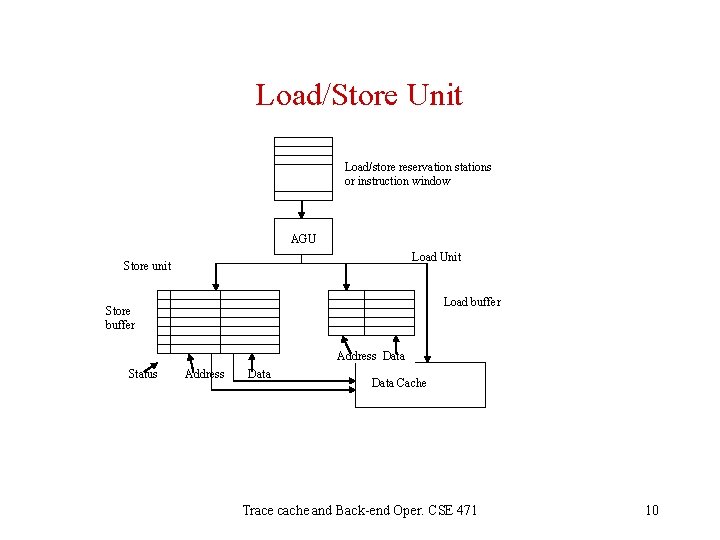
Load/Store Unit Load/store reservation stations or instruction window AGU Load Unit Store unit Load buffer Store buffer Address Data Status Address Data Cache Trace cache and Back-end Oper. CSE 471 10
Load Issue • Simple scheme: Load and store issue (to AGU) in program order – Simplest: Load can issue only if store buffer empty – Simpler: load bypassing – load issue if no address conflict with addresses in store buffer • Requires to check if preceding store instruction has entered the address in the store buffer • If there is a match in state AD or RE the load is aborted (contents discarded) – Next: load forwarding • Take advantage of states RE and CO and forward result to result register of load. Trace cache and Back-end Oper. CSE 471 11
More load speculation • Stores issue in program order but a load can issue before some store (i. e. , load/store res. station is not a queue) • Pessimistic approach (previous slide) + check that there is no store left “unissued” in reservation station before the load – Used in Pentium • Optimistic approach: always issue loads – Need of a load buffer so we can recover • Dependence prediction – Like optimistic but use of a predictor of memory dependencies and hence fewer recoveries Trace cache and Back-end Oper. CSE 471 12
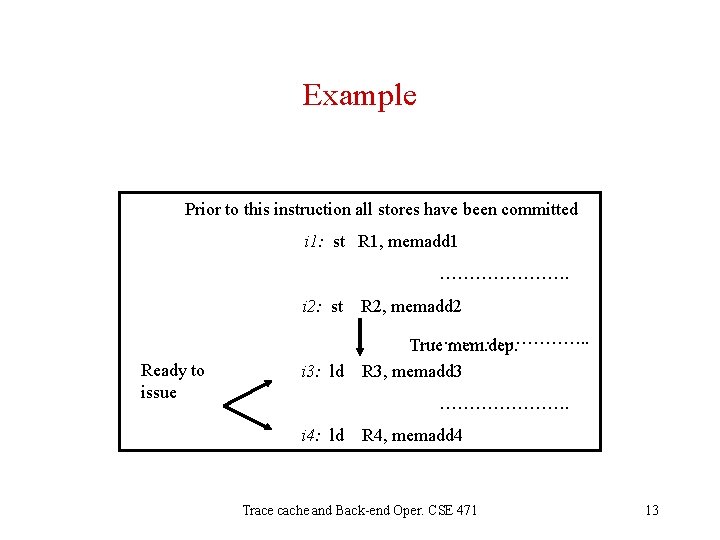
Example Prior to this instruction all stores have been committed i 1: st R 1, memadd 1 …………………. Ready to issue i 2: st R 2, memadd 2 i 3: ld ……………. . True mem. dep. R 3, memadd 3 …………………. i 4: ld R 4, memadd 4 Trace cache and Back-end Oper. CSE 471 13
Example (c’ed) • Pessimistic: – no load can issue until i 2 has computed its address and put it in store buffer – Then i 4 can issue – i 3 will have to wait till i 2 has computed result and can forward (state RE) • Optimistic – i 3 and i 4 issue and are put in load buffer. – When i 1 computes its address, nothing happens in the load buffer – When i 2 reaches state RE (or AD depending on implementation), i 3 and i 4 are removed from the load buffer and will have to reissue (i 4 because it might depend on i 3, again depending on implementation) • Dependence prediction – If dependence between i 2 and i 3 is predicted, i 3 cannot issue but i 4 can (if not dependent on i 3) Trace cache and Back-end Oper. CSE 471 14
- Slides: 14