
Instream Flow Programs and the Policies that Benefit
Instream Flow Programs and the Policies that Benefit a River’s Health A Senior Thesis By Kyle B. Jackson Under the Advice of J. Michael Jess
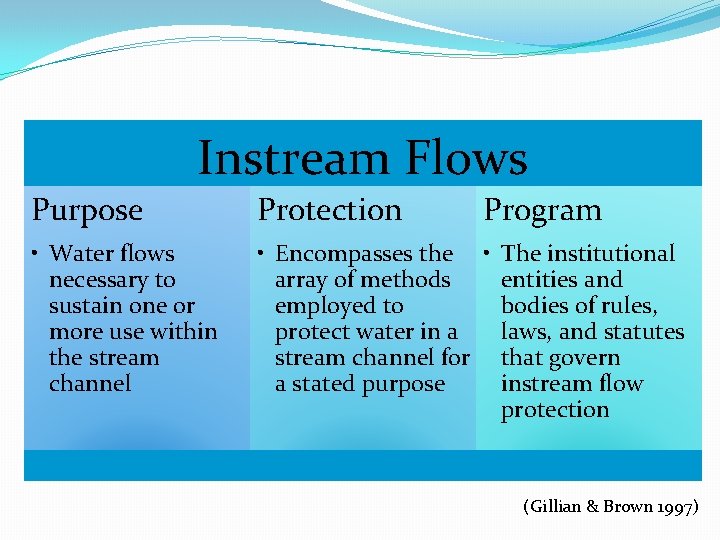
Instream Flows Purpose Protection Program • Water flows necessary to sustain one or more use within the stream channel • Encompasses the • The institutional array of methods entities and employed to bodies of rules, protect water in a laws, and statutes stream channel for that govern a stated purpose instream flow protection (Gillian & Brown 1997)
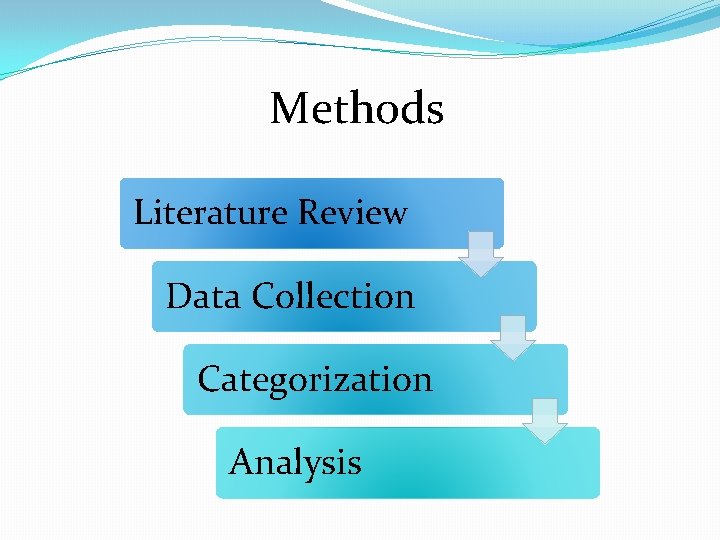
Methods Literature Review Data Collection Categorization Analysis
Sources Academic Journals Contacts • Natural Resource Management • Agency staff Government Reports • Bureau Land Management State Statutes • State Government Websites
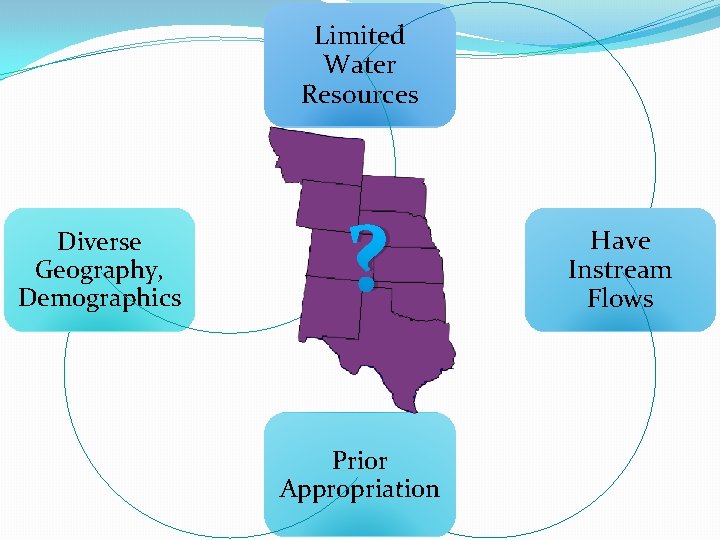
Limited Water Resources Diverse Geography, Demographics ? Prior Appropriation Have Instream Flows
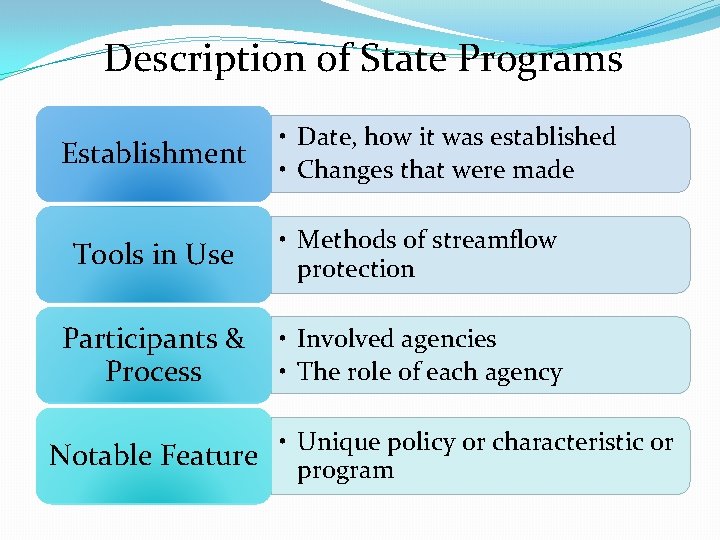
Description of State Programs Establishment • Date, how it was established • Changes that were made Tools in Use • Methods of streamflow protection Participants & Process • Involved agencies • The role of each agency • Unique policy or characteristic or Notable Feature program
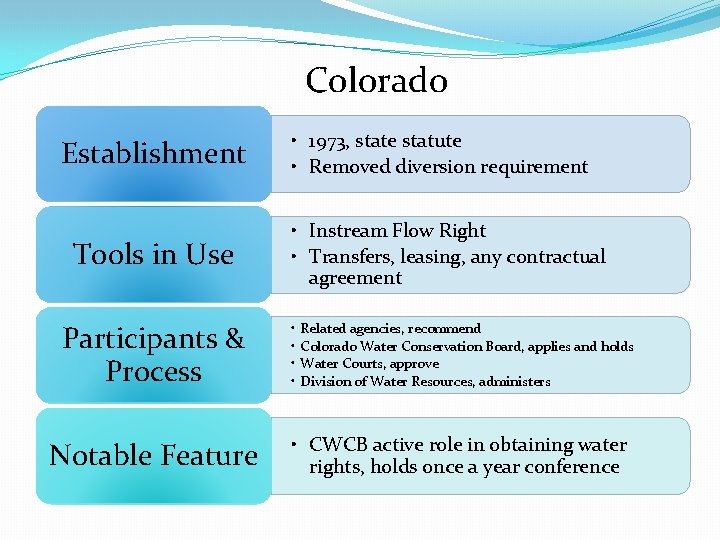
Colorado Establishment Tools in Use Participants & Process Notable Feature • 1973, state statute • Removed diversion requirement • Instream Flow Right • Transfers, leasing, any contractual agreement • • Related agencies, recommend Colorado Water Conservation Board, applies and holds Water Courts, approve Division of Water Resources, administers • CWCB active role in obtaining water rights, holds once a year conference
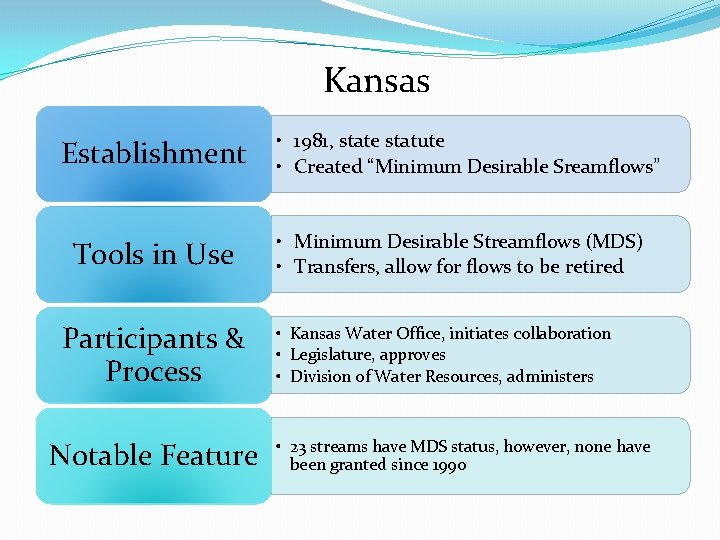
Kansas Establishment Tools in Use Participants & Process Notable Feature • 1981, state statute • Created “Minimum Desirable Sreamflows” • Minimum Desirable Streamflows (MDS) • Transfers, allow for flows to be retired • Kansas Water Office, initiates collaboration • Legislature, approves • Division of Water Resources, administers • 23 streams have MDS status, however, none have been granted since 1990
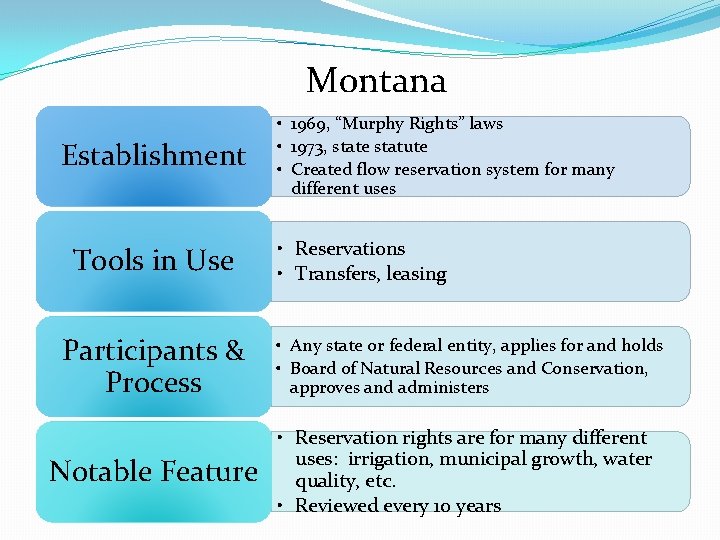
Montana Establishment Tools in Use • 1969, “Murphy Rights” laws • 1973, state statute • Created flow reservation system for many different uses • Reservations • Transfers, leasing Participants & Process • Any state or federal entity, applies for and holds • Board of Natural Resources and Conservation, approves and administers Notable Feature • Reservation rights are for many different uses: irrigation, municipal growth, water quality, etc. • Reviewed every 10 years
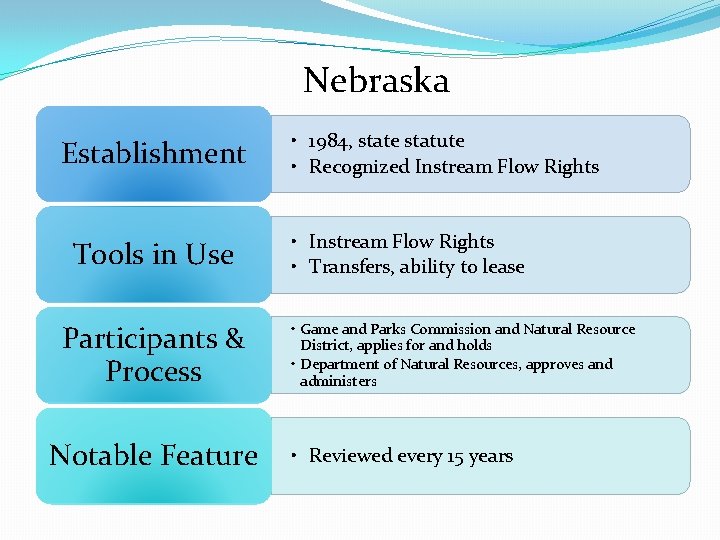
Nebraska Establishment Tools in Use Participants & Process Notable Feature • 1984, state statute • Recognized Instream Flow Rights • Transfers, ability to lease • Game and Parks Commission and Natural Resource District, applies for and holds • Department of Natural Resources, approves and administers • Reviewed every 15 years
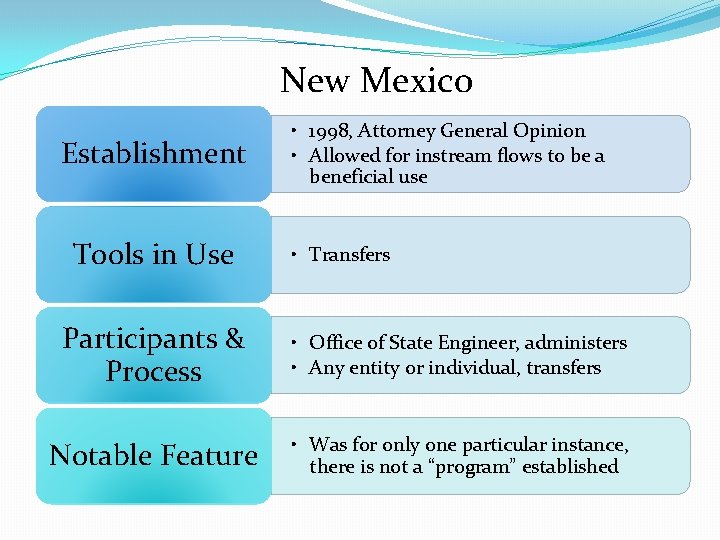
New Mexico Establishment Tools in Use • 1998, Attorney General Opinion • Allowed for instream flows to be a beneficial use • Transfers Participants & Process • Office of State Engineer, administers • Any entity or individual, transfers Notable Feature • Was for only one particular instance, there is not a “program” established
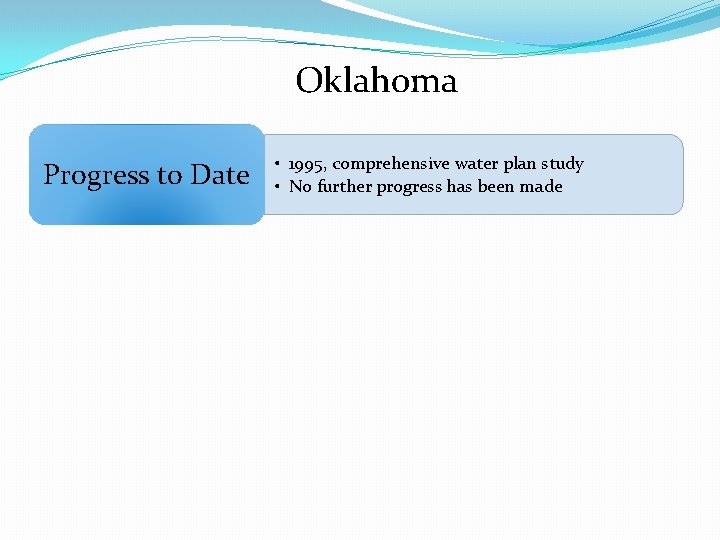
Oklahoma Progress to Date • 1995, comprehensive water plan study • No further progress has been made
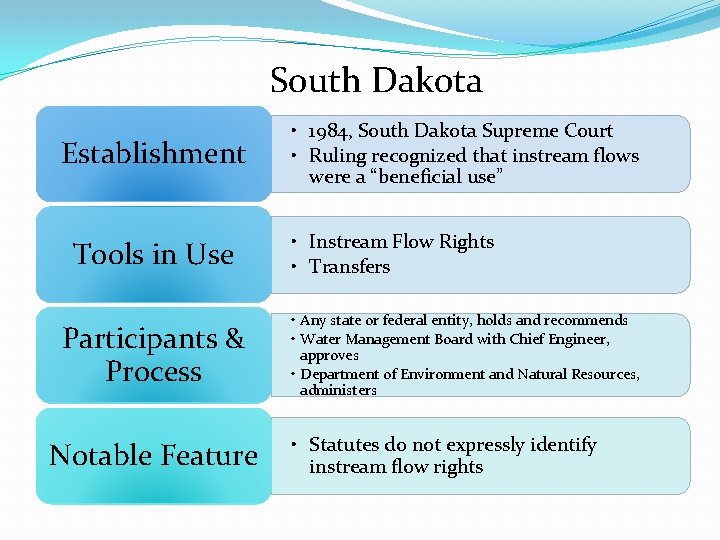
South Dakota Establishment Tools in Use Participants & Process Notable Feature • 1984, South Dakota Supreme Court • Ruling recognized that instream flows were a “beneficial use” • Instream Flow Rights • Transfers • Any state or federal entity, holds and recommends • Water Management Board with Chief Engineer, approves • Department of Environment and Natural Resources, administers • Statutes do not expressly identify instream flow rights
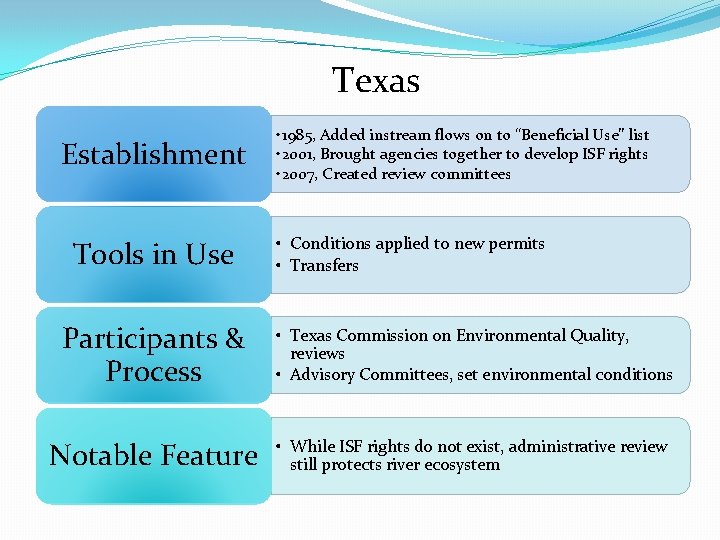
Texas Establishment Tools in Use • 1985, Added instream flows on to “Beneficial Use” list • 2001, Brought agencies together to develop ISF rights • 2007, Created review committees • Conditions applied to new permits • Transfers Participants & Process • Texas Commission on Environmental Quality, reviews • Advisory Committees, set environmental conditions Notable Feature • While ISF rights do not exist, administrative review still protects river ecosystem
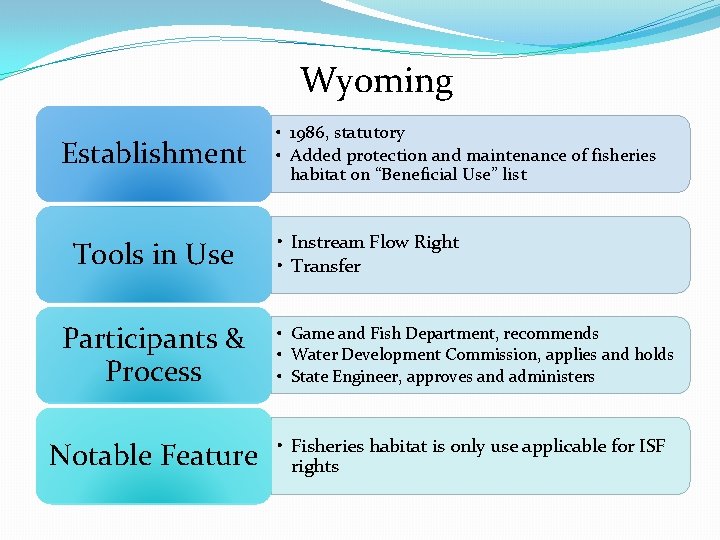
Wyoming Establishment Tools in Use • 1986, statutory • Added protection and maintenance of fisheries habitat on “Beneficial Use” list • Instream Flow Right • Transfer Participants & Process • Game and Fish Department, recommends • Water Development Commission, applies and holds • State Engineer, approves and administers Notable Feature • Fisheries habitat is only use applicable for ISF rights
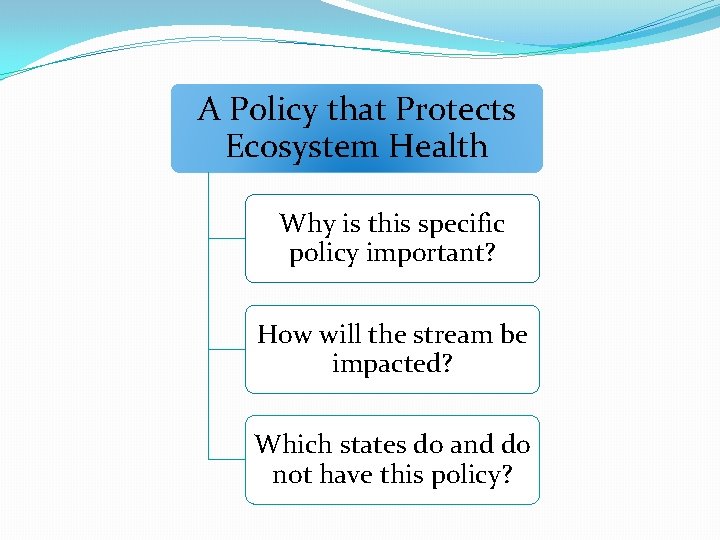
A Policy that Protects Ecosystem Health Why is this specific policy important? How will the stream be impacted? Which states do and do not have this policy?
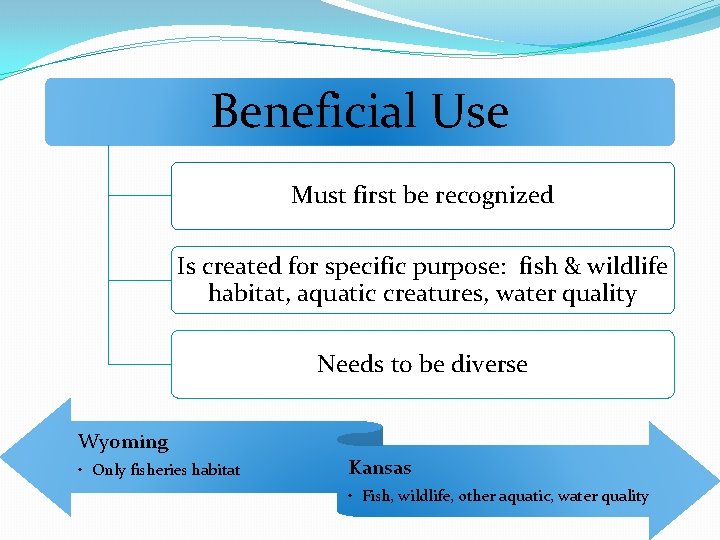
Beneficial Use Must first be recognized Is created for specific purpose: fish & wildlife habitat, aquatic creatures, water quality Needs to be diverse Wyoming • Only fisheries habitat Kansas • Fish, wildlife, other aquatic, water quality
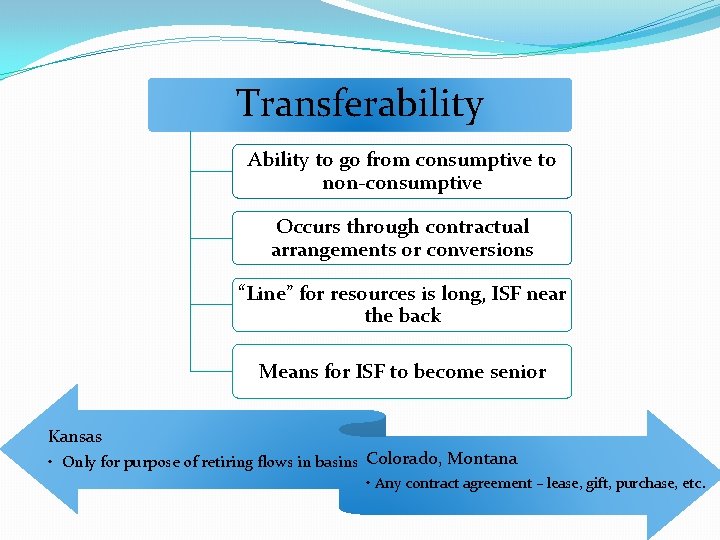
Transferability Ability to go from consumptive to non-consumptive Occurs through contractual arrangements or conversions “Line” for resources is long, ISF near the back Means for ISF to become senior Kansas • Only for purpose of retiring flows in basins Colorado, Montana • Any contract agreement – lease, gift, purchase, etc.
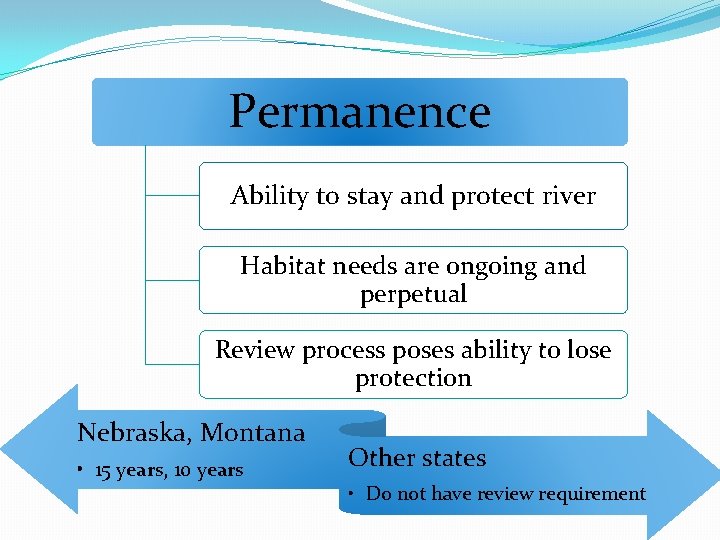
Permanence Ability to stay and protect river Habitat needs are ongoing and perpetual Review process poses ability to lose protection Nebraska, Montana • 15 years, 10 years Other states • Do not have review requirement
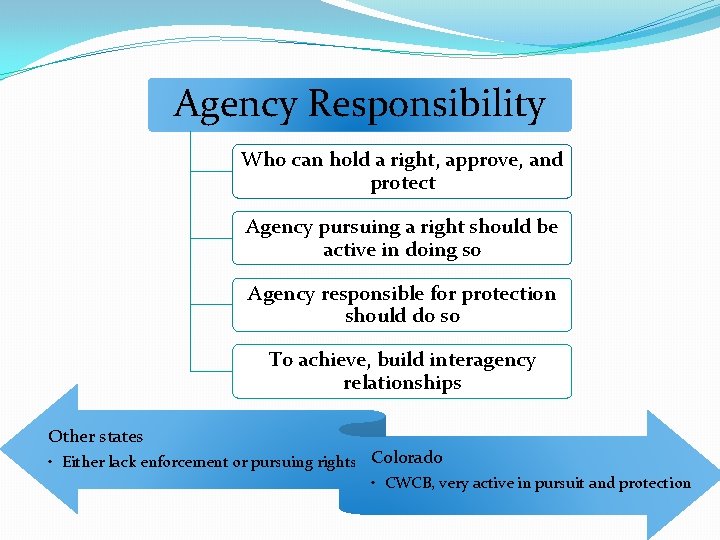
Agency Responsibility Who can hold a right, approve, and protect Agency pursuing a right should be active in doing so Agency responsible for protection should do so To achieve, build interagency relationships Other states • Either lack enforcement or pursuing rights Colorado • CWCB, very active in pursuit and protection
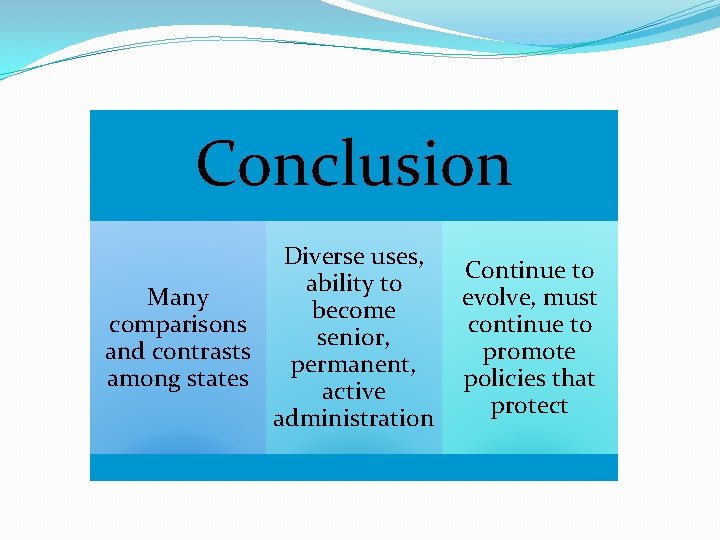
Conclusion Diverse uses, ability to Many become comparisons senior, and contrasts permanent, among states active administration Continue to evolve, must continue to promote policies that protect
Works Cited � “About Us. ” Oklahoma Water Resources Board. 11 September 2008. 18 March 2009 http: //www. owrb. ok. gov/about/management/board. php. � Charney, Sasha. "Decades Down the Road: An Analysis of Instream Flow Programs in Colorado and the Western United States. " Colorado Water Conservation Board. 2005. � "Draft Proposals for Stream Water. " Oklahoma Water Resources Board. 2008. � “Environment and Natural Resources. ” Water Rights Division, South Dakota Department of Natural Resources. Chapter 45 -6. 19 March 2009. http: //www. state. sd. us/denr/DES/waterrights/46 -5. htm#46 -530. 2. � “Instream Flow Filings. ” Wyoming Water Development Commission. March 2006. 21 March 2009. http: //wwdc. state. wy. us/instream_flows. html. � “Instream Uses Program. ” Texas Commission on Environmental Quality. 14 January 2009. 21 March 2009. http: //www. tceq. state. tx. us/permitting/water_supply/water_rights/instreamusesprogram. html. � Kaiser, RA. "Untying the Gordian Knot: Negotiated Strategies for Protecting Instream Flows in Texas. " Natural Resources Journal. Vol. 38: 157 -196. 1998. � Mc. Kinney, Matthew. "Instream Flow Policy in Montana: A History and Blueprint for the Future. " Public Land Law Review. Vol. 11. 1990. � Neuman, Janet. "Beneficial use, Waste, and Forfeiture: The Search for a True and Lasting Relationship with the Land. " Environmental Law. Vol. 28: 919 -969. 1998. � "Programmatic Work Plan. " Oklahoma Water Resource Board, Oklahoma Comprehensive Water Plan. 2008 � Rath, Mark. South Dakota Department of Environment and Natural Resources. 19 March 2009. � Thomas, A. C. and D. D. Paul. "Water Management Unit Five-Year Plan; 2006 to 2010. " 2006. � Zuerlein, Gene. "Remember our rivers! An overview of instream flows in Nebraska. " Prairie Fire. August 2007.
Acknowledgments Mike Jess Ann Bleed Bob Kuzelka Erin Frank
- Slides: 23