
Institutional Review Boards IRBs and Human Subjects Research
Institutional Review Boards (IRBs) and Human Subjects Research Protection Programs (HRPP) Lifespan 1
Institution Review Boards, (IRB) • • • What is an IRB and what does it do? Who regulates the IRB? What is the history of IRBs and research? Lifespan 2

What is an IRB? n An IRB is an Institutional Review Board • • • It must consist of at least 5 members One member must have a scientific background One member must be a non-scientist (this member must attend a meeting to achieve quorum) You should have at least one non-affiliated member (not affiliated with the institution) Members should have expertise in the research that will be reviewed. Lifespan 3
What does the IRB do? n IRBs review research involving human subjects • • Human subject research includes research involving human subjects and/or their identifiable information The review encompasses the research protocol, the informed consent and process, any advertisements and all relevant documents Lifespan 4
What is the main purpose of an IRB? n The purpose of the IRB is to review research studies: • • to assess the risk/benefit ratio. To ensure that the informed consent Ø Ø Ø • • clearly states all the risks to the subjects provides full disclosure of what will be expected of the participant Is not coercive To verify that the ads are not misleading or coercive To ensure that the selection of subject is equitable and justified Lifespan 5
Who regulates the IRB n n Research and IRBs are regulated by State and Federal Regulations Two federal bodies come under HHS (Health and Human Services) • • FDA (Food and Drug Administration) and OHRP (Office for Human Research Protection) Lifespan 6
Federal Regulation of Research – FDA _______________ n All research that involves a food, drug, device or cosmetic is regulated under Title 21 CFR (The are several parts to this Title CFR that regulate research) Lifespan 7
Federal Regulation of Research – OHRP _______________ n The Office for Human Research Protections, OHRP, regulates research under Title 45 CFR Part 46. Lifespan 8
State Regulation of Research n States have regulations that regulates research and subsequently IRBs. The State of Rhode Island regulates research under Section 16 of the Rules and Regulations for Licensing Hospitals. Lifespan 9
Where did the concept of the IRB originate? • • The concept of IRB grew out of hospital based scientific peer review Ø Peers being physicians and other experts within the institution 1953 - NIH organized a “disinterested” committee of scientists to review research conducted at NIH Lifespan 10
Where did the concept of the IRB originate? n n n 1966 first federal policy for the protection of human subjects – NIH. 1974 National Research Act became law – provided protection for human subjects involved in biomedical and behavioral research 1993 –concept of local IRB review was firmly entrenched for institutions receiving federal research funds. Lifespan 11
Federal take on what an IRB is and does! 45 CFR 46. 102 (Definitions) n (h) IRB approval means the determination of the IRB that the research has been reviewed and may be conducted at an institution within the constraints set forth by the IRB and by other institutional and federal requirements. Lifespan 12
What is the History of Research? The history of Research has not always been one of ethics and regulations – Nazi war crimes; Tuskegee syphilis study; Yale Milgram experiments (obedience to authority, 196162); tea room experiments (homosexual behavior in public restroom – mid 60’s) Lifespan 13
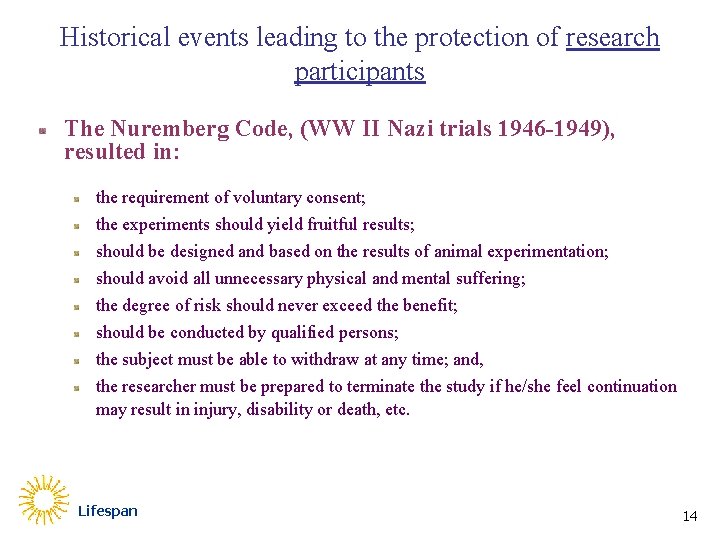
Historical events leading to the protection of research participants The Nuremberg Code, (WW II Nazi trials 1946 -1949), resulted in: the requirement of voluntary consent; the experiments should yield fruitful results; should be designed and based on the results of animal experimentation; should avoid all unnecessary physical and mental suffering; the degree of risk should never exceed the benefit; should be conducted by qualified persons; the subject must be able to withdraw at any time; and, the researcher must be prepared to terminate the study if he/she feel continuation may result in injury, disability or death, etc. Lifespan 14
Government and the World Medical Association oversight of Research (1962 -present) n 1962 Congress passed legislation requiring consent for all FDA studies (however, this had broad exceptions) 1964 Declaration of Helsinki – World Medical Association developed ethical principles and guidance for medical research involving human subjects and/or their identifiable data Lifespan 15
Government and the World Medical Association oversight of Research (1962 -present) n 1966 the Surgeon general stated clinical research would be supported only if the investigator sought prior review by institutional officials concerning the rights and welfare of the research subjects, informed consent and risks and benefits. (see above the 1966 NIH policy for IRB review) Lifespan 16
Government and the World Medical Association oversight of Research (1962 -present) National Research Act 1974 - National Commission for the Protection of Human Subjects of Biomedical and Behavioral Research Mandated specific numerical requirements for these institutional review committees and quorum required a non-scientist Application for grants required assurances satisfactory to DHHS, then known as the Dept of Health, Education and Welfare’ That institutional committees be known as Institutional Review Boards (IRBs) Lifespan 17
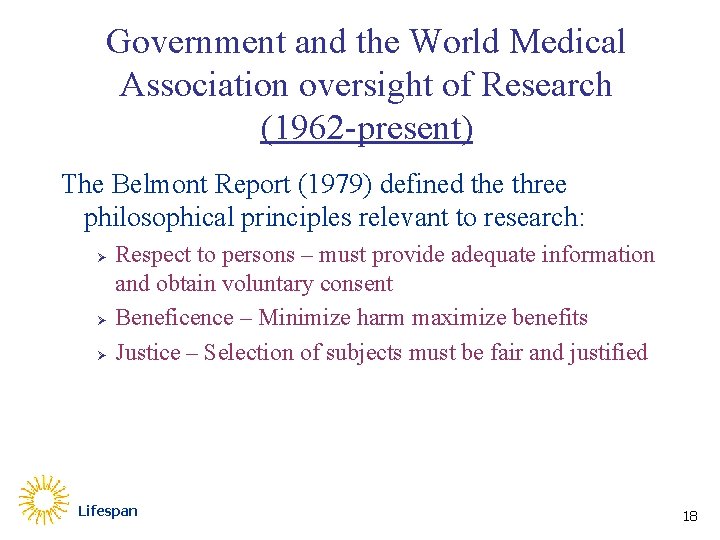
Government and the World Medical Association oversight of Research (1962 -present) The Belmont Report (1979) defined the three philosophical principles relevant to research: Ø Ø Ø Respect to persons – must provide adequate information and obtain voluntary consent Beneficence – Minimize harm maximize benefits Justice – Selection of subjects must be fair and justified Lifespan 18
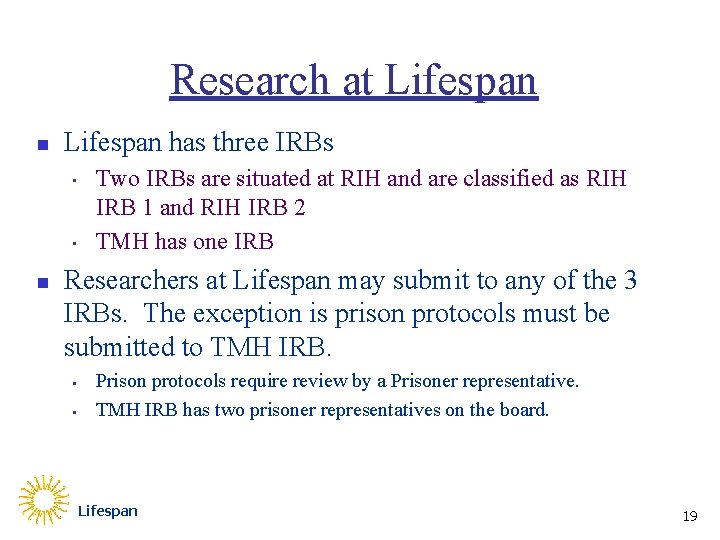
Research at Lifespan n Lifespan has three IRBs • • n Two IRBs are situated at RIH and are classified as RIH IRB 1 and RIH IRB 2 TMH has one IRB Researchers at Lifespan may submit to any of the 3 IRBs. The exception is prison protocols must be submitted to TMH IRB. • • Prison protocols require review by a Prisoner representative. TMH IRB has two prisoner representatives on the board. Lifespan 19
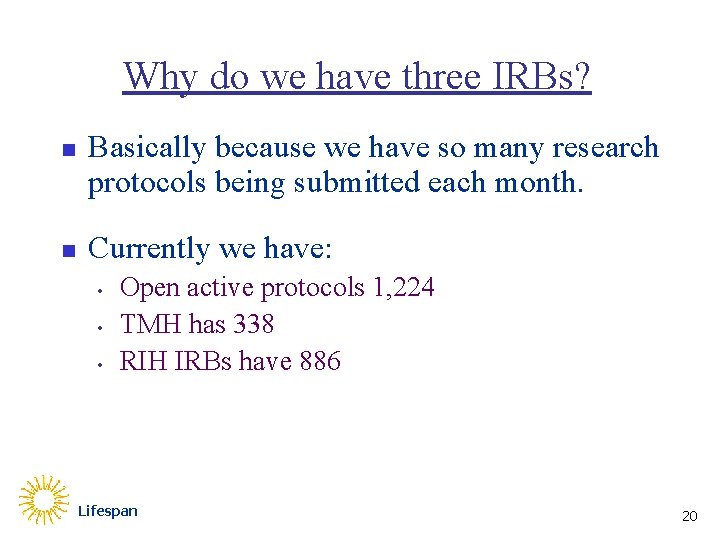
Why do we have three IRBs? n n Basically because we have so many research protocols being submitted each month. Currently we have: • • • Open active protocols 1, 224 TMH has 338 RIH IRBs have 886 Lifespan 20
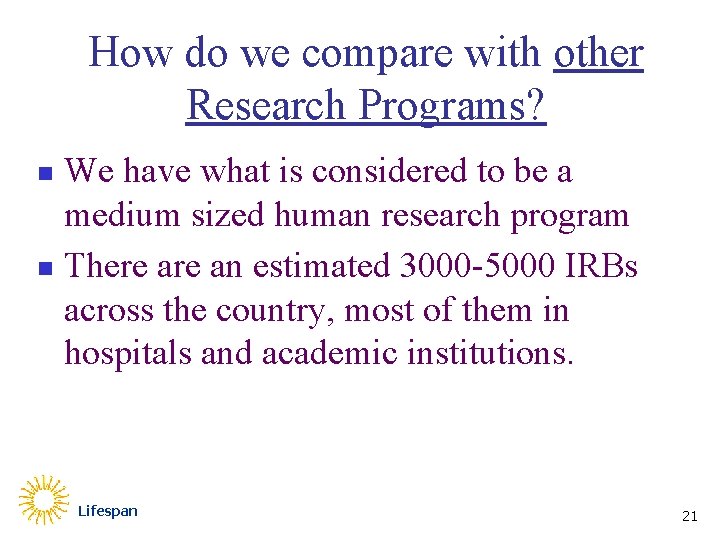
How do we compare with other Research Programs? We have what is considered to be a medium sized human research program n There an estimated 3000 -5000 IRBs across the country, most of them in hospitals and academic institutions. n Lifespan 21
Lifespan’s HRPP hierarchy n Dr. Boyd King, VP Medical Affairs has oversight responsibilities for the HRPP • This oversight has been delegated to him through Ø Ø n Joe Amaral at RIH, Kathleen Hittner at TMH, Dan Wall at Bradley Hospital, and Arthur Sampson at Newport Hospital Peg Mc. Gill is the Director of Lifespan’s Office of Research Administration. n Pat Houser is the Manager of the Research Review Committees Lifespan 22
Do we need more members? YES! ALWAYS Currently we need non-affiliated members. So if you have any family or friends that would like to volunteer their time for a worthwhile cause please have them call me. Lifespan 23
Who are the members of Lifespan’s IRBs? Lifespan’s IRBs are made up of physicians, Ph. Ds, pharmacists, nurses, clergy, retirees, and community members. n Lifespan general counsel provides legal representation and counseling to the IRB as needed n Lifespan 24

What is the time commitment for IRB members? n n n IRB members spend approximately two to two and a half hours/month reviewing protocols for the IRB meetings. The Chairs and Associate chairs spend considerably more time since they review expedited initial, continuing and changes to protocol. Adverse events are also reviewed by either the chair or his/her designate. Lifespan 25
What is the IRBs primary concern? The Rights and Welfare of the Research Participants Lifespan 26
So what do the IRB members do at a meeting? n n The IRB follows Robert’s Rule (Parliamentary Procedures – a set of rules of conduct for meetings), to review research protocols that have been submitted by the research investigators. Meetings cannot begin unless we have quorum (a majority of IRB members and the non-scientist must be present for quorum). Lifespan 27
So what do the IRB members do at a meeting? The IRB chair calls the meeting to order n The minutes from the previous meeting are reviewed and a motion to accept is put forth for acceptance of the minutes n Lifespan 28
So what do the IRB members do at a meeting? n n The first researcher on the agenda is brought into the meeting. Two primary reviewers had been assigned to that project (they reviewed the entire application as submitted) and now will proceed with any questions and/or concerns and direct them to the researcher Lifespan 29
So what do the IRB members do at a meeting? n Next the remaining members of the committee will proceed with any questions and/or concerns and direct them to the researcher n The chair asks for a motion and the board votes on that motion. n The board can: • • • Approve with changes requested. (This is why after the meeting the ORA will ask you to make changes requested by the board). Defer approval - if the changes are detailed and many. Disapprove - if the board feels no matter how the project is changed they cannot approve the project as designed. Lifespan 30
So what do the IRB members do at a meeting? n n All new protocols requiring full board review are presented, discussed and voted upon. Next the board will discuss any adverse events that may require full board discussion Then the board will review the continuing reviews that require full board review Finally any new business is discussed. Lifespan 31
So what do the IRB members do at a meeting? n n Any Non-compliance issues or complaints that have been identified since the prior meeting will be discussed. This discussion may result in an action taken by the board. This action can be: Ø Ø Further investigation into the matter Suspension Termination of the project Termination of the researcher to conduct research at this institution Lifespan 32
Accreditation of the Human Research Protection Program n n Lifespan is seeking accreditation of our human research protection program This accreditation seeks to accredit the entire human research protection program for all of Lifespan not just the IRBs. That means we’re all in this together. Lifespan 33
Want to learn more about research and the IRB? The Office of Research Administration has an online Human Subjects Protection course through the CITI program. www. citiprogram. org This site also offers: • • A good clinical practice course (GCP) And will soon offer a Recombinant DNA course For information and instructions go to: http: //www. lifespan. org/research/irb/mandatoryedg uidance. asp Lifespan 34
Contacts for Research If you have any questions, concerns, or otherwise just want to learn more about research you can contact: Peg Mc. Gill, Director Research Administration pmcgill@lifespan. org 444 -5113 Patricia Houser, Manager Research Review Committees and Communication at phouser@lifespan. org 444 -2099 Deborah Temple, ORA Manager Compliance and Training at dtemple@lifespan. org 444 -5843 Lifespan 35
- Slides: 35