
Institutional Review Board Nuts and Bolts of CGU

Institutional Review Board Nuts and Bolts of CGU IRB Procedures James Griffith Institutional Review Board Manager
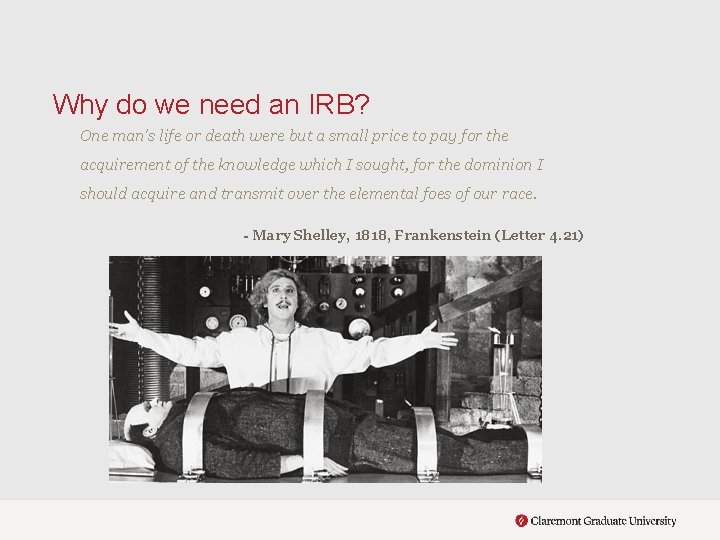
Why do we need an IRB? One man's life or death were but a small price to pay for the acquirement of the knowledge which I sought, for the dominion I should acquire and transmit over the elemental foes of our race. - Mary Shelley, 1818, Frankenstein (Letter 4. 21)
3 Why do we need an IRB? • WWII represents a turning point in the ethics of science • • • Physics – atomic science Medical experiments in Nazi prison camps Triggered Nuremberg trials Nuremberg Code • Nuremberg code violated even in U. S. • • 1949 – Human radiation exposure experiment 1956 -70 – Willowbrook hepatitis study 1960 s – Army/CIA LSD experiments 1931 -1972 Tuskegee syphilis experiment • Recognition of ethical issues led to push for acceptance of Belmont Principles and finally the Common Rule
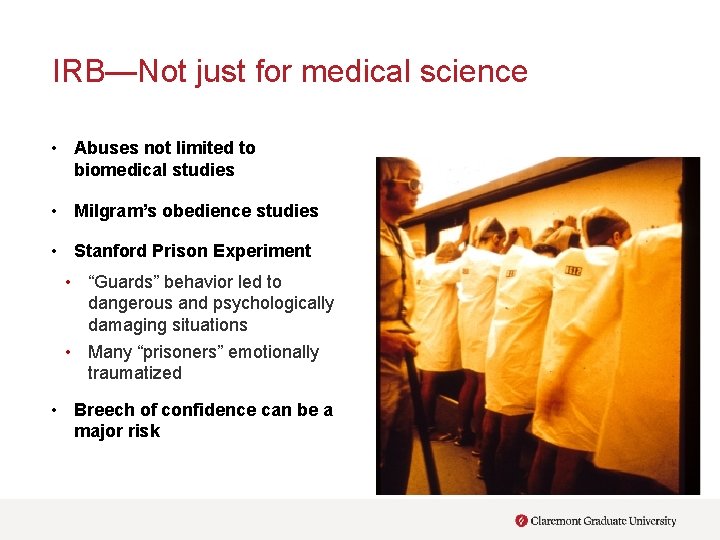
IRB—Not just for medical science • Abuses not limited to biomedical studies • Milgram’s obedience studies • Stanford Prison Experiment • “Guards” behavior led to dangerous and psychologically damaging situations • Many “prisoners” emotionally traumatized • Breech of confidence can be a major risk
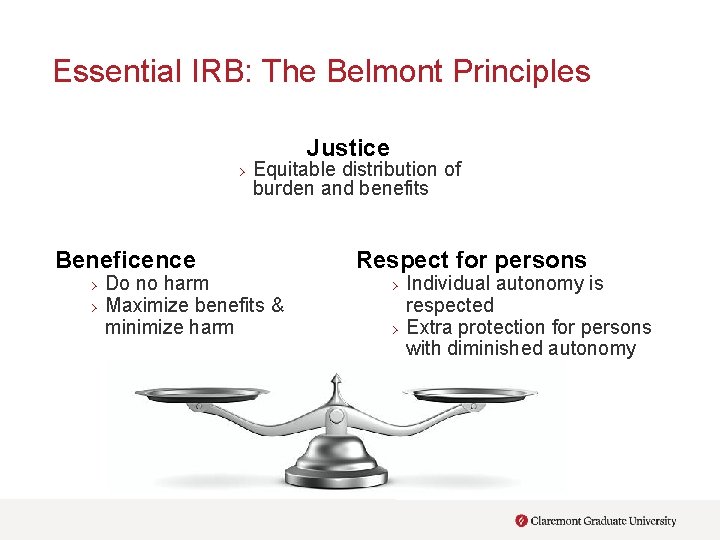
6 Essential IRB: The Belmont Principles Justice › Equitable distribution of burden and benefits Beneficence › Do no harm › Maximize benefits & minimize harm Respect for persons › Individual autonomy is respected › Extra protection for persons with diminished autonomy
7 IRB Mission • Facilitate ethical conduct of research with human subjects • Promote a culture of research that aspires to highest ethical standards
8 The Purpose of IRB Review • Assure that all investigators meet specific ethical standards in all research that involves human subjects. • Assure compliance with federal regulations and university policies
9 Do You Need IRB Review? Determining the Applicability of 45 CFR Part 46 Consider the following questions: • Does the activity involve Research? • Does the activity involve Human Participants?
1 0 IRB Process in a Nutshell • PI completes human subjects protections training • Faculty, or students with faculty endorsement, submit “protocols” (specific descriptions of study designs) • An IRB staff member reviews protocol for completeness • At least one IRB analyst or member reads each entire application package • Research is designated by the risk level into exempt, expedited, or full board review • Often necessary for IRB to correspond with investigator(s) to seek written clarification or revision of one or more protocol elements
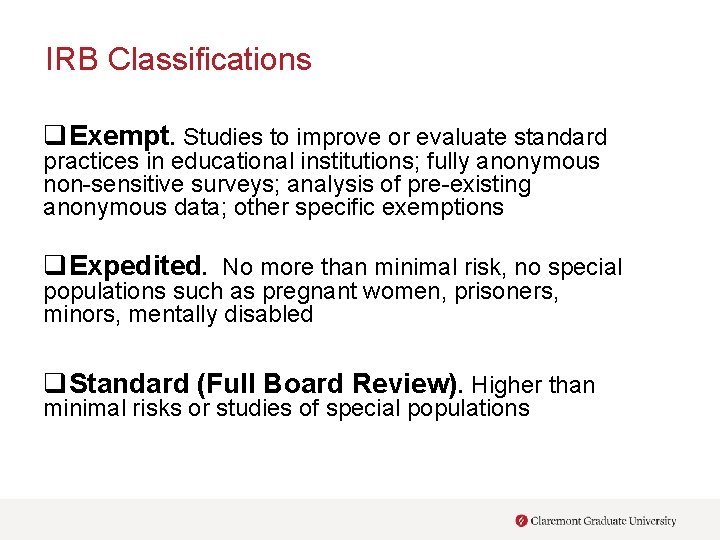
1 1 IRB Classifications q. Exempt. Studies to improve or evaluate standard practices in educational institutions; fully anonymous non-sensitive surveys; analysis of pre-existing anonymous data; other specific exemptions q. Expedited. No more than minimal risk, no special populations such as pregnant women, prisoners, minors, mentally disabled q. Standard (Full Board Review). Higher than minimal risks or studies of special populations
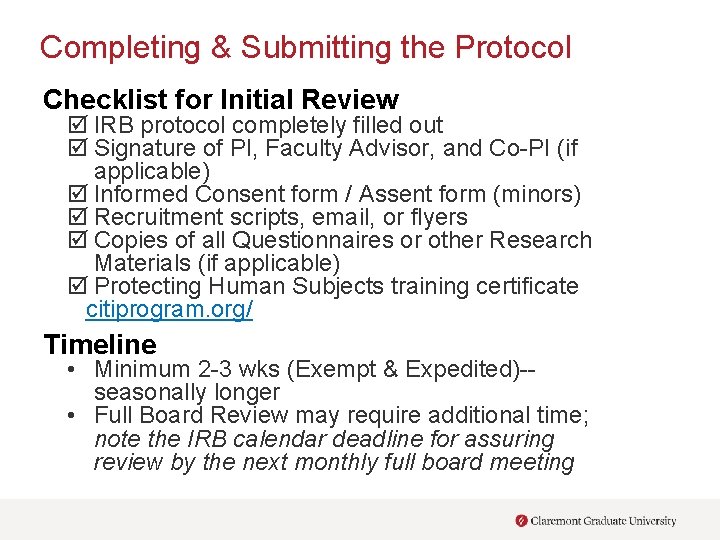
1 2 Completing & Submitting the Protocol Checklist for Initial Review þ IRB protocol completely filled out þ Signature of PI, Faculty Advisor, and Co-PI (if applicable) þ Informed Consent form / Assent form (minors) þ Recruitment scripts, email, or flyers þ Copies of all Questionnaires or other Research Materials (if applicable) þ Protecting Human Subjects training certificate citiprogram. org/ Timeline • Minimum 2 -3 wks (Exempt & Expedited)-seasonally longer • Full Board Review may require additional time; note the IRB calendar deadline for assuring review by the next monthly full board meeting
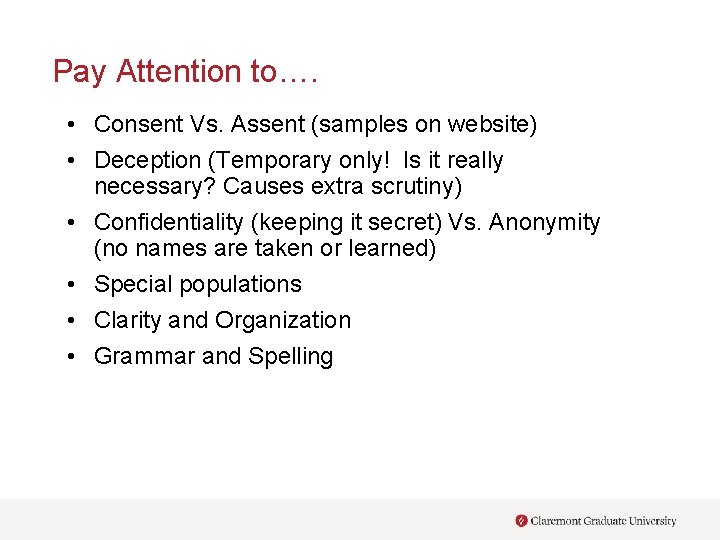
1 3 Pay Attention to…. • Consent Vs. Assent (samples on website) • Deception (Temporary only! Is it really necessary? Causes extra scrutiny) • Confidentiality (keeping it secret) Vs. Anonymity (no names are taken or learned) • Special populations • Clarity and Organization • Grammar and Spelling
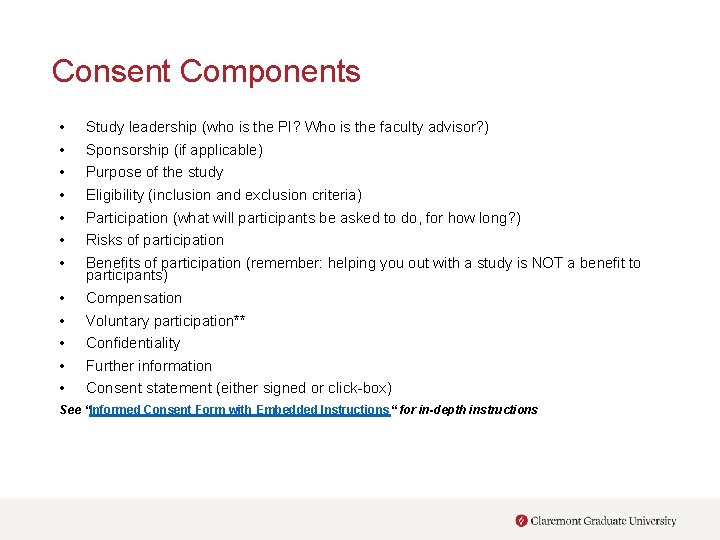
1 4 Consent Components • • Study leadership (who is the PI? Who is the faculty advisor? ) • • • Compensation Sponsorship (if applicable) Purpose of the study Eligibility (inclusion and exclusion criteria) Participation (what will participants be asked to do, for how long? ) Risks of participation Benefits of participation (remember: helping you out with a study is NOT a benefit to participants) Voluntary participation** Confidentiality Further information Consent statement (either signed or click-box) See “Informed Consent Form with Embedded Instructions“ for in-depth instructions
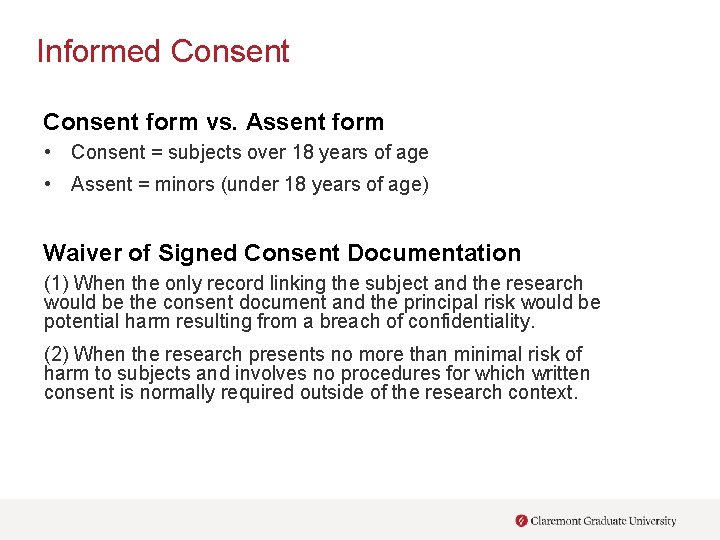
1 5 Informed Consent form vs. Assent form • Consent = subjects over 18 years of age • Assent = minors (under 18 years of age) Waiver of Signed Consent Documentation (1) When the only record linking the subject and the research would be the consent document and the principal risk would be potential harm resulting from a breach of confidentiality. (2) When the research presents no more than minimal risk of harm to subjects and involves no procedures for which written consent is normally required outside of the research context.
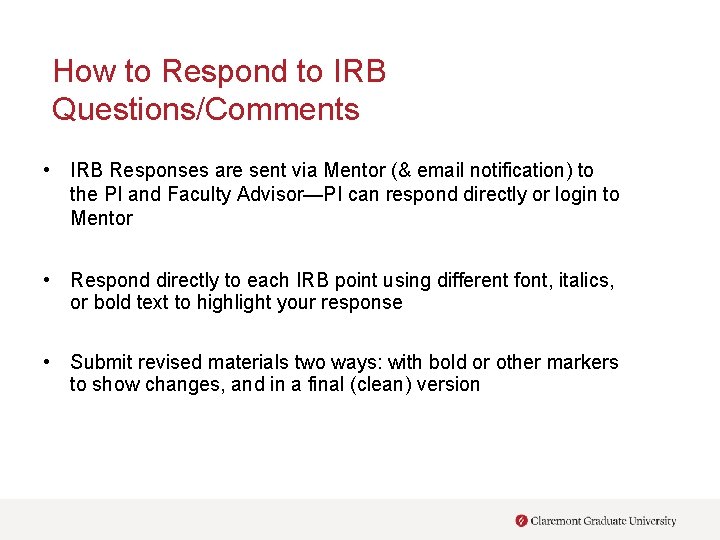
1 6 How to Respond to IRB Questions/Comments • IRB Responses are sent via Mentor (& email notification) to the PI and Faculty Advisor—PI can respond directly or login to Mentor • Respond directly to each IRB point using different font, italics, or bold text to highlight your response • Submit revised materials two ways: with bold or other markers to show changes, and in a final (clean) version
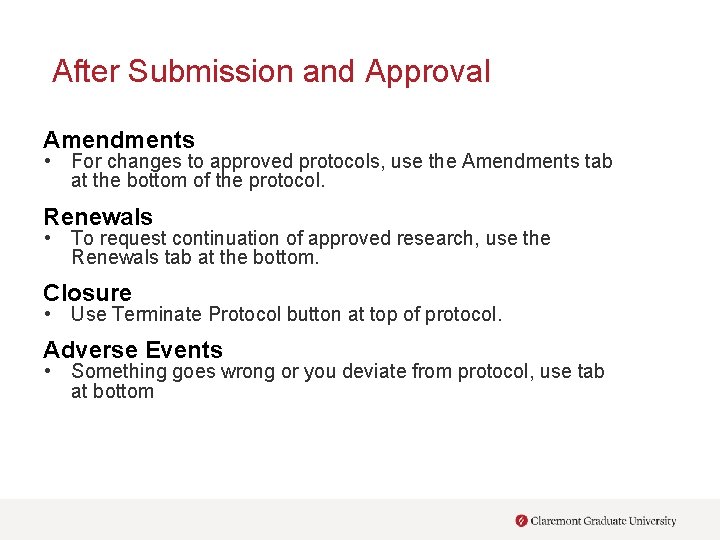
1 7 After Submission and Approval Amendments • For changes to approved protocols, use the Amendments tab at the bottom of the protocol. Renewals • To request continuation of approved research, use the Renewals tab at the bottom. Closure • Use Terminate Protocol button at top of protocol. Adverse Events • Something goes wrong or you deviate from protocol, use tab at bottom
1 8 More Information: Frequently Asked Questions • http: //www. cgu. edu/irb (See Links menu) • http: //www. hhs. gov/ohrp/policy/faq/index. html Contact the IRB for clarifications Email: irb@cgu. edu Phone: 909 -607 -9406 Hours: 8: 30 AM – 5: 00 PM Website: http: //www. cgu. edu/irb Location: 152 Harper Hall
- Slides: 17