
Institutional finance The organised component of money market

- Slides: 20
Institutional finance
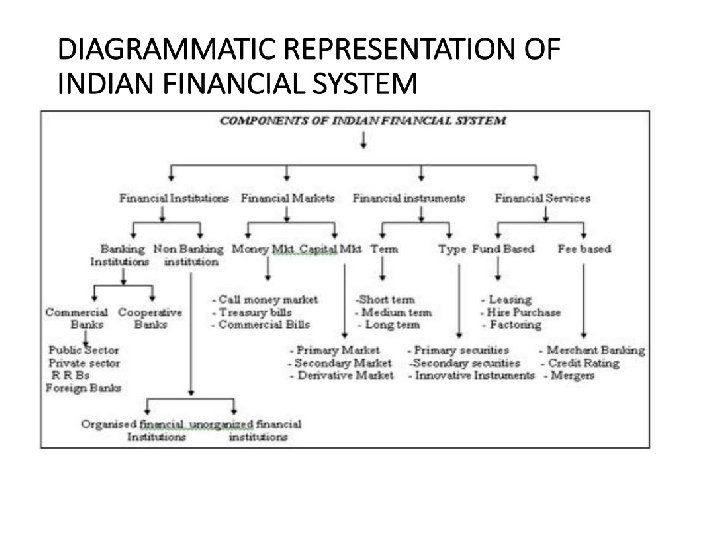
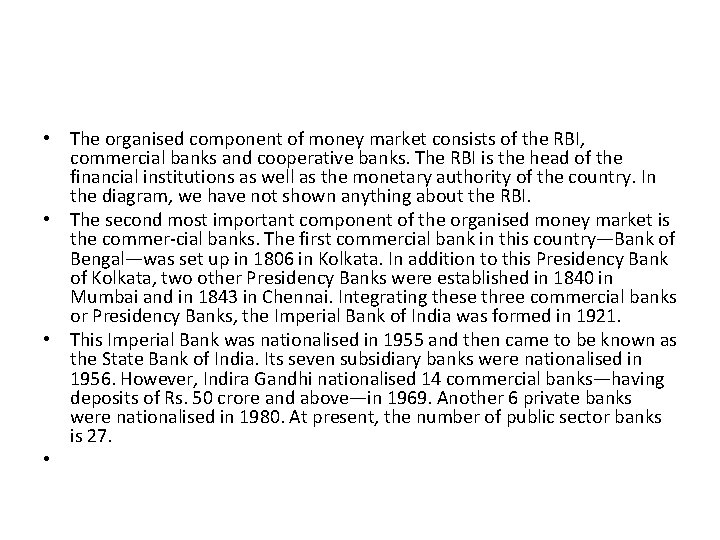
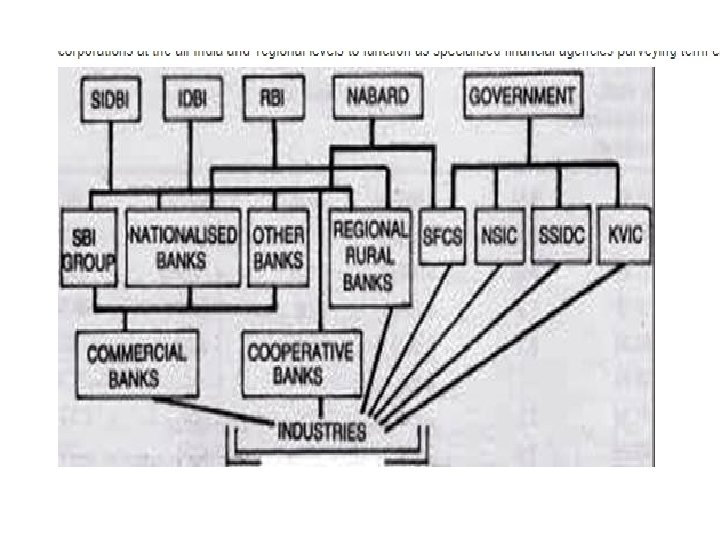
• The organised component of money market consists of the RBI, commercial banks and cooperative banks. The RBI is the head of the financial institutions as well as the monetary authority of the country. In the diagram, we have not shown anything about the RBI. • The second most important component of the organised money market is the commer cial banks. The first commercial bank in this country—Bank of Bengal—was set up in 1806 in Kolkata. In addition to this Presidency Bank of Kolkata, two other Presidency Banks were established in 1840 in Mumbai and in 1843 in Chennai. Integrating these three commercial banks or Presidency Banks, the Imperial Bank of India was formed in 1921. • This Imperial Bank was nationalised in 1955 and then came to be known as the State Bank of India. Its seven subsidiary banks were nationalised in 1956. However, Indira Gandhi nationalised 14 commercial banks—having deposits of Rs. 50 crore and above—in 1969. Another 6 private banks were nationalised in 1980. At present, the number of public sector banks is 27. •
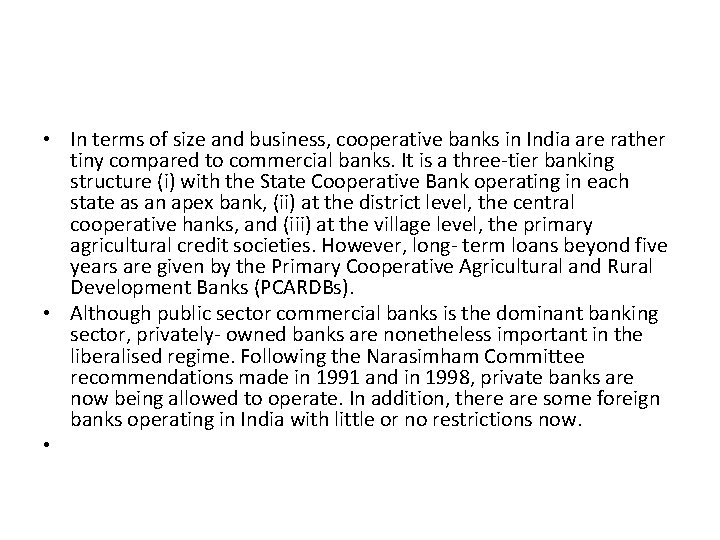
• In terms of size and business, cooperative banks in India are rather tiny compared to commercial banks. It is a three tier banking structure (i) with the State Cooperative Bank operating in each state as an apex bank, (ii) at the district level, the central cooperative hanks, and (iii) at the village level, the primary agricultural credit societies. However, long term loans beyond five years are given by the Primary Cooperative Agricultural and Rural Development Banks (PCARDBs). • Although public sector commercial banks is the dominant banking sector, privately owned banks are nonetheless important in the liberalised regime. Following the Narasimham Committee recommendations made in 1991 and in 1998, private banks are now being allowed to operate. In addition, there are some foreign banks operating in India with little or no restrictions now. •
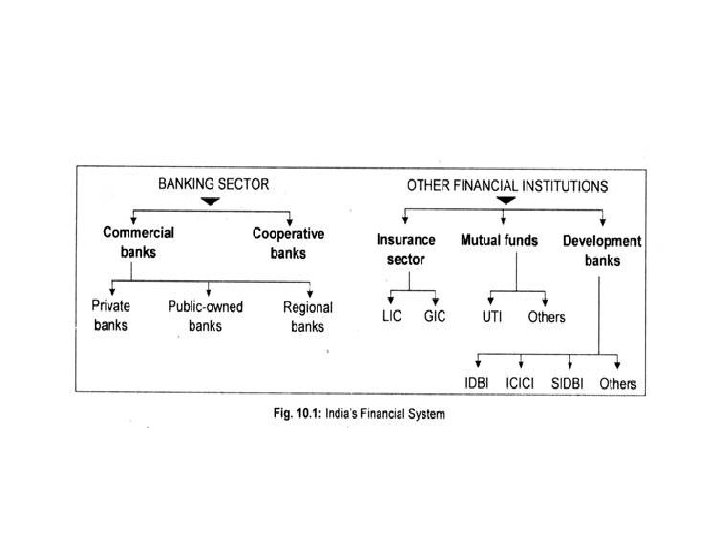
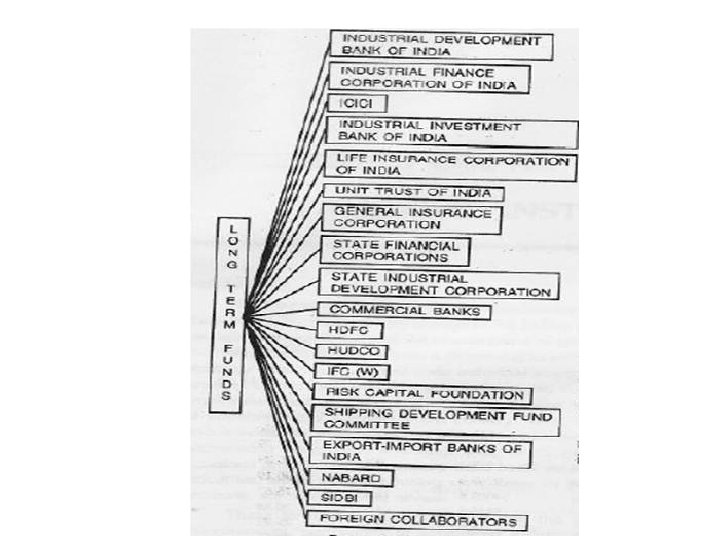
• Finally, regional rural banks have been functioning since 1975 to meet the credit needs of the rural people. At present, the number of regional banks stands at 76. • The other side of the Fig. 10. 1 deals with ‘other financial institutions’. The main three elements of other financial institutions are: (i) insurance sector, (ii) mutual funds, and (iii) development banks. The two notable insurance institutions are the Life Insurance Corporation of India and the General Insurance Corporation.
• The most prominent mutual funds institution is the Unit Trust of India. Finally, as the name suggests, development banks provide long term capital to industries in a rather non conventional way. At present, there as many as 60 develop ment banks in the country. The largest of them is the Industrial Development Bank of India (IDB 1). • Finally, in the realm of industrial finance, there is an institution called capital market that provides long term funds to both public and private sector units. Security market is the most important component of the capital market that deals in both corporate and government or gilt edged securities. In India, the capital market has undergone a revolutionary change in recent years following the launching of the new economic policies in 1991.
• The most prominent mutual funds institution is the Unit Trust of India. Finally, as the name suggests, development banks provide long term capital to industries in a rather non conventional way. At present, there as many as 60 develop ment banks in the country. The largest of them is the Industrial Development Bank of India (IDB 1). • Finally, in the realm of industrial finance, there is an institution called capital market that provides long term funds to both public and private sector units. Security market is the most important component of the capital market that deals in both corporate and government or gilt edged securities. In India, the capital market has undergone a revolutionary change in recent years following the launching of the new economic policies in 1991.
• 1. Industrial Finance Corporation of India (IFCI) Incorporation and Purpose The Industrial Finance Corporation of India (IFCI) was established in 1948 under an Act of Parliament with the object of providing medium and long term credit to industrial concerns in India. IFCI transformed into a corporation from 21 st May, 1993 to, provide greater flexibility to’ respond to the needs of the rapidly changing financial system. •
• • Entrepreneurship Development Schemes by IFCI Scheme for Encouraging Entrepreneurship Development in Tourism and Tourism related Activities. Scheme for Encouraging Self Employment amongst Persons Rendered Jobless due to Retrenchment or Rationalization in a Sick Industrial Unit in the’ Organised sector Undergoing a Process of Rehabilitation/Revival. The Consultancy for Subsidy Schemes is aimed at providing subsidized consultancy services to industrial units, largely in Village and Small Industries’ (VSI) Sector through Technical Consultancy Organisations (TCOs). The Interest Subsidy Schemes are intended to provide encouragement to self develop ment and self. Employment to unemployed youths, women entrepreneurs adoption of quality control measures, amassing the indigenously available technology etc. The Entrepreneurship Development Schemes envisage ‘giving impetus to self employ ment in tourism related activities in the small scale sector, and help in mitigating the suffering of people, who have to face retrenchment due to implementation of modernization, rehabili tation and revival plans in the case of potentially viable sick units, by process of retaining or self employment avenues.
• 2. The Industrial Development Bank Of India (IDBI) The industrial bank of India (IDBI) was established on 1 st July, 1964 under the industrial development back of India act, as a wholly owned subsidiary of the reserve bank of India. In terms of the public financial institutions laws (Amendment) Act, 1975, the ownership of the l. DBI has been transferred to the central government with effect from 16 the February 1976. The most distinguishing feature of the l. DBI is that It has been assigned the role of the principal financial institution for co ordinating, in conformity with national priorities, the activities of the institutions engaged in financing, promotion or developing industry. The IDBI has been assigned a special role to play in regard to industrial development.
• • Objectives and Functions To serve as an apex institution for term finance for industry, to co ordinate the working of institutions engaged in financing, promoting or developing industries and to assist in the development of these institutions. To plan, promote and develop industries to fill gaps in the industrial structure in the country. To provide technical and administrative assistance for promotion, manage ment or expansion of industry. To undertake market and investment research and surveys as also technical and economics studies in connection with development of industry. To act as lender of last resort and to finance all types of industrial concerns which are engaged, or which propose to be engaged, in the manufacture, processing or preservation of goods, or in mining, shipping, transport, hotel industries, or in the generation distribution of power, in fishing or in providing shore’ fishing, or in the maintenance, repairs, testing or servicing of machinery or vehicles, vessels, etc. , or for the setting up of industrial estates. The Bank may also assist industrial concerns engaged in the research and development of any process or product or in providing special or technical knowledge or other services for the promotion of industrial growth. Besides, it provides finance or the export of engineering goods and service on deferred payment basis. The IDBI has been playing a significant role in the promotion of small scale industries. Its assistance has been channeled through its scheme for the refinance of industrial loans, and to a limited extent, through the Bills Rediscounting Scheme. Since its inception, the lost has been playing a significant role in the promotion of small scale industries
• 3. ICICI (The Industrial Credit and Investment Corporation of India) The ICICI (Industrial Credit and Investment Corporation of India) was conceived as a private sector development bank in 1955 with the primary function of providing development finance to the private sector. Its objectives now include: • assisting in the creation, expansion and modernization of such enterprises; • encouraging and promoting the participation of private capital, both internal and external, in ownership of industrial investment and the expansion of investment markets. • Apart from its head office at Mumbai, the ICICI has four regional offices located at Mumbai, Calcutta, Chennai and New Delhi.
Financial assistance is being provided by ICICI in the following forms: Rupee and foreign currency term loans Underwriting of share and debenture issues Direct subscription to equity Guarantees Soft loans Suppliers line of credit for promoting sale of industrial equipment on deferred payment terms • Lease financing • Financial Indo US joint ventures in research and development. • In practice only such projects costing in excess of Rs. 300 lakhs are considered for financial assistance by the ICICI. However, for purpose of foreign currency loans, no minimum project cost restriction is imposed. • •
• 4. The National Bank for Agriculture and Rural Development The Preamble to the National Bank for Agriculture and Rural Development Act 1981, sets out the objectives for establishing the ‘new institution. To quote, An Act to establish a bank to be known as the’ National Bank’ of Agriculture and Rural Development for providing credit for’ the’ promotion’ of agrict 1 lture, small scale industries, cottage and village industries, handicrafts and other rural crafts and other allied economic activities in rural areas with a view to promoting integrated rural development and securing prosperity of rural areas, and for matters connected therewith or incidental thereto.
• 5. The Small Industries Development Bank of India (SIDBI) The idea of setting up small industries development bank of India (SIDBI), in response to a long standing domain form the small scale sector as an apex level national institution for promotion, financing and development of industries in the small scale sector, embodied an opportunity to set up proactive, responsive and forward looking institution to serve the current and emerging needs of small scale industries in the country. As a precursor to the setting up of the new institution, the small industries development fund was cleared by industrial development fund was created by industrial development bank of India (IDBI) in 1986 exclusively for refinancing, bills rediscounting and equity support to the small castle sector. The outstanding portfolio of the order of Rs. 4200 crore from IDBI was transferred to SIDBI in March 1990. SIDBI started off from a strong base; percentage of IDBI, banking of a special statute, the small industries development bank of India act of 1989, a large capital base of Rs, 450 crore, availability of experi enced manpower endowed with development banking skills carved out of IDBIs professional staff and ready availability of a cast network of institutional infrastructure and enduring financial linkages with state financial corporations (SFCs), commercial banks and other institutions; all these augured well for the growth of the nascent institution. ’ SIDBI ‘ became operational on April 2, 1990.
• • 6. Industrial Investment Bank of India The Industrial Investment Bank of India (IIBI) was established in 1985 under the IRBI Act, 1984 on reconstitution of the erstwhile Industrial Reconstruction Corporation of India as the principal credit and reconstruction agency to, undertake reconstruction and rehabilitation of sick and closed industrial units in the country. IRBI was converted into a full fledged all purpose development institution as IIBI on 17. 03. 97. The scope of IIBIs financing activities has widened with the withdrawal of the Government stipulation that 60% of its portfolio should consist of ‘ sick companies; IIBI now finances all industrial projects like any other financial institution. IIBI extends loans and advances to industrial concerns, under writes stocks, shares, bonds, and debentures and provides guarantees, for loans/deferred payments. It provides finance for acquisition of equipment and makes available machinery and other equipment on lease or hire purchase basis. It also provides infrastructure facilities, consultancy, managerial and merchant banking services. During 1993 94, as a part of its merchant banking services, IRSI ventured into issue management activities for the first time. It also took several steps to re orient its business strategy in response to the emerging environment and ongoing changes in the financial sector by introducing newer products for financing. IIBI has envisaged the setting up of a Special Fund, viz. , Reconstruction Assistance Fund to meet special financial needs of ‘ assisted medium and large scale units for their revival and rehabilitation which cannot be met from banks and’ financial institutions under normal conditions.
• 7. Life Insurance Corporation of India The Life Insurance Corporation of India. (LIC) was set up under the LIC Act in 1956, as a wholly owned Corporation of the Government of India, on nationalization of the life insurance business in the country. LIC took over the life insurance business from private companies to carry on the business and deploy the funds in accordance with the Plan priorities. UC operates a variety of schemes so as to extend social security to various segments of society and for the benefit of individuals and groups from the urban and rural areas. The Committee on Reforms in the Insurance Sector set up by the Government has recommended privatization and restructuring of UC with Government retaining 50% stake. The Committee has also suggested that foreign companies be’ allowed to conduct life insurance business in the country through joint ventures with India partners