
Institutional Biosafety Committee Member Training October 2014 Background
Institutional Biosafety Committee Member Training October 2014
Background Recombinant DNA work covered under NIH Office of Biotechnology Activities (NIH OBA) in: • NIH GUIDELINES FOR RESEARCH INVOLVING • RECOMBINANT OR SYNTHETIC NUCLEIC ACID MOLECULES (March 2013) Purpose of Guidelines: • specify the practices for constructing and handling: • (i) recombinant nucleic acid molecules, • (ii) synthetic nucleic acid molecules, including those that are chemically or otherwise modified but can base pair with naturally occurring nucleic acid molecules, • (iii) cells, organisms, and viruses containing such molecules.
IBC Institutional Biosafety Committee (IBC) • Reviews all research that involves the use of r. DNA NIH/OBA r. DNA Guidelines as reference document • Reviews research involving the use of infectious agents NOT r. DNA • Inclusive of subcommittees-needlestick and healthcare • BMBL as a reference document
Biosafety Levels Biosafety levels are a combination of facilities, equipment and practices. Level 1: basic lab, good lab practices Level 2: limited lab access, specific training and practices Level 3: containment (biosafety cabinet), specific training and practices Level 4: full containment; specific facility, training and practices
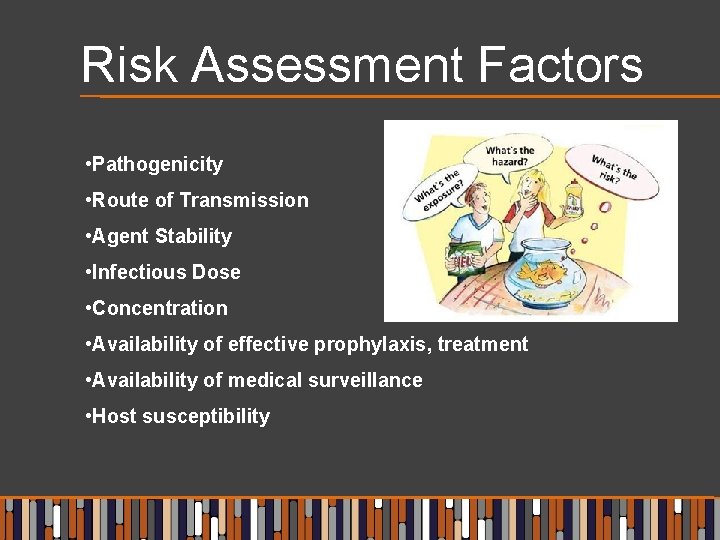
Risk Assessment Factors • Pathogenicity • Route of Transmission • Agent Stability • Infectious Dose • Concentration • Availability of effective prophylaxis, treatment • Availability of medical surveillance • Host susceptibility
Risk Assessment Organism Hosts Vector Expression of foreign gene Protein produced Containment Facility Laboratory-specific protocol Training & expertise of personnel
History of the Guidelines The NIH Guidelines were implemented in response to public and scientific concern over the emerging science of r. DNA technologies in the early 1970’s. By 1976, NIH had published the first set of guidelines which have been amended over time to allow for greater public access and a greater emphasis on safety.
Section I: Scope and Applicability If your institution receives NIH funding for r. DNA research, then it must comply with the NIH Guidelines. Even if a project is privately sponsored, that research must still be conducted in accordance with the NIH Guidelines if conducted at an institution subject to the NIH Guidelines.
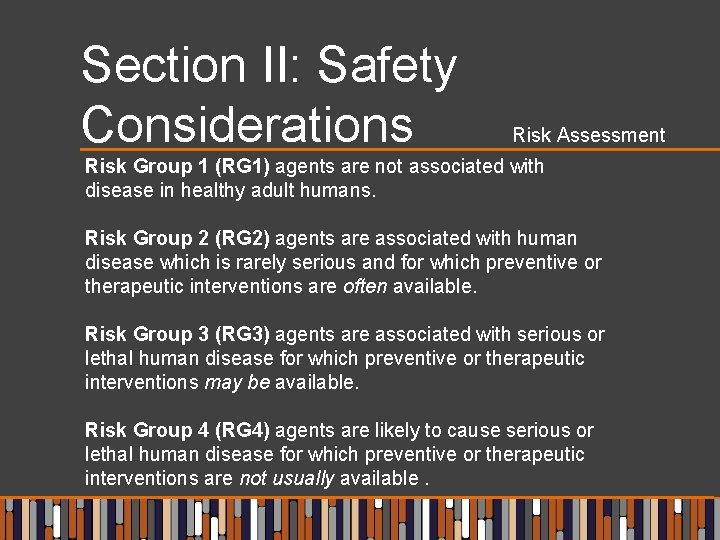
Section II: Safety Considerations Risk Assessment Risk Group 1 (RG 1) agents are not associated with disease in healthy adult humans. Risk Group 2 (RG 2) agents are associated with human disease which is rarely serious and for which preventive or therapeutic interventions are often available. Risk Group 3 (RG 3) agents are associated with serious or lethal human disease for which preventive or therapeutic interventions may be available. Risk Group 4 (RG 4) agents are likely to cause serious or lethal human disease for which preventive or therapeutic interventions are not usually available.
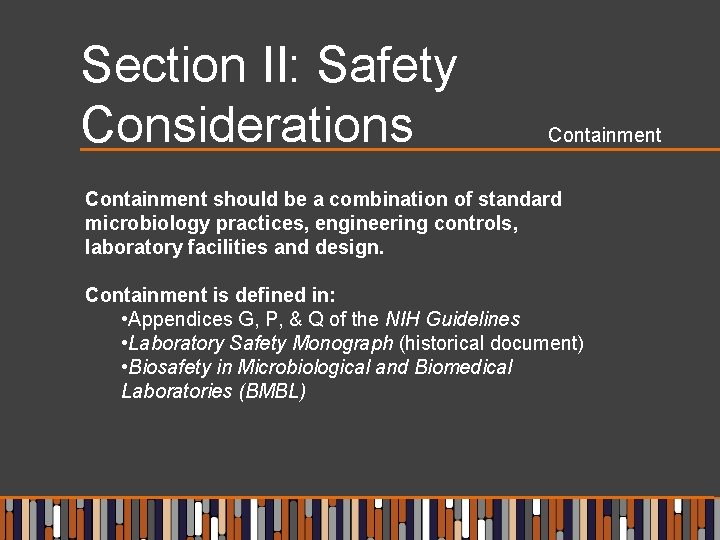
Section II: Safety Considerations Containment should be a combination of standard microbiology practices, engineering controls, laboratory facilities and design. Containment is defined in: • Appendices G, P, & Q of the NIH Guidelines • Laboratory Safety Monograph (historical document) • Biosafety in Microbiological and Biomedical Laboratories (BMBL)
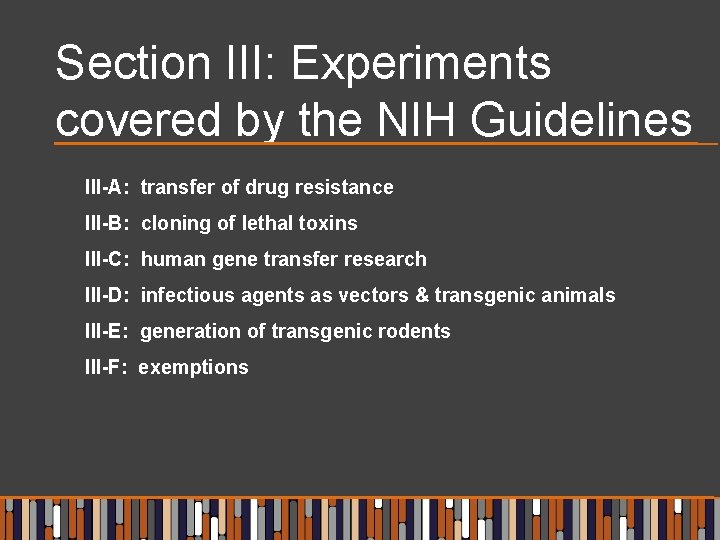
Section III: Experiments covered by the NIH Guidelines III-A: transfer of drug resistance III-B: cloning of lethal toxins III-C: human gene transfer research III-D: infectious agents as vectors & transgenic animals III-E: generation of transgenic rodents III-F: exemptions
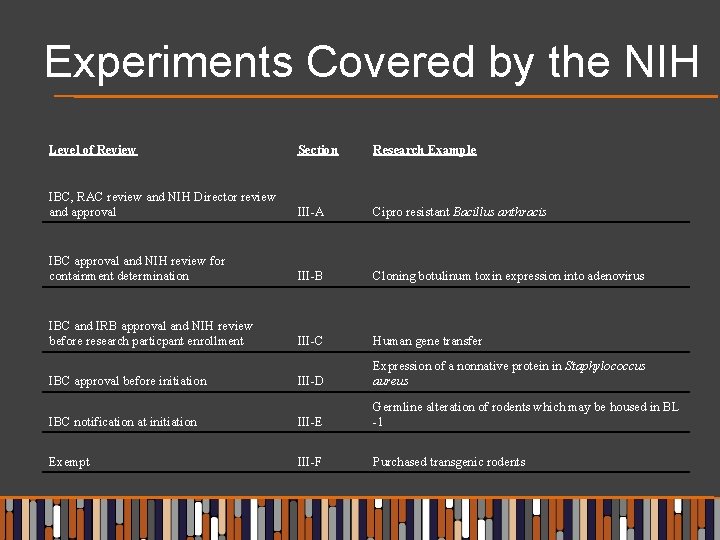
Experiments Covered by the NIH Level of Review Section Research Example IBC, RAC review and NIH Director review and approval III-A Cipro resistant Bacillus anthracis IBC approval and NIH review for containment determination III-B Cloning botulinum toxin expression into adenovirus IBC and IRB approval and NIH review before research particpant enrollment III-C Human gene transfer III-D Expression of a nonnative protein in Staphylococcus aureus IBC notification at initiation III-E Germline alteration of rodents which may be housed in BL -1 Exempt III-F Purchased transgenic rodents IBC approval before initiation
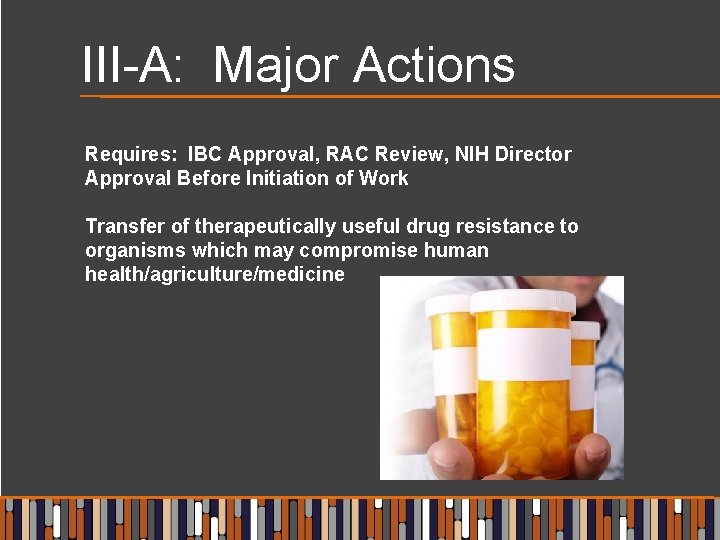
III-A: Major Actions Requires: IBC Approval, RAC Review, NIH Director Approval Before Initiation of Work Transfer of therapeutically useful drug resistance to organisms which may compromise human health/agriculture/medicine
III-B: Toxin Transfer Requires: NIH/OBA, IBC Review and Approval Before Initiation of Work Deliberate cloning of toxin molecules lethal to vertebrates at an LD 50 of less than 100 nanograms/Kg of body weight (e. g. , botulinum toxin) Containment determined by NIH/OBA
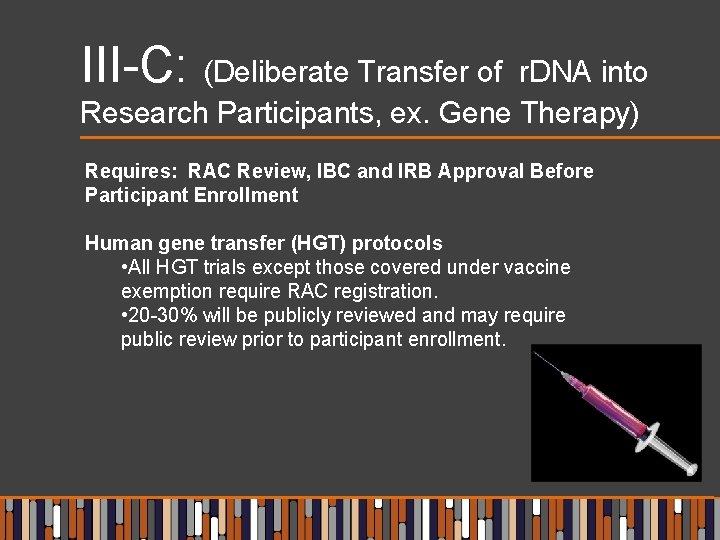
III-C: (Deliberate Transfer of r. DNA into Research Participants, ex. Gene Therapy) Requires: RAC Review, IBC and IRB Approval Before Participant Enrollment Human gene transfer (HGT) protocols • All HGT trials except those covered under vaccine exemption require RAC registration. • 20 -30% will be publicly reviewed and may require public review prior to participant enrollment.
III-D: General Work Requires: IBC Review and Approval Prior to the Initiation of Work • Involves RG 2 -4 agents, host/vector system • Cloned DNA from RG 2 -4 agents into non-pathogenic prokaryotes • RG 2 -4 agents into whole animals, usually transgenic • Recombinant plants • Large scale experiments greater than 10 L • Generation of any transgenic animal other than BSL-1 rodents
III-E: Less Restrictive Work Requires: IBC Notification at the Initiation of Work (BSL-1 Containment), and Subsequent IBC Review and Approval • r. DNA molecules that contains less than 2/3 of any eukaryotic viral genome • Transgenic rodents with BSL-1 containment • (crossbreeding of transgenics now exempt at BSL-1) • Whole plants that require minimal containment • Anything else NOT covered under sections III-A through IIID & III-F
III-F: Exemptions Exempt from the NIH Guidelines and Does Not Require IBC Review or Approval r. DNA molecules that are: • Not in organisms or viruses • Not a risk to health or the environment -See Appendix C • Note: exceptions to exemptions!
FAQ Review process for human gene transfer protocols http: //osp. od. nih. gov/office-biotechnologyactivities/biomedical-technology-assessment/hgt Vaccine exemptions http: //osp. od. nih. gov/faqs-about-vaccine-exemption-nihguidelines-research-involving-recombinant-dna-molecules Major actions under the guidelines http: //osp. od. nih. gov/sites/default/files/resources/Major_Actio n_FAQs_March_2013. pdf Transgenic animals http: //osp. od. nih. gov/sites/default/files/Animals_NA_0. pdf
FAQ IBC committee minutes http: //osp. od. nih. gov/sites/default/files/resources/IBC_M eetings_and_Minutes_FAQs. pdf Experiments that are exempt http: //osp. od. nih. gov/sites/default/files/Experiments_that _are_Exempt_from_the_NIH_Guidelines. pdf
Section IV: Roles and Responsibilities of the Institution: • Ensure compliance with NIH Guidelines • Establish IBC • Appoint a Biosafety Officer if conducting BSL-3, BSL-4, or large-scale work • Ensure IBC has expertise in the research that is reviewed • Establish a medical surveillance program as needed • Report all incidents to the NIH OBA
Section IV: Roles and Responsibilities of the IBC: • Review r. DNA research, and approve those research projects that are found to conform with the NIH Guidelines. This review shall include: -(i) independent assessment of the containment levels required by the NIH Guidelines for the proposed research; (ii) assessment of the facilities, procedures, practices, and training and expertise of personnel involved in r. DNA research; (iii) ensuring that all aspects of Appendix M have been appropriately addressed by the PI; (vii) ensuring compliance with all surveillance, data reporting, and adverse event reporting requirements set forth in the NIH Guidelines. • Notify the PI of the results of the IBC’s review and approval. • Lower containment levels for certain experiments as specified in Section III-D-2 -a, Experiments in which DNA from Risk Group 2, Risk Group 3, Risk Group 4, or Restricted Agents is Cloned into Nonpathogenic Prokaryotic or Lower Eukaryotic Host-Vector Systems. • Set containment levels as specified in Sections III-D-4 -b, Experiments Involving Whole Animals.
Section IV: Roles and Responsibilities of the IBC: • Periodically review r. DNA research conducted at the institution to ensure compliance with the NIH Guidelines. • Adopt emergency plans covering accidental spills and personnel contamination resulting from r. DNA research. • Report any significant problems with or violations of the NIH Guidelines and any significant research-related accidents or illnesses to the appropriate institutional official and NIH/OBA within 30 days. • The IBC may not authorize initiation of experiments which are not explicitly covered by the NIH Guidelines until NIH establishes the containment requirement. • Perform such other functions as may be delegated to the IBC.
Section IV: Roles and Responsibilities of the Biological Safety Officer (BSO) • Periodic inspections to ensure that laboratory standards are rigorously followed; • Report to the IBC and the institution any significant problems, violations of the NIH Guidelines, and any significant research-related accidents or illnesses of which the BSO becomes aware; • Develop emergency plans for handling accidental spills and personnel contamination and investigating laboratory accidents involving r. DNA research; • Provide advice on laboratory security; • Provide technical advice to PIs and the IBC on research safety procedures.
Section IV: Roles and Responsibilities of the Principal Investigator (PI) • Initiate or modify no recombinant DNA research which requires IBC approval prior to initiation until that research or the proposed modification thereof has been approved by the IBC and has met all other requirements of the NIH Guidelines; • Determine whether experiments are covered by Section III-E, and ensure that the appropriate procedures are followed; • Report any significant problems, violations of the NIH Guidelines, or any significant research-related accidents and illnesses to the BSO, Animal Facility Director (where applicable), IBC, NIH/OBA, and other appropriate authorities (if applicable) within 30 days; • Report any new information bearing on the NIH Guidelines to the Institutional Biosafety Committee and to NIH/OBA • Be adequately trained in good microbiological techniques; • Adhere to IBC approved emergency plans for handling accidental spills and personnel contamination; • Comply with shipping requirements for r. DNA molecules.
Section IV: Roles and Responsibilities of the PI: • Responsible for full compliance with the NIH Guidelines in the conduct of r. DNA research. • Responsible for ensuring that the reporting requirements are fulfilled and will be held accountable for any reporting lapses. • Prior to initiating research: -Make available to all laboratory staff the protocols that describe the potential biohazards and the precautions to be taken; -Instruct and train laboratory staff in: (i) the practices and techniques required to ensure safety, and (ii) the procedures for dealing with accidents; and -Inform the laboratory staff of the reasons and provisions for any precautionary medical practices advised or requested (e. g. , vaccinations).
Section IV: Roles and Responsibilities of the PI: During conduct of research: • Supervise the safety performance of the laboratory staff to ensure that the required safety practices and techniques are employed; • Investigate and report any significant problems pertaining to the operation and implementation of containment practices and procedures in writing to the BSO, Animal Facility Director (where applicable), IBC, NIH/OBA, and other appropriate authorities (if applicable) • Correct work errors and conditions that may result in the release of r. DNA materials; and • Ensure the integrity of the physical containment (e. g. , biological safety cabinets) and the biological containment (e. g. , purity and genotypic and phenotypic characteristics).

IBC Requirements No fewer than 5 members who exhibit: r. DNA Knowledge Research expertise Community interest Required to annually submit IBC roster update including curriculum vitae of new members, brief biographical sketch and any significant updates of existing members to OBA
Dual Use Consider dual use if any agents/toxins from the below list: a) Avian influenza virus (highly pathogenic) b) Bacillus anthracis c) Botulinum neurotoxin d) Burkholderia mallei e) Burkholderia pseudomallei f) Ebola virus g) Foot-and-mouth disease virus h) Francisella tularensis i) Marburg virus j) Reconstructed 1918 Influenza virus k) Rinderpest virus l) Toxin-producing strains of Clostridium botulinum m) Variola major virus n) Variola minor virus o) Yersinia pestis
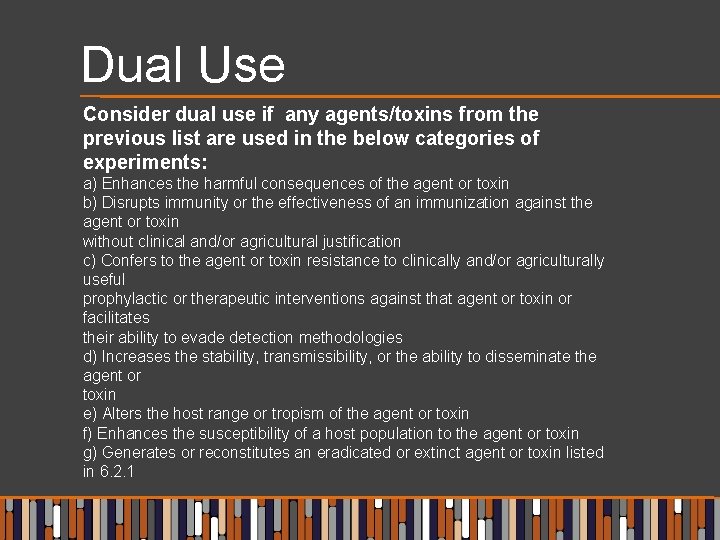
Dual Use Consider dual use if any agents/toxins from the previous list are used in the below categories of experiments: a) Enhances the harmful consequences of the agent or toxin b) Disrupts immunity or the effectiveness of an immunization against the agent or toxin without clinical and/or agricultural justification c) Confers to the agent or toxin resistance to clinically and/or agriculturally useful prophylactic or therapeutic interventions against that agent or toxin or facilitates their ability to evade detection methodologies d) Increases the stability, transmissibility, or the ability to disseminate the agent or toxin e) Alters the host range or tropism of the agent or toxin f) Enhances the susceptibility of a host population to the agent or toxin g) Generates or reconstitutes an eradicated or extinct agent or toxin listed in 6. 2. 1
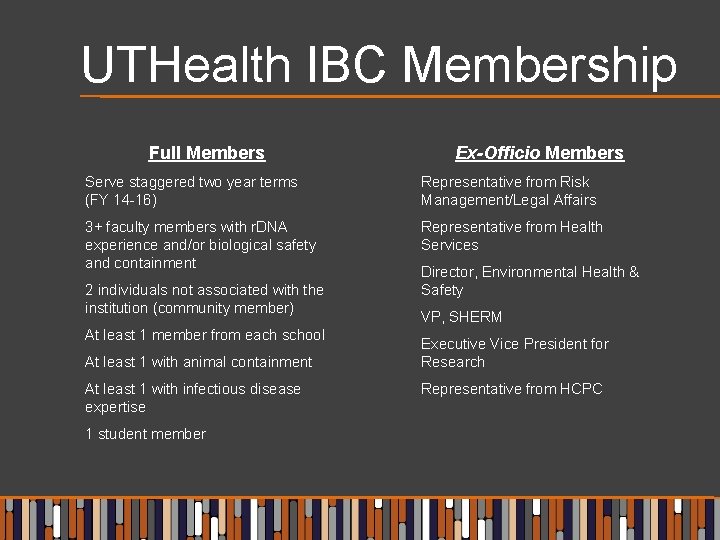
UTHealth IBC Membership Full Members Ex-Officio Members Serve staggered two year terms (FY 14 -16) Representative from Risk Management/Legal Affairs 3+ faculty members with r. DNA experience and/or biological safety and containment Representative from Health Services 2 individuals not associated with the institution (community member) At least 1 member from each school At least 1 with animal containment At least 1 with infectious disease expertise 1 student member Director, Environmental Health & Safety VP, SHERM Executive Vice President for Research Representative from HCPC
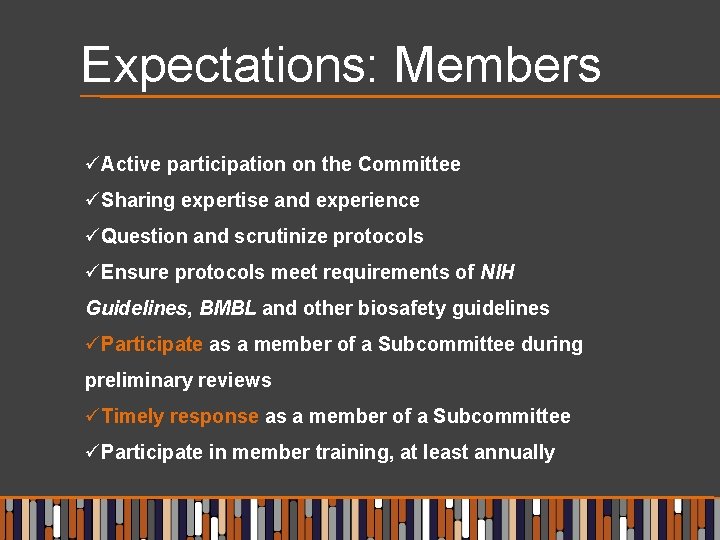
Expectations: Members üActive participation on the Committee üSharing expertise and experience üQuestion and scrutinize protocols üEnsure protocols meet requirements of NIH Guidelines, BMBL and other biosafety guidelines üParticipate as a member of a Subcommittee during preliminary reviews üTimely response as a member of a Subcommittee üParticipate in member training, at least annually
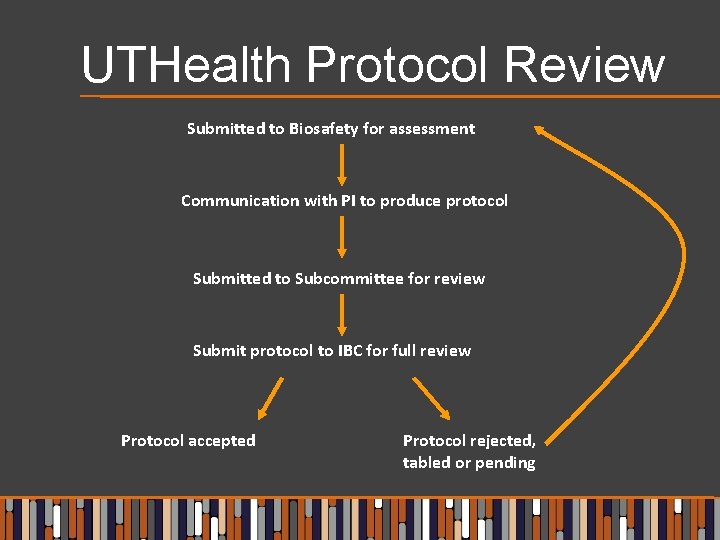
UTHealth Protocol Review Submitted to Biosafety for assessment Communication with PI to produce protocol Submitted to Subcommittee for review Submit protocol to IBC for full review Protocol accepted Protocol rejected, tabled or pending
Approval Memos Once a protocol is approved the appropriate memo is sent out • Approval memo • Conditional approval memo
Conditionally Exempt Protocols To be a conditionally exempt protocol, proposed work must meet the following conditions: • No work that falls under the NIH Guidelines • Only involves the collection of human samples (i. e. blood, urine, tissue, etc. ) • Sample processing limited to: • Centrifugation • Storage • Biological safety office reviews and approves protocols • Protocols appear in meeting packets
IBC Resources NIH Guidelines for Research Involving Recombinant or Synthetic Nucleic Acid Molecules http: //osp. od. nih. gov/sites/default/files/NIH_Guideline s_0. pdf Office of Biotechnology Activities http: //www 4. od. nih. gov/oba/ CDC/NIH Biosafety in Microbiological and Biomedical Laboratories (BMBL) http: //www. cdc. gov/biosafety/publications/bmbl 5/BMB L. pdf
Questions?
- Slides: 37