
Institutional Analysis Lecture 6 Collective Action Theory of
- Slides: 13
Institutional Analysis Lecture 6: Collective Action
Theory of Collective Action u All group behavior is the sum of individual actions. u But rational individual behavior can lead to collectively irrational outcomes. u So groups must motivate their members (provide incentives) to achieve their goals. òThis is the basis of effective interest group action.
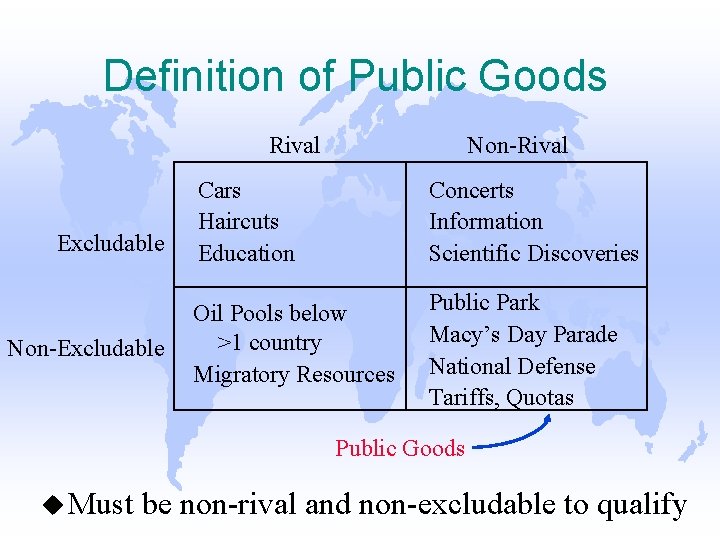
Definition of Public Goods Rival Excludable Non-Rival Cars Haircuts Education Concerts Information Scientific Discoveries Oil Pools below >1 country Migratory Resources Public Park Macy’s Day Parade National Defense Tariffs, Quotas Public Goods u Must be non-rival and non-excludable to qualify
The Problem of Public Goods u All individuals in a group benefit from having the good supplied. u But once it is supplied, cannot prevent others from using it. u Each individual would rather have others pay the costs, and take the benefits themselves. èMany public goods are not supplied, even though their total utility exceeds their cost.
Free Rider Problem u Definition: – An individual “free rides” if they pay less than their true marginal value derived from the public good. u Example: – Public Television – Highway Construction
Example: Tragedy of the Commons
The Prisoners’ Dilemma u Substantive problem Ø Cooperation is valuable. . . Ø. . . but it is hard to achieve. u What makes cooperation valuable? – Greater social benefits (aggregate payoffs) when it occurs than when it doesn’t occur. u What makes cooperation hard to achieve? – The incentive to free-ride, defect, not cooperate, not contribute. . . òConcepts: dominant strategy, equilibrium
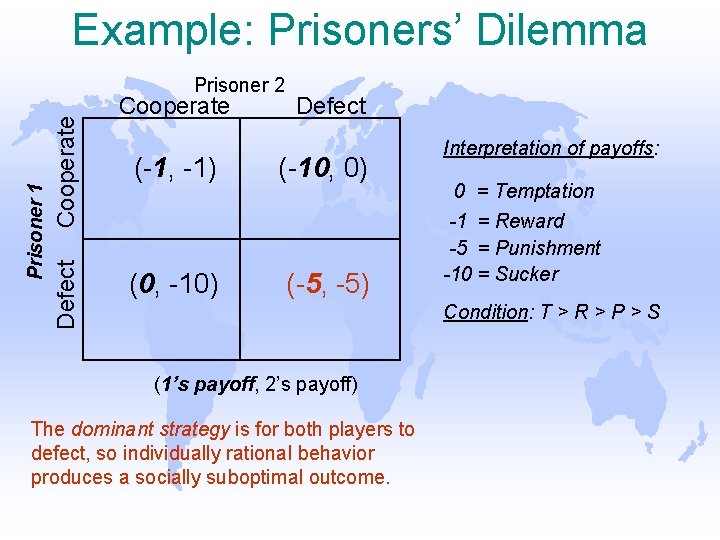
Example: Prisoners’ Dilemma Cooperate Defect Prisoner 1 Prisoner 2 Cooperate (-1, -1) (0, -10) Defect (-10, 0) (-5, -5) Interpretation of payoffs: 0 = Temptation -1 = Reward -5 = Punishment -10 = Sucker Condition: T > R > P > S (1’s payoff, 2’s payoff) The dominant strategy is for both players to defect, so individually rational behavior produces a socially suboptimal outcome.
Prisoners’ Dilemma Illustrated
Ways Around the Dilemma u The players themselves – Internal moral rules, codes of conduct, norms… – Communication – Repetition F if the probability of continuation is “sufficiently high” then cooperation becomes an equilibrium u External solutions F Privately agreed upon 3 rd party monitoring F Contract law & its enforcement by courts F International u These organizations (e. g. , GATT, WTO) are all extensions of -- not covered within -the one-shot PD considered above.
Distributive Politics & Collective Action Problems u All legislators like district-specific benefits F Acting alone this can not be achieved as a majority is need to enact legislation u One way to get everyone to go along is logroll F Enact bills that have something for all districts F Can go back to district and claim credit u Assumption F Voters care only about the benefits they receive and not the overall costs of the legislative package
Collective Dilemma & Logrolling u True everyone would be better off with the logroll – All 435 members get a little something and split the costs u But just as with the Divide the Dollar Game it is tempting to cut 1 legislator out of the bargain u But given this logic, another district would be cut out… – Until the logroll falls apart
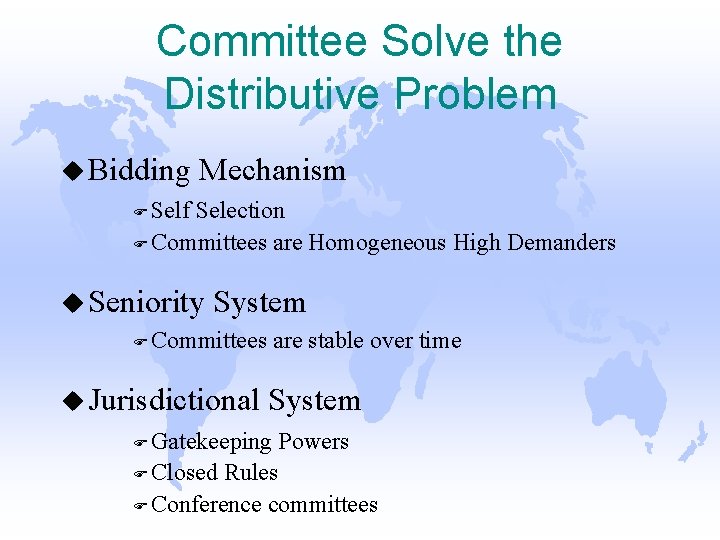
Committee Solve the Distributive Problem u Bidding Mechanism F Self Selection F Committees are Homogeneous High Demanders u Seniority System F Committees are stable over time u Jurisdictional System F Gatekeeping Powers F Closed Rules F Conference committees