
Institutional Ableism thinking through inequalities through a Different
Institutional Ableism – thinking through inequalities through a Different Lens Prof Fiona Kumari Campbell Professor of Disability & Ableism Studies School of Education and Social Work, University of Dundee For 1 st (virtual) inclusive. IB Symposium, 25 August 2020 University Of Berkeley, California f. k. campbell@dundee. ac. uk

Acknowledgement of Country I respectfully acknowledge that UC Berkeley sits on the territory of Huichin and is built on the unceded, traditional lands of the Chochenyo Ohlone People. I acknowledge them as Traditional Owners of the land on which we meet today, (even if virtually), and pay my respects to Elders past, present and emerging.
Why is challenging ableism important? Ableism is everyone’s business, not because of some ideological imperative but because we as living creatures, human and animal, are affected by the spectre and spectrum of the ‘abled’ body. It is critical that ableism stops being thought of as just a disability issue. Ablement, the process of becoming ‘abled’, impacts on daily routines, interactions, speculations and, significantly, imagination. While all people are affected by ableism, we are not all impacted by ableist practices in the same way. Due to their positioning some individuals actually benefit: they become entitled by virtue of academic ableism.
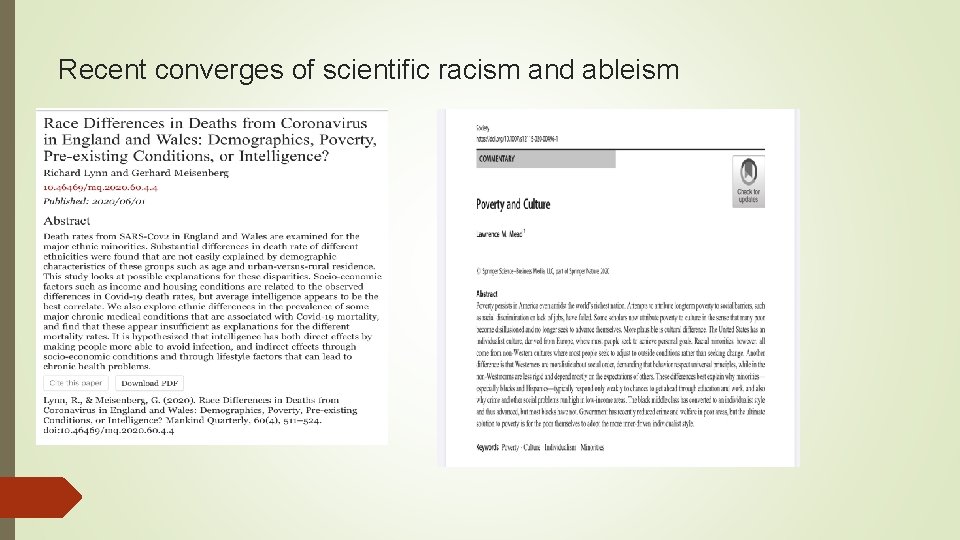
Recent converges of scientific racism and ableism
Origin of the concept Disabled women started speaking and writing about ableism as early as 1981. Records of this work appear in a special themed ‘women with disabilities’ issue of Off Our Backs. In 2001 I tried to locate ableism as a knowledge system: ‘a network of beliefs, processes and practices that produces a particular kind of self and body (the corporeal standard) that is projected as the perfect, species typical and therefore essential and fully human. Disability then is cast as a diminished state of being human (Campbell 2001, 44).
Ableism … A system of dividing practices, ableism institutes the reification and classification of populations. Ableist systems involve the differentiation, ranking, negation, notification and prioritization of sentient life. Campbell, 2017, cited in Campbell, 2019. Precision Ableism: a studies in ableism approach to developing histories of disability and abledment, Rethinking History, 23(2): 147. – emphasis added • The point of Studies in Ableism is to turn the spotlight on the idea of abledness and how ablement is preserved. In other words, to invert our gaze.
Five prongs of ableism? My own understanding of ableism as having five prongs which are useful for thinking about political & strategic interventions and an approach to research: Differentiation (neoliberal technicism, productivity, encumbrance, citizen(ship) Ranking (causation/income/class/caste/songbun/Jim Crow Racialism) negation (what it is not/outliers/disposability) notification (notices/documents/certifications/regulation) prioritization of sentient life (access to the common-wealth, coalition building amongst minoritized peoples)
Focus of Studies in Ableism (SIA) SIA – studies the production of abledness, the idea of ablement (in contrast from disablement or disability) Draws in Interdisciplinary knowledges : Biopower Citizenship Actor Network Theory General System Theory Buddhist studies (Paticca Samuppada – Dependant Origination)
Systems features of Ableism Open systems – dynamic and changing Fields of power circulate Conditions arise and decline – possibility for interventions Our interest is in formations & contestations around personhood, productivity, citizenship, mutuality Ideas of Self – the ‘I’ as object relations, instead of ‘We-I’ (interdependent relations).
Ableism : Usage, Problems & Challenges There has been a flurry of research claiming to use ableism as an operational concept. We have witnessed a plethora of usage on Facebook and Twitter that characterises ableism as a discriminatory slight without any sense of its properties and parameters – leaving vague any sense of what kinds of practices and behaviours can be considered ableist. I use ‘ablement’ to express a productive relation: the ongoing, dynamic processes of becoming abled. Although ablement is often used interchangeably with ableism, I prefer to use ablement when I wish to emphasise its coupling with disablement. My approach contrasts with the terminology of ability/abled or able-bodied, which are assumed to be static states. Ablement scholars, there are researchers who focus on the dynamics of being abled, or ableism as a practice, rather than primarily looking at disability per se. These states are not self-evident and require problematisation. For instance, the very divisions performed as silos, deemed as ‘protected characteristics’ (in equalities law and policy, segregate and dissipate understandings of intersectionality
The turn to the study of abledness and the idea of ableism rather than primarily focusing on disability per se provides a new intellectual terrain, to map discourses of unencumbrance, ideas of productivity, citizenship and ethical norms, buttressed by configurations of the normative (endowed, extolled) and non-normative ‘failed’ bodies. The idea of ‘ability’ needs to be understood alongside its constitutive outside (failed, unproductive) by considering those grey zones of uncertain populations that resist enumeration – the long-term ill, people with episodic/chronic illness and non-apparent disability, biracial people, stateless. ableism is deeply seeded at the level of epistemological systems of life, personhood, power and liveability. Ableism is not just a matter of ignorance or negative attitudes towards disabled [and minoritized] people; it is a trajectory of perfection, a deep way of thinking about bodies, wholeness, permeability and how certain clusters of people are en-abled via valued entitlements. Bluntly, ableism functions to ‘inaugurat[e] the norm’ (Campbell 2009, 5).
Idea of abledbodiedness … Able-bodiedness circulates and produces notions within a university environment of ‘Health’ – wholeness, enhancement/endowment, intelligence/adaptability Productive contributory citizens – the ‘competent worker or student’ ‘Species-typical’ functions – demarcations between human wellbeing, ill and injured people Universalisms – objectivities that can be measured irrespective of university, campus and location Possessive individualism (ideas of autonomy, independence, being governed by reason) – the archetypical academic, although might vary by academic discipline Idea of human normativity (balanced, normalised functioning, categorisations into ‘race’, ‘ethnicity’, caste) Hegemonic proprioceptive lens (ways of sensing, experiencing universities and relationships)
examining conditions of ableist relations originates (samudaya), its source (nidana), processes of generation (jatika), how being emerges (pabhava), is nourished (ahara), how the condition acts foundationally (upaniisa) and induces a flow (upayapeti). POSSIBLE SITES OF ENQUIRY IN RESEARCH ANALYSIS & activism
Technicism Technicism, from the word techne, is not merely about an orientation towards technical detailing; it is a crafting of argumentation or pleading based on certain assumptions of the archetypal academic and bodyscapes. In this sense, its focus is in presenting overly instrumental views, giving primacy to scientific rationality based on a benchmark body (white, heterosexual, abled, male, Christian) that orders and structures workplace environments and student experiences. Resources, like other technologies, are characterological, in the sense of being fit for purpose – imbuing the technology with its creator’s desires, which are reflected in the technology’s design and purpose (cf. Campbell 2009, chapter 4). What is that purpose, you might ask? The academic and student is required to be flexible and able to be shifted about in different spaces (online, scheduled classes, meetings), in various inter-/intra-campus locations and time zones – a body-for-hire that augments the delivery of education. The notion of time and temporality is filtered through these various spatial domains. Despite the rhetoric of personalisation, fitting-for-purpose means that academics and students need to be moulded to fit standardised practices such as ratio of staff, work allocation formulas for marking, and built environment specifications (based on optimum benchmark bodies to fit furniture, etc. ) Idea of and basis of Disability/Race/Ethnicity Disclosures and data collections for people marked as different – race/ethnicity categories? How are we recorded by these systems, what conceptual enumerations are used, how are we known, how do we think about oneself?
Ableism entitles some folk … Professional development planning for academics embraces what Fendler (2001) refers to as ‘technologies of developmentality’, which promote values of choice and progressive efficiency. Here, ‘technologies present as regulatory systems, the technologies of management that do not just structure the physical environment and make use of natural resources but treat people as a resource to be ordered’ (Roder 2011, 65). Employers, corporations and town planners already engage in the unacknowledged process of accommodating the needs of their employees, citizens and visitors (without disability). Governments and other entities spend money and energy accommodating users ‘without denominating it as such’, and this is the hidden aspect of ableist models (Burgdorf 1997, 529).
academic ableism & law Another twin domain that interconnects with academic ableism is law. Here too we find pervasive technicist ableism. Black-letter jurisprudence is obsessed with rule-making and process through the dynamic of precedent. The rule entrapment of the law works against its beneficiaries through such ideas as ‘reasonableness’, ‘substantially limited’ or even the very denotation and purview of ‘legal disability’. This technicism belies the fact that objectivity or seeming neutrality is not value-free; instead, as feminist and more recently disability scholars have argued, law’s body is intrinsically partial and ideological. Distinct categories or self identification? – this issue is not clear cut – unintended consequences
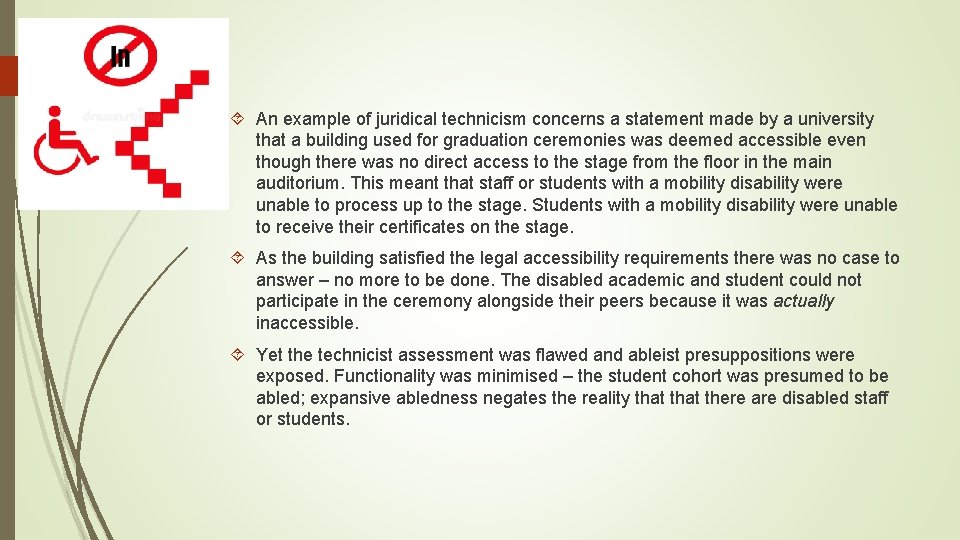
An example of juridical technicism concerns a statement made by a university that a building used for graduation ceremonies was deemed accessible even though there was no direct access to the stage from the floor in the main auditorium. This meant that staff or students with a mobility disability were unable to process up to the stage. Students with a mobility disability were unable to receive their certificates on the stage. As the building satisfied the legal accessibility requirements there was no case to answer – no more to be done. The disabled academic and student could not participate in the ceremony alongside their peers because it was actually inaccessible. Yet the technicist assessment was flawed and ableist presuppositions were exposed. Functionality was minimised – the student cohort was presumed to be abled; expansive abledness negates the reality that there are disabled staff or students.
(Un)reasonable adjustments - accommodations The UN Convention on the Rights of People with Disability (2006) promotes disabled people taking up leadership positions in their communities and understands that ‘disability’ is a concept founded on an evolving interaction between impairment and relational contexts. Under the Convention, ‘“Reasonable accommodation” means necessary and appropriate modification and adjustments not imposing a disproportionate or undue burden, where needed in a particular case, to ensure to persons with disabilities the enjoyment or exercise on an equal basis with others of all human rights and fundamental freedoms’ (Article 2). Within the Convention, reasonable accommodation is not limited to employment, but covers education, accessibility, health, access to justice and legal capacity. The focus is on an individual’s case and what needs to be done to ensure that the particular person can participate fully (though the adjustment may be of benefit to others). Reasonable adjustment can be denied if an undue or disproportionate burden or hardship is involved, reinstituting a conflation between disability and burden, thus making disability equality provisional.
(Un)reasonable adjustments. . Contin. . In taking into account of any characteristics related to disability that may impact on the job in order to accommodate the disabled academic’s/ students needs, employers [the University] need to de-ontologise impairment by reducing the impairment effects to ‘immutable characteristics’ to avoid any inferences of feigning disability or ennobling accommodations. The problem with the immutability argument is that it invokes ethically implicated divisions of ‘innate’ (unchangeable) and ‘fluid’ (how people make sense of who they are, implying ‘choice’ over disability). There have been moves in the United States to propose new categories in law around the idea of voluntary or elective disability, to describe individuals who ‘choose’ to remain disabled and resist therapeutic programs or medical interventions. This ‘choice of disability’ argument could be invoked by universities to justify refusals in disability accommodations (see Campbell 2009).
Humiliation as claim does not choose its context. On the contrary, the context plays a far more determinative role in deciding the form and content of humiliation. It can be generally observed that society of the socially dead cannot provide the active context for the articulation of humiliation. Or, that a society with heaven on earth would make humiliation redundant. In fact, it is the context that decides the nature, level, and intensity of humiliation. (Guru 2011, 10)
Ableism as Humiliation Inaccessible relations hurt and as such constitute an assault on beingness and shape our ontological character. Humiliation caused by inaccessibility can lead to low self-esteem, social phobia, anxiety and depression, pointing to a link between humiliation and ableist practices as a form of harm (Hartling and Luchetta 1999; Torres and Bergner 2010). Torres and Bergner (2010) identify four key elements of humiliation on which there is general consensus in the literature, namely Calling into question a status claim There is a public failure of the status claim The degrader has status to degrade, highlighting asymmetrical power relations There is a rejection of the status to claim a status, that is, a disabled academic is denied recognition of their claim to discrimination.
humiliation always has a context As Guru (2011) reminds us, humiliation always has a context, as does the Convention’s preamble, which understands the production of disability to occur within the context of interactions. Context and responses of technicism within universities towards the disabled academic or student often mask humiliating practices. Indeed, acts of humiliation are a direct attack on equality measures and run counter to an ethos of celebrating diversity. This is because humiliation is only possible when an individual already possesses a sense of self determination: it is an assault on the self-respect of the victim.
Where to next? Read about Ableism – do not just use the concept as a convenient hashtag. Be prepared to think/read difficult stuff and be exposed to complexities. Hashtags are dangerous they simplify deep ideas and are appropriated for weaponization. Thing about convergences of ableisms amongst/across minoritized groups – return of Scientific Racism (Saini, 2019), Caste/ songbun [USA/India, DPRK] Wilkerson, 2020, attacks on sex based rights/Caste: (Chakravarti 2018) Foreground ableist policies & practices in your department/university. Amplify disabled and minoritized voices around experiences of humiliating practices. Investigate how ableism provides you with entitlements and use those entitlements to good ends.
References Burgdorf, Robert L. ‘“Substantially Limited”: Protection from Disability Discrimination: The Special Treatment Model and Misconceptions of the Definition of Disability’, Villanova Law Review 42 (1997): 409– 585. Campbell, Fiona Kumari. ‘Inciting Legal Fictions: “Disability’s” Date with Ontology and the Ableist Body of the Law’, Griffith Law Review 10/1 (2001): 42– 62. Campbell, Fiona Kumari. Contours of Ableism: The Production of Disability and Abledness. Basingstoke and New York: Palgrave Macmillan, 2009. Campbell, Fiona Kumari. ‘Precision Ableism: A Studies in Ableism Approach to Developing Histories of Disability and Abledment’, Rethinking History 23/2 (2019): 135– 56. Online. https: //doi. org/10. 1080/13642529. 2019. 1607475 (accessed 30 May 2020). Chakravarti, Uma. Gendering Caste through a Feminist Lens, Delhi: Sage India, 2018. Guru, Gopal. ‘Introduction: Theorizing Humiliation’. In Humiliation: Claims and Context, edited by Gopal Guru, 1– 22. New Delhi: Oxford University Press, 2011. Hartling, Linda. and Luchetta, Tracy. ‘Humiliation: Assessing the Impact of Derision, Degradation, and Debasement’, The Journal of Primary Prevention 19/4 (1999): 259– 78. Online. https: //doi. org/10. 1023/A: 1022622422521 (accessed 30 May 2020). Roder, John. ‘Beyond Technicism: Towards ‘Being’ and ‘Knowing’ in an Intra-active Pedagogy’, He Kupu 2/5 (2011): 61– 72. Saini, Angela. Superior: The Return of Race Science, Harper. Collins, 2019. Torres, Walter and Bergner, Raymond. ‘Humiliation: Its Nature and Consequences’, Journal of American Academy of Psychiatric Law 38 (2010): 195– 204. Wilkerson, Isabel. Caste The Lies That Divide, Random House, 2020. FOR FURTHER ACCESS TO MY WRITING, GO TO https: //dundee. academia. edu/Fiona. Kumari. Campbell
- Slides: 25