
Instituting a Quality Assurance Audit Program at USMC


- Slides: 27
Instituting a Quality Assurance Audit Program at USMC Corrosion Repair Facilities Andrew Sheetz Naval Surface Warfare Center Carderock Division Lauren Paladino Elzly Technology Corporation Distribution A: Approved for Public Release. Distribution is unlimited. 1
The CPAC Program USMC Corrosion Prevention and Control (CPAC) Program Responsibilities : • Extending the useful life of all Marine Corps tactical ground and ground support equipment • Identifying, implementing and developing corrosion prevention and control products, materials, technologies and processes • Reducing maintenance requirements and associated costs through use of corrosion control methodologies Distribution A: Approved for Public Release. Distribution is unlimited. 2
The CPAC Program In support of maintaining the function of fielded equipment: • Identify corrosion issues • Correct the issue using appropriate repair procedures • Maintain equipment through preventive maintenance services on established intervals by location Distribution A: Approved for Public Release. Distribution is unlimited. 3
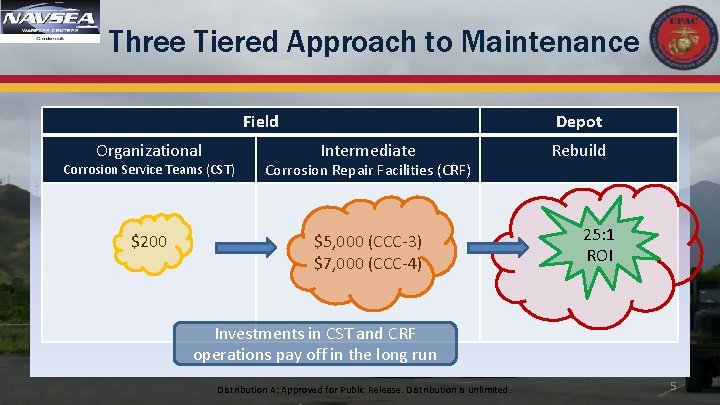
Three Tiered Approach to Maintenance (ROI 25: 1) Field Organizational Corrosion Service Teams (CST) Apply resources here to prevent corrosion onset/progression Depot Intermediate Corrosion Repair Facilities (CRF) Perform Corrective Maintenance; Increase Time btwn Repairs Distribution A: Approved for Public Release. Distribution is unlimited. Rebuild Delay/Prevent the need for depot rebuild as long as possible 4
Three Tiered Approach to Maintenance Field Organizational Depot Intermediate Corrosion Service Teams (CST) Corrosion Repair Facilities (CRF) $200 $5, 000 (CCC-3) $7, 000 (CCC-4) Rebuild 25: 1 ROI Investments in CST and CRF operations pay off in the long run Distribution A: Approved for Public Release. Distribution is unlimited. 5
Corrosion Repair Facilities Corrosion Repair Facility Responsibilities: • Repair: • Corrosion that is beyond the owning unit capability • Significantly degraded coatings • Correct the issue using appropriate repair procedures • Perform body repair • Surface Preparation • Recoating of the CARC system • Application of corrosion preventive compounds as needed Distribution A: Approved for Public Release. Distribution is unlimited. 6
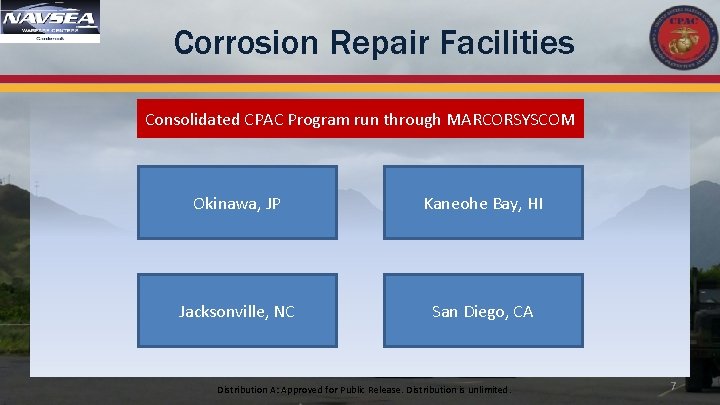
Corrosion Repair Facilities Consolidated CPAC Program run through MARCORSYSCOM Okinawa, JP Kaneohe Bay, HI Jacksonville, NC San Diego, CA Distribution A: Approved for Public Release. Distribution is unlimited. 7
Developing Audit Requirements CRF Guiding Documents: • CRF SOW • Number of assets per month • Follow technical guidance in TM 4750 -OD/1_ “Painting, Coating, Underbody and Registration Marking for Marine Corps Combat and Tactical Equipment” Distribution A: Approved for Public Release. Distribution is unlimited. 8
Audit Process Categories CRF Performance Audit Administrative • Facility Management • Production Mgmt. • Quality Mgmt. • Regulatory Mgmt. • Personnel Mgmt. • Reporting Technical • Cleaning • Disassembly • Body Repair • Surface Prep • Zinc Application • Epoxy Application • CARC Application • Touch-up Coating • Camouflage • Undercoat App. • Bedliner App. • Final Assessment Regulatory* • Safety • Coating Storage • Facilities/Equipment • Environmental *Encompasses common problems found in general painting operations, rather than a rehashing of audit processes accomplished by outside agencies Distribution A: Approved for Public Release. Distribution is unlimited. 9
Developing Audit Requirements Example of Zinc Requirements: 1. Use of the appropriate material 2. Application to appropriate substrates 3. Surface cleanliness prior to coating 4. Mixing practices 5. Use of agitation to prevent settling 6. Application of coating IAW TM 7. Environmental conditions 8. Film thickness ranges 9. Dry/recoat times 10. Pot life 11. Material storage conditions 12. QA checkpoints (visual inspection) 13. QA checkpoints (DFT measurement) Distribution A: Approved for Public Release. Distribution is unlimited. 10
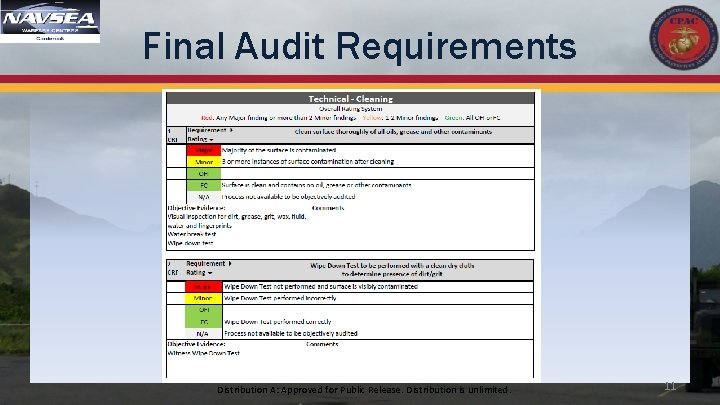
Final Audit Requirements CPAC Form 9 Distribution A: Approved for Public Release. Distribution is unlimited. 11
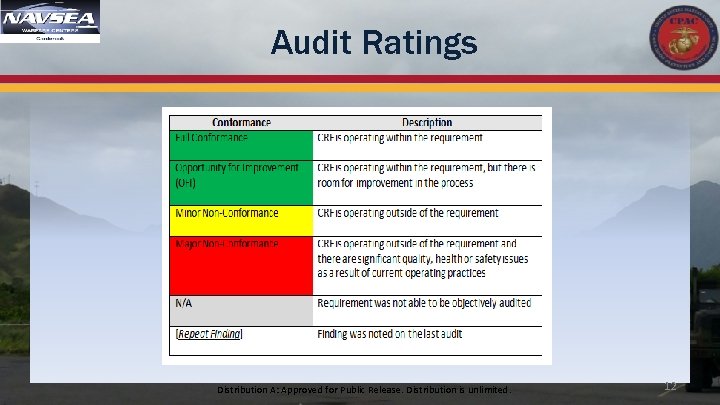
Audit Ratings Distribution A: Approved for Public Release. Distribution is unlimited. 12
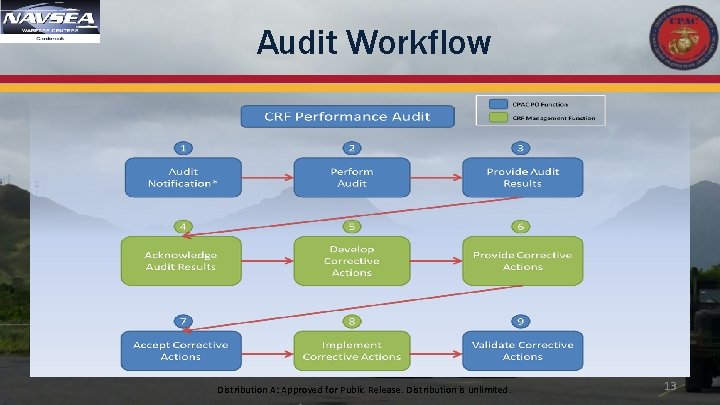
Audit Workflow Distribution A: Approved for Public Release. Distribution is unlimited. 13
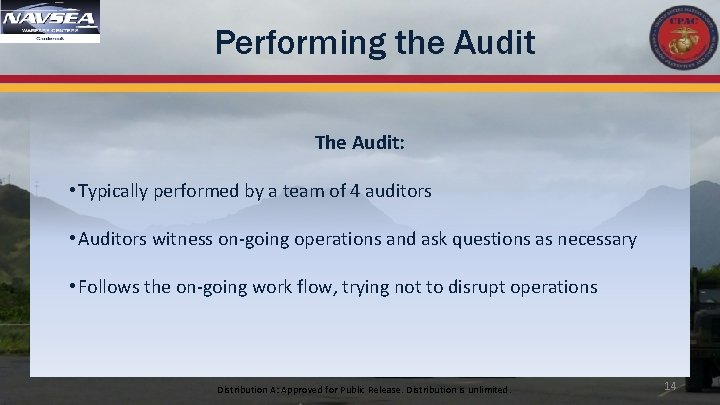
Performing the Audit The Audit: • Typically performed by a team of 4 auditors • Auditors witness on-going operations and ask questions as necessary • Follows the on-going work flow, trying not to disrupt operations Distribution A: Approved for Public Release. Distribution is unlimited. 14
Audit & On the Job Training: • Auditors use findings as On the Job Training opportunities • Will stop the ongoing process and teach the correct action (if a major finding) or will wait until best time to teach the correct action • Will teach CRF artisans and/supervisors so all understand the correct action Distribution A: Approved for Public Release. Distribution is unlimited. 15
Audit Results are Provided: • Initial draft at the end of the audit week provided as an out-brief • Allows CRF team to ask questions, understand findings • Program Office able to determine if objectives were met • Final Report is an in-depth document including: • Telecom with management to brief findings • A report of all findings (CPAC Form 9) • Pictures of findings • Corrective Action Form Distribution A: Approved for Public Release. Distribution is unlimited. 16
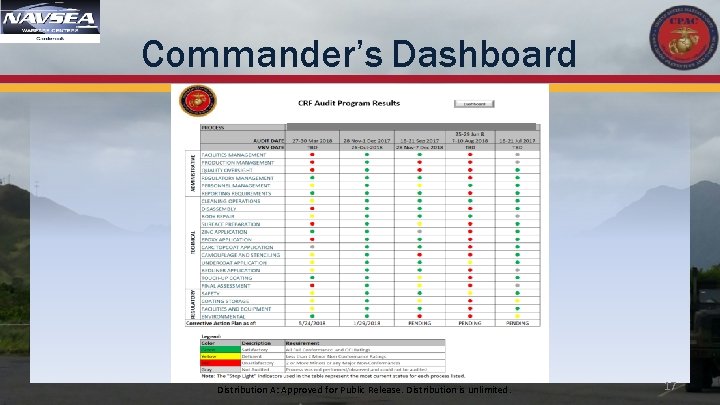
Commander’s Dashboard Distribution A: Approved for Public Release. Distribution is unlimited. 17
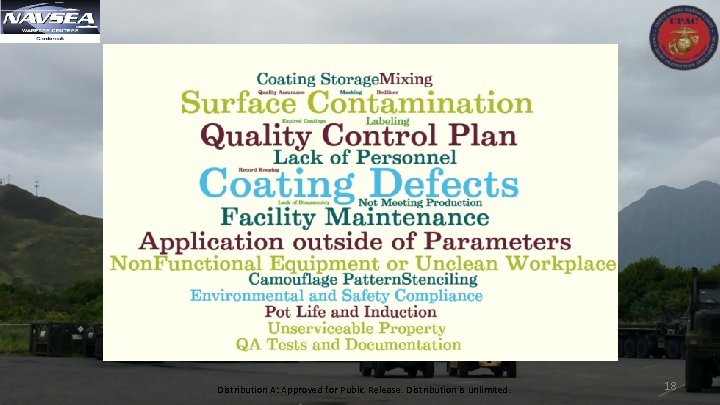
Distribution A: Approved for Public Release. Distribution is unlimited. 18
Corrective Actions CRF’s are Responsible for Developing Corrective Action Plans: • Include both short-term and long-term corrections • Provide feedback to the program stating they immediately corrected the issue • Accepted by the program and tracked through completion • Validated by the audit team during V&V visits (performed as available) Distribution A: Approved for Public Release. Distribution is unlimited. 19
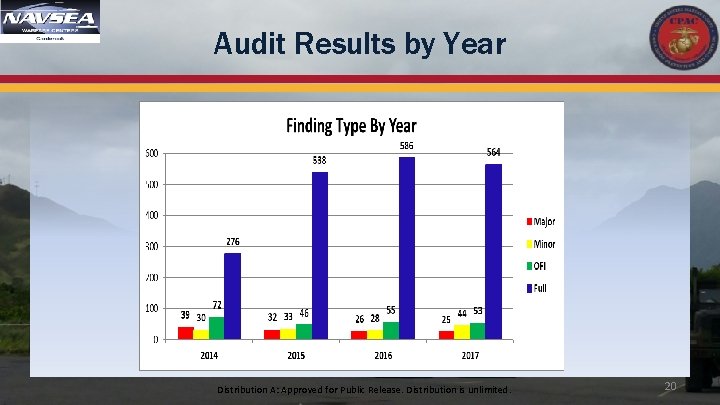
Audit Results by Year Distribution A: Approved for Public Release. Distribution is unlimited. 20
Increased Life Since the Consolidation in 2014 through the end of 2015 • 86% of assets are still in a condition requiring only O-level Maintenance • Majority of the other 14% have mechanical damage unrelated to CRF repair. • Will continue to watch this data over time Distribution A: Approved for Public Release. Distribution is unlimited. 21
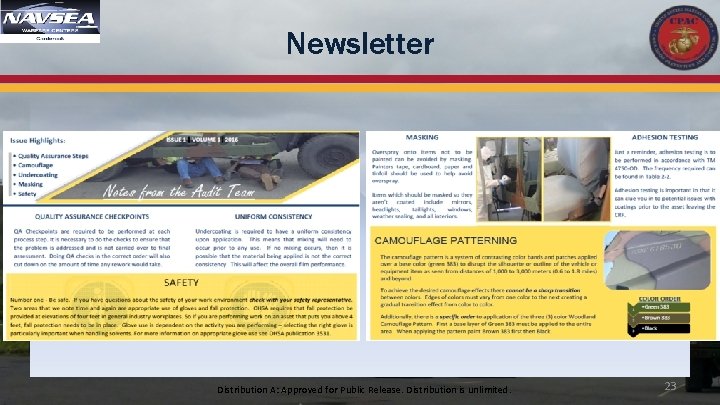
Sharing Lessons Learned • Identified an opportunity to share results of the audits with other CRF’s beyond the overall status of the program • Is used as a valuable teaching tool • Created CPAC Newsletter to discuss topics related to trouble areas identified during the previous audit Distribution A: Approved for Public Release. Distribution is unlimited. 22
Newsletter Distribution A: Approved for Public Release. Distribution is unlimited. 23
Successes • The CPAC program has benefited from an increase in quality and uniformity of product. • Audits have led the program to: • See the value in continued artisan training • Realize gaps in the knowledge base and develop specialized training • Note products burdensome to the coatings process • Direct engineering and RDT&E efforts to improve coatings process Distribution A: Approved for Public Release. Distribution is unlimited. 24
Challenges • One consistent challenge is production management. • CRFs are a continuous batch process, so small changes can have a significant impact. • Can be seen with: • Equipment malfunction • Personnel turnover • Changes in facility management Distribution A: Approved for Public Release. Distribution is unlimited. 25
Conclusions • Implementing an audit program across the CRF’s has been instrumental in the CPAC program meeting annual objectives • Improvements in: • Product turn-around time • Enhanced the knowledge level of the CRF Personnel • Engagement of CRF management in the coatings process • Uniformity of product • End State: Extending the useful service life at less cost Distribution A: Approved for Public Release. Distribution is unlimited. 26
Conclusions • The biggest lesson learned is that quality is driven by facility management. • Successful CRFs implement a culture of quality and meet audit criteria head on. • Continuing an audit program will: • Ensure CRFs provide a product that meets expectations • Reduce waste within the production process • Improve processes and operations • Educate the workforce in coating best practices Distribution A: Approved for Public Release. Distribution is unlimited. 27