
Institute of Food Research Scoping the risk perception

- Slides: 15
Institute of Food Research Scoping the risk perception universe: Structured analysis and preliminary findings Gillian Hawkes, Julie Houghton and Gene Rowe Institute of Food Research, Norwich, UK
Introduction • The issue of how risk is ‘perceived’ is important to the setting of social policies in almost every domain • Prediction of human responses to novel potential hazards (or novel manifestations of old hazards) is neither reliable nor complete • There is no widely accepted model of risk perception
Aims of the Structured Review • Provide a structured review of qualitative studies of risk perception • Consider the extent to which research has addressed different facets (the whole domain set) of ‘risk perception’ • • • Discuss methodological deficiencies Summarise the main findings Comment upon the comprehensiveness, validity and usefulness of qualitative research in this area
Method of the Structured Review 1 • • Relevant papers (374) identified in October 2005 Used a number of criteria to select a smaller sample of the most directly relevant papers: § the papers had to be in English § they had to present the findings of empirical studies § they had to deal with risk perception § the research methods used had to be qualitative in nature (or to include a qualitative – in addition to quantitative – component) • Through this process, 28 qualitative studies were identified, including three studies that used both qualitative and quantitative research methods
Method of the Structured Review 2 • The selected papers were then interrogated using the following questions: § What hazards were studied? § What research methods were used? § How were the research questions framed (i. e. what questions were asked of subjects)? § What sampling methods were employed? § What results were attained (in particular, what factors were related to perceived risk, and how)? • All 28 papers were cross-checked for consistency of interpretation by at least two researchers
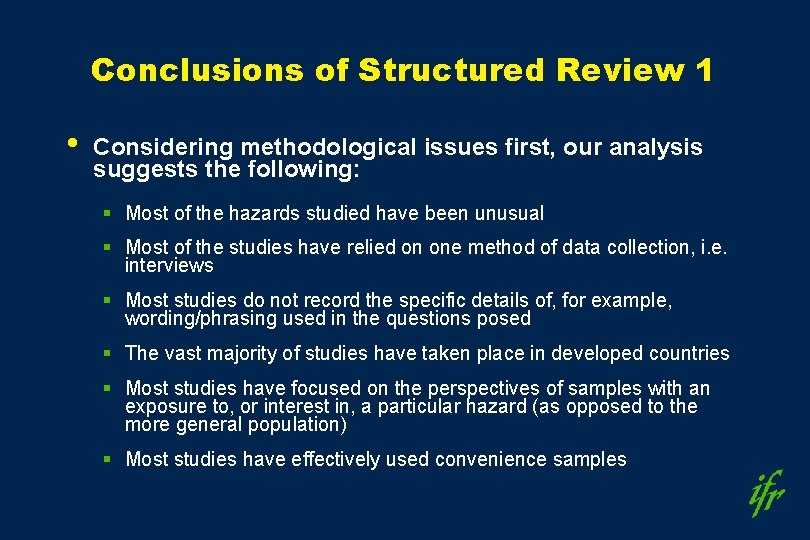
Conclusions of Structured Review 1 • Considering methodological issues first, our analysis suggests the following: § Most of the hazards studied have been unusual § Most of the studies have relied on one method of data collection, i. e. interviews § Most studies do not record the specific details of, for example, wording/phrasing used in the questions posed § The vast majority of studies have taken place in developed countries § Most studies have focused on the perspectives of samples with an exposure to, or interest in, a particular hazard (as opposed to the more general population) § Most studies have effectively used convenience samples
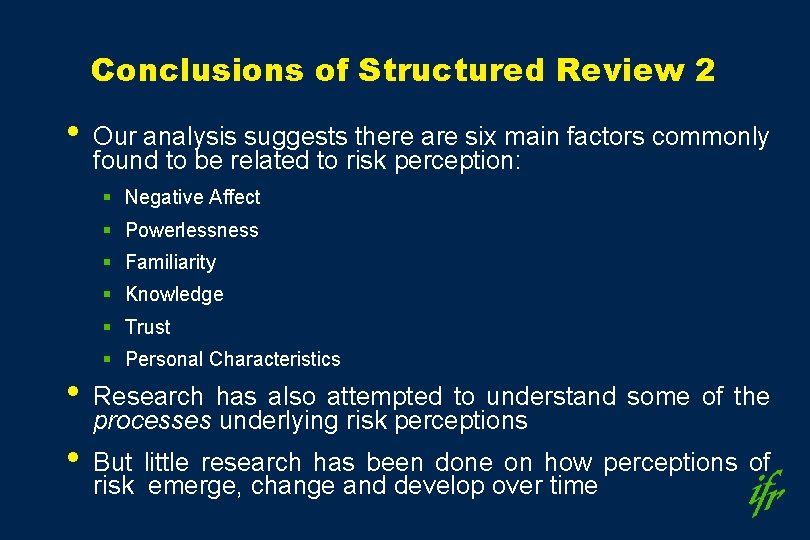
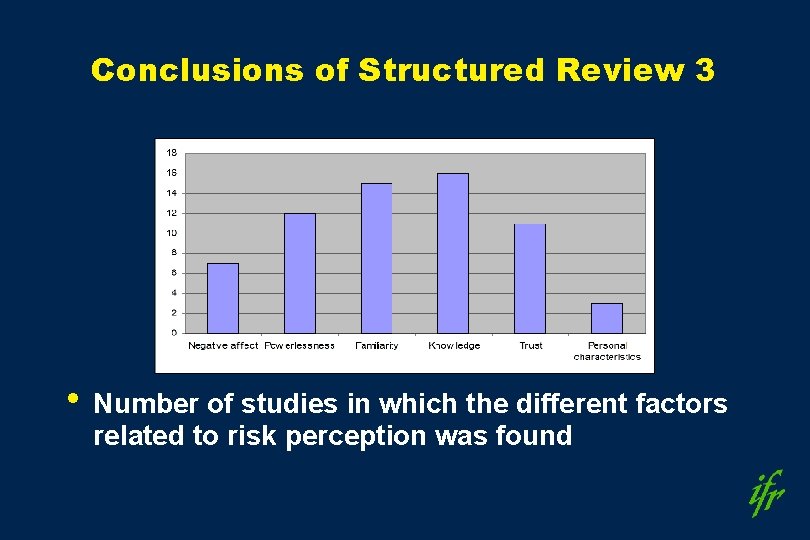
Conclusions of Structured Review 2 • Our analysis suggests there are six main factors commonly found to be related to risk perception: § Negative Affect § Powerlessness § Familiarity § Knowledge § Trust § Personal Characteristics • Research has also attempted to understand some of the processes underlying risk perceptions • But little research has been done on how perceptions of risk emerge, change and develop over time
Conclusions of Structured Review 3 • Number of studies in which the different factors related to risk perception was found
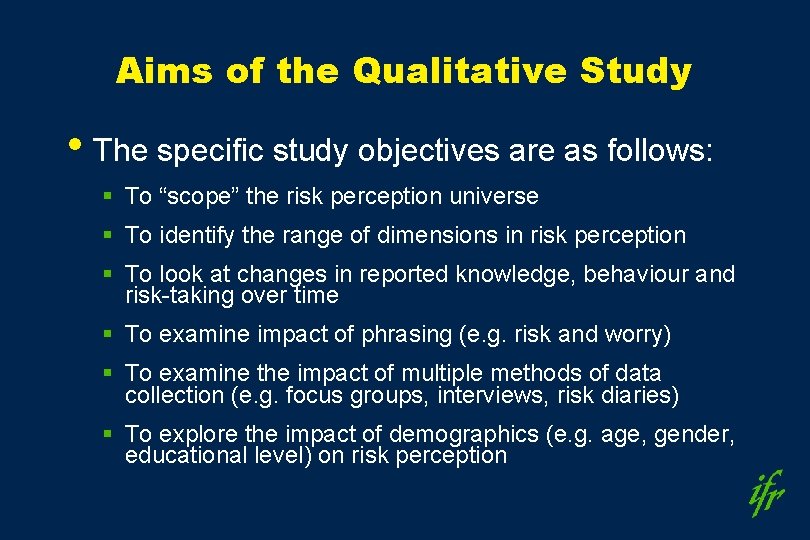
Aims of the Qualitative Study • The specific study objectives are as follows: § To “scope” the risk perception universe § To identify the range of dimensions in risk perception § To look at changes in reported knowledge, behaviour and risk-taking over time § To examine impact of phrasing (e. g. risk and worry) § To examine the impact of multiple methods of data collection (e. g. focus groups, interviews, risk diaries) § To explore the impact of demographics (e. g. age, gender, educational level) on risk perception
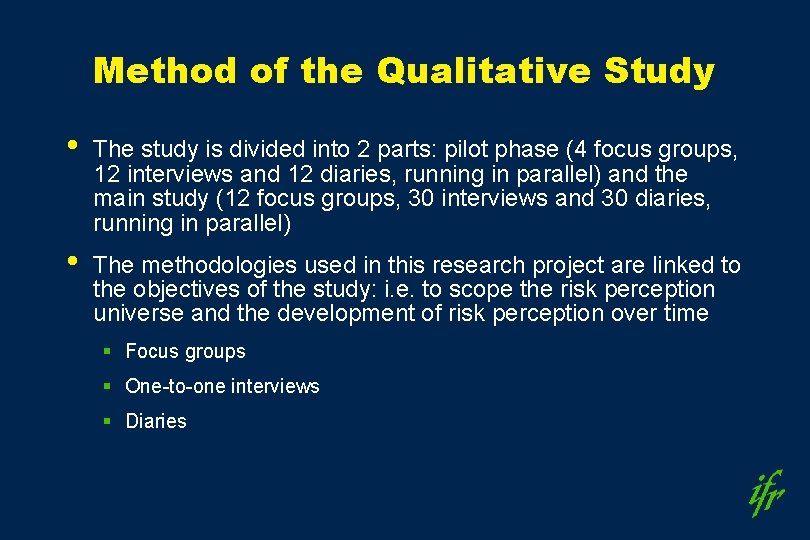
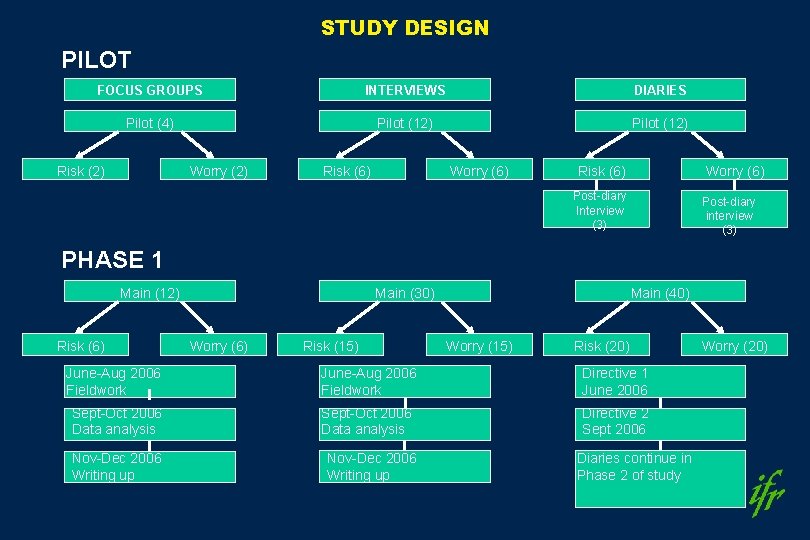
Method of the Qualitative Study • The study is divided into 2 parts: pilot phase (4 focus groups, 12 interviews and 12 diaries, running in parallel) and the main study (12 focus groups, 30 interviews and 30 diaries, running in parallel) • The methodologies used in this research project are linked to the objectives of the study: i. e. to scope the risk perception universe and the development of risk perception over time § Focus groups § One-to-one interviews § Diaries
STUDY DESIGN PILOT FOCUS GROUPS INTERVIEWS DIARIES Pilot (4) Pilot (12) Risk (2) Worry (2) Risk (6) Worry (6) Post-diary Interview (3) Post-diary interview (3) PHASE 1 Main (12) Risk (6) Main (30) Worry (6) Risk (15) Main (40) Worry (15) Risk (20) June-Aug 2006 Fieldwork Directive 1 June 2006 Sept-Oct 2006 Data analysis Directive 2 Sept 2006 Nov-Dec 2006 Writing up Diaries continue in Phase 2 of study Worry (20)
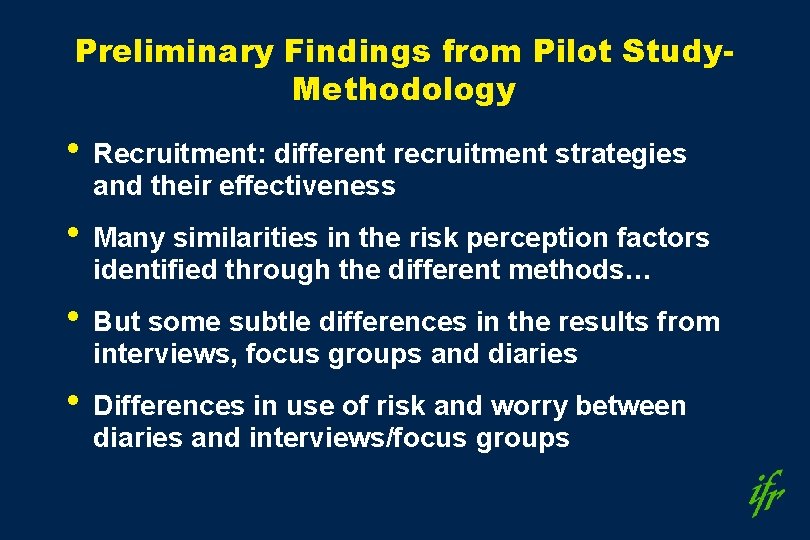
Preliminary Findings from Pilot Study. Methodology • Recruitment: different recruitment strategies and their effectiveness • Many similarities in the risk perception factors identified through the different methods… • But some subtle differences in the results from interviews, focus groups and diaries • Differences in use of risk and worry between diaries and interviews/focus groups
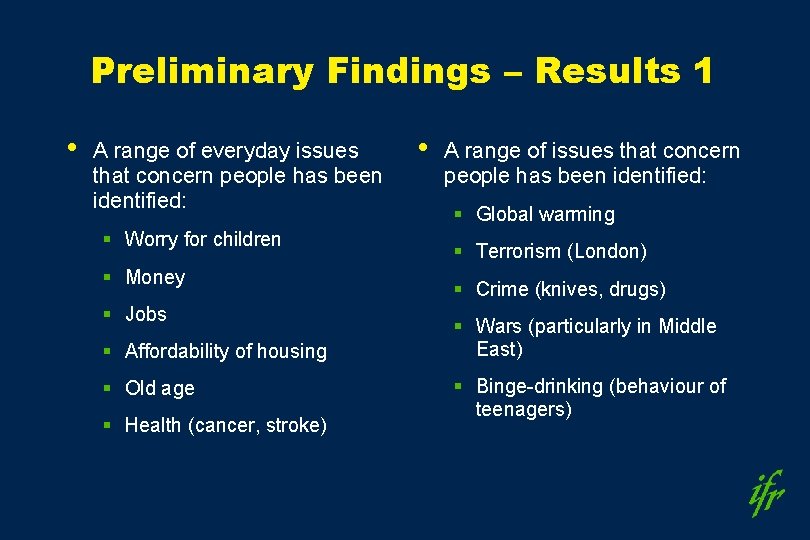
Preliminary Findings – Results 1 • A range of everyday issues that concern people has been identified: § Worry for children § Money § Jobs § Affordability of housing § Old age § Health (cancer, stroke) • A range of issues that concern people has been identified: § Global warming § Terrorism (London) § Crime (knives, drugs) § Wars (particularly in Middle East) § Binge-drinking (behaviour of teenagers)
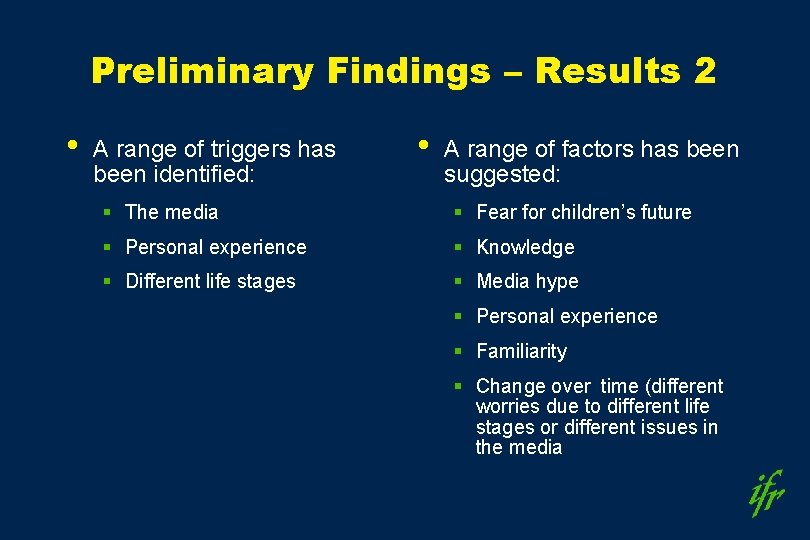
Preliminary Findings – Results 2 • A range of triggers has been identified: • A range of factors has been suggested: § The media § Fear for children’s future § Personal experience § Knowledge § Different life stages § Media hype § Personal experience § Familiarity § Change over time (different worries due to different life stages or different issues in the media
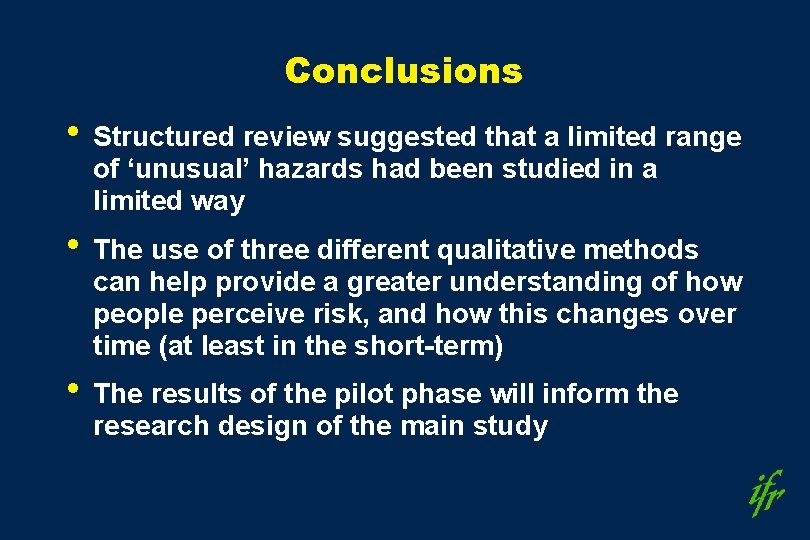
Conclusions • Structured review suggested that a limited range of ‘unusual’ hazards had been studied in a limited way • The use of three different qualitative methods can help provide a greater understanding of how people perceive risk, and how this changes over time (at least in the short-term) • The results of the pilot phase will inform the research design of the main study