
Institute for Transport Studies FACULTY OF ENVIRONMENT Thursday
![CONTENTS [1] ASSESSING VEHICLE EMISSIONS: A new approach a. The on road measurement &](https://slidetodoc.com/presentation_image/1f0157b9828ed566bf755e55a0dc819d/image-3.jpg "CONTENTS [1] ASSESSING VEHICLE EMISSIONS: A new approach a. The on road measurement &")
![[1 a] ON ROAD VEHICLE A remote sensing approach EMISSIONS: Halifax, Calderdale MBC, October](https://slidetodoc.com/presentation_image/1f0157b9828ed566bf755e55a0dc819d/image-4.jpg "[1 a] ON ROAD VEHICLE A remote sensing approach EMISSIONS: Halifax, Calderdale MBC, October")
![[1 a] ON ROAD VEHICLE A remote sensing approach EMISSIONS: Sowerby Bridge, Calderdale MBC,](https://slidetodoc.com/presentation_image/1f0157b9828ed566bf755e55a0dc819d/image-5.jpg "[1 a] ON ROAD VEHICLE A remote sensing approach EMISSIONS: Sowerby Bridge, Calderdale MBC,")
![[1 a] ON ROAD VEHICLE A remote sensing approach EMISSIONS: Sowerby Bridge, Calderdale MBC,](https://slidetodoc.com/presentation_image/1f0157b9828ed566bf755e55a0dc819d/image-6.jpg "[1 a] ON ROAD VEHICLE A remote sensing approach EMISSIONS: Sowerby Bridge, Calderdale MBC,")
![[1 a] ON ROAD VEHICLE A remote sensing approach Emission measurements: CO/CO 2, NO/CO](https://slidetodoc.com/presentation_image/1f0157b9828ed566bf755e55a0dc819d/image-7.jpg "[1 a] ON ROAD VEHICLE A remote sensing approach Emission measurements: CO/CO 2, NO/CO")
![[1 b] VEHICLE EMISSIONS Laboratory testing Fig. Chassis dynamometer and exhaust analysing equipment Technical](https://slidetodoc.com/presentation_image/1f0157b9828ed566bf755e55a0dc819d/image-8.jpg "[1 b] VEHICLE EMISSIONS Laboratory testing Fig. Chassis dynamometer and exhaust analysing equipment Technical")
![[1 b] VEHICLE EMISSIONS: Vehicle operation in the laboratory Fig. Speed profile used for](https://slidetodoc.com/presentation_image/1f0157b9828ed566bf755e55a0dc819d/image-9.jpg "[1 b] VEHICLE EMISSIONS: Vehicle operation in the laboratory Fig. Speed profile used for")
![[1 b] VEHICLE EMISSION Passenger cars STANDARDS NOX Latest EU directive for Euro 5](https://slidetodoc.com/presentation_image/1f0157b9828ed566bf755e55a0dc819d/image-10.jpg "[1 b] VEHICLE EMISSION Passenger cars STANDARDS NOX Latest EU directive for Euro 5")
![[1 b] ON ROAD VEHICLE EMISSIONS: NOX Emissions from Euro 5 Commercial Vehicles Ligterink](https://slidetodoc.com/presentation_image/1f0157b9828ed566bf755e55a0dc819d/image-11.jpg "[1 b] ON ROAD VEHICLE EMISSIONS: NOX Emissions from Euro 5 Commercial Vehicles Ligterink")
![[2 a] RESULTS Shropshire Council Project Spring 2010 10 days monitoring (8 am –](https://slidetodoc.com/presentation_image/1f0157b9828ed566bf755e55a0dc819d/image-12.jpg "[2 a] RESULTS Shropshire Council Project Spring 2010 10 days monitoring (8 am –")
![[2 a] RESULTS Observed passenger car fleet NOTE: The recommended UK fuel split is](https://slidetodoc.com/presentation_image/1f0157b9828ed566bf755e55a0dc819d/image-13.jpg "[2 a] RESULTS Observed passenger car fleet NOTE: The recommended UK fuel split is")
![[2 a] RESULTS Observed passenger car fleet](https://slidetodoc.com/presentation_image/1f0157b9828ed566bf755e55a0dc819d/image-14.jpg "[2 a] RESULTS Observed passenger car fleet")
![[2 a] RESULTS Observed passenger car fleet CO 2 (grams/km): From type approval drive-cycle](https://slidetodoc.com/presentation_image/1f0157b9828ed566bf755e55a0dc819d/image-15.jpg "[2 a] RESULTS Observed passenger car fleet CO 2 (grams/km): From type approval drive-cycle")
![[2 a] RESULTS Observed passenger car fleet](https://slidetodoc.com/presentation_image/1f0157b9828ed566bf755e55a0dc819d/image-16.jpg "[2 a] RESULTS Observed passenger car fleet")
![[2 b] RESULTS Observed passenger car fleet](https://slidetodoc.com/presentation_image/1f0157b9828ed566bf755e55a0dc819d/image-17.jpg "[2 b] RESULTS Observed passenger car fleet")
![[2 a] RESULTS Observed passenger car fleet](https://slidetodoc.com/presentation_image/1f0157b9828ed566bf755e55a0dc819d/image-18.jpg "[2 a] RESULTS Observed passenger car fleet")
![[2 b] RESULTS Observed passenger car fleet](https://slidetodoc.com/presentation_image/1f0157b9828ed566bf755e55a0dc819d/image-20.jpg "[2 b] RESULTS Observed passenger car fleet")
![[2 b] SUMMARY p-NO 2 Trends RESULTS ASSUMPTIONS: • The 2010 passenger car fleet](https://slidetodoc.com/presentation_image/1f0157b9828ed566bf755e55a0dc819d/image-21.jpg "[2 b] SUMMARY p-NO 2 Trends RESULTS ASSUMPTIONS: • The 2010 passenger car fleet")
![[2 c] IMPLICATIONS Low Emission Strategies • Policies to encourage the replacement of older](https://slidetodoc.com/presentation_image/1f0157b9828ed566bf755e55a0dc819d/image-22.jpg "[2 c] IMPLICATIONS Low Emission Strategies • Policies to encourage the replacement of older")
![[2 c] IMPLICATIONS E. g. The UK Car Scrappage Scheme](https://slidetodoc.com/presentation_image/1f0157b9828ed566bf755e55a0dc819d/image-23.jpg "[2 c] IMPLICATIONS E. g. The UK Car Scrappage Scheme")
![[3 a] OUTLOOK Summary • The UK and EU vehicle fleets are in a](https://slidetodoc.com/presentation_image/1f0157b9828ed566bf755e55a0dc819d/image-24.jpg "[3 a] OUTLOOK Summary • The UK and EU vehicle fleets are in a")
![[3 b] OUTLOOK Research extensions Regional Group initiative: • West Yorkshire Transport Emissions Group](https://slidetodoc.com/presentation_image/1f0157b9828ed566bf755e55a0dc819d/image-25.jpg "[3 b] OUTLOOK Research extensions Regional Group initiative: • West Yorkshire Transport Emissions Group")
- Slides: 25
Institute for Transport Studies FACULTY OF ENVIRONMENT Thursday 7 th October 2010 Leeds Low Emission Vehicle Exhibition and Conference VEHICLE EMISSION MONITORING AND MODELLING Dr James Tate Lecturer (50% Research) j. e. tate@its. leeds. ac. uk
Institute for Transport Studies FACULTY OF ENVIRONMENT Thursday 7 th October 2010 Leeds Low Emission Vehicle Exhibition and Conference BETTER UNDERSTANDING VEHICLE EMISSIONS ON THE ROAD: - Why local air pollution is still a concern - The benefits of hybrid cars Dr James Tate Lecturer (50% Research) j. e. tate@its. leeds. ac. uk
CONTENTS [1] ASSESSING VEHICLE EMISSIONS: A new approach a. The on road measurement & categorisation of vehicles & emissions b. Vehicle emission standards & the traditional lab. testing approach [2] RESULTS: Trends in UK passenger car on road emissions a. The on road fleet b. Emission characteristics c. Implications for Low Emission Strategies [3] OUTLOOK a. A rapidly changing vehicle fleet b. Future extensions
[1 a] ON ROAD VEHICLE A remote sensing approach EMISSIONS: Halifax, Calderdale MBC, October 2009
[1 a] ON ROAD VEHICLE A remote sensing approach EMISSIONS: Sowerby Bridge, Calderdale MBC, July 2010
[1 a] ON ROAD VEHICLE A remote sensing approach EMISSIONS: Sowerby Bridge, Calderdale MBC, Also July 2010….
[1 a] ON ROAD VEHICLE A remote sensing approach Emission measurements: CO/CO 2, NO/CO 2, HC/CO 2 & a Particle measure from peak exhaust plume conc. EMISSIONS: Vehicle Fleet: Classification from number plate (ANPR) →Detailed registration information (DVLA) →Collaboration with www. smmt. co. uk
[1 b] VEHICLE EMISSIONS Laboratory testing Fig. Chassis dynamometer and exhaust analysing equipment Technical University of Graz (Austria): • Light-duty • Heavy-duty Engine & Chassis dynos.
[1 b] VEHICLE EMISSIONS: Vehicle operation in the laboratory Fig. Speed profile used for type approval purposes (New EU Drive-Cycle) Fig. Real-world driving: The Common ARTEMIS Drive Cycle (Andre, 2004).
[1 b] VEHICLE EMISSION Passenger cars STANDARDS NOX Latest EU directive for Euro 5 and 6 - 2007/715/EC PM
[1 b] ON ROAD VEHICLE EMISSIONS: NOX Emissions from Euro 5 Commercial Vehicles Ligterink et al, 2009, On-road NOx emissions of Euro-V trucks. TNO report, 2 nd December 2009
[2 a] RESULTS Shropshire Council Project Spring 2010 10 days monitoring (8 am – 6 pm) Data collection Enviro Tech plc. >18 000 records = paired emission + vehicle info. e. g. vehicle & euro category, weight, size, engine capacity, manufacturer & model, CO 2 rating, etc.
[2 a] RESULTS Observed passenger car fleet NOTE: The recommended UK fuel split is Petrol (70%) / Diesel (30%) e. g. NAEI & EFT ver 4. 2
[2 a] RESULTS Observed passenger car fleet
[2 a] RESULTS Observed passenger car fleet CO 2 (grams/km): From type approval drive-cycle (NEDC)
[2 a] RESULTS Observed passenger car fleet
[2 b] RESULTS Observed passenger car fleet
[2 a] RESULTS Observed passenger car fleet
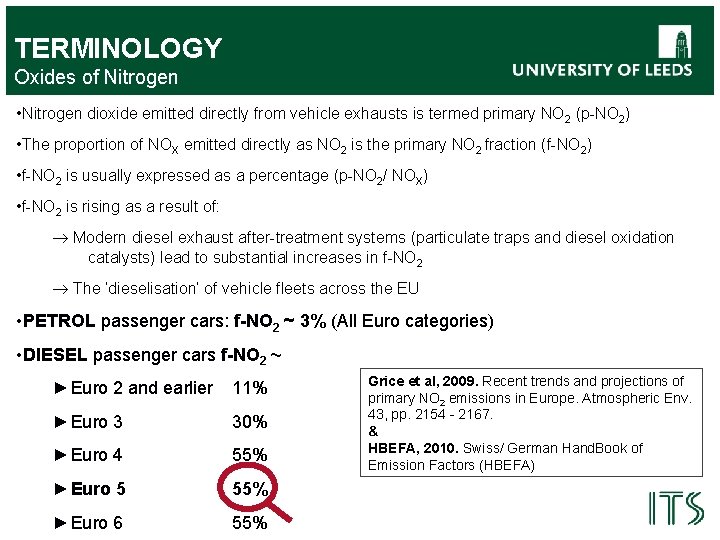
TERMINOLOGY Oxides of Nitrogen • Nitrogen dioxide emitted directly from vehicle exhausts is termed primary NO 2 (p-NO 2) • The proportion of NOX emitted directly as NO 2 is the primary NO 2 fraction (f-NO 2) • f-NO 2 is usually expressed as a percentage (p-NO 2/ NOX) • f-NO 2 is rising as a result of: Modern diesel exhaust after-treatment systems (particulate traps and diesel oxidation catalysts) lead to substantial increases in f-NO 2 The ‘dieselisation’ of vehicle fleets across the EU • PETROL passenger cars: f-NO 2 ~ 3% (All Euro categories) • DIESEL passenger cars f-NO 2 ~ ►Euro 2 and earlier 11% ►Euro 3 30% ►Euro 4 55% ►Euro 5 55% ►Euro 6 55% Grice et al, 2009. Recent trends and projections of primary NO 2 emissions in Europe. Atmospheric Env. 43, pp. 2154 - 2167. & HBEFA, 2010. Swiss/ German Hand. Book of Emission Factors (HBEFA)
[2 b] RESULTS Observed passenger car fleet
[2 b] SUMMARY p-NO 2 Trends RESULTS ASSUMPTIONS: • The 2010 passenger car fleet petrol/ diesel split and average NO 2 figures, projected to new vehicles 2011 • The number of new vehicles, assumed to be equivalent to 2009 • Scrappage of older vehicles not currently considered Note: Euro 6 Sept 2014 -
[2 c] IMPLICATIONS Low Emission Strategies • Policies to encourage the replacement of older passenger cars with “potentially more environmentally friendly models” (www. berr. gov. uk) may exacerbate the NO 2 problem E. g. The UK Car Scrappage Scheme • Boost to the car industry • Voluntary discount scheme under which motor dealers gave motorists £ 2, 000 or more towards a new vehicle if they traded in a car or van over 10 years old for scrap between the 21 st October 2009 and the 28 th of February • Number of vehicles scrapped = 400 000 • The scheme has supported replacing older passenger cars (typically petrol engines) with modern diesel passenger cars that emit more p-NO 2 • For all other legislated emissions, the scheme is considered to have been beneficial
[2 c] IMPLICATIONS E. g. The UK Car Scrappage Scheme
[3 a] OUTLOOK Summary • The UK and EU vehicle fleets are in a period of transition: – Increasing fleet share of DIESEL passenger cars – DIESEL passenger cars emit more NO 2 directly – Little expected reduction in the NO 2 emissions from Euro 6 DIESELS (2014 -) √ Initial stages of growth for HYBRID and ELECTRIC vehicles √ Unlike diesels vehicles, HYBRID and ELECTRIC vehicles potentially benefit the GLOBAL and LOCAL environment both • Vehicle emission models and management policies need to better consider the composition of the on road vehicle fleet • NO 2 air pollution standards are likely to continue to be exceeded 2015 • Emission standards and Legislation should be extended to: ► Better represent “real-world” driving conditions ► Include standards for NO 2
[3 b] OUTLOOK Research extensions Regional Group initiative: • West Yorkshire Transport Emissions Group • DEFRA funding 2010 - 2011 • Surveys completed in Calderdale MBC July 2010 • Surveys planned in Bradford, Kirklees, Leeds and York: 2010 – 2011 • >25 000 valid records from each Local Authority • Rich resource to better understand vehicle emissions & inform Low Emission Strategies Future Research Priorities: • Inform the development and calibration of emission models e. g. study the % of failed catalysts in vehicle type sub-categories • With a larger dataset, study the important Heavy-duty vehicle sub-categories