
Institute for Social Analysis and Forecasting Theoretical Replacement

- Slides: 19
Institute for Social Analysis and Forecasting Theoretical Replacement Rate as a Tool for Pension System Analysis and Forecasting Gorlin Y. , Lyashok V.
Institute for Social Analysis and Forecasting Theoretical Replacement Rates measure how a retiree’s pension income in the first year after retirement would compare to their earnings immediately before retirement. (European Commission, 2018) It makes it possible to assess the extent to which the pension system has fulfilled the function of "income smoothing", i. e. the function of compensating for an acceptable degree of earnings (within the insurable part of it) lost after retirement. Goals: • Analysis of the pension provision situation in the country by analyzing the dynamics in the historical and the forecast periods, as well as cross-country comparisons • Setting target values and monitoring the implementation of pension policy • Assessment of the impact of measures in the pension and related fields on the achievement of the set goals 2
Institute for Social Analysis and Forecasting Theoretical replacement rate. Approaches International Labour Organization (ILO Conventions No. 102, No. 128, ILO Recommendation No. 131): • Typical recipient: A man and wife of retirement age who has worked as a skilled manual worker. The wife is presumed to be the husband's dependant. • Conditions: 30 years of employment or contribution. • Size: at least 40%/45%/55% of previous earnings (ILO Conventions No. 102/ 128/ ILO Recommendation No. 131, respectively). • Benefits include pensions and other social benefits received by husband wife. • Since 2019, the Russian Federation has ratified ILO Convention No. 102. 3
Institute for Social Analysis and Forecasting Theoretical replacement rate. Approaches OECD: • Prospective assessment of the size of pensions, provided the current parameters and mechanisms of the pension system are maintained. • Continuous working experience from 22 years to the generally established retirement age. • Includes public pensions (solidarity and contributory-service pensions), private pensions (if at least 85% of employees participate, as in Sweden, Denmark and the Netherlands). • Calculated separately for men and women in case of a difference in the general retirement age. • Wages: 0. 5, 1. 0 and 1. 5 of the average, according to official statistics, throughout the period of employment. • The gross and net replacement rate is calculated. 4
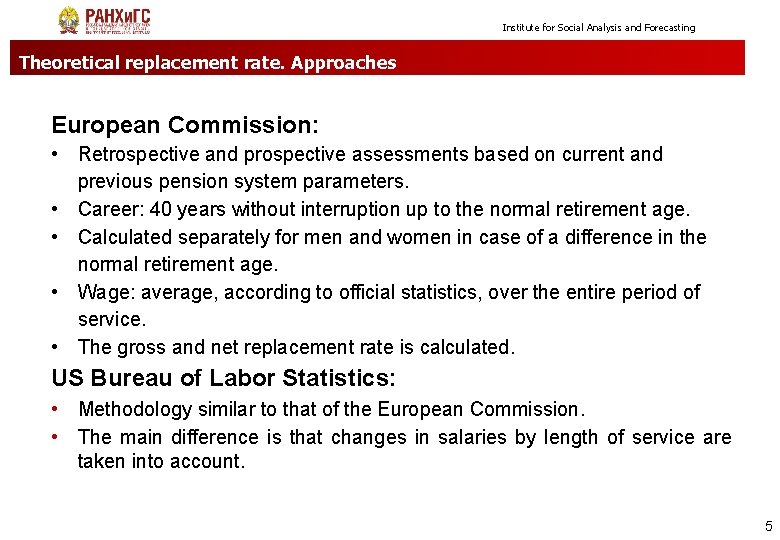
Institute for Social Analysis and Forecasting Theoretical replacement rate. Approaches European Commission: • Retrospective and prospective assessments based on current and previous pension system parameters. • Career: 40 years without interruption up to the normal retirement age. • Calculated separately for men and women in case of a difference in the normal retirement age. • Wage: average, according to official statistics, over the entire period of service. • The gross and net replacement rate is calculated. US Bureau of Labor Statistics: • Methodology similar to that of the European Commission. • The main difference is that changes in salaries by length of service are taken into account. 5
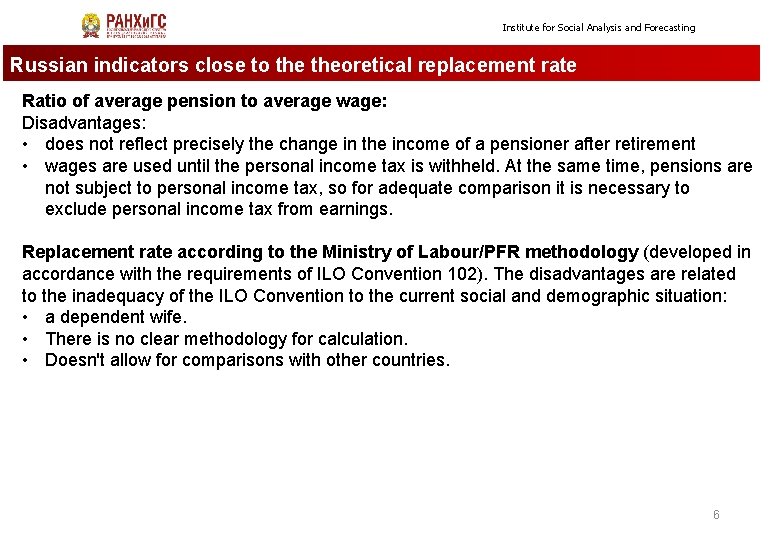
Institute for Social Analysis and Forecasting Russian indicators close to theoretical replacement rate Ratio of average pension to average wage: Disadvantages: • does not reflect precisely the change in the income of a pensioner after retirement • wages are used until the personal income tax is withheld. At the same time, pensions are not subject to personal income tax, so for adequate comparison it is necessary to exclude personal income tax from earnings. Replacement rate according to the Ministry of Labour/PFR methodology (developed in accordance with the requirements of ILO Convention 102). The disadvantages are related to the inadequacy of the ILO Convention to the current social and demographic situation: • a dependent wife. • There is no clear methodology for calculation. • Doesn't allow for comparisons with other countries. 6
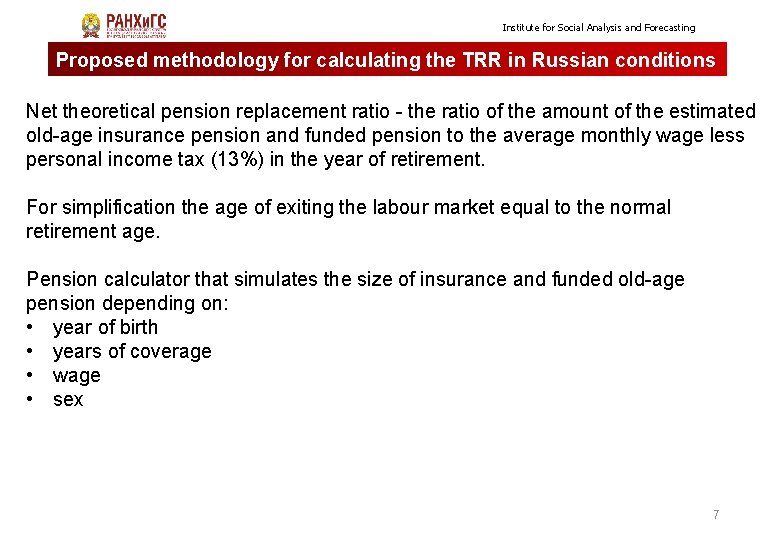
Institute for Social Analysis and Forecasting Proposed methodology for calculating the TRR in Russian conditions Net theoretical pension replacement ratio - the ratio of the amount of the estimated old-age insurance pension and funded pension to the average monthly wage less personal income tax (13%) in the year of retirement. For simplification the age of exiting the labour market equal to the normal retirement age. Pension calculator that simulates the size of insurance and funded old-age pension depending on: • year of birth • years of coverage • wage • sex 7
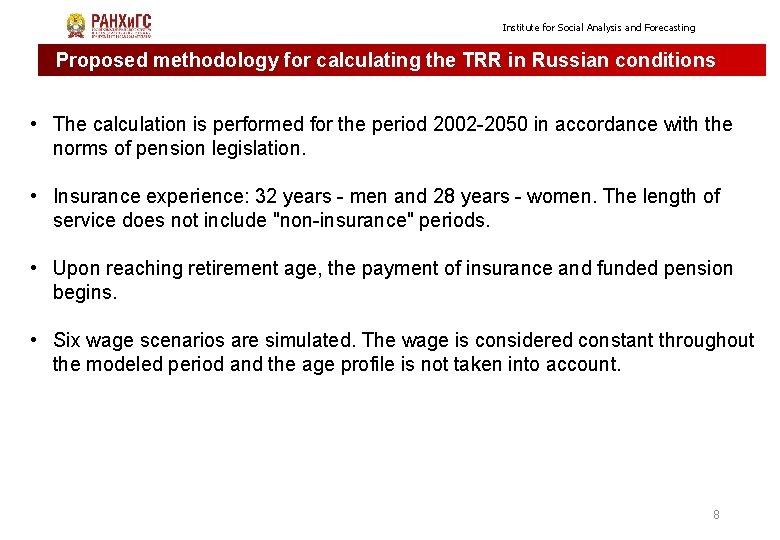
Institute for Social Analysis and Forecasting Proposed methodology for calculating the TRR in Russian conditions • The calculation is performed for the period 2002 -2050 in accordance with the norms of pension legislation. • Insurance experience: 32 years - men and 28 years - women. The length of service does not include "non-insurance" periods. • Upon reaching retirement age, the payment of insurance and funded pension begins. • Six wage scenarios are simulated. The wage is considered constant throughout the modeled period and the age profile is not taken into account. 8
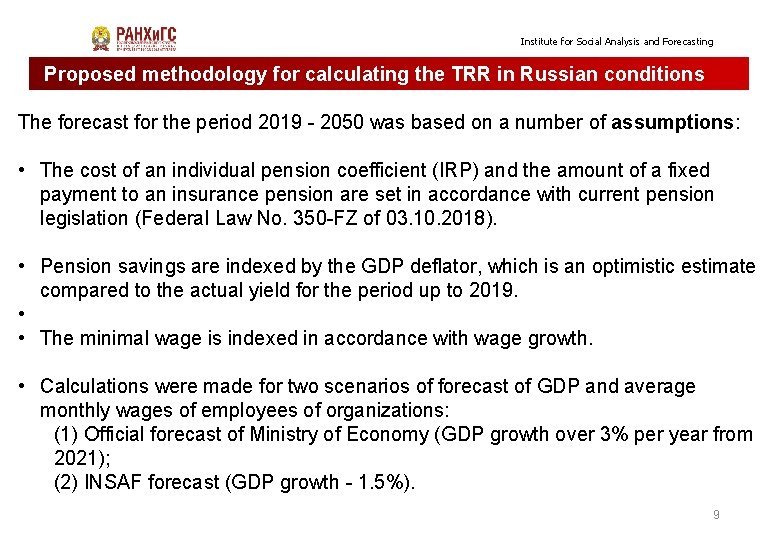
Institute for Social Analysis and Forecasting Proposed methodology for calculating the TRR in Russian conditions The forecast for the period 2019 - 2050 was based on a number of assumptions: • The cost of an individual pension coefficient (IRP) and the amount of a fixed payment to an insurance pension are set in accordance with current pension legislation (Federal Law No. 350 -FZ of 03. 10. 2018). • Pension savings are indexed by the GDP deflator, which is an optimistic estimate compared to the actual yield for the period up to 2019. • • The minimal wage is indexed in accordance with wage growth. • Calculations were made for two scenarios of forecast of GDP and average monthly wages of employees of organizations: (1) Official forecast of Ministry of Economy (GDP growth over 3% per year from 2021); (2) INSAF forecast (GDP growth - 1. 5%). 9
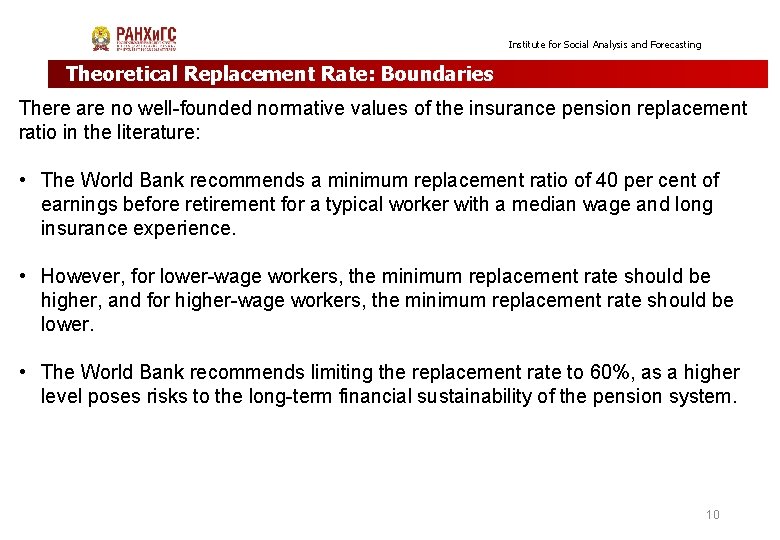
Institute for Social Analysis and Forecasting Theoretical Replacement Rate: Boundaries There are no well-founded normative values of the insurance pension replacement ratio in the literature: • The World Bank recommends a minimum replacement ratio of 40 per cent of earnings before retirement for a typical worker with a median wage and long insurance experience. • However, for lower-wage workers, the minimum replacement rate should be higher, and for higher-wage workers, the minimum replacement rate should be lower. • The World Bank recommends limiting the replacement rate to 60%, as a higher level poses risks to the long-term financial sustainability of the pension system. 10
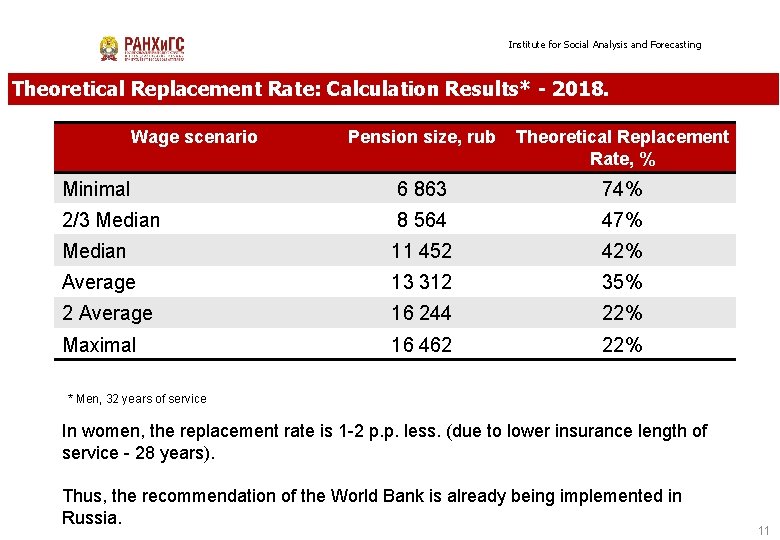
Institute for Social Analysis and Forecasting Theoretical Replacement Rate: Calculation Results* - 2018. Wage scenario Pension size, rub Theoretical Replacement Rate, % Minimal 6 863 74% 2/3 Median 8 564 47% Median 11 452 42% Average 13 312 35% 2 Average 16 244 22% Maximal 16 462 22% * Men, 32 years of service In women, the replacement rate is 1 -2 p. p. less. (due to lower insurance length of service - 28 years). Thus, the recommendation of the World Bank is already being implemented in Russia. 11
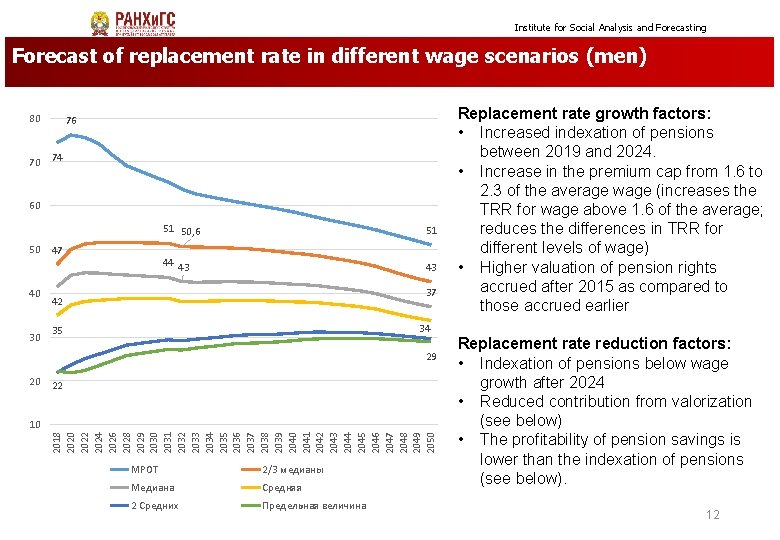
Institute for Social Analysis and Forecasting Forecast of replacement rate in different wage scenarios (men) 80 70 76 74 60 50 40 30 47 51 50, 6 51 44 43 43 37 42 34 35 29 20 22 2018 2020 2022 2024 2026 2028 2029 2030 2031 2032 2033 2034 2035 2036 2037 2038 2039 2040 2041 2042 2043 2044 2045 2046 2047 2048 2049 2050 10 МРОТ 2/3 медианы Медиана Средняя 2 Средних Предельная величина Replacement rate growth factors: • Increased indexation of pensions between 2019 and 2024. • Increase in the premium cap from 1. 6 to 2. 3 of the average wage (increases the TRR for wage above 1. 6 of the average; reduces the differences in TRR for different levels of wage) • Higher valuation of pension rights accrued after 2015 as compared to those accrued earlier Replacement rate reduction factors: • Indexation of pensions below wage growth after 2024 • Reduced contribution from valorization (see below) • The profitability of pension savings is lower than the indexation of pensions (see below). 12
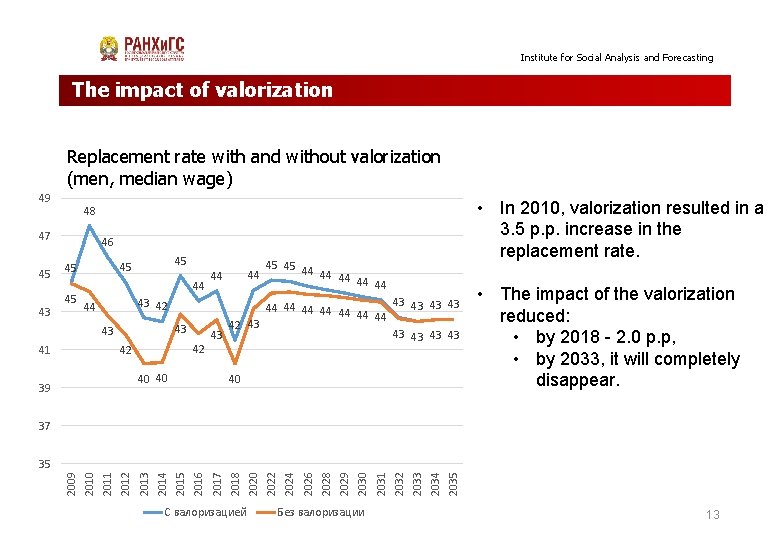
Institute for Social Analysis and Forecasting The impact of valorization Replacement rate with and without valorization (men, median wage) 49 47 45 43 • In 2010, valorization resulted in a 3. 5 p. p. increase in the replacement rate. 48 46 45 45 44 43 42 44 43 43 42 42 41 45 45 44 44 44 43 43 44 44 42 43 43 43 40 40 39 44 44 40 • The impact of the valorization reduced: • by 2018 - 2. 0 p. p, • by 2033, it will completely disappear. 37 С валоризацией Без валоризации 2035 2034 2033 2032 2031 2030 2029 2028 2026 2024 2022 2020 2018 2017 2016 2015 2014 2013 2012 2011 2010 2009 35 13
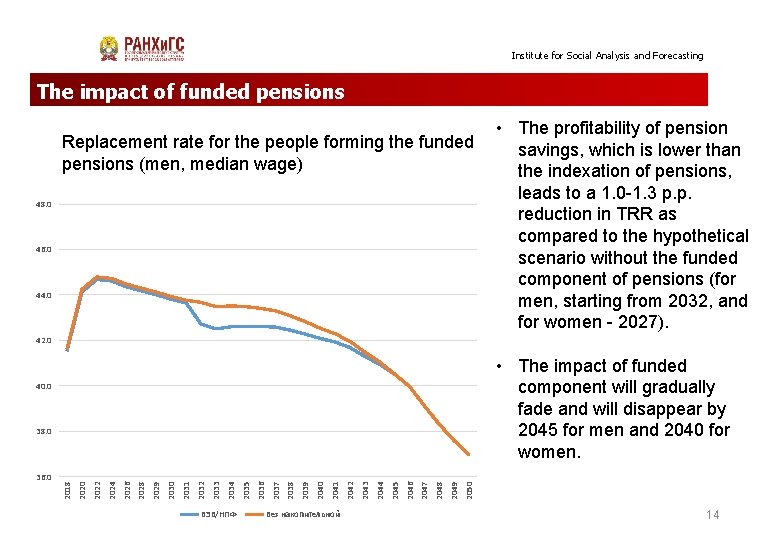
Institute for Social Analysis and Forecasting The impact of funded pensions Replacement rate for the people forming the funded pensions (men, median wage) 48. 0 46. 0 44. 0 • The profitability of pension savings, which is lower than the indexation of pensions, leads to a 1. 0 -1. 3 p. p. reduction in TRR as compared to the hypothetical scenario without the funded component of pensions (for men, starting from 2032, and for women - 2027). 42. 0 • The impact of funded component will gradually fade and will disappear by 2045 for men and 2040 for women. 40. 0 ВЭБ/НПФ Без накопительной 2050 2049 2048 2047 2046 2045 2044 2043 2042 2041 2040 2039 2038 2037 2036 2035 2034 2033 2032 2031 2030 2029 2028 2026 2024 2022 2020 36. 0 2018 38. 0 14
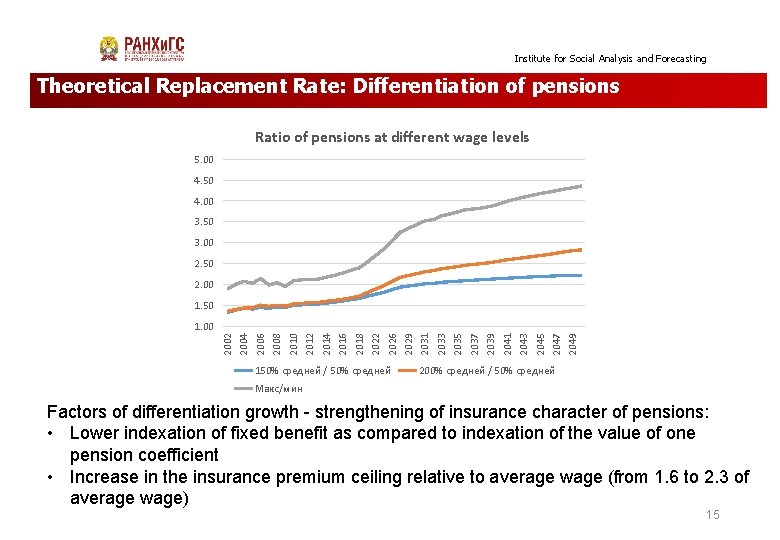
Institute for Social Analysis and Forecasting Theoretical Replacement Rate: Differentiation of pensions Ratio of pensions at different wage levels 5. 00 4. 50 4. 00 3. 50 3. 00 2. 50 2. 00 1. 50 2002 2004 2006 2008 2010 2012 2014 2016 2018 2022 2026 2029 2031 2033 2035 2037 2039 2041 2043 2045 2047 2049 1. 00 150% средней / 50% средней 200% средней / 50% средней Макс/мин Factors of differentiation growth - strengthening of insurance character of pensions: • Lower indexation of fixed benefit as compared to indexation of the value of one pension coefficient • Increase in the insurance premium ceiling relative to average wage (from 1. 6 to 2. 3 of average wage) 15
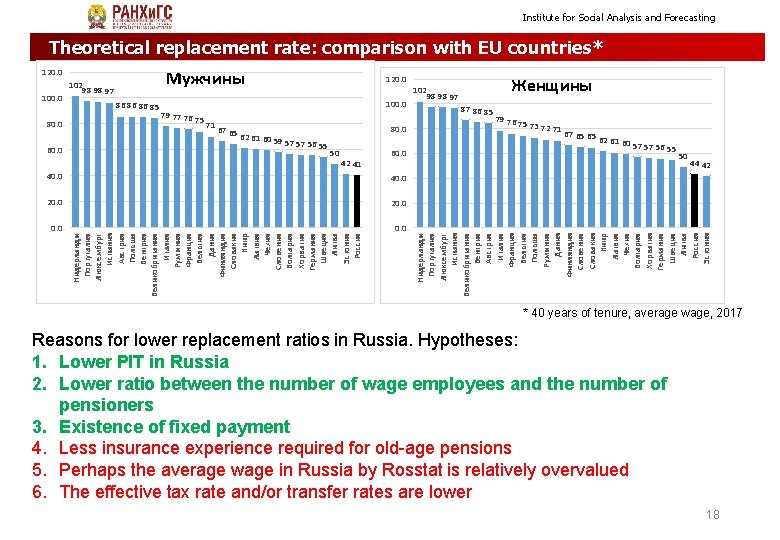
Institute for Social Analysis and Forecasting Theoretical replacement rate: comparison with EU countries* 100. 0 80. 0 60. 0 Мужчины 102 98 98 97 86 86 86 85 79 77 76 120. 0 100. 0 75 71 67 65 62 61 60 59 80. 0 57 57 56 55 50 42 41 60. 0 40. 0 20. 0 Нидерланды Португалия Люксембург Испания Австрия Польша Венгрия Великобритания Италия Румыния Франция Бельгия Дания Финляндия Словакия Кипр Латвия Чехия Словения Болгария Хорватия Германия Швеция Литва Эстония Россия 40. 0 Женщины 102 98 98 97 87 86 85 79 76 75 73 72 71 67 65 65 62 61 60 57 57 56 55 50 44 42 Нидерланды Португалия Люксембург Испания Великобритания Венгрия Австрия Италия Франция Бельгия Польша Румыния Дания Финляндия Словения Словакия Кипр Латвия Чехия Болгария Хорватия Германия Швеция Литва Россия Эстония 120. 0 * 40 years of tenure, average wage, 2017 Reasons for lower replacement ratios in Russia. Hypotheses: 1. Lower PIT in Russia 2. Lower ratio between the number of wage employees and the number of pensioners 3. Existence of fixed payment 4. Less insurance experience required for old-age pensions 5. Perhaps the average wage in Russia by Rosstat is relatively overvalued 6. The effective tax rate and/or transfer rates are lower 18
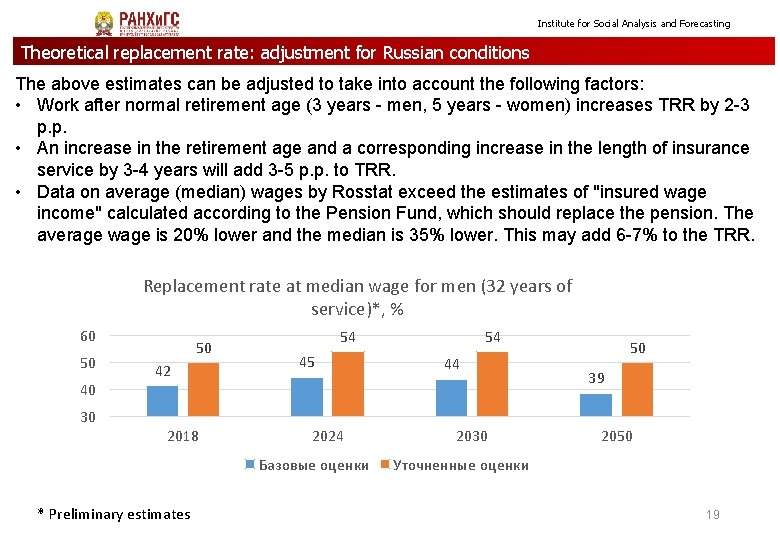
Institute for Social Analysis and Forecasting Theoretical replacement rate: adjustment for Russian conditions The above estimates can be adjusted to take into account the following factors: • Work after normal retirement age (3 years - men, 5 years - women) increases TRR by 2 -3 p. p. • An increase in the retirement age and a corresponding increase in the length of insurance service by 3 -4 years will add 3 -5 p. p. to TRR. • Data on average (median) wages by Rosstat exceed the estimates of "insured wage income" calculated according to the Pension Fund, which should replace the pension. The average wage is 20% lower and the median is 35% lower. This may add 6 -7% to the TRR. Replacement rate at median wage for men (32 years of service)*, % 60 50 42 54 45 54 44 50 39 30 2018 2024 Базовые оценки * Preliminary estimates 2030 2050 Уточненные оценки 19
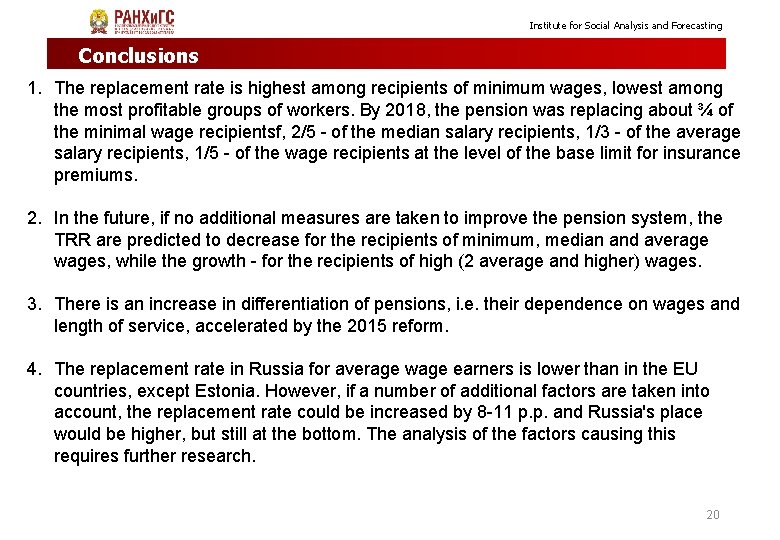
Institute for Social Analysis and Forecasting Conclusions 1. The replacement rate is highest among recipients of minimum wages, lowest among the most profitable groups of workers. By 2018, the pension was replacing about ¾ of the minimal wage recipientsf, 2/5 - of the median salary recipients, 1/3 - of the average salary recipients, 1/5 - of the wage recipients at the level of the base limit for insurance premiums. 2. In the future, if no additional measures are taken to improve the pension system, the TRR are predicted to decrease for the recipients of minimum, median and average wages, while the growth - for the recipients of high (2 average and higher) wages. 3. There is an increase in differentiation of pensions, i. e. their dependence on wages and length of service, accelerated by the 2015 reform. 4. The replacement rate in Russia for average wage earners is lower than in the EU countries, except Estonia. However, if a number of additional factors are taken into account, the replacement rate could be increased by 8 -11 p. p. and Russia's place would be higher, but still at the bottom. The analysis of the factors causing this requires further research. 20
Thank you for your attention! Institute for Social Analysis and Forecasting 21