
Institute for Internal Combustion Engines and Thermodynamics Analysis
Institute for Internal Combustion Engines and Thermodynamics Analysis of options for a transfer function for emission correction between moderate and extended driving conditions Overview on the status of work at TU Graz (based on work plan proposed at 15. 08. 2015) 14. 09. 2015 S. Hausberger, S. Lipp Stefan Hausberger RDE test procedure 1
Institute for Internal Combustion Engines and Thermodynamics Background: effects not covered by the actual normalisation tools Already presented in an audioweb meeting on 19. August 2015. Updates marked in red NOx emissions from diesel cars depend beside engine power also on following parameters which are not considered in the actual normalisation tools: - Driving dynamics: high power gradients limit proper controlling of EGR, of NH 3 fill levels of the SCR and of NSC regeneration. - High power and rpm levels: occurring at high altitude differences (m/100 km), high loading, high speeds, high driving dynamics Effect: high power limit EGR rates, high rpm increases space velocity in catalysts (conversion efficiency is typically reduced at higher space velocities, low temperatures and low NH 3 fill level in case of SCR) The “ideal” normalisation tool would also consider these effects to allow CF limit values for RDE testing in combination with cost efficient technology selection (no need to adjust hardware to worst case test condition combination which hardly occurs in real world driving). Stefan Hausberger RDE test procedure 2
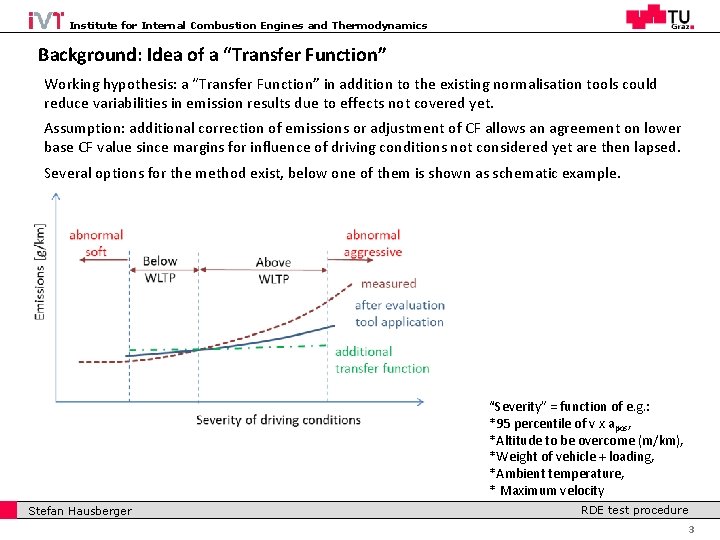
Institute for Internal Combustion Engines and Thermodynamics Background: Idea of a “Transfer Function” Working hypothesis: a “Transfer Function” in addition to the existing normalisation tools could reduce variabilities in emission results due to effects not covered yet. Assumption: additional correction of emissions or adjustment of CF allows an agreement on lower base CF value since margins for influence of driving conditions not considered yet are then lapsed. Several options for the method exist, below one of them is shown as schematic example. “Severity” = function of e. g. : *95 percentile of v x apos, *Altitude to be overcome (m/km), *Weight of vehicle + loading, *Ambient temperature, * Maximum velocity Stefan Hausberger RDE test procedure 3
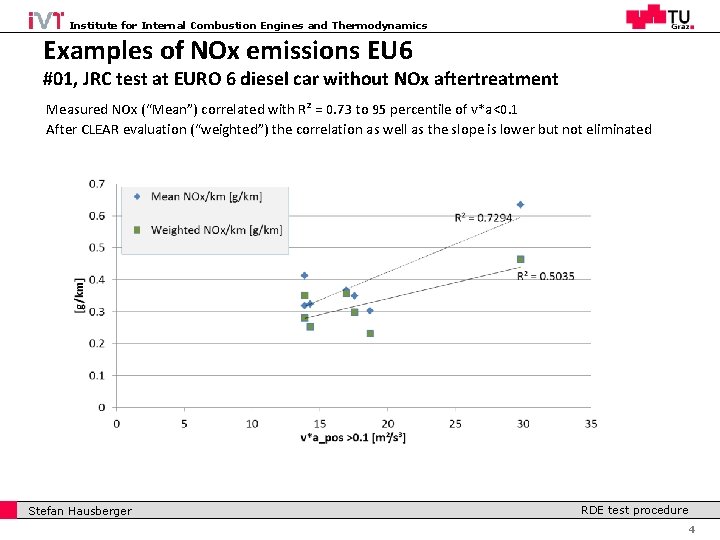
Institute for Internal Combustion Engines and Thermodynamics Examples of NOx emissions EU 6 #01, JRC test at EURO 6 diesel car without NOx aftertreatment Measured NOx (“Mean”) correlated with R² = 0. 73 to 95 percentile of v*a<0. 1 After CLEAR evaluation (“weighted”) the correlation as well as the slope is lower but not eliminated Stefan Hausberger RDE test procedure 4
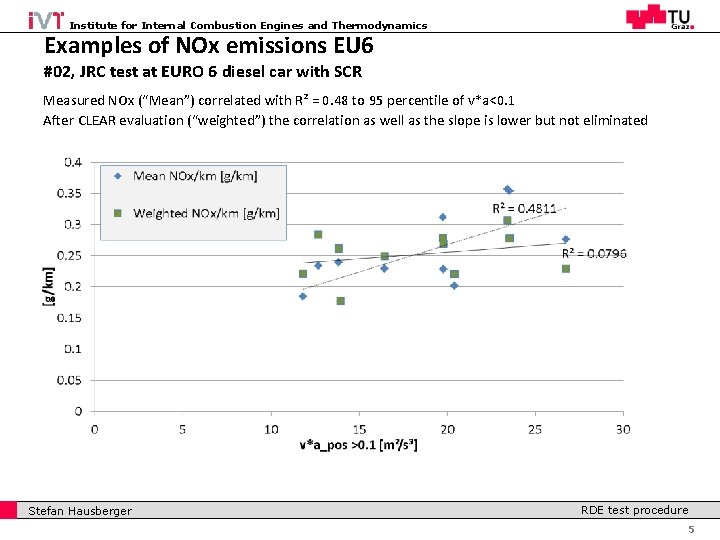
Institute for Internal Combustion Engines and Thermodynamics Examples of NOx emissions EU 6 #02, JRC test at EURO 6 diesel car with SCR Measured NOx (“Mean”) correlated with R² = 0. 48 to 95 percentile of v*a<0. 1 After CLEAR evaluation (“weighted”) the correlation as well as the slope is lower but not eliminated Stefan Hausberger RDE test procedure 5
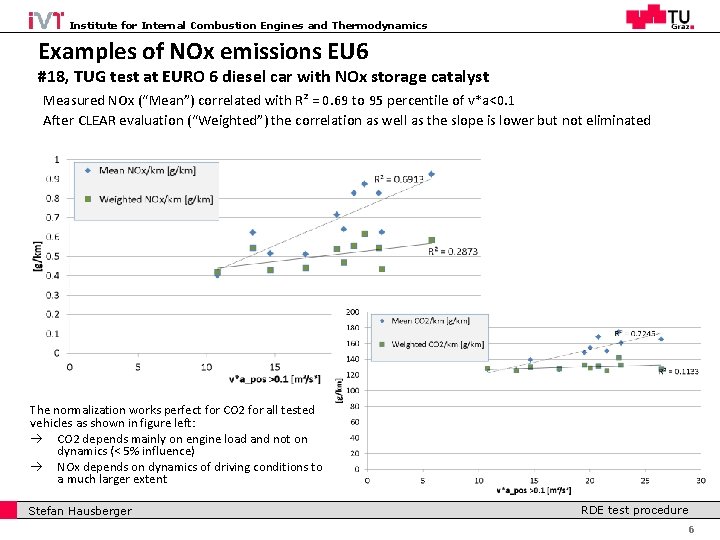
Institute for Internal Combustion Engines and Thermodynamics Examples of NOx emissions EU 6 #18, TUG test at EURO 6 diesel car with NOx storage catalyst Measured NOx (“Mean”) correlated with R² = 0. 69 to 95 percentile of v*a<0. 1 After CLEAR evaluation (“Weighted”) the correlation as well as the slope is lower but not eliminated The normalization works perfect for CO 2 for all tested vehicles as shown in figure left: CO 2 depends mainly on engine load and not on dynamics (< 5% influence) NOx depends on dynamics of driving conditions to a much larger extent Stefan Hausberger RDE test procedure 6
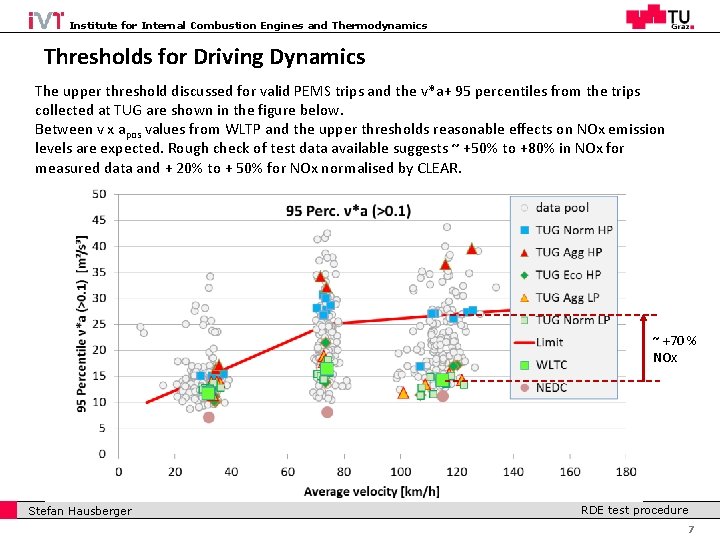
Institute for Internal Combustion Engines and Thermodynamics Thresholds for Driving Dynamics The upper threshold discussed for valid PEMS trips and the v*a+ 95 percentiles from the trips collected at TUG are shown in the figure below. Between v x apos values from WLTP and the upper thresholds reasonable effects on NOx emission levels are expected. Rough check of test data available suggests ~ +50% to +80% in NOx for measured data and + 20% to + 50% for NOx normalised by CLEAR. ~ +70 % NOx Stefan Hausberger RDE test procedure 7
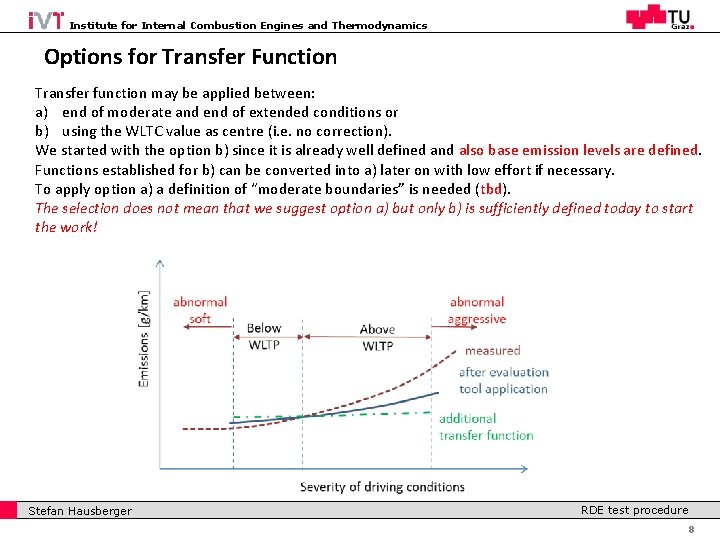
Institute for Internal Combustion Engines and Thermodynamics Options for Transfer Function Transfer function may be applied between: a) end of moderate and end of extended conditions or b) using the WLTC value as centre (i. e. no correction). We started with the option b) since it is already well defined and also base emission levels are defined. Functions established for b) can be converted into a) later on with low effort if necessary. To apply option a) a definition of “moderate boundaries” is needed (tbd). The selection does not mean that we suggest option a) but only b) is sufficiently defined today to start the work! Stefan Hausberger RDE test procedure 8
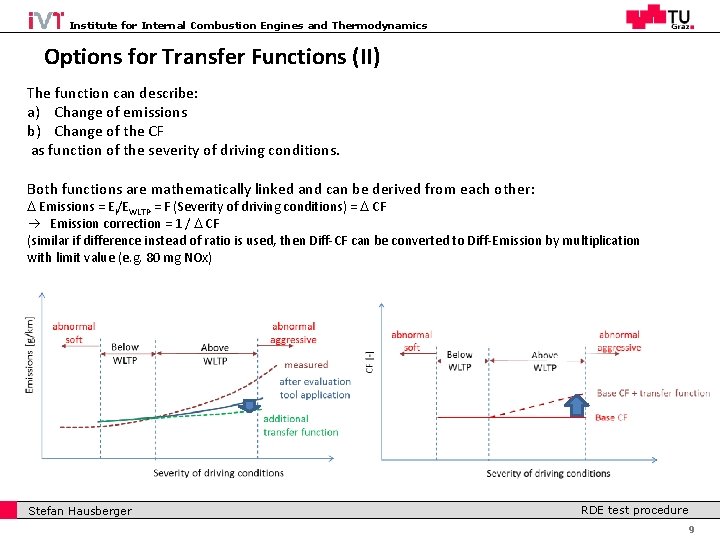
Institute for Internal Combustion Engines and Thermodynamics Options for Transfer Functions (II) The function can describe: a) Change of emissions b) Change of the CF as function of the severity of driving conditions. Both functions are mathematically linked and can be derived from each other : D Emissions = Ei/EWLTP = F (Severity of driving conditions) = D CF Emission correction = 1 / D CF (similar if difference instead of ratio is used, then Diff-CF can be converted to Diff-Emission by multiplication with limit value (e. g. 80 mg NOx) Stefan Hausberger RDE test procedure 9
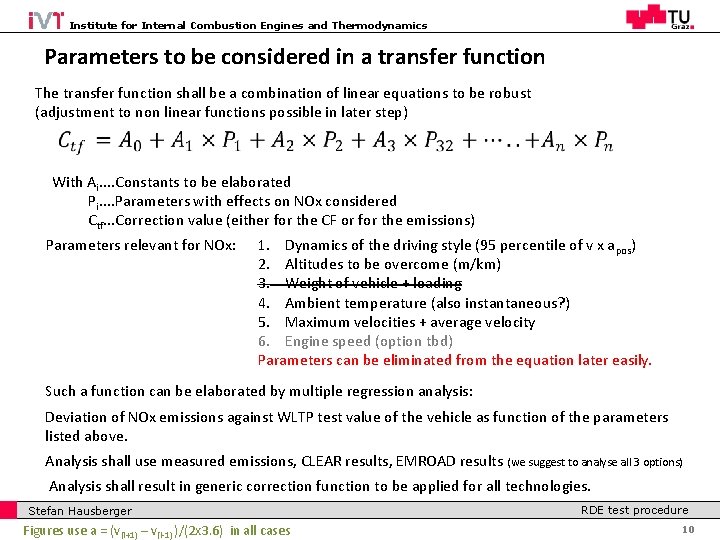
Institute for Internal Combustion Engines and Thermodynamics Parameters to be considered in a transfer function The transfer function shall be a combination of linear equations to be robust (adjustment to non linear functions possible in later step) With Ai. . Constants to be elaborated Pi. . Parameters with effects on NOx considered Ctf. . . Correction value (either for the CF or for the emissions) Parameters relevant for NOx: 1. Dynamics of the driving style (95 percentile of v x apos) 2. Altitudes to be overcome (m/km) 3. Weight of vehicle + loading 4. Ambient temperature (also instantaneous? ) 5. Maximum velocities + average velocity 6. Engine speed (option tbd) Parameters can be eliminated from the equation later easily. Such a function can be elaborated by multiple regression analysis: Deviation of NOx emissions against WLTP test value of the vehicle as function of the parameters listed above. Analysis shall use measured emissions, CLEAR results, EMROAD results (we suggest to analyse all 3 options) Analysis shall result in generic correction function to be applied for all technologies. Stefan Hausberger Figures use a = (v(i+1) – v(i-1) )/(2 x 3. 6) in all cases RDE test procedure 10
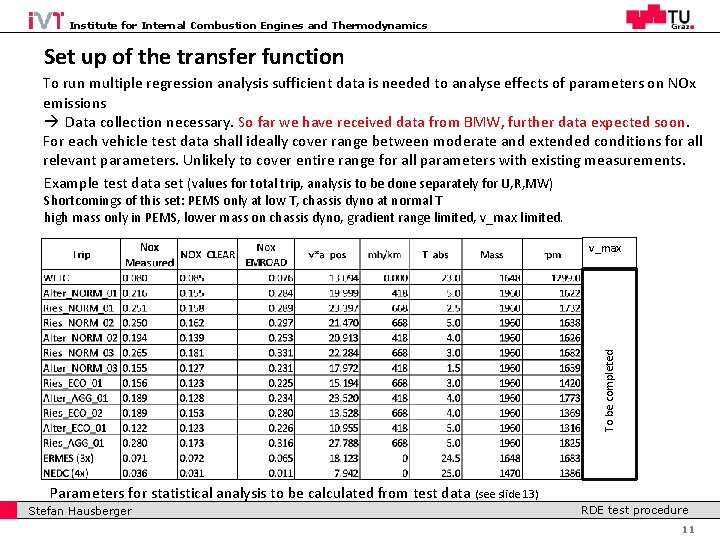
Institute for Internal Combustion Engines and Thermodynamics Set up of the transfer function To run multiple regression analysis sufficient data is needed to analyse effects of parameters on NOx emissions Data collection necessary. So far we have received data from BMW, further data expected soon. For each vehicle test data shall ideally cover range between moderate and extended conditions for all relevant parameters. Unlikely to cover entire range for all parameters with existing measurements. Example test data set (values for total trip, analysis to be done separately for U, R, MW) Shortcomings of this set: PEMS only at low T, chassis dyno at normal T high mass only in PEMS, lower mass on chassis dyno, gradient range limited, v_max limited. To be completed v_max Parameters for statistical analysis to be calculated from test data (see slide 13) Stefan Hausberger RDE test procedure 11
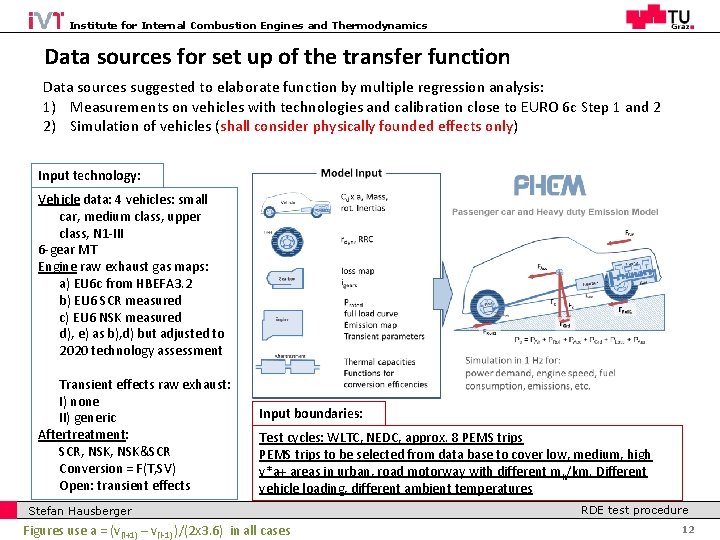
Institute for Internal Combustion Engines and Thermodynamics Data sources for set up of the transfer function Data sources suggested to elaborate function by multiple regression analysis: 1) Measurements on vehicles with technologies and calibration close to EURO 6 c Step 1 and 2 2) Simulation of vehicles (shall consider physically founded effects only) Input technology: Vehicle data: 4 vehicles: small car, medium class, upper class, N 1 -III 6 -gear MT Engine raw exhaust gas maps: a) EU 6 c from HBEFA 3. 2 b) EU 6 SCR measured c) EU 6 NSK measured d), e) as b), d) but adjusted to 2020 technology assessment Transient effects raw exhaust: I) none II) generic Aftertreatment: SCR, NSK&SCR Conversion = F(T, SV) Open: transient effects Input boundaries: Test cycles: WLTC, NEDC, approx. 8 PEMS trips to be selected from data base to cover low, medium, high v*a+ areas in urban, road motorway with different mh/km. Different vehicle loading, different ambient temperatures Stefan Hausberger Figures use a = (v(i+1) – v(i-1) )/(2 x 3. 6) in all cases RDE test procedure 12
Institute for Internal Combustion Engines and Thermodynamics Actual status (11. 09. 2015) Simulation: 3 cars established in models so far (2 EURO 6 cars measured at TU Graz, 1 “RDE-ready” car from BMW). • Vehicle data from these 3 cars and for 4 generic vehicles (small car up to LCV N 1 -III) • Raw exhaust emission maps • SCR temperature model calibrated • SCR conversion model calibrated Validation ongoing Generic vehicle: Analysis of options to simulate transient effects charge air pressure and on EGR ongoing Analysis of options to simulate change in NOx as function of change in EGR rate ongoing (Zeldovich equations, function from test data, literature) Analysis of measured data for direct transfer function by regression analysis: Data collection ongoing Analysis for one EURO 6 vehicle from TU Graz measurements used to test and improve the approach (3 routes, 2 loadings, 4 drivers, summer and winter tests). Stefan Hausberger Figures use a = (v(i+1) – v(i-1) )/(2 x 3. 6) in all cases RDE test procedure 13
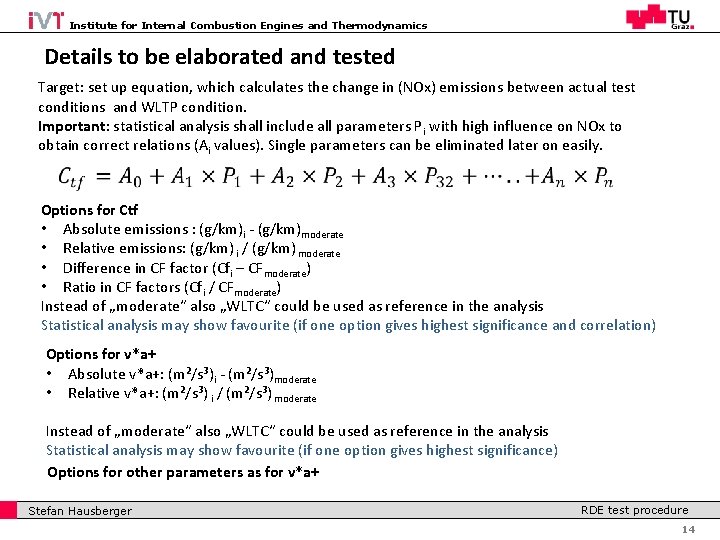
Institute for Internal Combustion Engines and Thermodynamics Details to be elaborated and tested Target: set up equation, which calculates the change in (NOx) emissions between actual test conditions and WLTP condition. Important: statistical analysis shall include all parameters Pi with high influence on NOx to obtain correct relations (Ai values). Single parameters can be eliminated later on easily. Options for Ctf • Absolute emissions : (g/km)i - (g/km)moderate • Relative emissions: (g/km) i / (g/km) moderate • Difference in CF factor (Cfi – CFmoderate) • Ratio in CF factors (Cfi / CFmoderate) Instead of „moderate“ also „WLTC“ could be used as reference in the analysis Statistical analysis may show favourite (if one option gives highest significance and correlation) Options for v*a+ • Absolute v*a+: (m²/s³)i - (m²/s³)moderate • Relative v*a+: (m²/s³) i / (m²/s³) moderate Instead of „moderate“ also „WLTC“ could be used as reference in the analysis Statistical analysis may show favourite (if one option gives highest significance) Options for other parameters as for v*a+ Stefan Hausberger RDE test procedure 14
Institute for Internal Combustion Engines and Thermodynamics Details to be elaborated and tested Options for Ctf Basis for calculation of delta or diff emissions can be a) Measured emissions (if successful may replace existing normalisation tools) b) Results from CLEAR c) Result from EMROAD If functions gained from b) and c) are different, each tool would have specific set of constants for the transfer function. Stefan Hausberger RDE test procedure 15
Institute for Internal Combustion Engines and Thermodynamics Details to be elaborated and tested Time resolution of the transfer function: Minimum = separation into urban, road, motorway averages. Corrected total trip can be calculated easily from the three corrected parts. Reason: v*a+ limits and thus severity of driving at given v*a+ depend on road category. This option is suggested as base case. Alternatives: Correction of MAWs: seems to be also possible but would need different limits for v*a+ Reason: MAW typically are shorter than the 90 minute trips composed by Heinz Steven from the WLTP db for elaboration of the 95 percentile limits. shorter trips have more variability in v*a+ than longer trips and thus most likely would result in higher 95 percentiles for the v*a+ 95 percentiles. different reference value for v*a+ severity. Correction of 1 Hz data: seems to be possible if “Diff-Emission” is used but would give identical result as base case (linear equations). If “D Emission” are used 1 Hz application is meaningless since cause and impact on emission changes are not necessarily closely linked in time (e. g. NSC regeneration events, NH 3 storage capacity of SCR, Oxygen storage of 3 -way catalyst). Stefan Hausberger RDE test procedure 16
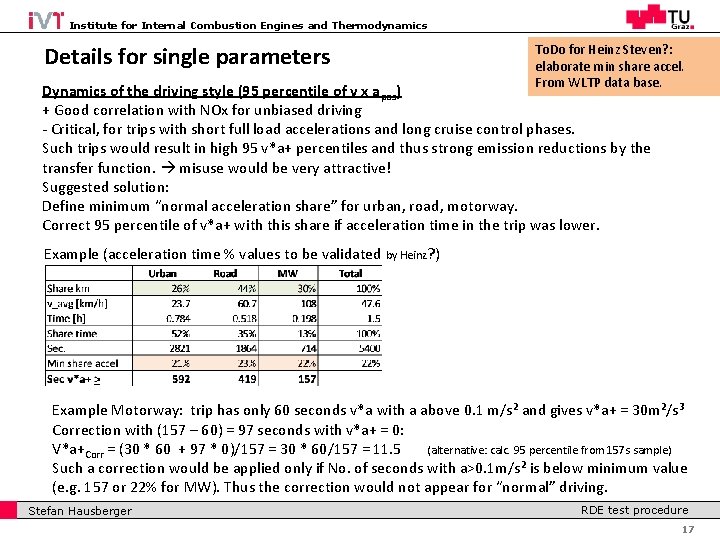
Institute for Internal Combustion Engines and Thermodynamics Details for single parameters To. Do for Heinz Steven? : elaborate min share accel. From WLTP data base. Dynamics of the driving style (95 percentile of v x apos) + Good correlation with NOx for unbiased driving - Critical, for trips with short full load accelerations and long cruise control phases. Such trips would result in high 95 v*a+ percentiles and thus strong emission reductions by the transfer function. misuse would be very attractive! Suggested solution: Define minimum “normal acceleration share” for urban, road, motorway. Correct 95 percentile of v*a+ with this share if acceleration time in the trip was lower. Example (acceleration time % values to be validated by Heinz? ) Example Motorway: trip has only 60 seconds v*a with a above 0. 1 m/s² and gives v*a+ = 30 m²/s³ Correction with (157 – 60) = 97 seconds with v*a+ = 0: V*a+Corr = (30 * 60 + 97 * 0)/157 = 30 * 60/157 = 11. 5 (alternative: calc. 95 percentile from 157 s sample) Such a correction would be applied only if No. of seconds with a>0. 1 m/s² is below minimum value (e. g. 157 or 22% for MW). Thus the correction would not appear for “normal” driving. Stefan Hausberger RDE test procedure 17
Institute for Internal Combustion Engines and Thermodynamics Test cycles for simulation work WLTP PEMS trips with: 3 different altitude gains (m/100 km) With each 1 trip with low v*a+ 1 trip s with average v*a+ 1 trips with high v*a+ Additional some with v_max up to >145 km/h Simulated with different loading and (optional gear shift behaviour) To cover entire range of parameters of the transfer function. Already available cycles at TUG cover already large area. Missing @ 15. 08. 2015: • V_max above 130 km/h ( status 14. 09. 2015: use Garmisch Data from Heinz) • altitude gains >(1000 m/100 km) status 14. 09. 2015: test route with 1050 m/100 km driven with PEMS around Graz Still to be analysed if these trips are useful. Stefan Hausberger RDE test procedure 18
Institute for Internal Combustion Engines and Thermodynamics Suggested rough timeline vs. status Topic Who until Collection of measured Emission data (PEMS and WLTP) > 3 vehicles “Step 2 like” > 3 vehicles “Step 1 like” Status: only data for one vehicle received yet ACEA 30. 8. 2015 Analysis of these data to TUG • validate feasibility of transfer function • elaborate best design of transfer function (relevant parameters, diff or delta, etc. by checking significances and correlation coefficients) Status: Delayed due to missing data 20. 9. 2015 Set up PHEM models as shown before Status: Ongoing TUG 30. 9. 2015 Analyse simulation results and elaborate preliminary transfer function. Status: open TUG 30. 10. 2015 Further improvements, discussions etc. All ? Stefan Hausberger RDE test procedure 19
- Slides: 19