
Institute for Basic Science and Rare Isotope Science
Institute for Basic Science and Rare Isotope Science Project Sun Kee Kim
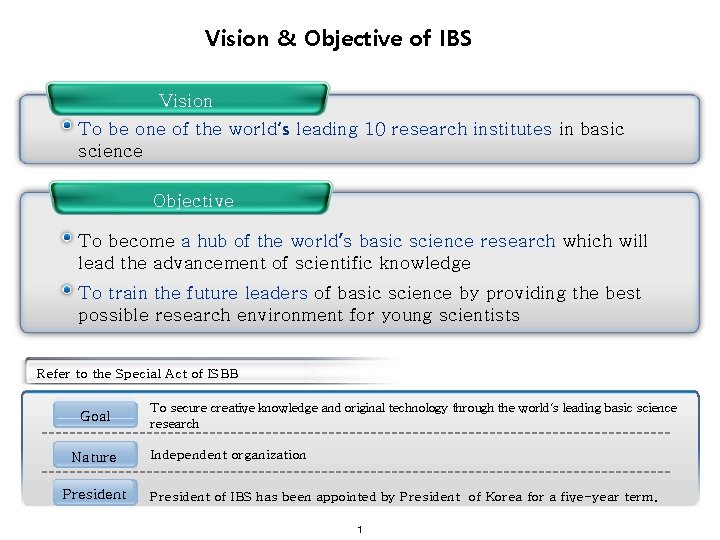
Vision & Objective of IBS Vision To be one of the world’s leading 10 research institutes in basic science Objective To become a hub of the world’s basic science research which will lead the advancement of scientific knowledge To train the future leaders of basic science by providing the best possible research environment for young scientists Refer to the Special Act of ISBB Goal Nature President To secure creative knowledge and original technology through the world’s leading basic science research Independent organization President of IBS has been appointed by President of Korea for a five-year term. 1
2. Key Functions Conducting the world’s top-class research in fields of basic science and pure basic science Training the future leaders of basic science Building a global network of basic science Research Themes Early Stage Initially Directors are selected without any limit on research themes ⇒ Timetable for the implementation of research fields agreed on the appointment of Directors Established Stage Research themes are taken into account in the selection of Directors. 2
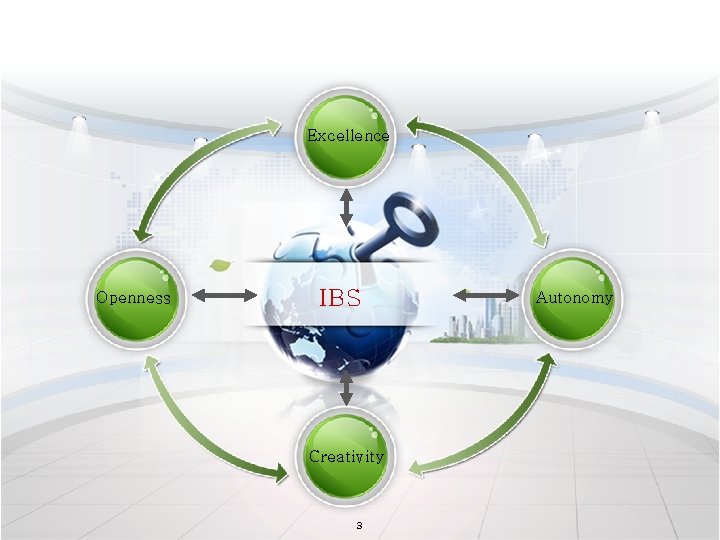
3. Fundamental Principles Excellence Openness IBS Creativity 3 Autonomy
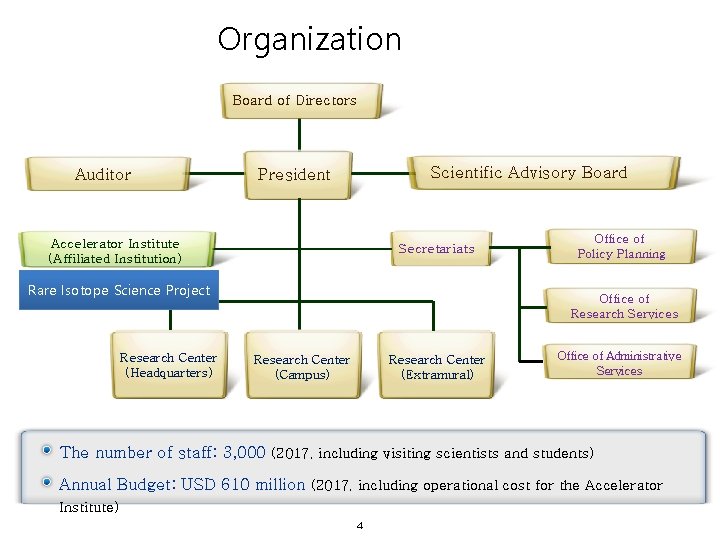
4. Organizational. Organization Structure Board of Directors Auditor Scientific Advisory Board President Accelerator Institute (Affiliated Institution) Secretariats Rare Isotope Science Project Research Center (Headquarters) Office of Policy Planning Office of Research Services Research Center (Campus) Research Center (Extramural) Office of Administrative Services The number of staff: 3, 000 (2017, including visiting scientists and students) Annual Budget: USD 610 million (2017, including operational cost for the Accelerator Institute) 4
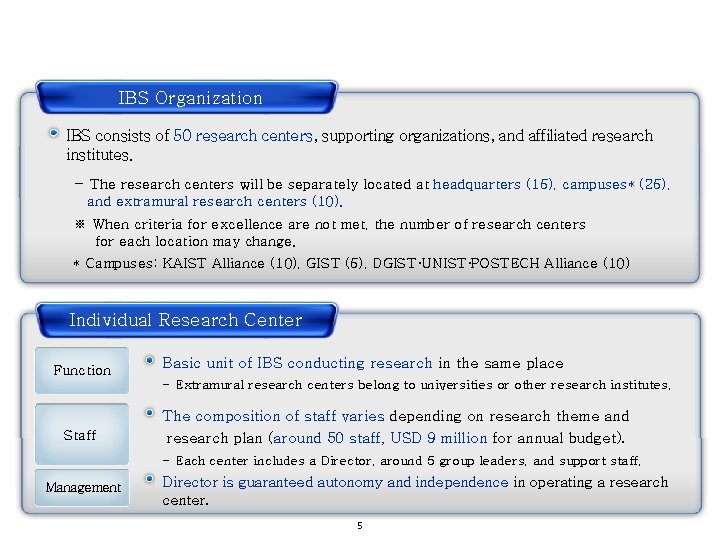
4. Organizational Structure IBS Organization IBS consists of 50 research centers, supporting organizations, and affiliated research institutes. - The research centers will be separately located at headquarters (15), campuses* (25), and extramural research centers (10). ※ When criteria for excellence are not met, the number of research centers for each location may change. * Campuses: KAIST Alliance (10), GIST (5), DGIST‧UNIST‧POSTECH Alliance (10) Individual Research Center Function Basic unit of IBS conducting research in the same place - Extramural research centers belong to universities or other research institutes. Staff The composition of staff varies depending on research theme and research plan (around 50 staff, USD 9 million for annual budget). - Each center includes a Director, around 5 group leaders, and support staff. Management Director is guaranteed autonomy and independence in operating a research center. 5
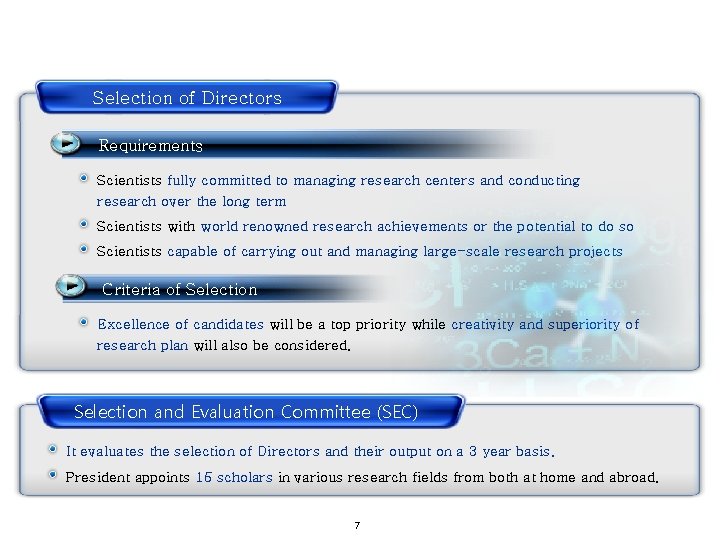
5. Selection & Management of Research Centers Selection of Directors Requirements Scientists fully committed to managing research centers and conducting research over the long term Scientists with world renowned research achievements or the potential to do so Scientists capable of carrying out and managing large-scale research projects Criteria of Selection Excellence of candidates will be a top priority while creativity and superiority of research plan will also be considered. Selection and Evaluation Committee (SEC) It evaluates the selection of Directors and their output on a 3 year basis. President appoints 15 scholars in various research fields from both at home and abroad. 7
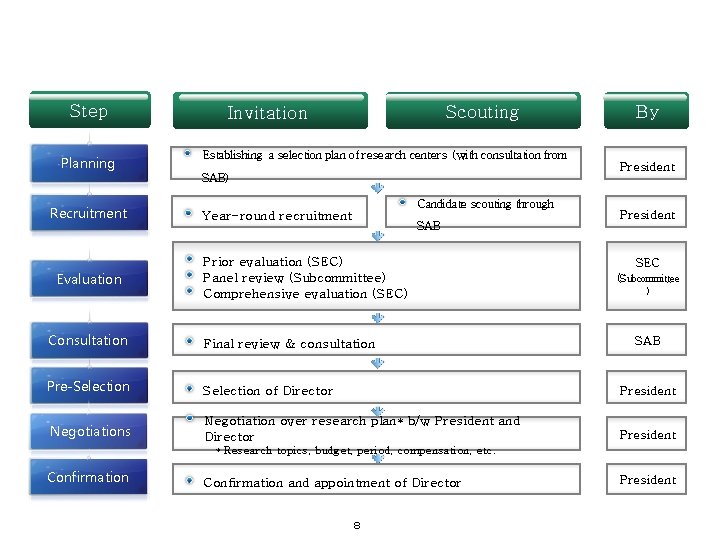
5. Selection & Management of Research Centers Step Planning Recruitment Evaluation 후보자 결정 자문 Scouting Invitation Establishing a selection plan of research centers (with consultation from SAB) Candidate scouting through Year-round recruitment SAB Prior evaluation (SEC) Panel review (Subcommittee) Comprehensive evaluation (SEC) By President SEC (Subcommittee ) Consultation Final review & consultation Pre-Selection of Director President Negotiations Negotiation over research plan* b/w President and Director President SAB * Research topics, budget, period, compensation, etc. Confirmation and appointment of Director 8 President
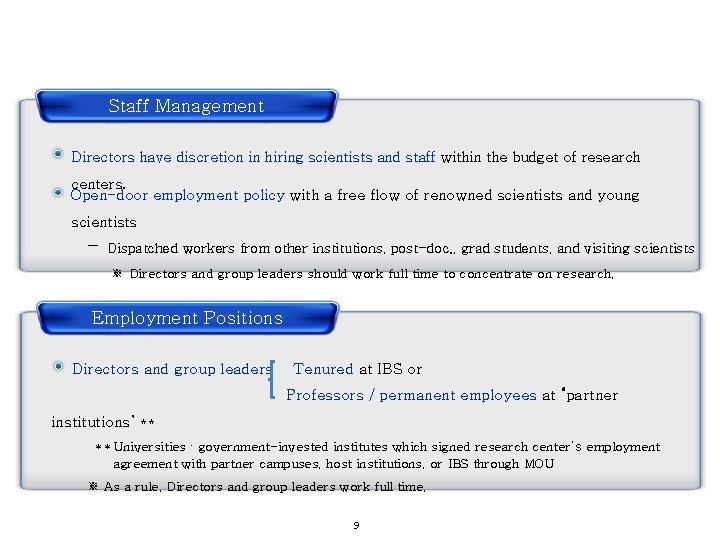
5. Selection & Management of Research Centers Staff Management Directors have discretion in hiring scientists and staff within the budget of research centers. Open-door employment policy with a free flow of renowned scientists and young scientists - Dispatched workers from other institutions, post-doc. , grad students, and visiting scientists ※ Directors and group leaders should work full time to concentrate on research. Employment Positions Directors and group leaders Tenured at IBS or Professors / permanent employees at ‘partner institutions’ ** * * Universities · government-invested institutes which signed research center’s employment agreement with partner campuses, host institutions, or IBS through MOU ※ As a rule, Directors and group leaders work full time. 9
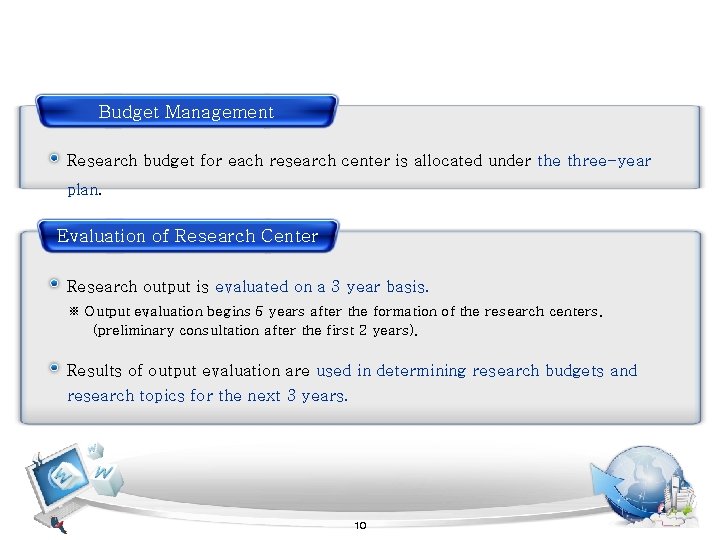
5. Selection & Management of Research Centers Budget Management Research budget for each research center is allocated under the three-year plan. Evaluation of Research Center Research output is evaluated on a 3 year basis. ※ Output evaluation begins 5 years after the formation of the research centers. (preliminary consultation after the first 2 years). Results of output evaluation are used in determining research budgets and research topics for the next 3 years. 10
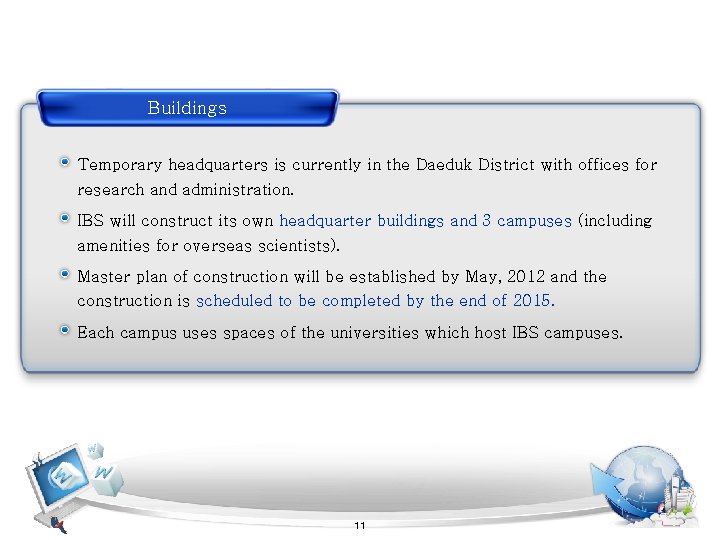
6. Buildings Temporary headquarters is currently in the Daeduk District with offices for research and administration. IBS will construct its own headquarter buildings and 3 campuses (including amenities for overseas scientists). Master plan of construction will be established by May, 2012 and the construction is scheduled to be completed by the end of 2015. Each campus uses spaces of the universities which host IBS campuses. 11
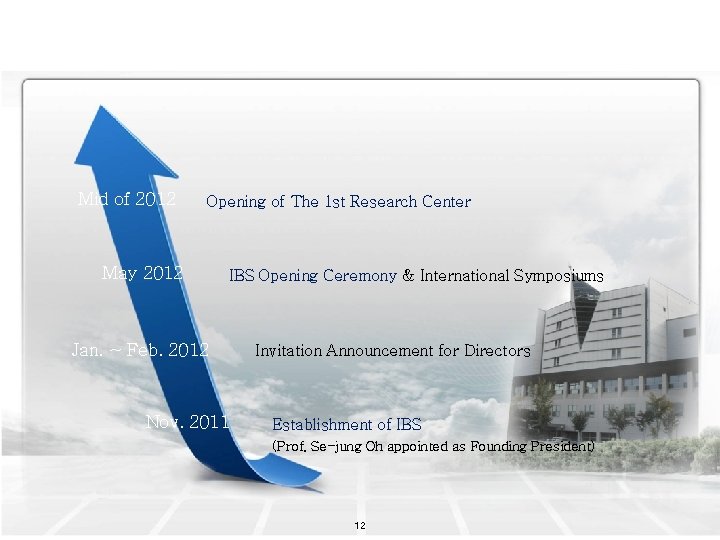
7. Main Schedules Mid of 2012 Opening of The 1 st Research Center May 2012 IBS Opening Ceremony & International Symposiums Jan. ~ Feb. 2012 Nov. 2011 Invitation Announcement for Directors Establishment of IBS (Prof. Se-jung Oh appointed as Founding President) 12
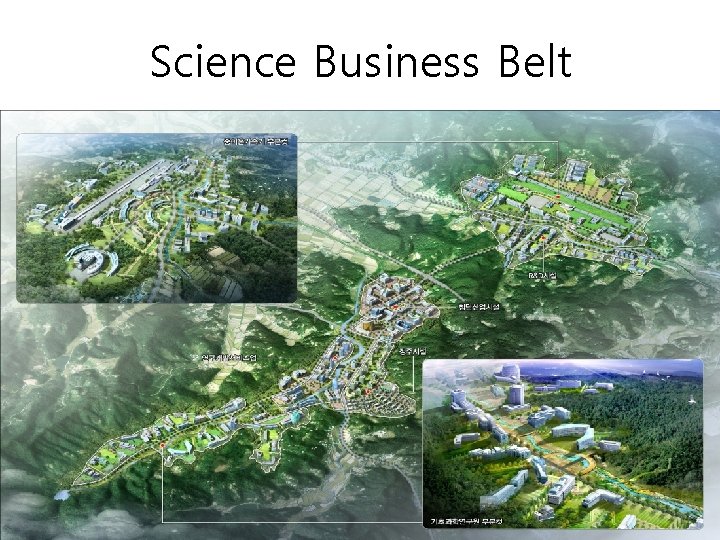
Science Business Belt
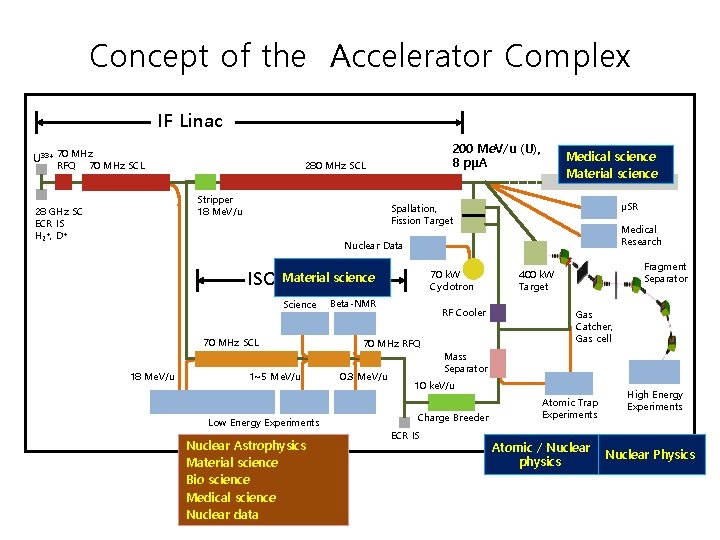
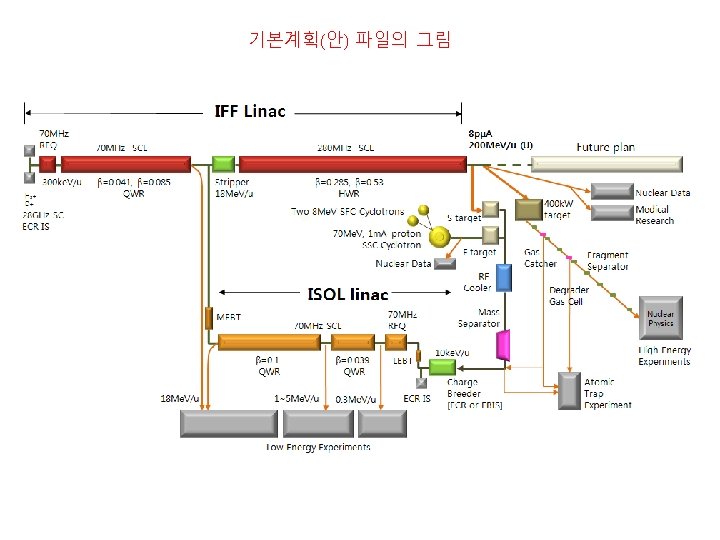
Concept of the Accelerator Complex IF Linac U 33+ 70 MHz RFQ 70 MHz SCL 280 MHz SCL Stripper 18 Me. V/u 28 GHz SC ECR IS H 2+, D+ 200 Me. V/u (U), 8 pμA Medical science Future Extension Material science μSR Spallation, Fission Target Medical Research Nuclear Data ISOLMaterial Linacscience Material Science 70 MHz SCL 18 Me. V/u 1~5 Me. V/u Low Energy Experiments Nuclear Astrophysics Material science Bio science Medical science Nuclear data 70 k. W Cyclotron Beta-NMR RF Cooler 70 MHz RFQ 0. 3 Me. V/u Fragment Separator 400 k. W Target Gas Catcher, Gas cell Mass Separator 10 ke. V/u Charge Breeder ECR IS Atomic Trap Experiments Atomic / Nuclear physics High Energy Experiments Nuclear Physics
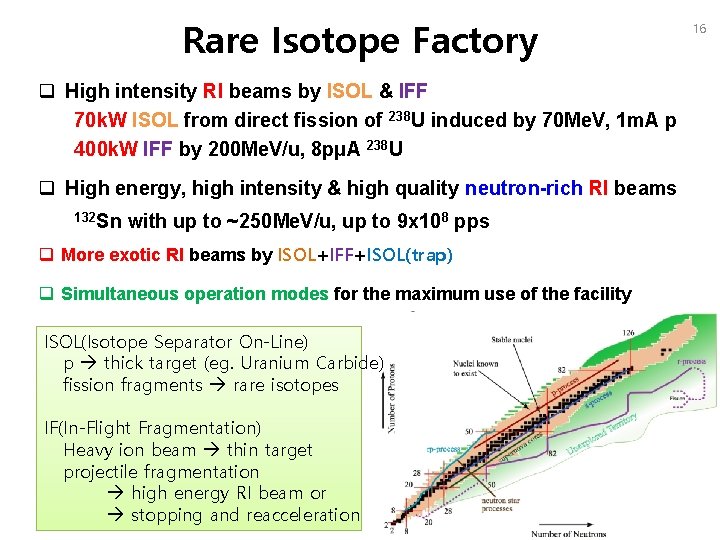
Rare Isotope Factory q High intensity RI beams by ISOL & IFF 70 k. W ISOL from direct fission of 238 U induced by 70 Me. V, 1 m. A p 400 k. W IFF by 200 Me. V/u, 8 pμA 238 U q High energy, high intensity & high quality neutron-rich RI beams 132 Sn with up to ~250 Me. V/u, up to 9 x 10⁸ pps q More exotic RI beams by ISOL+IFF+ISOL(trap) q Simultaneous operation modes for the maximum use of the facility ISOL(Isotope Separator On-Line) p thick target (eg. Uranium Carbide) fission fragments rare isotopes IF(In-Flight Fragmentation) Heavy ion beam thin target projectile fragmentation high energy RI beam or stopping and reacceleration 16
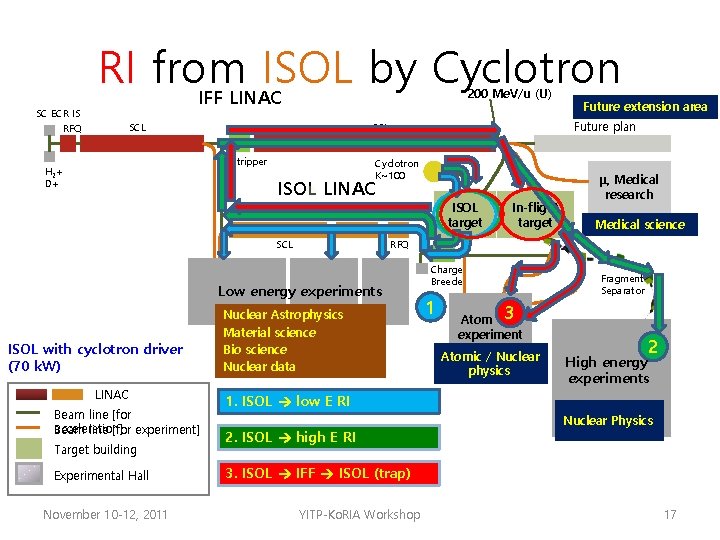
RI from ISOL by Cyclotron IFF LINAC 200 Me. V/u (U) SC ECR IS SCL RFQ Future plan SCL Stripper H 2+ D+ Cyclotron K~100 ISOL LINAC SCL ISOL target LINAC Beam line [for acceleration] Beam line [for experiment] Target building Experimental Hall November 10 -12, 2011 In-flight target μ, Medical research Medical science RFQ Low energy experiments ISOL with cyclotron driver (70 k. W) Future extension area Nuclear Astrophysics Material science Bio science Nuclear data Charge Breeder 1 3 Atom trap experiment Atomic / Nuclear physics Fragment Separator 2 High energy experiments 1. ISOL low E RI 2. ISOL high E RI Nuclear Physics 3. ISOL IFF ISOL (trap) YITP-Ko. RIA Workshop 17
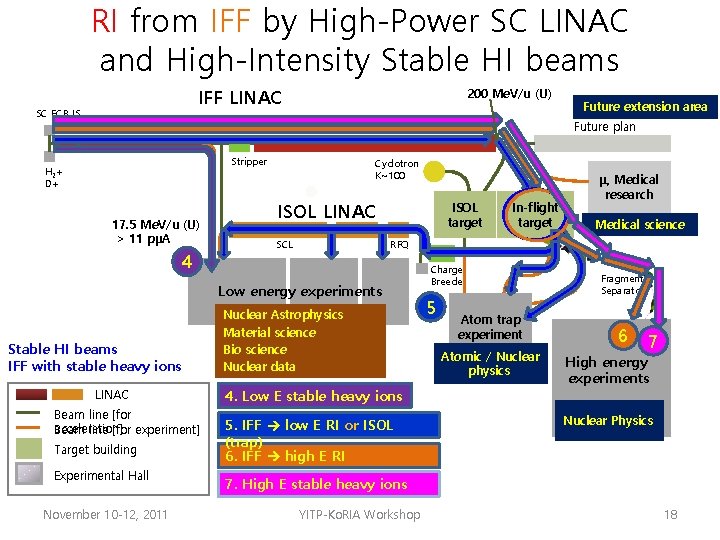
RI from IFF by High-Power SC LINAC and High-Intensity Stable HI beams IFF LINAC SC ECR IS 200 Me. V/u (U) SCL RFQ Future plan SCL Stripper H 2+ D+ 17. 5 Me. V/u (U) > 11 pμA 4 Cyclotron K~100 ISOL LINAC SCL ISOL target LINAC Beam line [for acceleration] Beam line [for experiment] Target building Experimental Hall November 10 -12, 2011 In-flight target μ, Medical research Medical science RFQ Low energy experiments Stable HI beams IFF with stable heavy ions Future extension area Nuclear Astrophysics Material science Bio science Nuclear data 4. Low E stable heavy ions 5. IFF low E RI or ISOL (trap) 6. IFF high E RI Charge Breeder 5 Atom trap experiment Atomic / Nuclear physics Fragment Separator 6 7 High energy experiments Nuclear Physics 7. High E stable heavy ions YITP-Ko. RIA Workshop 18
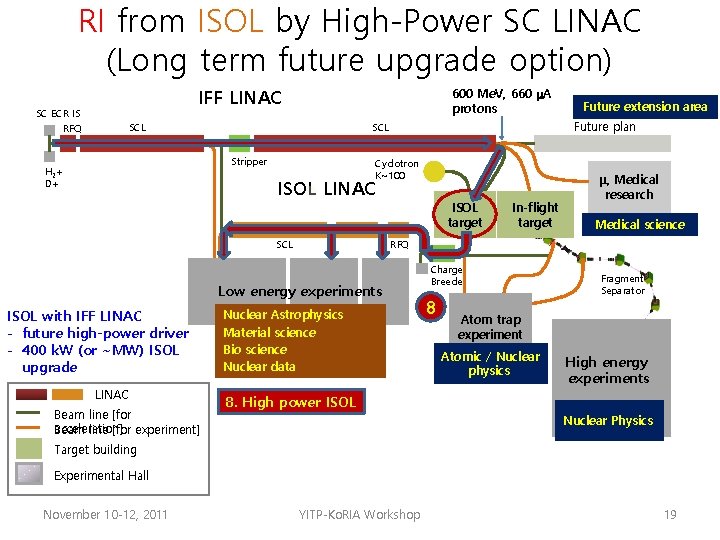
RI from ISOL by High-Power SC LINAC (Long term future upgrade option) IFF LINAC SC ECR IS 600 Me. V, 660 A protons SCL RFQ Future plan SCL Stripper H 2+ D+ Cyclotron K~100 ISOL LINAC SCL ISOL target LINAC Beam line [for acceleration] Beam line [for experiment] In-flight target μ, Medical research Medical science RFQ Low energy experiments ISOL with IFF LINAC - future high-power driver - 400 k. W (or ~MW) ISOL upgrade Future extension area Nuclear Astrophysics Material science Bio science Nuclear data Charge Breeder 8 Fragment Separator Atom trap experiment Atomic / Nuclear physics High energy experiments 8. High power ISOL Nuclear Physics Target building Experimental Hall November 10 -12, 2011 YITP-Ko. RIA Workshop 19
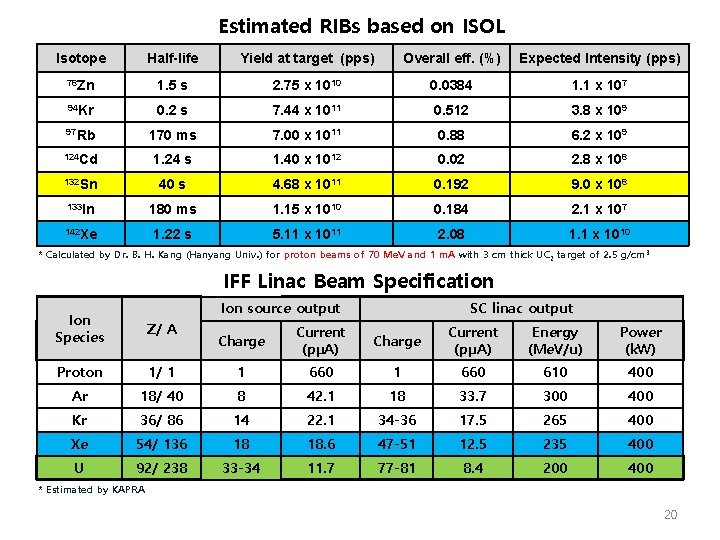
Estimated RIBs based on ISOL Isotope Half-life Yield at target (pps) Overall eff. (%) Expected Intensity (pps) 78 Zn 1. 5 s 2. 75 x 1010 0. 0384 1. 1 x 10⁷ 94 Kr 0. 2 s 7. 44 x 1011 0. 512 3. 8 x 10⁹ 97 Rb 170 ms 7. 00 x 1011 0. 88 6. 2 x 10⁹ 124 Cd 1. 24 s 1. 40 x 1012 0. 02 2. 8 x 10⁸ 132 Sn 40 s 4. 68 x 1011 0. 192 9. 0 x 108 133 In 180 ms 1. 15 x 1010 0. 184 2. 1 x 10⁷ 142 Xe 1. 22 s 5. 11 x 1011 2. 08 1. 1 x 10¹⁰ * Calculated by Dr. B. H. Kang (Hanyang Univ. ) for proton beams of 70 Me. V and 1 m. A with 3 cm thick UC 2 target of 2. 5 g/cm 3 IFF Linac Beam Specification Ion source output Ion Species Z/ A Proton SC linac output Charge Current (pµA) Energy (Me. V/u) Power (k. W) 1/ 1 1 660 610 400 Ar 18/ 40 8 42. 1 18 33. 7 300 400 Kr 36/ 86 14 22. 1 34 -36 17. 5 265 400 Xe 54/ 136 18 18. 6 47 -51 12. 5 235 400 U 92/ 238 33 -34 11. 7 77 -81 8. 4 200 400 * Estimated by KAPRA 20
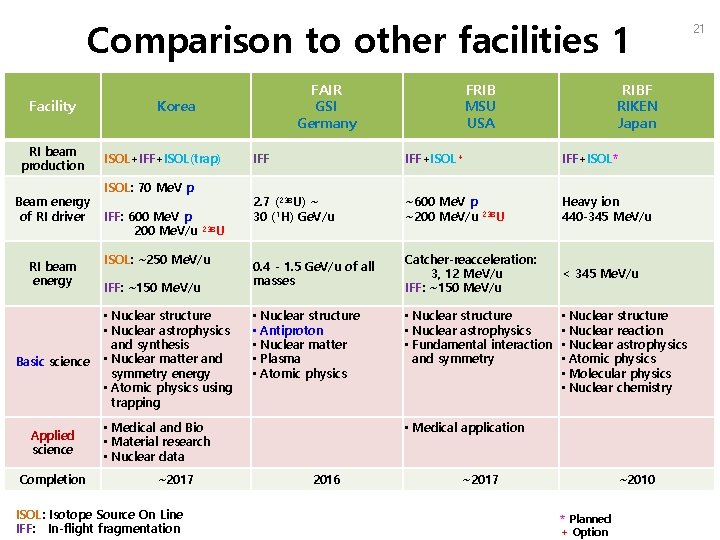
Comparison to other facilities 1 Facility RI beam production Beam energy of RI driver RI beam energy Basic science Applied science Completion FAIR GSI Germany Korea ISOL+IFF+ISOL(trap) ISOL: 70 Me. V p IFF: 600 Me. V p 200 Me. V/u 238 U ISOL: ~250 Me. V/u IFF: ~150 Me. V/u • Nuclear structure • Nuclear astrophysics and synthesis • Nuclear matter and symmetry energy • Atomic physics using trapping IFF+ISOL+ 2. 7 (238 U) ~ 30 (1 H) Ge. V/u ~600 Me. V p ~200 Me. V/u 0. 4 - 1. 5 Ge. V/u of all masses Catcher-reacceleration: 3, 12 Me. V/u IFF: ~150 Me. V/u • Nuclear structure • Antiproton • Nuclear matter • Plasma • Atomic physics • Medical and Bio • Material research • Nuclear data ~2017 ISOL: Isotope Source On Line IFF: In-flight fragmentation FRIB MSU USA RIBF RIKEN Japan IFF+ISOL* 238 U • Nuclear structure • Nuclear astrophysics • Fundamental interaction and symmetry Heavy ion 440 -345 Me. V/u < 345 Me. V/u • Nuclear structure • Nuclear reaction • Nuclear astrophysics • Atomic physics • Molecular physics • Nuclear chemistry • Medical application 2016 ~2017 ~2010 * Planned + Option 21
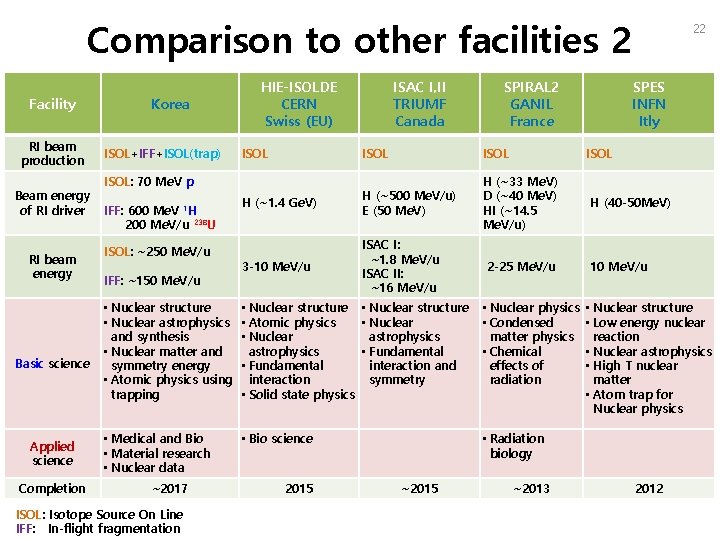
Comparison to other facilities 2 Facility RI beam production Beam energy of RI driver RI beam energy Basic science Applied science Completion Korea ISOL+IFF+ISOL(trap) HIE-ISOLDE CERN Swiss (EU) ISOL: ~250 Me. V/u IFF: ~150 Me. V/u SPIRAL 2 GANIL France ISOL H (~1. 4 Ge. V) H (~500 Me. V/u) E (50 Me. V) H (~33 Me. V) D (~40 Me. V) HI (~14. 5 Me. V/u) 3 -10 Me. V/u ISAC I: ~1. 8 Me. V/u ISAC II: ~16 Me. V/u ISOL: 70 Me. V p IFF: 600 Me. V 1 H 200 Me. V/u 238 U ISAC I, II TRIUMF Canada 2 -25 Me. V/u • Nuclear structure • Atomic physics • Nuclear astrophysics • Fundamental interaction and interaction symmetry • Solid state physics • Nuclear physics • Condensed matter physics • Chemical effects of radiation • Medical and Bio • Material research • Nuclear data • Bio science • Radiation biology ISOL: Isotope Source On Line IFF: In-flight fragmentation 2015 ~2015 SPES INFN Itly ISOL • Nuclear structure • Nuclear astrophysics and synthesis • Nuclear matter and symmetry energy • Atomic physics using trapping ~2017 22 ~2013 H (40 -50 Me. V) 10 Me. V/u • Nuclear structure • Low energy nuclear reaction • Nuclear astrophysics • High T nuclear matter • Atom trap for Nuclear physics 2012
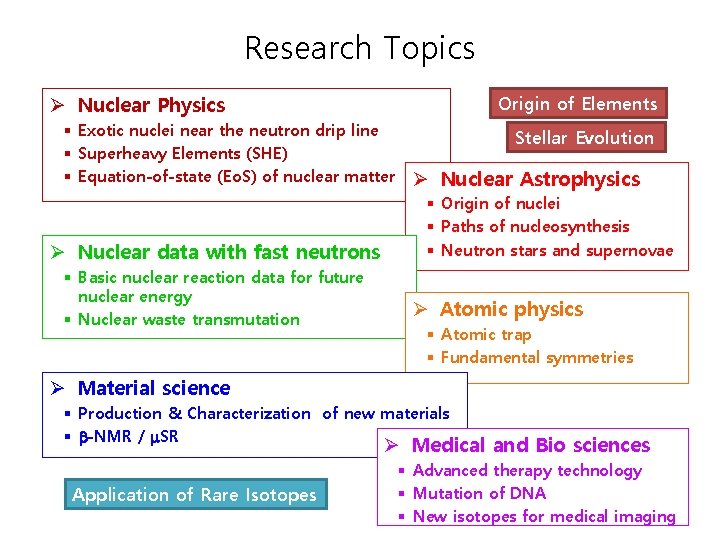
Research Topics Ø Nuclear Physics Origin of Elements § Exotic nuclei near the neutron drip line § Superheavy Elements (SHE) § Equation-of-state (Eo. S) of nuclear matter Ø Nuclear data with fast neutrons § Basic nuclear reaction data for future nuclear energy § Nuclear waste transmutation Stellar Evolution Ø Nuclear Astrophysics § Origin of nuclei § Paths of nucleosynthesis § Neutron stars and supernovae Ø Atomic physics § Atomic trap § Fundamental symmetries Ø Material science § Production & Characterization of new materials § -NMR / SR Ø Medical and Bio sciences Application of Rare Isotopes § Advanced therapy technology § Mutation of DNA 23 § New isotopes for medical imaging
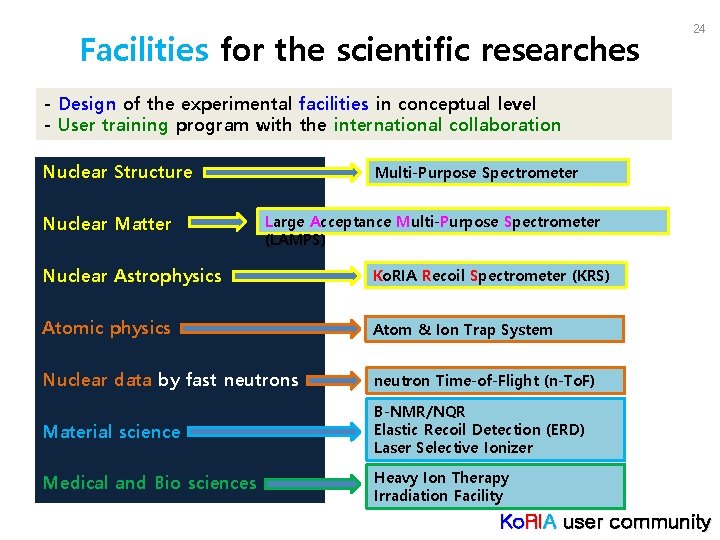
Facilities for the scientific researches 24 - Design of the experimental facilities in conceptual level - User training program with the international collaboration Nuclear Structure Nuclear Matter Multi-Purpose Spectrometer Large Acceptance Multi-Purpose Spectrometer (LAMPS) Nuclear Astrophysics Ko. RIA Recoil Spectrometer (KRS) Atomic physics Atom & Ion Trap System Nuclear data by fast neutrons neutron Time-of-Flight (n-To. F) Material science Β-NMR/NQR Elastic Recoil Detection (ERD) Laser Selective Ionizer Medical and Bio sciences Heavy Ion Therapy Irradiation Facility Ko. RIA user community
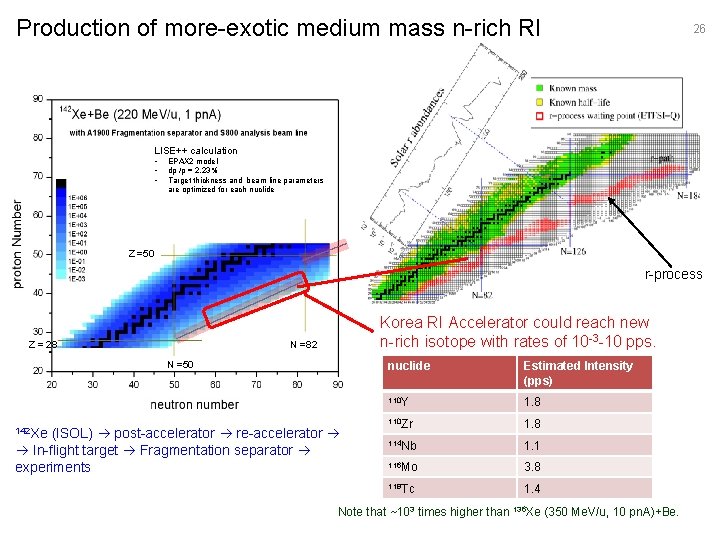
Production of more-exotic medium mass n-rich RI 26 LISE++ calculation • • • EPAX 2 model dp /p = 2. 23% Target thickness and beam line parameters are optimized for each nuclide Z =50 r-process Z = 28 Korea RI Accelerator could reach new n-rich isotope with rates of 10 -3 -10 pps. N =82 N =50 142 Xe (ISOL) post-accelerator re-accelerator In-flight target Fragmentation separator experiments nuclide Estimated Intensity (pps) 110 Y 1. 8 110 Zr 1. 8 114 Nb 1. 1 116 Mo 3. 8 118 Tc 1. 4 Note that ~103 times higher than 136 Xe (350 Me. V/u, 10 pn. A)+Be.
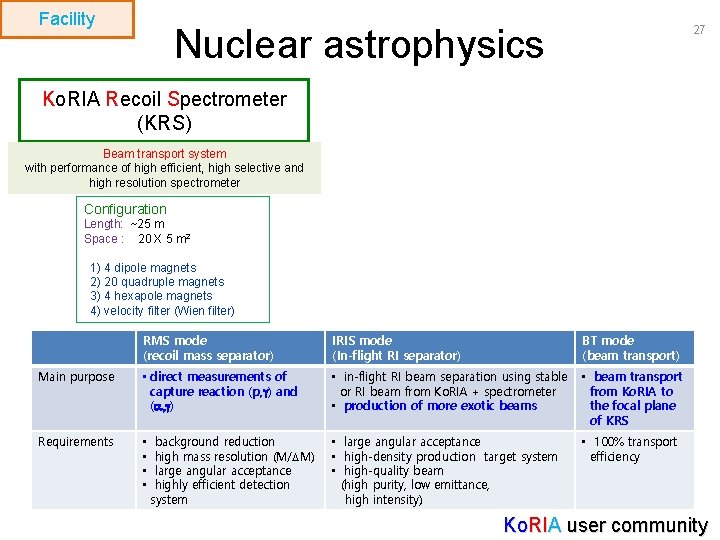
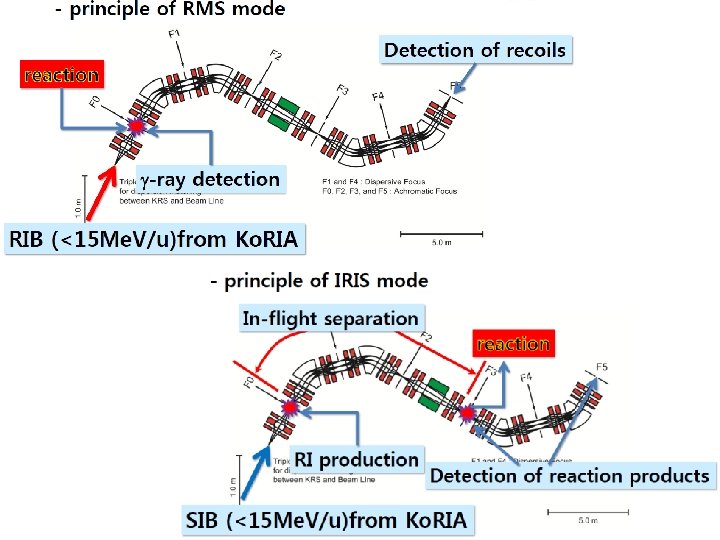
Facility Nuclear astrophysics 27 Ko. RIA Recoil Spectrometer (KRS) Beam transport system with performance of high efficient, high selective and high resolution spectrometer Configuration Length: ~25 m Space : 20 X 5 m 2 1) 4 dipole magnets 2) 20 quadruple magnets 3) 4 hexapole magnets 4) velocity filter (Wien filter) RMS mode (recoil mass separator) IRIS mode (In-flight RI separator) BT mode (beam transport) Main purpose • direct measurements of capture reaction (p, g) and (a, g) • in-flight RI beam separation using stable or RI beam from Ko. RIA + spectrometer • production of more exotic beams • beam transport from Ko. RIA to the focal plane of KRS Requirements • • • large angular acceptance • high-density production target system • high-quality beam (high purity, low emittance, high intensity) • 100% transport efficiency background reduction high mass resolution (M/DM) large angular acceptance highly efficient detection system Ko. RIA user community
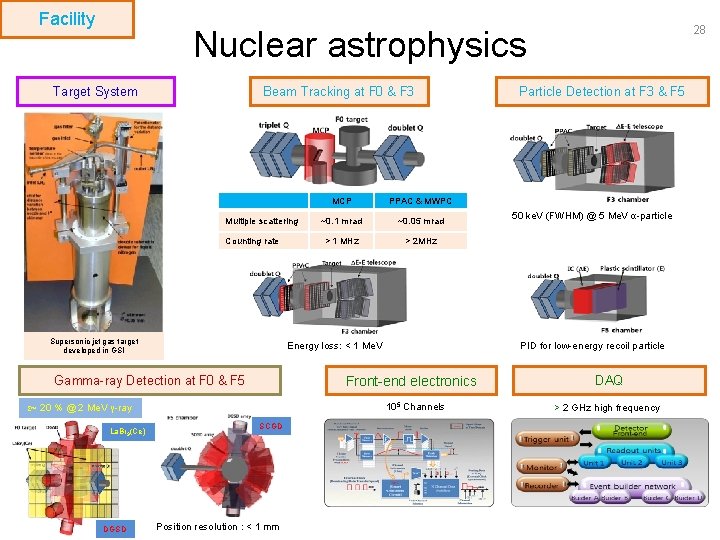
Facility 28 Nuclear astrophysics Beam Tracking at F 0 & F 3 Target System Multiple scattering Counting rate Supersonic jet gas target developed in GSI ~0. 1 mrad ~0. 05 mrad > 1 MHz > 2 MHz 105 Channels SCGD Position resolution : < 1 mm 50 ke. V (FWHM) @ 5 Me. V α-particle PID for low-energy recoil particle Front-end electronics ε~ 20 % @ 2 Me. V γ-ray DGSD PPAC & MWPC Energy loss: < 1 Me. V Gamma-ray Detection at F 0 & F 5 La. Br 3(Ce) MCP Particle Detection at F 3 & F 5 DAQ > 2 GHz high frequency
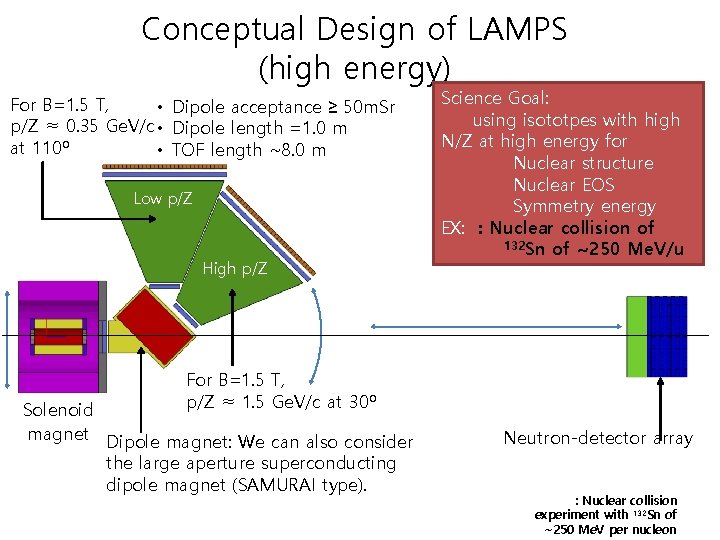
Conceptual Design of LAMPS (high energy) For B=1. 5 T, • Dipole acceptance ≥ 50 m. Sr p/Z ≈ 0. 35 Ge. V/c • Dipole length =1. 0 m at 110 o • TOF length ~8. 0 m Low p/Z High p/Z Science Goal: using isototpes with high N/Z at high energy for Nuclear structure Nuclear EOS Symmetry energy EX: : Nuclear collision of 132 Sn of ~250 Me. V/u For B=1. 5 T, p/Z ≈ 1. 5 Ge. V/c at 30 o Solenoid magnet Dipole magnet: We can also consider the large aperture superconducting dipole magnet (SAMURAI type). Neutron-detector array : Nuclear collision experiment with 132 Sn of ~250 Me. V per nucleon
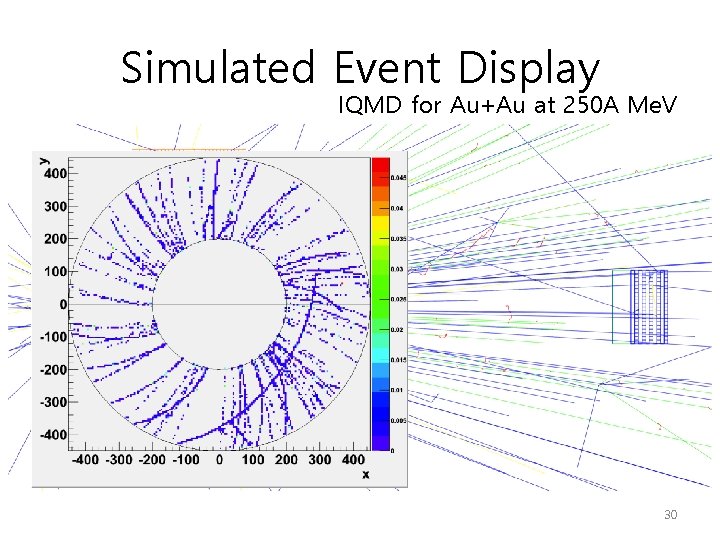
Simulated Event Display IQMD for Au+Au at 250 A Me. V 30
Status and Plan • Conceptual Design report (Mar. 2010 - Feb. 2011) • IAC review (Jul. 2011 – Oct. 2011) • Rare Isotope Science Project started in IBS (Dec. 2011) • Technical Design Report (by Jun. 2013)
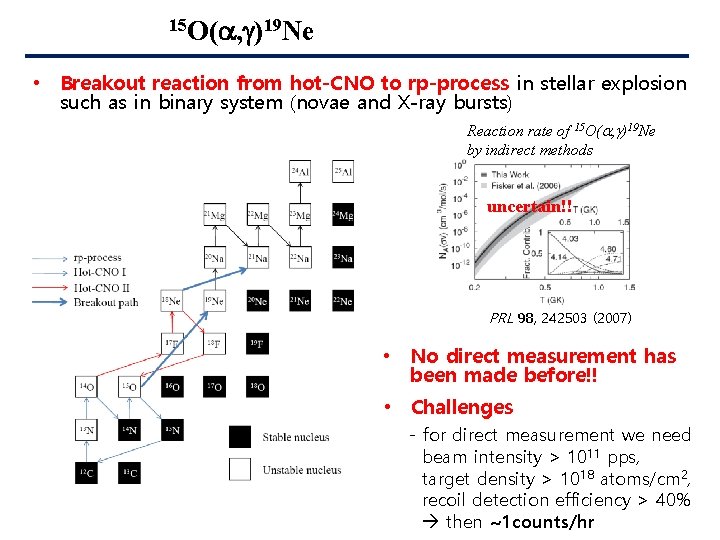
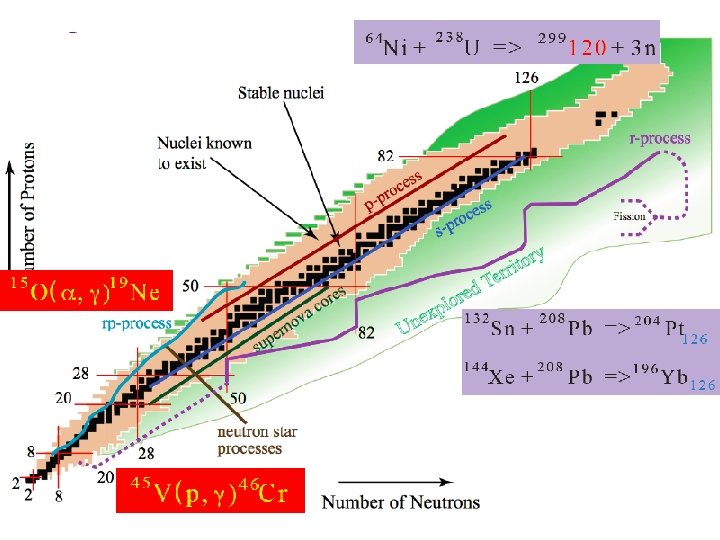
15 O(a, g)19 Ne • Breakout reaction from hot-CNO to rp-process in stellar explosion such as in binary system (novae and X-ray bursts) Reaction rate of 15 O(a, g)19 Ne by indirect methods uncertain!! PRL 98, 242503 (2007) • No direct measurement has been made before!! • Challenges - for direct measurement we need beam intensity > 1011 pps, target density > 1018 atoms/cm 2, recoil detection efficiency > 40% then ~1 counts/hr
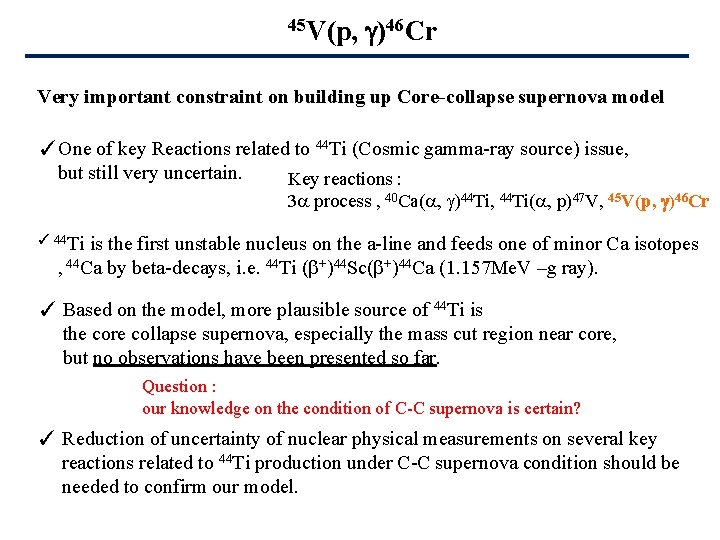
45 V(p, g)46 Cr Very important constraint on building up Core-collapse supernova model ✓One of key Reactions related to 44 Ti (Cosmic gamma-ray source) issue, but still very uncertain. Key reactions : 3 a process , 40 Ca(a, g)44 Ti, 44 Ti(a, p)47 V, 45 V(p, g)46 Cr ✓ 44 Ti is the first unstable nucleus on the a-line and feeds one of minor Ca isotopes , 44 Ca by beta-decays, i. e. 44 Ti (b+)44 Sc(b+)44 Ca (1. 157 Me. V –g ray). ✓ Based on the model, more plausible source of 44 Ti is the core collapse supernova, especially the mass cut region near core, but no observations have been presented so far. Question : our knowledge on the condition of C-C supernova is certain? ✓ Reduction of uncertainty of nuclear physical measurements on several key reactions related to 44 Ti production under C-C supernova condition should be needed to confirm our model.
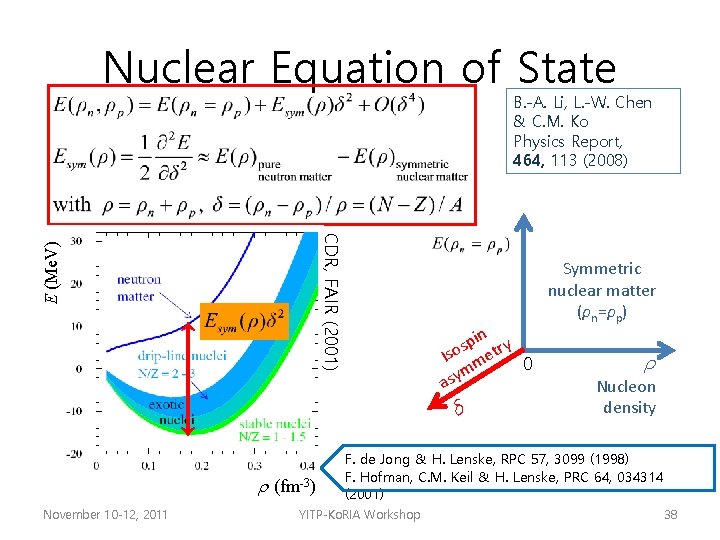
Nuclear Equation of State 18 CDR, FAIR (2001) E (Me. V) B. -A. Li, L. -W. Chen & C. M. Ko Physics Report, 464, 113 (2008) in y p s Iso metr 0 m asy δ r (fm-3) November 10 -12, 2011 Symmetric nuclear matter (ρn=ρp) ρ Nucleon density F. de Jong & H. Lenske, RPC 57, 3099 (1998) F. Hofman, C. M. Keil & H. Lenske, PRC 64, 034314 (2001) YITP-Ko. RIA Workshop 38
- Slides: 38