
Institut for Nordiske Studier og Sprogvidenskab TRACING THE
Institut for Nordiske Studier og Sprogvidenskab TRACING THE INDO-EUROPEANS: THEIR LANGUAGE AND CULTURE Birgit Anette Rasmussen (Olsen) Roots of Europe, language, culture, and migrations Department of Nordic Studies and Linguistics Dias 1
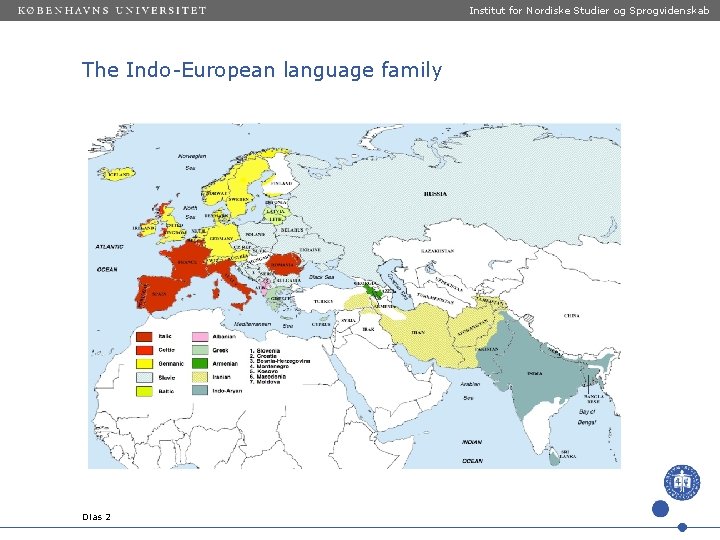
Institut for Nordiske Studier og Sprogvidenskab The Indo-European language family Dias 2
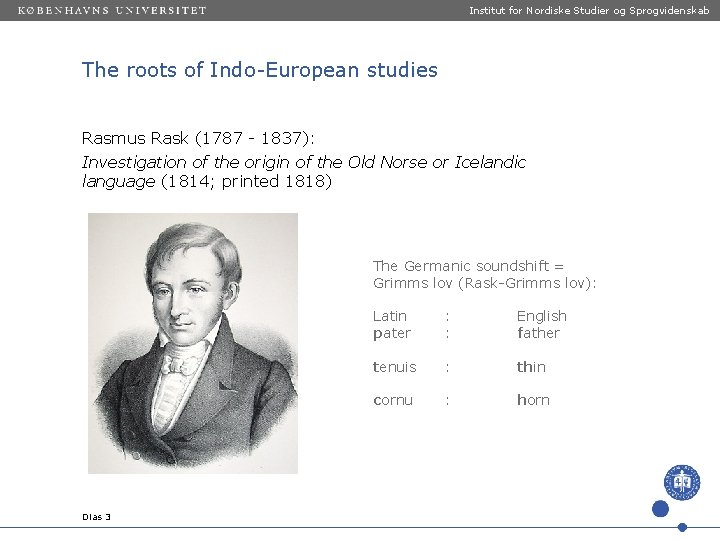
Institut for Nordiske Studier og Sprogvidenskab The roots of Indo-European studies Rasmus Rask (1787 - 1837): Investigation of the origin of the Old Norse or Icelandic language (1814; printed 1818) The Germanic soundshift = Grimms lov (Rask-Grimms lov): Dias 3 Latin pater : : English father tenuis : thin cornu : horn
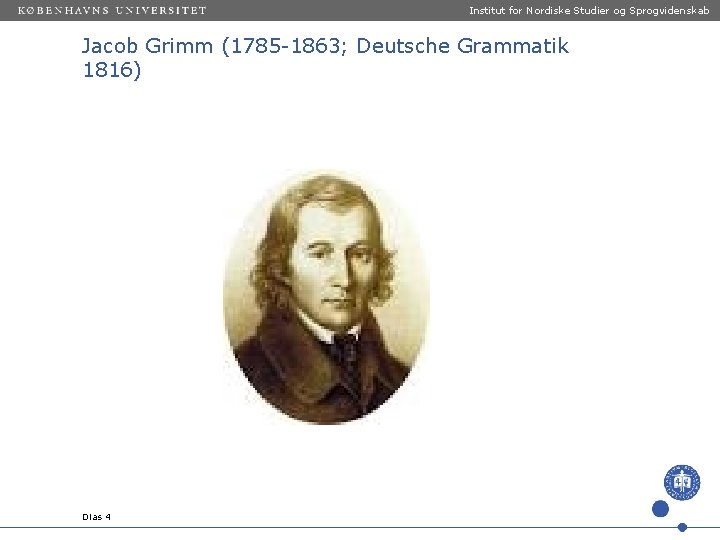
Institut for Nordiske Studier og Sprogvidenskab Jacob Grimm (1785 -1863; Deutsche Grammatik 1816) Dias 4
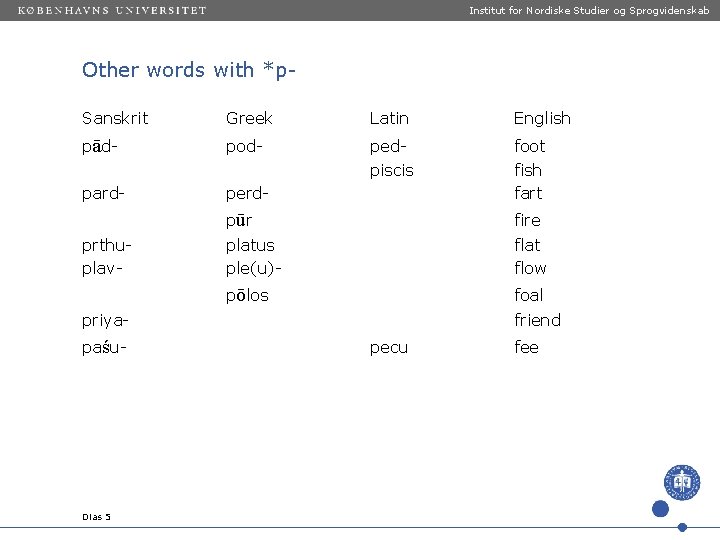
Institut for Nordiske Studier og Sprogvidenskab Other words with *p. Sanskrit Greek Latin English pād- pod- ped- foot piscis perd- fish fart pūr fire platus ple(u)- flat flow pōlos foal pardprthuplavpriyapaśu- Dias 5 friend pecu fee
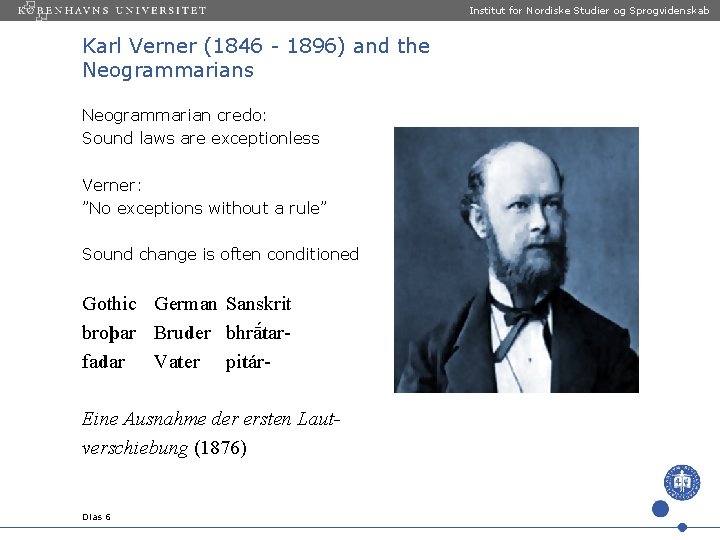
Institut for Nordiske Studier og Sprogvidenskab Karl Verner (1846 - 1896) and the Neogrammarians Neogrammarian credo: Sound laws are exceptionless Verner: ”No exceptions without a rule” Sound change is often conditioned Gothic German Sanskrit broþar Bruder bhrā tarfadar Vater pitár. Eine Ausnahme der ersten Lautverschiebung (1876) Dias 6
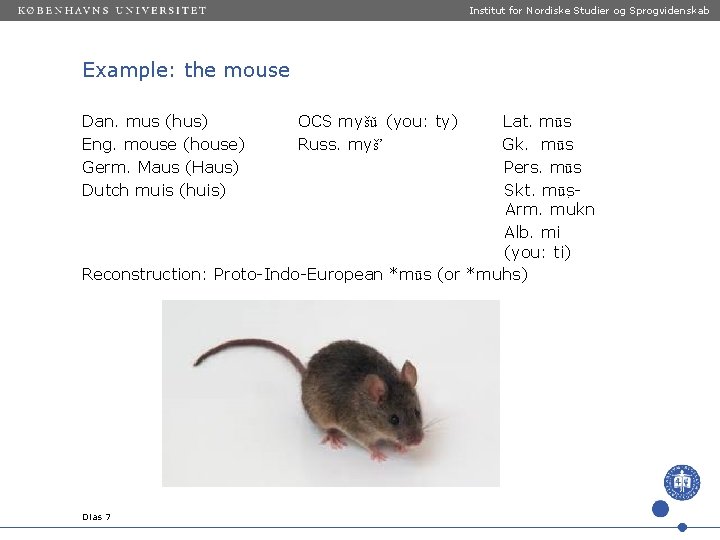
Institut for Nordiske Studier og Sprogvidenskab Example: the mouse Dan. mus (hus) Eng. mouse (house) Germ. Maus (Haus) Dutch muis (huis) Lat. mūs Gk. mūs Pers. mūs Skt. mūs Arm. mukn Alb. mi (you: ti) Reconstruction: Proto-Indo-European *mūs (or *muhs) Dias 7 OCS myšŭ (you: ty) Russ. myš’
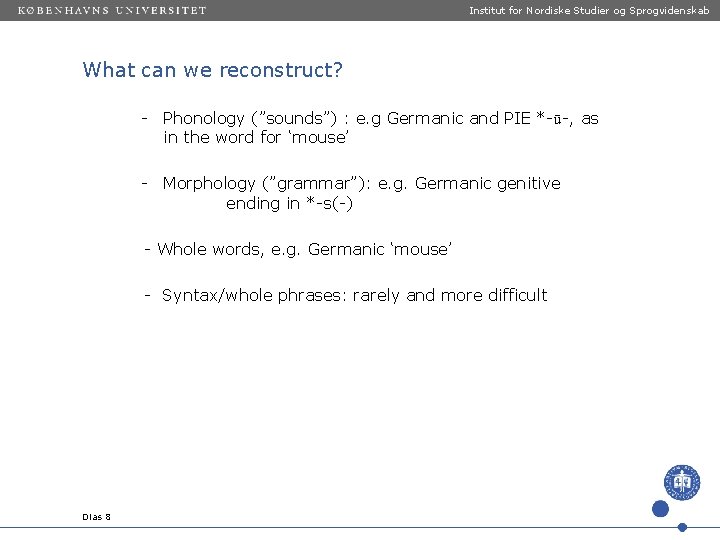
Institut for Nordiske Studier og Sprogvidenskab What can we reconstruct? - Phonology (”sounds”) : e. g Germanic and PIE *-ū-, as in the word for ‘mouse’ - Morphology (”grammar”): e. g. Germanic genitive ending in *-s(-) - Whole words, e. g. Germanic ‘mouse’ - Syntax/whole phrases: rarely and more difficult Dias 8
Institut for Nordiske Studier og Sprogvidenskab What is palaeolinguistics? If a given word or phrase can be reconstructed on the basis of several – preferably geographically distant - branches of the Indo-European family with regular sound change and (reasonably) identical meaning, the corresponding concept belongs to the common, inherited culture. Beware of Loanwords Independent formations Attestation only in neighbouring branches So: the Indo-Europeans knew of mice, and they had fathers and brothers. But what can the common vocabulary tell us about their culture? Dias 9
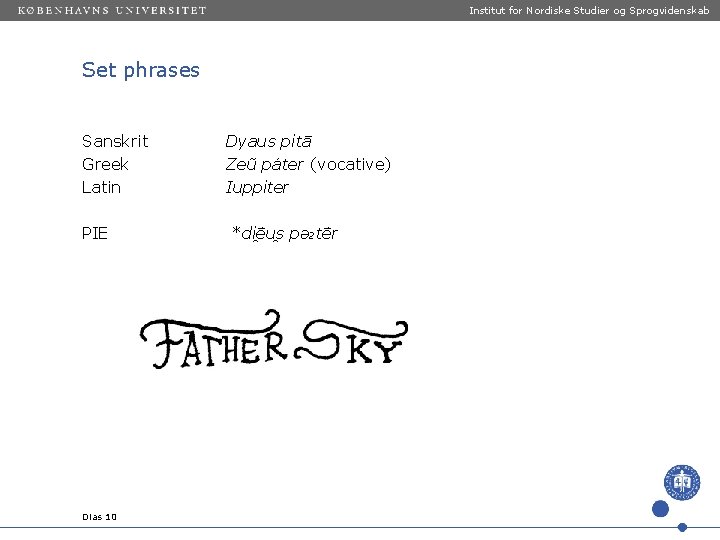
Institut for Nordiske Studier og Sprogvidenskab Set phrases Sanskrit Greek Latin PIE Dias 10 Dyaus pitā Zeũ páter (vocative) Iuppiter *di ē u s pə 2 tē r
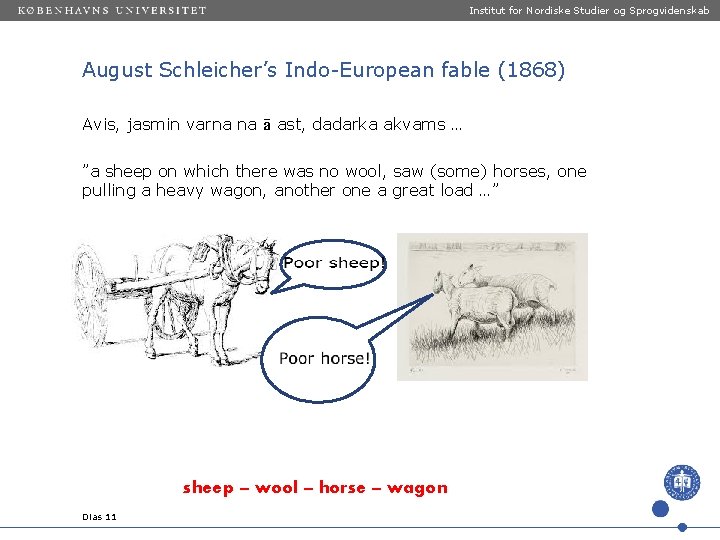
Institut for Nordiske Studier og Sprogvidenskab August Schleicher’s Indo-European fable (1868) Avis, jasmin varna na ā ast, dadarka akvams … ”a sheep on which there was no wool, saw (some) horses, one pulling a heavy wagon, another one a great load …” p sheep – wool – horse – wagon Dias 11
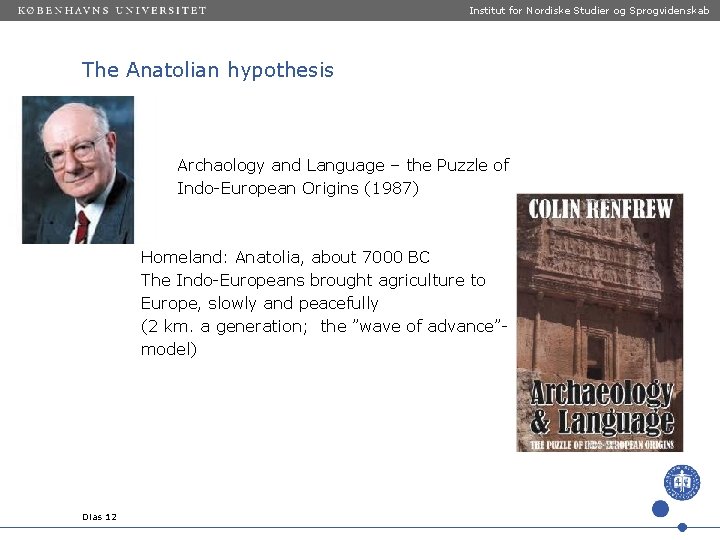
Institut for Nordiske Studier og Sprogvidenskab The Anatolian hypothesis Archaology and Language – the Puzzle of Indo-European Origins (1987) Homeland: Anatolia, about 7000 BC The Indo-Europeans brought agriculture to Europe, slowly and peacefully (2 km. a generation; the ”wave of advance”model) Dias 12
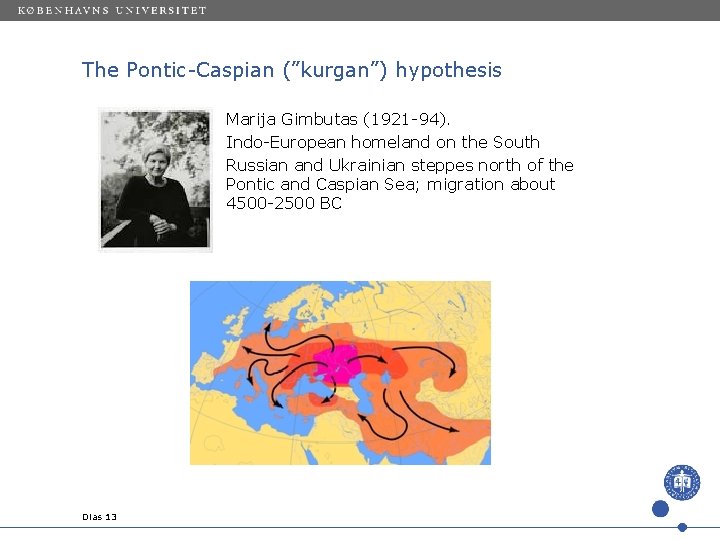
The Pontic-Caspian (”kurgan”) hypothesis Marija Gimbutas (1921 -94). Indo-European homeland on the South Russian and Ukrainian steppes north of the Pontic and Caspian Sea; migration about 4500 -2500 BC Dias 13
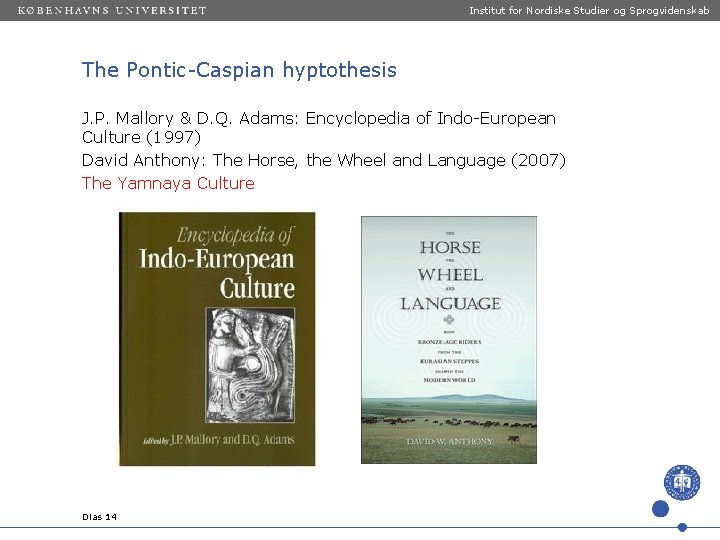
Institut for Nordiske Studier og Sprogvidenskab The Pontic-Caspian hyptothesis J. P. Mallory & D. Q. Adams: Encyclopedia of Indo-European Culture (1997) David Anthony: The Horse, the Wheel and Language (2007) The Yamnaya Culture Dias 14
Institut for Nordiske Studier og Sprogvidenskab How did they get around? horse and wheel *(h 1)ek’u os ‘horse’: Sanskrit áśva-, Avestan aspa-, Greek híppos (Myc. i-qo), Latin equus, Old Irish ech, Old English eoh, Tocharian yakwe etc. ; Hier. Luwian ásù-, Lycian esb- ‘horse’ Names: Sanskrit Brhadasva- ‘High-horse’, Greek Xanthippos ‘Golden-horse’ Domestication 4800 -4500 BC *kwekwlo- ‘wheel’: Sanskrit cakrá-, Avestan caxra-, Greek kúklos, Old English hweol, Tocharian A kukäl Pre-IE: *kwe-kwlh 1 o- ‘roll-roll’ Old Irish roth, Old High German rad, Lithuanian rãtas, Latin rota ‘wheel’; Sanskrit rátha-, Avestan raθa‘chariot’; root *ret- (or *reth-) ‘run’ Dias 15
Institut for Nordiske Studier og Sprogvidenskab Wheeled vehicles • *h 2 ak’s- ‘axle’: Sanskrit ákṣa-, Greek axōn (Myc. a-koso-ne), Latin axis, Old High German ahsa, Lithuanian ašìs, Old Slavic osь; Welsh echel, Old Norse o xull • *h 2/3 eihos-/*h 2/3 ihs- ‘shaft’: Hittite hissas ‘pole, shaft’, Sanskrit īșā-, Slovene oje (plur. ojesa) ‘pole, shaft’ • *u eg’he-: ‘convey (in a wagon)’: Sanskrit váhati, Avestan vazaiti, Greek (Pamphylian) wekheto, Latin vehit, Old Norse vega, Lithuanian vežù, Old Slavic vezo ; Albania vjedh ‘steals’; Cf. also Sanskrit vahitram, Latin vehiculum ‘wagon’ (English way) • *iugóm: ‘yoke’: Ved. yugám, Gk. zugón, Lat. iugum, OWelsh iou, English yoke; Hitt. iūk- ‘yoke, pair’< *ieug; root *ieug- ‘connect, pair’ Wheel and wagon after 4000 -3500 BC. Must belong to ”core Indo-European”, according to Renfrew (Gray. Atkinson, Bouckaert) no later than 6500 BC. Dias 16
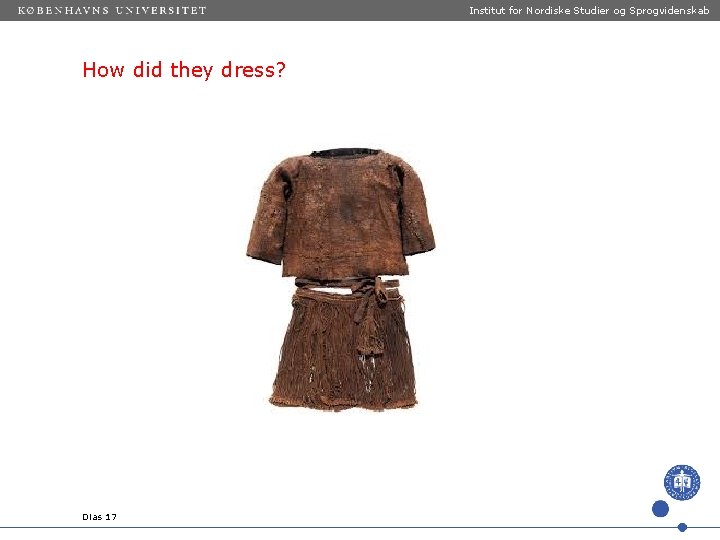
Institut for Nordiske Studier og Sprogvidenskab How did they dress? Dias 17
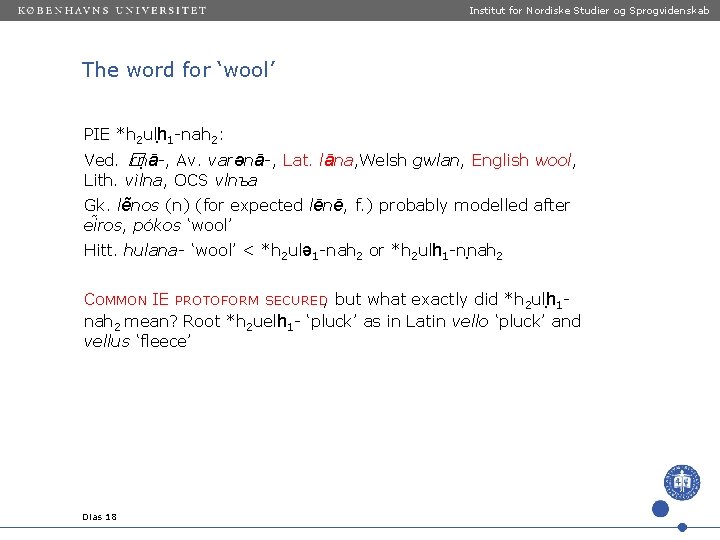
Institut for Nordiske Studier og Sprogvidenskab The word for ‘wool’ PIE *h 2 ul h 1 -nah 2: Ved. � rn ā-, Av. varənā-, Lat. lāna, Welsh gwlan, English wool, Lith. vìlna, OCS vlnъa Gk. lẽnos (n) (for expected lēnē, f. ) probably modelled after ei ros, pókos ‘wool’ Hitt. hulana- ‘wool’ < *h 2 ulə 1 -nah 2 or *h 2 ulh 1 -n nah 2 COMMON IE PROTOFORM SECURED, but what exactly did *h 2 ul h 1 nah 2 mean? Root *h 2 uelh 1 - ‘pluck’ as in Latin vello ‘pluck’ and vellus ‘fleece’ Dias 18
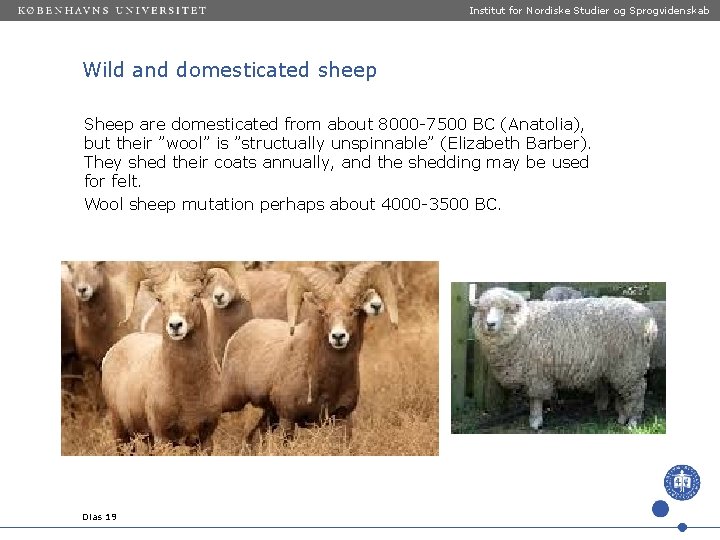
Institut for Nordiske Studier og Sprogvidenskab Wild and domesticated sheep Sheep are domesticated from about 8000 -7500 BC (Anatolia), but their ”wool” is ”structually unspinnable” (Elizabeth Barber). They shed their coats annually, and the shedding may be used for felt. Wool sheep mutation perhaps about 4000 -3500 BC. Dias 19
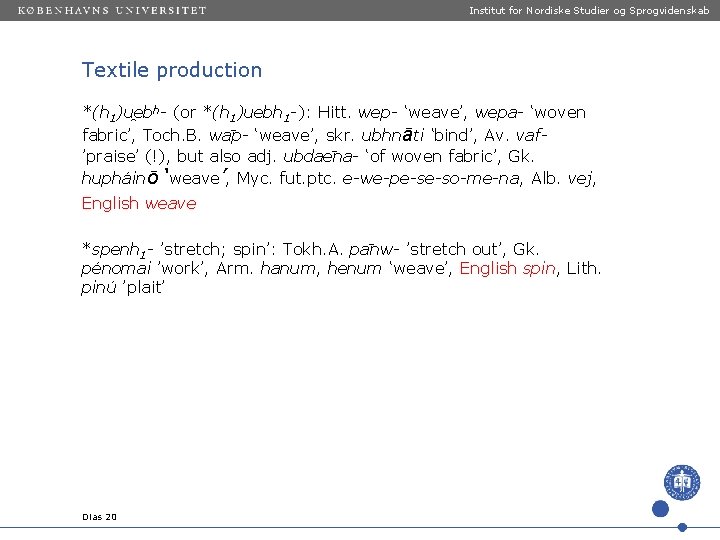
Institut for Nordiske Studier og Sprogvidenskab Textile production *(h 1)u ebh- (or *(h 1)uebh 1 -): Hitt. wep- ‘weave’, wepa- ‘woven fabric’, Toch. B. wa p- ‘weave’, skr. ubhnāti ‘bind’, Av. vaf’praise’ (!), but also adj. ubdae na- ‘of woven fabric’, Gk. hupháinō ‘weave’, Myc. fut. ptc. e-we-pe-se-so-me-na, Alb. vej, English weave *spenh 1 - ’stretch; spin’: Tokh. A. pa nw- ’stretch out’, Gk. pénomai ’work’, Arm. hanum, henum ‘weave’, English spin, Lith. pinú ’plait’ Dias 20
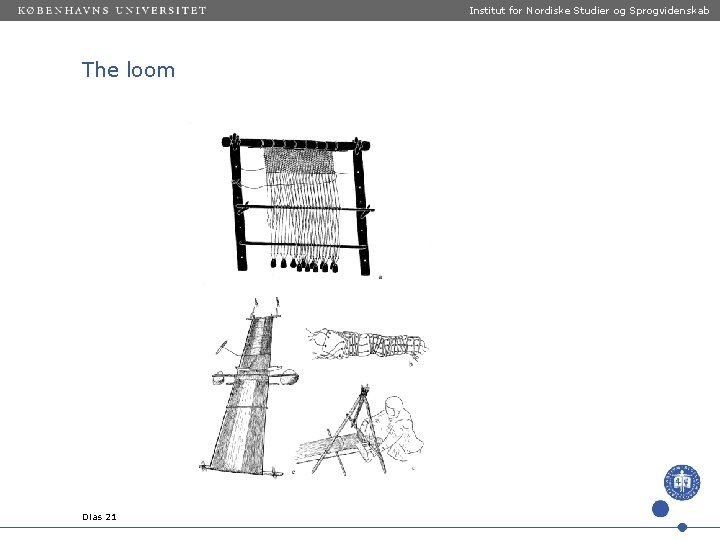
Institut for Nordiske Studier og Sprogvidenskab The loom Dias 21
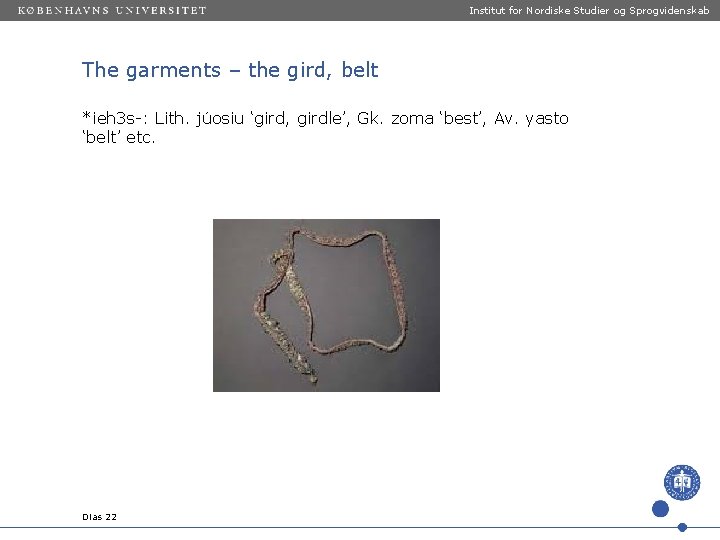
Institut for Nordiske Studier og Sprogvidenskab The garments – the gird, belt *ieh 3 s-: Lith. júosiu ‘gird, girdle’, Gk. zoma ‘best’, Av. yasto ‘belt’ etc. Dias 22
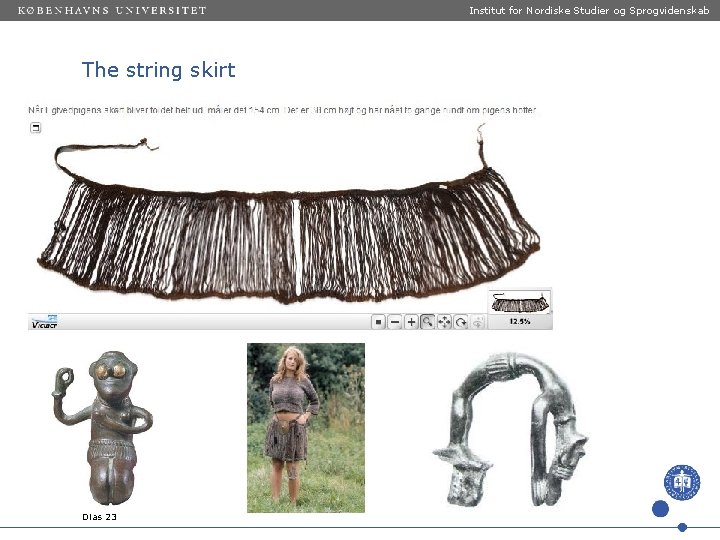
Institut for Nordiske Studier og Sprogvidenskab The string skirt Dias 23
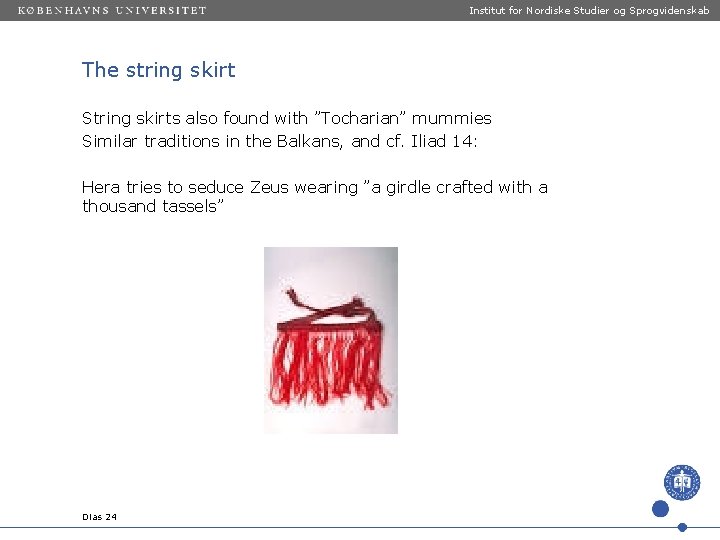
Institut for Nordiske Studier og Sprogvidenskab The string skirt String skirts also found with ”Tocharian” mummies Similar traditions in the Balkans, and cf. Iliad 14: Hera tries to seduce Zeus wearing ”a girdle crafted with a thousand tassels” Dias 24
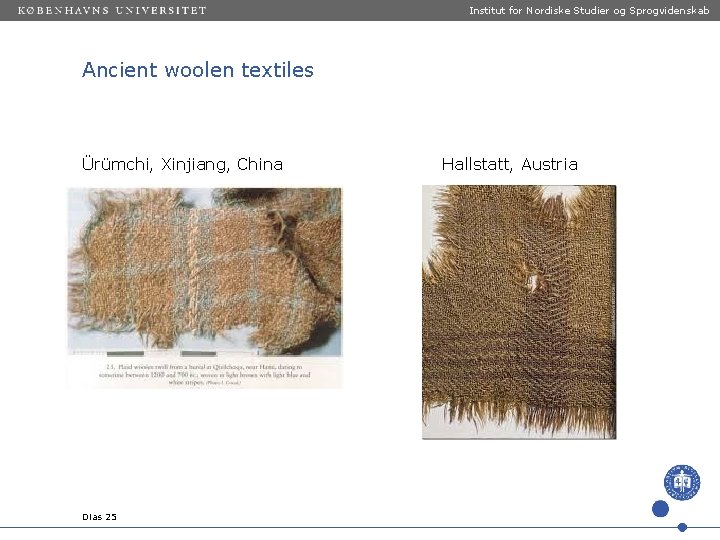
Institut for Nordiske Studier og Sprogvidenskab Ancient woolen textiles Ürümchi, Xinjiang, China Dias 25 Hallstatt, Austria
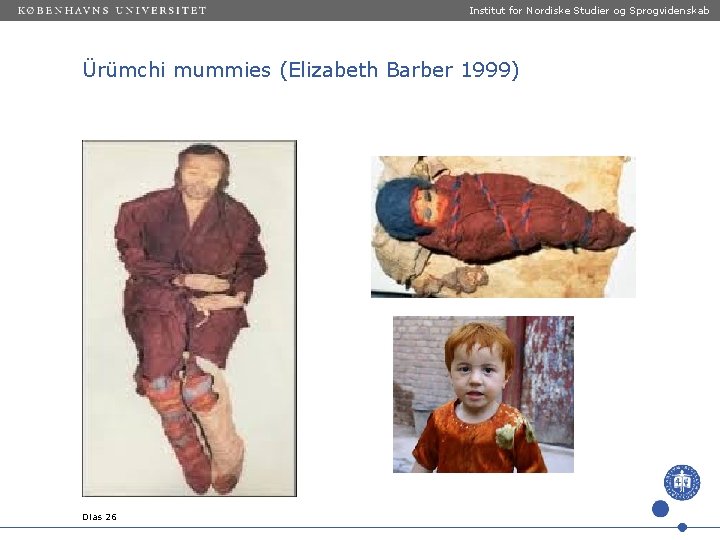
Institut for Nordiske Studier og Sprogvidenskab Ürümchi mummies (Elizabeth Barber 1999) Dias 26
Institut for Nordiske Studier og Sprogvidenskab What were their families like? The wife’s words (to take a wife = to conduct, Engl. wed, wedding) Husband’s brother *daiuér-: Skt. devár-, Pashto levar, Gk. daēr, Arm. taygr, OCS děverъ, OE tācor, OHG zeihhur Husband’s sister *g’l huos-: Gk. gálōs, Arm. tal (for *cal), Lat. glōs, OCS zъlъva; cf. also Skt. giri- ‘brother’s wife’ Husband’s brother’s wife *(h)ienh 2 ter-: Skt. yātar-, Pashto yor, Gk. pl. einatéres, Arm. ner, Lat. pl. ianitrices, OCS jętry The husband’s words Less precise, often derived from a root ‘to bind’, e. g. same word for ‘brother-in-law’ and ‘father-in-law’
Institut for Nordiske Studier og Sprogvidenskab How did they organize their society? priests/rulers – warriors - commoners *dems-poti- ’master of the house’ (despote) *u i� s-poti- ’master of the clan’ *h 3 rēĝ-s ’king’ : Ved. rāj-, Lat. rēx, Gaul. rix ( ⇒ Goth. reiks, Eng. rich); root meaning: ’direct, stretch out’ Rigveda 10. 90. 12 (Purusha): His mouth was the Brahman, His two arms were made the warrior, His two thighs the Vaishya, From his two feet the Sudra was born Dias 28
Institut for Nordiske Studier og Sprogvidenskab The people, war and warbands *teu táh-: the people consisting of free, especially married men - Osc. touto, OIr. túath, Goth. þiuda, Lith. tautà, German Deutsch Goth. also þiudans ’king’ < *teutono. As opposed to *kóro- > OP ka ra- ’people, army’; Lith. ka ras, ka re ’war’ ⇒ *korio- ‘host, army’ > MIr. cuire, Goth. harjis, Lith. ka rias ’army’. *korios = ”warband” Herjann, epithet of Odin, Gk. koíranos (dialectal word) ‘master of war’, Bret. ethnonym koriono-tota < *koriono- ‘master of a korios’ Dias 29
Institut for Nordiske Studier og Sprogvidenskab War and warbands Similar Germanic and Greek traditions, e. g. Greek ephebes, age 16 -25, living in the woods and carrying wolf- or bear-skin Ved. márya- ’young man’ about Indra’s followers, cf. Av. mairiio ’scoundrel, bandit’, perhaps OIr. muire ’leader’ Dias 30
Institut for Nordiske Studier og Sprogvidenskab Wolf and dog *ul kwos: Toch. B. walkwe, Skt. vr ka-, Av. vǝhrka-, Gk. lýkos, Lat. lupus, Alb. ujk, ON ulfr, English woolf, Lith. vilkas, OCS vlъkъ Hitt. walkuwa- means something negative, but not clearly identified: ”The queen of Kanis bore thirty sons within one year. She says: ”What kind of w. did I give birth to? ” ”What kind of w. do you … They answer: ”The Hurrian army comes to the country”. Skt. a-vr ka- ’safe’, so walkuwa- perhaps ’danger(ous thing)’ Dias 31
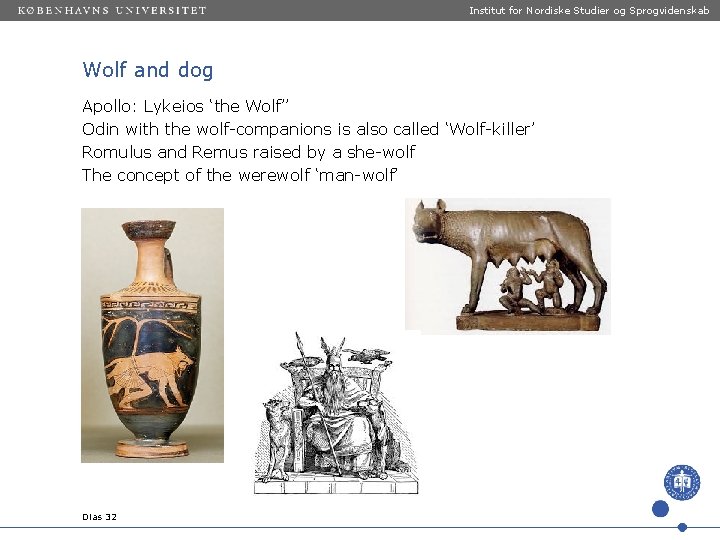
Institut for Nordiske Studier og Sprogvidenskab Wolf and dog Apollo: Lykeios ‘the Wolf’’ Odin with the wolf-companions is also called ‘Wolf-killer’ Romulus and Remus raised by a she-wolf The concept of the werewolf ‘man-wolf’ Dias 32
Institut for Nordiske Studier og Sprogvidenskab To become a wolf Hittite laws, § 37: If anyone elopes with a woman, and a group of supporters goes after them, and if two or three men are killed, there shall be no compensation: ”You have become a wolf”. ON vargr: 1) ‘woolf’; 2) ‘an outlaw whose crimes has put him outside society, and who can be killed like the wolf’ Dias 33
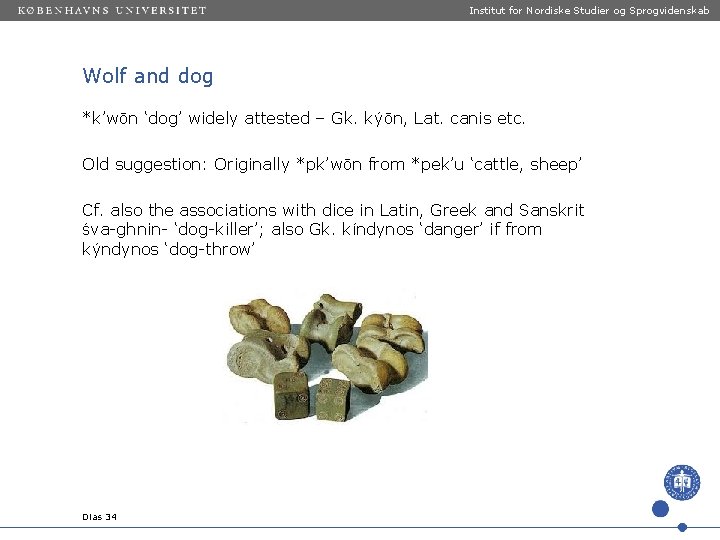
Institut for Nordiske Studier og Sprogvidenskab Wolf and dog *k’wōn ‘dog’ widely attested – Gk. kýōn, Lat. canis etc. Old suggestion: Originally *pk’wōn from *pek’u ‘cattle, sheep’ Cf. also the associations with dice in Latin, Greek and Sanskrit śva-ghnin- ‘dog-killer’; also Gk. kíndynos ‘danger’ if from kýndynos ‘dog-throw’ Dias 34
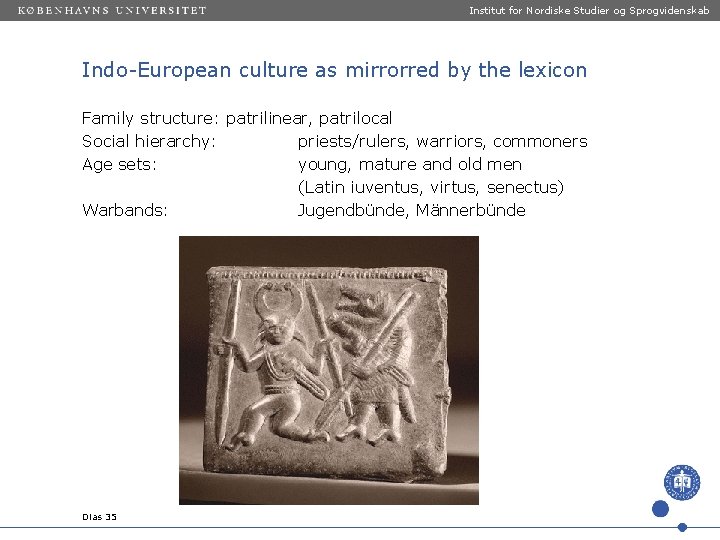
Institut for Nordiske Studier og Sprogvidenskab Indo-European culture as mirrorred by the lexicon Family structure: patrilinear, patrilocal Social hierarchy: priests/rulers, warriors, commoners Age sets: young, mature and old men (Latin iuventus, virtus, senectus) Warbands: Jugendbünde, Männerbünde Dias 35
Institut for Nordiske Studier og Sprogvidenskab Indo-European culture as mirrored by the lexicon Religion: Dias 36 Father Sky, his daughters, the Dawns, a dragon-slaying wargod, the divine twins (associated with horses)
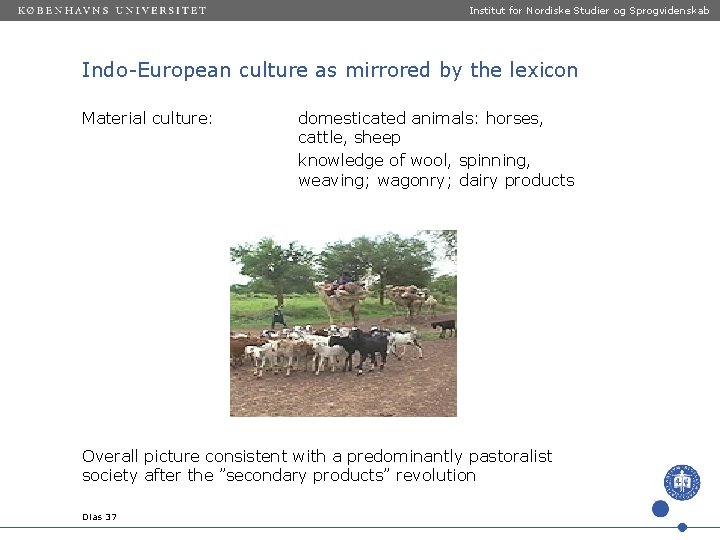
Institut for Nordiske Studier og Sprogvidenskab Indo-European culture as mirrored by the lexicon Material culture: domesticated animals: horses, cattle, sheep knowledge of wool, spinning, weaving; wagonry; dairy products Overall picture consistent with a predominantly pastoralist society after the ”secondary products” revolution Dias 37
Institut for Nordiske Studier og Sprogvidenskab What did they have and what did’nt they? No common protoforms : Common protoforms GOATS : SHEEP FLAX, LINEN : WOOL PULSES : OTHER AGRICULTURAL TERMS (Guus Kroonen) HORSE, WHEEL AND WAGON DAIRY PRODUCTS (BUT NOT MILK!) THEY WERE NOT THE FIRST FARMERS – THE (OLD) EUROPEANS ALREADY KNEW FARMING WHEN THE INDO-EUROPEANS ARRIVED Dias 38
- Slides: 38