
Institut for Nordiske Studier og Sprogvidenskab Palaeolinguistics kinship
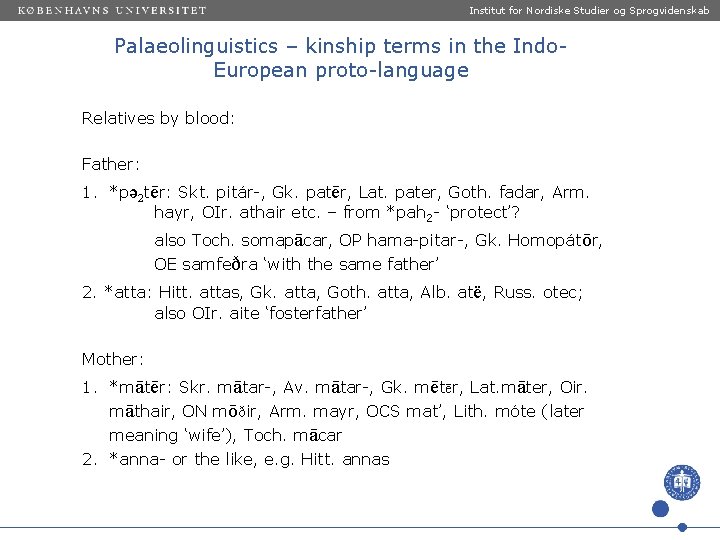
Institut for Nordiske Studier og Sprogvidenskab Palaeolinguistics – kinship terms in the Indo. European proto-language Relatives by blood: Father: 1. *pə 2 tēr: Skt. pitár-, Gk. patēr, Lat. pater, Goth. fadar, Arm. hayr, OIr. athair etc. – from *pah 2 - ‘protect’? also Toch. somapācar, OP hama-pitar-, Gk. Homopátōr, OE samfeðra ‘with the same father’ 2. *atta: Hitt. attas, Gk. atta, Goth. atta, Alb. atë, Russ. otec; also OIr. aite ‘fosterfather’ Mother: 1. *mātēr: Skr. mātar-, Av. mātar-, Gk. mētēr, Lat. māter, Oir. māthair, ON mōðir, Arm. mayr, OCS mat’, Lith. móte (later meaning ‘wife’), Toch. mācar 2. *anna- or the like, e. g. Hitt. annas

Institut for Nordiske Studier og Sprogvidenskab Brother and sister Brother: *bhrāter-: Skt. bhrātar-, Av. brātar-, Lat. frāter, Oir. bráthair (also meaning ‘relative, cousin’, Goth. brōðar, Lith. broterelis, OCS brat’, Toch. prācar, Arm. ełbayr; Gk. phrātēr means ‘member of a brotherhood’ beside adelphos ‘consanguineous brother’ Sister: *suesor- (‘one’s own woman’? ): Skt. svasar-, Gk. eor, Lat. soror, Goth. swistar, Lith. sesuo, OCS sestra, Oir. siur, Arm. khoyr, Toch. s ar; Hitt. –sara- in e. g. hassussara- ‘queen’ from hassu- ‘king’ Also *suesrio- in Lat. consobrinus ‘mother’s sister’s/brother’s son’, OE (ge)swor ‘mother’s sister’s son’, Arm. kher i ‘mother’s brother’ Sibling? Why German Geschwister, Danish søskende (sister- + kin) Dias 2
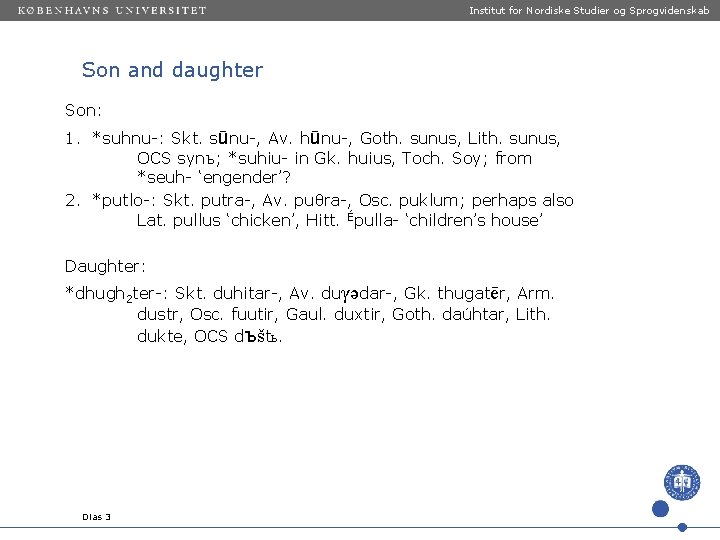
Institut for Nordiske Studier og Sprogvidenskab Son and daughter Son: 1. *suhnu-: Skt. sūnu-, Av. hūnu-, Goth. sunus, Lith. sunus, OCS synъ; *suhiu- in Gk. huius, Toch. Soy; from *seuh- ‘engender’? 2. *putlo-: Skt. putra-, Av. puθra-, Osc. puklum; perhaps also Lat. pullus ‘chicken’, Hitt. Épulla- ‘children’s house’ Daughter: *dhugh 2 ter-: Skt. duhitar-, Av. duγədar-, Gk. thugatēr, Arm. dustr, Osc. fuutir, Gaul. duxtir, Goth. daúhtar, Lith. dukte, OCS dъštь. Dias 3
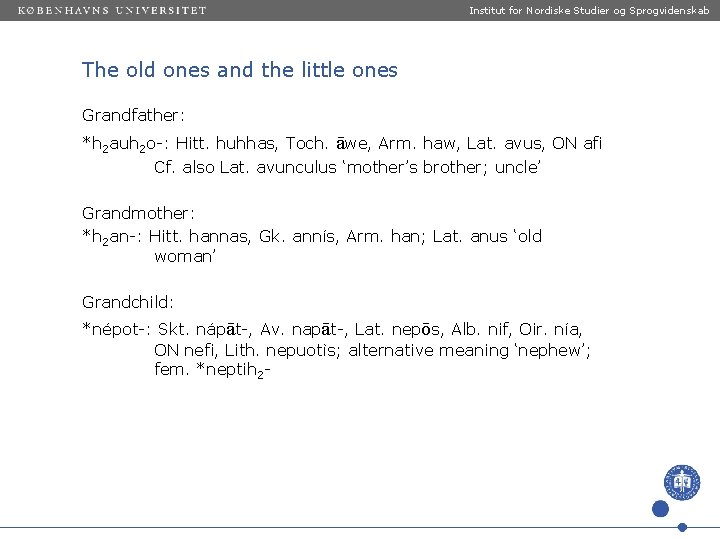
Institut for Nordiske Studier og Sprogvidenskab The old ones and the little ones Grandfather: *h 2 auh 2 o-: Hitt. huhhas, Toch. āwe, Arm. haw, Lat. avus, ON afi Cf. also Lat. avunculus ‘mother’s brother; uncle’ Grandmother: *h 2 an-: Hitt. hannas, Gk. annís, Arm. han; Lat. anus ‘old woman’ Grandchild: *népot-: Skt. nápāt-, Av. napāt-, Lat. nepōs, Alb. nif, Oir. nía, ON nefi, Lith. nepuotìs; alternative meaning ‘nephew’; fem. *neptih 2 -
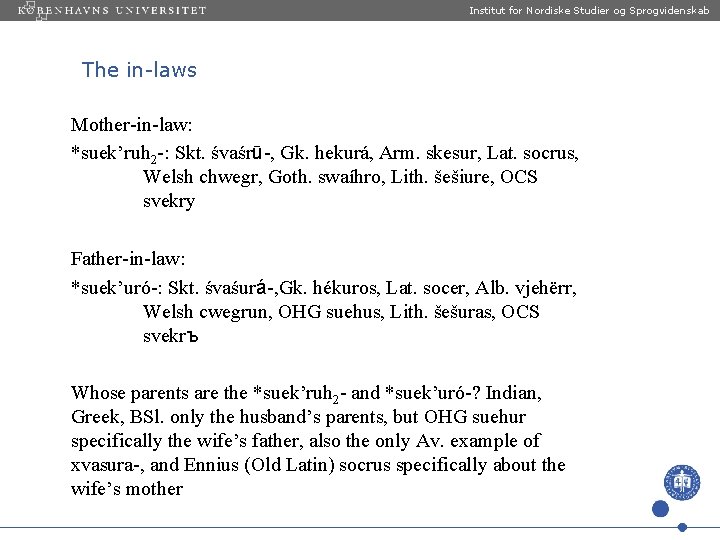
Institut for Nordiske Studier og Sprogvidenskab The in-laws Mother-in-law: *suek’ruh 2 -: Skt. śvaśrū-, Gk. hekurá, Arm. skesur, Lat. socrus, Welsh chwegr, Goth. swaíhro, Lith. šešiure, OCS svekry Father-in-law: *suek’uró-: Skt. śvaśurá-, Gk. hékuros, Lat. socer, Alb. vjehërr, Welsh cwegrun, OHG suehus, Lith. šešuras, OCS svekrъ Whose parents are the *suek’ruh 2 - and *suek’uró-? Indian, Greek, BSl. only the husband’s parents, but OHG suehur specifically the wife’s father, also the only Av. example of xvasura-, and Ennius (Old Latin) socrus specifically about the wife’s mother
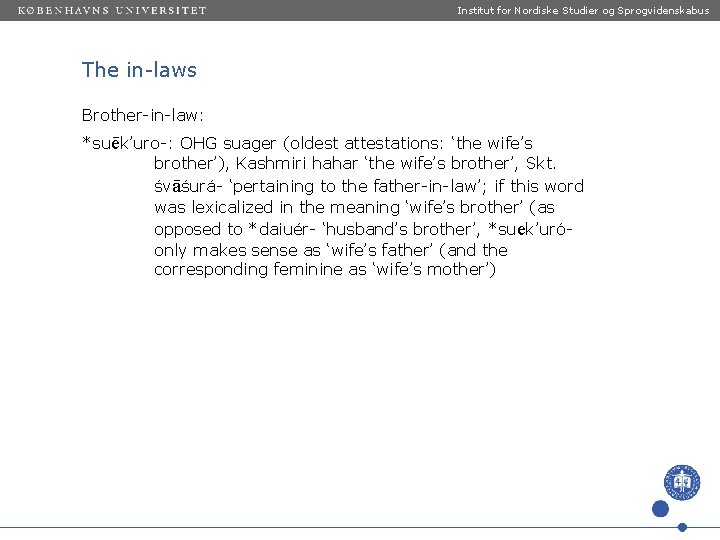
Institut for Nordiske Studier og Sprogvidenskabus The in-laws Brother-in-law: *suēk’uro-: OHG suager (oldest attestations: ‘the wife’s brother’), Kashmiri hahar ‘the wife’s brother’, Skt. śvāśurá- ‘pertaining to the father-in-law’; if this word was lexicalized in the meaning ‘wife’s brother’ (as opposed to *daiuér- ‘husband’s brother’, *suek’uró- only makes sense as ‘wife’s father’ (and the corresponding feminine as ‘wife’s mother’)
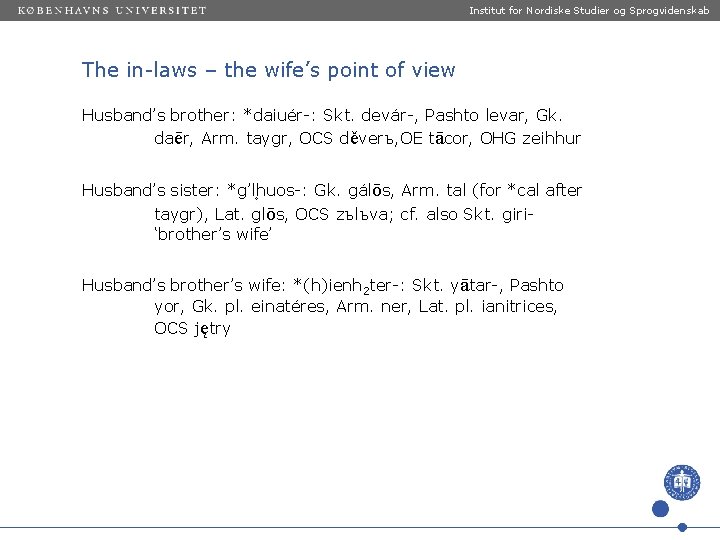
Institut for Nordiske Studier og Sprogvidenskab The in-laws – the wife’s point of view Husband’s brother: *daiuér-: Skt. devár-, Pashto levar, Gk. daēr, Arm. taygr, OCS děverъ, OE tācor, OHG zeihhur Husband’s sister: *g’l huos-: Gk. gálōs, Arm. tal (for *cal after taygr), Lat. glōs, OCS zъlъva; cf. also Skt. giri- ‘brother’s wife’ Husband’s brother’s wife: *(h)ienh 2 ter-: Skt. yātar-, Pashto yor, Gk. pl. einatéres, Arm. ner, Lat. pl. ianitrices, OCS jętry
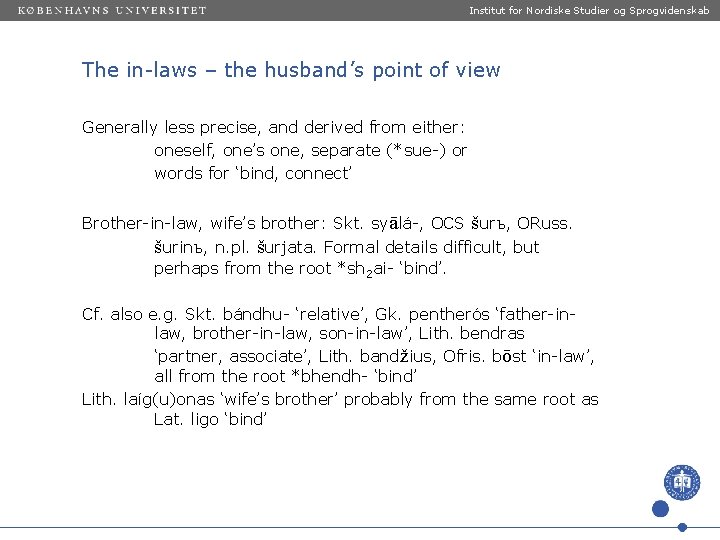
Institut for Nordiske Studier og Sprogvidenskab The in-laws – the husband’s point of view Generally less precise, and derived from either: oneself, one’s one, separate (*sue-) or words for ‘bind, connect’ Brother-in-law, wife’s brother: Skt. syālá-, OCS šurъ, ORuss. šurinъ, n. pl. šurjata. Formal details difficult, but perhaps from the root *sh 2 ai- ‘bind’. Cf. also e. g. Skt. bándhu- ‘relative’, Gk. pentherós ‘father-inlaw, brother-in-law, son-in-law’, Lith. bendras ‘partner, associate’, Lith. bandžius, Ofris. bōst ‘in-law’, all from the root *bhendh- ‘bind’ Lith. laíg(u)onas ‘wife’s brother’ probably from the same root as Lat. ligo ‘bind’
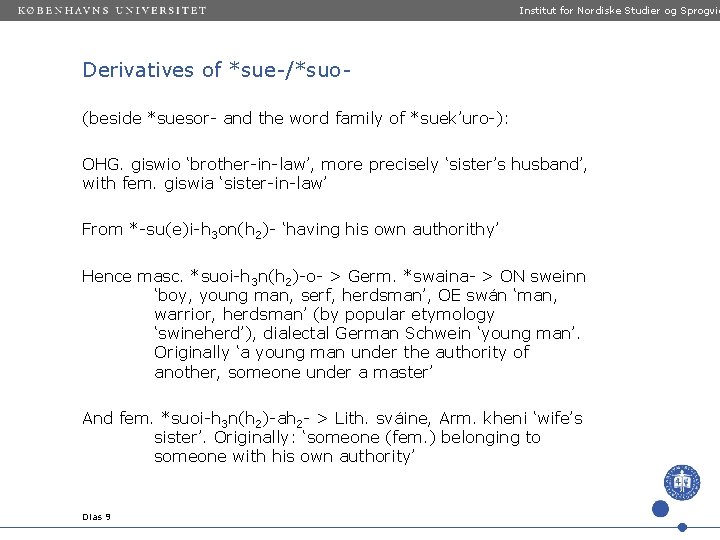
Institut for Nordiske Studier og Sprogvid Derivatives of *sue-/*suo- (beside *suesor- and the word family of *suek’uro-): OHG. giswio ‘brother-in-law’, more precisely ‘sister’s husband’, with fem. giswia ‘sister-in-law’ From *-su(e)i-h 3 on(h 2)- ‘having his own authorithy’ Hence masc. *suoi-h 3 n(h 2)-o- > Germ. *swaina- > ON sweinn ‘boy, young man, serf, herdsman’, OE swán ‘man, warrior, herdsman’ (by popular etymology ‘swineherd’), dialectal German Schwein ‘young man’. Originally ‘a young man under the authority of another, someone under a master’ And fem. *suoi-h 3 n(h 2)-ah 2 - > Lith. sváine, Arm. kheni ‘wife’s sister’. Originally: ‘someone (fem. ) belonging to someone with his own authority’ Dias 9
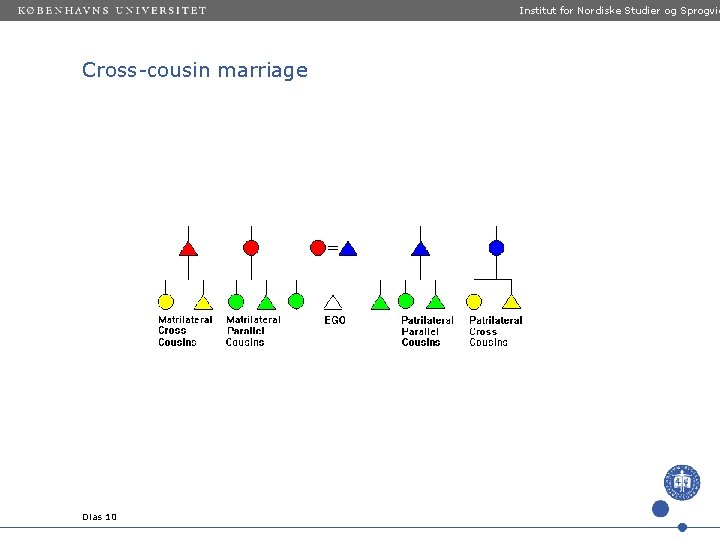
Institut for Nordiske Studier og Sprogvid Cross-cousin marriage Dias 10
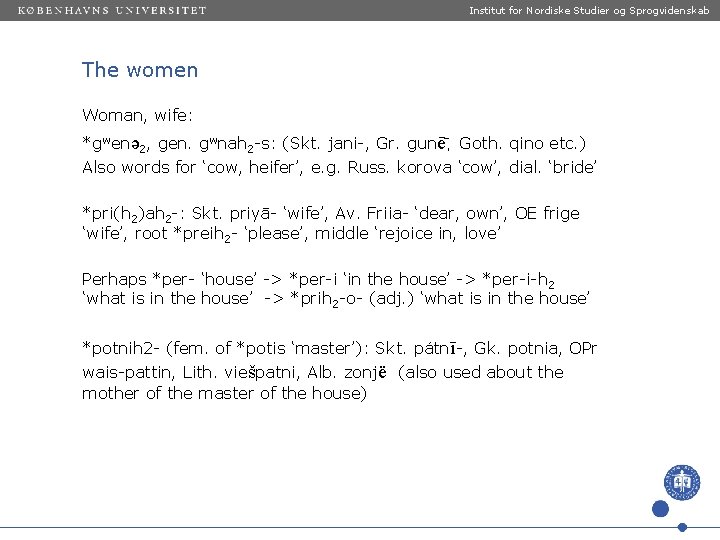
Institut for Nordiske Studier og Sprogvidenskab The women Woman, wife: *gwenə 2, gen. gwnah 2 -s: (Skt. jani-, Gr. gunē , Goth. qino etc. ) Also words for ‘cow, heifer’, e. g. Russ. korova ‘cow’, dial. ‘bride’ *pri(h 2)ah 2 -: Skt. priyā- ‘wife’, Av. Friia- ‘dear, own’, OE frige ‘wife’, root *preih 2 - ‘please’, middle ‘rejoice in, love’ Perhaps *per- ‘house’ -> *per-i ‘in the house’ -> *per-i-h 2 ‘what is in the house’ -> *prih 2 -o- (adj. ) ‘what is in the house’ *potnih 2 - (fem. of *potis ‘master’): Skt. pátnī-, Gk. potnia, OPr wais-pattin, Lith. viešpatni, Alb. zonjë (also used about the mother of the master of the house)
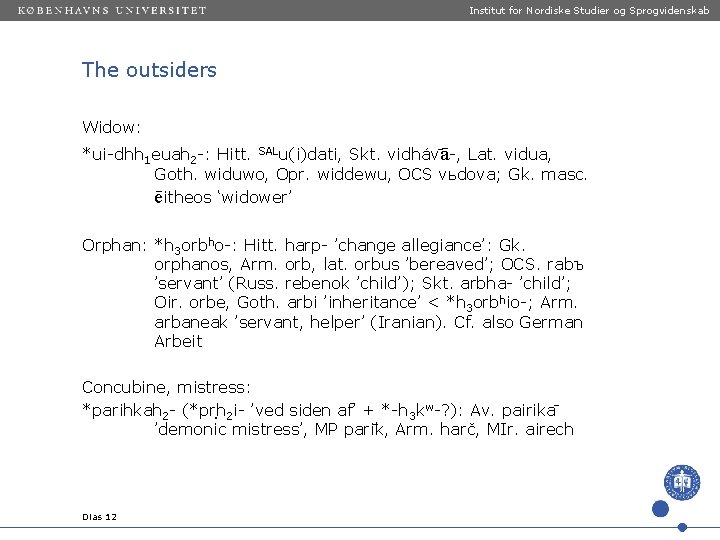
Institut for Nordiske Studier og Sprogvidenskab The outsiders Widow: *ui-dhh 1 euah 2 -: Hitt. SALu(i)dati, Skt. vidháv ā-, Lat. vidua, Goth. widuwo, Opr. widdewu, OCS vьdova; Gk. masc. ēitheos ‘widower’ Orphan: *h 3 orbho-: Hitt. harp- ’change allegiance’: Gk. orphanos, Arm. orb, lat. orbus ’bereaved’; OCS. rabъ ’servant’ (Russ. rebenok ’child’); Skt. arbha- ’child’; Oir. orbe, Goth. arbi ’inheritance’ < *h 3 orbhio-; Arm. arbaneak ’servant, helper’ (Iranian). Cf. also German Arbeit Concubine, mistress: *parihkah 2 - (*pr h 2 i- ’ved siden af’ + *-h 3 kw-? ): Av. pairika ’demonic mistress’, MP pari k, Arm. harč, MIr. airech Dias 12
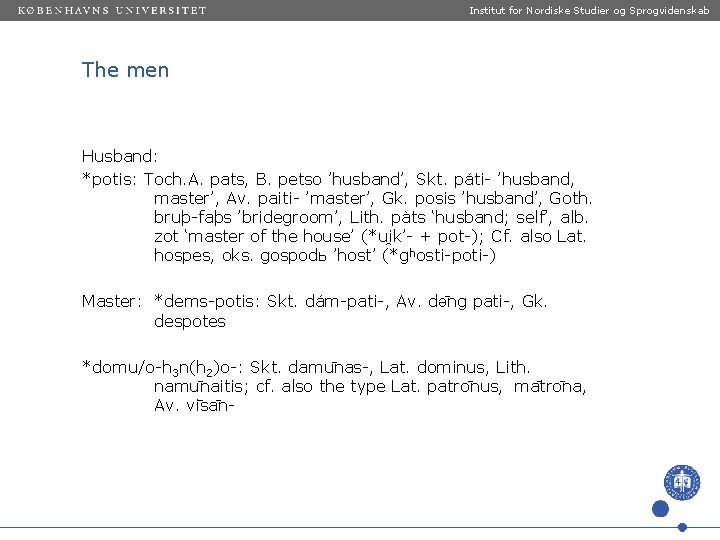
Institut for Nordiske Studier og Sprogvidenskab The men Husband: *potis: Toch. A. pats, B. petso ’husband’, Skt. páti- ’husband, master’, Av. paiti- ’master’, Gk. posis ’husband’, Goth. bruþ-faþs ’bridegroom’, Lith. pàts ‘husband; self’, alb. zot ‘master of the house’ (*u ik’- + pot-); Cf. also Lat. hospes, oks. gospodь ’host’ (*ghosti-poti-) Master: *dems-potis: Skt. dám-pati-, Av. dǝ ng pati-, Gk. despotes *domu/o-h 3 n(h 2)o-: Skt. damu nas-, Lat. dominus, Lith. namu naitis; cf. also the type Lat. patro nus, ma tro na, Av. vi sa n-
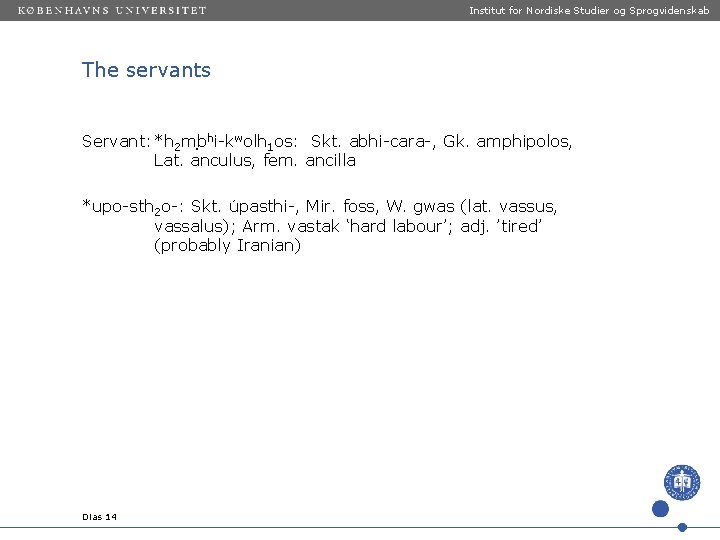
Institut for Nordiske Studier og Sprogvidenskab The servants Servant: *h 2 m bhi-kwolh 1 os: Skt. abhi-cara-, Gk. amphipolos, Lat. anculus, fem. ancilla *upo-sth 2 o-: Skt. úpasthi-, Mir. foss, W. gwas (lat. vassus, vassalus); Arm. vastak ‘hard labour’; adj. ’tired’ (probably Iranian) Dias 14
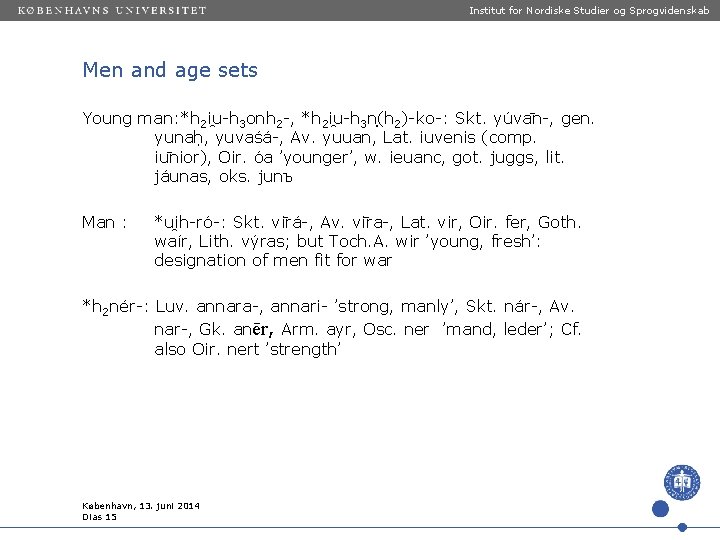
Institut for Nordiske Studier og Sprogvidenskab Men and age sets Young man: *h 2 i u-h 3 onh 2 -, *h 2 i u-h 3 n (h 2)-ko-: Skt. yúva n-, gen. yunah , yuvaśá-, Av. yuuan, Lat. iuvenis (comp. iu nior), Oir. óa ’younger’, w. ieuanc, got. juggs, lit. jáunas, oks. junъ Man : *u ih-ró-: Skt. vi rá-, Av. vi ra-, Lat. vir, Oir. fer, Goth. waír, Lith. vy ras; but Toch. A. wir ’young, fresh’: designation of men fit for war *h 2 nér-: Luv. annara-, annari- ’strong, manly’, Skt. nár-, Av. nar-, Gk. anēr, Arm. ayr, Osc. ner ’mand, leder’; Cf. also Oir. nert ’strength’ København, 13. juni 2014 Dias 15
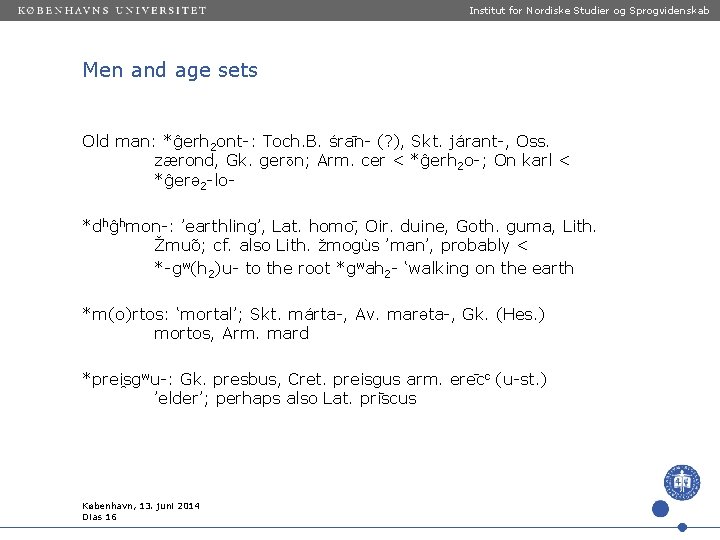
Institut for Nordiske Studier og Sprogvidenskab Men and age sets Old man: *ĝerh 2 ont-: Toch. B. śra n- (? ), Skt. járant-, Oss. zærond, Gk. gerōn; Arm. cer < *ĝerh 2 o-; On karl < *ĝerǝ 2 -lo*dhĝhmon-: ’earthling’, Lat. homo , Oir. duine, Goth. guma, Lith. Žmuo ; cf. also Lith. žmogùs ’man’, probably < *-gw(h 2)u- to the root *gwah 2 - ‘walking on the earth *m(o)rtos: ‘mortal’; Skt. márta-, Av. marǝta-, Gk. (Hes. ) mortos, Arm. mard *prei sgwu-: Gk. presbus, Cret. preisgus arm. ere cc (u-st. ) ’elder’; perhaps also Lat. pri scus København, 13. juni 2014 Dias 16
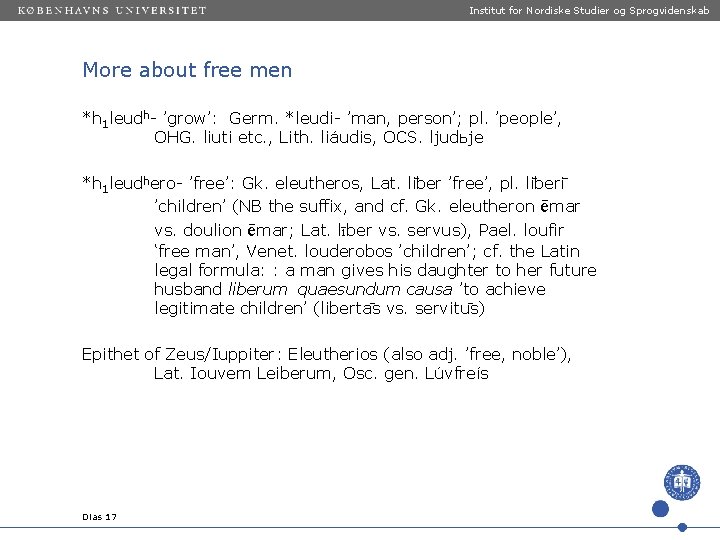
Institut for Nordiske Studier og Sprogvidenskab More about free men *h 1 leudh- ’grow’: Germ. *leudi- ’man, person’; pl. ’people’, OHG. liuti etc. , Lith. liáudis, OCS. ljudьje *h 1 leudhero- ’free’: Gk. eleutheros, Lat. li ber ’free’, pl. li beri ’children’ (NB the suffix, and cf. Gk. eleutheron ēmar vs. doulion ēmar; Lat. līber vs. servus), Pael. loufir ‘free man’, Venet. louderobos ’children’; cf. the Latin legal formula: : a man gives his daughter to her future husband liberum quaesundum causa ’to achieve legitimate children’ (liberta s vs. servitu s) Epithet of Zeus/Iuppiter: Eleutherios (also adj. ’free, noble’), Lat. Iouvem Leiberum, Osc. gen. Lúvfreís Dias 17
- Slides: 17