
Instant Runoff Voting Ranked Choice Voting Presented By
Instant Runoff Voting (Ranked Choice Voting) Presented By: Rob Richie, Executive Director The Center for Voting and Democracy (The Center is a non-profit, non-partisan organization in Maryland. Its chairman is former Congressman John Anderson, who lives and votes in Fort Lauderdale) Website: www. fairvote. org/irv
Summary of Presentation 1. History of Instant Runoff Voting (IRV) 2. IRV: What, How, Why (from presentation by Vermont Secretary of State to N. A. S. S. ) 3. Addressing Concerns 4. Contrasting Runoffs and IRV in Florida 5. Recommendations for Legislative Action
Brief History of Instant Runoff Voting • An American invention in 1870 • Early use, including in Florida • International: Australia, Ireland, London • Non-governmental organizations and Robert’s Rules of Order • Rising interest in the United States: San Francisco, Utah, Louisiana
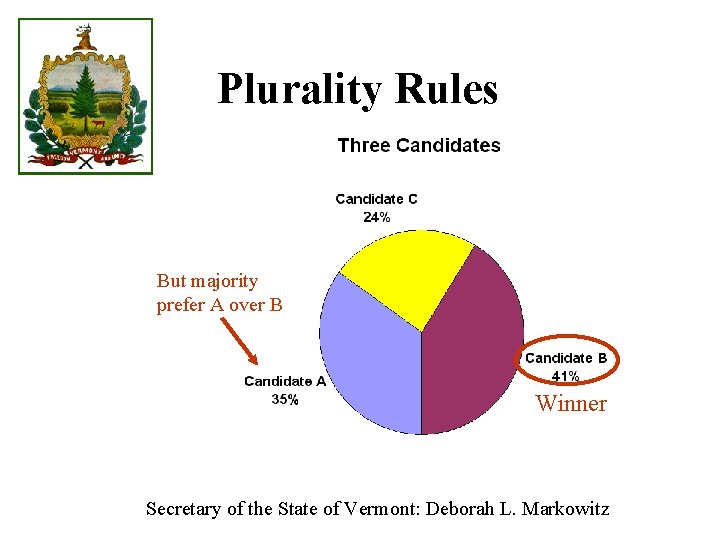
Plurality Rules But majority prefer A over B Winner Secretary of the State of Vermont: Deborah L. Markowitz
Second-Election Runoffs If no candidate receives a majority, all candidates but the top two are eliminated. A second “runoff” election is conducted between the finalists. Advantages • Assures majority winner in second election Problems • Added taxpayer expense for second election • Added candidate expense for runoff • Often lower voter turnout for runoff • Can be difficult to administer • Potential compromise candidate could be eliminated after first round in big field
What Is Instant Runoff Voting (IRV)? • Method of voting that requires a majority to elect a candidate • Determines a majority winner through instant runoffs using voter preferences until one candidate has a majority • Cheaper and more efficient than second elections because voters go to the polls only once
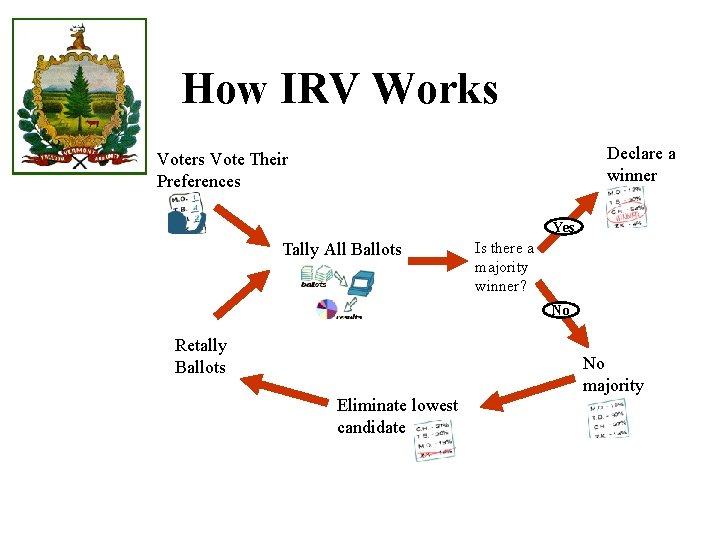
How IRV Works Declare a winner Voters Vote Their Preferences Yes Tally All Ballots Is there a majority winner? No Retally Ballots No majority Eliminate lowest candidate
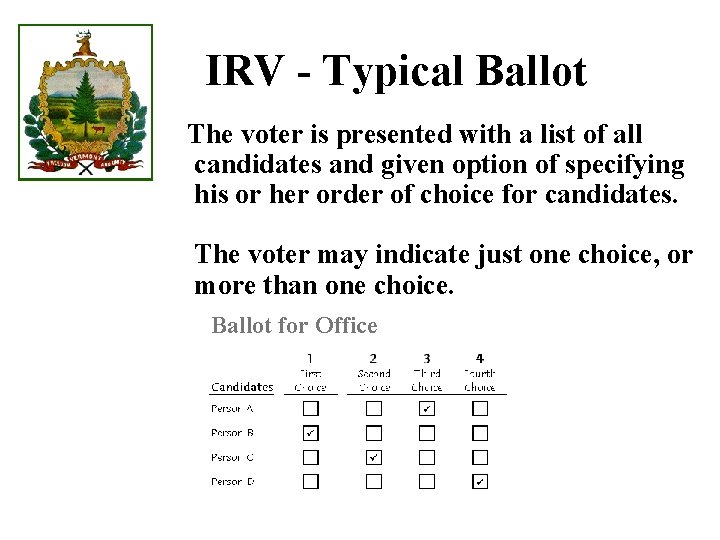
IRV - Typical Ballot The voter is presented with a list of all candidates and given option of specifying his or her order of choice for candidates. The voter may indicate just one choice, or more than one choice. Ballot for Office
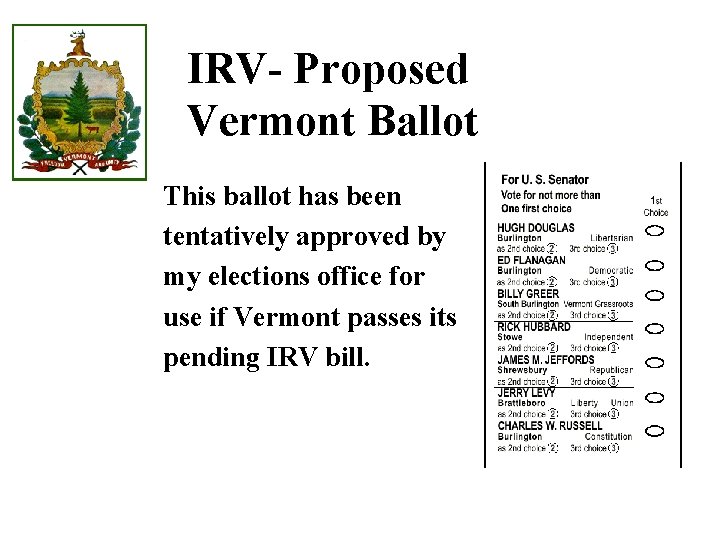
IRV- Proposed Vermont Ballot This ballot has been tentatively approved by my elections office for use if Vermont passes its pending IRV bill.
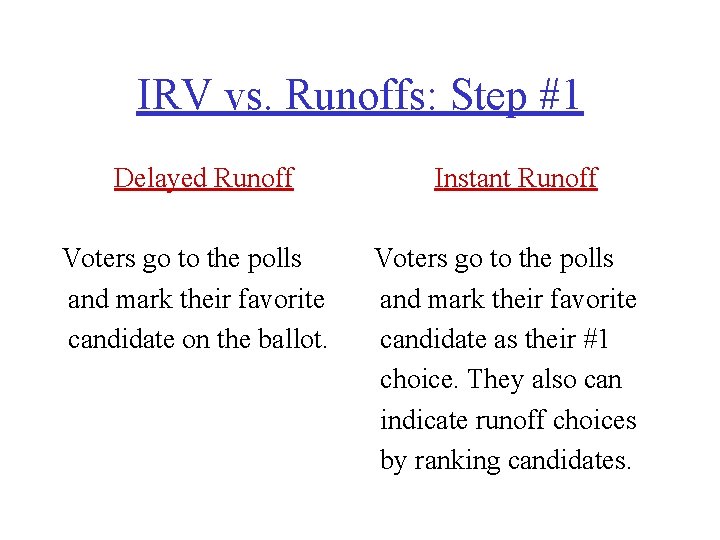
IRV vs. Runoffs: Step #1 Delayed Runoff Voters go to the polls and mark their favorite candidate on the ballot. Instant Runoff Voters go to the polls and mark their favorite candidate as their #1 choice. They also can indicate runoff choices by ranking candidates.
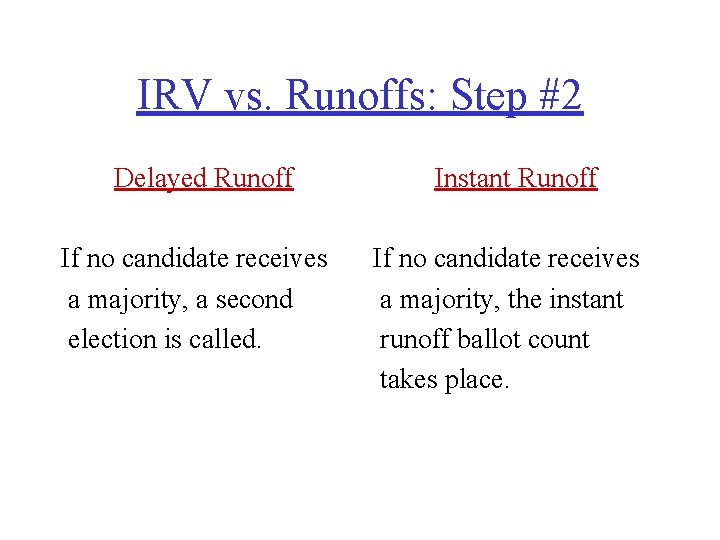
IRV vs. Runoffs: Step #2 Delayed Runoff If no candidate receives a majority, a second election is called. Instant Runoff If no candidate receives a majority, the instant runoff ballot count takes place.

IRV vs. Runoffs: Step #3 Delayed Runoff Instant Runoff Candidates resume raising money and campaigning. New ballots are printed and polling stations set up again. Voter turnout usually drops. Skip step 3.
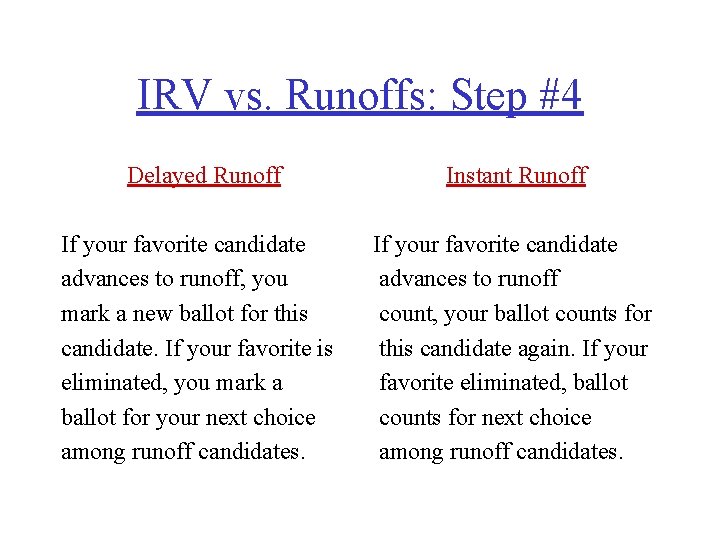
IRV vs. Runoffs: Step #4 Delayed Runoff Instant Runoff If your favorite candidate advances to runoff, you mark a new ballot for this candidate. If your favorite is eliminated, you mark a ballot for your next choice among runoff candidates. If your favorite candidate advances to runoff count, your ballot counts for this candidate again. If your favorite eliminated, ballot counts for next choice among runoff candidates.
IRV vs. Runoffs: Step #5 Delayed Runoff The candidate with the majority of the votes (of those voting in runoff election) wins. Instant Runoff The candidate with the majority of the votes wins.
IRV vs. Runoffs: Summary Delayed Runoff Instant Runoff • Requires tax dollars • Saves tax dollars • Extends campaign • One election, not two • Inconvenient for voters • More convenient for voters / administrators • Lower turnout in decisive elections • Maximizes turnout in decisive election
Addressing Concerns: Voters and Administrators Can Handle IRV • Low voter error rate where IRV used • Voter education timely with 2004 elections • Voting equipment vendors are telling jurisdictions they can support IRV • One-time costs for transition to IRV still less expensive than one year of runoffs
Runoffs in Florida: A Few Facts • Winners in multi-candidate state primaries are very likely to win the general election • Multi-candidate primaries are not unusual • With runoffs, frontrunning candidates after the first primary will sometimes lose • Voter turnout almost always drops significantly in down-ballot races that go to runoffs
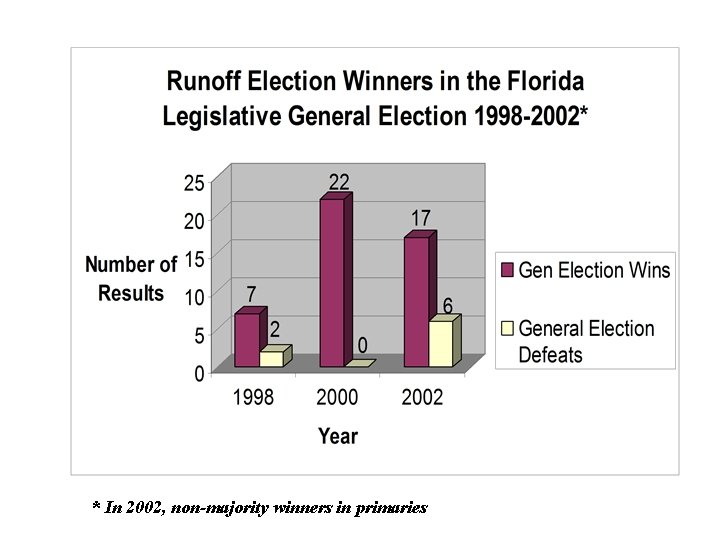
* In 2002, non-majority winners in primaries
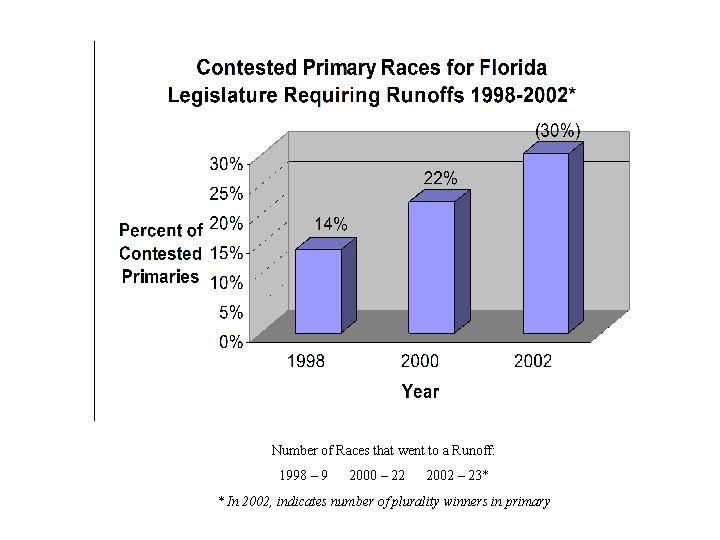
Number of Races that went to a Runoff: 1998 – 9 2000 – 22 2002 – 23* * In 2002, indicates number of plurality winners in primary
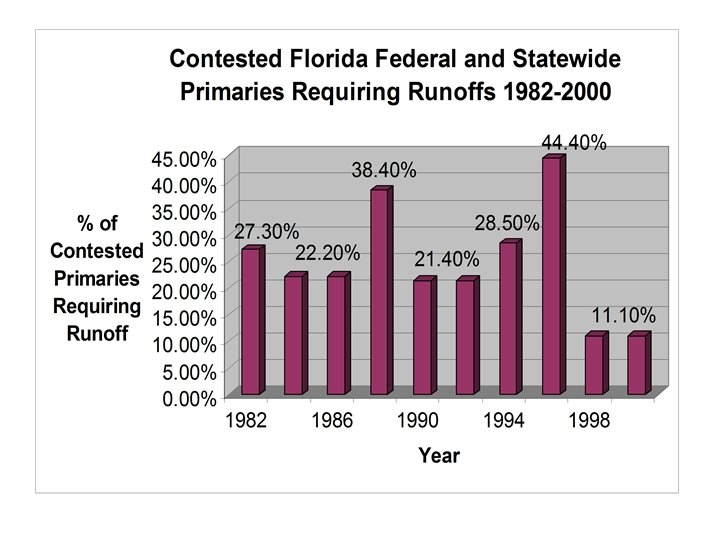
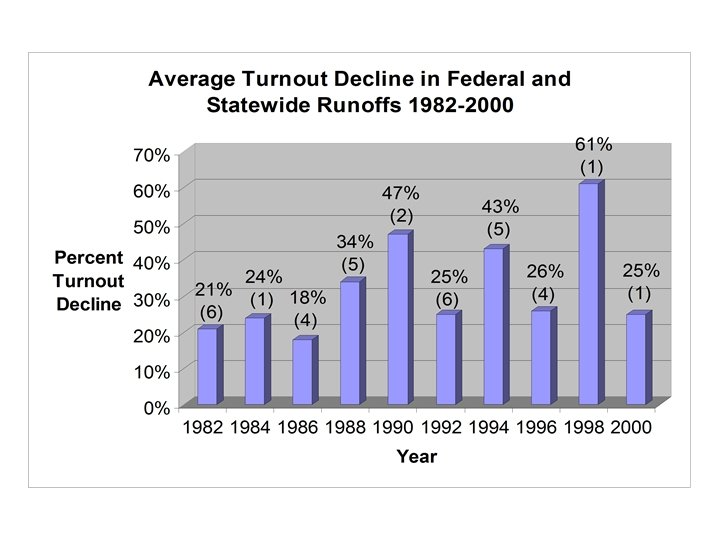
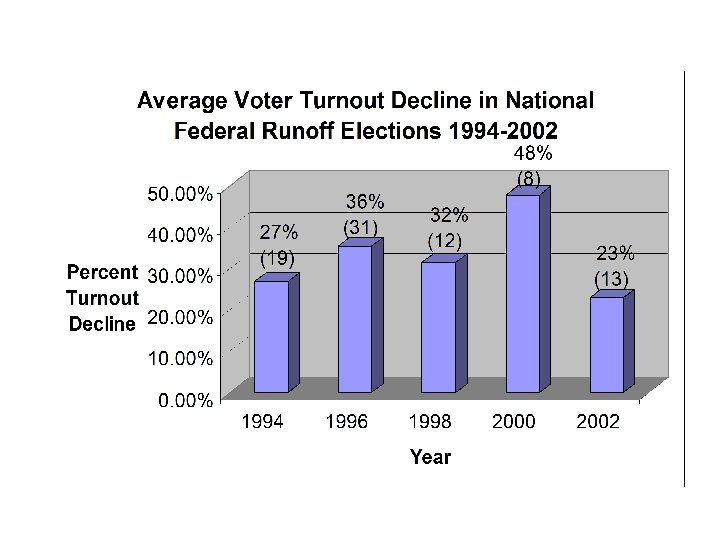
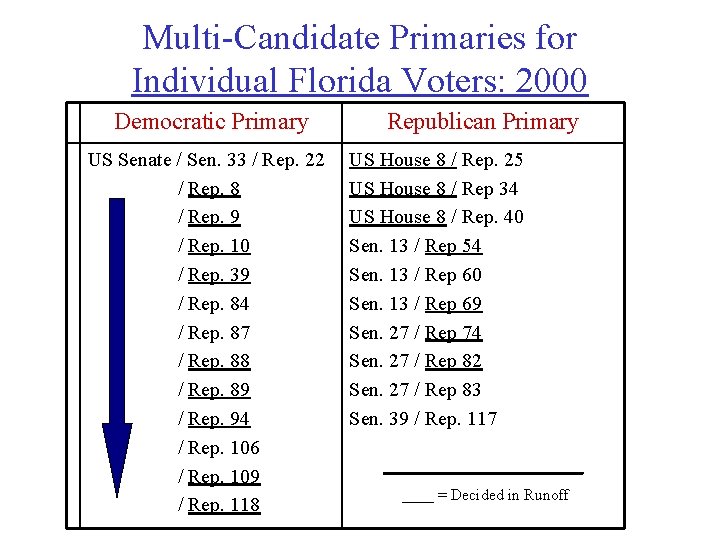
Multi-Candidate Primaries for Individual Florida Voters: 2000 Democratic Primary US Senate / Sen. 33 / Rep. 22 / Rep. 8 / Rep. 9 / Rep. 10 / Rep. 39 / Rep. 84 / Rep. 87 / Rep. 88 / Rep. 89 / Rep. 94 / Rep. 106 / Rep. 109 / Rep. 118 Republican Primary US House 8 / Rep. 25 US House 8 / Rep 34 US House 8 / Rep. 40 Sen. 13 / Rep 54 Sen. 13 / Rep 60 Sen. 13 / Rep 69 Sen. 27 / Rep 74 Sen. 27 / Rep 82 Sen. 27 / Rep 83 Sen. 39 / Rep. 117 __________ = Decided in Runoff
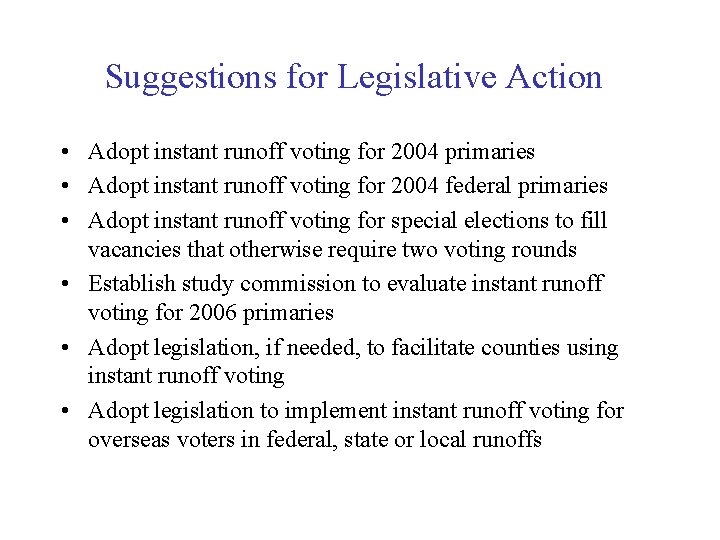
Suggestions for Legislative Action • Adopt instant runoff voting for 2004 primaries • Adopt instant runoff voting for 2004 federal primaries • Adopt instant runoff voting for special elections to fill vacancies that otherwise require two voting rounds • Establish study commission to evaluate instant runoff voting for 2006 primaries • Adopt legislation, if needed, to facilitate counties using instant runoff voting • Adopt legislation to implement instant runoff voting for overseas voters in federal, state or local runoffs
For More Information The Center for Voting and Democracy 6930 Carroll Avenue, Suite 610 Takoma Park, MD 20912 (301) 270 -4161 www. fairvote. org/irv
- Slides: 25