
Instant Radiosity Alexander Keller University Kaiserslautern Present by
Instant Radiosity Alexander Keller University Kaiserslautern Present by Li-Fong Lin
Outline • • • Global Illumination Quai-Monte Carlo Integration Algorithm Extensions Reasults
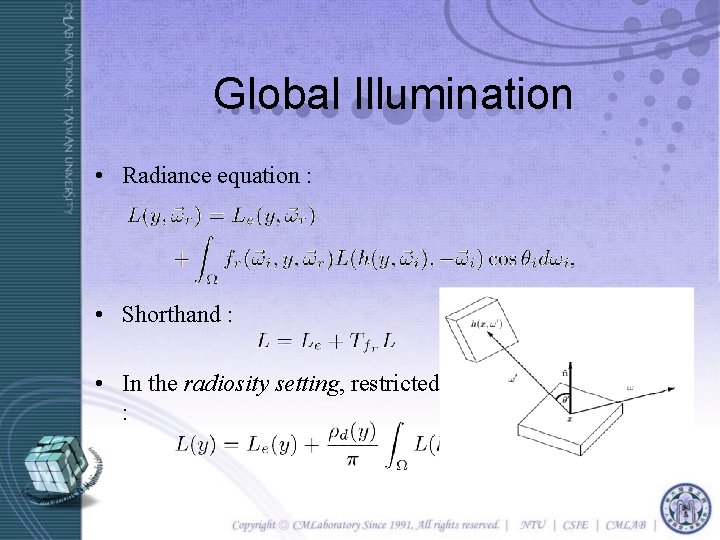
Global Illumination • Radiance equation : • Shorthand : • In the radiosity setting, restricted to only diffuse reflection :

Global Illumination • Detector functional Ψ: the sum of orthonormal base vectors of a finite vector space. • Directly select the function below in this paper
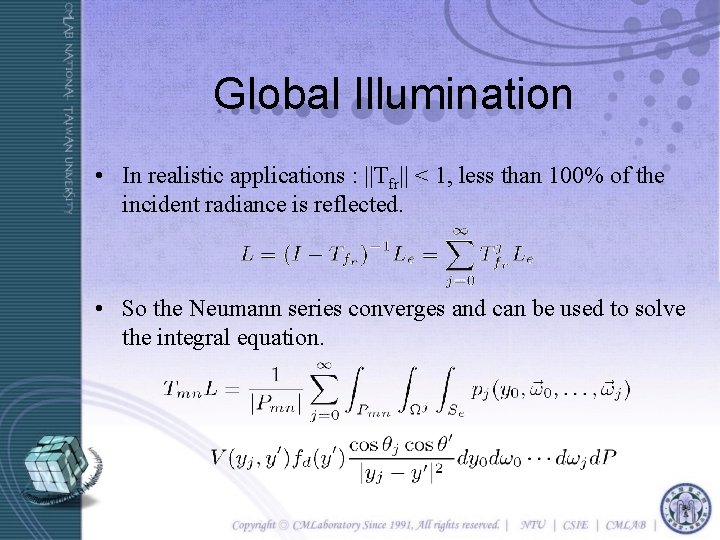
Global Illumination • In realistic applications : ||Tfr|| < 1, less than 100% of the incident radiance is reflected. • So the Neumann series converges and can be used to solve the integral equation.
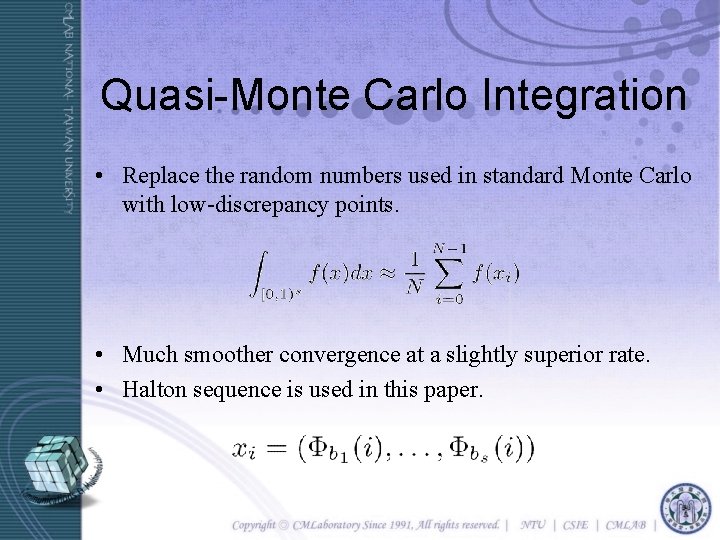
Quasi-Monte Carlo Integration • Replace the random numbers used in standard Monte Carlo with low-discrepancy points. • Much smoother convergence at a slightly superior rate. • Halton sequence is used in this paper.

van der Corput sequence
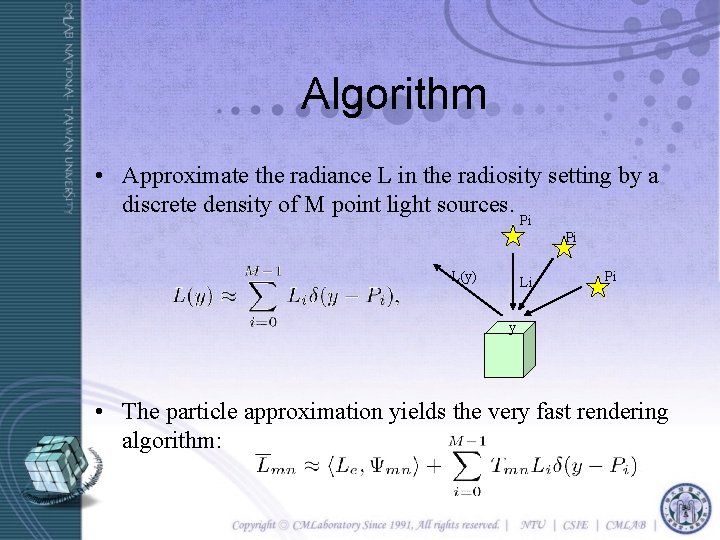
Algorithm • Approximate the radiance L in the radiosity setting by a discrete density of M point light sources. Pi Pi L(y) Li Pi y • The particle approximation yields the very fast rendering algorithm:
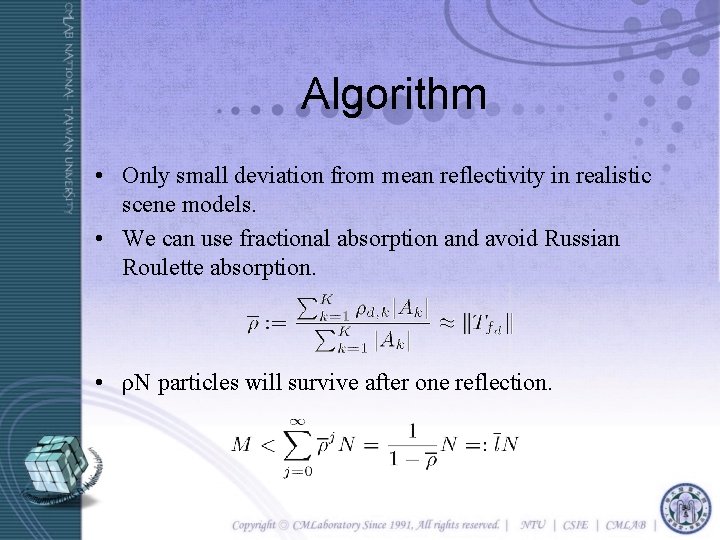
Algorithm • Only small deviation from mean reflectivity in realistic scene models. • We can use fractional absorption and avoid Russian Roulette absorption. • ρN particles will survive after one reflection.
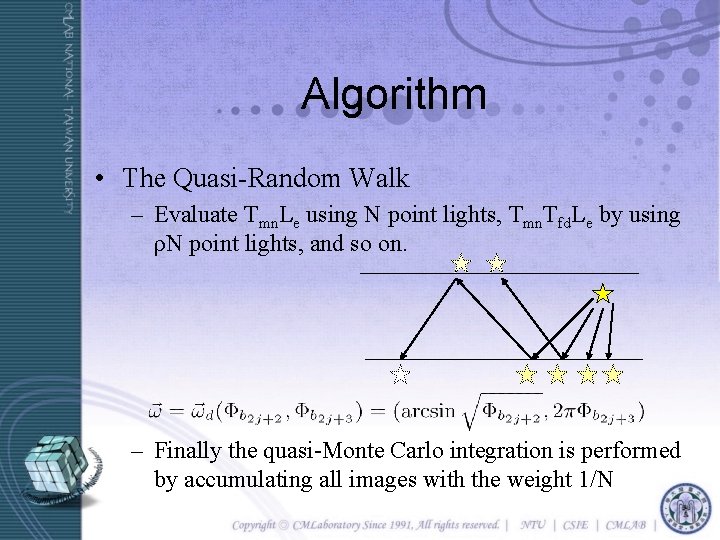
Algorithm • The Quasi-Random Walk – Evaluate Tmn. Le using N point lights, Tmn. Tfd. Le by using ρN point lights, and so on. – Finally the quasi-Monte Carlo integration is performed by accumulating all images with the weight 1/N
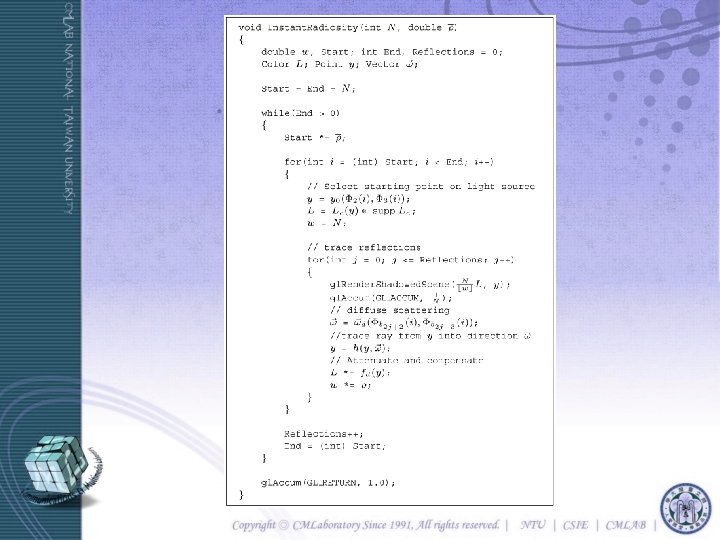
Pseudo-Code
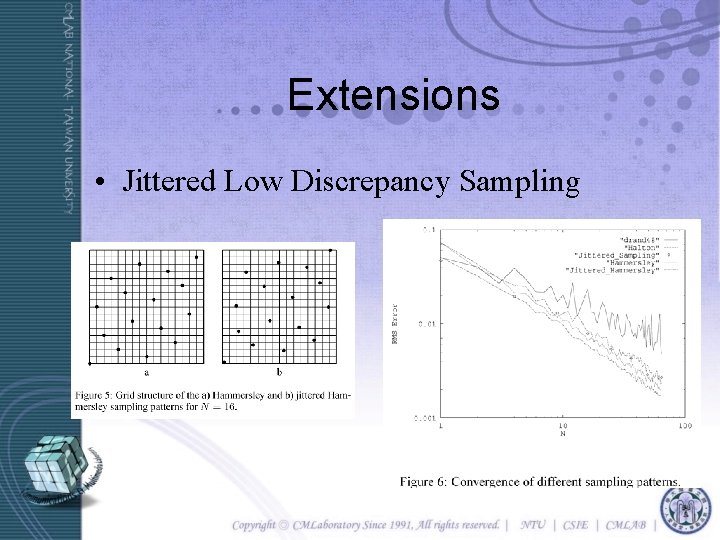
Extensions • Jittered Low Discrepancy Sampling
Extensions • Specular Effects – By a random decision each surface is tested to be specular or diffuse according to its BRDF. – Mirror the origin ray by the specular surface. • Realtime Walkthroughs – In an animated environment, trace fixed length paths. – Keeping the last N images of the last N paths, the oldest image is replaced by the new one each time. – Render the global diffuse illumination (only direct illumination) into textures, then can be displayed interactively.
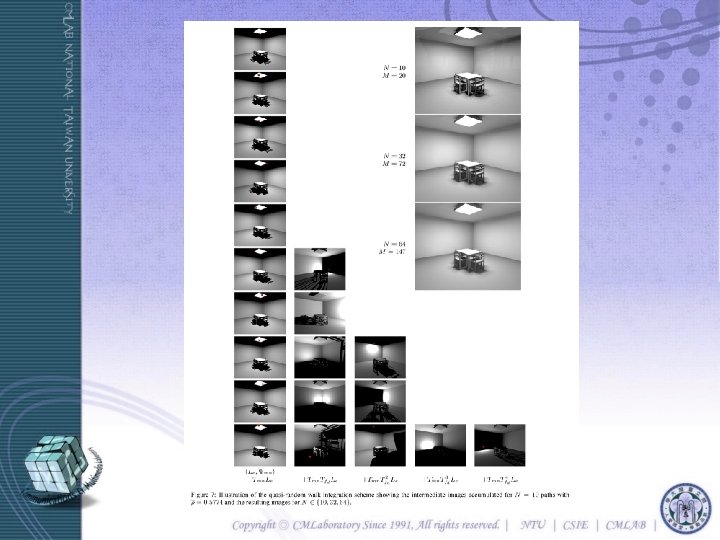
Results
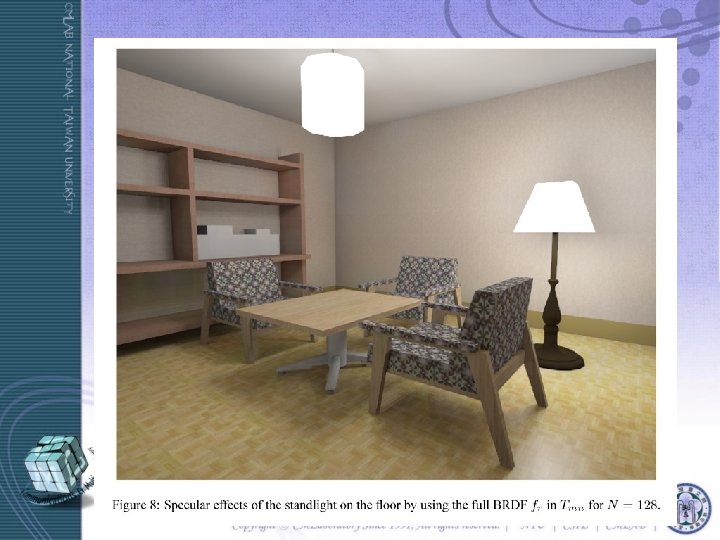
Results
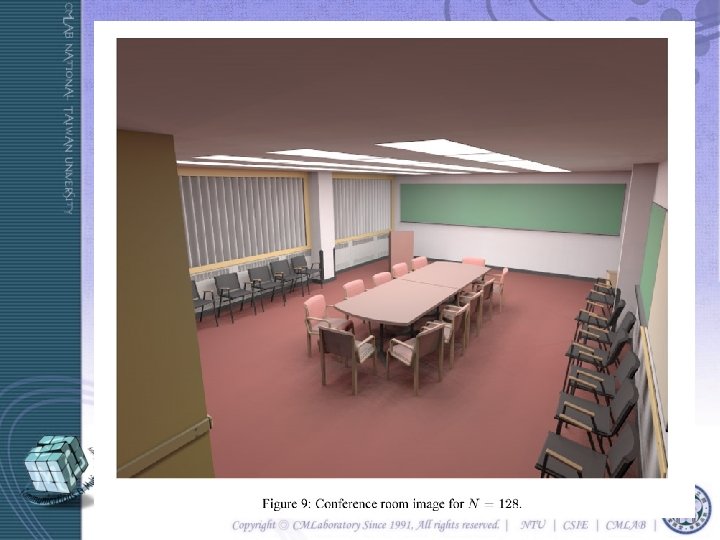
Results
- Slides: 16