
Installing Plunger Lift in Gas Wells Lessons Learned
- Slides: 21
Installing Plunger Lift in Gas Wells Lessons Learned from Natural Gas STAR Exploration & Production, Gulf Coast Environmental Affairs Group, American Petroleum Institute and EPA’s Natural Gas STAR Program June 19, 2003
Installing Plunger Lift in Gas Wells p Methane Losses p Methane Recovery p Is Recovery Profitable? p Industry Experience p Discussion Questions Reducing Emissions, Increasing Efficiency, Maximizing Profits Page 2
What is the Problem? p There approximately 316, 000 condensate and natural gas wells (on and offshore) in the U. S. p Accumulation of liquid hydrocarbons or water in the well bores of gas wells reduces and can halt production p Common practices to temporarily restore production vent significant quantities of methane Reducing Emissions, Increasing Efficiency, Maximizing Profits Page 3
Methane Emissions p By venting, or “blowing” the well to the atmosphere, a high volume of gas entrains accumulated liquids to the surface p Methane is released to the atmosphere along with the gas p On average, 50 to 600 Mcf of methane per well may be emitted each year p To date, about 6 Bcf/yr of gas is being saved with plunger lift installations Reducing Emissions, Increasing Efficiency, Maximizing Profits Page 4
How Can Plunger Lifts Reduce Methane Emissions? p Plunger lifts automatically produce liquids without blowing the well to the atmosphere p Gas pressure stored in the casing annulus periodically pushes the plunger and liquid load from the well bottom to surface vessels p Wells with the right combination of shut-in pressure, depth and liquid accumulation are kept productive without operator attention p Other wells can use injected gas lift more efficiently with a plunger lift system Reducing Emissions, Increasing Efficiency, Maximizing Profits Page 5
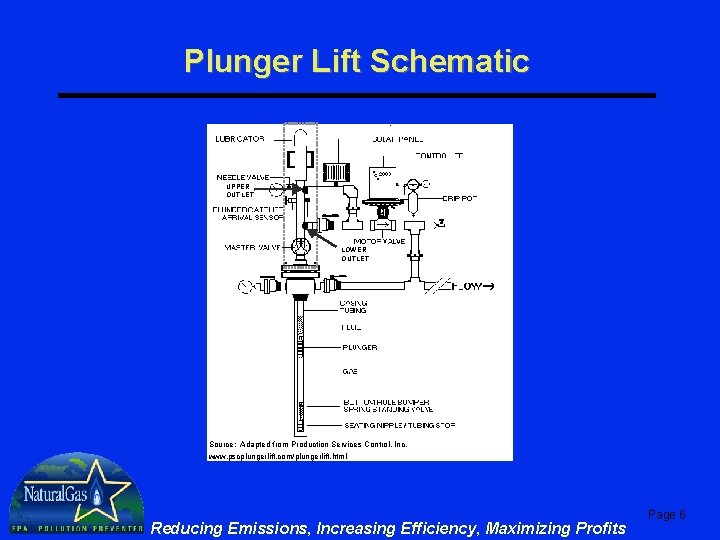
Plunger Lift Schematic UPPER OUTLET LOWER OUTLET Source: Adapted from Production Services Control, Inc. www. pscplungerlift. com/plungerlift. html Reducing Emissions, Increasing Efficiency, Maximizing Profits Page 6
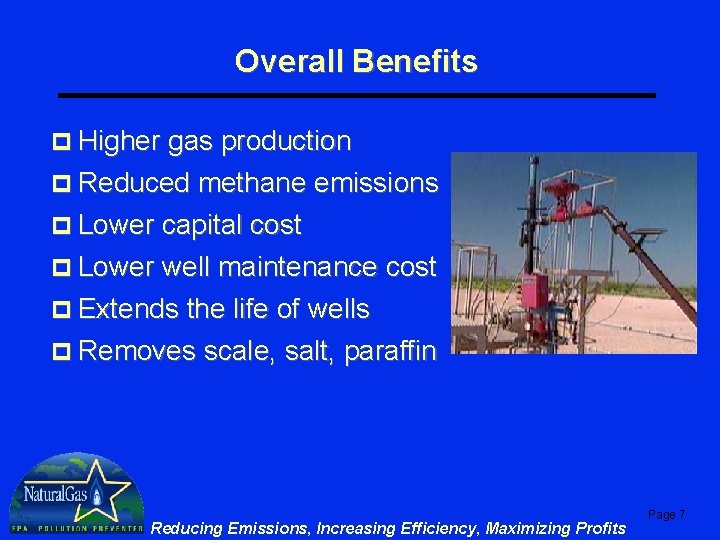
Overall Benefits p Higher gas production p Reduced methane emissions p Lower capital cost p Lower well maintenance cost p Extends the life of wells p Removes scale, salt, paraffin Reducing Emissions, Increasing Efficiency, Maximizing Profits Page 7
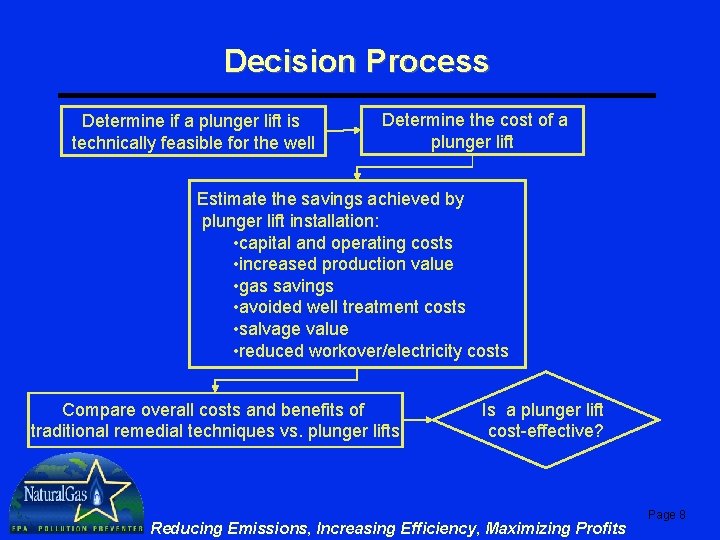
Decision Process Determine if a plunger lift is technically feasible for the well Determine the cost of a plunger lift Estimate the savings achieved by plunger lift installation: • capital and operating costs • increased production value • gas savings • avoided well treatment costs • salvage value • reduced workover/electricity costs Compare overall costs and benefits of traditional remedial techniques vs. plunger lifts Is a plunger lift cost-effective? Reducing Emissions, Increasing Efficiency, Maximizing Profits Page 8
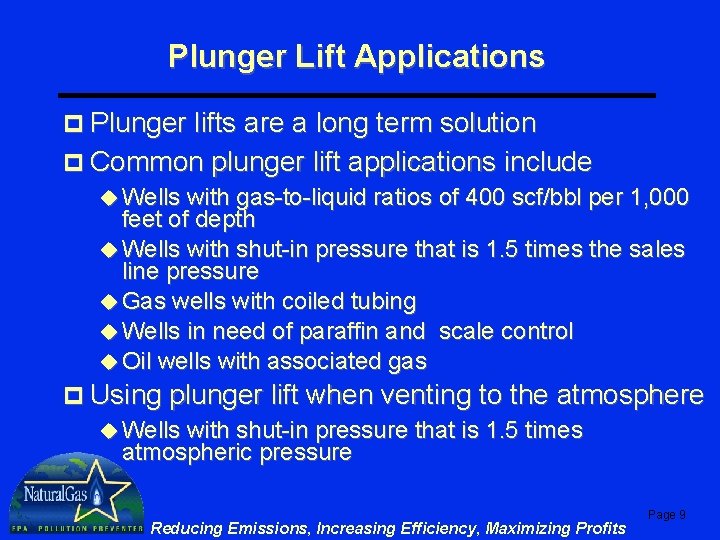
Plunger Lift Applications p Plunger lifts are a long term solution p Common plunger lift applications include u Wells with gas-to-liquid ratios of 400 scf/bbl per 1, 000 feet of depth u Wells with shut-in pressure that is 1. 5 times the sales line pressure u Gas wells with coiled tubing u Wells in need of paraffin and scale control u Oil wells with associated gas p Using plunger lift when venting to the atmosphere u Wells with shut-in pressure that is 1. 5 times atmospheric pressure Reducing Emissions, Increasing Efficiency, Maximizing Profits Page 9
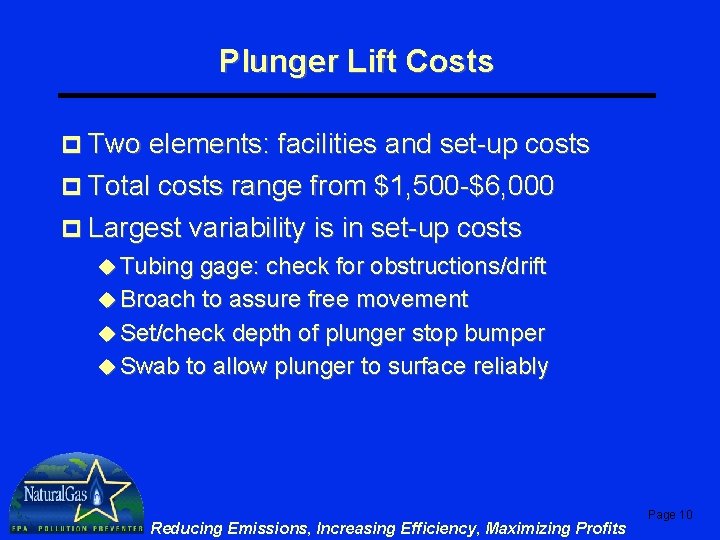
Plunger Lift Costs p Two elements: facilities and set-up costs p Total costs range from $1, 500 -$6, 000 p Largest variability is in set-up costs u Tubing gage: check for obstructions/drift u Broach to assure free movement u Set/check depth of plunger stop bumper u Swab to allow plunger to surface reliably Reducing Emissions, Increasing Efficiency, Maximizing Profits Page 10
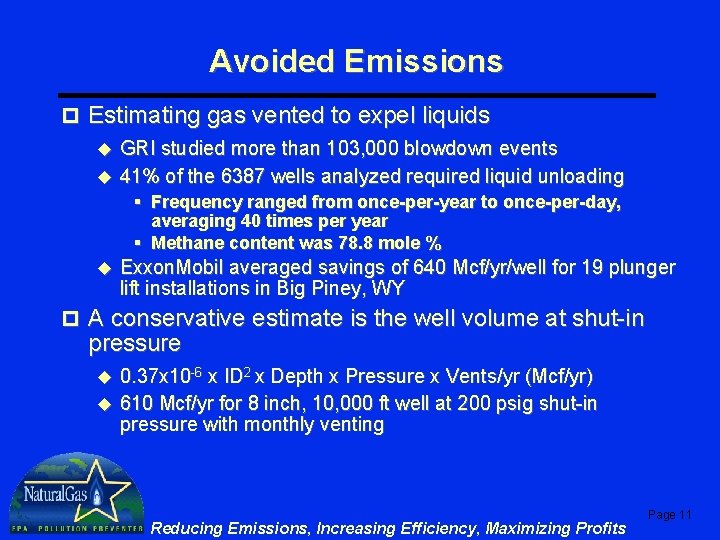
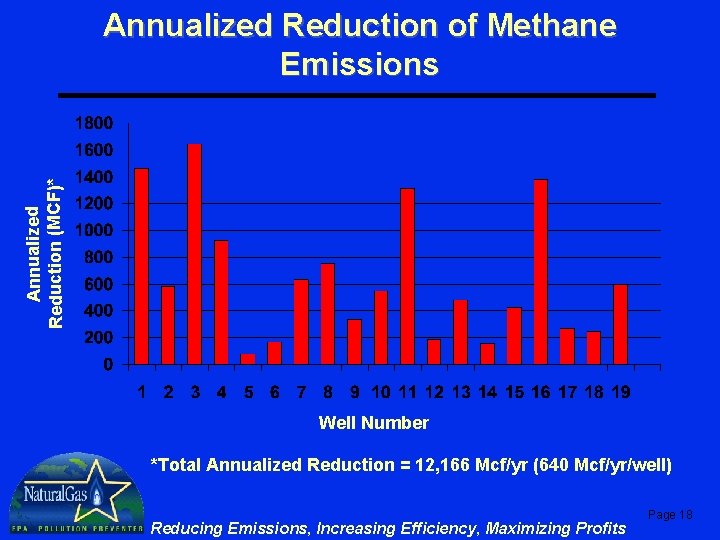
Avoided Emissions p Estimating gas vented to expel liquids u GRI studied more than 103, 000 blowdown events u 41% of the 6387 wells analyzed required liquid unloading § Frequency ranged from once-per-year to once-per-day, averaging 40 times per year § Methane content was 78. 8 mole % u Exxon. Mobil averaged savings of 640 Mcf/yr/well for 19 plunger lift installations in Big Piney, WY p A conservative estimate is the well volume at shut-in pressure 0. 37 x 10 -6 x ID 2 x Depth x Pressure x Vents/yr (Mcf/yr) u 610 Mcf/yr for 8 inch, 10, 000 ft well at 200 psig shut-in pressure with monthly venting u Reducing Emissions, Increasing Efficiency, Maximizing Profits Page 11
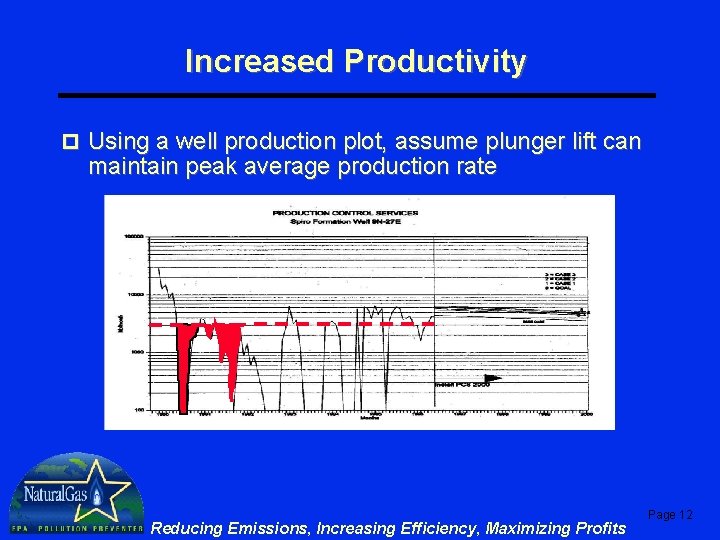
Increased Productivity p Using a well production plot, assume plunger lift can maintain peak average production rate Reducing Emissions, Increasing Efficiency, Maximizing Profits Page 12
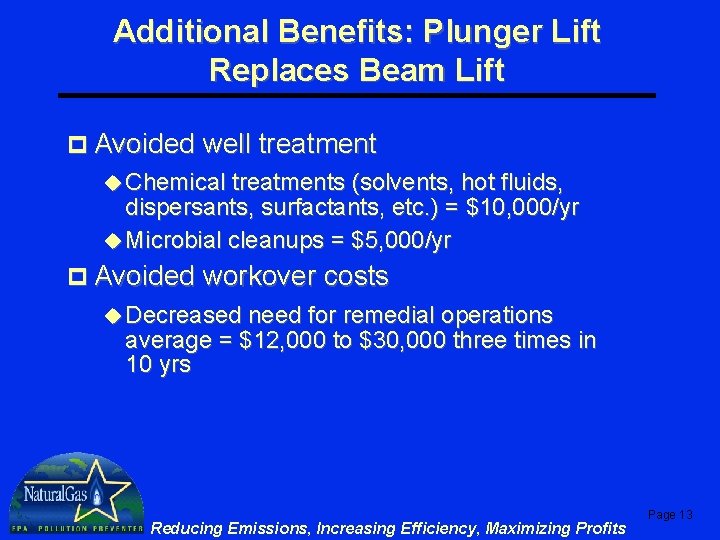
Additional Benefits: Plunger Lift Replaces Beam Lift p Avoided well treatment u Chemical treatments (solvents, hot fluids, dispersants, surfactants, etc. ) = $10, 000/yr u Microbial cleanups = $5, 000/yr p Avoided workover costs u Decreased need for remedial operations average = $12, 000 to $30, 000 three times in 10 yrs Reducing Emissions, Increasing Efficiency, Maximizing Profits Page 13
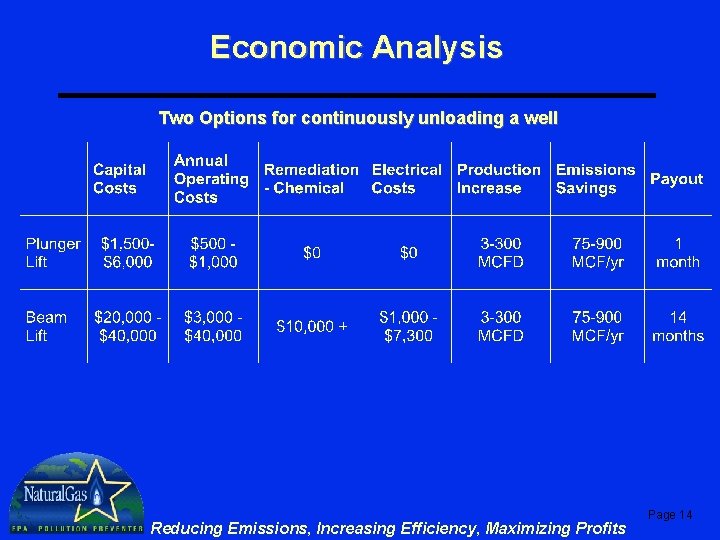
Economic Analysis Two Options for continuously unloading a well Reducing Emissions, Increasing Efficiency, Maximizing Profits Page 14
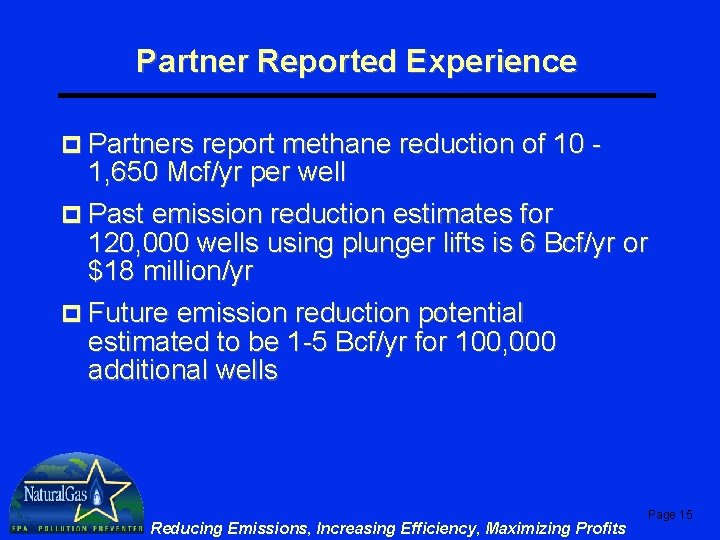
Partner Reported Experience p Partners report methane reduction of 10 - 1, 650 Mcf/yr per well p Past emission reduction estimates for 120, 000 wells using plunger lifts is 6 Bcf/yr or $18 million/yr p Future emission reduction potential estimated to be 1 -5 Bcf/yr for 100, 000 additional wells Reducing Emissions, Increasing Efficiency, Maximizing Profits Page 15
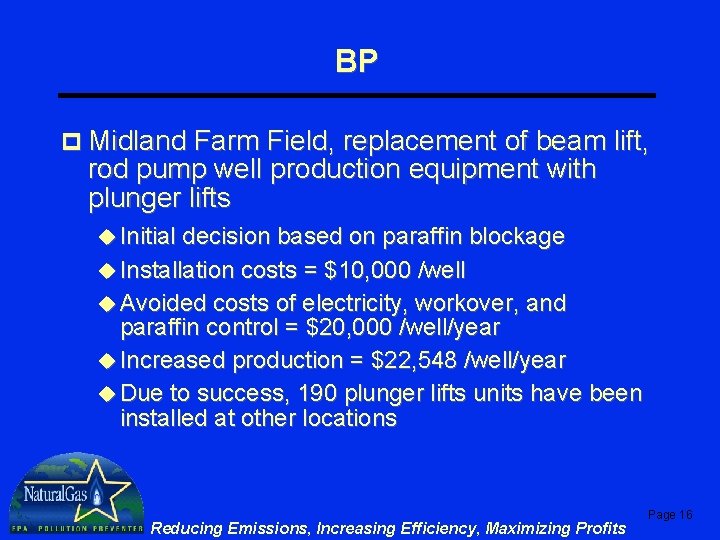
BP p Midland Farm Field, replacement of beam lift, rod pump well production equipment with plunger lifts u Initial decision based on paraffin blockage u Installation costs = $10, 000 /well u Avoided costs of electricity, workover, and paraffin control = $20, 000 /well/year u Increased production = $22, 548 /well/year u Due to success, 190 plunger lifts units have been installed at other locations Reducing Emissions, Increasing Efficiency, Maximizing Profits Page 16
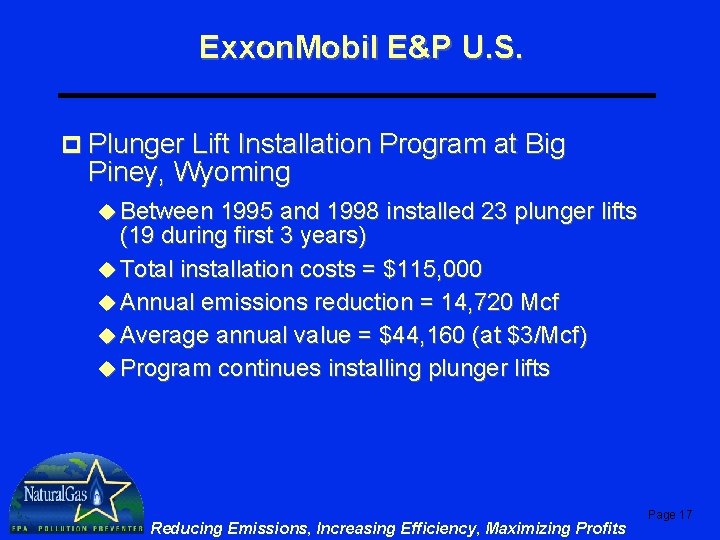
Exxon. Mobil E&P U. S. p Plunger Lift Installation Program at Big Piney, Wyoming u Between 1995 and 1998 installed 23 plunger lifts (19 during first 3 years) u Total installation costs = $115, 000 u Annual emissions reduction = 14, 720 Mcf u Average annual value = $44, 160 (at $3/Mcf) u Program continues installing plunger lifts Reducing Emissions, Increasing Efficiency, Maximizing Profits Page 17
Annualized Reduction (MCF)* Annualized Reduction of Methane Emissions Well Number *Total Annualized Reduction = 12, 166 Mcf/yr (640 Mcf/yr/well) Reducing Emissions, Increasing Efficiency, Maximizing Profits Page 18
Lessons Learned p Most remedial actions (many of which can be replaced by plunger lifts) are costly, repetitive, and lead to excessive gas emissions p Plunger lift installations reduce the amount of remedial work needed throughout the lifetime of the well, and the amount of methane releases Reducing Emissions, Increasing Efficiency, Maximizing Profits Page 19
Lessons Learned p An economic analysis of plunger lift installation should include incremental boost in productivity and associated extension of well life p Plunger lift installations can offer quick paybacks and high return on investments Reducing Emissions, Increasing Efficiency, Maximizing Profits Page 20
Discussion Questions p To what extent are you implementing this technology? p How can the Lessons Learned study be improved upon or altered for use in your operation(s)? p What are the barriers (technological, economic, lack of information, regulatory, etc. ) that are preventing you from implementing this technology? Reducing Emissions, Increasing Efficiency, Maximizing Profits Page 21