
inst eecs berkeley educs 61 c UCB CS
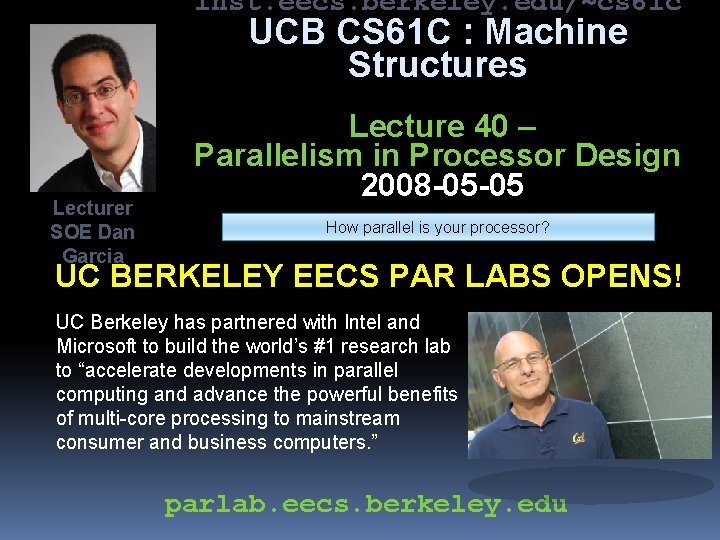
inst. eecs. berkeley. edu/~cs 61 c UCB CS 61 C : Machine Structures Lecturer SOE Dan Garcia Lecture 40 – Parallelism in Processor Design 2008 -05 -05 How parallel is your processor? UC BERKELEY EECS PAR LABS OPENS! UC Berkeley has partnered with Intel and Microsoft to build the world’s #1 research lab to “accelerate developments in parallel computing and advance the powerful benefits of multi-core processing to mainstream consumer and business computers. ” parlab. eecs. berkeley. edu
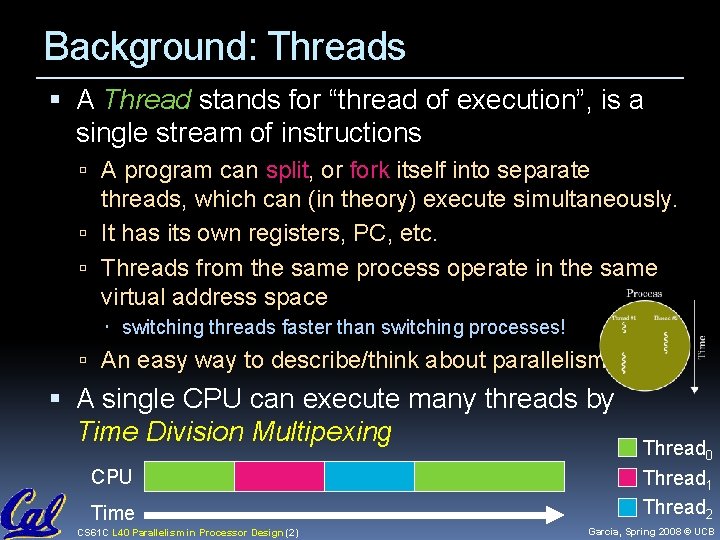
Background: Threads A Thread stands for “thread of execution”, is a single stream of instructions A program can split, or fork itself into separate threads, which can (in theory) execute simultaneously. It has its own registers, PC, etc. Threads from the same process operate in the same virtual address space switching threads faster than switching processes! An easy way to describe/think about parallelism A single CPU can execute many threads by Time Division Multipexing CPU Time CS 61 C L 40 Parallelism in Processor Design (2) Thread 0 Thread 1 Thread 2 Garcia, Spring 2008 © UCB
Background: Multithreading is running multiple threads through the same hardware Could we do Time Division Multipexing better in hardware? Sure, if we had the HW to support it! CS 61 C L 40 Parallelism in Processor Design (3) Garcia, Spring 2008 © UCB
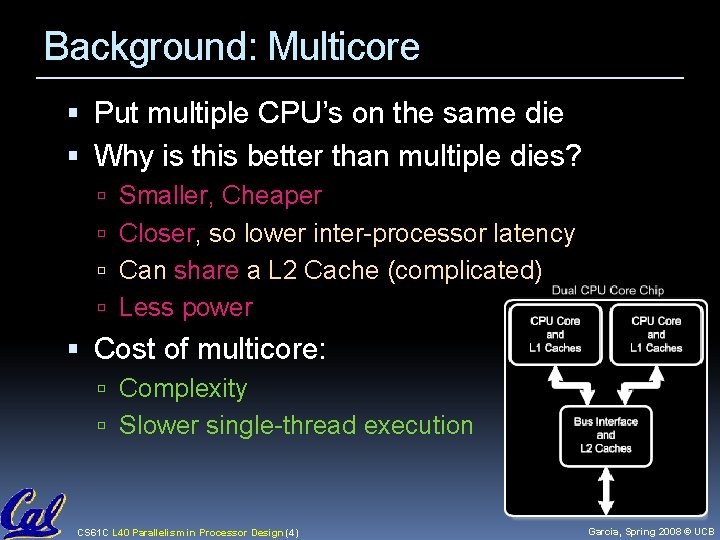
Background: Multicore Put multiple CPU’s on the same die Why is this better than multiple dies? Smaller, Cheaper Closer, so lower inter-processor latency Can share a L 2 Cache (complicated) Less power Cost of multicore: Complexity Slower single-thread execution CS 61 C L 40 Parallelism in Processor Design (4) Garcia, Spring 2008 © UCB
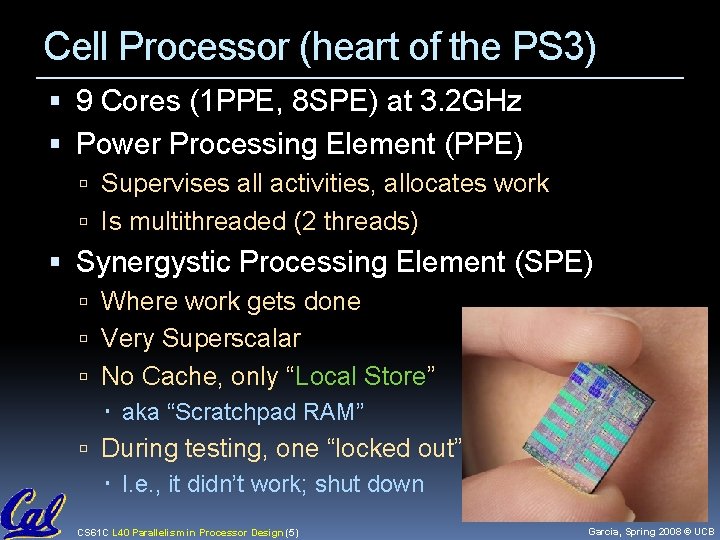
Cell Processor (heart of the PS 3) 9 Cores (1 PPE, 8 SPE) at 3. 2 GHz Power Processing Element (PPE) Supervises all activities, allocates work Is multithreaded (2 threads) Synergystic Processing Element (SPE) Where work gets done Very Superscalar No Cache, only “Local Store” aka “Scratchpad RAM” During testing, one “locked out” I. e. , it didn’t work; shut down CS 61 C L 40 Parallelism in Processor Design (5) Garcia, Spring 2008 © UCB
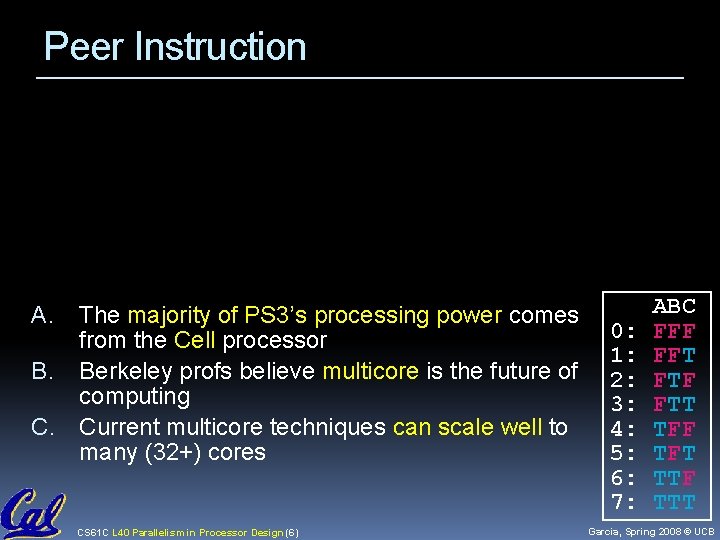
Peer Instruction A. The majority of PS 3’s processing power comes from the Cell processor B. Berkeley profs believe multicore is the future of computing C. Current multicore techniques can scale well to many (32+) cores CS 61 C L 40 Parallelism in Processor Design (6) 0: 1: 2: 3: 4: 5: 6: 7: ABC FFF FFT FTF FTT TFF TFT TTF TTT Garcia, Spring 2008 © UCB
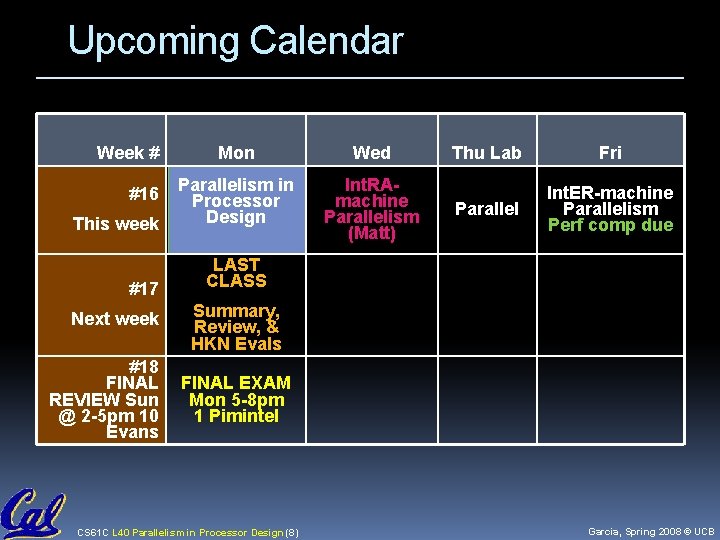
Upcoming Calendar Week # #16 This week #17 Next week #18 FINAL REVIEW Sun @ 2 -5 pm 10 Evans Mon Wed Parallelism in Processor Design Int. RAmachine Parallelism (Matt) Thu Lab Fri Parallel Int. ER-machine Parallelism Perf comp due LAST CLASS Summary, Review, & HKN Evals FINAL EXAM Mon 5 -8 pm 1 Pimintel CS 61 C L 40 Parallelism in Processor Design (8) Garcia, Spring 2008 © UCB
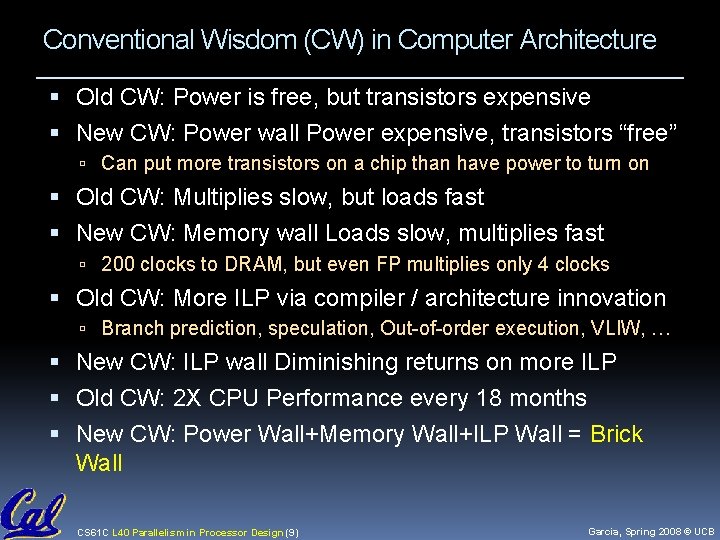
Conventional Wisdom (CW) in Computer Architecture Old CW: Power is free, but transistors expensive New CW: Power wall Power expensive, transistors “free” Can put more transistors on a chip than have power to turn on Old CW: Multiplies slow, but loads fast New CW: Memory wall Loads slow, multiplies fast 200 clocks to DRAM, but even FP multiplies only 4 clocks Old CW: More ILP via compiler / architecture innovation Branch prediction, speculation, Out-of-order execution, VLIW, … New CW: ILP wall Diminishing returns on more ILP Old CW: 2 X CPU Performance every 18 months New CW: Power Wall+Memory Wall+ILP Wall = Brick Wall CS 61 C L 40 Parallelism in Processor Design (9) Garcia, Spring 2008 © UCB
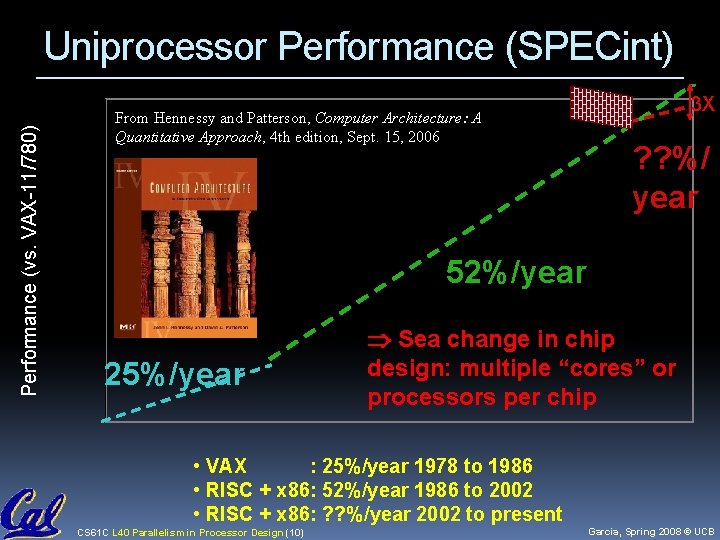
Performance (vs. VAX-11/780) CS 61 C L 40 Parallelism in Processor Design (10) Garcia, Spring 2008 © UCB
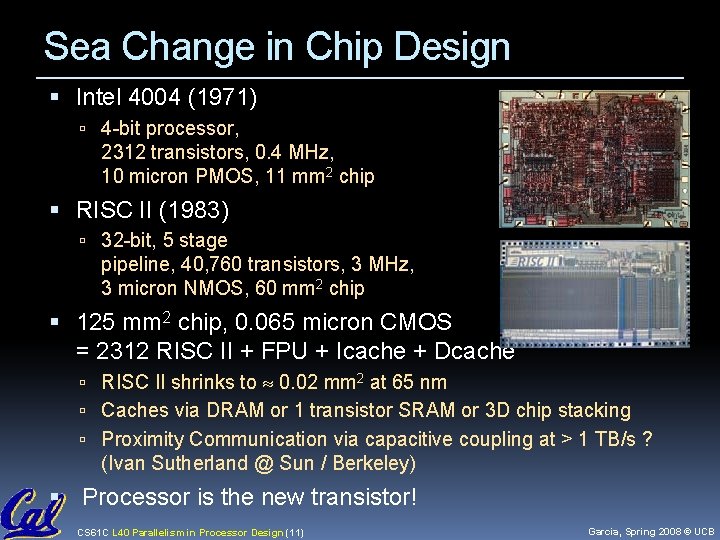
Sea Change in Chip Design Intel 4004 (1971) 4 -bit processor, 2312 transistors, 0. 4 MHz, 10 micron PMOS, 11 mm 2 chip RISC II (1983) 32 -bit, 5 stage pipeline, 40, 760 transistors, 3 MHz, 3 micron NMOS, 60 mm 2 chip 125 mm 2 chip, 0. 065 micron CMOS = 2312 RISC II + FPU + Icache + Dcache RISC II shrinks to 0. 02 mm 2 at 65 nm Caches via DRAM or 1 transistor SRAM or 3 D chip stacking Proximity Communication via capacitive coupling at > 1 TB/s ? (Ivan Sutherland @ Sun / Berkeley) Processor is the new transistor! CS 61 C L 40 Parallelism in Processor Design (11) Garcia, Spring 2008 © UCB
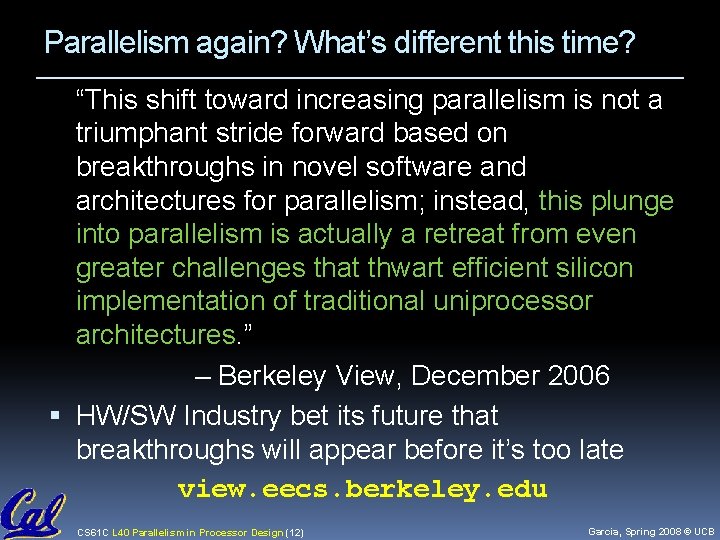
Parallelism again? What’s different this time? “This shift toward increasing parallelism is not a triumphant stride forward based on breakthroughs in novel software and architectures for parallelism; instead, this plunge into parallelism is actually a retreat from even greater challenges that thwart efficient silicon implementation of traditional uniprocessor architectures. ” – Berkeley View, December 2006 HW/SW Industry bet its future that breakthroughs will appear before it’s too late view. eecs. berkeley. edu CS 61 C L 40 Parallelism in Processor Design (12) Garcia, Spring 2008 © UCB
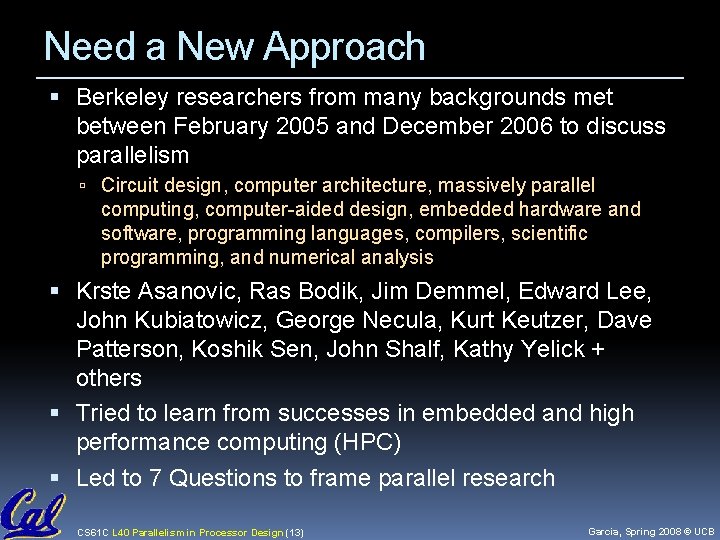
Need a New Approach Berkeley researchers from many backgrounds met between February 2005 and December 2006 to discuss parallelism Circuit design, computer architecture, massively parallel computing, computer-aided design, embedded hardware and software, programming languages, compilers, scientific programming, and numerical analysis Krste Asanovic, Ras Bodik, Jim Demmel, Edward Lee, John Kubiatowicz, George Necula, Kurt Keutzer, Dave Patterson, Koshik Sen, John Shalf, Kathy Yelick + others Tried to learn from successes in embedded and high performance computing (HPC) Led to 7 Questions to frame parallel research CS 61 C L 40 Parallelism in Processor Design (13) Garcia, Spring 2008 © UCB
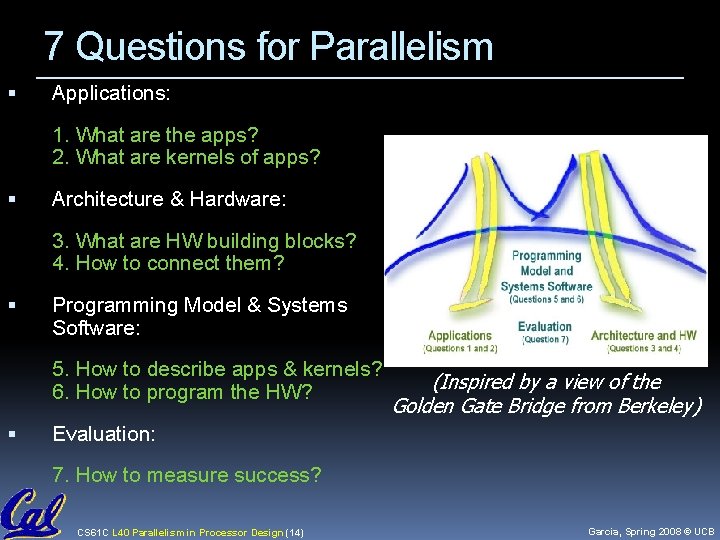
7 Questions for Parallelism Applications: 1. What are the apps? 2. What are kernels of apps? Architecture & Hardware: 3. What are HW building blocks? 4. How to connect them? Programming Model & Systems Software: 5. How to describe apps & kernels? 6. How to program the HW? (Inspired by a view of the Golden Gate Bridge from Berkeley) Evaluation: 7. How to measure success? CS 61 C L 40 Parallelism in Processor Design (14) Garcia, Spring 2008 © UCB
Hardware Tower: What are problems? Power limits leading edge chip designs Intel Tejas Pentium 4 cancelled due to power issues Yield on leading edge processes dropping dramatically IBM quotes yields of 10 – 20% on 8 -processor Cell Design/validation leading edge chip is becoming unmanageable Verification teams > design teams on leading edge processors CS 61 C L 40 Parallelism in Processor Design (15) Garcia, Spring 2008 © UCB
HW Solution: Small is Beautiful Expect modestly pipelined (5 - to 9 -stage) CPUs, FPUs, vector, Single Inst Multiple Data (SIMD) Processing Elements (PEs) Small cores not much slower than large cores Parallel is energy efficient path to performance: POWER ≈ VOLTAGE 2 Lower threshold and supply voltages lowers energy per op Redundant processors can improve chip yield Cisco Metro 188 CPUs + 4 spares; Cell in PS 3 Small, regular processing elements easier to verify CS 61 C L 40 Parallelism in Processor Design (16) Garcia, Spring 2008 © UCB
Number of Cores/Socket We need revolution, not evolution Software or architecture alone can’t fix parallel programming problem, need innovations in both “Multicore” 2 X cores per generation: 2, 4, 8, … “Manycore” 100 s is highest performance per unit area, and per Watt, then 2 X per generation: 64, 128, 256, 512, 1024 … Multicore architectures & Programming Models good for 2 to 32 cores won’t evolve to Manycore systems of 1000’s of processors Desperately need HW/SW models that work for Manycore or will run out of steam (as ILP ran out of steam at 4 instructions) CS 61 C L 40 Parallelism in Processor Design (17) Garcia, Spring 2008 © UCB
Measuring Success: What are the problems? 1. Only companies can build HW; it takes years 2. Software people don’t start working hard until hardware arrives 3 months after HW arrives, SW people list everything that must be fixed, then we all wait 4 years for next iteration of HW/SW 3. How get 1000 CPU systems in hands of researchers to innovate in timely fashion on in algorithms, compilers, languages, OS, architectures, … ? 4. Can avoid waiting years between HW/SW iterations? CS 61 C L 40 Parallelism in Processor Design (18) Garcia, Spring 2008 © UCB
Build Academic Manycore from FPGAs 16 CPUs will fit in Field Programmable Gate Array (FPGA), 1000 -CPU system from 64 FPGAs? 8 32 -bit simple “soft core” RISC at 100 MHz in 2004 (Virtex-II) 2 X CPUs, 1. 2 X clock rate HW research community does logic design (“gate shareware”) to create out-of-the-box, Manycore FPGA generations every 1. 5 yrs; E. g. , 1000 processor, standard ISA binary-compatible, 64 -bit, cache-coherent supercomputer @ 150 MHz/CPU in 2007 RAMPants: 10 faculty at Berkeley, CMU, MIT, Stanford, Texas, and Washington “Research Accelerator for Multiple Processors” as a vehicle to attract many to parallel challenge CS 61 C L 40 Parallelism in Processor Design (19) Garcia, Spring 2008 © UCB
And in Conclusion… Everything is changing Old conventional wisdom is out We desperately need new approach to HW and SW based on parallelism since industry has bet its future that parallelism works Need to create a “watering hole” to bring everyone together to quickly find that solution architects, language designers, application experts, numerical analysts, algorithm designers, programmers, … CS 61 C L 40 Parallelism in Processor Design (20) Garcia, Spring 2008 © UCB
Bonus slides These are extra slides that used to be included in lecture notes, but have been moved to this, the “bonus” area to serve as a supplement. The slides will appear in the order they would have in the normal presentation CS 61 C L 40 Parallelism in Processor Design (21) Garcia, Spring 2008 © UCB
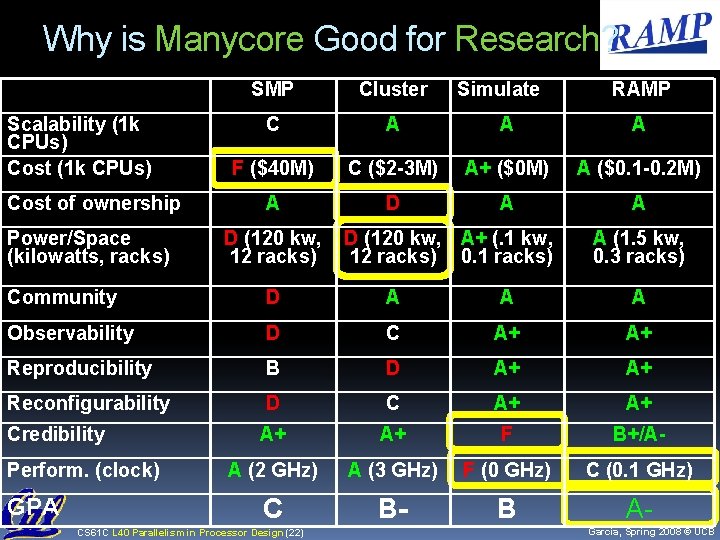
Why is Manycore Good for Research? Scalability (1 k CPUs) Cost of ownership Power/Space (kilowatts, racks) SMP Cluster C A A A F ($40 M) C ($2 -3 M) A+ ($0 M) A ($0. 1 -0. 2 M) A D A A D (120 kw, 12 racks) Simulate D (120 kw, A+ (. 1 kw, 12 racks) 0. 1 racks) RAMP A (1. 5 kw, 0. 3 racks) Community D A A A Observability D C A+ A+ Reproducibility B D A+ A+ Reconfigurability D C A+ A+ Credibility A+ A+ F B+/A- A (2 GHz) A (3 GHz) F (0 GHz) C (0. 1 GHz) C B- B A- Perform. (clock) GPA CS 61 C L 40 Parallelism in Processor Design (22) Garcia, Spring 2008 © UCB
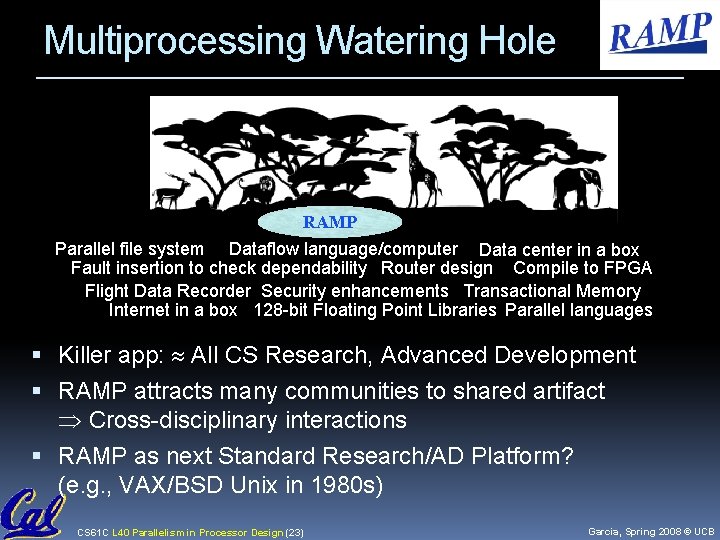
Multiprocessing Watering Hole RAMP Parallel file system Dataflow language/computer Data center in a box Fault insertion to check dependability Router design Compile to FPGA Flight Data Recorder Security enhancements Transactional Memory Internet in a box 128 -bit Floating Point Libraries Parallel languages Killer app: All CS Research, Advanced Development RAMP attracts many communities to shared artifact Cross-disciplinary interactions RAMP as next Standard Research/AD Platform? (e. g. , VAX/BSD Unix in 1980 s) CS 61 C L 40 Parallelism in Processor Design (23) Garcia, Spring 2008 © UCB
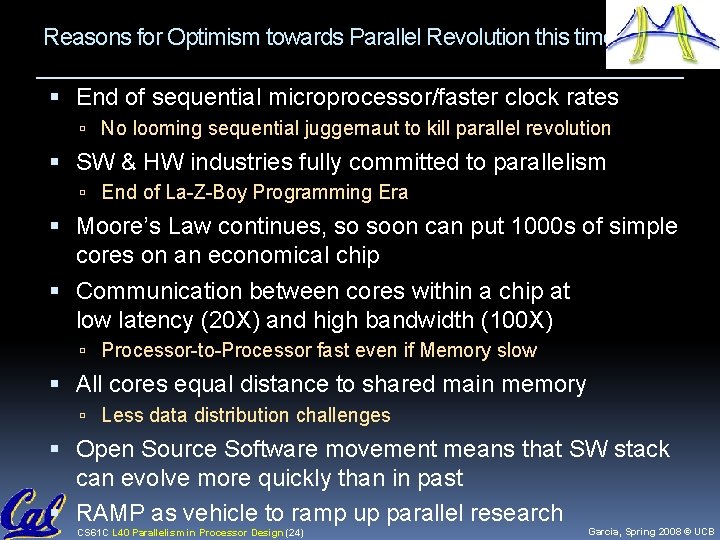
Reasons for Optimism towards Parallel Revolution this time End of sequential microprocessor/faster clock rates No looming sequential juggernaut to kill parallel revolution SW & HW industries fully committed to parallelism End of La-Z-Boy Programming Era Moore’s Law continues, so soon can put 1000 s of simple cores on an economical chip Communication between cores within a chip at low latency (20 X) and high bandwidth (100 X) Processor-to-Processor fast even if Memory slow All cores equal distance to shared main memory Less data distribution challenges Open Source Software movement means that SW stack can evolve more quickly than in past RAMP as vehicle to ramp up parallel research CS 61 C L 40 Parallelism in Processor Design (24) Garcia, Spring 2008 © UCB
- Slides: 23