
inst eecs berkeley educs 61 c UCB CS
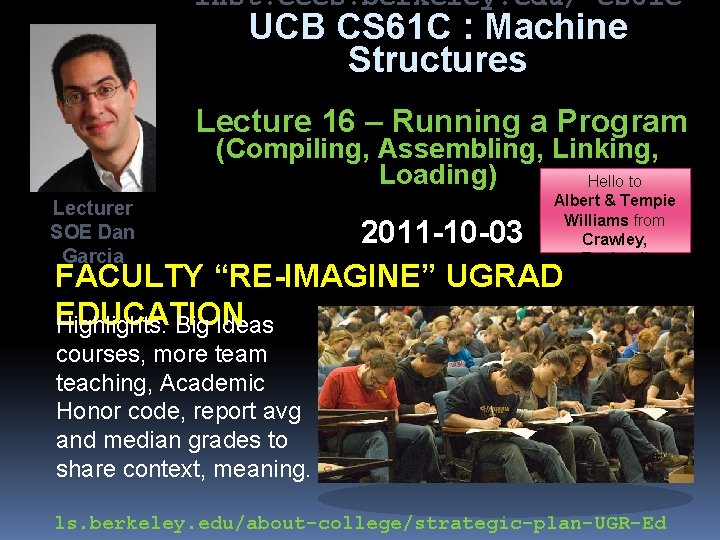
inst. eecs. berkeley. edu/~cs 61 c UCB CS 61 C : Machine Structures Lecture 16 – Running a Program (Compiling, Assembling, Linking, Loading) Hello to Lecturer SOE Dan Garcia Albert & Tempie Williams from Crawley, England! 2011 -10 -03 FACULTY “RE-IMAGINE” UGRAD EDUCATION Highlights: Big Ideas courses, more team teaching, Academic Honor code, report avg and median grades to share context, meaning. ls. berkeley. edu/about-college/strategic-plan-UGR-Ed

Administrivia… Midterm Exam on Thursday @ 7 -9 pm You’re responsible for all material up through today You get to bring Your study sheet Your green sheet Pens & Pencils What you don’t need to bring Calculator, cell phone, pagers Conflicts? Email Brian (head TA) CS 61 C L 16 : Running a Progam I … Compiling, Assembling, Linking, and Garcia, Fall 2011 © UCB
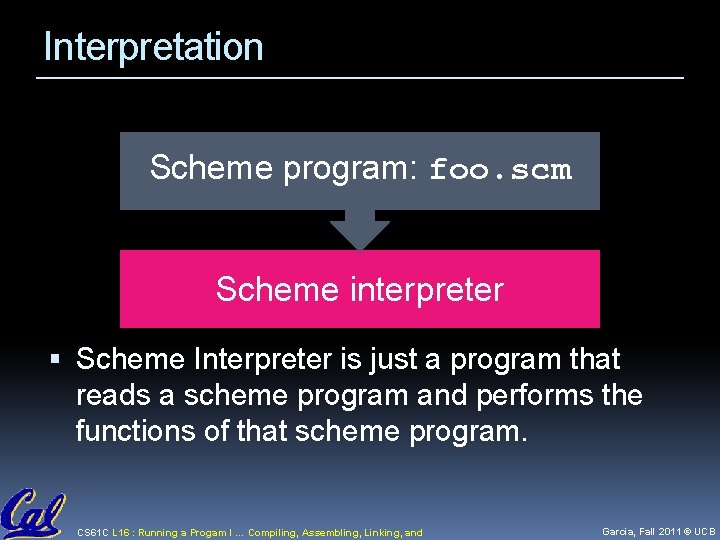
Interpretation Scheme program: foo. scm Scheme interpreter Scheme Interpreter is just a program that reads a scheme program and performs the functions of that scheme program. CS 61 C L 16 : Running a Progam I … Compiling, Assembling, Linking, and Garcia, Fall 2011 © UCB
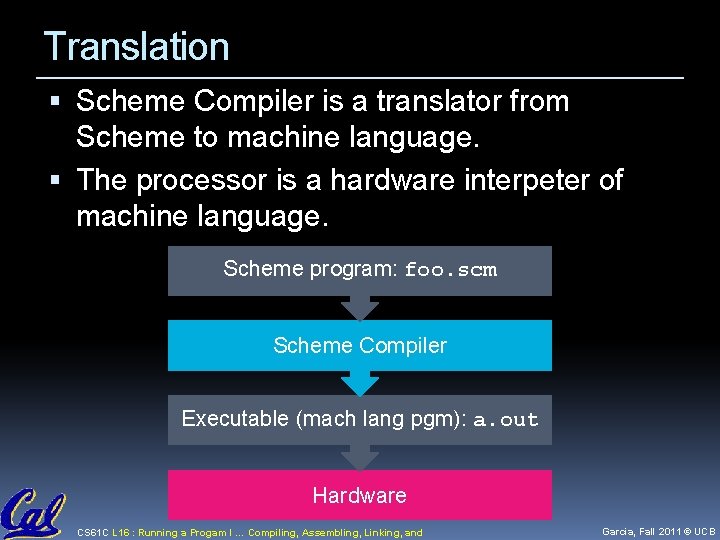
Translation Scheme Compiler is a translator from Scheme to machine language. The processor is a hardware interpeter of machine language. Scheme program: foo. scm Scheme Compiler Executable (mach lang pgm): a. out Hardware CS 61 C L 16 : Running a Progam I … Compiling, Assembling, Linking, and Garcia, Fall 2011 © UCB
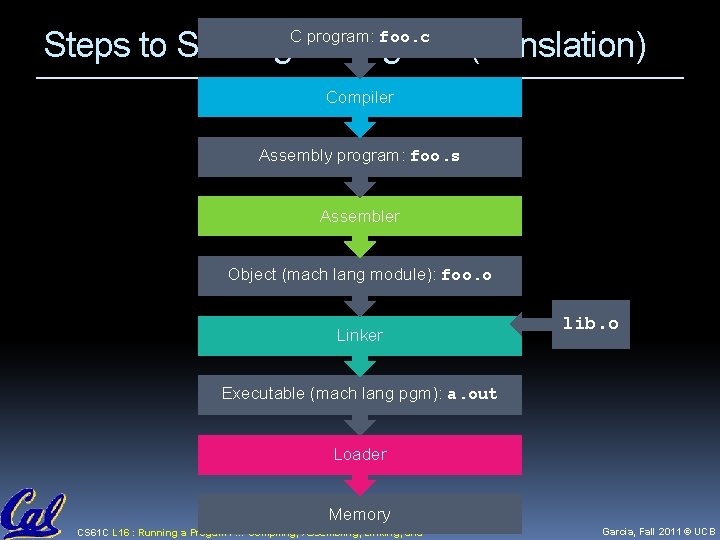
Steps to Starting a Program (translation) C program: foo. c Compiler Assembly program: foo. s Assembler Object (mach lang module): foo. o Linker lib. o Executable (mach lang pgm): a. out Loader Memory CS 61 C L 16 : Running a Progam I … Compiling, Assembling, Linking, and Garcia, Fall 2011 © UCB
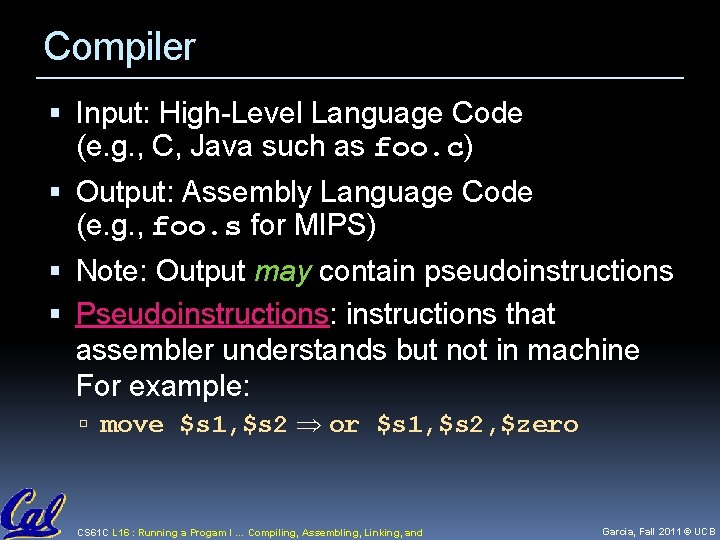
Compiler Input: High-Level Language Code (e. g. , C, Java such as foo. c) Output: Assembly Language Code (e. g. , foo. s for MIPS) Note: Output may contain pseudoinstructions Pseudoinstructions: instructions that assembler understands but not in machine For example: move $s 1, $s 2 or $s 1, $s 2, $zero CS 61 C L 16 : Running a Progam I … Compiling, Assembling, Linking, and Garcia, Fall 2011 © UCB
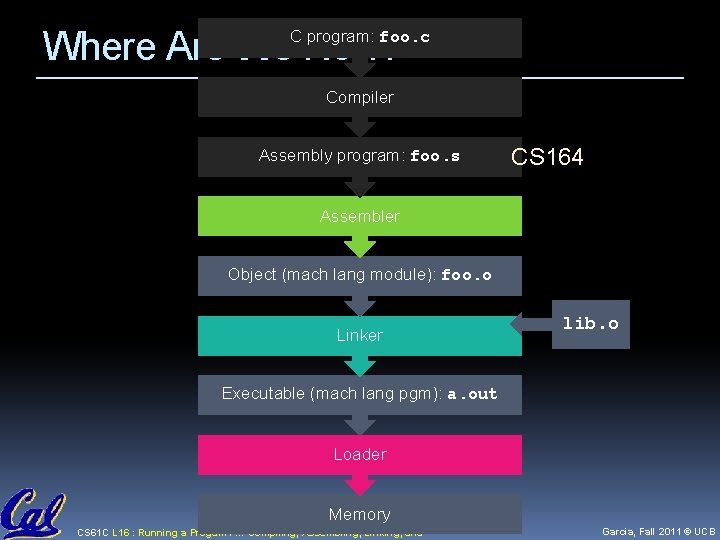
Where Are We Now? C program: foo. c Compiler Assembly program: foo. s CS 164 Assembler Object (mach lang module): foo. o Linker lib. o Executable (mach lang pgm): a. out Loader Memory CS 61 C L 16 : Running a Progam I … Compiling, Assembling, Linking, and Garcia, Fall 2011 © UCB
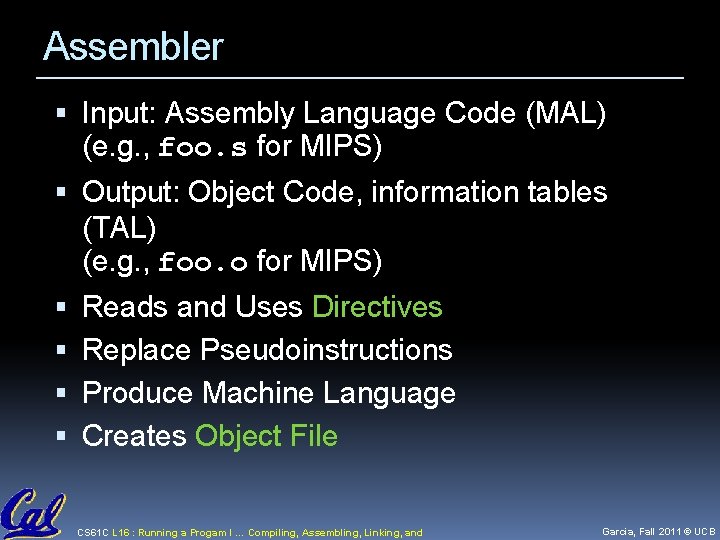
Assembler Input: Assembly Language Code (MAL) (e. g. , foo. s for MIPS) Output: Object Code, information tables (TAL) (e. g. , foo. o for MIPS) Reads and Uses Directives Replace Pseudoinstructions Produce Machine Language Creates Object File CS 61 C L 16 : Running a Progam I … Compiling, Assembling, Linking, and Garcia, Fall 2011 © UCB
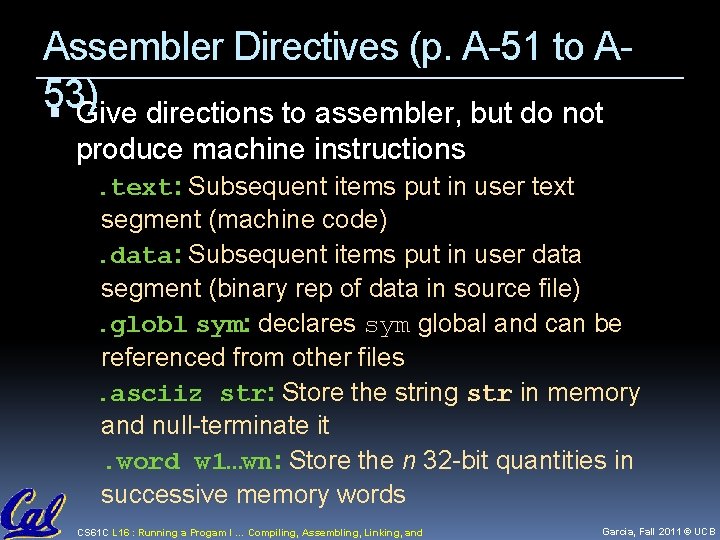
Assembler Directives (p. A-51 to A 53) Give directions to assembler, but do not produce machine instructions. text: Subsequent items put in user text segment (machine code). data: Subsequent items put in user data segment (binary rep of data in source file). globl sym: declares sym global and can be referenced from other files. asciiz str: Store the string str in memory and null-terminate it. word w 1…wn: Store the n 32 -bit quantities in successive memory words CS 61 C L 16 : Running a Progam I … Compiling, Assembling, Linking, and Garcia, Fall 2011 © UCB
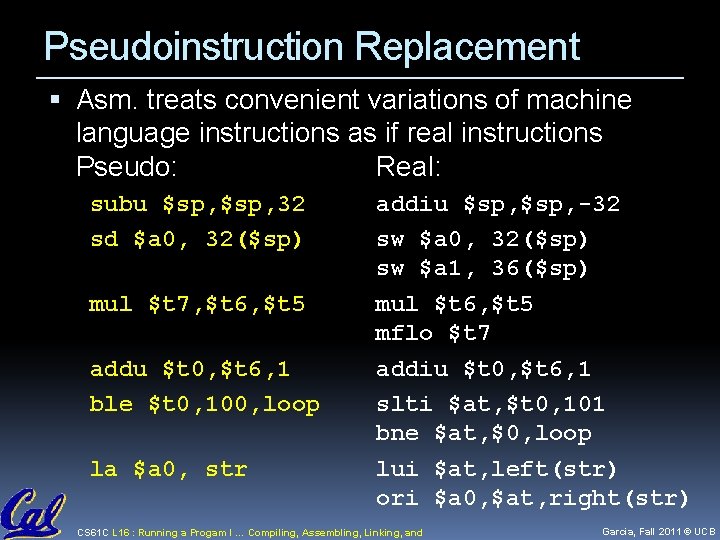
Pseudoinstruction Replacement Asm. treats convenient variations of machine language instructions as if real instructions Pseudo: Real: subu $sp, 32 sd $a 0, 32($sp) mul $t 7, $t 6, $t 5 addu $t 0, $t 6, 1 ble $t 0, 100, loop la $a 0, str addiu $sp, -32 sw $a 0, 32($sp) sw $a 1, 36($sp) mul $t 6, $t 5 mflo $t 7 addiu $t 0, $t 6, 1 slti $at, $t 0, 101 bne $at, $0, loop lui $at, left(str) ori $a 0, $at, right(str) CS 61 C L 16 : Running a Progam I … Compiling, Assembling, Linking, and Garcia, Fall 2011 © UCB
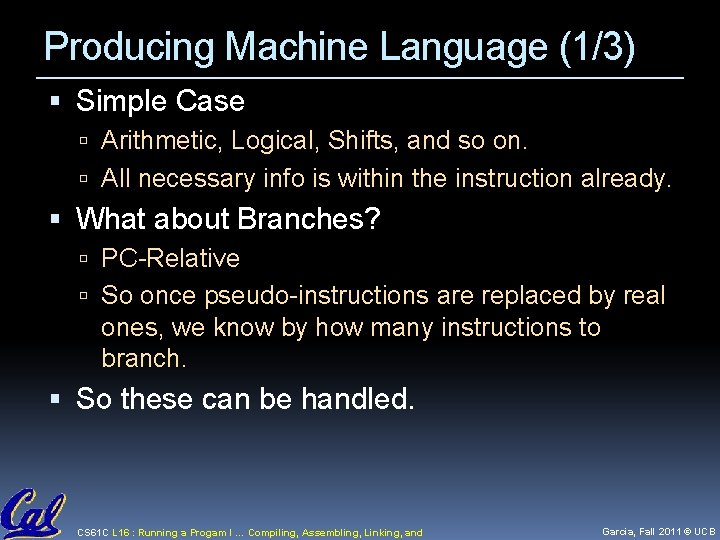
Producing Machine Language (1/3) Simple Case Arithmetic, Logical, Shifts, and so on. All necessary info is within the instruction already. What about Branches? PC-Relative So once pseudo-instructions are replaced by real ones, we know by how many instructions to branch. So these can be handled. CS 61 C L 16 : Running a Progam I … Compiling, Assembling, Linking, and Garcia, Fall 2011 © UCB
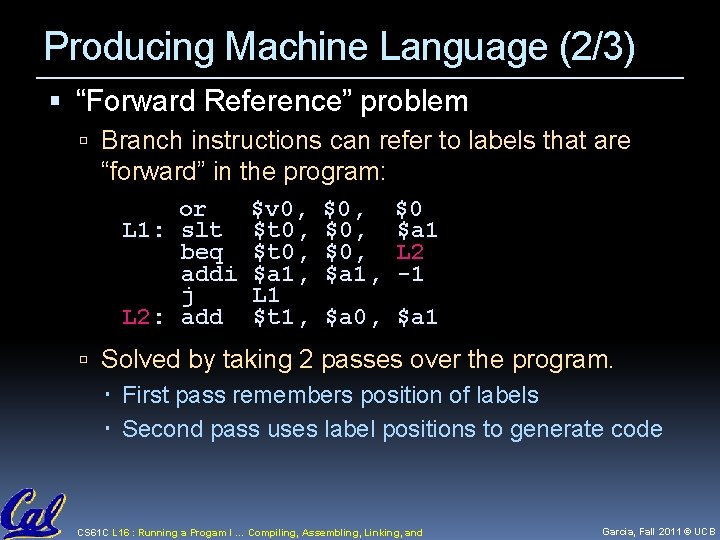
Producing Machine Language (2/3) “Forward Reference” problem Branch instructions can refer to labels that are “forward” in the program: or L 1: slt beq addi j L 2: add $v 0, $t 0, $a 1, L 1 $t 1, $0, $0, $a 1, $0 $a 1 L 2 -1 $a 0, $a 1 Solved by taking 2 passes over the program. First pass remembers position of labels Second pass uses label positions to generate code CS 61 C L 16 : Running a Progam I … Compiling, Assembling, Linking, and Garcia, Fall 2011 © UCB
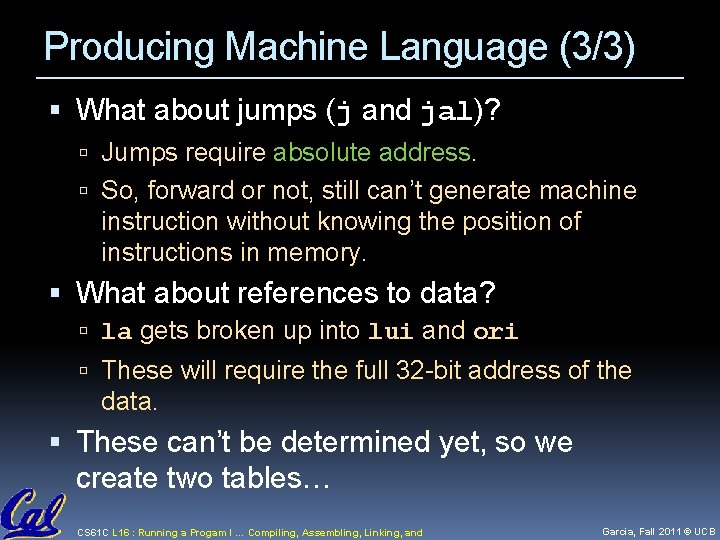
Producing Machine Language (3/3) What about jumps (j and jal)? Jumps require absolute address. So, forward or not, still can’t generate machine instruction without knowing the position of instructions in memory. What about references to data? la gets broken up into lui and ori These will require the full 32 -bit address of the data. These can’t be determined yet, so we create two tables… CS 61 C L 16 : Running a Progam I … Compiling, Assembling, Linking, and Garcia, Fall 2011 © UCB
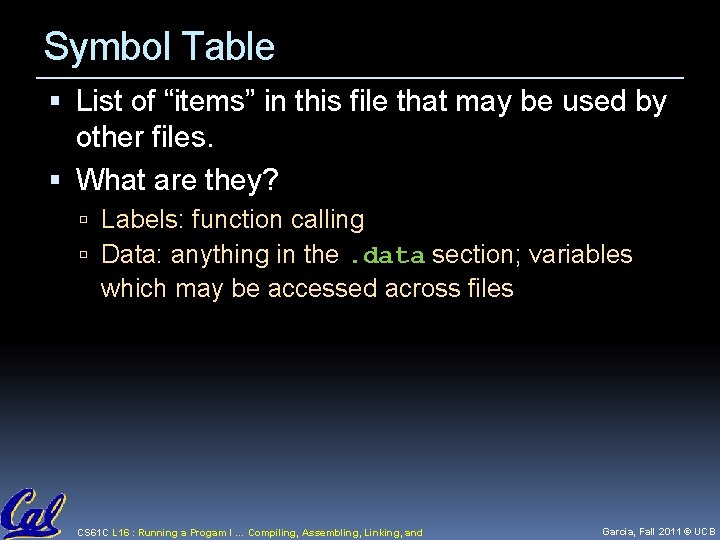
Symbol Table List of “items” in this file that may be used by other files. What are they? Labels: function calling Data: anything in the. data section; variables which may be accessed across files CS 61 C L 16 : Running a Progam I … Compiling, Assembling, Linking, and Garcia, Fall 2011 © UCB
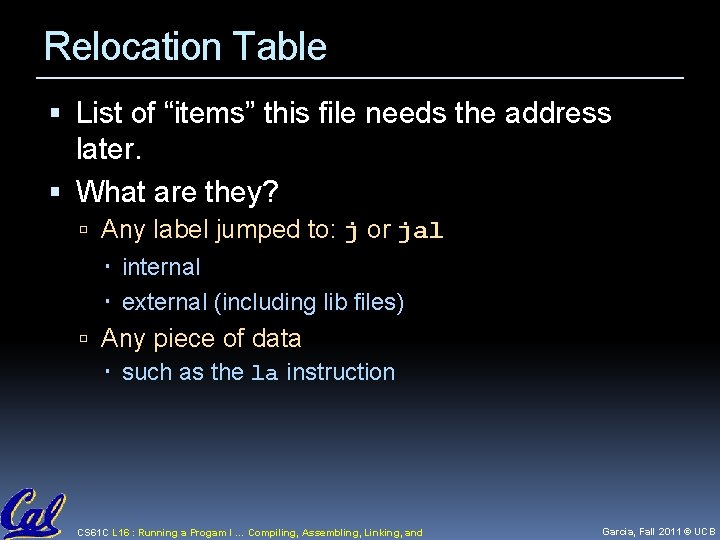
Relocation Table List of “items” this file needs the address later. What are they? Any label jumped to: j or jal internal external (including lib files) Any piece of data such as the la instruction CS 61 C L 16 : Running a Progam I … Compiling, Assembling, Linking, and Garcia, Fall 2011 © UCB
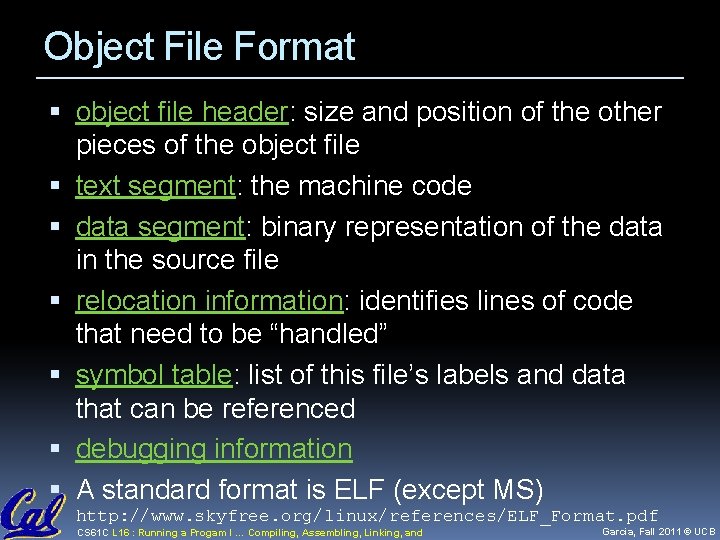
Object File Format object file header: size and position of the other pieces of the object file text segment: the machine code data segment: binary representation of the data in the source file relocation information: identifies lines of code that need to be “handled” symbol table: list of this file’s labels and data that can be referenced debugging information A standard format is ELF (except MS) http: //www. skyfree. org/linux/references/ELF_Format. pdf CS 61 C L 16 : Running a Progam I … Compiling, Assembling, Linking, and Garcia, Fall 2011 © UCB
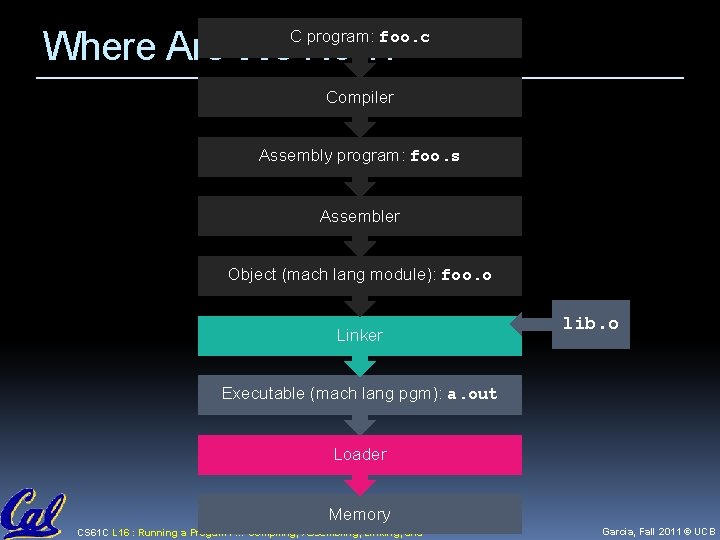
Where Are We Now? C program: foo. c Compiler Assembly program: foo. s Assembler Object (mach lang module): foo. o Linker lib. o Executable (mach lang pgm): a. out Loader Memory CS 61 C L 16 : Running a Progam I … Compiling, Assembling, Linking, and Garcia, Fall 2011 © UCB
Linker (1/3) Input: Object Code files, information tables (e. g. , foo. o, libc. o for MIPS) Output: Executable Code (e. g. , a. out for MIPS) Combines several object (. o) files into a single executable (“linking”) Enable Separate Compilation of files Changes to one file do not require recompilation of whole program Windows NT source was > 40 M lines of code! Old name “Link Editor” from editing the “links” in jump and link instructions CS 61 C L 16 : Running a Progam I … Compiling, Assembling, Linking, and Garcia, Fall 2011 © UCB
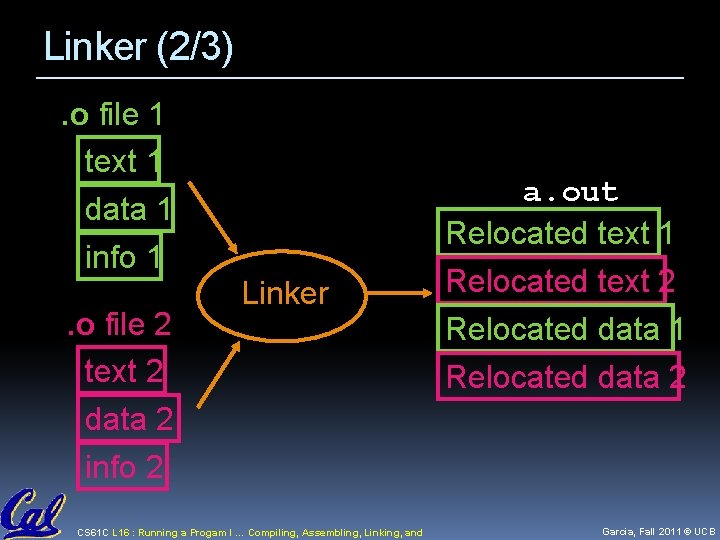
Linker (2/3). o file 1 text 1 data 1 a. out Relocated text 1 info 1. o file 2 text 2 data 2 info 2 Linker CS 61 C L 16 : Running a Progam I … Compiling, Assembling, Linking, and Relocated text 2 Relocated data 1 Relocated data 2 Garcia, Fall 2011 © UCB
Linker (3/3) Step 1: Take text segment from each. o file and put them together. Step 2: Take data segment from each. o file, put them together, and concatenate this onto end of text segments. Step 3: Resolve References Go through Relocation Table; handle each entry That is, fill in all absolute addresses CS 61 C L 16 : Running a Progam I … Compiling, Assembling, Linking, and Garcia, Fall 2011 © UCB
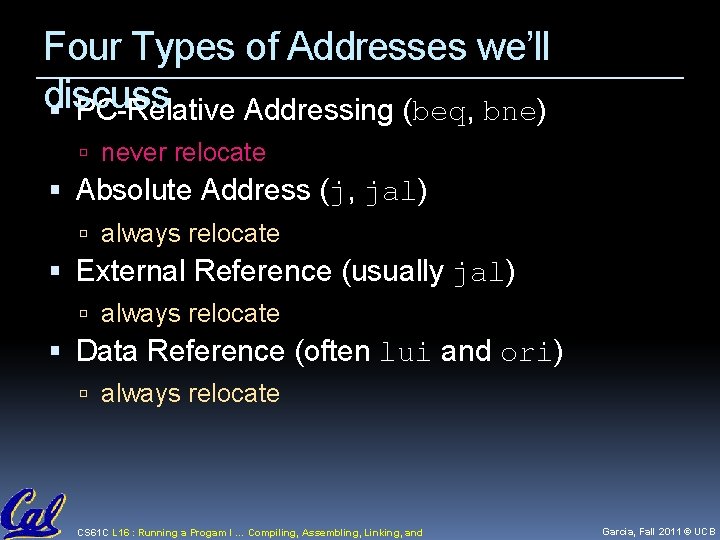
Four Types of Addresses we’ll discuss PC-Relative Addressing (beq, bne) never relocate Absolute Address (j, jal) always relocate External Reference (usually jal) always relocate Data Reference (often lui and ori) always relocate CS 61 C L 16 : Running a Progam I … Compiling, Assembling, Linking, and Garcia, Fall 2011 © UCB
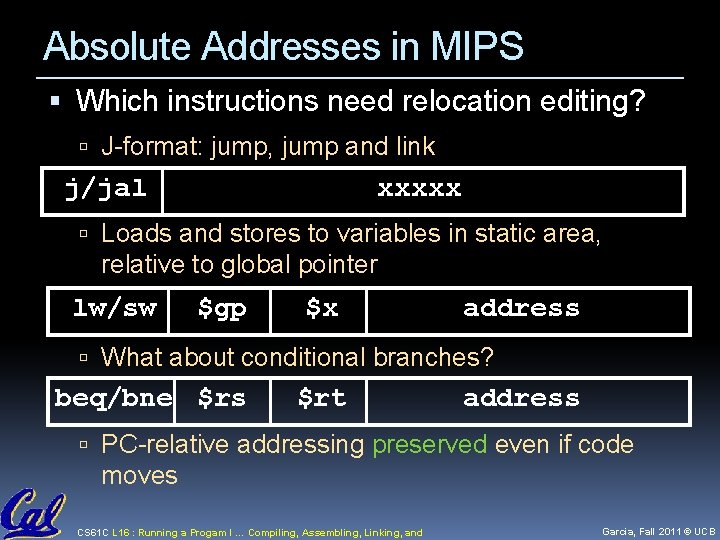
Absolute Addresses in MIPS Which instructions need relocation editing? J-format: jump, jump and link j/jal xxxxx Loads and stores to variables in static area, relative to global pointer lw/sw $gp $x address What about conditional branches? beq/bne $rs $rt address PC-relative addressing preserved even if code moves CS 61 C L 16 : Running a Progam I … Compiling, Assembling, Linking, and Garcia, Fall 2011 © UCB
Resolving References (1/2) Linker assumes first word of first text segment is at address 0 x 0000. (More later when we study “virtual memory”) Linker knows: length of each text and data segment ordering of text and data segments Linker calculates: absolute address of each label to be jumped to (internal or external) and each piece of data being referenced CS 61 C L 16 : Running a Progam I … Compiling, Assembling, Linking, and Garcia, Fall 2011 © UCB
Resolving References (2/2) To resolve references: search for reference (data or label) in all “user” symbol tables if not found, search library files (for example, for printf) once absolute address is determined, fill in the machine code appropriately Output of linker: executable file containing text and data (plus header) CS 61 C L 16 : Running a Progam I … Compiling, Assembling, Linking, and Garcia, Fall 2011 © UCB
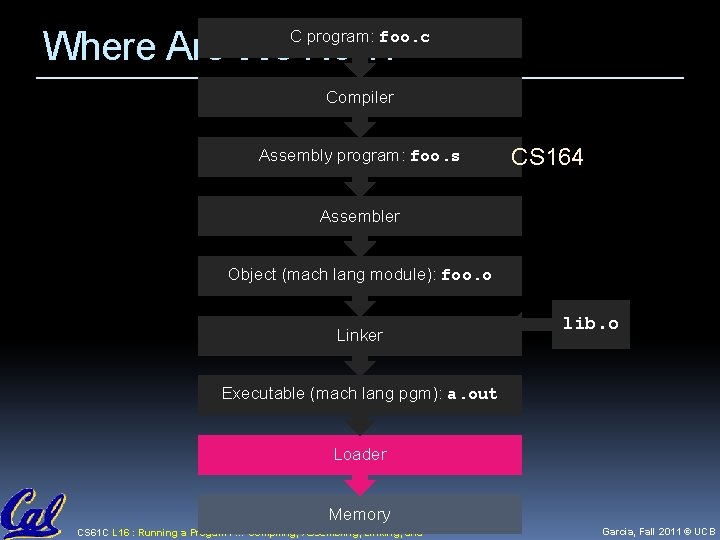
Where Are We Now? C program: foo. c Compiler Assembly program: foo. s CS 164 Assembler Object (mach lang module): foo. o Linker lib. o Executable (mach lang pgm): a. out Loader Memory CS 61 C L 16 : Running a Progam I … Compiling, Assembling, Linking, and Garcia, Fall 2011 © UCB
Loader Basics Input: Executable Code (e. g. , a. out for MIPS) Output: (program is run) Executable files are stored on disk. When one is run, loader’s job is to load it into memory and start it running. In reality, loader is the operating system (OS) loading is one of the OS tasks CS 61 C L 16 : Running a Progam I … Compiling, Assembling, Linking, and Garcia, Fall 2011 © UCB
Loader … what does it do? Reads executable file’s header to determine size of text and data segments Creates new address space for program large enough to hold text and data segments, along with a stack segment Copies instructions and data from executable file into the new address space Copies arguments passed to the program onto the stack Initializes machine registers Most registers cleared, but stack pointer assigned address of 1 st free stack location Jumps to start-up routine that copies program’s arguments from stack to registers & sets the PC If main routine returns, start-up routine terminates program with the exit system call CS 61 C L 16 : Running a Progam I … Compiling, Assembling, Linking, and Garcia, Fall 2011 © UCB
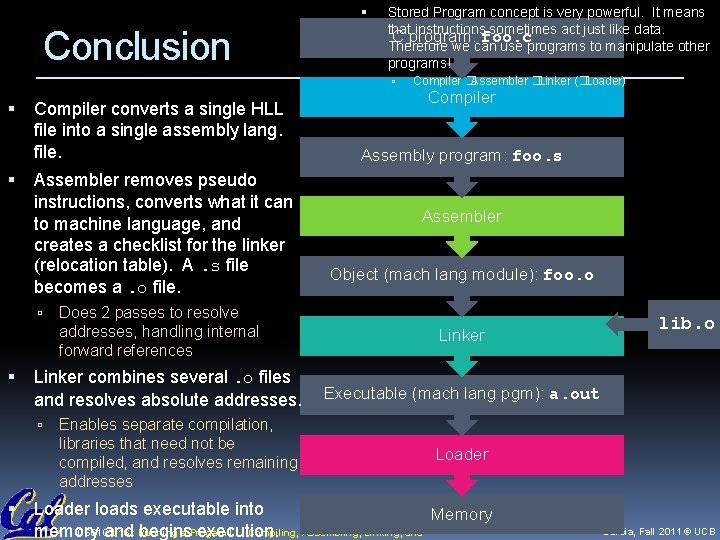
Conclusion Stored Program concept is very powerful. It means that instructions sometimes act just like data. C program: foo. c Therefore we can use programs to manipulate other programs! Compiler converts a single HLL file into a single assembly lang. file. Assembler removes pseudo instructions, converts what it can to machine language, and creates a checklist for the linker (relocation table). A. s file becomes a. o file. Linker combines several. o files and resolves absolute addresses. Does 2 passes to resolve addresses, handling internal forward references Enables separate compilation, libraries that need not be compiled, and resolves remaining addresses Compiler �Assembler �Linker (�Loader) Compiler Assembly program: foo. s Assembler Object (mach lang module): foo. o Linker lib. o Executable (mach lang pgm): a. out Loader loads executable into Memory CS 61 C L 16 : Running a Progam I … Compiling, Assembling, Linking, and memory and begins execution. Garcia, Fall 2011 © UCB
Bonus slides These are extra slides that used to be included in lecture notes, but have been moved to this, the “bonus” area to serve as a supplement. The slides will appear in the order they would have in the normal presentation CS 61 C L 16 : Running a Progam I … Compiling, Assembling, Linking, and Garcia, Fall 2011 © UCB
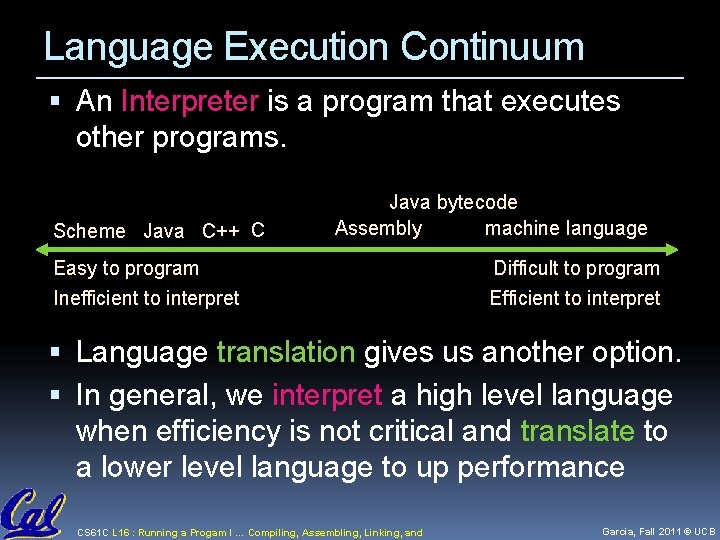
Language Execution Continuum An Interpreter is a program that executes other programs. Scheme Java C++ C Java bytecode Assembly machine language Easy to program Inefficient to interpret Difficult to program Efficient to interpret Language translation gives us another option. In general, we interpret a high level language when efficiency is not critical and translate to a lower level language to up performance CS 61 C L 16 : Running a Progam I … Compiling, Assembling, Linking, and Garcia, Fall 2011 © UCB
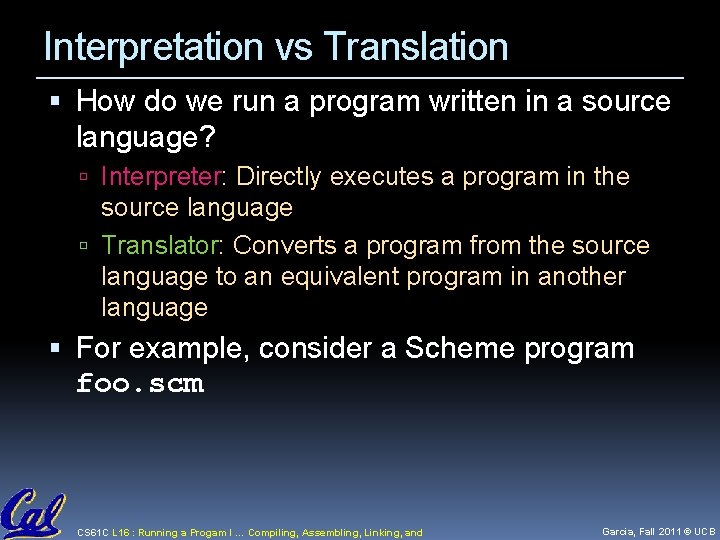
Interpretation vs Translation How do we run a program written in a source language? Interpreter: Directly executes a program in the source language Translator: Converts a program from the source language to an equivalent program in another language For example, consider a Scheme program foo. scm CS 61 C L 16 : Running a Progam I … Compiling, Assembling, Linking, and Garcia, Fall 2011 © UCB
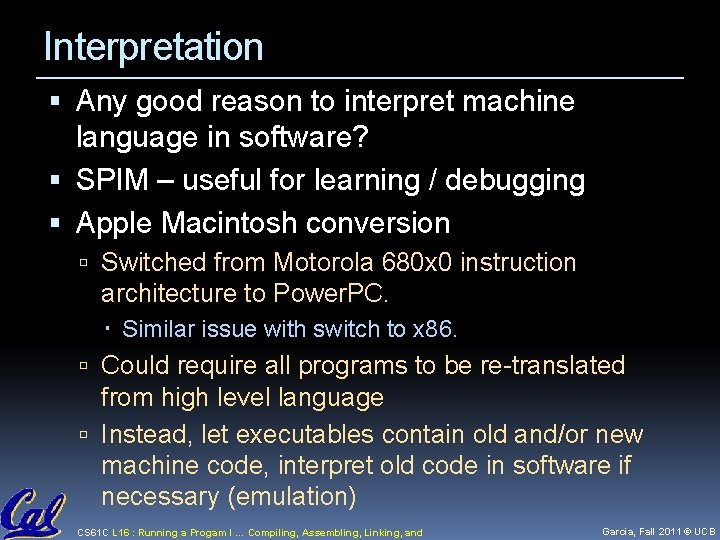
Interpretation Any good reason to interpret machine language in software? SPIM – useful for learning / debugging Apple Macintosh conversion Switched from Motorola 680 x 0 instruction architecture to Power. PC. Similar issue with switch to x 86. Could require all programs to be re-translated from high level language Instead, let executables contain old and/or new machine code, interpret old code in software if necessary (emulation) CS 61 C L 16 : Running a Progam I … Compiling, Assembling, Linking, and Garcia, Fall 2011 © UCB
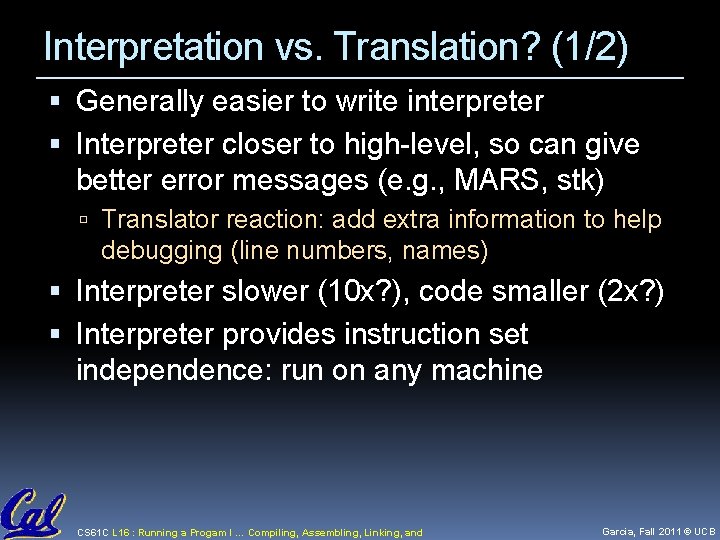
Interpretation vs. Translation? (1/2) Generally easier to write interpreter Interpreter closer to high-level, so can give better error messages (e. g. , MARS, stk) Translator reaction: add extra information to help debugging (line numbers, names) Interpreter slower (10 x? ), code smaller (2 x? ) Interpreter provides instruction set independence: run on any machine CS 61 C L 16 : Running a Progam I … Compiling, Assembling, Linking, and Garcia, Fall 2011 © UCB
Interpretation vs. Translation? (2/2) Translated/compiled code almost always more efficient and therefore higher performance: Important for many applications, particularly operating systems. Translation/compilation helps “hide” the program “source” from the users: One model for creating value in the marketplace (eg. Microsoft keeps all their source code secret) Alternative model, “open source”, creates value by publishing the source code and fostering a community of developers. CS 61 C L 16 : Running a Progam I … Compiling, Assembling, Linking, and Garcia, Fall 2011 © UCB
Static vs Dynamically linked libraries What we’ve described is the traditional way: statically-linked approach The library is now part of the executable, so if the library updates, we don’t get the fix (have to recompile if we have source) It includes the entire library even if not all of it will be used. Executable is self-contained. An alternative is dynamically linked libraries (DLL), common on Windows & UNIX platforms CS 61 C L 16 : Running a Progam I … Compiling, Assembling, Linking, and Garcia, Fall 2011 © UCB
en. wikipedia. org/wiki/Dynamic_linking Dynamically linked libraries Space/time issues + Storing a program requires less disk space + Sending a program requires less time + Executing two programs requires less memory (if they share a library) – At runtime, there’s time overhead to do link Upgrades + Replacing one file (lib. XYZ. so) upgrades every program that uses library “XYZ” – Having the executable isn’t enough anymore Overall, dynamic linking adds quite a bit of complexity to the compiler, linker, and operating system. However, it provides many benefits that often outweigh these. CS 61 C L 16 : Running a Progam I … Compiling, Assembling, Linking, and Garcia, Fall 2011 © UCB
Dynamically linked libraries The prevailing approach to dynamic linking uses machine code as the “lowest common denominator” The linker does not use information about how the program or library was compiled (i. e. , what compiler or language) This can be described as “linking at the machine code level” This isn’t the only way to do it. . . CS 61 C L 16 : Running a Progam I … Compiling, Assembling, Linking, and Garcia, Fall 2011 © UCB
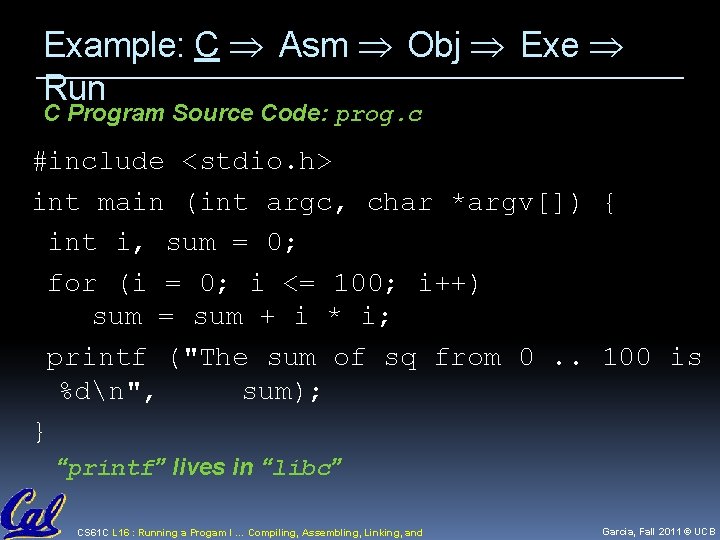
Example: C Asm Obj Exe Run C Program Source Code: prog. c #include <stdio. h> int main (int argc, char *argv[]) { int i, sum = 0; for (i = 0; i <= 100; i++) sum = sum + i * i; printf ("The sum of sq from 0. . 100 is %dn", sum); } “printf” lives in “libc” CS 61 C L 16 : Running a Progam I … Compiling, Assembling, Linking, and Garcia, Fall 2011 © UCB
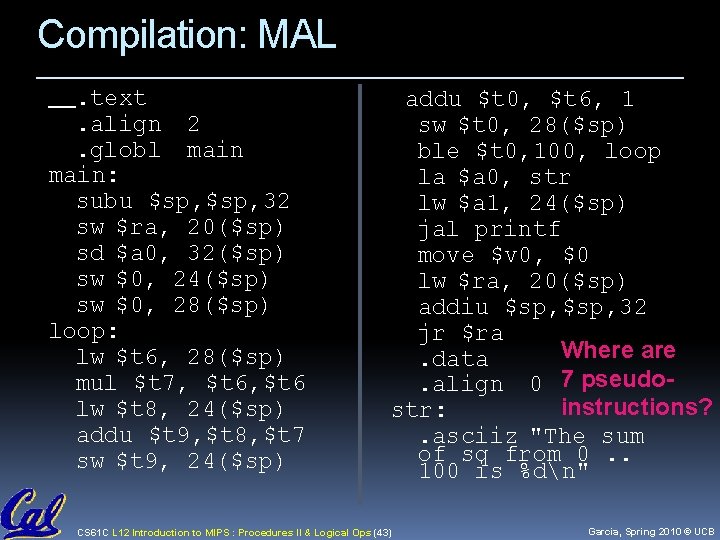
Compilation: MAL. text. align 2. globl main: subu $sp, 32 sw $ra, 20($sp) sd $a 0, 32($sp) sw $0, 24($sp) sw $0, 28($sp) loop: lw $t 6, 28($sp) mul $t 7, $t 6 lw $t 8, 24($sp) addu $t 9, $t 8, $t 7 sw $t 9, 24($sp) addu $t 0, $t 6, 1 sw $t 0, 28($sp) ble $t 0, 100, loop la $a 0, str lw $a 1, 24($sp) jal printf move $v 0, $0 lw $ra, 20($sp) addiu $sp, 32 jr $ra Where are. data. align 0 7 pseudoinstructions? str: . asciiz "The sum of sq from 0. . 100 is %dn" CS 61 C L 12 Introduction to MIPS : Procedures II & Logical Ops (43) Garcia, Spring 2010 © UCB
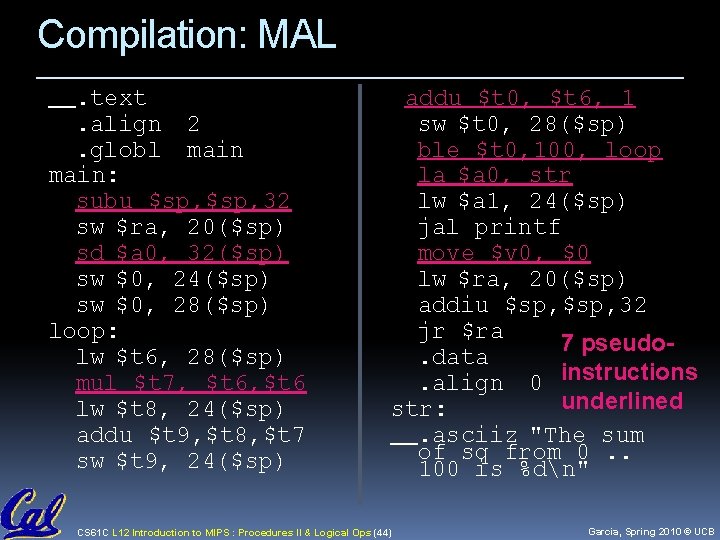
Compilation: MAL. text. align 2. globl main: subu $sp, 32 sw $ra, 20($sp) sd $a 0, 32($sp) sw $0, 24($sp) sw $0, 28($sp) loop: lw $t 6, 28($sp) mul $t 7, $t 6 lw $t 8, 24($sp) addu $t 9, $t 8, $t 7 sw $t 9, 24($sp) addu $t 0, $t 6, 1 sw $t 0, 28($sp) ble $t 0, 100, loop la $a 0, str lw $a 1, 24($sp) jal printf move $v 0, $0 lw $ra, 20($sp) addiu $sp, 32 jr $ra 7 pseudo. data. align 0 instructions underlined str: . asciiz "The sum of sq from 0. . 100 is %dn" CS 61 C L 12 Introduction to MIPS : Procedures II & Logical Ops (44) Garcia, Spring 2010 © UCB
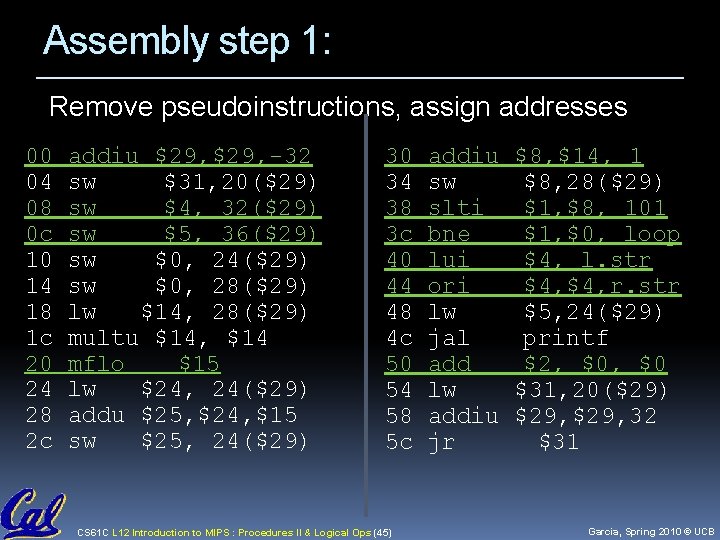
Assembly step 1: Remove pseudoinstructions, assign addresses 00 04 08 0 c 10 14 18 1 c 20 24 28 2 c addiu $29, -32 sw $31, 20($29) sw $4, 32($29) sw $5, 36($29) sw $0, 24($29) sw $0, 28($29) lw $14, 28($29) multu $14, $14 mflo $15 lw $24, 24($29) addu $25, $24, $15 sw $25, 24($29) 30 34 38 3 c 40 44 48 4 c 50 54 58 5 c CS 61 C L 12 Introduction to MIPS : Procedures II & Logical Ops (45) addiu sw slti bne lui ori lw jal add lw addiu jr $8, $14, 1 $8, 28($29) $1, $8, 101 $1, $0, loop $4, l. str $4, r. str $5, 24($29) printf $2, $0 $31, 20($29) $29, 32 $31 Garcia, Spring 2010 © UCB
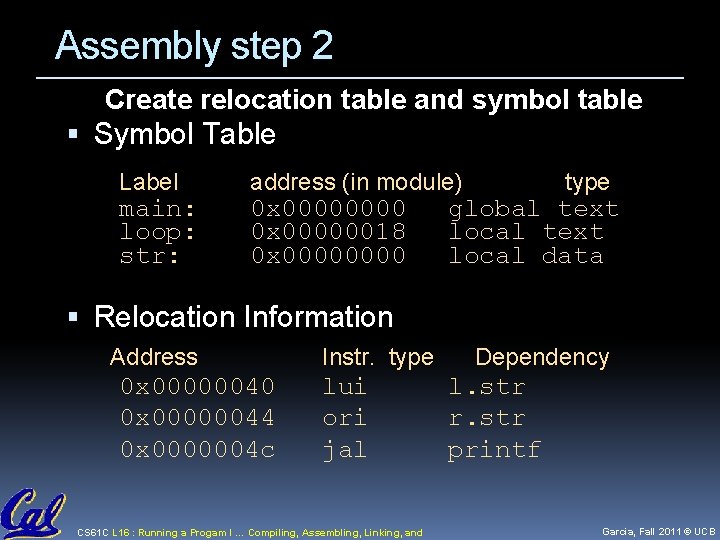
Assembly step 2 Create relocation table and symbol table Symbol Table Label main: loop: str: address (in module) 0 x 00000018 0 x 0000 type global text local data Relocation Information Address 0 x 00000040 0 x 00000044 0 x 0000004 c Instr. type lui ori jal CS 61 C L 16 : Running a Progam I … Compiling, Assembling, Linking, and Dependency l. str r. str printf Garcia, Fall 2011 © UCB
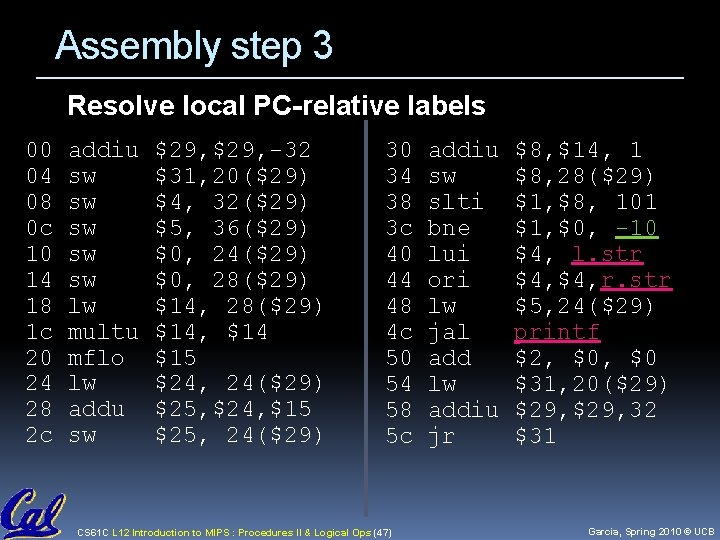
Assembly step 3 Resolve local PC-relative labels 00 04 08 0 c 10 14 18 1 c 20 24 28 2 c addiu sw sw sw lw multu mflo lw addu sw $29, -32 $31, 20($29) $4, 32($29) $5, 36($29) $0, 24($29) $0, 28($29) $14, $14 $15 $24, 24($29) $25, $24, $15 $25, 24($29) 30 34 38 3 c 40 44 48 4 c 50 54 58 5 c CS 61 C L 12 Introduction to MIPS : Procedures II & Logical Ops (47) addiu sw slti bne lui ori lw jal add lw addiu jr $8, $14, 1 $8, 28($29) $1, $8, 101 $1, $0, -10 $4, l. str $4, r. str $5, 24($29) printf $2, $0 $31, 20($29) $29, 32 $31 Garcia, Spring 2010 © UCB
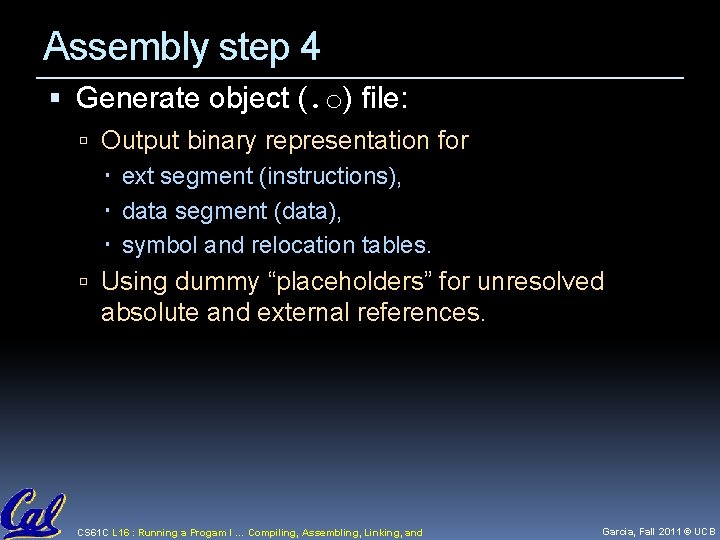
Assembly step 4 Generate object (. o) file: Output binary representation for ext segment (instructions), data segment (data), symbol and relocation tables. Using dummy “placeholders” for unresolved absolute and external references. CS 61 C L 16 : Running a Progam I … Compiling, Assembling, Linking, and Garcia, Fall 2011 © UCB
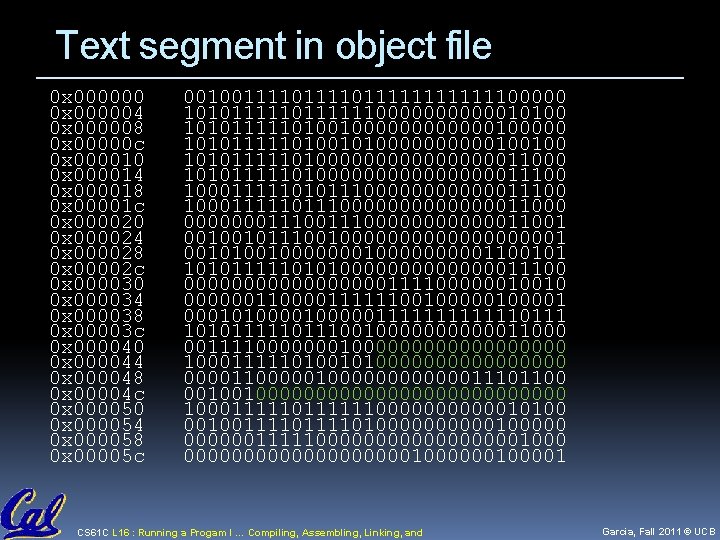
Text segment in object file 0 x 000000 0 x 000004 0 x 000008 0 x 00000 c 0 x 000010 0 x 000014 0 x 000018 0 x 00001 c 0 x 000020 0 x 000024 0 x 000028 0 x 00002 c 0 x 000030 0 x 000034 0 x 000038 0 x 00003 c 0 x 000040 0 x 000044 0 x 000048 0 x 00004 c 0 x 000050 0 x 000054 0 x 000058 0 x 00005 c 001001111011111100000 101011111100000010100 10101111101001000000100000 10101111101000000100100 101011111010000000011000 101011111010000000011100 10001111101011100000011100 1000111110000000011000 000000011100000011001 00100101110010000000001 001010010000000001100101 1010111110101000000011100 000000000111100000010010 0000001111110010000101000001111110111 10101111100100000011000 0011110000000000000 100011111010000000001100000000000011101100 0010010000000000000 100011111100000010100 00100111101000001000000111110000000001000 000000000010000001 CS 61 C L 16 : Running a Progam I … Compiling, Assembling, Linking, and Garcia, Fall 2011 © UCB
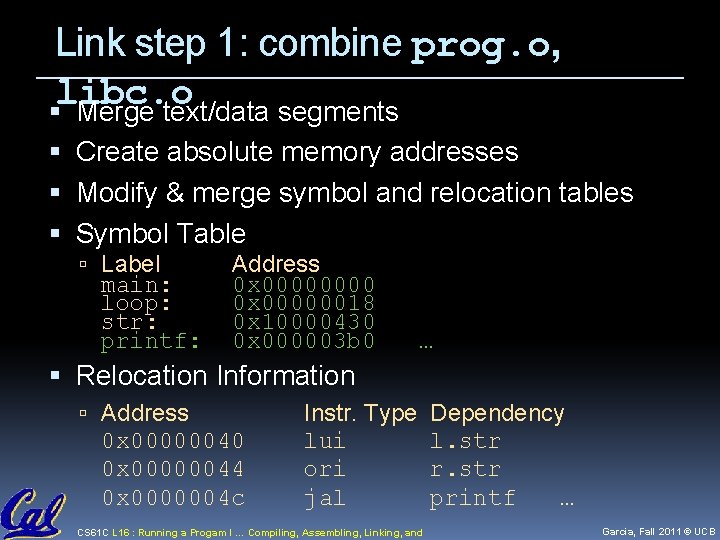
Link step 1: combine prog. o, libc. o Merge text/data segments Create absolute memory addresses Modify & merge symbol and relocation tables Symbol Table Label main: loop: str: printf: Address 0 x 00000018 0 x 10000430 0 x 000003 b 0 … Relocation Information Address 0 x 00000040 0 x 00000044 0 x 0000004 c Instr. Type lui ori jal CS 61 C L 16 : Running a Progam I … Compiling, Assembling, Linking, and Dependency l. str r. str printf … Garcia, Fall 2011 © UCB
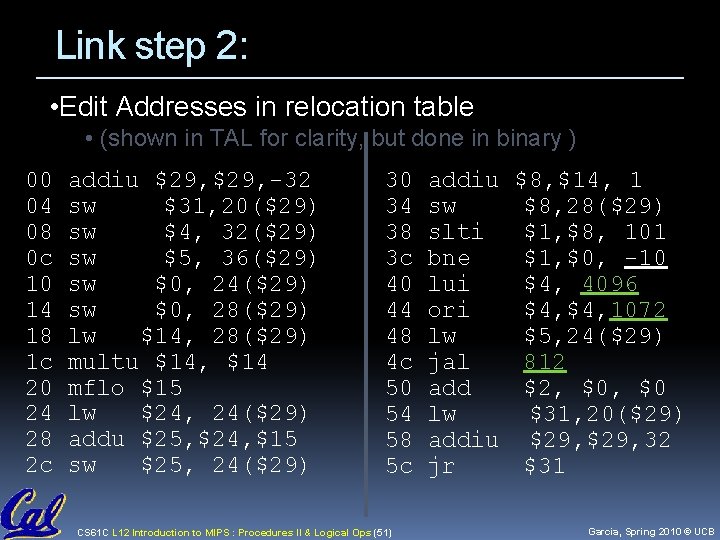
Link step 2: • Edit Addresses in relocation table • (shown in TAL for clarity, but done in binary ) 00 04 08 0 c 10 14 18 1 c 20 24 28 2 c addiu $29, -32 sw $31, 20($29) sw $4, 32($29) sw $5, 36($29) sw $0, 24($29) sw $0, 28($29) lw $14, 28($29) multu $14, $14 mflo $15 lw $24, 24($29) addu $25, $24, $15 sw $25, 24($29) 30 34 38 3 c 40 44 48 4 c 50 54 58 5 c CS 61 C L 12 Introduction to MIPS : Procedures II & Logical Ops (51) addiu sw slti bne lui ori lw jal add lw addiu jr $8, $14, 1 $8, 28($29) $1, $8, 101 $1, $0, -10 $4, 4096 $4, 1072 $5, 24($29) 812 $2, $0 $31, 20($29) $29, 32 $31 Garcia, Spring 2010 © UCB
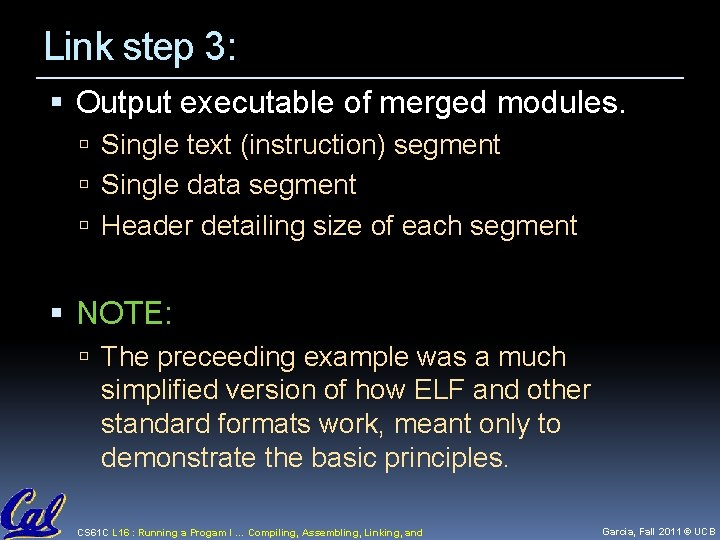
Link step 3: Output executable of merged modules. Single text (instruction) segment Single data segment Header detailing size of each segment NOTE: The preceeding example was a much simplified version of how ELF and other standard formats work, meant only to demonstrate the basic principles. CS 61 C L 16 : Running a Progam I … Compiling, Assembling, Linking, and Garcia, Fall 2011 © UCB
- Slides: 48