
inst eecs berkeley educs 61 c UC Berkeley
inst. eecs. berkeley. edu/~cs 61 c UC Berkeley CS 61 C : Machine Structures Lecture 31 – Caches I 2007 -04 -06 Lecturer SOE Dan Garcia www. cs. berkeley. edu/~ddgarcia Powerpoint bad!! Research done at the Univ of NSW says that “working memory”, the brain part providing temporary storage, is limited (3 -4 things for 20 sec unless rehearsal), and saying what is on slides splits attention, & bad. slashdot. org/article. pl? sid=07/04/04/1319247 Garcia, Spring 2007 © UCB CS 61 C L 31 Caches I (1)
Review : Pipelining • Pipeline challenge is hazards • Forwarding helps w/many data hazards • Delayed branch helps with control hazard in our 5 stage pipeline • Data hazards w/Loads Load Delay Slot § Interlock “smart” CPU has HW to detect if conflict with inst following load, if so it stalls • More aggressive performance (discussed in section next week) • Superscalar (parallelism) • Out-of-order execution CS 61 C L 31 Caches I (2) Garcia, Spring 2007 © UCB
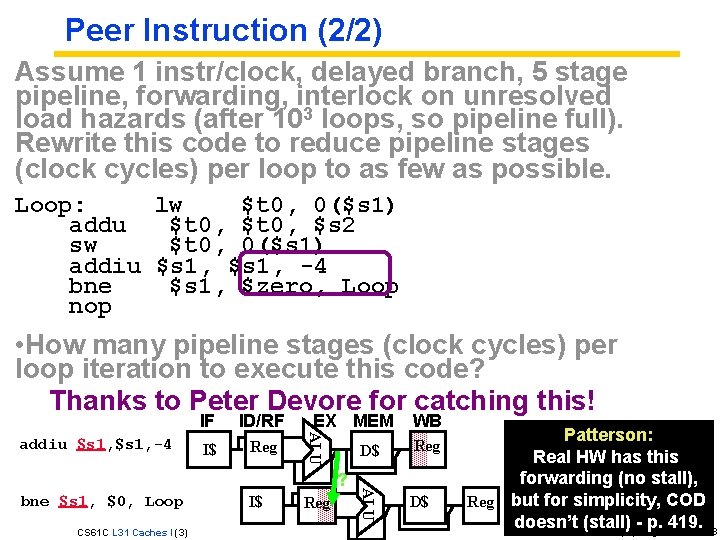
Peer Instruction (2/2) Assume 1 instr/clock, delayed branch, 5 stage pipeline, forwarding, interlock on unresolved load hazards (after 103 loops, so pipeline full). Rewrite this code to reduce pipeline stages (clock cycles) per loop to as few as possible. Loop: lw $t 0, 0($s 1) addu $t 0, $s 2 sw $t 0, 0($s 1) addiu $s 1, -4 bne $s 1, $zero, Loop nop • How many pipeline stages (clock cycles) per loop iteration to execute this code? Thanks to Peter Devore for catching this! I$ Reg EX MEM ? bne $s 1, $0, Loop CS 61 C L 31 Caches I (3) I$ Reg WB D$ Reg ALU ID/RF ALU addiu $s 1, -4 IF D$ Patterson: Real HW has this forwarding (no stall), Reg but for simplicity, COD doesn’t (stall) - p. 419. Garcia, Spring 2007 © UCB
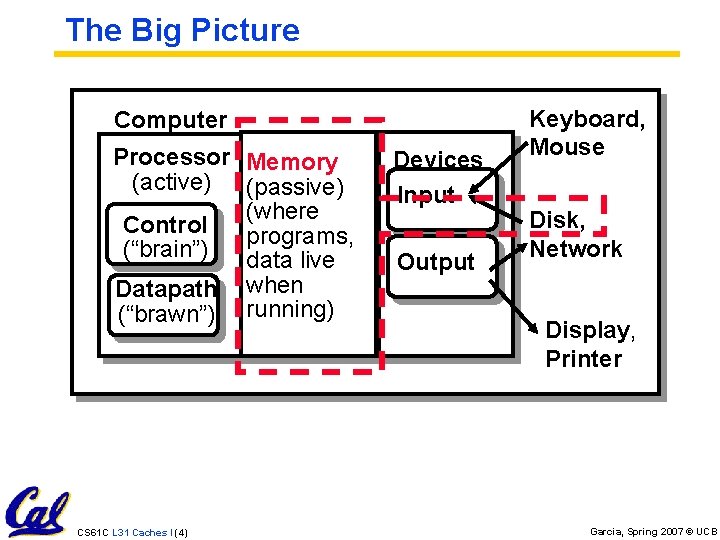
The Big Picture Computer Processor Memory (active) (passive) (where Control programs, (“brain”) data live Datapath when (“brawn”) running) CS 61 C L 31 Caches I (4) Devices Input Output Keyboard, Mouse Disk, Network Display, Printer Garcia, Spring 2007 © UCB
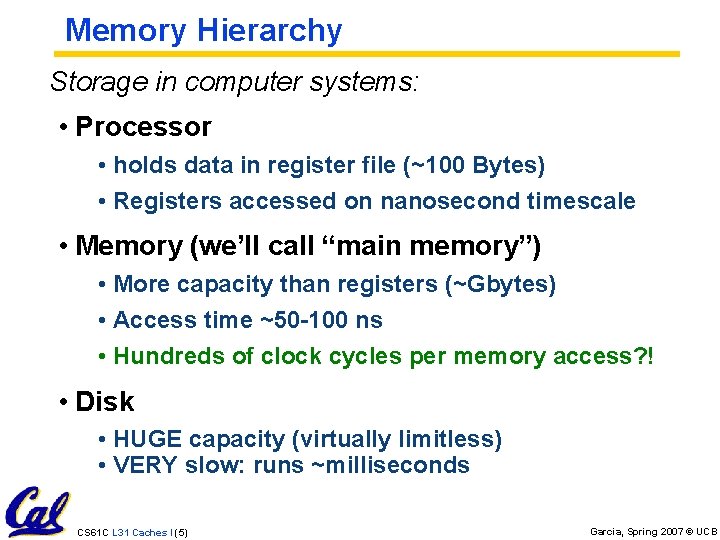
Memory Hierarchy Storage in computer systems: • Processor • holds data in register file (~100 Bytes) • Registers accessed on nanosecond timescale • Memory (we’ll call “main memory”) • More capacity than registers (~Gbytes) • Access time ~50 -100 ns • Hundreds of clock cycles per memory access? ! • Disk • HUGE capacity (virtually limitless) • VERY slow: runs ~milliseconds CS 61 C L 31 Caches I (5) Garcia, Spring 2007 © UCB
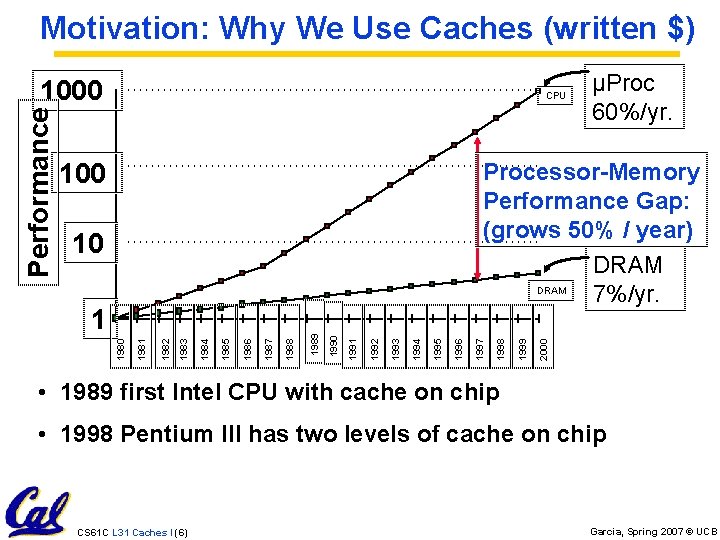
Motivation: Why We Use Caches (written $) CPU 100 µProc 60%/yr. 2000 1999 1998 1996 1995 1994 1993 1992 1991 1988 1987 1986 1985 1984 1983 1982 1981 1980 1 1990 10 1997 Processor-Memory Performance Gap: (grows 50% / year) DRAM 7%/yr. 1989 Performance 1000 • 1989 first Intel CPU with cache on chip • 1998 Pentium III has two levels of cache on chip CS 61 C L 31 Caches I (6) Garcia, Spring 2007 © UCB
Memory Caching • Mismatch between processor and memory speeds leads us to add a new level: a memory cache • Implemented with same IC processing technology as the CPU (usually integrated on same chip): faster but more expensive than DRAM memory. • Cache is a copy of a subset of main memory. • Most processors have separate caches for instructions and data. CS 61 C L 31 Caches I (7) Garcia, Spring 2007 © UCB
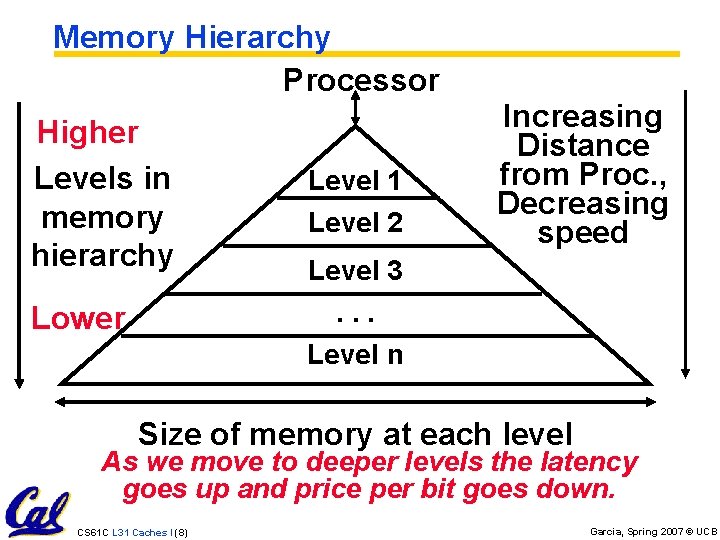
Memory Hierarchy Processor Higher Levels in memory hierarchy Lower Level 1 Level 2 Increasing Distance from Proc. , Decreasing speed Level 3. . . Level n Size of memory at each level As we move to deeper levels the latency goes up and price per bit goes down. CS 61 C L 31 Caches I (8) Garcia, Spring 2007 © UCB
Memory Hierarchy • If level closer to Processor, it is: • smaller • faster • subset of lower levels (contains most recently used data) • Lowest Level (usually disk) contains all available data (or does it go beyond the disk? ) • Memory Hierarchy presents the processor with the illusion of a very large very fast memory. CS 61 C L 31 Caches I (9) Garcia, Spring 2007 © UCB
Memory Hierarchy Analogy: Library (1/2) • You’re writing a term paper (Processor) at a table in Doe • Doe Library is equivalent to disk • essentially limitless capacity • very slow to retrieve a book • Table is main memory • smaller capacity: means you must return book when table fills up • easier and faster to find a book there once you’ve already retrieved it CS 61 C L 31 Caches I (10) Garcia, Spring 2007 © UCB
Memory Hierarchy Analogy: Library (2/2) • Open books on table are cache • smaller capacity: can have very few open books fit on table; again, when table fills up, you must close a book • much, much faster to retrieve data • Illusion created: whole library open on the tabletop • Keep as many recently used books open on table as possible since likely to use again • Also keep as many books on table as possible, since faster than going to library CS 61 C L 31 Caches I (11) Garcia, Spring 2007 © UCB
Memory Hierarchy Basis • Cache contains copies of data in memory that are being used. • Memory contains copies of data on disk that are being used. • Caches work on the principles of temporal and spatial locality. • Temporal Locality: if we use it now, chances are we’ll want to use it again soon. • Spatial Locality: if we use a piece of memory, chances are we’ll use the neighboring pieces soon. CS 61 C L 31 Caches I (12) Garcia, Spring 2007 © UCB
Cache Design • How do we organize cache? • Where does each memory address map to? (Remember that cache is subset of memory, so multiple memory addresses map to the same cache location. ) • How do we know which elements are in cache? • How do we quickly locate them? CS 61 C L 31 Caches I (13) Garcia, Spring 2007 © UCB
Administrivia • Project 4 (on Caches) will be in optional groups of two. • I’m releasing old CS 61 C finals • Check the course web page CS 61 C L 31 Caches I (14) Garcia, Spring 2007 © UCB
Direct-Mapped Cache (1/4) • In a direct-mapped cache, each memory address is associated with one possible block within the cache • Therefore, we only need to look in a single location in the cache for the data if it exists in the cache • Block is the unit of transfer between cache and memory CS 61 C L 31 Caches I (15) Garcia, Spring 2007 © UCB
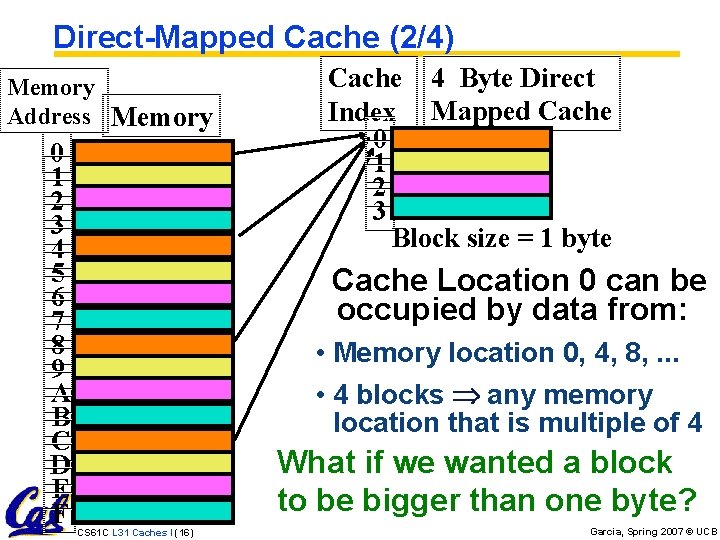
Direct-Mapped Cache (2/4) Memory Address Memory 0 1 2 3 4 5 6 7 8 9 A B C D E F Cache 4 Byte Direct Index Mapped Cache 0 1 2 3 Block size = 1 byte Cache Location 0 can be occupied by data from: • Memory location 0, 4, 8, . . . • 4 blocks any memory location that is multiple of 4 What if we wanted a block to be bigger than one byte? CS 61 C L 31 Caches I (16) Garcia, Spring 2007 © UCB
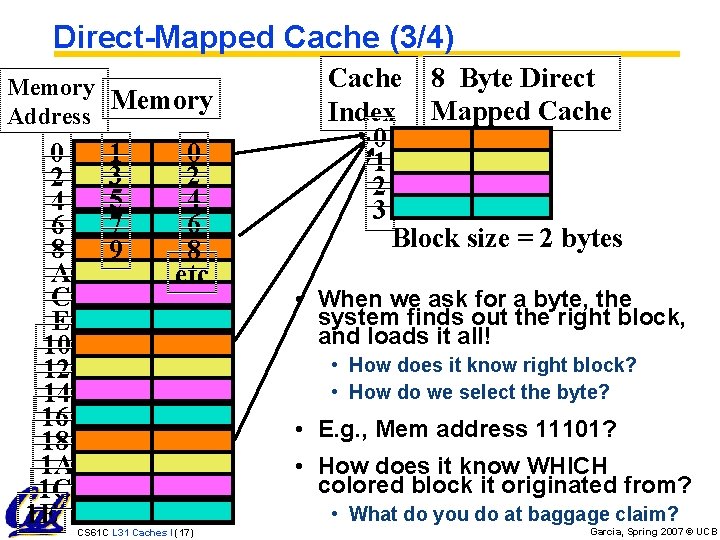
Direct-Mapped Cache (3/4) Memory Address 0 2 4 6 8 A C E 10 12 14 16 18 1 A 1 C 1 E 1 3 5 7 9 0 2 4 6 8 etc Cache 8 Byte Direct Index Mapped Cache 0 1 2 3 Block size = 2 bytes • When we ask for a byte, the system finds out the right block, and loads it all! • How does it know right block? • How do we select the byte? • E. g. , Mem address 11101? • How does it know WHICH colored block it originated from? • What do you do at baggage claim? CS 61 C L 31 Caches I (17) Garcia, Spring 2007 © UCB
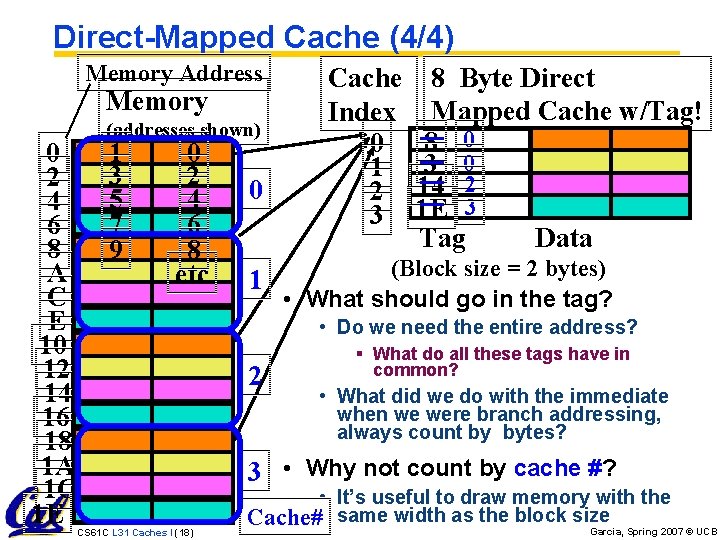
Direct-Mapped Cache (4/4) Memory Address Memory 0 2 4 6 8 A C E 10 12 14 16 18 1 A 1 C 1 E (addresses shown) 1 3 5 7 9 0 2 4 6 8 etc CS 61 C L 31 Caches I (18) 0 1 Cache Index 0 1 2 3 8 Byte Direct Mapped Cache w/Tag! 8 0 3 0 14 2 1 E 3 Tag Data (Block size = 2 bytes) • What should go in the tag? • Do we need the entire address? 2 § What do all these tags have in common? • What did we do with the immediate when we were branch addressing, always count by bytes? 3 • Why not count by cache #? • It’s useful to draw memory with the Cache# same width as the block size Garcia, Spring 2007 © UCB
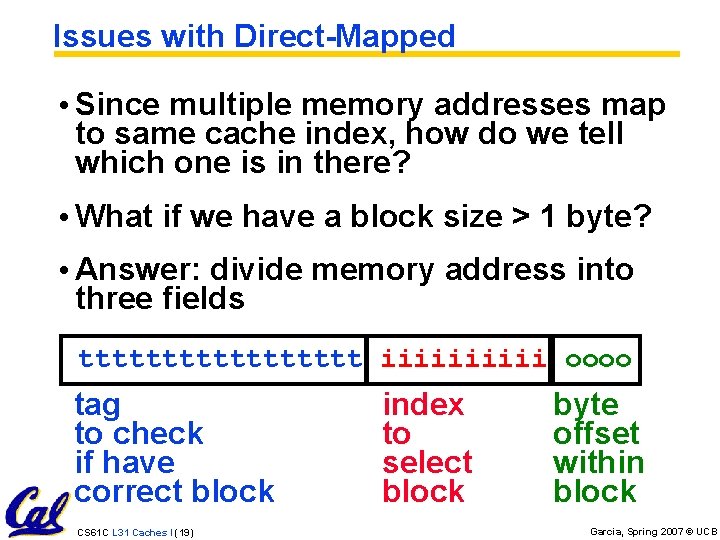
Issues with Direct-Mapped • Since multiple memory addresses map to same cache index, how do we tell which one is in there? • What if we have a block size > 1 byte? • Answer: divide memory address into three fields ttttttttt iiiii oooo tag to check if have correct block CS 61 C L 31 Caches I (19) index to select block byte offset within block Garcia, Spring 2007 © UCB
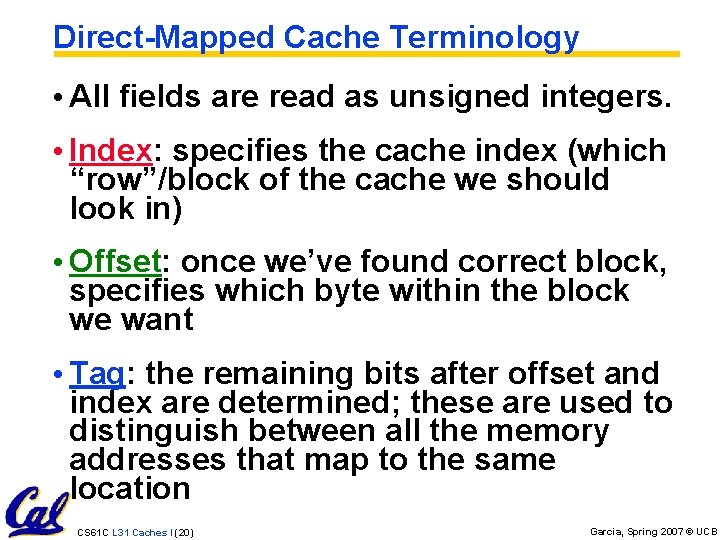
Direct-Mapped Cache Terminology • All fields are read as unsigned integers. • Index: specifies the cache index (which “row”/block of the cache we should look in) • Offset: once we’ve found correct block, specifies which byte within the block we want • Tag: the remaining bits after offset and index are determined; these are used to distinguish between all the memory addresses that map to the same location CS 61 C L 31 Caches I (20) Garcia, Spring 2007 © UCB
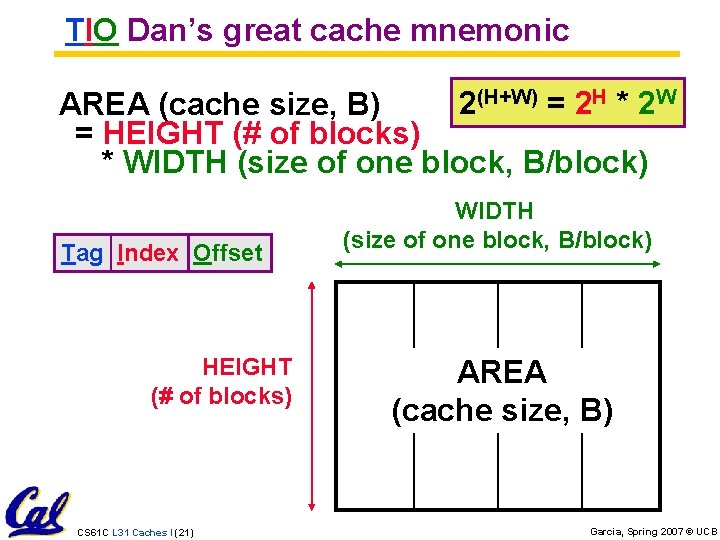
TIO Dan’s great cache mnemonic 2(H+W) = 2 H * 2 W AREA (cache size, B) = HEIGHT (# of blocks) * WIDTH (size of one block, B/block) Tag Index Offset HEIGHT (# of blocks) CS 61 C L 31 Caches I (21) WIDTH (size of one block, B/block) AREA (cache size, B) Garcia, Spring 2007 © UCB
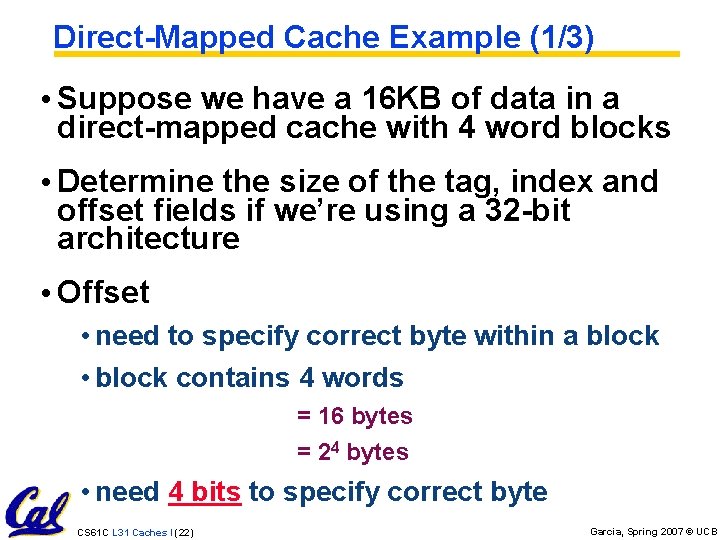
Direct-Mapped Cache Example (1/3) • Suppose we have a 16 KB of data in a direct-mapped cache with 4 word blocks • Determine the size of the tag, index and offset fields if we’re using a 32 -bit architecture • Offset • need to specify correct byte within a block • block contains 4 words = 16 bytes = 24 bytes • need 4 bits to specify correct byte CS 61 C L 31 Caches I (22) Garcia, Spring 2007 © UCB
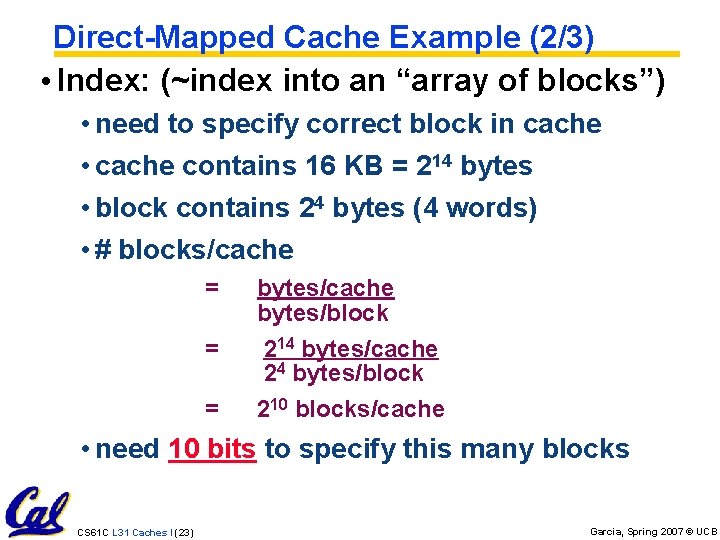
Direct-Mapped Cache Example (2/3) • Index: (~index into an “array of blocks”) • need to specify correct block in cache • cache contains 16 KB = 214 bytes • block contains 24 bytes (4 words) • # blocks/cache = = = bytes/cache bytes/block 214 bytes/cache 24 bytes/block 210 blocks/cache • need 10 bits to specify this many blocks CS 61 C L 31 Caches I (23) Garcia, Spring 2007 © UCB
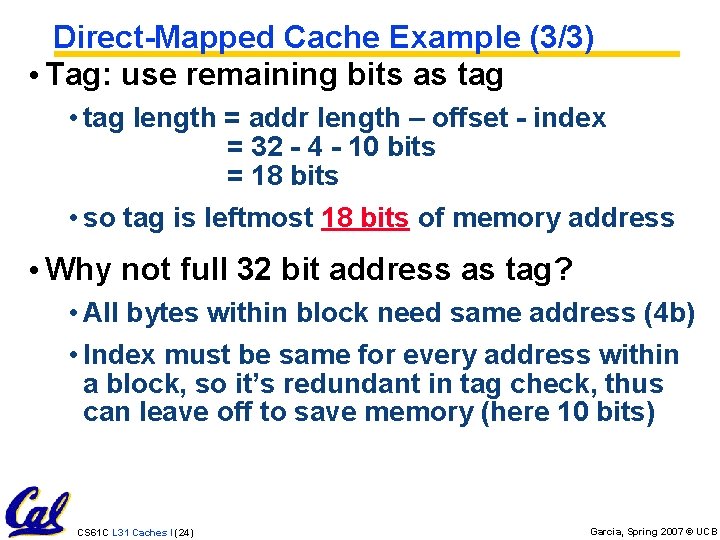
Direct-Mapped Cache Example (3/3) • Tag: use remaining bits as tag • tag length = addr length – offset - index = 32 - 4 - 10 bits = 18 bits • so tag is leftmost 18 bits of memory address • Why not full 32 bit address as tag? • All bytes within block need same address (4 b) • Index must be same for every address within a block, so it’s redundant in tag check, thus can leave off to save memory (here 10 bits) CS 61 C L 31 Caches I (24) Garcia, Spring 2007 © UCB
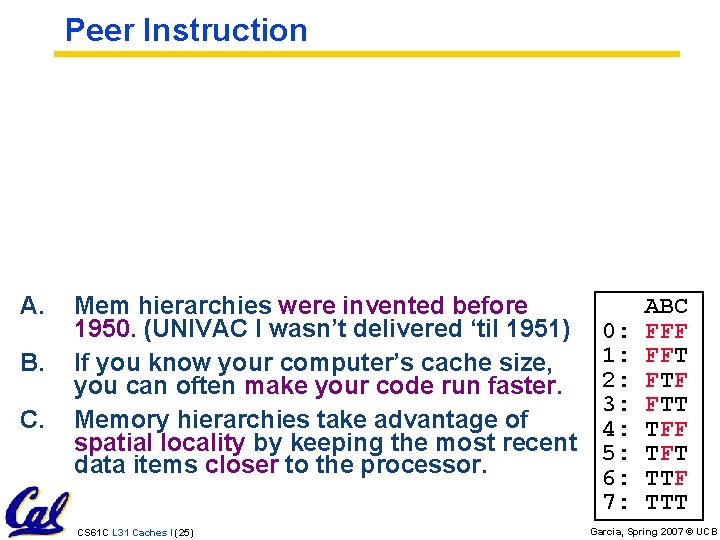
Peer Instruction A. B. C. Mem hierarchies were invented before 1950. (UNIVAC I wasn’t delivered ‘til 1951) If you know your computer’s cache size, you can often make your code run faster. Memory hierarchies take advantage of spatial locality by keeping the most recent data items closer to the processor. CS 61 C L 31 Caches I (25) 0: 1: 2: 3: 4: 5: 6: 7: ABC FFF FFT FTF FTT TFF TFT TTF TTT Garcia, Spring 2007 © UCB
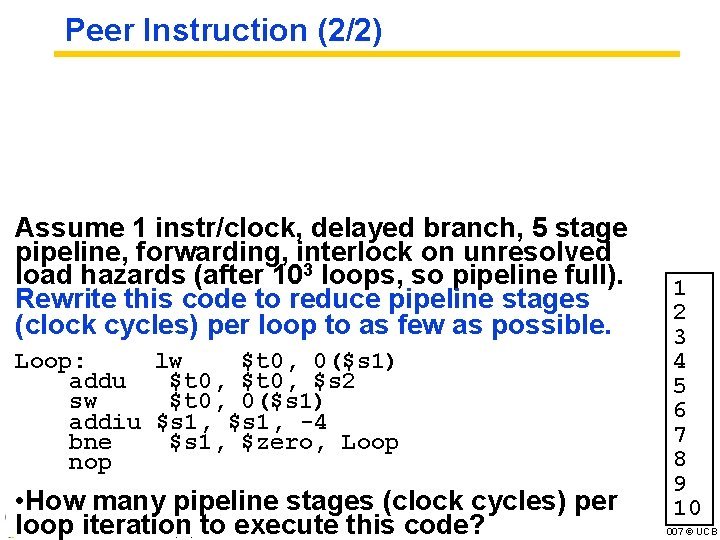
Peer Instruction (2/2) Assume 1 instr/clock, delayed branch, 5 stage pipeline, forwarding, interlock on unresolved load hazards (after 103 loops, so pipeline full). Rewrite this code to reduce pipeline stages (clock cycles) per loop to as few as possible. Loop: lw $t 0, 0($s 1) addu $t 0, $s 2 sw $t 0, 0($s 1) addiu $s 1, -4 bne $s 1, $zero, Loop nop • How many pipeline stages (clock cycles) per loop iteration to execute this code? CS 61 C L 31 Caches I (27) 1 2 3 4 5 6 7 8 9 10 Garcia, Spring 2007 © UCB
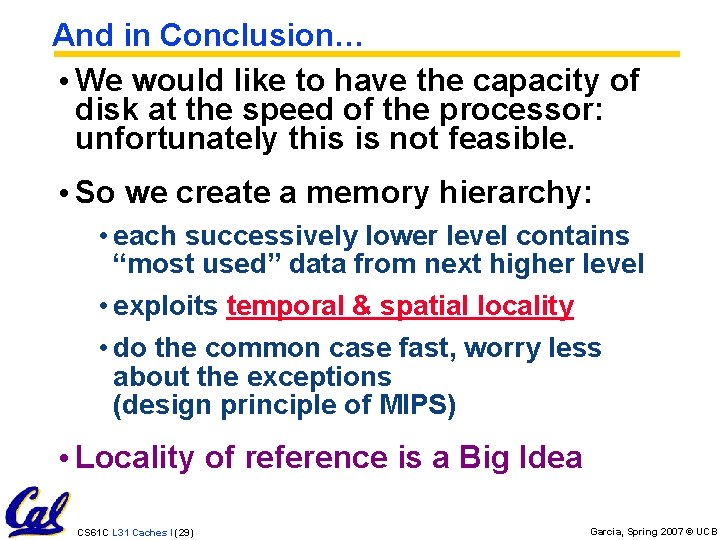
And in Conclusion… • We would like to have the capacity of disk at the speed of the processor: unfortunately this is not feasible. • So we create a memory hierarchy: • each successively lower level contains “most used” data from next higher level • exploits temporal & spatial locality • do the common case fast, worry less about the exceptions (design principle of MIPS) • Locality of reference is a Big Idea CS 61 C L 31 Caches I (29) Garcia, Spring 2007 © UCB
- Slides: 27