
inst eecs berkeley educs 61 c CS 61
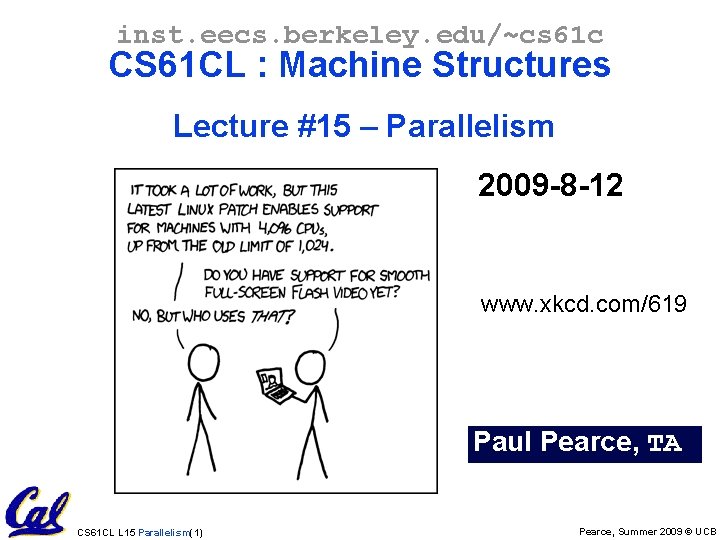
inst. eecs. berkeley. edu/~cs 61 c CS 61 CL : Machine Structures Lecture #15 – Parallelism 2009 -8 -12 www. xkcd. com/619 Paul Pearce, TA CS 61 CL L 15 Parallelism(1) Pearce, Summer 2009 © UCB
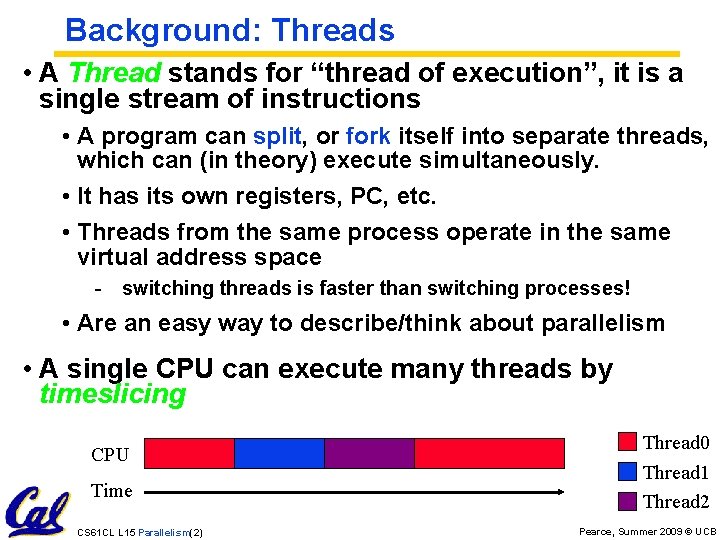
Background: Threads • A Thread stands for “thread of execution”, it is a single stream of instructions • A program can split, or fork itself into separate threads, which can (in theory) execute simultaneously. • It has its own registers, PC, etc. • Threads from the same process operate in the same virtual address space - switching threads is faster than switching processes! • Are an easy way to describe/think about parallelism • A single CPU can execute many threads by timeslicing CPU Time CS 61 CL L 15 Parallelism(2) Thread 0 Thread 1 Thread 2 Pearce, Summer 2009 © UCB
Introduction to Hardware Parallelism • Given many threads (somehow generated by software), how do we implement this in hardware? • “Iron Law” of Processor Performance Execution Time = (Inst. Count)(CPI)(Cycle Time) • Hardware Parallelism improves: • Instruction Count - If the equation is applied to each CPU, each CPU needs to do less • CPI - If the equation is applied to system as a whole, more is done per cycle • Cycle Time - Will probably be made worse in process CS 61 CL L 15 Parallelism(3) Pearce, Summer 2009 © UCB
Disclaimers • Please don’t let today’s material confuse what you have already learned about CPU’s and pipelining • When programmer is mentioned today, it means whoever is generating the assembly code (so it is probably a compiler) • Many of the concepts described today are difficult to implement, so if it sounds easy, think of possible hazards CS 61 CL L 15 Parallelism(4) Pearce, Summer 2009 © UCB
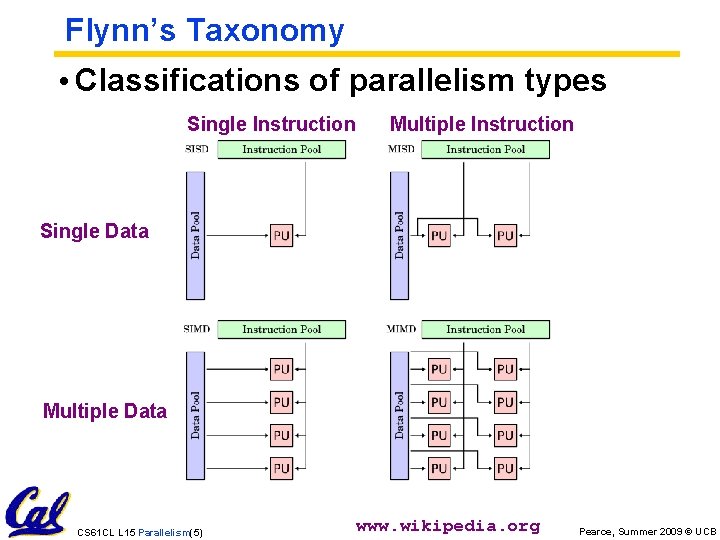
Flynn’s Taxonomy • Classifications of parallelism types Single Instruction Multiple Instruction Single Data Multiple Data CS 61 CL L 15 Parallelism(5) www. wikipedia. org Pearce, Summer 2009 © UCB

Superscalar • Add more functional units or pipelines to CPU • Directly reduces CPI by doing more per cycle • Consider what if we: • Added another ALU • Added 2 more read ports to the Reg. File • Added 1 more write port to the Reg. File CS 61 CL L 15 Parallelism(6) Pearce, Summer 2009 © UCB
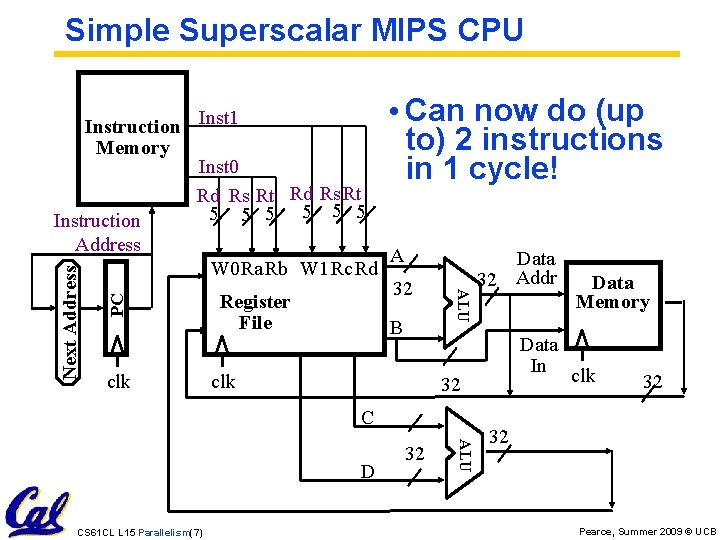
Simple Superscalar MIPS CPU • Can now do (up to) 2 instructions in 1 cycle! PC Next Address clk ALU Instruction Inst 1 Memory Inst 0 Rd Rs Rt 5 5 5 Instruction Address A W 0 Ra. Rb W 1 Rc. Rd 32 Register File B ALU D 32 Data Memory Data In clk 32 C CS 61 CL L 15 Parallelism(7) Data 32 Addr 32 32 Pearce, Summer 2009 © UCB
Simple Superscalar MIPS CPU (cont. ) • Considerations • ISA now has to be changed • Forwarding for pipelining now harder • Limitations • Programmer must explicitly generate parallel code OR require even more complex hardware for scheduling • Improvement only if other instructions can fill slots • Doesn’t scale well CS 61 CL L 15 Parallelism(8) Pearce, Summer 2009 © UCB
Superscalar in Practice • Performance improvement depends on program and programmer being able to fully utilize all slots • Can be parts other than ALU (like load) • Usefulness will be more apparent when combined with other parallel techniques • Other techniques, such as vectored data CS 61 CL L 15 Parallelism(9) Pearce, Summer 2009 © UCB
Multithreading • Multithreading is running multiple threads through the same hardware • Could we do Timeslicing better in hardware? • Consider if we gave the OS the abstraction of having 4 physical CPU’s that share memory and each executes one thread, but we did it all on 1 physical CPU? CS 61 CL L 15 Parallelism(10) Pearce, Summer 2009 © UCB

Static Multithreading Example Appears to be 4 CPU’s at 1/4 clock Introduced in 1964 by Seymour Cray ALU CS 61 CL L 15 Parallelism(11) Pipeline Stage Pearce, Summer 2009 © UCB

Static Multithreading Example Analyzed • Results: • 4 Threads running in hardware • Pipeline hazards reduced - No more need to forward - No control issues - Less structural hazards • Depends on being able to fully generate 4 threads evenly - Example if 1 Thread does 75% of the work – Utilization = (% time run)(% work done) = (. 25)(. 75) + (. 75)(. 25) =. 375 = 37. 5% CS 61 CL L 15 Parallelism(12) Pearce, Summer 2009 © UCB

Dynamic Multithreading • Adds flexibility in choosing time to switch thread • Simultaneous Multithreading (SMT) • Called Hyperthreading by Intel • Run multiple threads at the same time • Just allocate functional units when available • Superscalar helps with this CS 61 CL L 15 Parallelism(13) Pearce, Summer 2009 © UCB
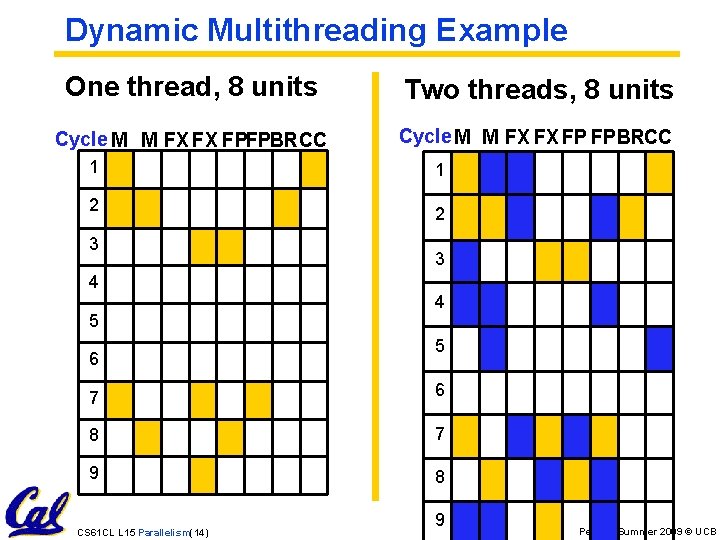
Dynamic Multithreading Example One thread, 8 units Two threads, 8 units Cycle M M FX FX FPFPBRCC Cycle M M FX FX FP FPBRCC 1 1 2 2 3 4 5 6 3 4 5 7 6 8 7 9 8 CS 61 CL L 15 Parallelism(14) 9 Pearce, Summer 2009 © UCB
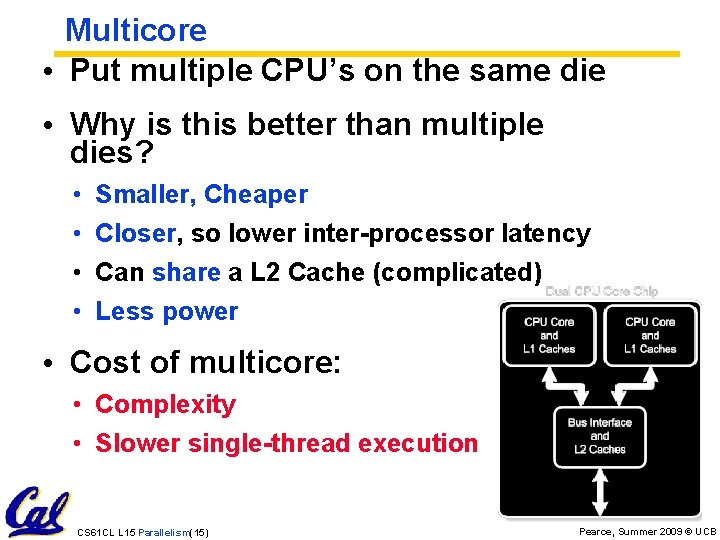
Multicore • Put multiple CPU’s on the same die • Why is this better than multiple dies? • • Smaller, Cheaper Closer, so lower inter-processor latency Can share a L 2 Cache (complicated) Less power • Cost of multicore: • Complexity • Slower single-thread execution CS 61 CL L 15 Parallelism(15) Pearce, Summer 2009 © UCB
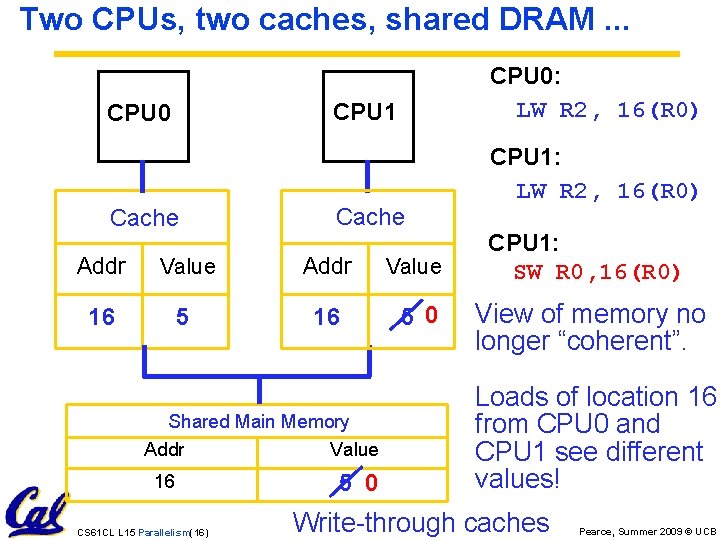
Two CPUs, two caches, shared DRAM. . . CPU 0: LW R 2, 16(R 0) CPU 1 CPU 0 Cache Addr Value 16 5 0 Shared Main Memory Addr Value 16 5 0 CS 61 CL L 15 Parallelism(16) CPU 1: LW R 2, 16(R 0) CPU 1: SW R 0, 16(R 0) View of memory no longer “coherent”. Loads of location 16 from CPU 0 and CPU 1 see different values! Write-through caches Pearce, Summer 2009 © UCB
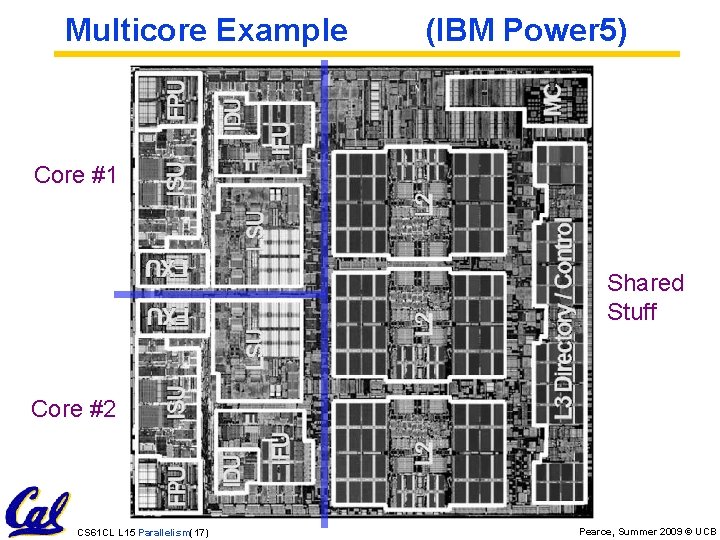
Multicore Example (IBM Power 5) Core #1 Shared Stuff Core #2 CS 61 CL L 15 Parallelism(17) Pearce, Summer 2009 © UCB
Administrivia • Absolutely nothing else due! • You survived, congratulations…. - Now study for your final tomorrow! • Final Exam: Tomorrow, 8/13, 9 am-12. 277 Cory (this room) • Final Exam Review: Right after this lecture! • Sleep! We won’t be answering any questions late into the night in an effort to get you guys to go to bed early! If you don’t sleep, you won’t do well. CS 61 CL L 15 Parallelism(18) Pearce, Summer 2009 © UCB
High Level Message • Everything is changing • Old conventional wisdom is out • We desperately need new approach to HW and SW based on parallelism since industry has bet its future that parallelism works • Need to create a “watering hole” to bring everyone together to quickly find that solution • architects, language designers, application experts, numerical analysts, algorithm designers, programmers, … CS 61 CL L 15 Parallelism(19) Pearce, Summer 2009 © UCB
Conventional Wisdom (CW) in Computer Architecture 1. Old CW: Power is free, but transistors expensive • New CW: Power wall Power expensive, transistors “free” • Can put more transistors on a chip than have power to turn on 2. Old CW: Multiplies slow, but loads fast • New CW: Memory wall Loads slow, multiplies fast • 3. 200 clocks to DRAM, but even FP multiplies only 4 clocks Old CW: More ILP via compiler / architecture innovation • Branch prediction, speculation, Out-of-order execution, VLIW, … • New CW: ILP wall Diminishing returns on more ILP 4. Old CW: 2 X CPU Performance every 18 months • New CW is Power Wall + Memory Wall + ILP Wall = Brick Wall CS 61 CL L 15 Parallelism(20) Pearce, Summer 2009 © UCB

Uniprocessor Performance (SPECint) 3 X From Hennessy and Patterson, Computer Architecture: A Quantitative Approach, 4 th edition, Sept. 15, 2006 Sea change in chip design: multiple “cores” or processors per chip • VAX : 25%/year 1978 to 1986 • RISC + x 86: 52%/year 1986 to 2002 • RISC + x 86: ? ? %/year 2002 to present CS 61 CL L 15 Parallelism(21) Pearce, Summer 2009 © UCB
Need a New Approach • Berkeley researchers from many backgrounds met between February 2005 and December 2006 to discuss parallelism • Circuit design, computer architecture, massively parallel computing, computer-aided design, embedded hardware and software, programming languages, compilers, scientific programming, and numerical analysis • Krste Asanovic, Ras Bodik, Jim Demmel, John Kubiatowicz, Edward Lee, George Necula, Kurt Keutzer, Dave Patterson, Koshik Sen, John Shalf, Kathy Yelick + others • Tried to learn from successes in embedded and high performance computing • Led to 7 Questions to frame parallel research CS 61 CL L 15 Parallelism(22) Pearce, Summer 2009 © UCB
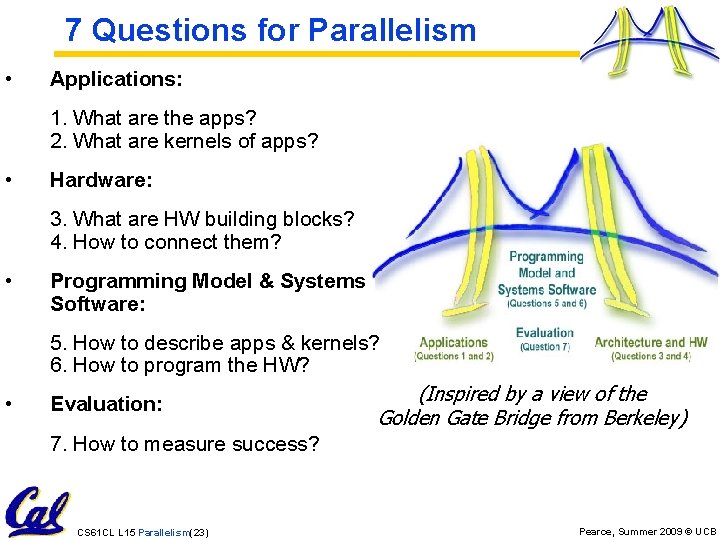
7 Questions for Parallelism • Applications: 1. What are the apps? 2. What are kernels of apps? • Hardware: 3. What are HW building blocks? 4. How to connect them? • Programming Model & Systems Software: 5. How to describe apps & kernels? 6. How to program the HW? • Evaluation: (Inspired by a view of the Golden Gate Bridge from Berkeley) 7. How to measure success? CS 61 CL L 15 Parallelism(23) Pearce, Summer 2009 © UCB
Hardware Tower: What are the problems? • Power limits leading edge chip designs • Intel Tejas Pentium 4 cancelled due to power issues • Yield on leading edge processes dropping dramatically • IBM quotes yields of 10 – 20% on 8 processor Cell • Design/validation leading edge chip is becoming unmanageable • Verification teams > design teams on leading edge processors CS 61 CL L 15 Parallelism(24) Pearce, Summer 2009 © UCB
HW Solution: Small is Beautiful • Expect modestly pipelined (5 - to 9 -stage) CPUs, FPUs, vector, Single Inst Multiple Data (SIMD) Processing Elements (PEs) • Small cores not much slower than large cores • Parallel is energy efficient path to performance: P≈V 2 • Lower threshold and supply voltages lowers energy per op • Redundant processors can improve chip yield • Cisco Metro 188 CPUs + 4 spares; Sun Niagara sells 6 or 8 CPUs • Small, regular processing elements easier to verify • One size fits all? Heterogeneous processors? CS 61 CL L 15 Parallelism(25) Pearce, Summer 2009 © UCB

Number of Cores/Socket • We need revolution, not evolution • Software or architecture alone can’t fix parallel programming problem, need innovations in both • “Multicore” 2 X cores per generation: 2, 4, 8, … • “Manycore” 100 s is highest performance per unit area, and per Watt, then 2 X per generation: 64, 128, 256, 512, 1024 … • Multicore architectures & Programming Models good for 2 to 32 cores won’t evolve to Manycore systems of 1000’s of processors Desperately need HW/SW models that work for Manycore or will run out of steam (as ILP ran out of steam at 4 instructions) CS 61 CL L 15 Parallelism(26) Pearce, Summer 2009 © UCB
Measuring Success: What are the problems? 1. Only companies can build HW, and it takes years 2. Software people don’t start working hard until hardware arrives • 3 months after HW arrives, SW people list everything that must be fixed, then we all wait 4 years for next iteration of HW/SW 3. How get 1000 CPU systems in hands of researchers to innovate in timely fashion on in algorithms, compilers, languages, OS, architectures, … ? 4. Can avoid waiting years between HW/SW iterations? CS 61 CL L 15 Parallelism(27) Pearce, Summer 2009 © UCB
Build Academic Manycore from FPGAs • As 16 CPUs will fit in Field Programmable Gate Array (FPGA), 1000 -CPU system from 64 FPGAs? • 8 32 -bit simple “soft core” RISC at 100 MHz in 2004 (Virtex-II) • FPGA generations every 1. 5 yrs; 2 X CPUs, 1. 2 X clock rate • HW research community does logic design (“gate shareware”) to create out-of-the-box, Manycore • E. g. , 1000 processor, standard ISA binary-compatible, 64 -bit, cache-coherent supercomputer @ 150 MHz/CPU in 2007 • RAMPants: 10 faculty at Berkeley, CMU, MIT, Stanford, Texas, and Washington • “Research Accelerator for Multiple Processors” as a vehicle to attract many to parallel challenge CS 61 CL L 15 Parallelism(28) Pearce, Summer 2009 © UCB
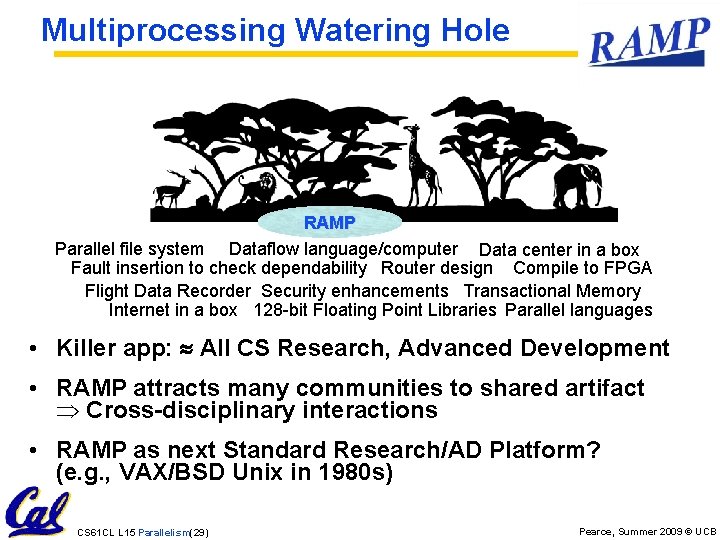
Multiprocessing Watering Hole RAMP Parallel file system Dataflow language/computer Data center in a box Fault insertion to check dependability Router design Compile to FPGA Flight Data Recorder Security enhancements Transactional Memory Internet in a box 128 -bit Floating Point Libraries Parallel languages • Killer app: All CS Research, Advanced Development • RAMP attracts many communities to shared artifact Cross-disciplinary interactions • RAMP as next Standard Research/AD Platform? (e. g. , VAX/BSD Unix in 1980 s) CS 61 CL L 15 Parallelism(29) Pearce, Summer 2009 © UCB
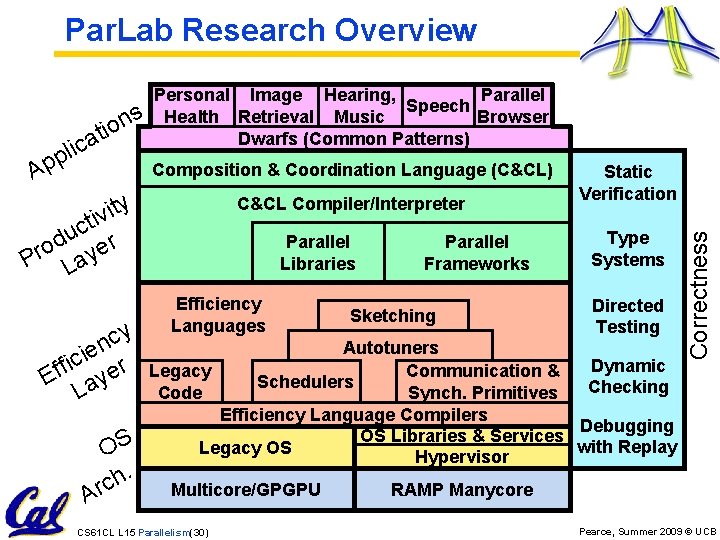
Par. Lab Research Overview c li p p A Composition & Coordination Language (C&CL) y t i v ti c u r d o Pr Laye cy n e i c i Eff ayer L OS. h Arc C&CL Compiler/Interpreter Parallel Libraries Efficiency Languages Parallel Frameworks Sketching Static Verification Type Systems Directed Testing Autotuners Dynamic Legacy Communication & Schedulers Checking Code Synch. Primitives Efficiency Language Compilers Debugging OS Libraries & Services with Replay Legacy OS Hypervisor Multicore/GPGPU CS 61 CL L 15 Parallelism(30) Correctness s on i t a Personal Image Hearing, Parallel Speech Health Retrieval Music Browser Dwarfs (Common Patterns) RAMP Manycore Pearce, Summer 2009 © UCB
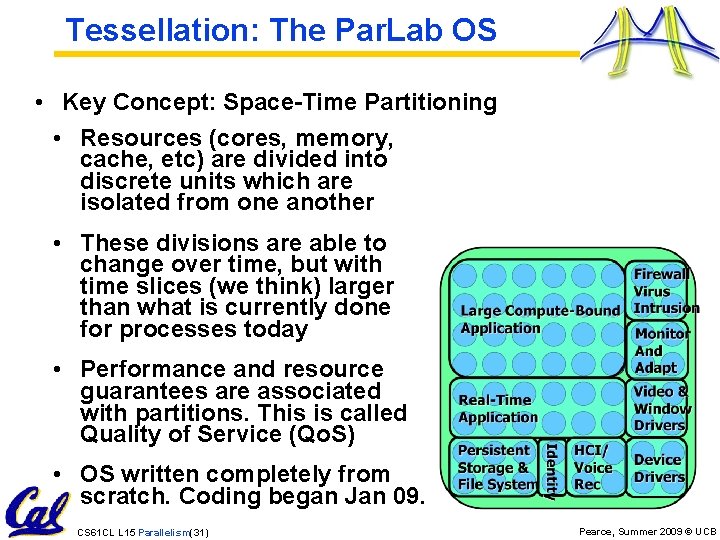
Tessellation: The Par. Lab OS • Key Concept: Space-Time Partitioning • Resources (cores, memory, cache, etc) are divided into discrete units which are isolated from one another • These divisions are able to change over time, but with time slices (we think) larger than what is currently done for processes today • Performance and resource guarantees are associated with partitions. This is called Quality of Service (Qo. S) • OS written completely from scratch. Coding began Jan 09. CS 61 CL L 15 Parallelism(31) Pearce, Summer 2009 © UCB
What I do on Tessellation • Remote System Calls (RSCs) • System Calls are functions that transfer control to the kernel to perform privileged operations • Tessellation doesn’t have Disk / File System support, so we package up file related System Calls and send them over some medium (serial / Ethernet) to a remote machine for processing and return the result • PCI / Ethernet / IOAPIC Support • Wrote a basic PCI bus parser, and Ethernet driver. This gives Tessellation the ability to perform basic network communication. RSCs currently run over this medium • Standalone TCP/IP Stack Integration • Responsible for integrating a third-party TCP/IP stack into OS as a user space library running inside of a partition – the first example of our partitioning model • Interrupt Routing • Wrote the system that allows device interrupts to be routed to specific cores or groups of cores. Random side note: AHHHH x 86 is ugly! Be grateful for MIPS! CS 61 CL L 15 Parallelism(32) Pearce, Summer 2009 © UCB
How to get involved • We’ve talked in-depth about a few research projects. The purpose of this was to give you a brief overview of some of the great projects being worked on here at Cal by undergraduates just like you • I’m an undergraduate transfer. I sat in the very seats you were in Spring 08. I began work on Tessellation by simply asking my CS 162 Professor if he had a project he needed help with • How to get involved: • Attend lecture and office hours, get to know the instructors • Have conversations with professors, ask them what they are working on, and if they need help (the answer will likely be yes) • Not sure who to talk too? Check out these great resources. These programs have lists of projects looking for undergraduates. You can get units, and in some cases money! • http: //research. berkeley. edu/urap/ • http: //coe. berkeley. edu/students/current-undergraduates/studentresearch/uro/ CS 61 CL L 15 Parallelism(33) Pearce, Summer 2009 © UCB
Summary • Superscalar: More functional units • Multithread: Multiple threads executing on same CPU • Multicore: Multiple CPU’s on the same die • The gains from all these parallel hardware techniques relies heavily on the programmer being able to map their task well to multiple threads • Research projects need your help! CS 61 CL L 15 Parallelism(34) Pearce, Summer 2009 © UCB
Reasons for Optimism towards Parallel Revolution this time • End of sequential microprocessor/faster clock rates • No looming sequential juggernaut to kill parallel revolution • SW & HW industries fully committed to parallelism • End of lazy Programming Era • Moore’s Law continues, so soon can put 1000 s of simple cores on an economical chip • Open Source Software movement means that SW stack can evolve more quickly than in past • RAMP as vehicle to ramp up parallel research • Tessellation as a way to manage and utilize new manycore hardware CS 61 CL L 15 Parallelism(35) Pearce, Summer 2009 © UCB
Credits • Thanks to the following people and possibly others for these slides: • Krste Asanovic • Scott Beamer • Albert Chae • Dan Garcia • John Kubiatowicz CS 61 CL L 15 Parallelism(36) Pearce, Summer 2009 © UCB

Up next…. . Review time with Josh and James! CS 61 CL L 15 Parallelism(37) Pearce, Summer 2009 © UCB
- Slides: 37