
inst eecs berkeley educs 61 c CS 61
inst. eecs. berkeley. edu/~cs 61 c CS 61 C : Machine Structures Lecture #1 – Introduction & Numbers 2005 -06 -20 Andy Carle CS 61 C L 01 Introduction + Numbers (1) A Carle -- Su 2005 © UCB
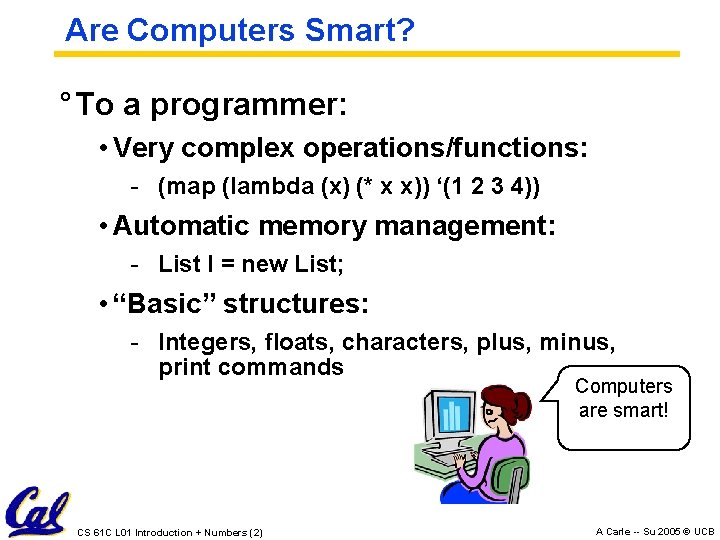
Are Computers Smart? ° To a programmer: • Very complex operations/functions: - (map (lambda (x) (* x x)) ‘(1 2 3 4)) • Automatic memory management: - List l = new List; • “Basic” structures: - Integers, floats, characters, plus, minus, print commands Computers are smart! CS 61 C L 01 Introduction + Numbers (2) A Carle -- Su 2005 © UCB
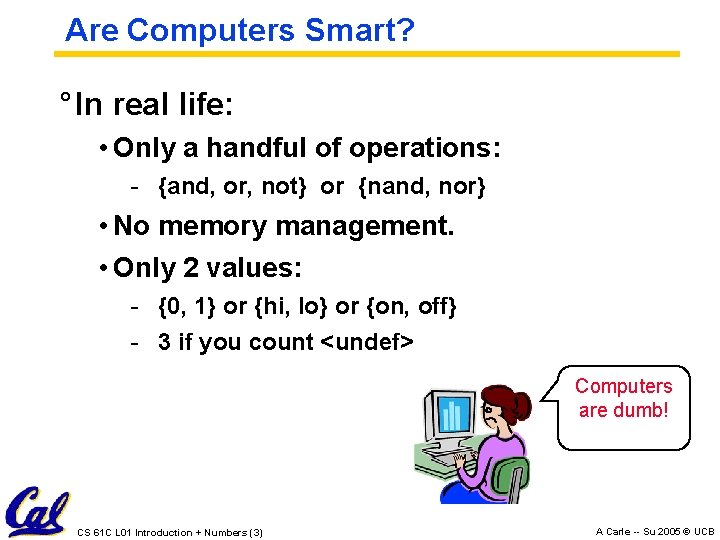
Are Computers Smart? ° In real life: • Only a handful of operations: - {and, or, not} or {nand, nor} • No memory management. • Only 2 values: - {0, 1} or {hi, lo} or {on, off} - 3 if you count <undef> Computers are dumb! CS 61 C L 01 Introduction + Numbers (3) A Carle -- Su 2005 © UCB
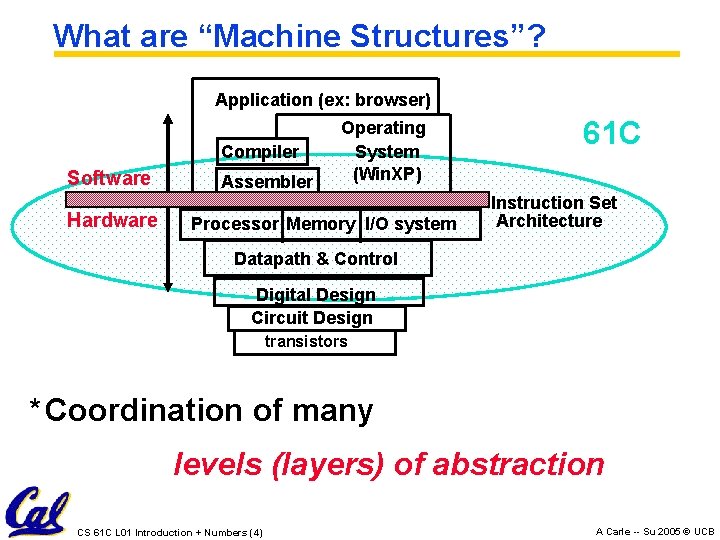
What are “Machine Structures”? Application (ex: browser) Compiler Software Hardware Assembler Operating System (Win. XP) Processor Memory I/O system 61 C Instruction Set Architecture Datapath & Control Digital Design Circuit Design transistors * Coordination of many levels (layers) of abstraction CS 61 C L 01 Introduction + Numbers (4) A Carle -- Su 2005 © UCB
![61 C Levels of Representation temp = v[k]; v[k] = v[k+1]; v[k+1] = temp;](http://slidetodoc.com/presentation_image_h2/87ee3a6eb11f5f8ad610e665c34f3bcc/image-5.jpg "61 C Levels of Representation temp = v[k]; v[k] = v[k+1]; v[k+1] = temp;")
61 C Levels of Representation temp = v[k]; v[k] = v[k+1]; v[k+1] = temp; High Level Language Program (e. g. , C) Compiler Assembly Language Program (e. g. , MIPS) Assembler Machine Language Program (MIPS) Machine Interpretation lw lw sw sw 0000 1010 1100 0101 $t 0, 0($2) $t 1, 4($2) $t 1, 0($2) $t 0, 4($2) 1001 1111 0110 1000 1100 0101 1010 0000 0110 1000 1111 1001 1010 0000 0101 1100 1111 1000 0110 0101 1100 0000 1010 1000 0110 1001 1111 Hardware Architecture Description (Logic, Logisim, etc. ) Architecture Implementation Logic Circuit Description (Logisim, etc. ) CS 61 C L 01 Introduction + Numbers (5) A Carle -- Su 2005 © UCB
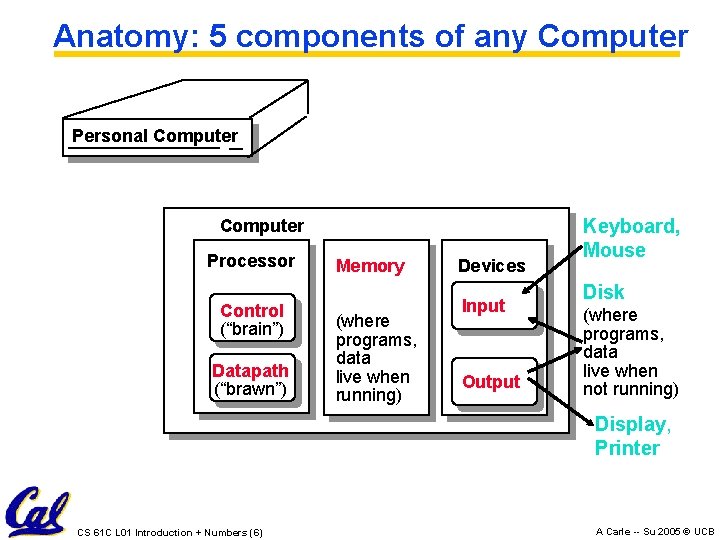
Anatomy: 5 components of any Computer Personal Computer Processor Control (“brain”) Datapath (“brawn”) Memory (where programs, data live when running) Devices Input Output Keyboard, Mouse Disk (where programs, data live when not running) Display, Printer CS 61 C L 01 Introduction + Numbers (6) A Carle -- Su 2005 © UCB
Overview of Physical Implementations The hardware out of which we make systems. ° Integrated Circuits (ICs) • Combinational logic circuits, memory elements, analog interfaces. ° Printed Circuits (PC) boards • substrate for ICs and interconnection, distribution of CLK, Vdd, and GND signals, heat dissipation. ° Power Supplies • Converts line AC voltage to regulated DC low voltage levels. ° Chassis (rack, card case, . . . ) • holds boards, power supply, provides physical interface to user or other systems. ° Connectors and Cables. CS 61 C L 01 Introduction + Numbers (7) A Carle -- Su 2005 © UCB

Integrated Circuits (2003 state-of-the-art) Bare Die ° Primarily Crystalline Silicon ° 1 mm - 25 mm on a side ° 2003 - feature size ~ 0. 13µm = 0. 13 x 10 -6 m ° 100 - 400 M transistors ° (25 - 100 M “logic gates") ° 3 - 10 conductive layers Chip in Package ° “CMOS” (complementary metal oxide semiconductor) - most common. ° Package provides: • spreading of chip-level signal paths to board-level • heat dissipation. ° Ceramic or plastic with gold wires. CS 61 C L 01 Introduction + Numbers (8) A Carle -- Su 2005 © UCB
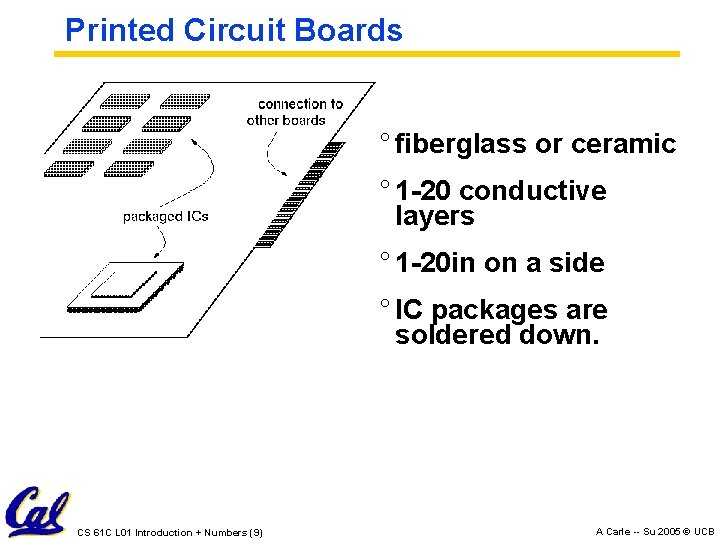
Printed Circuit Boards ° fiberglass or ceramic ° 1 -20 conductive layers ° 1 -20 in on a side ° IC packages are soldered down. CS 61 C L 01 Introduction + Numbers (9) A Carle -- Su 2005 © UCB
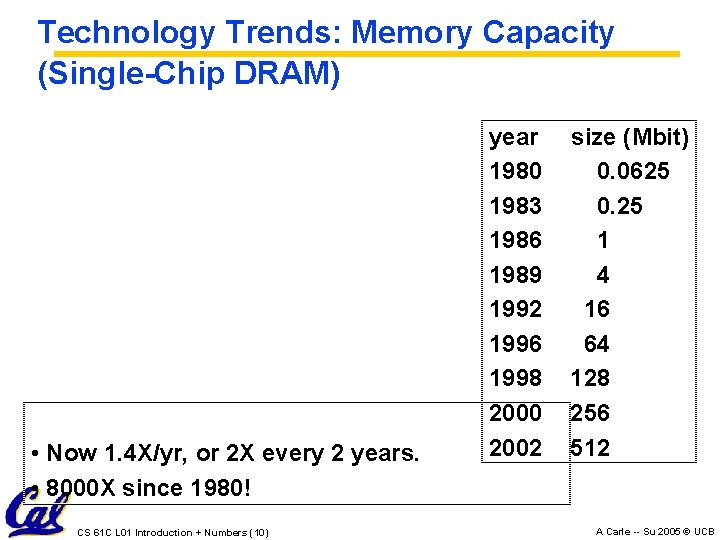
Technology Trends: Memory Capacity (Single-Chip DRAM) • Now 1. 4 X/yr, or 2 X every 2 years. • 8000 X since 1980! CS 61 C L 01 Introduction + Numbers (10) year 1980 1983 1986 1989 1992 1996 1998 2000 2002 size (Mbit) 0. 0625 0. 25 1 4 16 64 128 256 512 A Carle -- Su 2005 © UCB

Technology Trends: Microprocessor Complexity Moore’s Law Itanium 2: 41 Million Athlon (K 7): 22 Million Alpha 21264: 15 million Pentium Pro: 5. 5 million Power. PC 620: 6. 9 million Alpha 21164: 9. 3 million Sparc Ultra: 5. 2 million 2 X transistors/Chip Every 1. 5 years Called “Moore’s Law” CS 61 C L 01 Introduction + Numbers (11) A Carle -- Su 2005 © UCB

Performance measure Technology Trends: Processor Performance Intel P 4 2000 MHz (Fall 2001) 1. 54 X/yr year We’ll talk about processor performance later on… CS 61 C L 01 Introduction + Numbers (12) A Carle -- Su 2005 © UCB
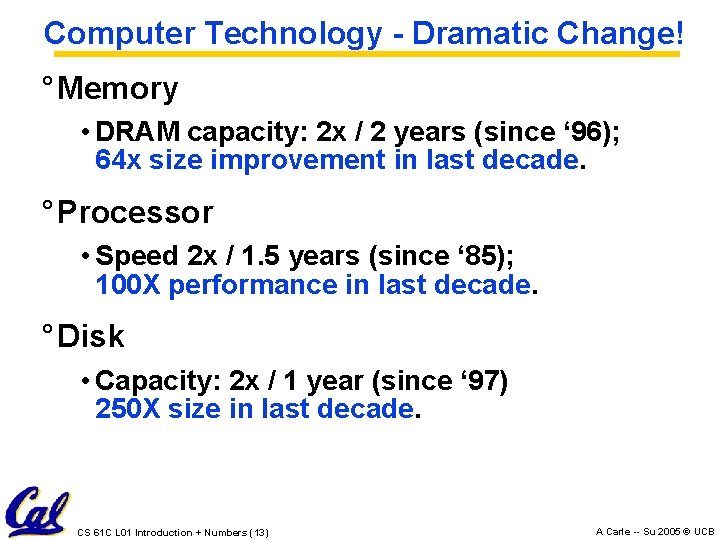
Computer Technology - Dramatic Change! ° Memory • DRAM capacity: 2 x / 2 years (since ‘ 96); 64 x size improvement in last decade. ° Processor • Speed 2 x / 1. 5 years (since ‘ 85); 100 X performance in last decade. ° Disk • Capacity: 2 x / 1 year (since ‘ 97) 250 X size in last decade. CS 61 C L 01 Introduction + Numbers (13) A Carle -- Su 2005 © UCB
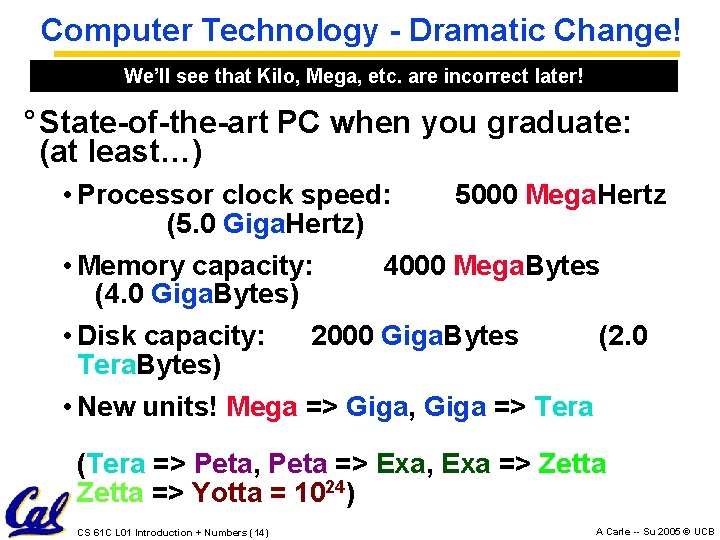
Computer Technology - Dramatic Change! We’ll see that Kilo, Mega, etc. are incorrect later! ° State-of-the-art PC when you graduate: (at least…) • Processor clock speed: 5000 Mega. Hertz (5. 0 Giga. Hertz) • Memory capacity: 4000 Mega. Bytes (4. 0 Giga. Bytes) • Disk capacity: 2000 Giga. Bytes (2. 0 Tera. Bytes) • New units! Mega => Giga, Giga => Tera (Tera => Peta, Peta => Exa, Exa => Zetta => Yotta = 1024) CS 61 C L 01 Introduction + Numbers (14) A Carle -- Su 2005 © UCB
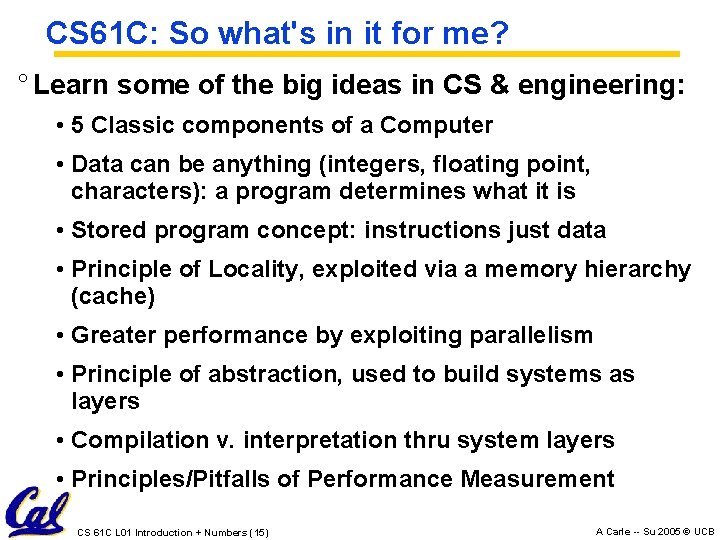
CS 61 C: So what's in it for me? ° Learn some of the big ideas in CS & engineering: • 5 Classic components of a Computer • Data can be anything (integers, floating point, characters): a program determines what it is • Stored program concept: instructions just data • Principle of Locality, exploited via a memory hierarchy (cache) • Greater performance by exploiting parallelism • Principle of abstraction, used to build systems as layers • Compilation v. interpretation thru system layers • Principles/Pitfalls of Performance Measurement CS 61 C L 01 Introduction + Numbers (15) A Carle -- Su 2005 © UCB

Others Skills learned in 61 C ° Learning C • If you know one, you should be able to learn another programming language largely on your own • Given that you know C++ or Java, should be easy to pick up their ancestor, C ° Assembly Language Programming • This is a skill you will pick up, as a side effect of understanding the Big Ideas ° Hardware design • We think of hardware at the abstract level, with only a little bit of physical logic to give things perspective • CS 150, 152 teach this CS 61 C L 01 Introduction + Numbers (16) A Carle -- Su 2005 © UCB
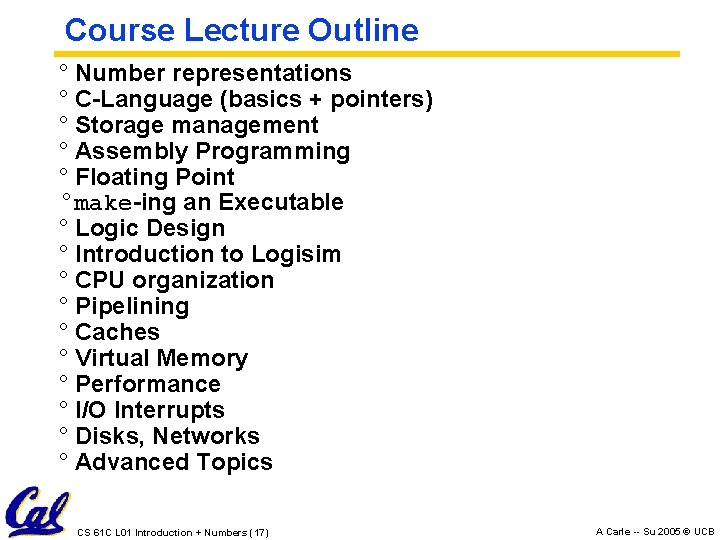
Course Lecture Outline ° Number representations ° C-Language (basics + pointers) ° Storage management ° Assembly Programming ° Floating Point ° make-ing an Executable ° Logic Design ° Introduction to Logisim ° CPU organization ° Pipelining ° Caches ° Virtual Memory ° Performance ° I/O Interrupts ° Disks, Networks ° Advanced Topics CS 61 C L 01 Introduction + Numbers (17) A Carle -- Su 2005 © UCB
Yoda Says Always in motion is the future… Our schedule is very flexible. This includes lectures, assignments, exams… CS 61 C L 01 Introduction + Numbers (18) A Carle -- Su 2005 © UCB
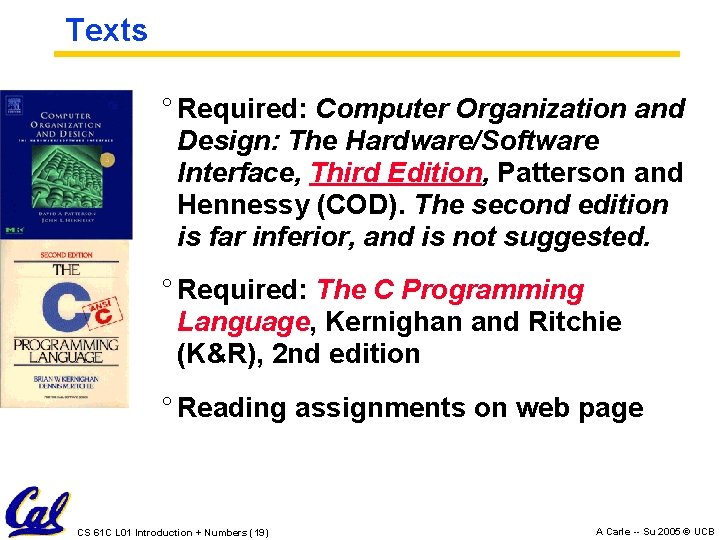
Texts ° Required: Computer Organization and Design: The Hardware/Software Interface, Third Edition, Patterson and Hennessy (COD). The second edition is far inferior, and is not suggested. ° Required: The C Programming Language, Kernighan and Ritchie (K&R), 2 nd edition ° Reading assignments on web page CS 61 C L 01 Introduction + Numbers (19) A Carle -- Su 2005 © UCB
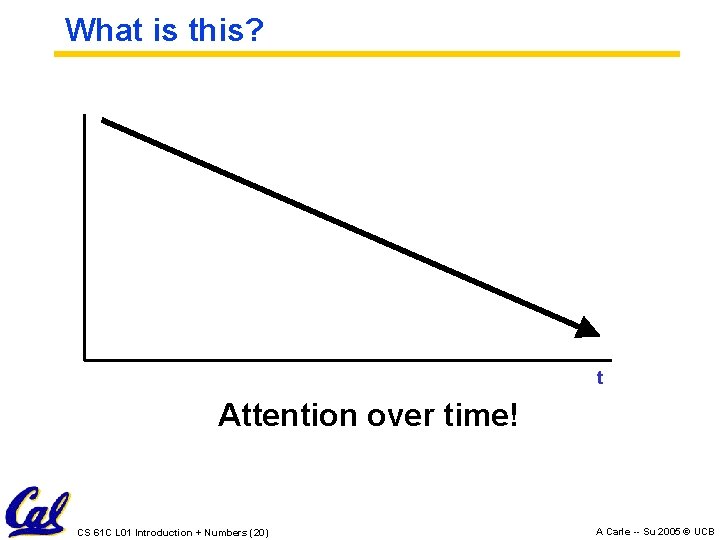
What is this? t Attention over time! CS 61 C L 01 Introduction + Numbers (20) A Carle -- Su 2005 © UCB
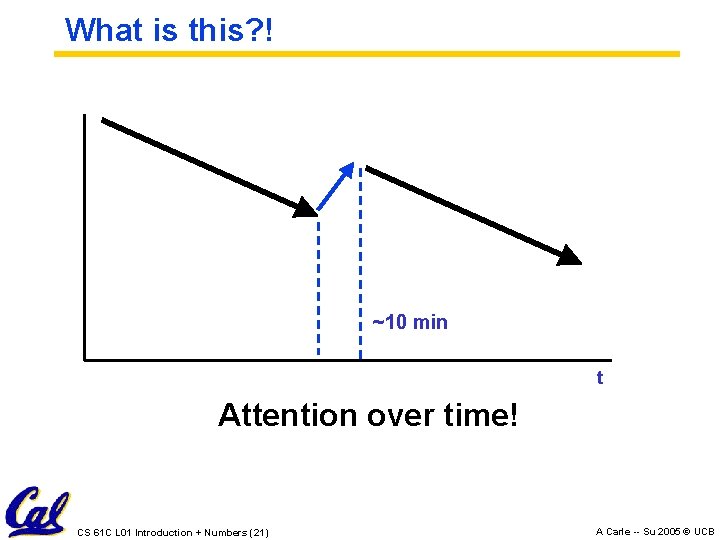
What is this? ! ~10 min t Attention over time! CS 61 C L 01 Introduction + Numbers (21) A Carle -- Su 2005 © UCB
Administrivia ° We WILL have sections today (320 Soda)! • If you are currently waitlisted, attend section 103 at 5: 00 pm • Everyone on the waitlist will eventually be enrolled… but you may have to switch yourself to the 5: 00 section. ° HW 1 is available • Rather simple book problems, due by the end of the day on the 26 th ° Office Hours are TBD • But, Andy will hold a quasi office hour here after class to address any questions anyone has about the course ° Full course policies + syllabus tomorrow CS 61 C L 01 Introduction + Numbers (22) A Carle -- Su 2005 © UCB
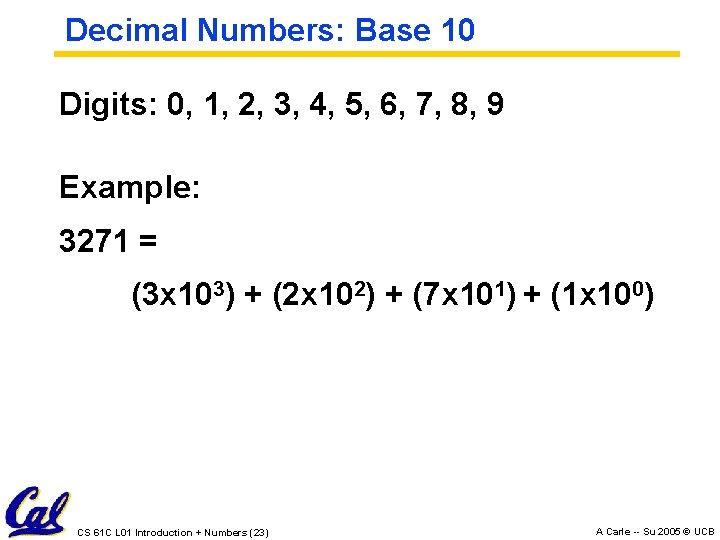
Decimal Numbers: Base 10 Digits: 0, 1, 2, 3, 4, 5, 6, 7, 8, 9 Example: 3271 = (3 x 10³) + (2 x 10²) + (7 x 101) + (1 x 100) CS 61 C L 01 Introduction + Numbers (23) A Carle -- Su 2005 © UCB
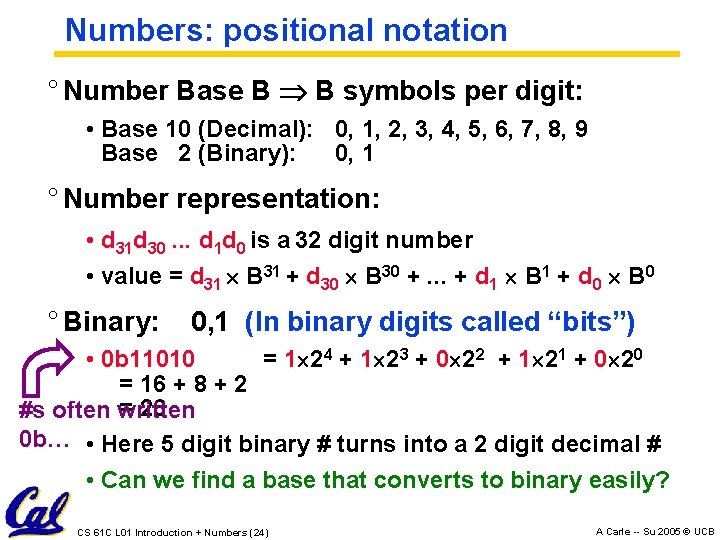
Numbers: positional notation ° Number Base B B symbols per digit: • Base 10 (Decimal): 0, 1, 2, 3, 4, 5, 6, 7, 8, 9 Base 2 (Binary): 0, 1 ° Number representation: • d 31 d 30. . . d 1 d 0 is a 32 digit number • value = d 31 B 31 + d 30 B 30 +. . . + d 1 B 1 + d 0 B 0 ° Binary: 0, 1 (In binary digits called “bits”) • 0 b 11010 = 1 24 + 1 23 + 0 22 + 1 21 + 0 20 = 16 + 8 + 2 = 26 #s often written 0 b… • Here 5 digit binary # turns into a 2 digit decimal # • Can we find a base that converts to binary easily? CS 61 C L 01 Introduction + Numbers (24) A Carle -- Su 2005 © UCB
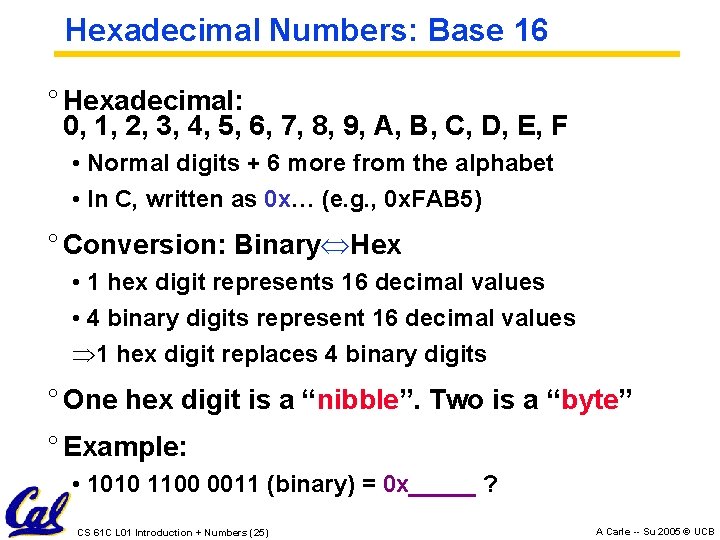
Hexadecimal Numbers: Base 16 ° Hexadecimal: 0, 1, 2, 3, 4, 5, 6, 7, 8, 9, A, B, C, D, E, F • Normal digits + 6 more from the alphabet • In C, written as 0 x… (e. g. , 0 x. FAB 5) ° Conversion: Binary Hex • 1 hex digit represents 16 decimal values • 4 binary digits represent 16 decimal values Þ 1 hex digit replaces 4 binary digits ° One hex digit is a “nibble”. Two is a “byte” ° Example: • 1010 1100 0011 (binary) = 0 x_____ ? CS 61 C L 01 Introduction + Numbers (25) A Carle -- Su 2005 © UCB
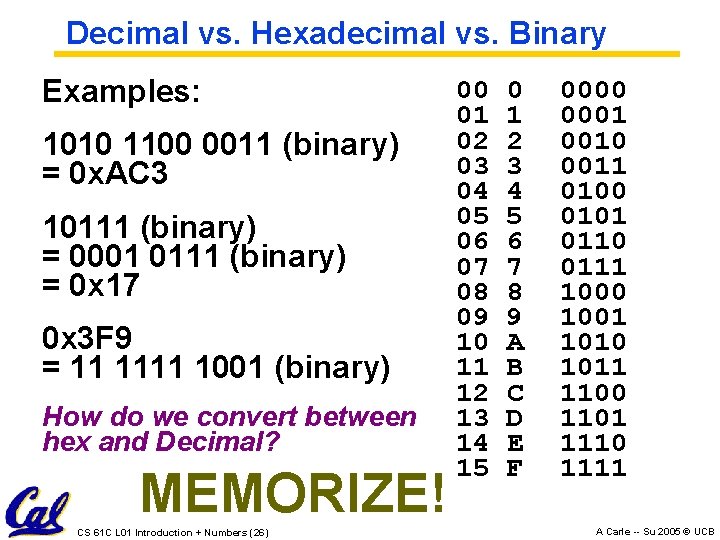
Decimal vs. Hexadecimal vs. Binary Examples: 1010 1100 0011 (binary) = 0 x. AC 3 10111 (binary) = 0001 0111 (binary) = 0 x 17 0 x 3 F 9 = 11 1111 1001 (binary) How do we convert between hex and Decimal? MEMORIZE! CS 61 C L 01 Introduction + Numbers (26) 00 01 02 03 04 05 06 07 08 09 10 11 12 13 14 15 0 1 2 3 4 5 6 7 8 9 A B C D E F 0000 0001 0010 0011 0100 0101 0110 0111 1000 1001 1010 1011 1100 1101 1110 1111 A Carle -- Su 2005 © UCB
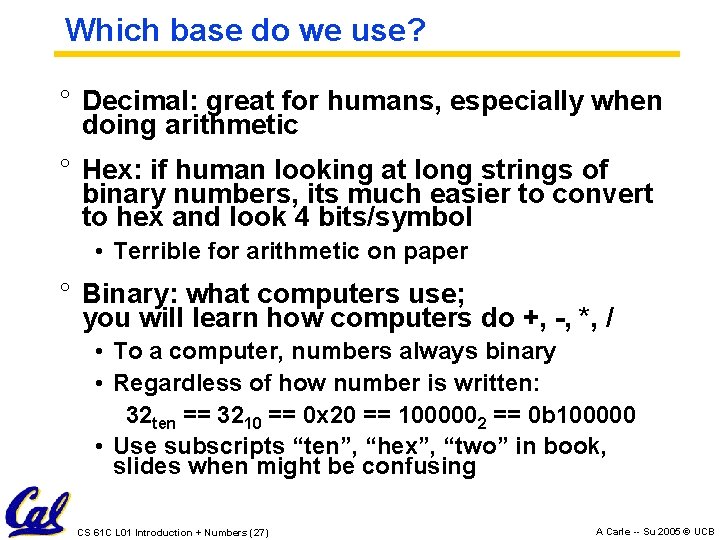
Which base do we use? ° Decimal: great for humans, especially when doing arithmetic ° Hex: if human looking at long strings of binary numbers, its much easier to convert to hex and look 4 bits/symbol • Terrible for arithmetic on paper ° Binary: what computers use; you will learn how computers do +, -, *, / • To a computer, numbers always binary • Regardless of how number is written: 32 ten == 3210 == 0 x 20 == 1000002 == 0 b 100000 • Use subscripts “ten”, “hex”, “two” in book, slides when might be confusing CS 61 C L 01 Introduction + Numbers (27) A Carle -- Su 2005 © UCB
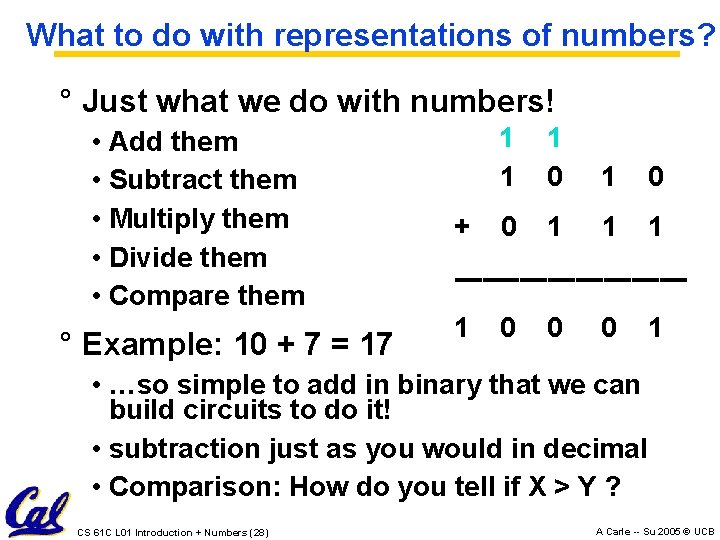
What to do with representations of numbers? ° Just what we do with numbers! • Add them • Subtract them • Multiply them • Divide them • Compare them ° Example: 10 + 7 = 17 + 1 1 1 0 0 1 1 1 ------------1 0 0 0 1 • …so simple to add in binary that we can build circuits to do it! • subtraction just as you would in decimal • Comparison: How do you tell if X > Y ? CS 61 C L 01 Introduction + Numbers (28) A Carle -- Su 2005 © UCB
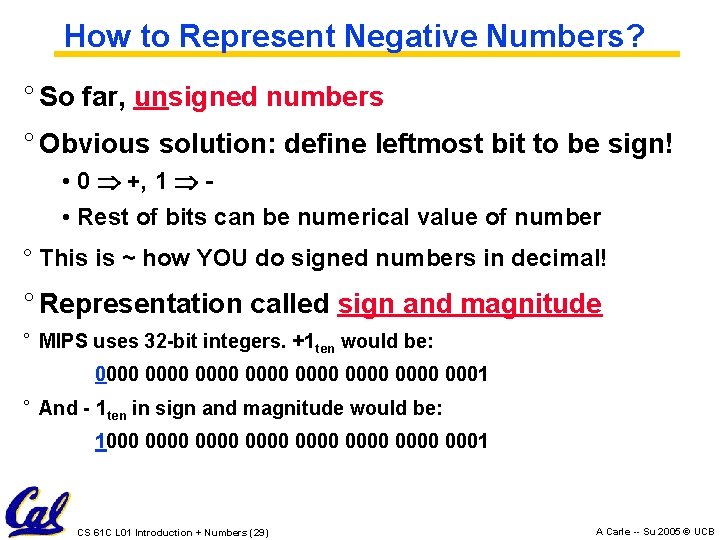
How to Represent Negative Numbers? ° So far, unsigned numbers ° Obvious solution: define leftmost bit to be sign! • 0 +, 1 • Rest of bits can be numerical value of number ° This is ~ how YOU do signed numbers in decimal! ° Representation called sign and magnitude ° MIPS uses 32 -bit integers. +1 ten would be: 0000 0000 0001 ° And - 1 ten in sign and magnitude would be: 1000 0000 0000 0001 CS 61 C L 01 Introduction + Numbers (29) A Carle -- Su 2005 © UCB
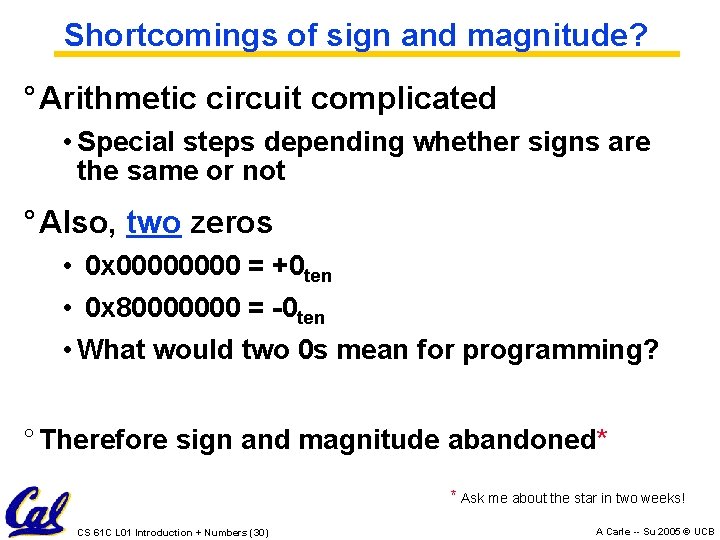
Shortcomings of sign and magnitude? ° Arithmetic circuit complicated • Special steps depending whether signs are the same or not ° Also, two zeros • 0 x 0000 = +0 ten • 0 x 80000000 = -0 ten • What would two 0 s mean for programming? ° Therefore sign and magnitude abandoned* * Ask me about the star in two weeks! CS 61 C L 01 Introduction + Numbers (30) A Carle -- Su 2005 © UCB
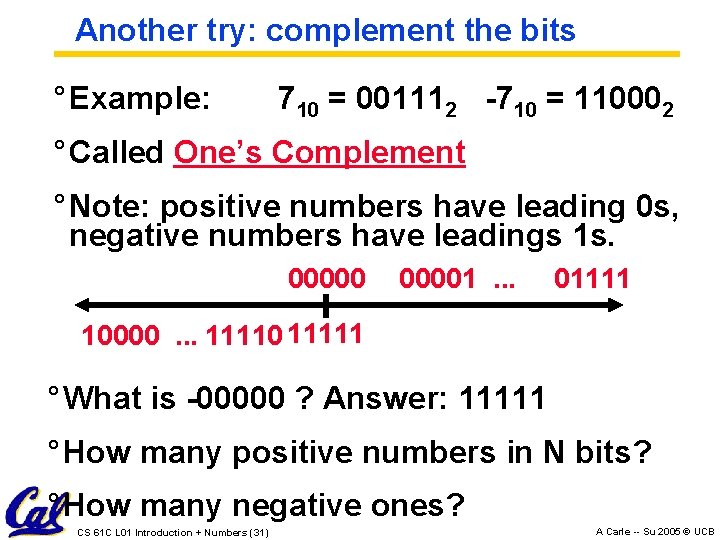
Another try: complement the bits ° Example: 710 = 001112 -710 = 110002 ° Called One’s Complement ° Note: positive numbers have leading 0 s, negative numbers have leadings 1 s. 000001. . . 01111 10000. . . 11110 11111 ° What is -00000 ? Answer: 11111 ° How many positive numbers in N bits? ° How many negative ones? CS 61 C L 01 Introduction + Numbers (31) A Carle -- Su 2005 © UCB
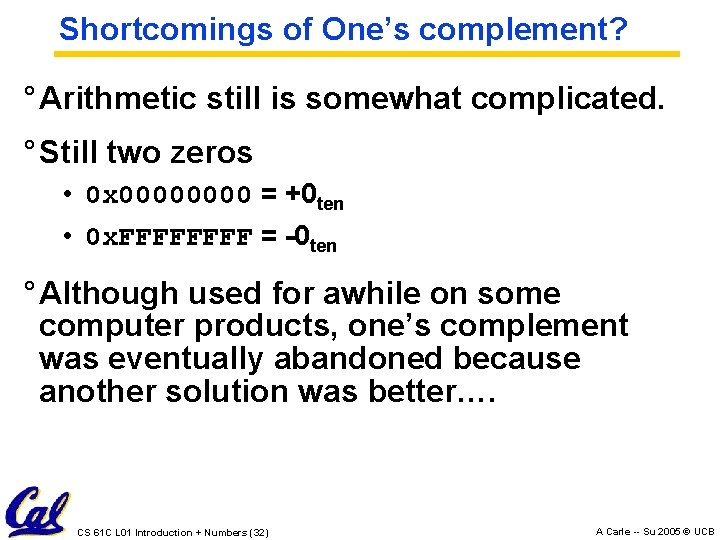
Shortcomings of One’s complement? ° Arithmetic still is somewhat complicated. ° Still two zeros • 0 x 0000 = +0 ten • 0 x. FFFF = -0 ten ° Although used for awhile on some computer products, one’s complement was eventually abandoned because another solution was better…. CS 61 C L 01 Introduction + Numbers (32) A Carle -- Su 2005 © UCB
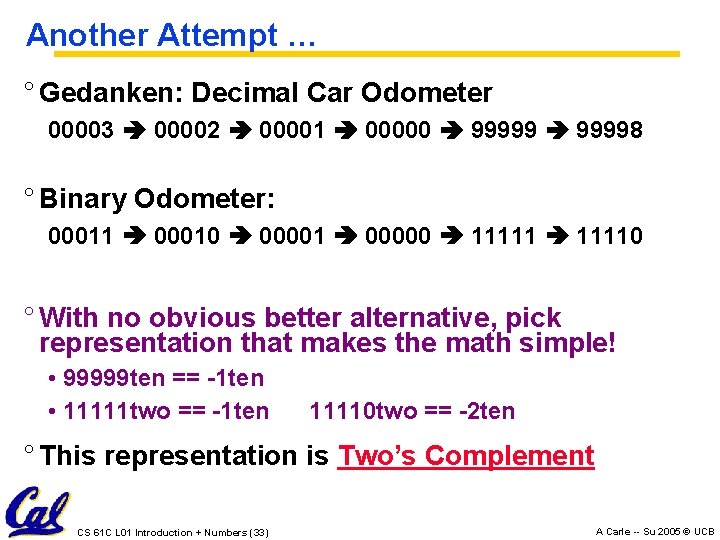
Another Attempt … ° Gedanken: Decimal Car Odometer 00003 00002 00001 00000 99999 99998 ° Binary Odometer: 00011 00010 00001 00000 11111 11110 ° With no obvious better alternative, pick representation that makes the math simple! • 99999 ten == -1 ten • 11111 two == -1 ten 11110 two == -2 ten ° This representation is Two’s Complement CS 61 C L 01 Introduction + Numbers (33) A Carle -- Su 2005 © UCB
2’s Complement Properties ° As with sign and magnitude, leading 0 s positive, leading 1 s negative - 000000. . . xxx is ≥ 0, 111111. . . xxx is < 0 - except 1… 1111 is -1, not -0 (as in sign & mag. ) ° Only 1 Zero! CS 61 C L 01 Introduction + Numbers (34) A Carle -- Su 2005 © UCB
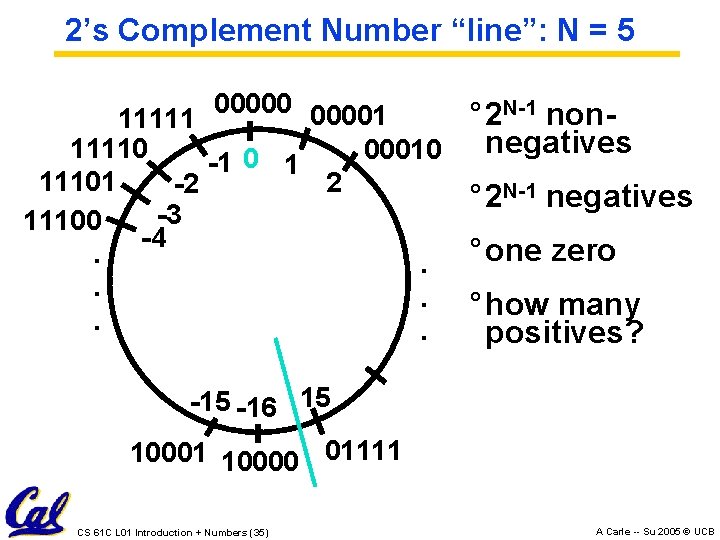
2’s Complement Number “line”: N = 5 000001 N-1 non° 2 11111 negatives 11110 00010 -1 0 1 11101 2 -2 ° 2 N-1 negatives -3 11100 -4. . ° one zero. . ° how many. . positives? -15 -16 15 10001 10000 01111 CS 61 C L 01 Introduction + Numbers (35) A Carle -- Su 2005 © UCB
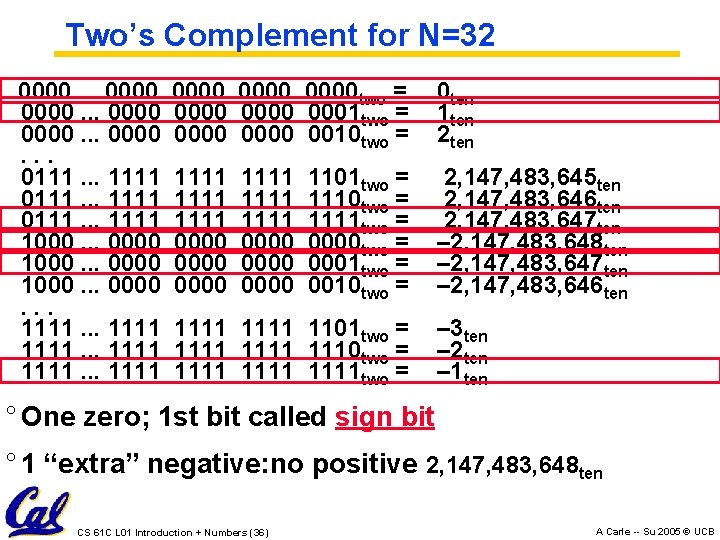
Two’s Complement for N=32 0000. . . 0111. . . 1111 1000. . . 0000. . . 1111 0000 two = 0000 0001 two = 0000 0010 two = 0 ten 1 ten 2 ten 1111 0000 2, 147, 483, 645 ten 2, 147, 483, 646 ten 2, 147, 483, 647 ten – 2, 147, 483, 648 ten – 2, 147, 483, 647 ten – 2, 147, 483, 646 ten 1111 0000 1101 two = 1110 two = 1111 two = 0000 two = 0001 two = 0010 two = 1111 1101 two = 1111 1110 two = 1111 two = – 3 ten – 2 ten – 1 ten ° One zero; 1 st bit called sign bit ° 1 “extra” negative: no positive 2, 147, 483, 648 ten CS 61 C L 01 Introduction + Numbers (36) A Carle -- Su 2005 © UCB
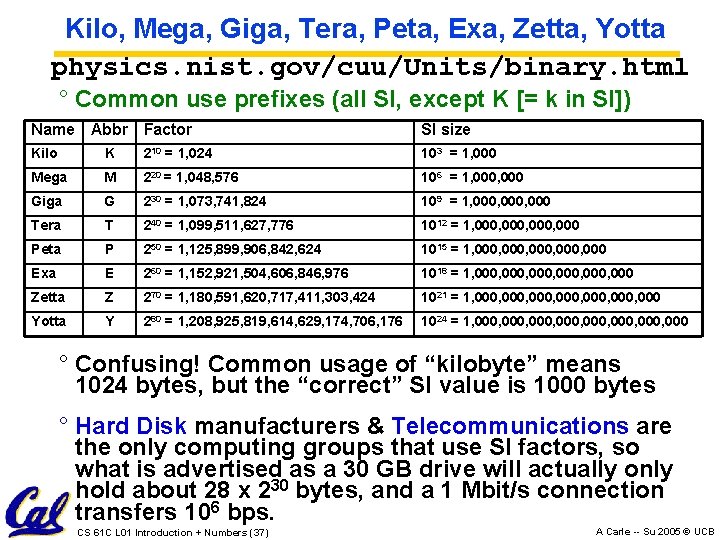
Kilo, Mega, Giga, Tera, Peta, Exa, Zetta, Yotta physics. nist. gov/cuu/Units/binary. html ° Common use prefixes (all SI, except K [= k in SI]) Name Abbr Factor SI size Kilo K 210 = 1, 024 103 = 1, 000 Mega M 220 = 1, 048, 576 106 = 1, 000 Giga G 230 = 1, 073, 741, 824 109 = 1, 000, 000 Tera T 240 = 1, 099, 511, 627, 776 1012 = 1, 000, 000 Peta P 250 = 1, 125, 899, 906, 842, 624 1015 = 1, 000, 000 Exa E 260 = 1, 152, 921, 504, 606, 846, 976 1018 = 1, 000, 000 Zetta Z 270 = 1, 180, 591, 620, 717, 411, 303, 424 1021 = 1, 000, 000, 000 Yotta Y 280 = 1, 208, 925, 819, 614, 629, 174, 706, 176 1024 = 1, 000, 000, 000 ° Confusing! Common usage of “kilobyte” means 1024 bytes, but the “correct” SI value is 1000 bytes ° Hard Disk manufacturers & Telecommunications are the only computing groups that use SI factors, so what is advertised as a 30 GB drive will actually only hold about 28 x 230 bytes, and a 1 Mbit/s connection transfers 106 bps. CS 61 C L 01 Introduction + Numbers (37) A Carle -- Su 2005 © UCB
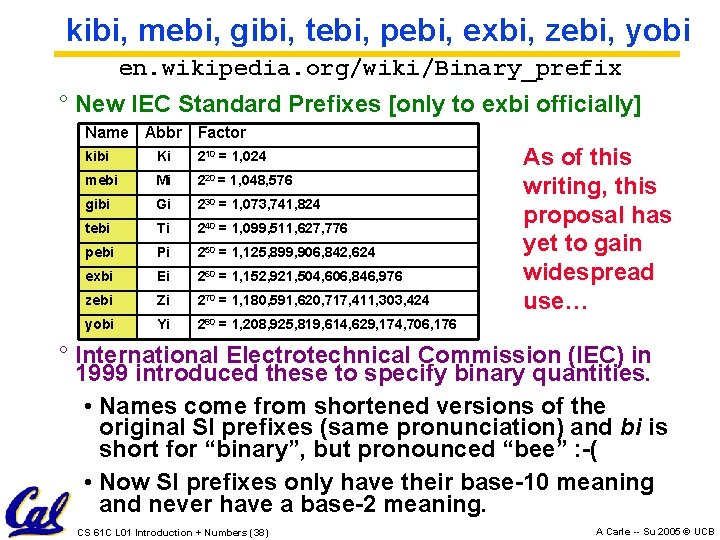
kibi, mebi, gibi, tebi, pebi, exbi, zebi, yobi en. wikipedia. org/wiki/Binary_prefix ° New IEC Standard Prefixes [only to exbi officially] Name Abbr Factor kibi Ki 210 = 1, 024 mebi Mi 220 = 1, 048, 576 gibi Gi 230 = 1, 073, 741, 824 tebi Ti 240 = 1, 099, 511, 627, 776 pebi Pi 250 = 1, 125, 899, 906, 842, 624 exbi Ei 260 = 1, 152, 921, 504, 606, 846, 976 zebi Zi 270 = 1, 180, 591, 620, 717, 411, 303, 424 yobi Yi 280 = 1, 208, 925, 819, 614, 629, 174, 706, 176 As of this writing, this proposal has yet to gain widespread use… ° International Electrotechnical Commission (IEC) in 1999 introduced these to specify binary quantities. • Names come from shortened versions of the original SI prefixes (same pronunciation) and bi is short for “binary”, but pronounced “bee” : -( • Now SI prefixes only have their base-10 meaning and never have a base-2 meaning. CS 61 C L 01 Introduction + Numbers (38) A Carle -- Su 2005 © UCB
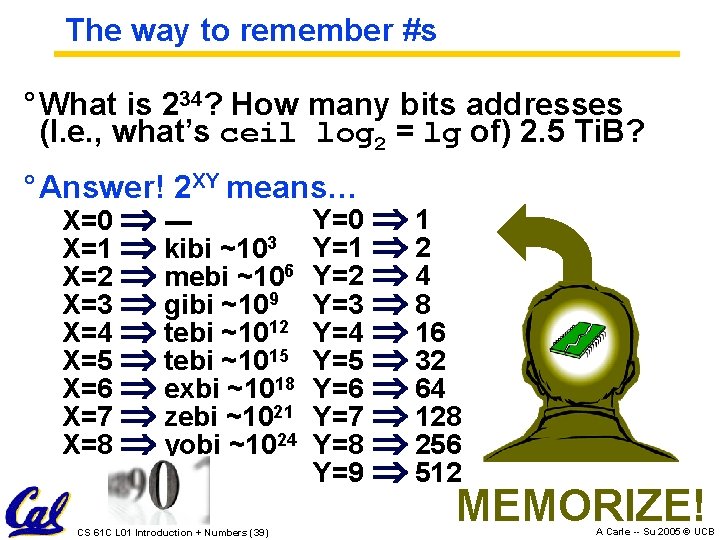
The way to remember #s ° What is 234? How many bits addresses (I. e. , what’s ceil log 2 = lg of) 2. 5 Ti. B? ° Answer! 2 XY means… X=0 --X=1 kibi ~103 X=2 mebi ~106 X=3 gibi ~109 X=4 tebi ~1012 X=5 tebi ~1015 X=6 exbi ~1018 X=7 zebi ~1021 X=8 yobi ~1024 CS 61 C L 01 Introduction + Numbers (39) Y=0 1 Y=1 2 Y=2 4 Y=3 8 Y=4 16 Y=5 32 Y=6 64 Y=7 128 Y=8 256 Y=9 512 MEMORIZE! A Carle -- Su 2005 © UCB
- Slides: 39