
inst eecs berkeley educs 61 c CS 61
inst. eecs. berkeley. edu/~cs 61 c CS 61 C : Machine Structures Lecture 20 Thread Level Parallelism Senior Lecturer SOE Dan Garcia www. cs. berkeley. edu/~ddgarcia Wireless “Matrix” device A team at Brown University has developed a subdermal implant of a “battery, coppor coil for recharging, wireless radio, infrared transmitters, and custom ICs in a small, leak-proof, body-friendly container 2 inches long. ” 100 -electrode neuronreading chip is implanted directly in the brain. www. technologyreview. com/news/512161/a-wireless-brain-computer-interface/ Garcia, Spring 2013 © UCB CS 61 C L 20 Thread Level Parallelism I (1)
Review • Flynn Taxonomy of Parallel Architectures – SIMD: Single Instruction Multiple Data – MIMD: Multiple Instruction Multiple Data – SISD: Single Instruction Single Data – MISD: Multiple Instruction Single Data (unused) • Intel SSE SIMD Instructions – One instruction fetch that operates on multiple operands simultaneously – 64/128 bit XMM registers – (SSE = Streaming SIMD Extensions) CS 61 C L 20 Thread Level Parallelism I (2) Garcia, Spring 2013 © UCB
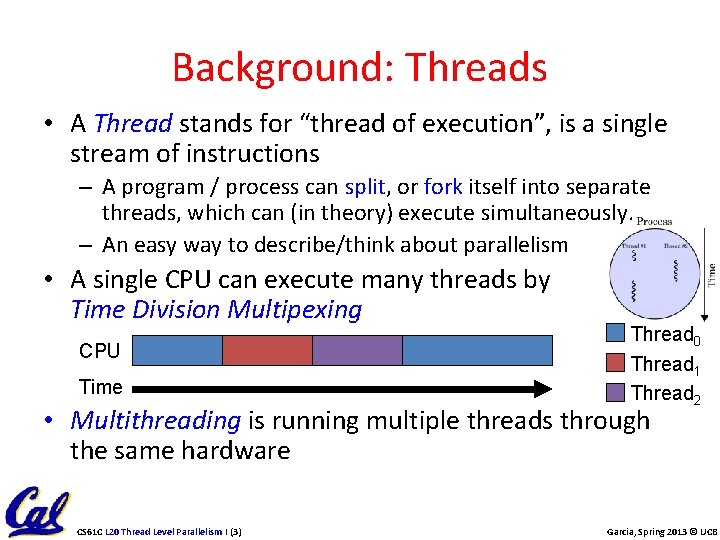
Background: Threads • A Thread stands for “thread of execution”, is a single stream of instructions – A program / process can split, or fork itself into separate threads, which can (in theory) execute simultaneously. – An easy way to describe/think about parallelism • A single CPU can execute many threads by Time Division Multipexing CPU Time Thread 0 Thread 1 Thread 2 • Multithreading is running multiple threads through the same hardware CS 61 C L 20 Thread Level Parallelism I (3) Garcia, Spring 2013 © UCB
Agenda • SSE Instructions in C • Multiprocessor “Although threads seem to be a small step from sequential computation, in fact, they represent a huge step. They discard the most essential and appealing properties of sequential computation: understandability, predictability, and determinism. Threads, as a model of computation, are wildly non-deterministic, and the job of the programmer becomes one of pruning that nondeterminism. ” — The Problem with Threads, Edward A. Lee, UC Berkeley, 2006 CS 61 C L 20 Thread Level Parallelism I (4) Garcia, Spring 2013 © UCB

Intel SSE Intrinsics • Intrinsics are C functions and procedures for putting in assembly language, including SSE instructions – With intrinsics, can program using these instructions indirectly – One-to-one correspondence between SSE instructions and intrinsics CS 61 C L 20 Thread Level Parallelism I (5) Garcia, Spring 2013 © UCB

Example SSE Intrinsics Instrinsics: Corresponding SSE instructions: • Vector data type: _m 128 d • Load and store operations: _mm_load_pd MOVAPD/aligned, packed double _mm_store_pd MOVAPD/aligned, packed double _mm_loadu_pd MOVUPD/unaligned, packed double _mm_storeu_pd MOVUPD/unaligned, packed double • Load and broadcast across vector _mm_load 1_pd MOVSD + shuffling/duplicating • Arithmetic: _mm_add_pd ADDPD/add, packed double _mm_mul_pd MULPD/multiple, packed double CS 61 C L 20 Thread Level Parallelism I (6) Garcia, Spring 2013 © UCB
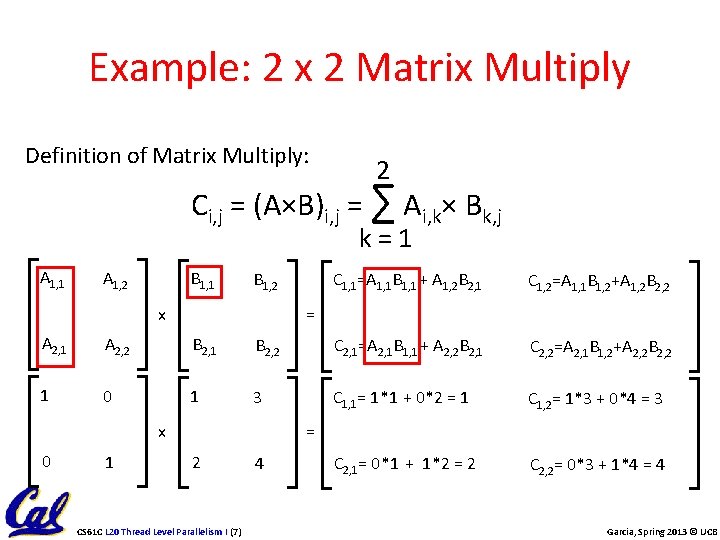
Example: 2 x 2 Matrix Multiply Definition of Matrix Multiply: 2 Ci, j = (A×B)i, j = ∑ Ai, k× Bk, j k=1 A 1, 2 B 1, 1 B 1, 2 x C 1, 1=A 1, 1 B 1, 1 + A 1, 2 B 2, 1 C 1, 2=A 1, 1 B 1, 2+A 1, 2 B 2, 2 = A 2, 1 A 2, 2 B 2, 1 B 2, 2 C 2, 1=A 2, 1 B 1, 1 + A 2, 2 B 2, 1 C 2, 2=A 2, 1 B 1, 2+A 2, 2 B 2, 2 1 0 1 3 C 1, 1= 1*1 + 0*2 = 1 C 1, 2= 1*3 + 0*4 = 3 C 2, 1= 0*1 + 1*2 = 2 C 2, 2= 0*3 + 1*4 = 4 x 0 1 = 2 CS 61 C L 20 Thread Level Parallelism I (7) 4 Garcia, Spring 2013 © UCB
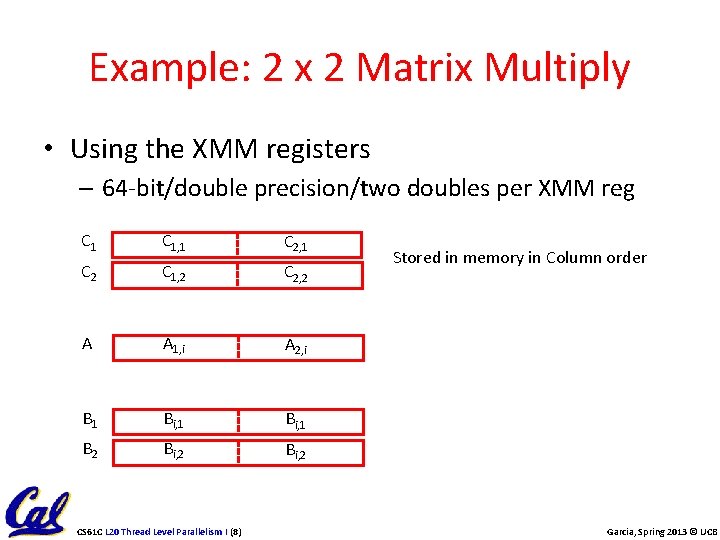
Example: 2 x 2 Matrix Multiply • Using the XMM registers – 64 -bit/double precision/two doubles per XMM reg C 1, 1 C 2 C 1, 2 C 2, 2 A A 1, i A 2, i B 1 Bi, 1 B 2 Bi, 2 CS 61 C L 20 Thread Level Parallelism I (8) Stored in memory in Column order Garcia, Spring 2013 © UCB
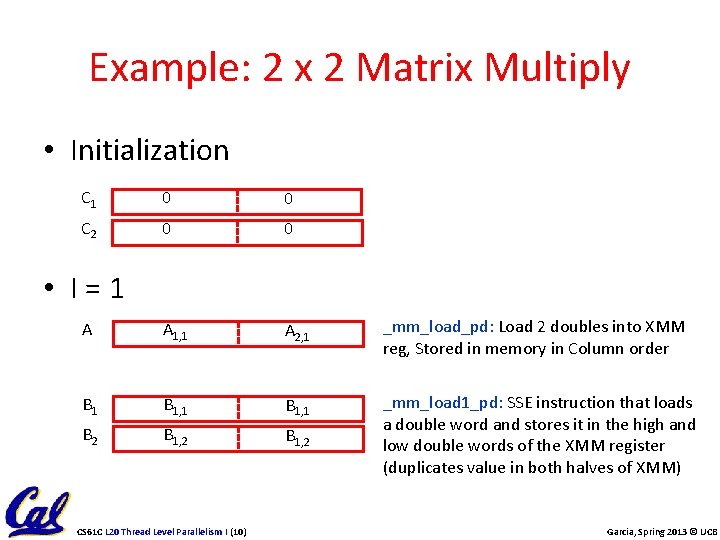
Example: 2 x 2 Matrix Multiply • Initialization C 1 0 0 C 2 0 0 A A 1, 1 A 2, 1 _mm_load_pd: Load 2 doubles into XMM reg, Stored in memory in Column order B 1, 1 B 2 B 1, 2 _mm_load 1_pd: SSE instruction that loads a double word and stores it in the high and low double words of the XMM register (duplicates value in both halves of XMM) • I=1 CS 61 C L 20 Thread Level Parallelism I (10) Garcia, Spring 2013 © UCB
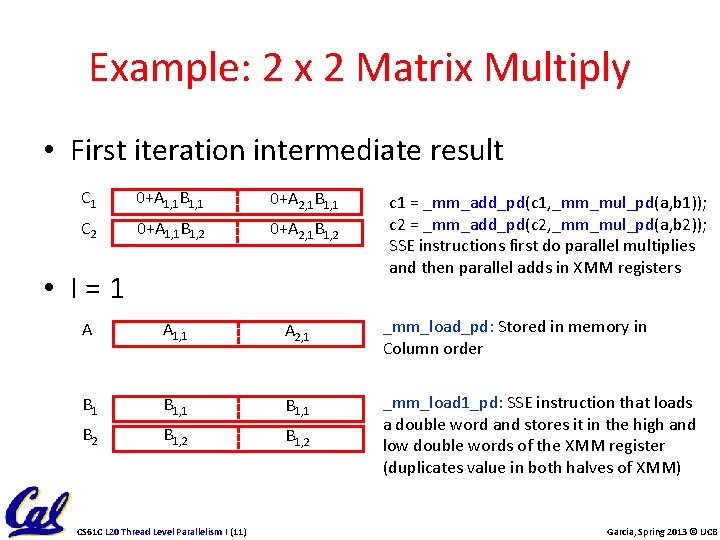
Example: 2 x 2 Matrix Multiply • First iteration intermediate result C 1 0+A 1, 1 B 1, 1 0+A 2, 1 B 1, 1 C 2 0+A 1, 1 B 1, 2 0+A 2, 1 B 1, 2 • I=1 c 1 = _mm_add_pd(c 1, _mm_mul_pd(a, b 1)); c 2 = _mm_add_pd(c 2, _mm_mul_pd(a, b 2)); SSE instructions first do parallel multiplies and then parallel adds in XMM registers A A 1, 1 A 2, 1 _mm_load_pd: Stored in memory in Column order B 1, 1 B 2 B 1, 2 _mm_load 1_pd: SSE instruction that loads a double word and stores it in the high and low double words of the XMM register (duplicates value in both halves of XMM) CS 61 C L 20 Thread Level Parallelism I (11) Garcia, Spring 2013 © UCB
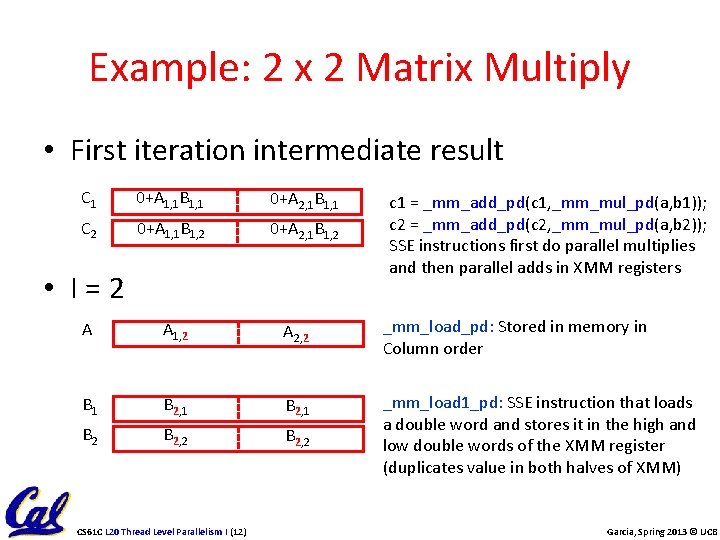
Example: 2 x 2 Matrix Multiply • First iteration intermediate result C 1 0+A 1, 1 B 1, 1 0+A 2, 1 B 1, 1 C 2 0+A 1, 1 B 1, 2 0+A 2, 1 B 1, 2 • I=2 c 1 = _mm_add_pd(c 1, _mm_mul_pd(a, b 1)); c 2 = _mm_add_pd(c 2, _mm_mul_pd(a, b 2)); SSE instructions first do parallel multiplies and then parallel adds in XMM registers A A 1, 2 A 2, 2 _mm_load_pd: Stored in memory in Column order B 1 B 2, 2 B 2, 2 _mm_load 1_pd: SSE instruction that loads a double word and stores it in the high and low double words of the XMM register (duplicates value in both halves of XMM) CS 61 C L 20 Thread Level Parallelism I (12) Garcia, Spring 2013 © UCB
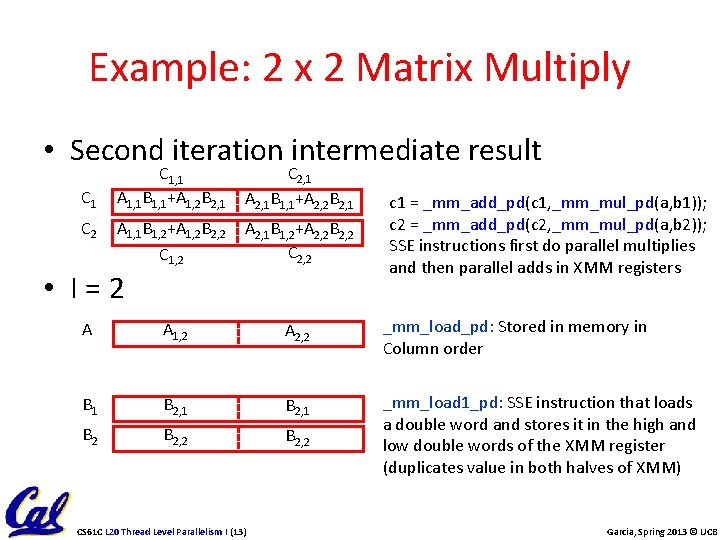
Example: 2 x 2 Matrix Multiply • Second iteration intermediate result C 1, 1 A 1, 1 B 1, 1+A 1, 2 B 2, 1 C 2, 1 A 2, 1 B 1, 1+A 2, 2 B 2, 1 A 1, 1 B 1, 2+A 1, 2 B 2, 2 C 1, 2 A 2, 1 B 1, 2+A 2, 2 B 2, 2 C 2, 2 A A 1, 2 A 2, 2 _mm_load_pd: Stored in memory in Column order B 1 B 2, 2 B 2, 2 _mm_load 1_pd: SSE instruction that loads a double word and stores it in the high and low double words of the XMM register (duplicates value in both halves of XMM) C 1 C 2 • I=2 CS 61 C L 20 Thread Level Parallelism I (13) c 1 = _mm_add_pd(c 1, _mm_mul_pd(a, b 1)); c 2 = _mm_add_pd(c 2, _mm_mul_pd(a, b 2)); SSE instructions first do parallel multiplies and then parallel adds in XMM registers Garcia, Spring 2013 © UCB
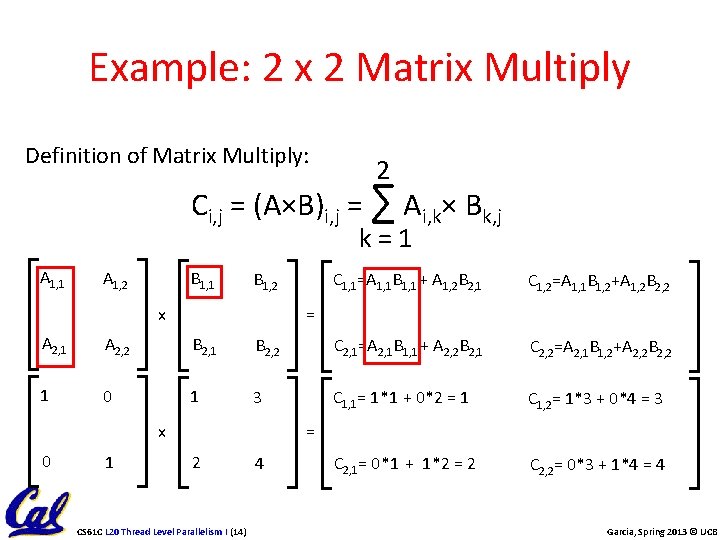
Example: 2 x 2 Matrix Multiply Definition of Matrix Multiply: 2 Ci, j = (A×B)i, j = ∑ Ai, k× Bk, j k=1 A 1, 2 B 1, 1 B 1, 2 x C 1, 1=A 1, 1 B 1, 1 + A 1, 2 B 2, 1 C 1, 2=A 1, 1 B 1, 2+A 1, 2 B 2, 2 = A 2, 1 A 2, 2 B 2, 1 B 2, 2 C 2, 1=A 2, 1 B 1, 1 + A 2, 2 B 2, 1 C 2, 2=A 2, 1 B 1, 2+A 2, 2 B 2, 2 1 0 1 3 C 1, 1= 1*1 + 0*2 = 1 C 1, 2= 1*3 + 0*4 = 3 C 2, 1= 0*1 + 1*2 = 2 C 2, 2= 0*3 + 1*4 = 4 x 0 1 = 2 CS 61 C L 20 Thread Level Parallelism I (14) 4 Garcia, Spring 2013 © UCB
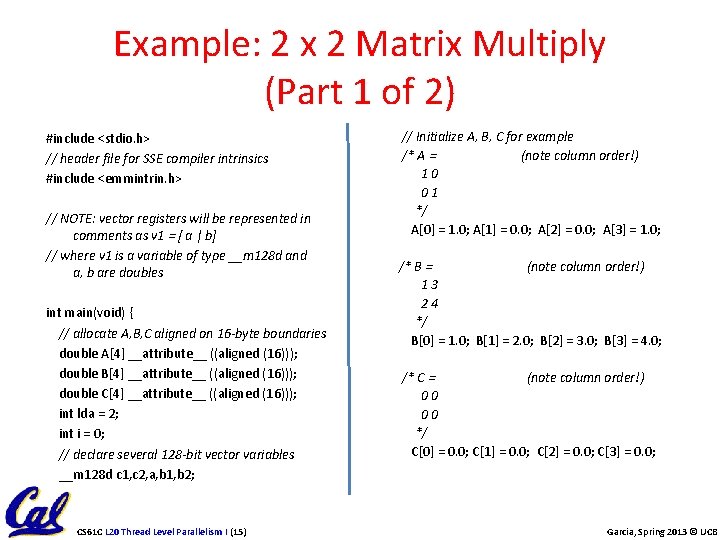
Example: 2 x 2 Matrix Multiply (Part 1 of 2) #include <stdio. h> // header file for SSE compiler intrinsics #include <emmintrin. h> // NOTE: vector registers will be represented in comments as v 1 = [ a | b] // where v 1 is a variable of type __m 128 d and a, b are doubles int main(void) { // allocate A, B, C aligned on 16 -byte boundaries double A[4] __attribute__ ((aligned (16))); double B[4] __attribute__ ((aligned (16))); double C[4] __attribute__ ((aligned (16))); int lda = 2; int i = 0; // declare several 128 -bit vector variables __m 128 d c 1, c 2, a, b 1, b 2; CS 61 C L 20 Thread Level Parallelism I (15) // Initialize A, B, C for example /* A = (note column order!) 10 01 */ A[0] = 1. 0; A[1] = 0. 0; A[2] = 0. 0; A[3] = 1. 0; /* B = (note column order!) 13 24 */ B[0] = 1. 0; B[1] = 2. 0; B[2] = 3. 0; B[3] = 4. 0; /* C = (note column order!) 00 00 */ C[0] = 0. 0; C[1] = 0. 0; C[2] = 0. 0; C[3] = 0. 0; Garcia, Spring 2013 © UCB
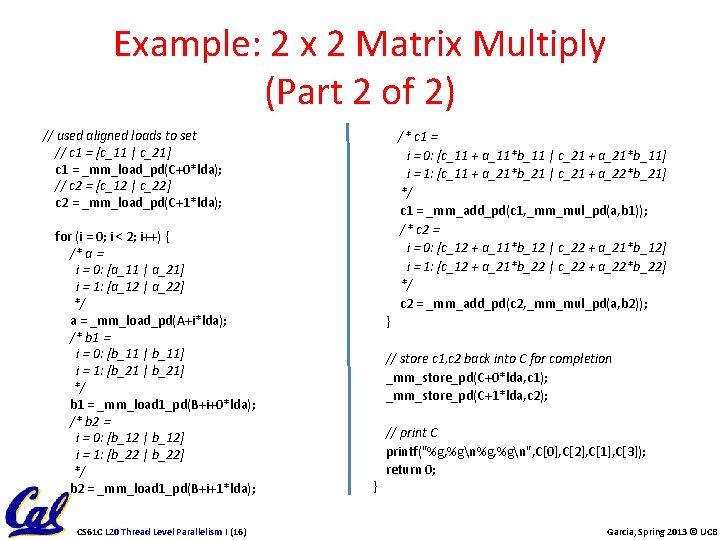
Example: 2 x 2 Matrix Multiply (Part 2 of 2) // used aligned loads to set // c 1 = [c_11 | c_21] c 1 = _mm_load_pd(C+0*lda); // c 2 = [c_12 | c_22] c 2 = _mm_load_pd(C+1*lda); for (i = 0; i < 2; i++) { /* a = i = 0: [a_11 | a_21] i = 1: [a_12 | a_22] */ a = _mm_load_pd(A+i*lda); /* b 1 = i = 0: [b_11 | b_11] i = 1: [b_21 | b_21] */ b 1 = _mm_load 1_pd(B+i+0*lda); /* b 2 = i = 0: [b_12 | b_12] i = 1: [b_22 | b_22] */ b 2 = _mm_load 1_pd(B+i+1*lda); CS 61 C L 20 Thread Level Parallelism I (16) /* c 1 = i = 0: [c_11 + a_11*b_11 | c_21 + a_21*b_11] i = 1: [c_11 + a_21*b_21 | c_21 + a_22*b_21] */ c 1 = _mm_add_pd(c 1, _mm_mul_pd(a, b 1)); /* c 2 = i = 0: [c_12 + a_11*b_12 | c_22 + a_21*b_12] i = 1: [c_12 + a_21*b_22 | c_22 + a_22*b_22] */ c 2 = _mm_add_pd(c 2, _mm_mul_pd(a, b 2)); } // store c 1, c 2 back into C for completion _mm_store_pd(C+0*lda, c 1); _mm_store_pd(C+1*lda, c 2); // print C printf("%g, %gn", C[0], C[2], C[1], C[3]); return 0; } Garcia, Spring 2013 © UCB
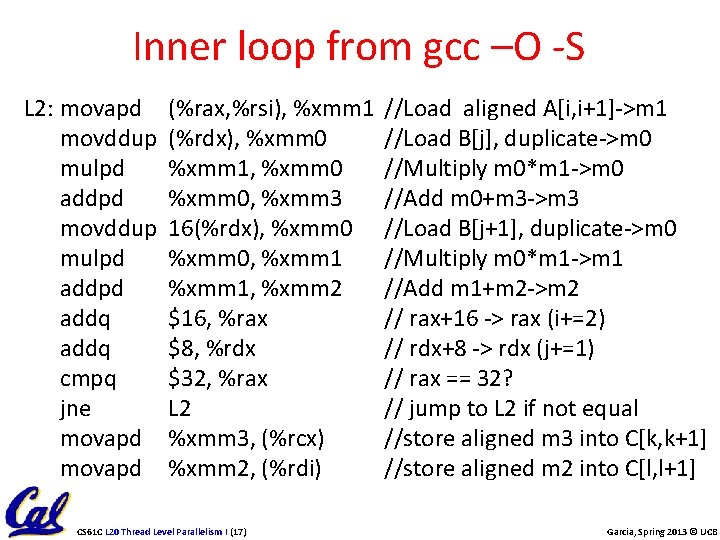
Inner loop from gcc –O -S L 2: movapd movddup mulpd addpd addq cmpq jne movapd (%rax, %rsi), %xmm 1 (%rdx), %xmm 0 %xmm 1, %xmm 0, %xmm 3 16(%rdx), %xmm 0, %xmm 1, %xmm 2 $16, %rax $8, %rdx $32, %rax L 2 %xmm 3, (%rcx) %xmm 2, (%rdi) CS 61 C L 20 Thread Level Parallelism I (17) //Load aligned A[i, i+1]->m 1 //Load B[j], duplicate->m 0 //Multiply m 0*m 1 ->m 0 //Add m 0+m 3 ->m 3 //Load B[j+1], duplicate->m 0 //Multiply m 0*m 1 ->m 1 //Add m 1+m 2 ->m 2 // rax+16 -> rax (i+=2) // rdx+8 -> rdx (j+=1) // rax == 32? // jump to L 2 if not equal //store aligned m 3 into C[k, k+1] //store aligned m 2 into C[l, l+1] Garcia, Spring 2013 © UCB
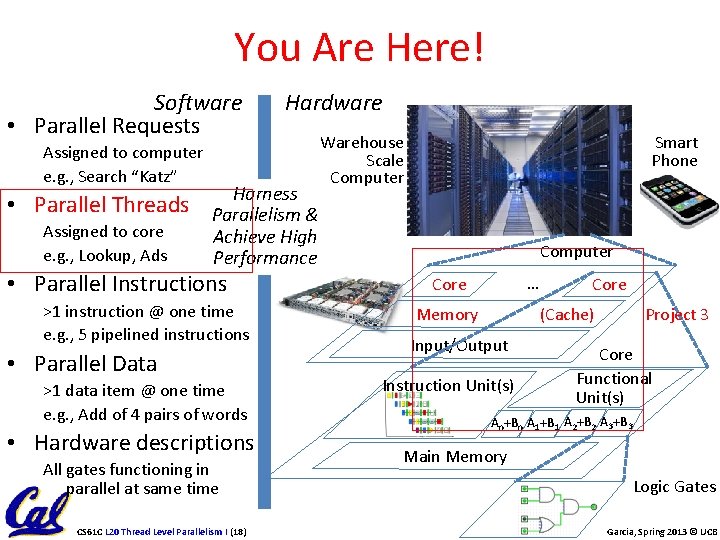
You Are Here! Software • Parallel Requests Assigned to computer e. g. , Search “Katz” • Parallel Threads Assigned to core e. g. , Lookup, Ads Hardware Harness Parallelism & Achieve High Performance • Parallel Instructions >1 instruction @ one time e. g. , 5 pipelined instructions • Parallel Data >1 data item @ one time e. g. , Add of 4 pairs of words • Hardware descriptions All gates functioning in parallel at same time CS 61 C L 20 Thread Level Parallelism I (18) Smart Phone Warehouse Scale Computer … Core Memory Core (Cache) Input/Output Instruction Unit(s) Project 3 Core Functional Unit(s) A 0+B 0 A 1+B 1 A 2+B 2 A 3+B 3 Main Memory Logic Gates Garcia, Spring 2013 © UCB
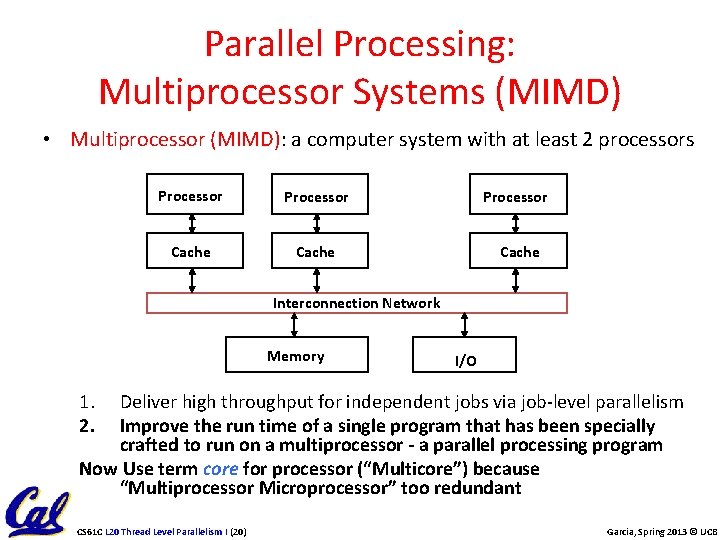
Parallel Processing: Multiprocessor Systems (MIMD) • Multiprocessor (MIMD): a computer system with at least 2 processors Processor Cache Interconnection Network Memory I/O 1. 2. Deliver high throughput for independent jobs via job-level parallelism Improve the run time of a single program that has been specially crafted to run on a multiprocessor - a parallel processing program Now Use term core for processor (“Multicore”) because “Multiprocessor Microprocessor” too redundant CS 61 C L 20 Thread Level Parallelism I (20) Garcia, Spring 2013 © UCB
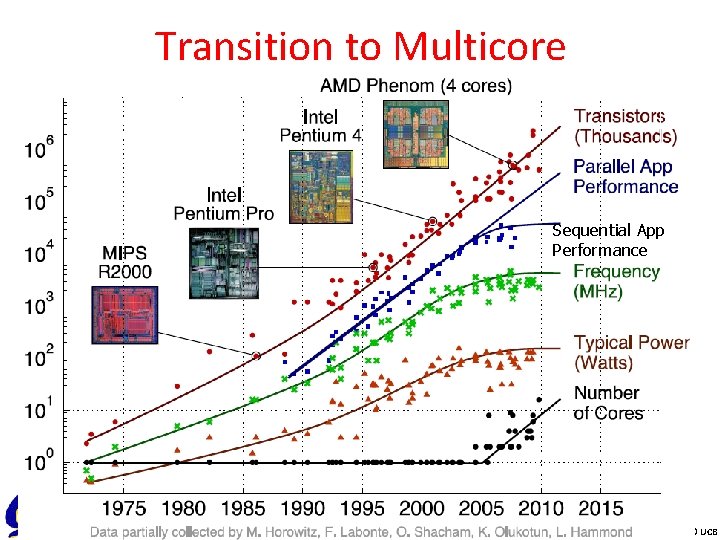
Transition to Multicore Sequential App Performance CS 61 C L 20 Thread Level Parallelism I (21) Garcia, Spring 2013 © UCB
Multiprocessors and You • Only path to performance is parallelism – Clock rates flat or declining – SIMD: 2 X width every 3 -4 years • 128 b wide now, 256 b 2011, 512 b in 2014? , 1024 b in 2018? • Advanced Vector Extensions are 256 -bits wide! – MIMD: Add 2 cores every 2 years: 2, 4, 6, 8, 10, … • A key challenge is to craft parallel programs that have high performance on multiprocessors as the number of processors increase – i. e. , that scale – Scheduling, load balancing, time for synchronization, overhead for communication • Will explore this further in labs and projects CS 61 C L 20 Thread Level Parallelism I (22) Garcia, Spring 2013 © UCB
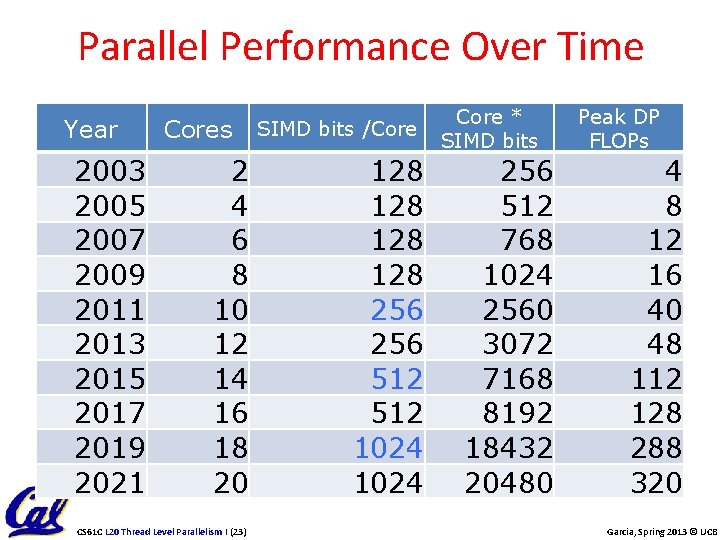
Parallel Performance Over Time Year 2003 2005 2007 2009 2011 2013 2015 2017 2019 2021 Cores 2 4 6 8 10 12 14 16 18 20 CS 61 C L 20 Thread Level Parallelism I (23) SIMD bits /Core 128 128 256 512 1024 Core * SIMD bits 256 512 768 1024 2560 3072 7168 8192 18432 20480 Peak DP FLOPs 4 8 12 16 40 48 112 128 288 320 Garcia, Spring 2013 © UCB
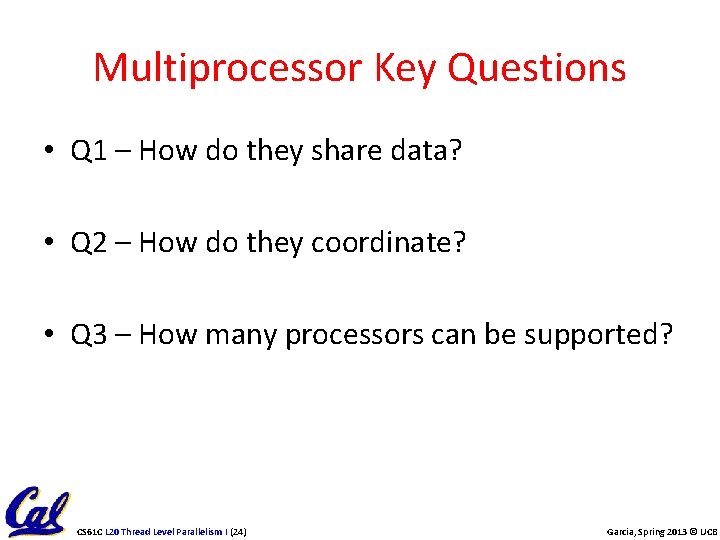
Multiprocessor Key Questions • Q 1 – How do they share data? • Q 2 – How do they coordinate? • Q 3 – How many processors can be supported? CS 61 C L 20 Thread Level Parallelism I (24) Garcia, Spring 2013 © UCB
Shared Memory Multiprocessor (SMP) • Q 1 – Single address space shared by all processors/cores • Q 2 – Processors coordinate/communicate through shared variables in memory (via loads and stores) – Use of shared data must be coordinated via synchronization primitives (locks) that allow access to data to only one processor at a time • All multicore computers today are SMP CS 61 C L 20 Thread Level Parallelism I (25) Garcia, Spring 2013 © UCB
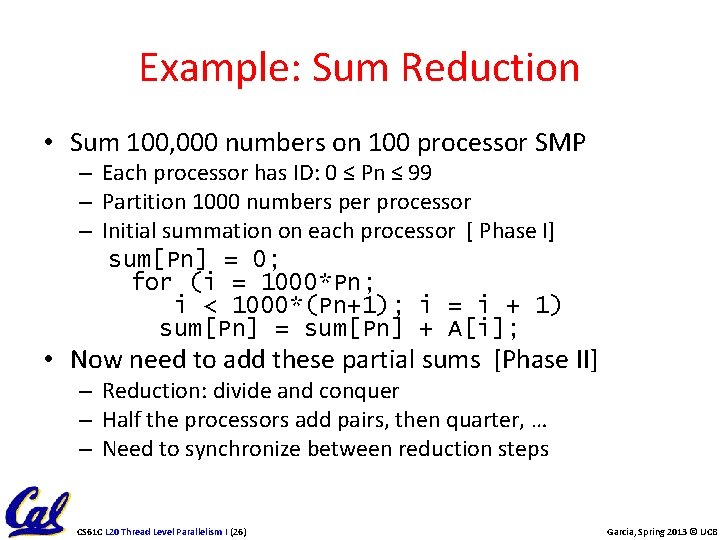
Example: Sum Reduction • Sum 100, 000 numbers on 100 processor SMP – Each processor has ID: 0 ≤ Pn ≤ 99 – Partition 1000 numbers per processor – Initial summation on each processor [ Phase I] sum[Pn] = 0; for (i = 1000*Pn; i < 1000*(Pn+1); i = i + 1) sum[Pn] = sum[Pn] + A[i]; • Now need to add these partial sums [Phase II] – Reduction: divide and conquer – Half the processors add pairs, then quarter, … – Need to synchronize between reduction steps CS 61 C L 20 Thread Level Parallelism I (26) Garcia, Spring 2013 © UCB
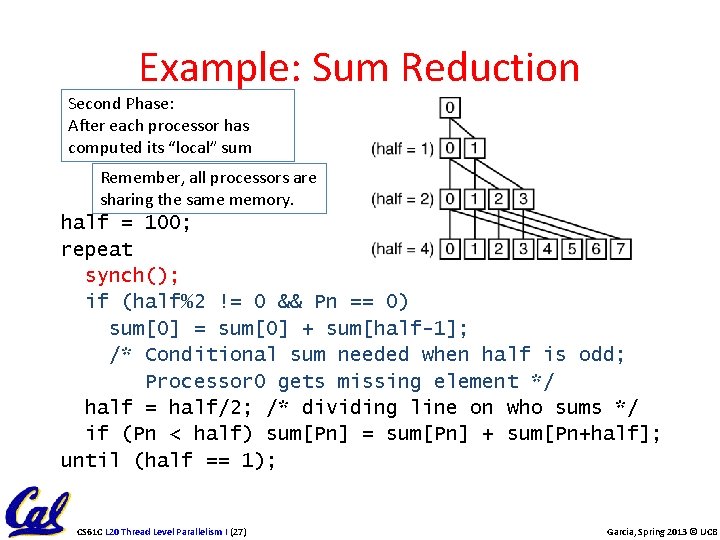
Example: Sum Reduction Second Phase: After each processor has computed its “local” sum Remember, all processors are sharing the same memory. half = 100; repeat synch(); if (half%2 != 0 && Pn == 0) sum[0] = sum[0] + sum[half-1]; /* Conditional sum needed when half is odd; Processor 0 gets missing element */ half = half/2; /* dividing line on who sums */ if (Pn < half) sum[Pn] = sum[Pn] + sum[Pn+half]; until (half == 1); CS 61 C L 20 Thread Level Parallelism I (27) Garcia, Spring 2013 © UCB
![An Example with 10 Processors sum[P 0] sum[P 1] sum[P 2] sum[P 3] sum[P](http://slidetodoc.com/presentation_image_h2/88066f4ade3e0a64a981e83636dc6e25/image-26.jpg "An Example with 10 Processors sum[P 0] sum[P 1] sum[P 2] sum[P 3] sum[P")
An Example with 10 Processors sum[P 0] sum[P 1] sum[P 2] sum[P 3] sum[P 4] sum[P 5] sum[P 6] sum[P 7] sum[P 8] sum[P 9] P 0 P 1 P 2 P 3 CS 61 C L 20 Thread Level Parallelism I (28) P 4 P 5 P 6 P 7 P 8 P 9 half = 10 Garcia, Spring 2013 © UCB
![An Example with 10 Processors sum[P 0] sum[P 1] sum[P 2] sum[P 3] sum[P](http://slidetodoc.com/presentation_image_h2/88066f4ade3e0a64a981e83636dc6e25/image-27.jpg "An Example with 10 Processors sum[P 0] sum[P 1] sum[P 2] sum[P 3] sum[P")
An Example with 10 Processors sum[P 0] sum[P 1] sum[P 2] sum[P 3] sum[P 4] sum[P 5] sum[P 6] sum[P 7] sum[P 8] sum[P 9] P 0 P 1 P 2 P 3 P 4 P 0 P 1 P 5 P 6 P 7 P 8 P 9 half = 10 half = 5 half = 2 half = 1 P 0 CS 61 C L 20 Thread Level Parallelism I (29) Garcia, Spring 2013 © UCB
So, In Conclusion… • Sequential software is slow software – SIMD and MIMD only path to higher performance • SSE Intrinsics allow SIMD instructions to be invoked from C programs • Multiprocessor (Multicore) uses Shared Memory (single address space) CS 61 C L 20 Thread Level Parallelism I (30) Garcia, Spring 2013 © UCB
- Slides: 28