
inst eecs berkeley educs 61 c CS 61
inst. eecs. berkeley. edu/~cs 61 c CS 61 C : Machine Structures Lecture #2 – Number Representation 2010 -08 -29 There is one handout today at the entrance! Lecturer SOE Dan Garcia www. cs. berkeley. edu/~ddgarcia Great book The Universal History of Numbers by Georges Ifrah CS 61 C L 02 Number Representation (1) Garcia, Fall 2011 © UCB
Review • CS 61 C: Learn 6 great ideas in computer architecture to enable high performance programming via parallelism, not just learn C 1. 2. 3. 4. 5. Layers of Representation/Interpretation Moore’s Law Principle of Locality/Memory Hierarchy Parallelism Performance Measurement and Improvement 6. Dependability via Redundancy CS 61 C L 02 Number Representation (2) Garcia, Fall 2011 © UCB
Putting it all in perspective… “If the automobile had followed the same development cycle as the computer, a Rolls-Royce would today cost $100, get a million miles per gallon, and explode once a year, killing everyone inside. ” – Robert X. Cringely CS 61 C L 02 Number Representation (3) Garcia, Fall 2011 © UCB
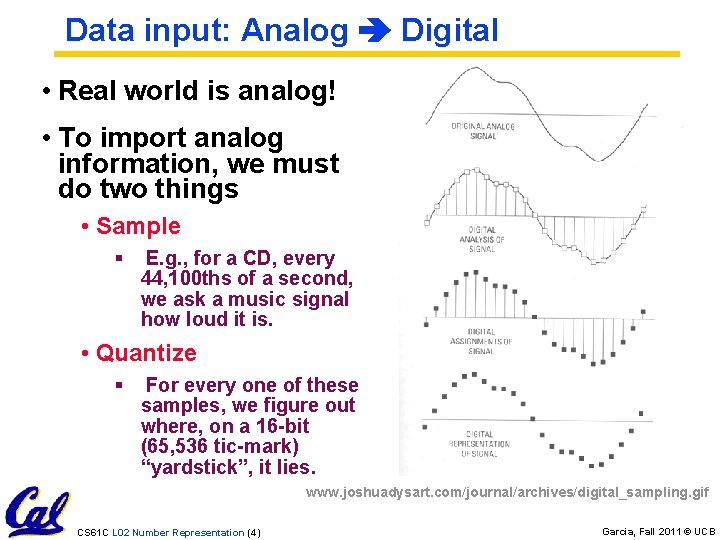
Data input: Analog Digital • Real world is analog! • To import analog information, we must do two things • Sample § E. g. , for a CD, every 44, 100 ths of a second, we ask a music signal how loud it is. • Quantize § For every one of these samples, we figure out where, on a 16 -bit (65, 536 tic-mark) “yardstick”, it lies. www. joshuadysart. com/journal/archives/digital_sampling. gif CS 61 C L 02 Number Representation (4) Garcia, Fall 2011 © UCB
Digital data not nec born Analog… hof. povray. org CS 61 C L 02 Number Representation (5) Garcia, Fall 2011 © UCB
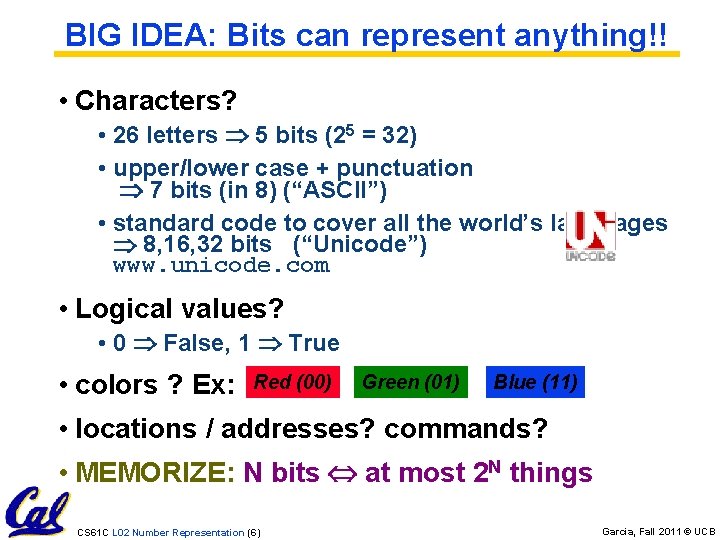
BIG IDEA: Bits can represent anything!! • Characters? • 26 letters 5 bits (25 = 32) • upper/lower case + punctuation 7 bits (in 8) (“ASCII”) • standard code to cover all the world’s languages 8, 16, 32 bits (“Unicode”) www. unicode. com • Logical values? • 0 False, 1 True • colors ? Ex: Red (00) Green (01) Blue (11) • locations / addresses? commands? • MEMORIZE: N bits at most 2 N things CS 61 C L 02 Number Representation (6) Garcia, Fall 2011 © UCB
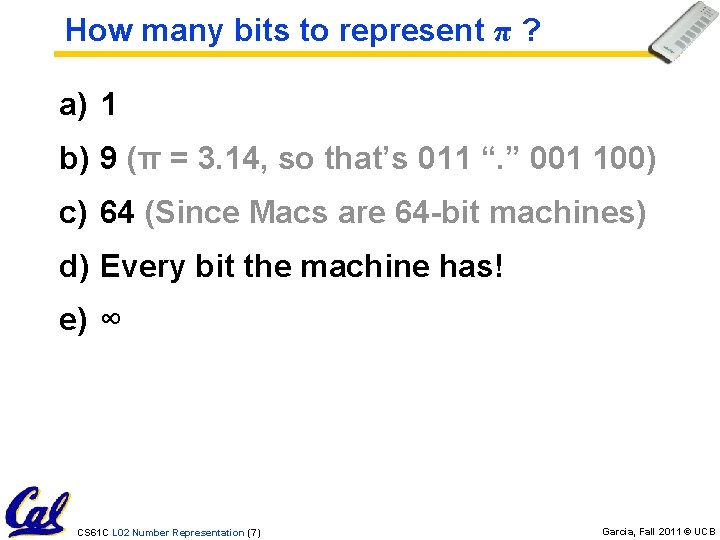
How many bits to represent π ? a) 1 b) 9 (π = 3. 14, so that’s 011 “. ” 001 100) c) 64 (Since Macs are 64 -bit machines) d) Every bit the machine has! e) ∞ CS 61 C L 02 Number Representation (7) Garcia, Fall 2011 © UCB
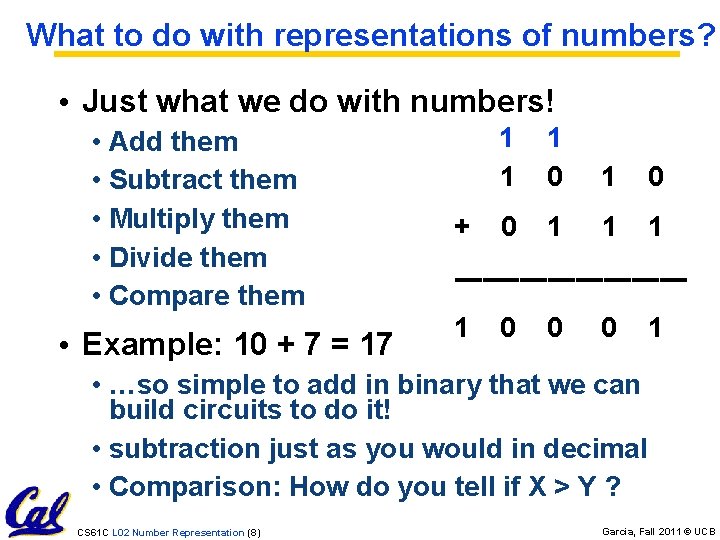
What to do with representations of numbers? • Just what we do with numbers! • Add them • Subtract them • Multiply them • Divide them • Compare them • Example: 10 + 7 = 17 + 1 1 1 0 0 1 1 1 ------------1 0 0 0 1 • …so simple to add in binary that we can build circuits to do it! • subtraction just as you would in decimal • Comparison: How do you tell if X > Y ? CS 61 C L 02 Number Representation (8) Garcia, Fall 2011 © UCB
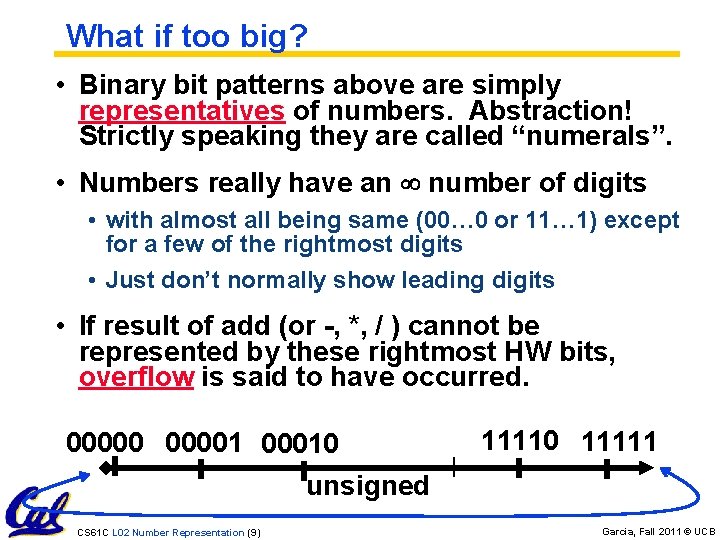
What if too big? • Binary bit patterns above are simply representatives of numbers. Abstraction! Strictly speaking they are called “numerals”. • Numbers really have an number of digits • with almost all being same (00… 0 or 11… 1) except for a few of the rightmost digits • Just don’t normally show leading digits • If result of add (or -, *, / ) cannot be represented by these rightmost HW bits, overflow is said to have occurred. 000001 00010 11111 unsigned CS 61 C L 02 Number Representation (9) Garcia, Fall 2011 © UCB
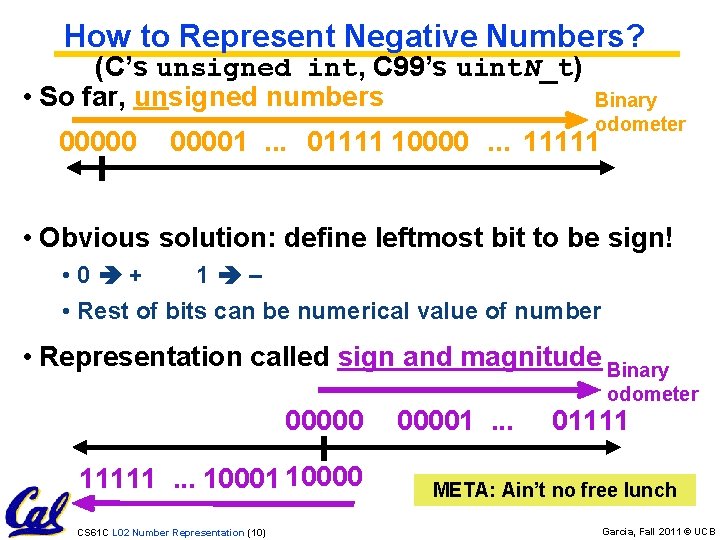
How to Represent Negative Numbers? (C’s unsigned int, C 99’s uint. N_t) • So far, unsigned numbers 00000 Binary odometer 00001. . . 01111 10000. . . 11111 • Obvious solution: define leftmost bit to be sign! • 0 + 1 – • Rest of bits can be numerical value of number • Representation called sign and magnitude Binary 00000 11111. . . 10001 10000 CS 61 C L 02 Number Representation (10) 00001. . . odometer 01111 META: Ain’t no free lunch Garcia, Fall 2011 © UCB
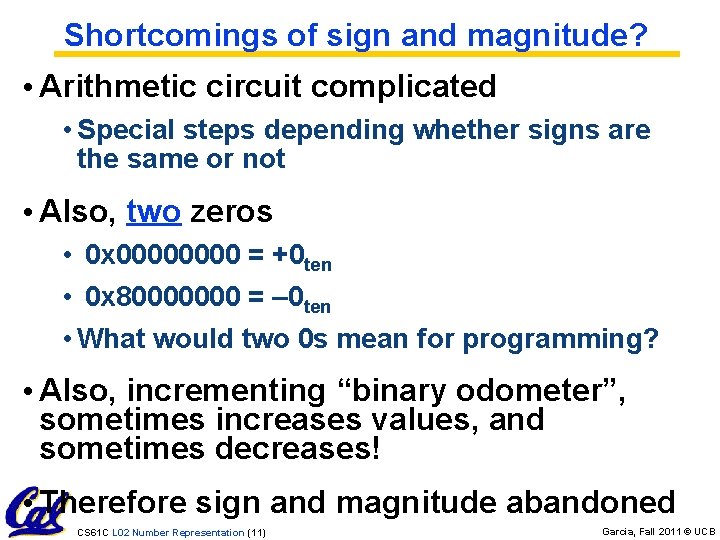
Shortcomings of sign and magnitude? • Arithmetic circuit complicated • Special steps depending whether signs are the same or not • Also, two zeros • 0 x 0000 = +0 ten • 0 x 80000000 = – 0 ten • What would two 0 s mean for programming? • Also, incrementing “binary odometer”, sometimes increases values, and sometimes decreases! • Therefore sign and magnitude abandoned CS 61 C L 02 Number Representation (11) Garcia, Fall 2011 © UCB
Administrivia • Upcoming lectures • Next few lectures: Introduction to C • Lab overcrowding • Remember, you can go to ANY discussion (none, or one that doesn’t match with lab, or even more than one if you want) • Overcrowded labs - consider finishing at home and getting checkoffs in lab, or bringing laptop to lab • If you’re checked off in 1 st hour, you get an extra point on the labs! • TAs get 24 x 7 cardkey access (and will announce after-hours times) • Enrollment • It will work out, don’t worry • Soda locks doors @ 6: 30 pm & on weekends • Look at class website, piazza often! http: //inst. eecs. berkeley. edu/~cs 61 c/ piazza. com Iclickerskinz. com CS 61 C L 02 Number Representation (12) Garcia, Fall 2011 © UCB
Great De. Cal courses I supervise • UCBUGG (3 units, P/NP) • UC Berkeley Undergraduate Graphics Group • Tu. Th 5 -7 pm in 200 Sutardja Dai • Learn to create a short 3 D animation • No prereqs (but they might have too many students, so admission not guaranteed) • http: //ucbugg. berkeley. edu • MS-DOS X (2 units, P/NP) • Macintosh Software Developers for OS X • Tu. Th 7 -9 pm in 200 Sutardja Dai • Learn to program i. OS devices! • No prereqs (other than interest) • http: //msdosx. berkeley. edu CS 61 C L 02 Number Representation (13) Garcia, Fall 2011 © UCB
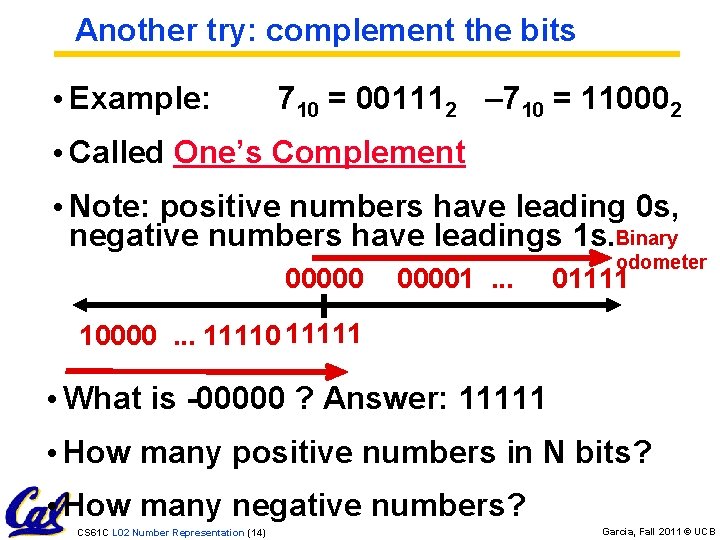
Another try: complement the bits • Example: 710 = 001112 – 710 = 110002 • Called One’s Complement • Note: positive numbers have leading 0 s, negative numbers have leadings 1 s. Binary 000001. . . odometer 01111 10000. . . 11110 11111 • What is -00000 ? Answer: 11111 • How many positive numbers in N bits? • How many negative numbers? CS 61 C L 02 Number Representation (14) Garcia, Fall 2011 © UCB
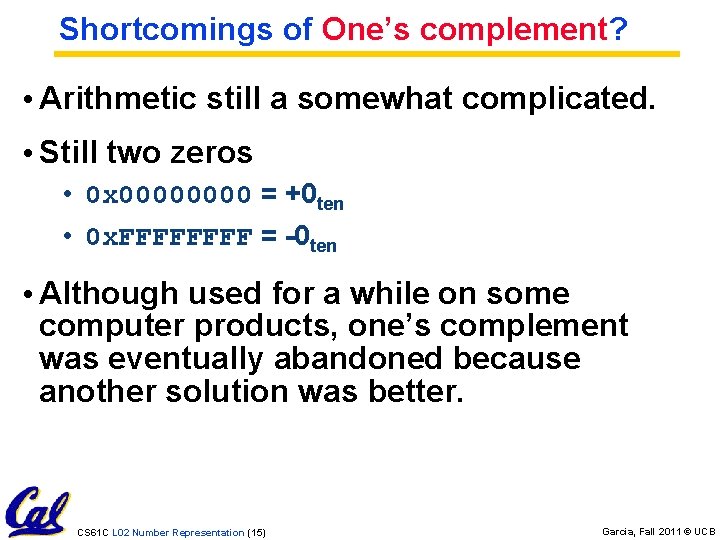
Shortcomings of One’s complement? • Arithmetic still a somewhat complicated. • Still two zeros • 0 x 0000 = +0 ten • 0 x. FFFF = -0 ten • Although used for a while on some computer products, one’s complement was eventually abandoned because another solution was better. CS 61 C L 02 Number Representation (15) Garcia, Fall 2011 © UCB
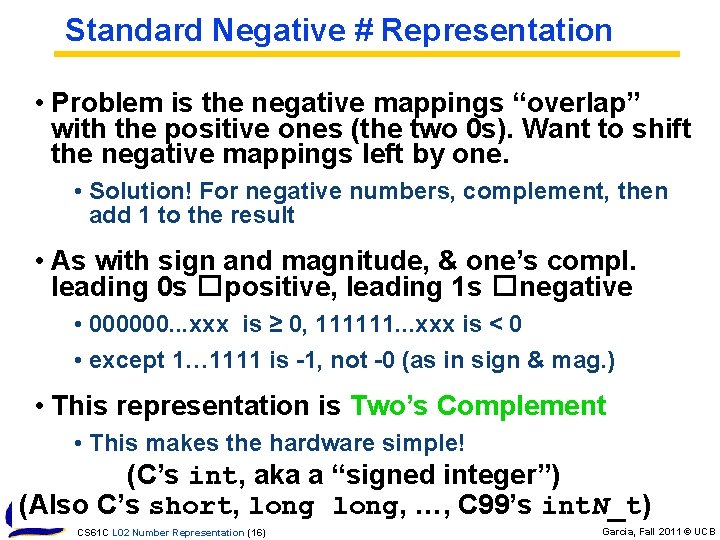
Standard Negative # Representation • Problem is the negative mappings “overlap” with the positive ones (the two 0 s). Want to shift the negative mappings left by one. • Solution! For negative numbers, complement, then add 1 to the result • As with sign and magnitude, & one’s compl. leading 0 s �positive, leading 1 s �negative • 000000. . . xxx is ≥ 0, 111111. . . xxx is < 0 • except 1… 1111 is -1, not -0 (as in sign & mag. ) • This representation is Two’s Complement • This makes the hardware simple! (C’s int, aka a “signed integer”) (Also C’s short, long, …, C 99’s int. N_t) CS 61 C L 02 Number Representation (16) Garcia, Fall 2011 © UCB
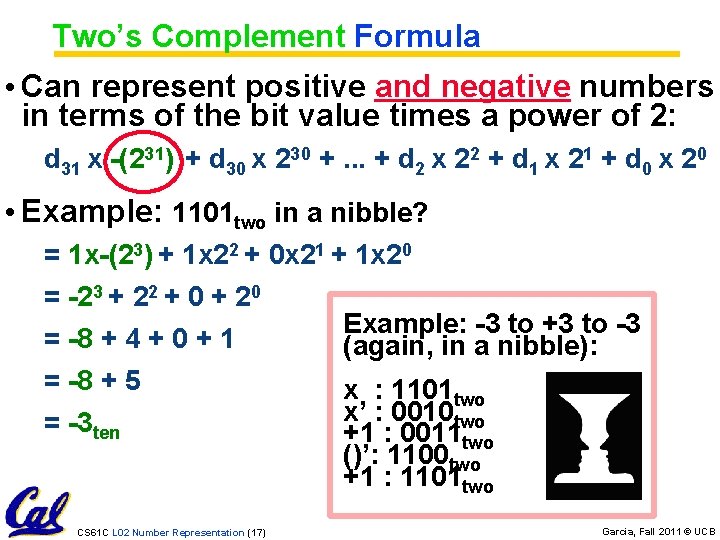
Two’s Complement Formula • Can represent positive and negative numbers in terms of the bit value times a power of 2: d 31 x -(231) + d 30 x 230 +. . . + d 2 x 22 + d 1 x 21 + d 0 x 20 • Example: 1101 two in a nibble? = 1 x-(23) + 1 x 22 + 0 x 21 + 1 x 20 = -23 + 22 + 0 + 20 = -8 + 4 + 0 + 1 = -8 + 5 = -3 ten CS 61 C L 02 Number Representation (17) Example: -3 to +3 to -3 (again, in a nibble): x : 1101 two x’ : 0010 two +1 : 0011 two ()’: 1100 two +1 : 1101 two Garcia, Fall 2011 © UCB
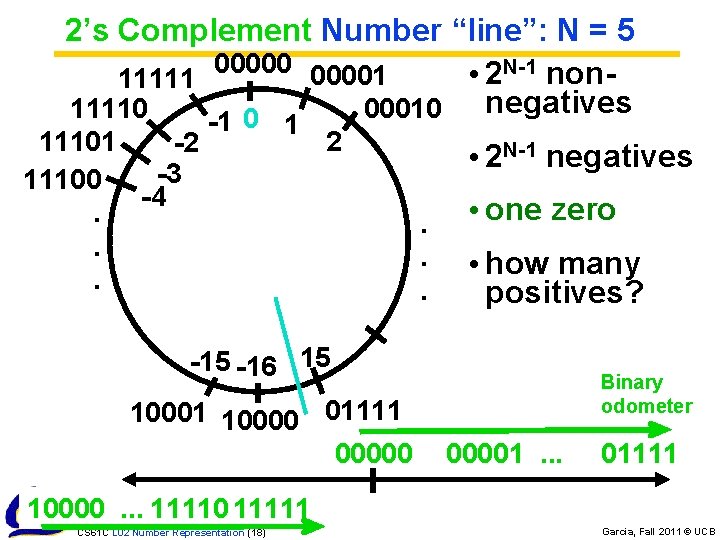
2’s Complement Number “line”: N = 5 000001 • 2 N-1 non 11111 negatives 11110 00010 0 11101 -2 -3 11100 -4. . . -1 1 2 • 2 N-1 negatives. . . • one zero • how many positives? -15 -16 15 10001 10000 01111 00000 Binary odometer 00001. . . 01111 10000. . . 11110 11111 CS 61 C L 02 Number Representation (18) Garcia, Fall 2011 © UCB
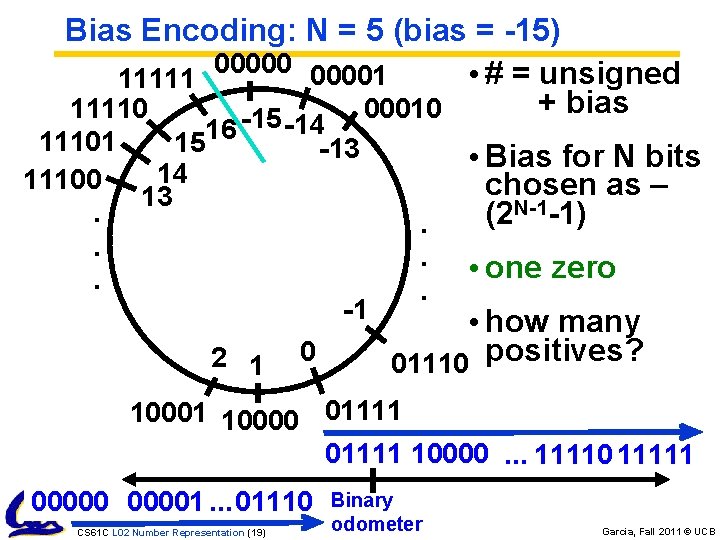
Bias Encoding: N = 5 (bias = -15) 000001 • # = unsigned 11111 + bias 11110 00010 -15 16 15 11101 14 11100 13. . . -14 -13 -1 2 1 0 . . . • Bias for N bits chosen as – (2 N-1 -1) • one zero • how many 01110 positives? 10001 10000 01111 10000. . . 11110 11111 000001. . . 01110 CS 61 C L 02 Number Representation (19) Binary odometer Garcia, Fall 2011 © UCB
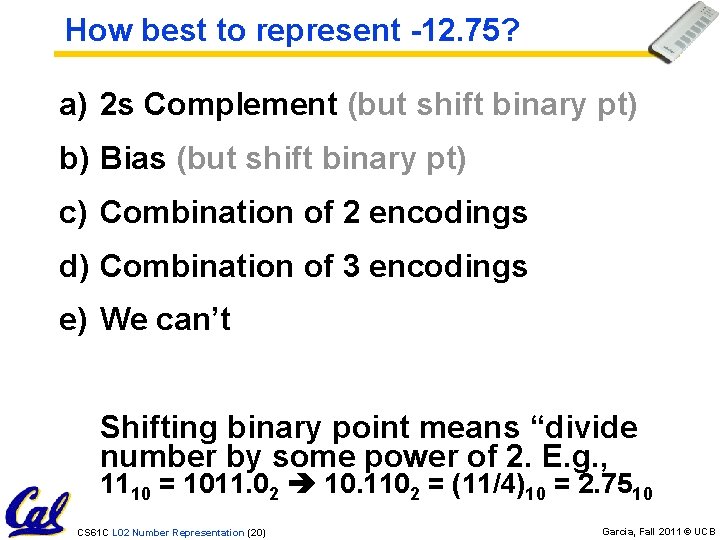
How best to represent -12. 75? a) 2 s Complement (but shift binary pt) b) Bias (but shift binary pt) c) Combination of 2 encodings d) Combination of 3 encodings e) We can’t Shifting binary point means “divide number by some power of 2. E. g. , 1110 = 1011. 02 10. 1102 = (11/4)10 = 2. 7510 CS 61 C L 02 Number Representation (20) Garcia, Fall 2011 © UCB
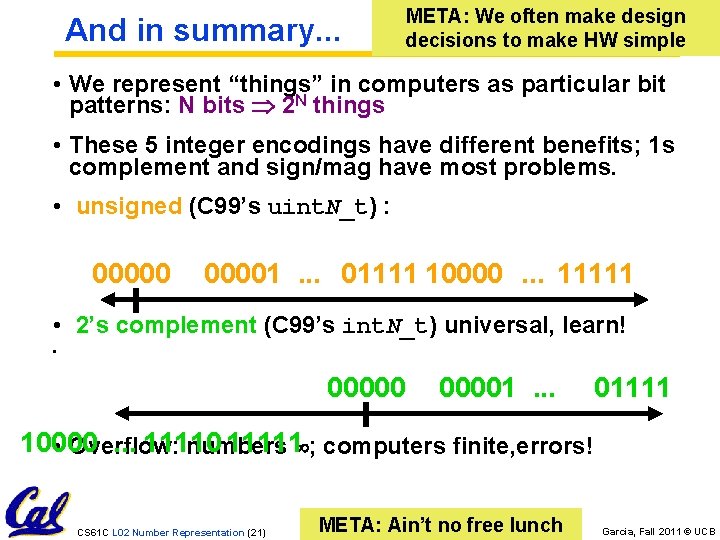
And in summary. . . META: We often make design decisions to make HW simple • We represent “things” in computers as particular bit patterns: N bits 2 N things • These 5 integer encodings have different benefits; 1 s complement and sign/mag have most problems. • unsigned (C 99’s uint. N_t) : 000001. . . 01111 10000. . . 11111 • 2’s complement (C 99’s int. N_t) universal, learn! • 000001. . . 01111 10000. . . 11110 11111 ; computers finite, errors! • Overflow: numbers CS 61 C L 02 Number Representation (21) META: Ain’t no free lunch Garcia, Fall 2011 © UCB
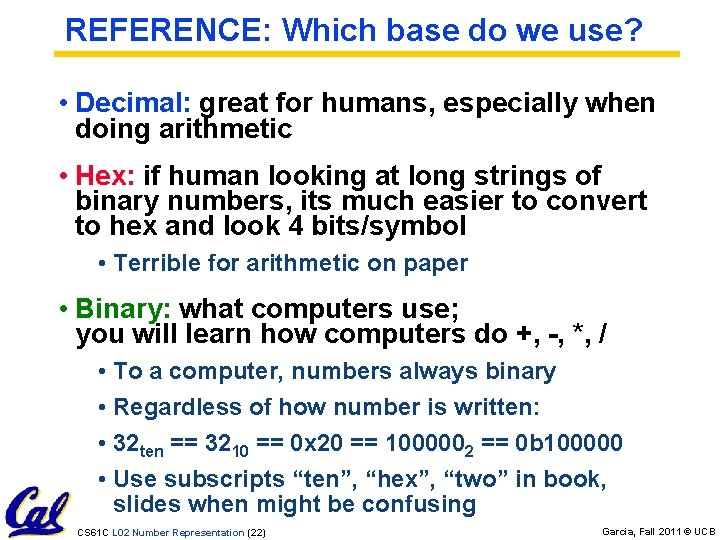
REFERENCE: Which base do we use? • Decimal: great for humans, especially when doing arithmetic • Hex: if human looking at long strings of binary numbers, its much easier to convert to hex and look 4 bits/symbol • Terrible for arithmetic on paper • Binary: what computers use; you will learn how computers do +, -, *, / • To a computer, numbers always binary • Regardless of how number is written: • 32 ten == 3210 == 0 x 20 == 1000002 == 0 b 100000 • Use subscripts “ten”, “hex”, “two” in book, slides when might be confusing CS 61 C L 02 Number Representation (22) Garcia, Fall 2011 © UCB
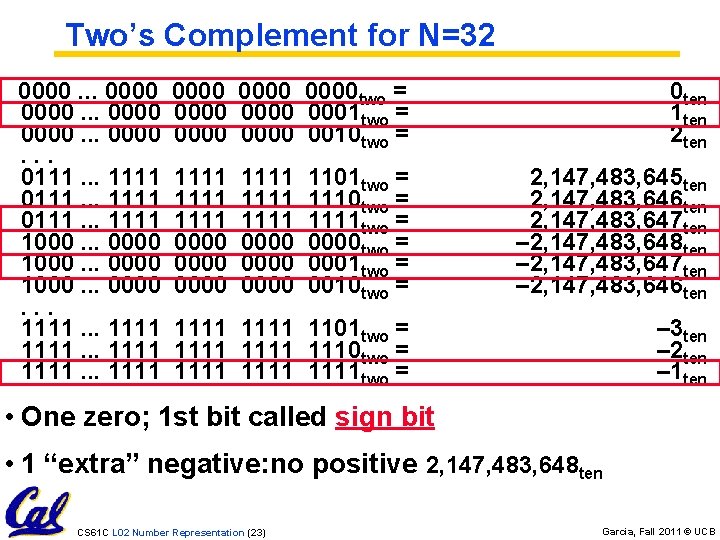
Two’s Complement for N=32 0000. . . 0111. . . 1111 1000. . . 0000. . . 1111 0000 two = 0000 0001 two = 0000 0010 two = 1111 1111 0000 0000 0 ten 1 ten 2 ten 1101 two = 1110 two = 1111 two = 0000 two = 0001 two = 0010 two = 2, 147, 483, 645 ten 2, 147, 483, 646 ten 2, 147, 483, 647 ten – 2, 147, 483, 648 ten – 2, 147, 483, 647 ten – 2, 147, 483, 646 ten 1111 1101 two = 1111 1110 two = 1111 two = – 3 ten – 2 ten – 1 ten • One zero; 1 st bit called sign bit • 1 “extra” negative: no positive 2, 147, 483, 648 ten CS 61 C L 02 Number Representation (23) Garcia, Fall 2011 © UCB
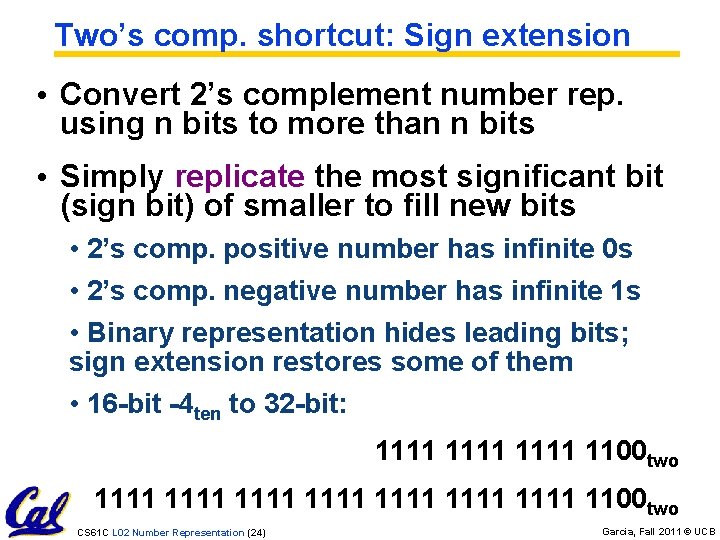
Two’s comp. shortcut: Sign extension • Convert 2’s complement number rep. using n bits to more than n bits • Simply replicate the most significant bit (sign bit) of smaller to fill new bits • 2’s comp. positive number has infinite 0 s • 2’s comp. negative number has infinite 1 s • Binary representation hides leading bits; sign extension restores some of them • 16 -bit -4 ten to 32 -bit: 1111 1100 two 1111 1111 1100 two CS 61 C L 02 Number Representation (24) Garcia, Fall 2011 © UCB
- Slides: 24