
inst eecs berkeley educs 61 c CS 61
inst. eecs. berkeley. edu/~cs 61 c CS 61 C : Machine Structures Lecture 6 – C Memory Management 2007 -02 -04 Hello to Justin H from Seattle, WA Lecturer SOE Dan Garcia www. cs. berkeley. edu/~ddgarcia Intel: High Speed Memory Intel says it has found a way to make its NAND flash memory five times faster (200 MB/s) than before. They call it “high-speed NAND”, and it is expected to be available this summer. Great for hybrid (disk + flash) drives ! www. computerworld. com/action/article. do? command=view. Article. Basic &article. Id=9060581 CS 61 C L 06 C Memory Management (1) Garcia, Spring 2008 © UCB
Review • Use handles to change pointers • Create abstractions (and your own data structures) with structures • Dynamically allocated heap memory must be manually deallocated in C. • Use malloc() and free() to allocate and de-allocate persistent storage. CS 61 C L 06 C Memory Management (2) Garcia, Spring 2008 © UCB

Don’t forget the globals! • Remember: • • • Structure declaration does not allocate memory Variable declaration does allocate memory So far we have talked about several different ways to allocate memory for data: 1. Declaration of a local variable int i; struct Node list; char *string; int ar[n]; 2. “Dynamic” allocation at runtime by calling allocation function (alloc). ptr = (struct Node *) malloc(sizeof(struct Node)*n); • One more possibility exists… 3. • Data declared outside of any procedure (i. e. , before main). Similar to #1 above, but has “global” scope. CS 61 C L 06 C Memory Management (3) int my. Global; main() { } Garcia, Spring 2008 © UCB
C Memory Management • C has 3 pools of memory • Static storage: global variable storage, basically permanent, entire program run • The Stack: local variable storage, parameters, return address (location of “activation records” in Java or “stack frame” in C) • The Heap (dynamic malloc storage): data lives until deallocated by programmer • C requires knowing where objects are in memory, otherwise things don’t work as expected • Java hides location of objects CS 61 C L 06 C Memory Management (4) Garcia, Spring 2008 © UCB
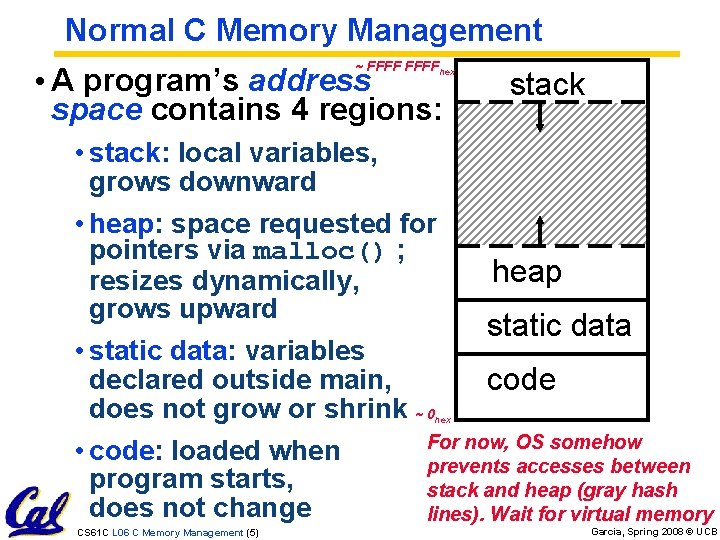
Normal C Memory Management ~ FFFFhex • A program’s address space contains 4 regions: stack • stack: local variables, grows downward • heap: space requested for pointers via malloc() ; heap resizes dynamically, grows upward static data • static data: variables declared outside main, code does not grow or shrink ~ 0 For now, OS somehow • code: loaded when prevents accesses between program starts, stack and heap (gray hash does not change lines). Wait for virtual memory hex CS 61 C L 06 C Memory Management (5) Garcia, Spring 2008 © UCB
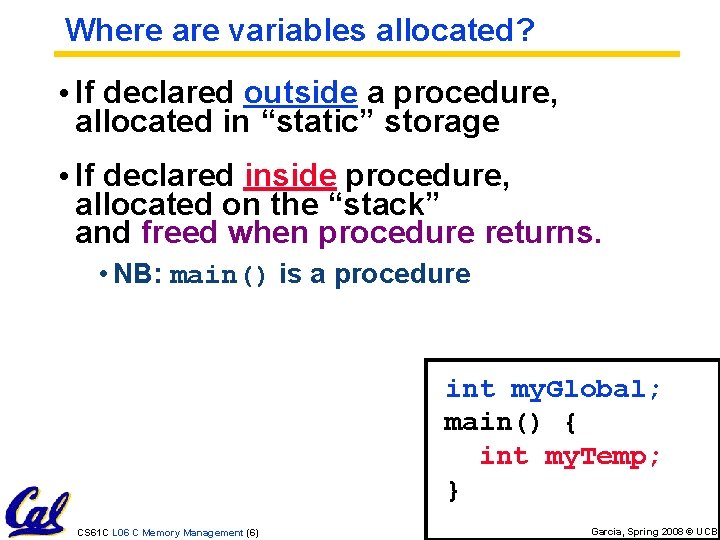
Where are variables allocated? • If declared outside a procedure, allocated in “static” storage • If declared inside procedure, allocated on the “stack” and freed when procedure returns. • NB: main() is a procedure int my. Global; main() { int my. Temp; } CS 61 C L 06 C Memory Management (6) Garcia, Spring 2008 © UCB

The Stack • Stack frame includes: • Return “instruction” address • Parameters • Space for other local variables SP • Stack frames contiguous blocks of memory; stack pointer tells where top stack frame is • When procedure ends, stack frame is tossed off the stack; frees memory for future stack frames CS 61 C L 06 C Memory Management (7) frame Garcia, Spring 2008 © UCB
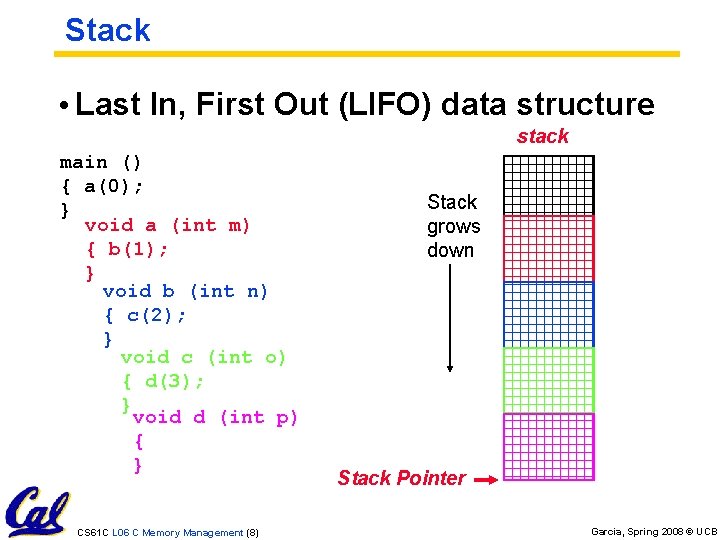
Stack • Last In, First Out (LIFO) data structure stack main () { a(0); } void a (int m) { b(1); } void b (int n) { c(2); } void c (int o) { d(3); } void d (int p) { } CS 61 C L 06 C Memory Management (8) Stack Pointer grows down Stack Pointer Garcia, Spring 2008 © UCB
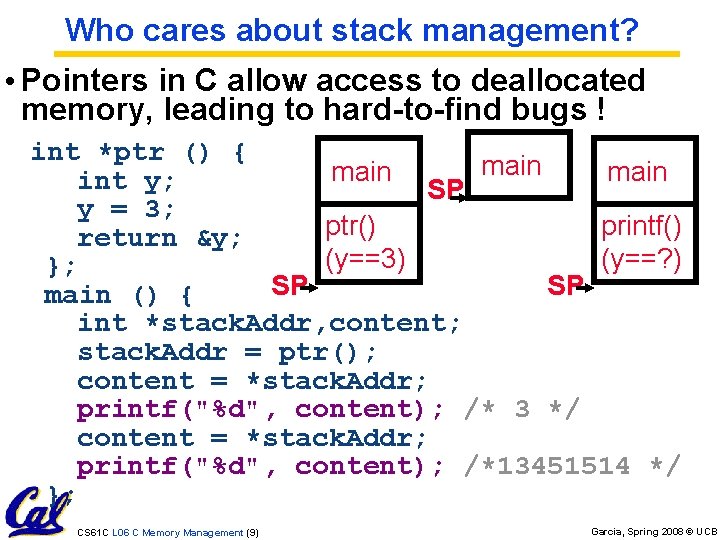
Who cares about stack management? • Pointers in C allow access to deallocated memory, leading to hard-to-find bugs ! int *ptr () { main int y; SP y = 3; ptr() printf() return &y; (y==3) (y==? ) }; SP SP main () { int *stack. Addr, content; stack. Addr = ptr(); content = *stack. Addr; printf("%d", content); /* 3 */ content = *stack. Addr; printf("%d", content); /*13451514 */ }; CS 61 C L 06 C Memory Management (9) Garcia, Spring 2008 © UCB
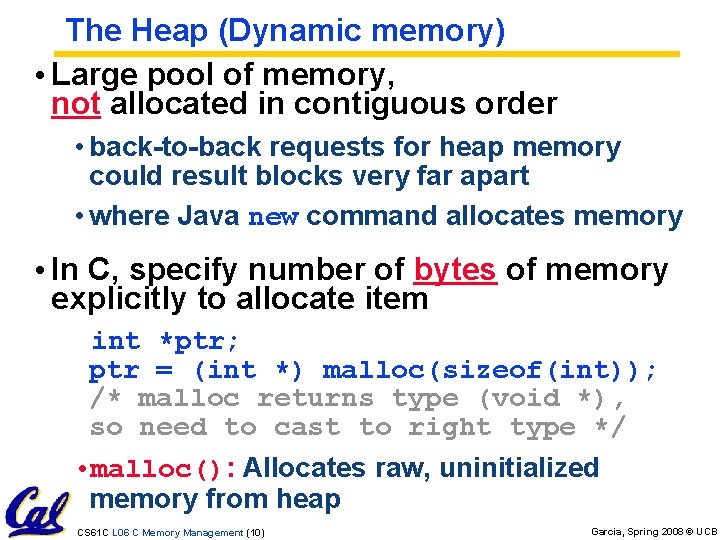
The Heap (Dynamic memory) • Large pool of memory, not allocated in contiguous order • back-to-back requests for heap memory could result blocks very far apart • where Java new command allocates memory • In C, specify number of bytes of memory explicitly to allocate item int *ptr; ptr = (int *) malloc(sizeof(int)); /* malloc returns type (void *), so need to cast to right type */ • malloc(): Allocates raw, uninitialized memory from heap CS 61 C L 06 C Memory Management (10) Garcia, Spring 2008 © UCB
Memory Management • How do we manage memory? • Code, Static storage are easy: they never grow or shrink • Stack space is also easy: stack frames are created and destroyed in last-in, first-out (LIFO) order • Managing the heap is tricky: memory can be allocated / deallocated at any time CS 61 C L 06 C Memory Management (11) Garcia, Spring 2008 © UCB
Heap Management Requirements • Want malloc() and free() to run quickly. • Want minimal memory overhead • Want to avoid fragmentation* – when most of our free memory is in many small chunks • In this case, we might have many free bytes but not be able to satisfy a large request since the free bytes are not contiguous in memory. * This is technically called external fragmention CS 61 C L 06 C Memory Management (12) Garcia, Spring 2008 © UCB
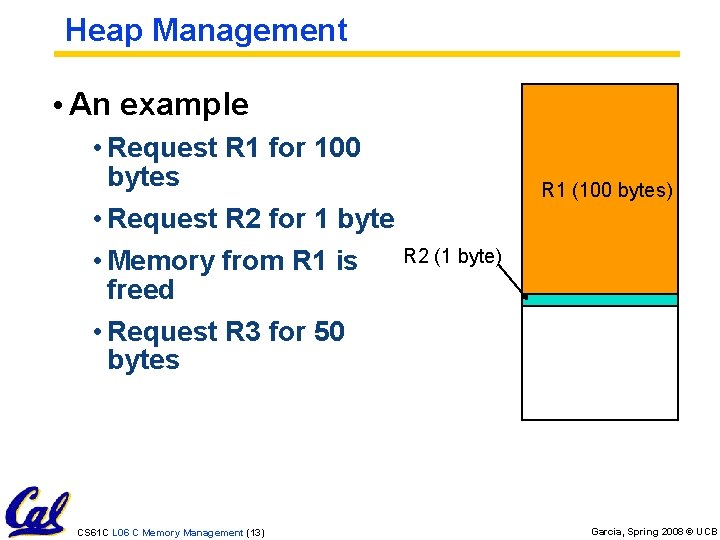
Heap Management • An example • Request R 1 for 100 bytes • Request R 2 for 1 byte • Memory from R 1 is freed • Request R 3 for 50 bytes CS 61 C L 06 C Memory Management (13) R 1 (100 bytes) R 2 (1 byte) Garcia, Spring 2008 © UCB
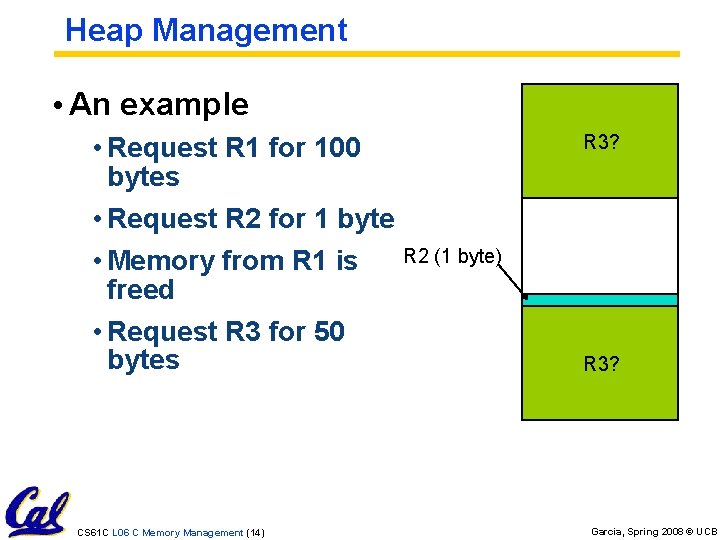
Heap Management • An example • Request R 1 for 100 bytes • Request R 2 for 1 byte • Memory from R 1 is freed • Request R 3 for 50 bytes CS 61 C L 06 C Memory Management (14) R 3? R 2 (1 byte) R 3? Garcia, Spring 2008 © UCB
K&R Malloc/Free Implementation • From Section 8. 7 of K&R • Code in the book uses some C language features we haven’t discussed and is written in a very terse style, don’t worry if you can’t decipher the code • Each block of memory is preceded by a header that has two fields: size of the block and a pointer to the next block • All free blocks are kept in a circular linked list, the pointer field is unused in an allocated block CS 61 C L 06 C Memory Management (15) Garcia, Spring 2008 © UCB
K&R Implementation • malloc() searches the free list for a block that is big enough. If none is found, more memory is requested from the operating system. If what it gets can’t satisfy the request, it fails. • free() checks if the blocks adjacent to the freed block are also free • If so, adjacent free blocks are merged (coalesced) into a single, larger free block • Otherwise, the freed block is just added to the free list CS 61 C L 06 C Memory Management (16) Garcia, Spring 2008 © UCB
Choosing a block in malloc() • If there are multiple free blocks of memory that are big enough for some request, how do we choose which one to use? • best-fit: choose the smallest block that is big enough for the request • first-fit: choose the first block we see that is big enough • next-fit: like first-fit but remember where we finished searching and resume searching from there CS 61 C L 06 C Memory Management (17) Garcia, Spring 2008 © UCB
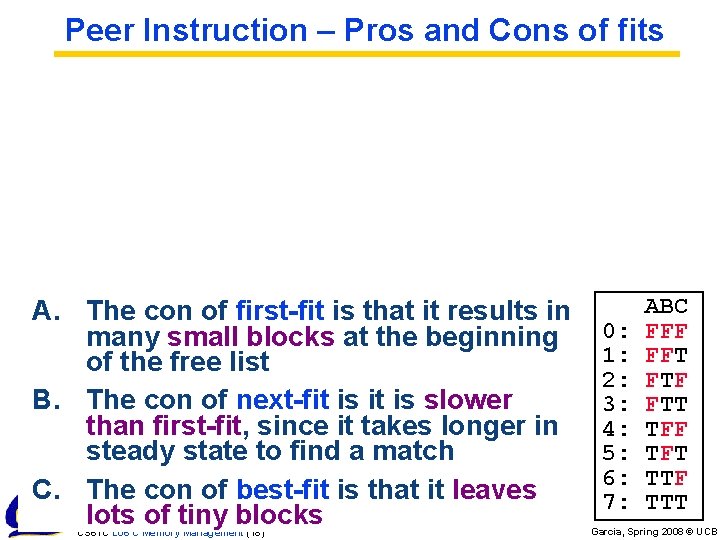
Peer Instruction – Pros and Cons of fits A. The con of first-fit is that it results in many small blocks at the beginning of the free list B. The con of next-fit is slower than first-fit, since it takes longer in steady state to find a match C. The con of best-fit is that it leaves lots of tiny blocks CS 61 C L 06 C Memory Management (18) 0: 1: 2: 3: 4: 5: 6: 7: ABC FFF FFT FTF FTT TFF TFT TTF TTT Garcia, Spring 2008 © UCB
And in conclusion… • C has 3 pools of memory • Static storage: global variable storage, basically permanent, entire program run • The Stack: local variable storage, parameters, return address • The Heap (dynamic storage): malloc() grabs space from here, free() returns it. • malloc() handles free space with freelist. Three different ways to find free space when given a request: • First fit (find first one that’s free) • Next fit (same as first, but remembers where left off) • Best fit (finds most “snug” free space) CS 61 C L 06 C Memory Management (19) Garcia, Spring 2008 © UCB

Bonus slides • These are extra slides that used to be included in lecture notes, but have been moved to this, the “bonus” area to serve as a supplement. • The slides will appear in the order they would have in the normal presentation CS 61 C L 06 C Memory Management (20) Garcia, Spring 2008 © UCB
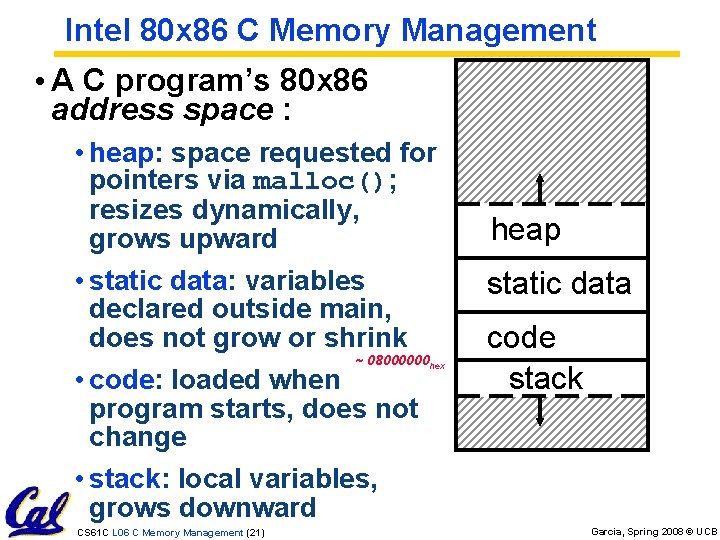
Intel 80 x 86 C Memory Management • A C program’s 80 x 86 address space : • heap: space requested for pointers via malloc(); resizes dynamically, grows upward • static data: variables declared outside main, does not grow or shrink ~ 08000000 • code: loaded when program starts, does not change • stack: local variables, grows downward hex CS 61 C L 06 C Memory Management (21) heap static data code stack Garcia, Spring 2008 © UCB

Tradeoffs of allocation policies • Best-fit: Tries to limit fragmentation but at the cost of time (must examine all free blocks for each malloc). Leaves lots of small blocks (why? ) • First-fit: Quicker than best-fit (why? ) but potentially more fragmentation. Tends to concentrate small blocks at the beginning of the free list (why? ) • Next-fit: Does not concentrate small blocks at front like first-fit, should be faster as a result. CS 61 C L 06 C Memory Management (22) Garcia, Spring 2008 © UCB
- Slides: 22