
inst eecs berkeley educs 61 c CS 61
inst. eecs. berkeley. edu/~cs 61 c CS 61 C : Machine Structures Lecture 23 Introduction to Synchronous Digital Systems (SDS) Switches, Transistors, Gates 2011 -10 -19 Hello to Daniel Beck listening from Washington DC! Lecturer SOE Dan Garcia www. cs. berkeley. edu/~ddgarcia Living in a Digital World “We are using technology to dial down human contact. ” “Heavy technology use can result in higher levels of loneliness and depression. ” Suggestions? Try going offline once a week. cacm. org/magazines/2011/10/131393 -living-in-a-digital-world/fulltext CS 61 C L 23 Synchronous Digital Systems (1) Garcia, Fall 2011 © UCB
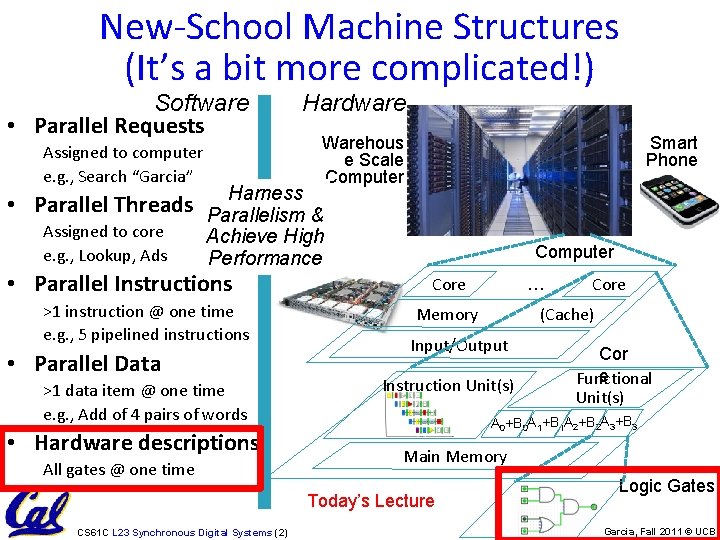
New-School Machine Structures (It’s a bit more complicated!) Software • Parallel Requests Assigned to computer e. g. , Search “Garcia” Hardware Warehous e Scale Computer Smart Phone Harness • Parallel Threads Parallelism & Assigned to core e. g. , Lookup, Ads Achieve High Performance • Parallel Instructions >1 instruction @ one time e. g. , 5 pipelined instructions • Parallel Data >1 data item @ one time e. g. , Add of 4 pairs of words • Hardware descriptions All gates @ one time Computer Core Memory Core (Cache) Input/Output Instruction Unit(s) Cor e Functional Unit(s) A 0+B 0 A 1+B 1 A 2+B 2 A 3+B 3 Main Memory Today’s Lecture CS 61 C L 23 Synchronous Digital Systems (2) … Logic Gates Garcia, Fall 2011 © UCB
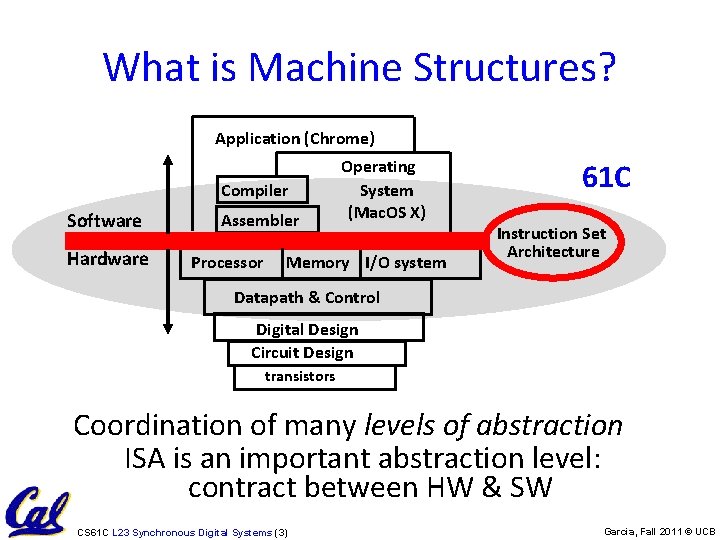
What is Machine Structures? Application (Chrome) Compiler Software Hardware Assembler Processor Operating System (Mac. OS X) Memory I/O system 61 C Instruction Set Architecture Datapath & Control Digital Design Circuit Design transistors Coordination of many levels of abstraction ISA is an important abstraction level: contract between HW & SW CS 61 C L 23 Synchronous Digital Systems (3) Garcia, Fall 2011 © UCB
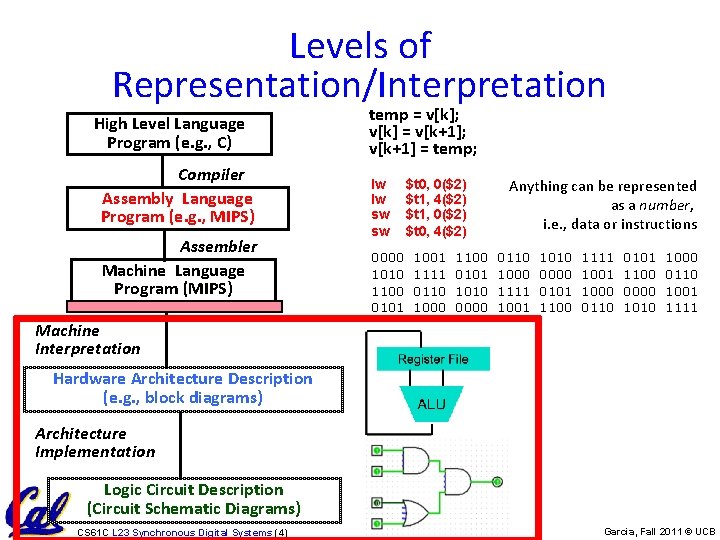
Levels of Representation/Interpretation High Level Language Program (e. g. , C) Compiler Assembly Language Program (e. g. , MIPS) Assembler Machine Language Program (MIPS) temp = v[k]; v[k] = v[k+1]; v[k+1] = temp; lw lw sw sw 0000 1010 1100 0101 $t 0, 0($2) $t 1, 4($2) $t 1, 0($2) $t 0, 4($2) 1001 1111 0110 1000 1100 0101 1010 0000 Anything can be represented as a number, i. e. , data or instructions 0110 1000 1111 1001 1010 0000 0101 1100 1111 1000 0110 0101 1100 0000 1010 1000 0110 1001 1111 Machine Interpretation Hardware Architecture Description (e. g. , block diagrams) Architecture Implementation Logic Circuit Description (Circuit Schematic Diagrams) CS 61 C L 23 Synchronous Digital Systems (4) Garcia, Fall 2011 © UCB
Synchronous Digital Systems Hardware of a processor, such as the MIPS, is an example of a Synchronous Digital System Synchronous: • All operations coordinated by a central clock § “Heartbeat” of the system! Digital: • All values represented by discrete values • Electrical signals are treated as 1 s and 0 s; grouped together to form words CS 61 C L 23 Synchronous Digital Systems (5) Garcia, Fall 2011 © UCB
Logic Design • Next several weeks: we’ll study how a modern processor is built; starting with basic elements as building blocks • Why study hardware design? – Understand capabilities and limitations of hw in general and processors in particular – What processors can do fast and what they can’t do fast (avoid slow things if you want your code to run fast!) – Background for more in depth hw courses (CS 150, CS 152) – There is just so much you can do with standard processors: you may need to design own custom hw CS 61 C L 23 Synchronous Digital Systems (6) Garcia, Fall 2011 © UCB
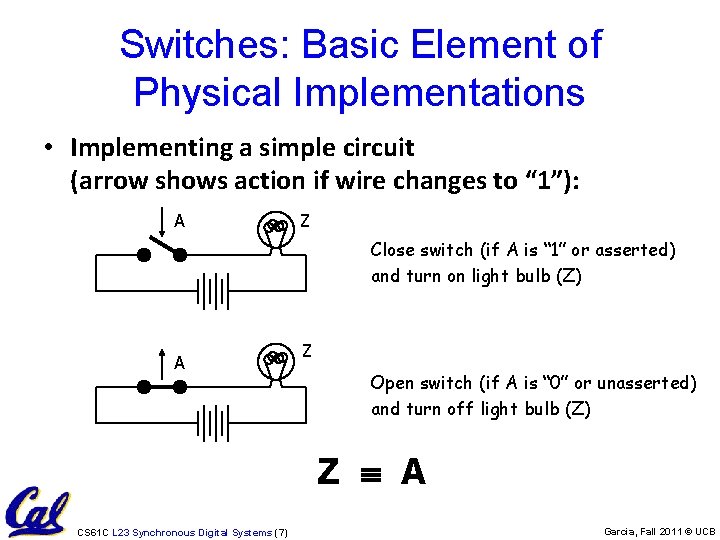
Switches: Basic Element of Physical Implementations • Implementing a simple circuit (arrow shows action if wire changes to “ 1”): A Z Close switch (if A is “ 1” or asserted) and turn on light bulb (Z) A Z Open switch (if A is “ 0” or unasserted) and turn off light bulb (Z) Z A CS 61 C L 23 Synchronous Digital Systems (7) Garcia, Fall 2011 © UCB
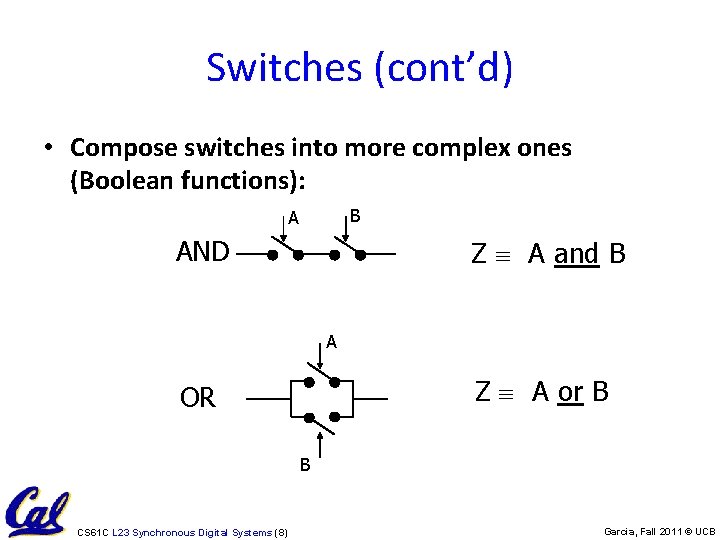
Switches (cont’d) • Compose switches into more complex ones (Boolean functions): B A AND Z A and B A Z A or B OR B CS 61 C L 23 Synchronous Digital Systems (8) Garcia, Fall 2011 © UCB
Transistor Networks • Modern digital systems designed in CMOS – MOS: Metal-Oxide on Semiconductor – C for complementary: normally-open and normally -closed switches • MOS transistors act as voltage-controlled switches CS 61 C L 23 Synchronous Digital Systems (9) Garcia, Fall 2011 © UCB
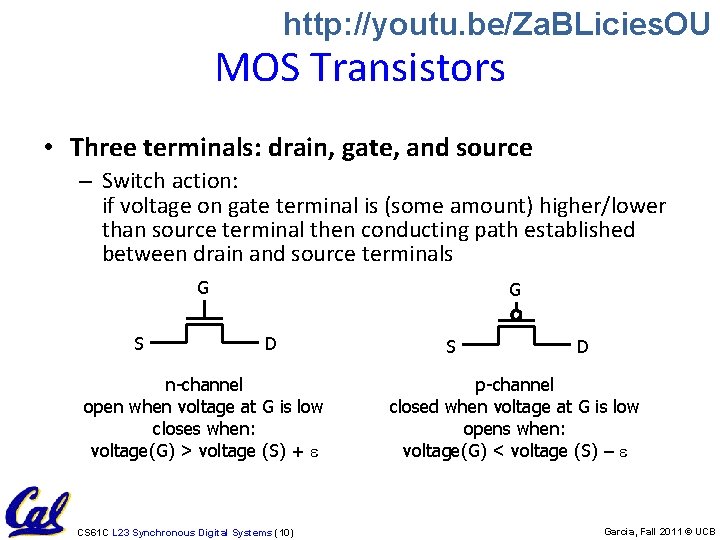
http: //youtu. be/Za. BLicies. OU MOS Transistors • Three terminals: drain, gate, and source – Switch action: if voltage on gate terminal is (some amount) higher/lower than source terminal then conducting path established between drain and source terminals G S G D n-channel open when voltage at G is low closes when: voltage(G) > voltage (S) + CS 61 C L 23 Synchronous Digital Systems (10) S D p-channel closed when voltage at G is low opens when: voltage(G) < voltage (S) – Garcia, Fall 2011 © UCB
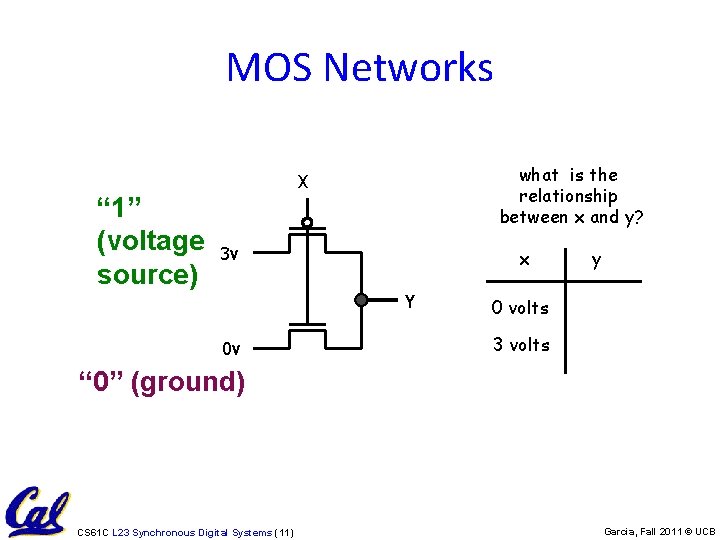
MOS Networks what is the relationship between x and y? X “ 1” (voltage source) 3 v x Y 0 v y 0 volts 3 volts “ 0” (ground) CS 61 C L 23 Synchronous Digital Systems (11) Garcia, Fall 2011 © UCB
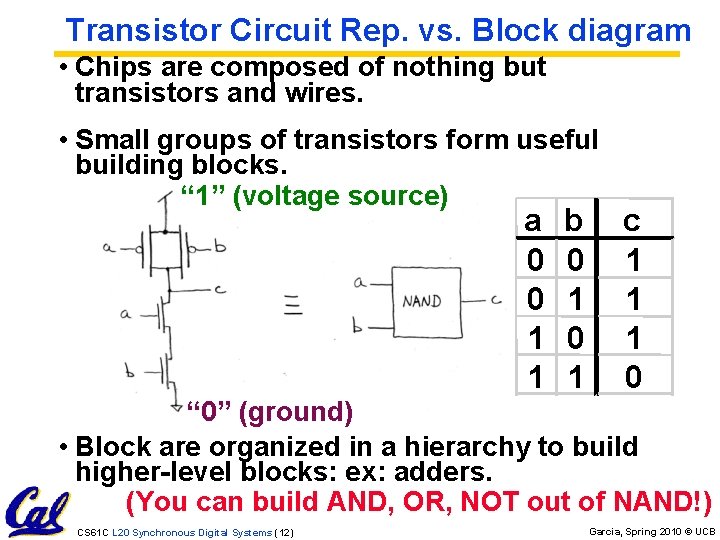
Transistor Circuit Rep. vs. Block diagram • Chips are composed of nothing but transistors and wires. • Small groups of transistors form useful building blocks. “ 1” (voltage source) a 0 0 1 1 b 0 1 c 1 1 1 0 “ 0” (ground) • Block are organized in a hierarchy to build higher-level blocks: ex: adders. (You can build AND, OR, NOT out of NAND!) CS 61 C L 20 Synchronous Digital Systems (12) Garcia, Spring 2010 © UCB
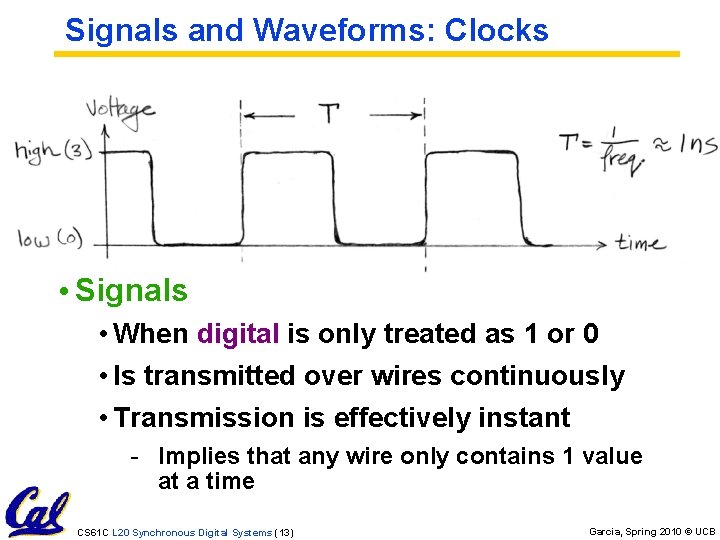
Signals and Waveforms: Clocks • Signals • When digital is only treated as 1 or 0 • Is transmitted over wires continuously • Transmission is effectively instant - Implies that any wire only contains 1 value at a time CS 61 C L 20 Synchronous Digital Systems (13) Garcia, Spring 2010 © UCB
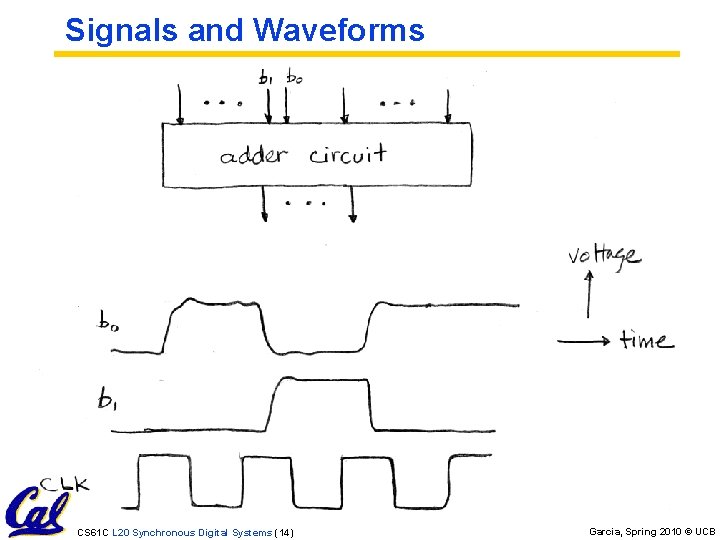
Signals and Waveforms CS 61 C L 20 Synchronous Digital Systems (14) Garcia, Spring 2010 © UCB
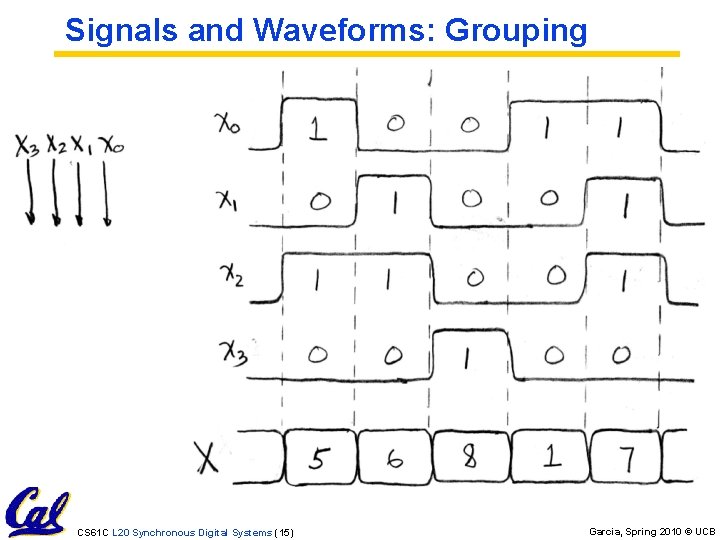
Signals and Waveforms: Grouping CS 61 C L 20 Synchronous Digital Systems (15) Garcia, Spring 2010 © UCB
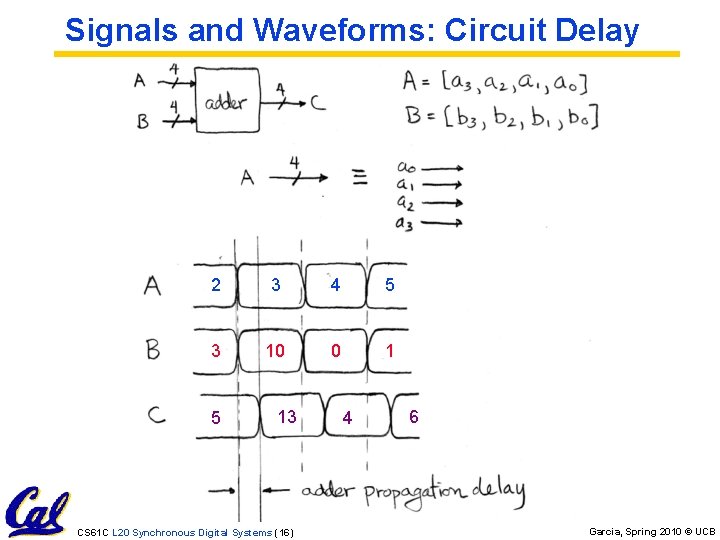
Signals and Waveforms: Circuit Delay 2 3 4 5 3 10 0 1 5 13 CS 61 C L 20 Synchronous Digital Systems (16) 4 6 Garcia, Spring 2010 © UCB
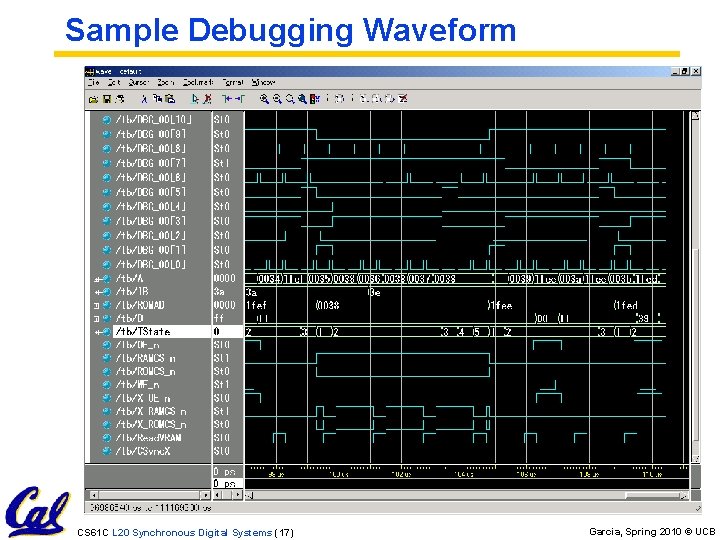
Sample Debugging Waveform CS 61 C L 20 Synchronous Digital Systems (17) Garcia, Spring 2010 © UCB
Type of Circuits • Synchronous Digital Systems are made up of two basic types of circuits: • Combinational Logic (CL) circuits • Our previous adder circuit is an example. • Output is a function of the inputs only. • Similar to a pure function in mathematics, y = f(x). (No way to store information from one invocation to the next. No side effects) • State Elements: circuits that store information. CS 61 C L 20 Synchronous Digital Systems (18) Garcia, Spring 2010 © UCB
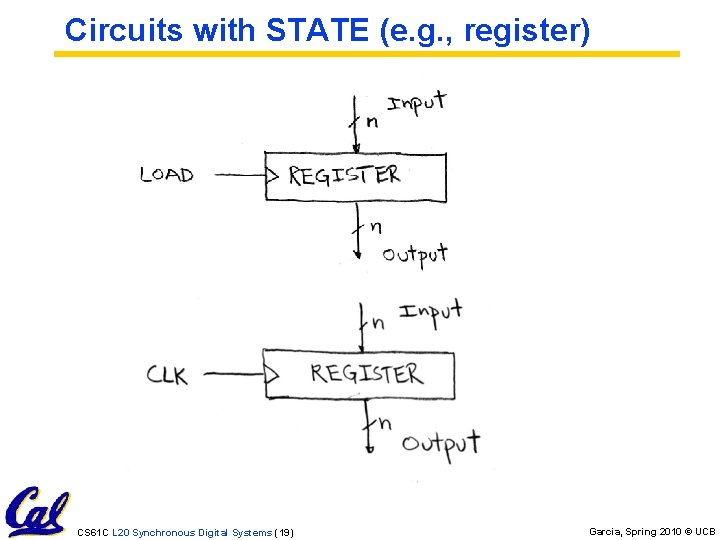
Circuits with STATE (e. g. , register) CS 61 C L 20 Synchronous Digital Systems (19) Garcia, Spring 2010 © UCB
Peer Instruction 12 1) SW can peek at HW (past ISA FF abstraction boundary) for optimizations a) b) FT c) TF 2) SW can depend on particular HW d) TT implementation of ISA CS 61 C L 20 Synchronous Digital Systems (20) Garcia, Spring 2010 © UCB
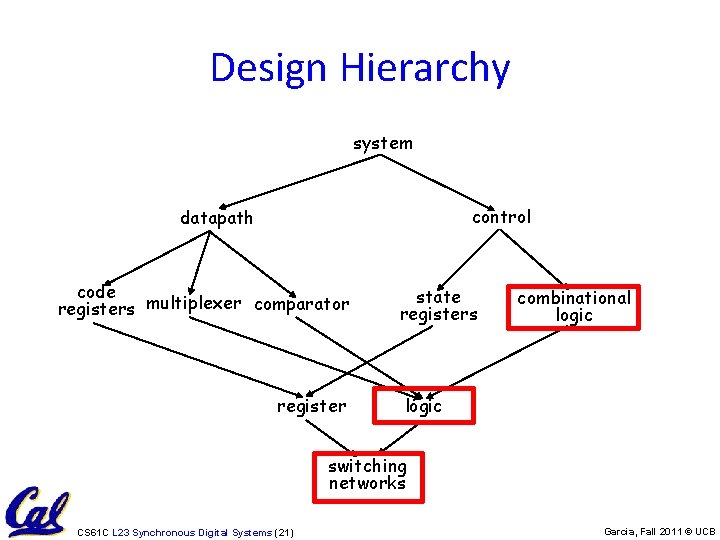
Design Hierarchy system control datapath code registers multiplexer comparator register state registers combinational logic switching networks CS 61 C L 23 Synchronous Digital Systems (21) Garcia, Fall 2011 © UCB
And in conclusion… • ISA is very important abstraction layer • Contract between HW and SW • Clocks control pulse of our circuits • Voltages are analog, quantized to 0/1 • Circuit delays are fact of life • Two types of circuits: • Stateless Combinational Logic (&, |, ~) • State circuits (e. g. , registers) CS 61 C L 20 Synchronous Digital Systems (22) Garcia, Spring 2010 © UCB
- Slides: 22