
INspir EDmath Using Rich Tasks to Build Mathematical
#INspir. EDmath Using Rich Tasks to Build Mathematical Rigor Emily Bruning Elementary Math and Science Specialist ebruning@doe. in. gov @Mrs. Bruning 317 -232 -9142 @Educate. IN @Mrs. Bruning
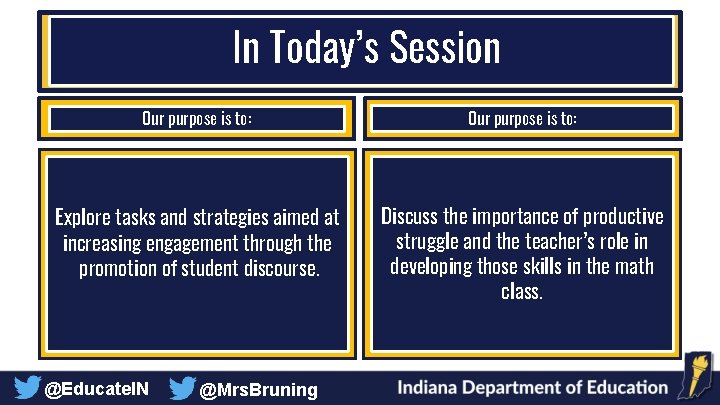
In Today’s Session Our purpose is to: Explore tasks and strategies aimed at increasing engagement through the promotion of student discourse. Discuss the importance of productive struggle and the teacher’s role in developing those skills in the math class. @Educate. IN @Mrs. Bruning
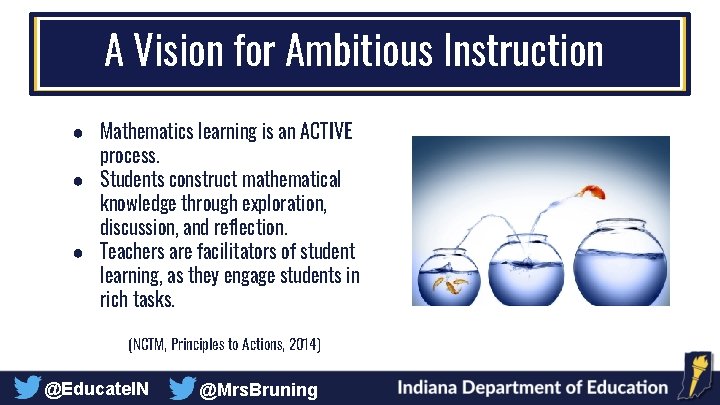
A Vision for Ambitious Instruction ● Mathematics learning is an ACTIVE process. ● Students construct mathematical knowledge through exploration, discussion, and reflection. ● Teachers are facilitators of student learning, as they engage students in rich tasks. (NCTM, Principles to Actions, 2014) @Educate. IN @Mrs. Bruning
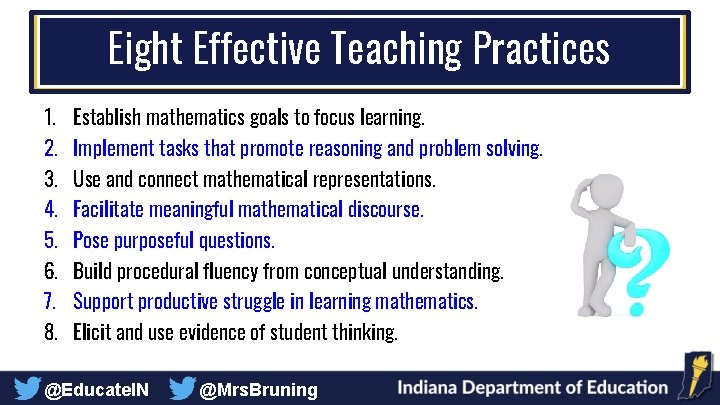
Eight Effective Teaching Practices 1. 2. 3. 4. 5. 6. 7. 8. Establish mathematics goals to focus learning. Implement tasks that promote reasoning and problem solving. Use and connect mathematical representations. Facilitate meaningful mathematical discourse. Pose purposeful questions. Build procedural fluency from conceptual understanding. Support productive struggle in learning mathematics. Elicit and use evidence of student thinking. @Educate. IN @Mrs. Bruning
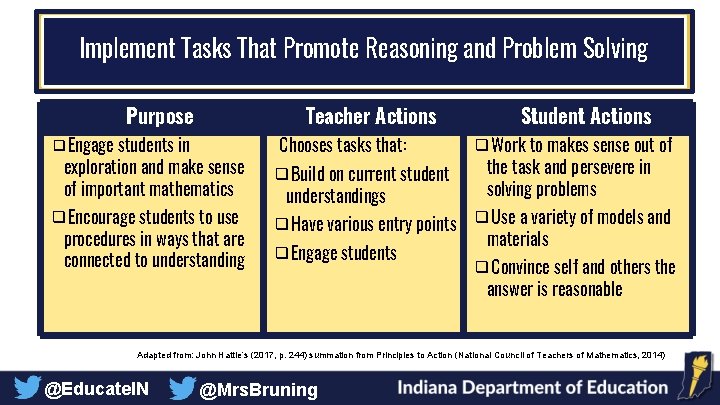
Implement Tasks That Promote Reasoning and Problem Solving Purpose Teacher Actions ❑Engage students in exploration and make sense of important mathematics ❑Encourage students to use procedures in ways that are connected to understanding Chooses tasks that: ❑Build on current student understandings Student Actions ❑Work to makes sense out of the task and persevere in solving problems ❑Have various entry points ❑Use a variety of models and materials ❑Engage students ❑Convince self and others the answer is reasonable Adapted from: John Hattie’s (2017, p. 244) summation from Principles to Action (National Council of Teachers of Mathematics, 2014) @Educate. IN @Mrs. Bruning
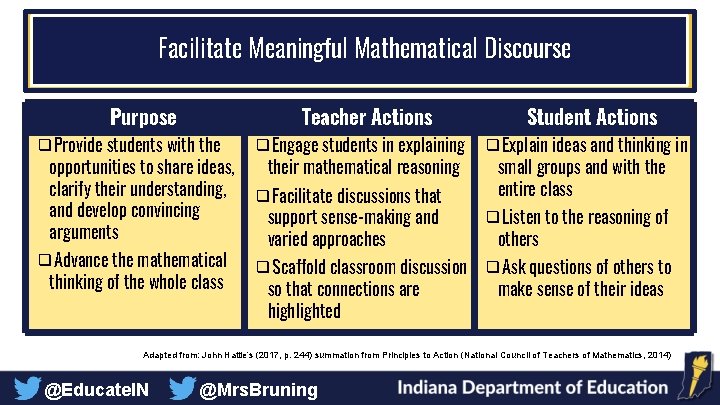
Facilitate Meaningful Mathematical Discourse Purpose ❑Provide students with the opportunities to share ideas, clarify their understanding, and develop convincing arguments ❑Advance the mathematical thinking of the whole class Teacher Actions ❑Engage students in explaining their mathematical reasoning ❑Facilitate discussions that support sense-making and varied approaches Student Actions ❑Explain ideas and thinking in small groups and with the entire class ❑Listen to the reasoning of others ❑Scaffold classroom discussion ❑Ask questions of others to so that connections are make sense of their ideas highlighted Adapted from: John Hattie’s (2017, p. 244) summation from Principles to Action (National Council of Teachers of Mathematics, 2014) @Educate. IN @Mrs. Bruning
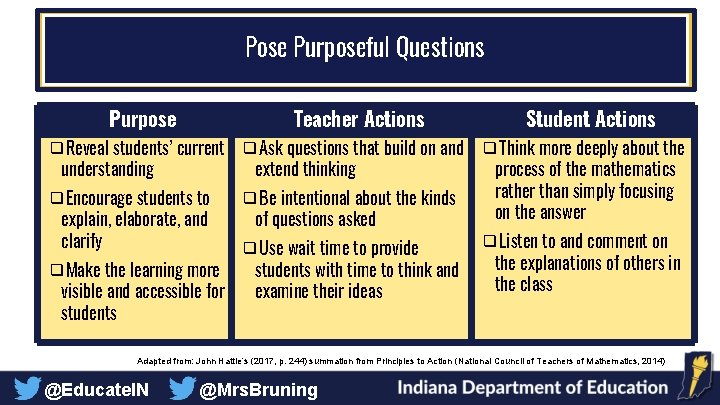
Pose Purposeful Questions Purpose Teacher Actions Student Actions ❑Reveal students’ current ❑Ask questions that build on and ❑Think more deeply about the understanding extend thinking process of the mathematics rather than simply focusing ❑Encourage students to ❑Be intentional about the kinds on the answer explain, elaborate, and of questions asked clarify ❑Use wait time to provide ❑Make the learning more students with time to think and visible and accessible for examine their ideas students ❑Listen to and comment on the explanations of others in the class Adapted from: John Hattie’s (2017, p. 244) summation from Principles to Action (National Council of Teachers of Mathematics, 2014) @Educate. IN @Mrs. Bruning
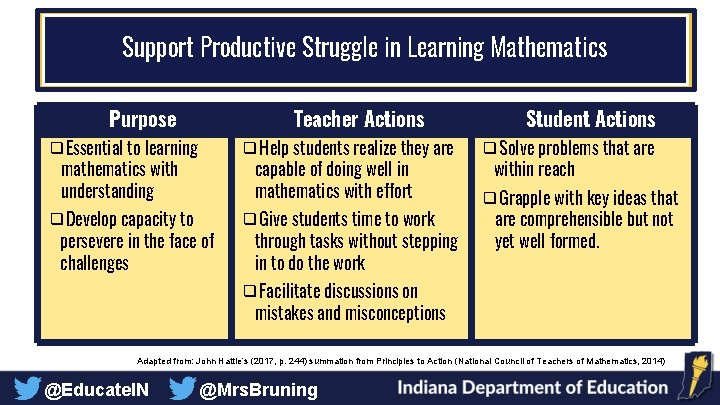
Support Productive Struggle in Learning Mathematics Purpose ❑Essential to learning mathematics with understanding Teacher Actions ❑Develop capacity to persevere in the face of challenges ❑Help students realize they are capable of doing well in mathematics with effort ❑Give students time to work through tasks without stepping in to do the work Student Actions ❑Solve problems that are within reach ❑Grapple with key ideas that are comprehensible but not yet well formed. ❑Facilitate discussions on mistakes and misconceptions Adapted from: John Hattie’s (2017, p. 244) summation from Principles to Action (National Council of Teachers of Mathematics, 2014) @Educate. IN @Mrs. Bruning
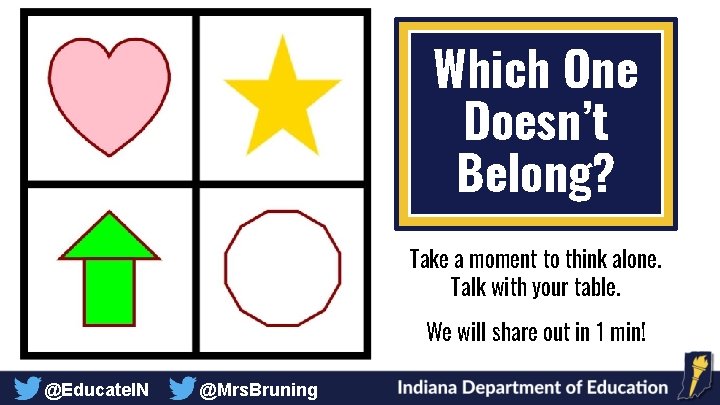
Which One Doesn’t Belong? Take a moment to think alone. Talk with your table. We will share out in 1 min! @Educate. IN @Mrs. Bruning
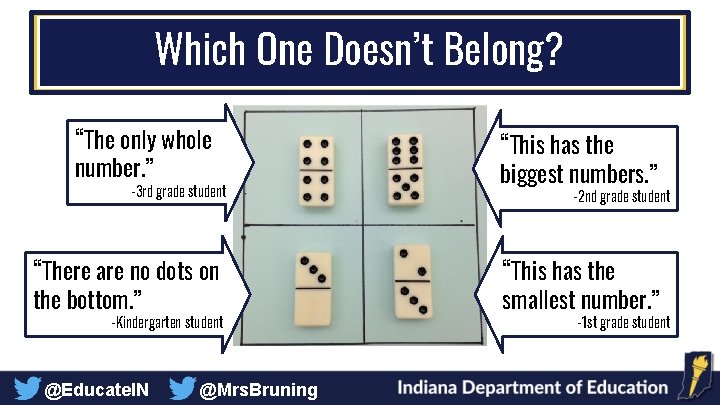
Which One Doesn’t Belong? “The only whole number. ” -3 rd grade student “There are no dots on the bottom. ” -Kindergarten student @Educate. IN @Mrs. Bruning “This has the biggest numbers. ” -2 nd grade student “This has the smallest number. ” -1 st grade student
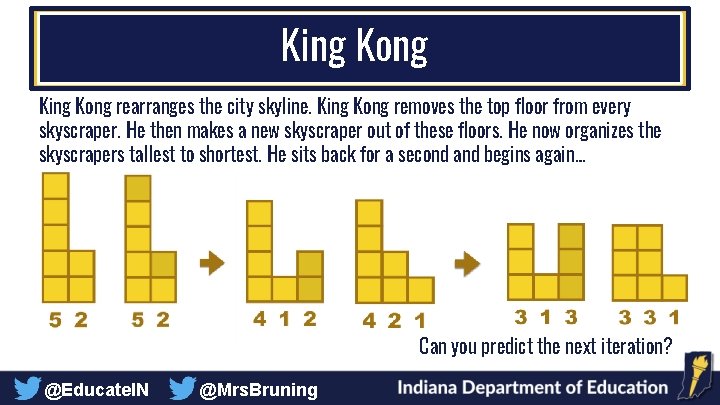
King Kong rearranges the city skyline. King Kong removes the top floor from every skyscraper. He then makes a new skyscraper out of these floors. He now organizes the skyscrapers tallest to shortest. He sits back for a second and begins again… Can you predict the next iteration? @Educate. IN @Mrs. Bruning
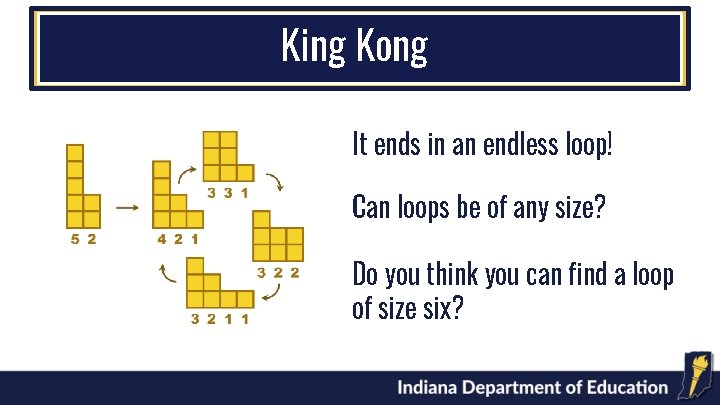
King Kong It ends in an endless loop! Can loops be of any size? Do you think you can find a loop of size six?
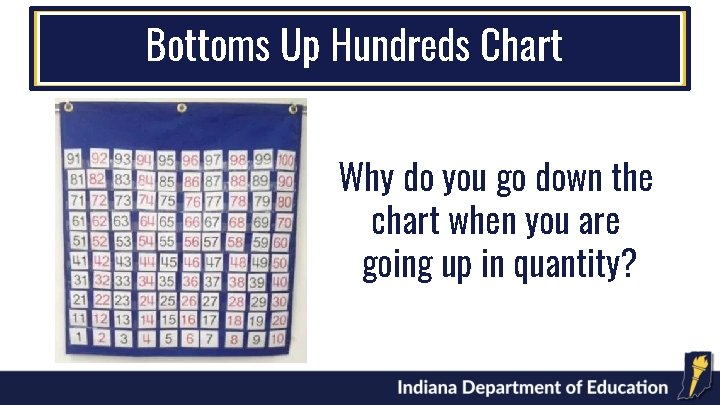
Bottoms Up Hundreds Chart Why do you go down the chart when you are going up in quantity?
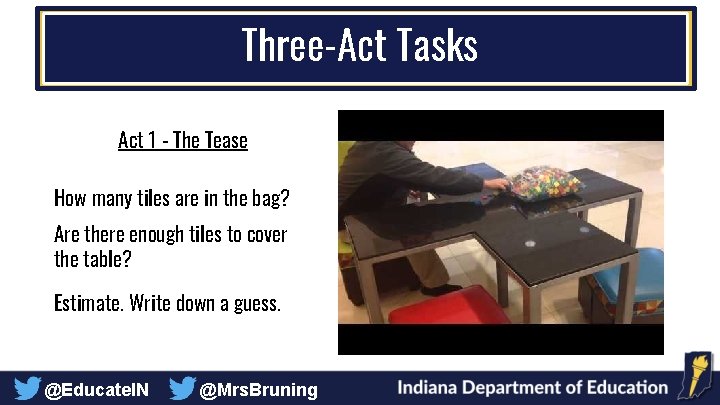
Three-Act Tasks Act 1 - The Tease How many tiles are in the bag? Are there enough tiles to cover the table? Estimate. Write down a guess. @Educate. IN @Mrs. Bruning
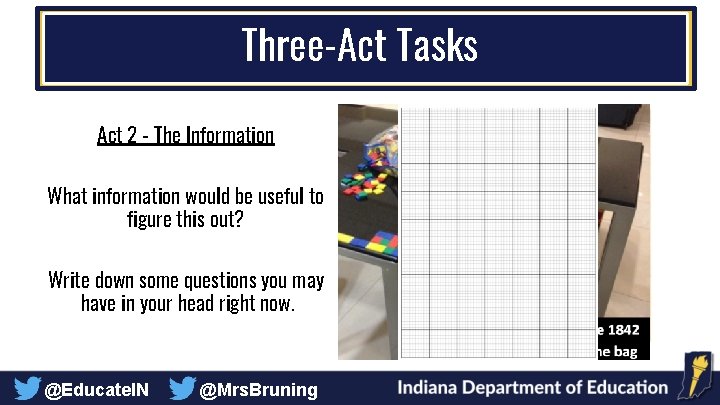
Three-Act Tasks Act 2 - The Information What information would be useful to figure this out? Write down some questions you may have in your head right now. @Educate. IN @Mrs. Bruning
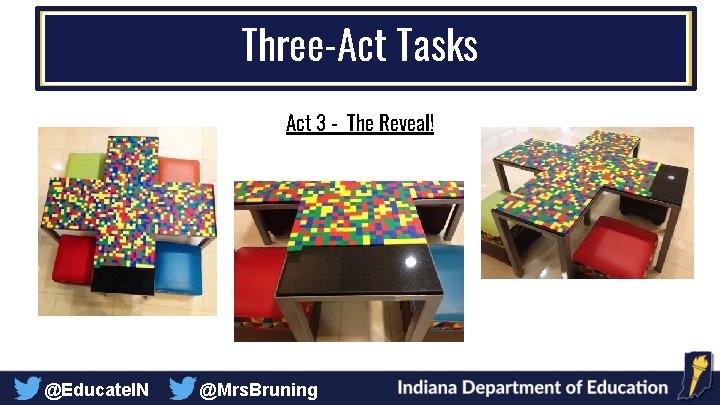
Three-Act Tasks Act 3 - The Reveal! @Educate. IN @Mrs. Bruning
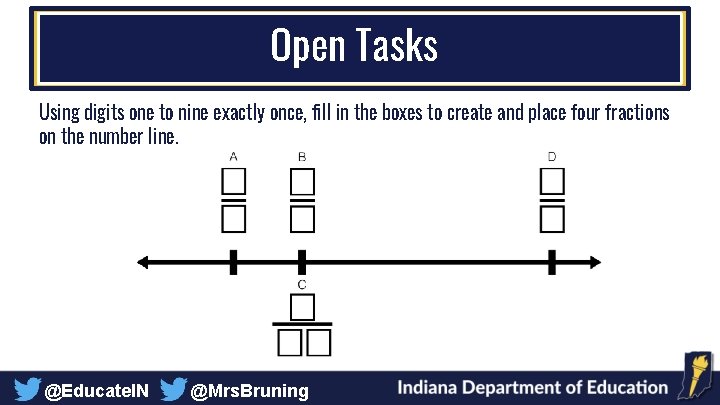
Open Tasks Using digits one to nine exactly once, fill in the boxes to create and place four fractions on the number line. @Educate. IN @Mrs. Bruning
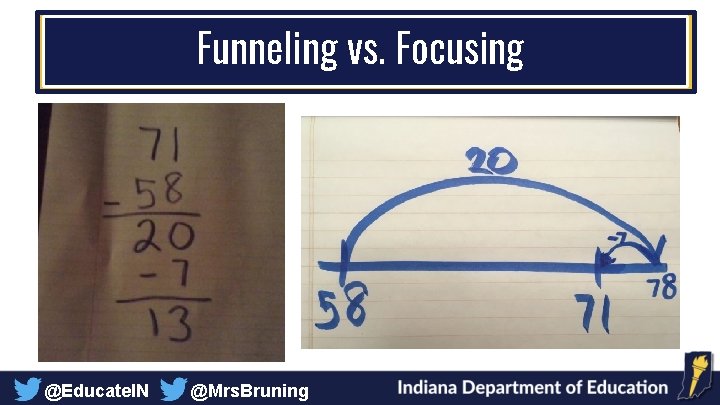
Funneling vs. Focusing What would you ask? What would you have done? Did she get the answer correct? @Educate. IN @Mrs. Bruning
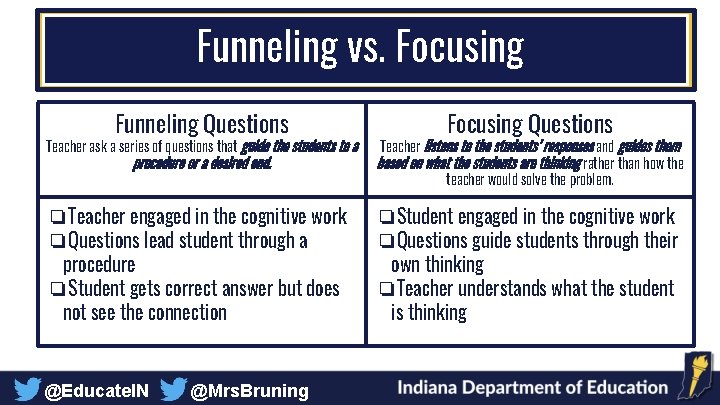
Funneling vs. Focusing Funneling Questions Focusing Questions Teacher ask a series of questions that guide the students to a Teacher listens to the students’ responses and guides them based on what the students are thinking rather than how the teacher would solve the problem. ❏Teacher engaged in the cognitive work ❏Questions lead student through a procedure ❏Student gets correct answer but does not see the connection ❏Student engaged in the cognitive work ❏Questions guide students through their own thinking ❏Teacher understands what the student is thinking procedure or a desired end. @Educate. IN @Mrs. Bruning
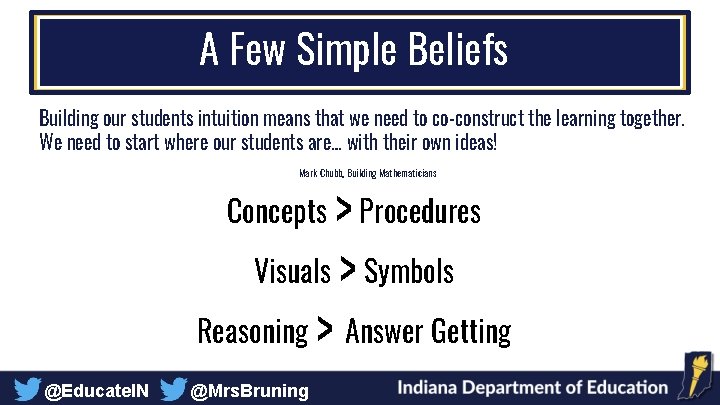
A Few Simple Beliefs Building our students intuition means that we need to co-construct the learning together. We need to start where our students are… with their own ideas! > Procedures Visuals > Symbols Reasoning > Answer Getting Mark Chubb, Building Mathematicians Concepts @Educate. IN @Mrs. Bruning
A Few Simple Beliefs ➔ The most productive discourse involves students thinking about, reasoning about, and making sense of mathematical ideas, problems, concepts, or even procedures. ➔ Engaging in mathematically rich tasks that challenge students somewhat beyond what they already know can set the stage for rich discourse around mathematical ideas. ➔ Students get used to the notion that it’s ok to struggle a bit over a challenging problem, even to make a mistake, knowing that the discussion that evolves from their struggle is likely to lead to better understanding. ➔ NCTM has suggested that the most effective student learning arises when tasks are carefully selected to elicit thinking and when the teacher poses questions that support the development of reasoning. @Educate. IN @Mrs. Bruning
Productive vs. Unproductive @Educate. IN @Mrs. Bruning
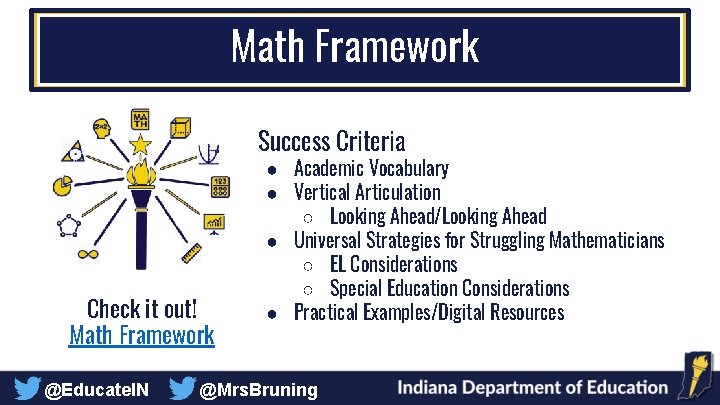
Math Framework Success Criteria Check it out! Math Framework @Educate. IN ● Academic Vocabulary ● Vertical Articulation ○ Looking Ahead/Looking Ahead ● Universal Strategies for Struggling Mathematicians ○ EL Considerations ○ Special Education Considerations ● Practical Examples/Digital Resources @Mrs. Bruning
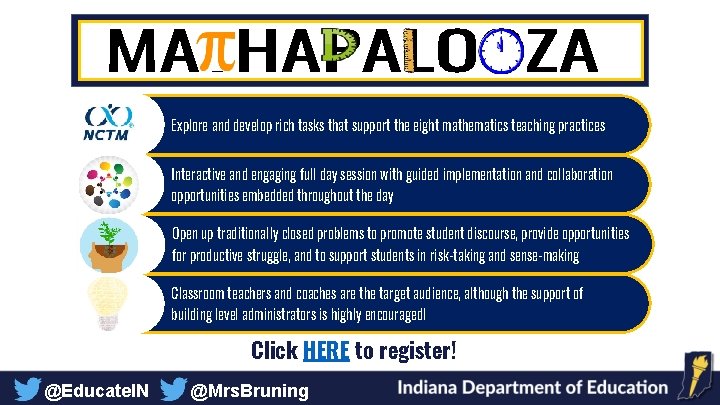
Explore and develop rich tasks that support the eight mathematics teaching practices Interactive and engaging full day session with guided implementation and collaboration opportunities embedded throughout the day Open up traditionally closed problems to promote student discourse, provide opportunities for productive struggle, and to support students in risk-taking and sense-making Classroom teachers and coaches are the target audience, although the support of building level administrators is highly encouraged! Click HERE to register! @Educate. IN @Mrs. Bruning
Online Student Course @Educate. IN @Mrs. Bruning
Get Connected! #INspir. EDmath Newsletter Click here to subscribe! @Educate. IN @Mrs. Bruning
Updates from IDOE Office of School Improvement Literacy Mathematics Social-Emotional Learning High Ability Indiana Academic Standards @Educate. IN @Mrs. Bruning
Contact Information for Assessment Dr. Charity Flores Tricia Stephens Director of Assessment cflores@doe. in. gov Assessment Specialist, Testing Security tstephens@doe. in. gov Dr. Kristine David Stephanie Thompson Sholonda Trice Mary Williams Assistant Director of Assessment, Content kdavide@doe. in. gov Assessment Specialist, I AM sthompson 2@doe. in. gov Assistant Director of Assessment strice@doe. in. gov Assessment Specialist, High School, Formative mwilliams@doe. in. gov Kelly Connelly Mark O’Malley Senior Assessment Specialist, ILEARN kconnelly@doe. in. gov @Educate. IN Assessment Specialist, IREAD-3 momalley@doe. in. gov
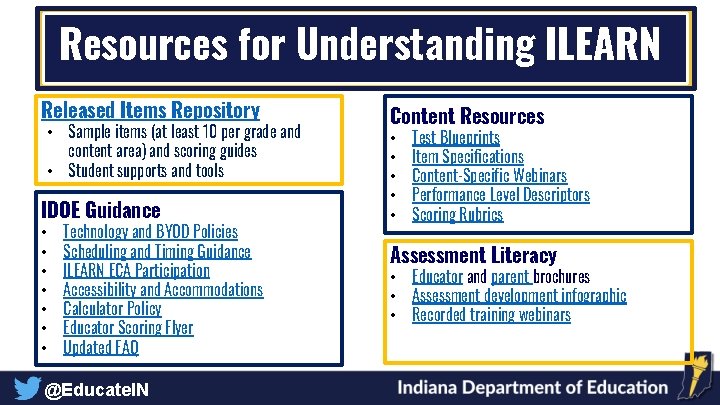
Resources for Understanding ILEARN Released Items Repository • Sample items (at least 10 per grade and content area) and scoring guides • Student supports and tools IDOE Guidance • • Technology and BYOD Policies Scheduling and Timing Guidance ILEARN ECA Participation Accessibility and Accommodations Calculator Policy Educator Scoring Flyer Updated FAQ @Educate. IN Content Resources • • • Test Blueprints Item Specifications Content-Specific Webinars Performance Level Descriptors Scoring Rubrics Assessment Literacy • • • Educator and parent brochures Assessment development infographic Recorded training webinars
Thank you! Emily Bruning Elementary Math and Science Specialist ebruning@doe. in. gov @Mrs. Bruning Use this URL to access today’s slides. It will ask you to make a copy, then you can take notes and share how you please. http: //bit. ly/OSIK 6 math @Educate. IN
Resources Digital Resources @Educate. IN @Mrs. Bruning
- Slides: 31