
INSPECTION MAINTENANCE OF TUNNELS Sabyasachi S Roy Sr
INSPECTION & MAINTENANCE OF TUNNELS Sabyasachi S. Roy Sr. Instructor (Track) IRICEN/Pune
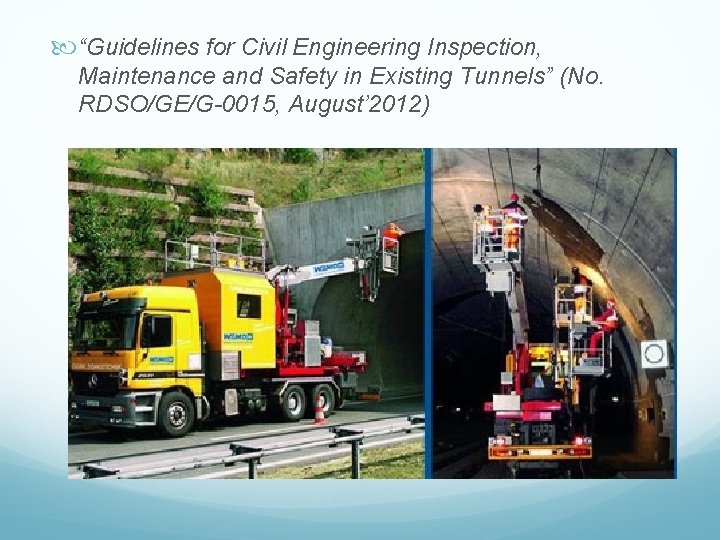
“Guidelines for Civil Engineering Inspection, Maintenance and Safety in Existing Tunnels” (No. RDSO/GE/G-0015, August’ 2012)
Pre-requisites for Tunnel Inspection Qualifications of Inspecting Officials: § All officials performing tunnel inspection work should possess basic knowledge of tunnel components and understand how they function. § The inspecting official/s should have the ability to identify and evaluate defects that pose a threat to the integrity of a structural member & should be able to assess the degree of deterioration of structural components of tunnel. § Training courses for building competency in tunnel inspections should be organized periodically.
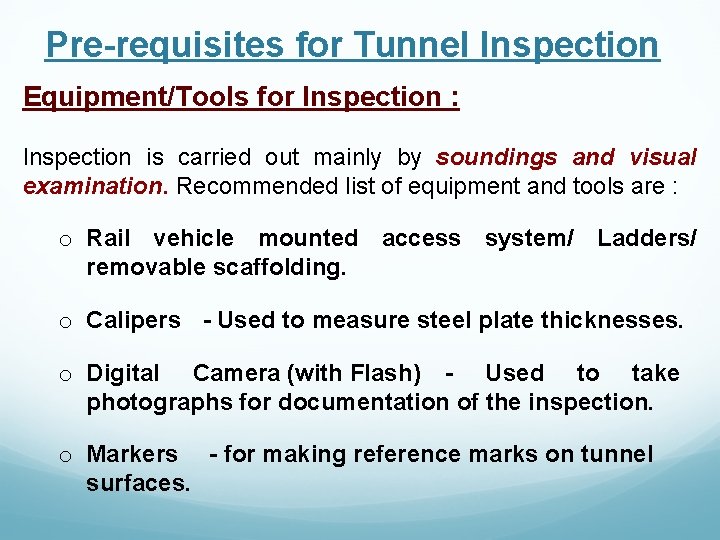
Pre-requisites for Tunnel Inspection Equipment/Tools for Inspection : Inspection is carried out mainly by soundings and visual examination. Recommended list of equipment and tools are : o Rail vehicle mounted access system/ Ladders/ removable scaffolding. o Calipers - Used to measure steel plate thicknesses. o Digital Camera (with Flash) - Used to take photographs for documentation of the inspection. o Markers - for making reference marks on tunnel surfaces.
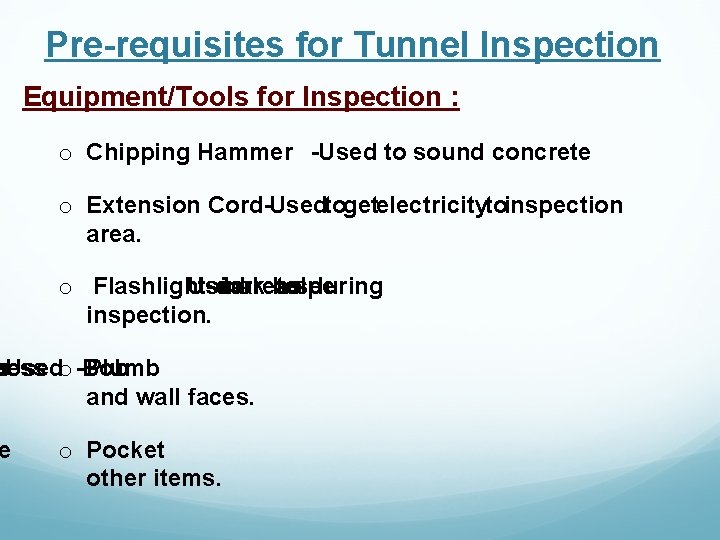
Pre-requisites for Tunnel Inspection Equipment/Tools for Inspection : o Chipping Hammer -Used to sound concrete o Extension Cord -Used to get electricity to inspection area. o Flashlights Used - dark in areas help to see during inspection. ness o s Used o - Bob Plumb and wall faces. e o Pocket other items.
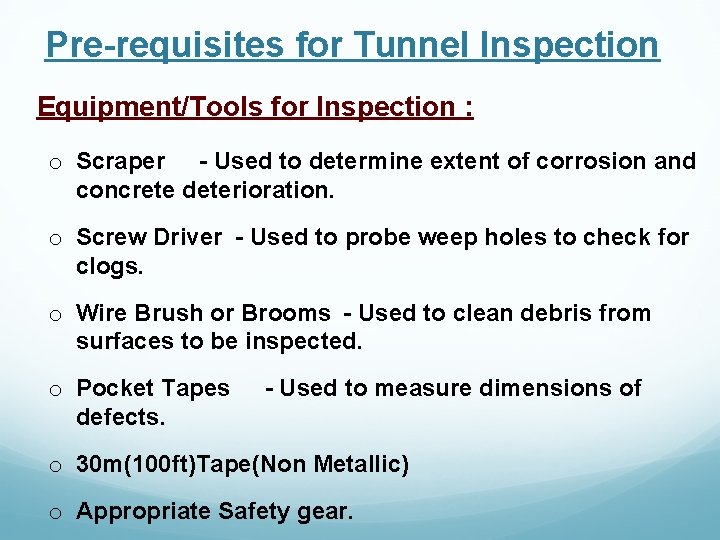
Pre-requisites for Tunnel Inspection Equipment/Tools for Inspection : o Scraper - Used to determine extent of corrosion and concrete deterioration. o Screw Driver - Used to probe weep holes to check for clogs. o Wire Brush or Brooms - Used to clean debris from surfaces to be inspected. o Pocket Tapes defects. - Used to measure dimensions of o 30 m(100 ft)Tape(Non Metallic) o Appropriate Safety gear.
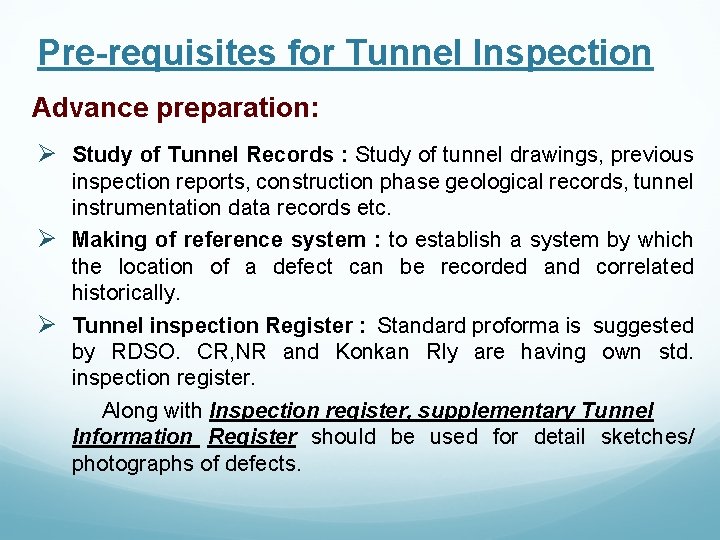
Pre-requisites for Tunnel Inspection Advance preparation: Ø Study of Tunnel Records : Study of tunnel drawings, previous inspection reports, construction phase geological records, tunnel instrumentation data records etc. Ø Making of reference system : to establish a system by which the location of a defect can be recorded and correlated historically. Ø Tunnel inspection Register : Standard proforma is suggested by RDSO. CR, NR and Konkan Rly are having own std. inspection register. Along with Inspection register, supplementary Tunnel Information Register should be used for detail sketches/ photographs of defects.
Pre-requisites for Tunnel Inspection Advance preparation: Ø Inspection Methodology : Identification of structural defects can be through visual inspection or through a combination of visual inspection and non-destructive techniques. Ø Ensuring Safety : Inspection team should ensure that safety practices are followed at all times. inspection team should take appropriate measures during inspection to prevent danger to the traffic, to staff, and to members of the inspection team.
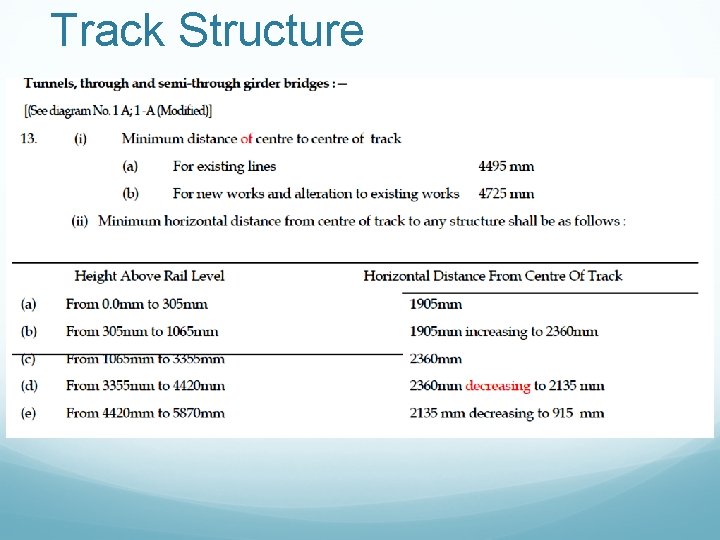
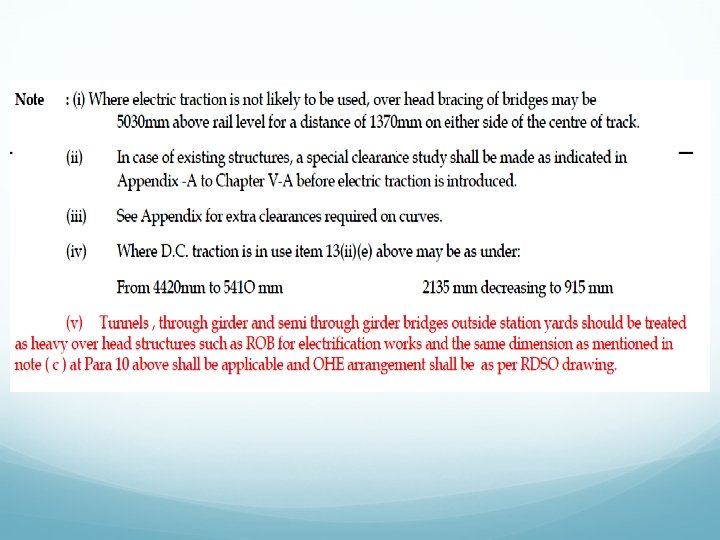
Track Structure
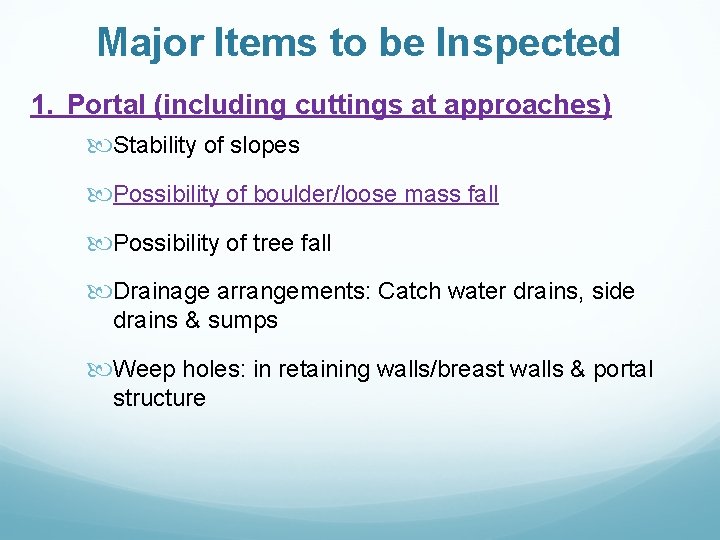
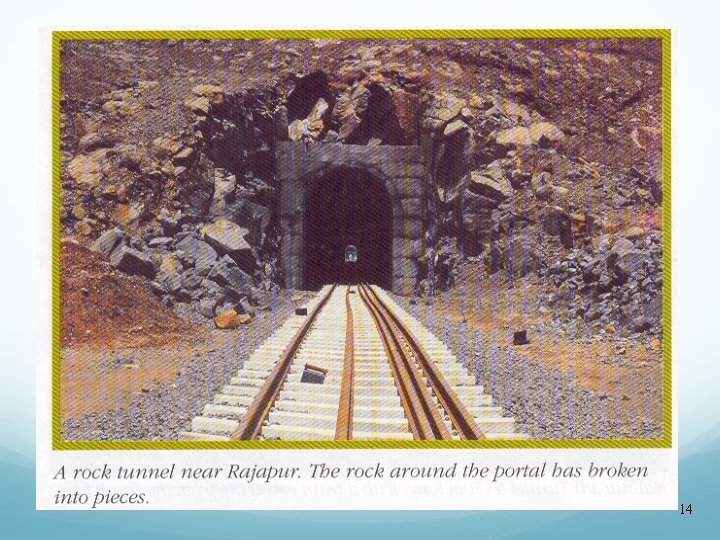
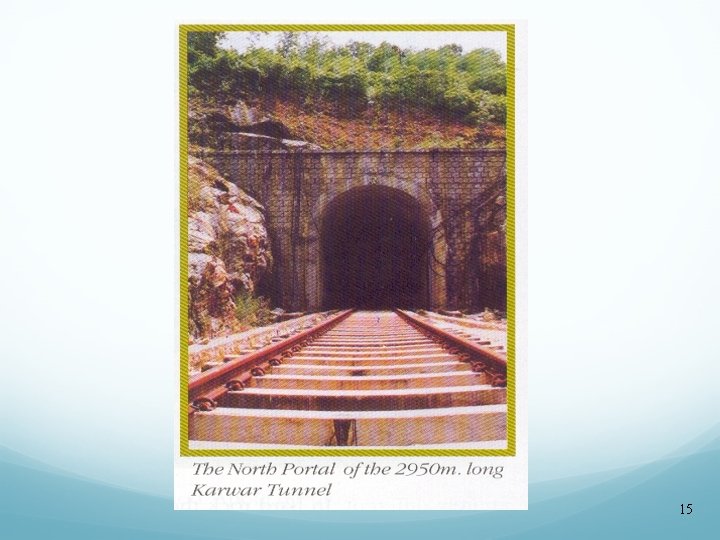
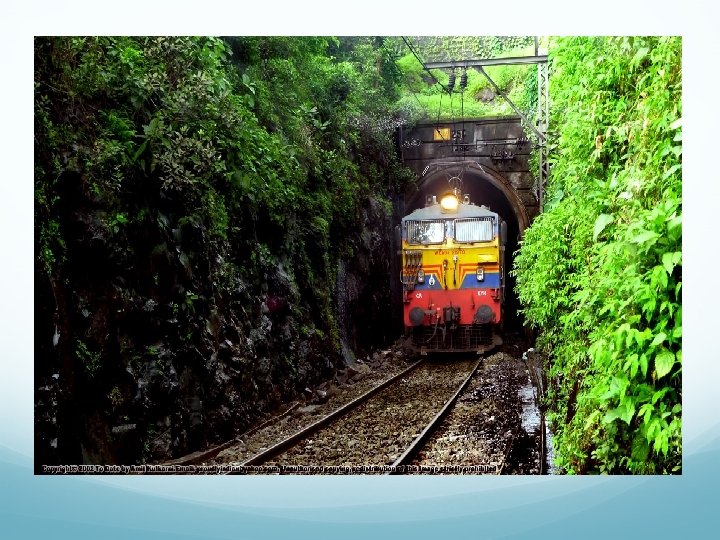
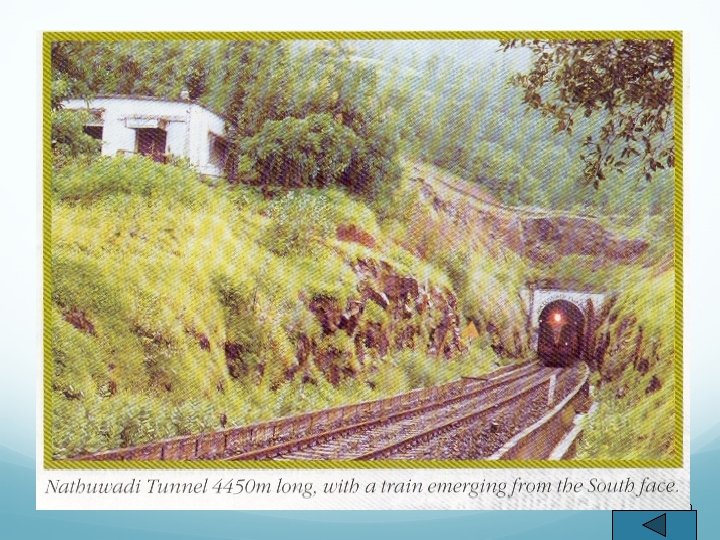
Major Items to be Inspected 1. Portal (including cuttings at approaches) Stability of slopes Possibility of boulder/loose mass fall Possibility of tree fall Drainage arrangements: Catch water drains, side drains & sumps Weep holes: in retaining walls/breast walls & portal structure
Major Items to be Inspected 1. Portal (including cuttings at approaches) Adequacy & condition of measures (like shotcreting, rock bolting etc. ) taken for strengthening/ stabilization/ erosion control of slopes/ tunnel face Structural condition of portals Emergency access & communication
14
15
17
19
Major Items to be Inspected 2. Section of tunnel in relation to moving dimensions Visible signs of any convergence/deformation in tunnel supports In case the conventional measurements indicate some movement/convergence, systematic convergence measurement using tape extensometer/ optical methods should be done. Scrutiny of past convergence/deformation history & instrumentation data
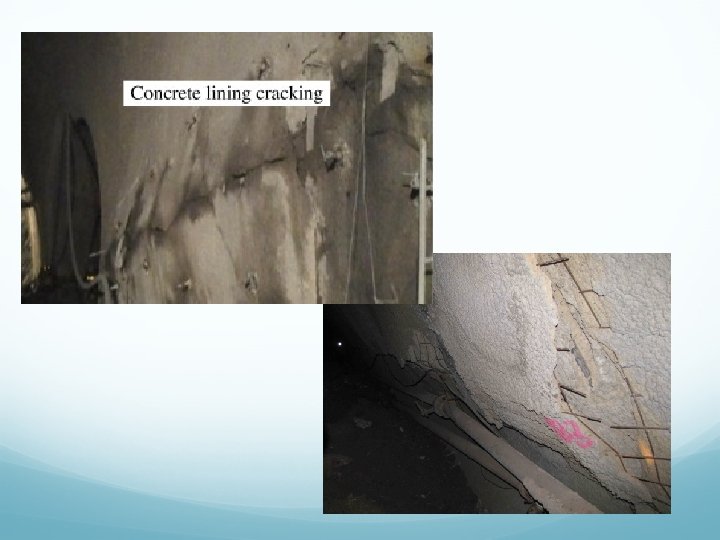
Major Items to be Inspected 3. Tunnel Roof, Walls & Invert Signs of any structural distress in tunnel supports (concrete/RCC/Stee. I / Shotcrete /Rock bolts etc. ) Signs of problem in formation (like disturbance in track alignment, levels) Seepage/dampness
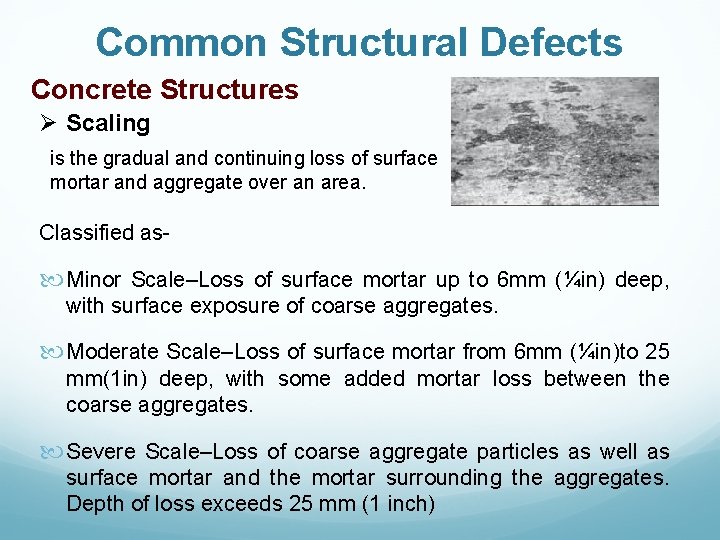
Common Structural Defects Concrete Structures Ø Scaling is the gradual and continuing loss of surface mortar and aggregate over an area. Classified as- Minor Scale–Loss of surface mortar up to 6 mm (¼in) deep, with surface exposure of coarse aggregates. Moderate Scale–Loss of surface mortar from 6 mm (¼in)to 25 mm(1 in) deep, with some added mortar loss between the coarse aggregates. Severe Scale–Loss of coarse aggregate particles as well as surface mortar and the mortar surrounding the aggregates. Depth of loss exceeds 25 mm (1 inch)
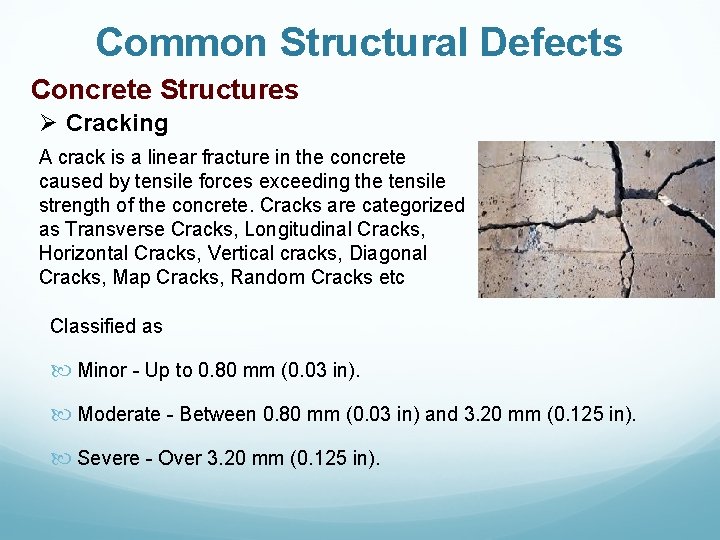
Common Structural Defects Concrete Structures Ø Cracking A crack is a linear fracture in the concrete caused by tensile forces exceeding the tensile strength of the concrete. Cracks are categorized as Transverse Cracks, Longitudinal Cracks, Horizontal Cracks, Vertical cracks, Diagonal Cracks, Map Cracks, Random Cracks etc Classified as Minor - Up to 0. 80 mm (0. 03 in). Moderate - Between 0. 80 mm (0. 03 in) and 3. 20 mm (0. 125 in). Severe - Over 3. 20 mm (0. 125 in).
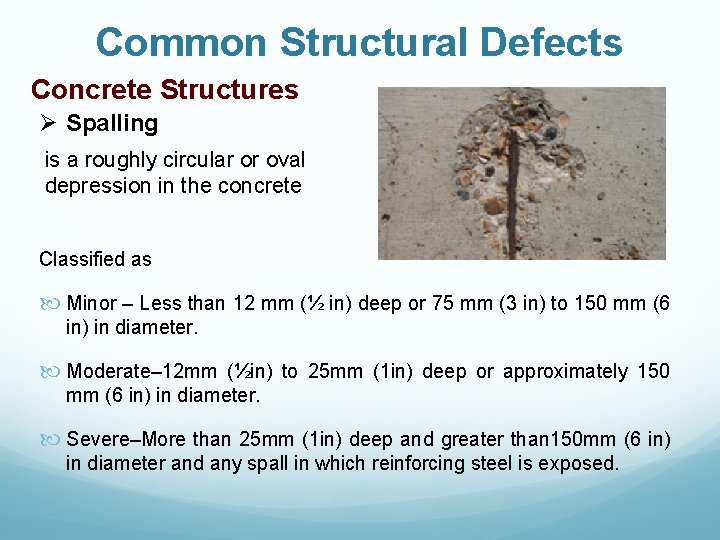
Common Structural Defects Concrete Structures Ø Spalling is a roughly circular or oval depression in the concrete Classified as Minor – Less than 12 mm (½ in) deep or 75 mm (3 in) to 150 mm (6 in) in diameter. Moderate– 12 mm (½in) to 25 mm (1 in) deep or approximately 150 mm (6 in) in diameter. Severe–More than 25 mm (1 in) deep and greater than 150 mm (6 in) in diameter and any spall in which reinforcing steel is exposed.
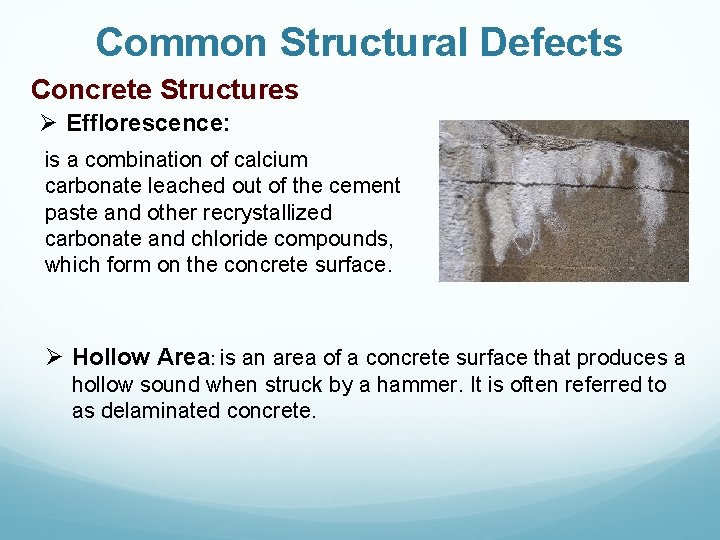
Common Structural Defects Concrete Structures Ø Efflorescence: is a combination of calcium carbonate leached out of the cement paste and other recrystallized carbonate and chloride compounds, which form on the concrete surface. Ø Hollow Area: is an area of a concrete surface that produces a hollow sound when struck by a hammer. It is often referred to as delaminated concrete.
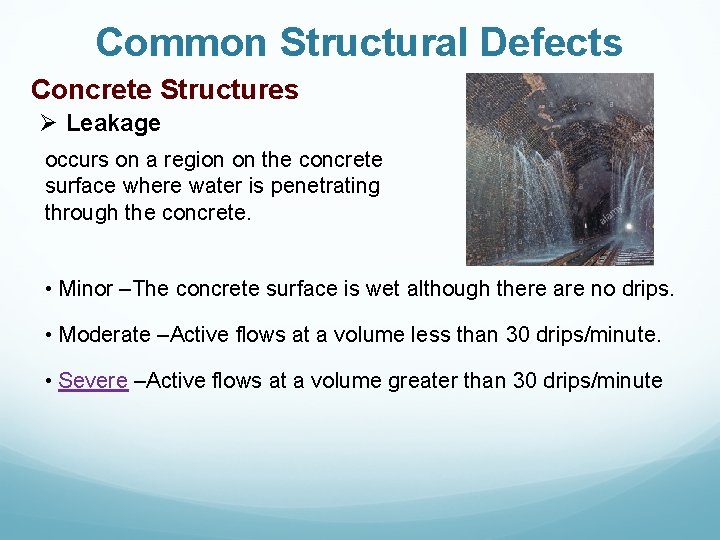
Common Structural Defects Concrete Structures Ø Leakage occurs on a region on the concrete surface where water is penetrating through the concrete. • Minor –The concrete surface is wet although there are no drips. • Moderate –Active flows at a volume less than 30 drips/minute. • Severe –Active flows at a volume greater than 30 drips/minute
Common Structural Defects Steel Structures Ø Corrosion: may be classified as • Minor –A light, loose corrosion formation pitting the paint surface. • Moderate –A looser corrosion formation with scales or flakes forming. Definite areas of corrosion are discernible. • Severe–A heavy, stratified corrosion or corrosion scale with pitting of the metal surface. This corrosion condition eventually culminates in loss of steel section and generally occurs where there is water infiltration Ø Cracks Ø Buckles and Kinks
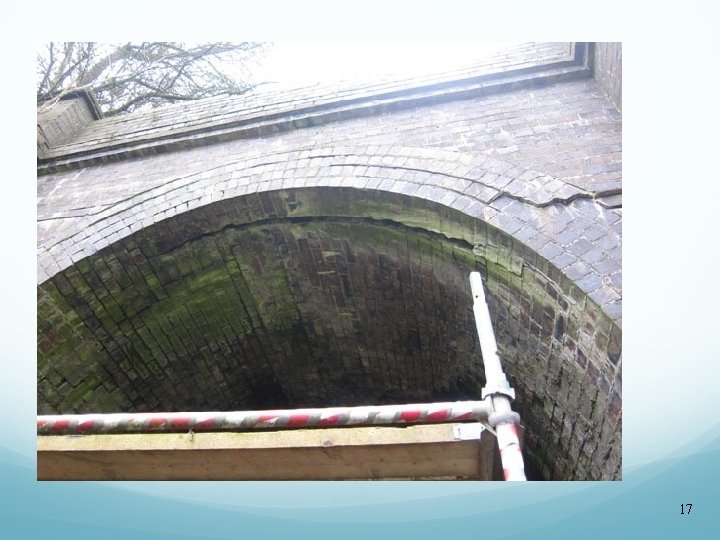
Common Structural Defects Masonry Structure Ø Masonry Units: The individual stones, bricks, or blocks should be checked for displaced, cracked, broken, crushed, or missing units. For some types of masonry, surface deterioration or weathering can also be a problem. • Minor – Surface deterioration at isolated locations. Minor cracking. • Moderate – Slight dislocation of masonry units; large areas of surface scaling. • Severe – Individual masonry units significantly displaced or missing
Common Structural Defects Masonry Structure Ø Mortar: The condition of the mortar should be checked to ensure that it is still holding strongly. It is particularly important to note cracked, deteriorated, or missing mortar if other deterioration is present such as missing or displaced masonry units. • Minor – Shallow mortar deterioration at isolated locations. • Moderate – Mortar generally deteriorated, loose, or missing mortar at isolated locations, infiltration staining apparent. • Severe – Extensive areas of missing mortar; infiltration causing misalignment of tunnel.
Common Structural Defects Masonry Structure Ø Shape: Masonry arches act primarily in compression. Flattened curvature, bulges in walls, or other shape deformations may indicate unstable soil conditions. Ø Leakage: A region on the masonry surface where water is penetrating through a joint or crack. • Minor: The masonry surface is wet although there are no drips. • Moderate: Active flows at a volume less than 30 drips/minute. • Severe: Active flows at a volume greater than 30 drips/minute.
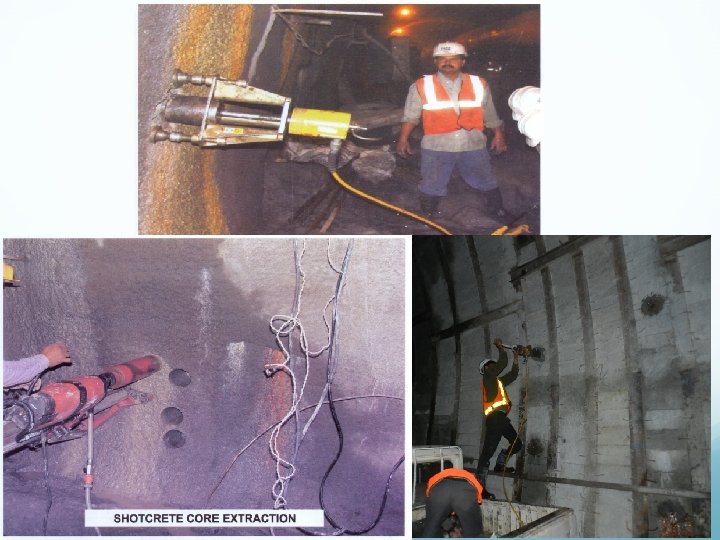
Common Structural Defects Shotcrete/Steel Fiber Reinforced Shotcrete (SFRS): Should particularly look for any cracking, spalling, scaling& water seepage and rate it as mentioned earlier for concrete structures. Rock Bolts: Only bolt end may be visible. The surroundings of bolts should be closely watched for any signs of cracks, loosening of shotcrete, dislocation etc. If any sign of looseness/cracks observed, sounding of the location to be done for about 10 m on either side and suitable action to be taken. Any dampness observed around the rock bolt to be recorded. A sample rock bolt selected in random in a tunnel at the rate of one rock bolt per 500 bolts or part thereof should be subjected to pull out test as a confirmatory test once in 10 years after provision of rock bolt.
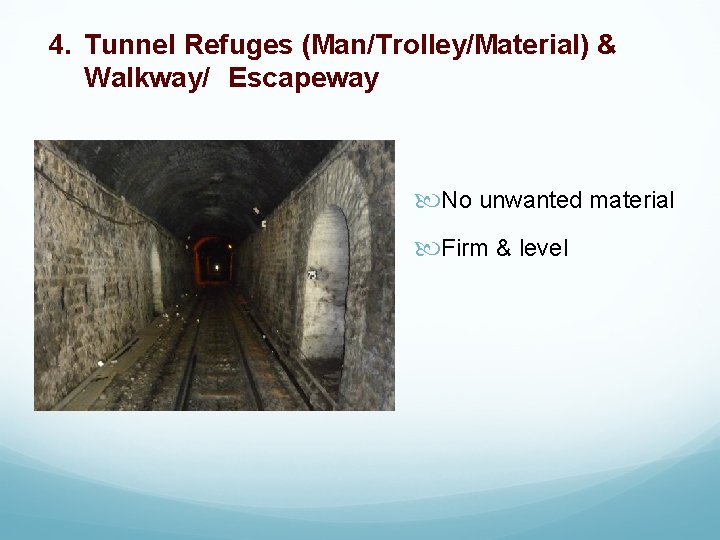
4. Tunnel Refuges (Man/Trolley/Material) & Walkway/ Escapeway No unwanted material Firm & level
Major Items to be Inspected 5. Drainage Side drains: cleanliness & No unwanted material. Weep holes: Check for clogging/choking Functioning of dewatering pumps Desilting of sumps 6. Track As per provisions of IRPWM. Detailed inspection needs to be carried out in locations where tunnel convergence/deformation has been observed
Major Items to be Inspected 7. Ventilation & Lighting, Telephonic Communication, Firefighting Preparedness & Electrical/Mechanical Systems Functioning of designed systems Comments on adequacy of available systems General comments on functioning of mechanical, electrical & signaling systems should be recorded during inspection. Any issue requiring urgent attention should immediately be brought to notice of concerned department.
Inspection Documentation Recoding of Defects : ü Documentation of severe defects should include a sketch showing the location and size of the defect and a verbal description of the defect. ü All severe defects should be photographed; however, a representative photo of minor or moderate defects will be sufficient. ü All defects should be described but sketches need only to be made for severe defects. ü The sketches should show the necessary plan and elevation views of the defects in structural element ü Each defect should be dimensioned showing its length, width, and depth(if applicable).
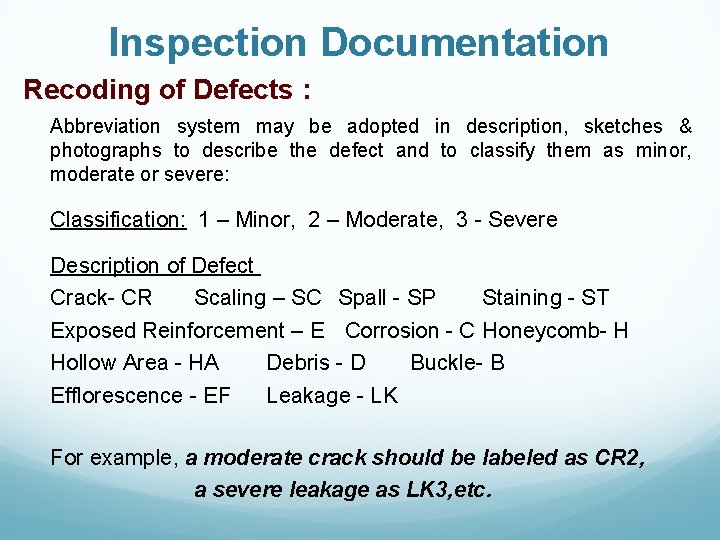
Inspection Documentation Recoding of Defects : Abbreviation system may be adopted in description, sketches & photographs to describe the defect and to classify them as minor, moderate or severe: Classification: 1 – Minor, 2 – Moderate, 3 - Severe Description of Defect Crack- CR Scaling – SC Spall - SP Staining - ST Exposed Reinforcement – E Corrosion - C Honeycomb- H Hollow Area - HA Debris - D Buckle- B Efflorescence - EF Leakage - LK For example, a moderate crack should be labeled as CR 2, a severe leakage as LK 3, etc.
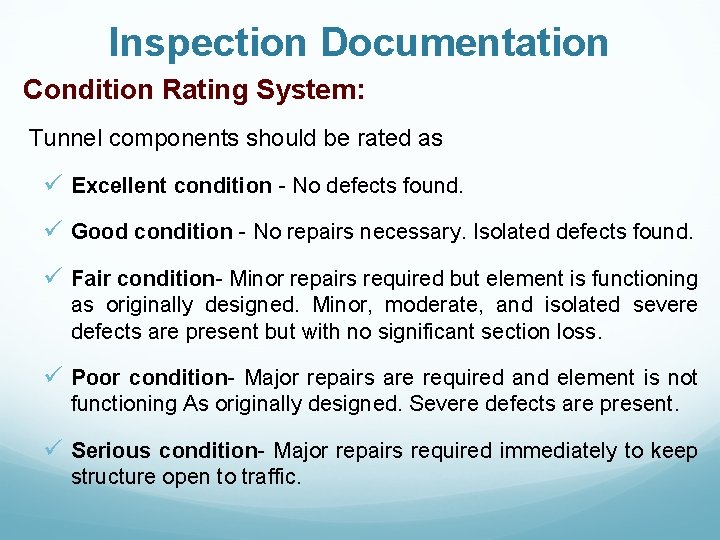
Inspection Documentation Condition Rating System: Tunnel components should be rated as ü Excellent condition - No defects found. ü Good condition - No repairs necessary. Isolated defects found. ü Fair condition- Minor repairs required but element is functioning as originally designed. Minor, moderate, and isolated severe defects are present but with no significant section loss. ü Poor condition- Major repairs are required and element is not functioning As originally designed. Severe defects are present. ü Serious condition- Major repairs required immediately to keep structure open to traffic.
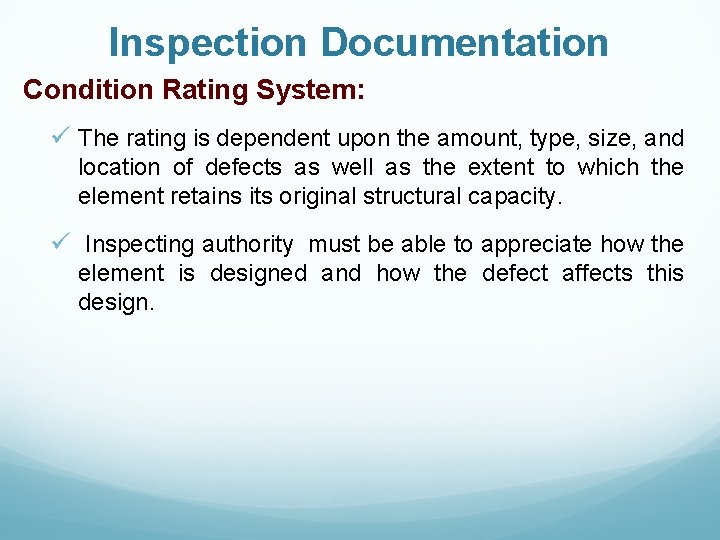
Inspection Documentation Condition Rating System: ü The rating is dependent upon the amount, type, size, and location of defects as well as the extent to which the element retains its original structural capacity. ü Inspecting authority must be able to appreciate how the element is designed and how the defect affects this design.
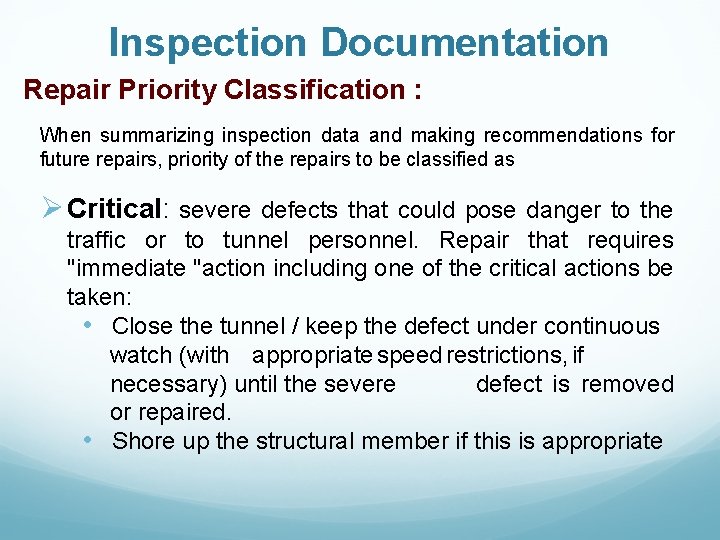
Inspection Documentation Repair Priority Classification : When summarizing inspection data and making recommendations for future repairs, priority of the repairs to be classified as Ø Critical: severe defects that could pose danger to the traffic or to tunnel personnel. Repair that requires "immediate "action including one of the critical actions be taken: • Close the tunnel / keep the defect under continuous watch (with appropriate speed restrictions, if necessary) until the severe defect is removed or repaired. • Shore up the structural member if this is appropriate
Inspection Documentation Repair Priority Classification : Ø Priority : Refers to conditions for which further investigations, design, and implementation of interim or long-term repairs should be undertaken on a priority basis, i. e. taking precedence over all other scheduled work. Ø Routine: Refers to conditions requiring further investigation or remedial work that can be undertaken as part of a scheduled maintenance program, other scheduled project, or routine facility maintenance depending on the action required.
Inspection Documentation Specialized Testing Reports: If the inspection utilizes any specialized testing agencies and equipment, all such reports derived from these special testings shall become a part of the documentation of the particular inspection period. Tunnel Inspection Report : should be developed that summarizes the findings of inspection on completion of the inspection and should be submitted along with Tunnel Inspection Registers & Supplementary Tunnel Information Registers to higher official/s
Inspection Documentation Tunnel Inspection Report : Suggested outline for the report is as under. • Report Number/Letter number - Identification number of report • Table of Contents - Self-explanatory. • Executive Summary - Provide a concise summary of the inspection, findings, and recommended repairs. • Major Inspection Findings -Summarize Minor, Moderate & serious defects in the tunnels • Recommendations - for repair/ rehabilitation of the tunnel components and recommendations should classify the repair/rehabilitation in to Critical / Priority / Routine.
Role / Duties of Inspecting Officials 1. Inspection by SE/WORK or SE/SSE/ P. WAY shall record the results of their inspection in prescribed tunnel inspection/information register. Inspector(s) in-charge of tunnel should inspect all the tunnel in his jurisdiction in detail after the monsoon and take the required necessary action. shall submit to the Assistant Engineer by the prescribed date a list of important defects with a certificate in duplicate to the effect. "I certify that I have personally carried out tunnel inspection of my section in accordance with standing orders for the year ending and append herewith a list of important defects. "
Role / Duties of Inspecting Officials 1. Inspection by SE/WORK or SE/SSE/ P. WAY The Assistant Engineer shall issue necessary orders to the Inspector and counter sign and forward one copy of the certificate of inspection to the Divisional Engineer with remarks if any. The Inspector shall accompany the assistant Engineer on the latter's annual inspection of tunnels.
Role / Duties of Inspecting Officials 2. Inspection by Assistant Engineer Shall inspect every tunnel on the sub division once a year before the monsoon during the prescribed months and record the results in ink in the tunnel inspection registers. The tunnel, the condition of which warrant special attention should be inspected more frequently. The inspection shall be detailed and cover all aspects. Should make an extract of all remarks concerning repairs required, send these to Inspector/Inspectors with explicit instructions and ensure expeditious compliance.
Role / Duties of Inspecting Officials 2. Inspection by Assistant Engineer On completion of his annual tunnel inspection the Assistant Engineer shall certify at the end of the register as follow: "I certify that I have inspected all the tunnels shown in register during the year ending . . . and have issued detailed orders in writing to the Inspectors concerned except the following on which the Divisional/ Sr. Divisional Engineer's orders are solicited". These registers should be in the Divisional/ Sr. Divisional Engineer's office by specified date.
Role / Duties of Inspecting Officials 3. Inspection by DEN / Sr. DEN Shall carefully scrutinize the ADEN tunnel inspection register and inspect such tunnels as called for his inspection. He shall record his orders regarding the points which require a decision by him and initial against every entry of tunnel in the registers in token of scrutiny. He should endorse on each register, below the assistant Engineer certificate, as "I have personally scrutinized this register and have issued orders regarding all essential points requiring a decision by me. The following points are submitted to the Territorial Head of the Department at Head Quarters for orders. "
Role / Duties of Inspecting Officials 3. Inspection by DEN / Sr. DEN Should extract the items of inspection register requiring attention and send it to the ADEN who should intimate the same to the Inspector concerned for expeditious compliance. The register should be forwarded to the Territorial Head of the Department at Headquarters who will examine each register, issue orders regarding matters referred to him, endorsing the registers to the effect and return them to the Divisional/Sr. Divisional Engineer. Subsequent action taken on the notes should be entered in the registers by the assistant Engineer.
Role / Duties of Inspecting Officials 4. Special Inspection Understanding & prediction of Tunnel behavior is a complex subject. Special inspections are recommended to be undertaken with assistance of experts on relevant field/s, to get a detailed inspection of tunnel conducted by a tunnel expert at a frequency varying from 1 to 6 years (depending on geology/tunnel condition). in case of special unexpected events like railway accident, earthquake etc. railway officials should undertake special inspection of tunnel/s.
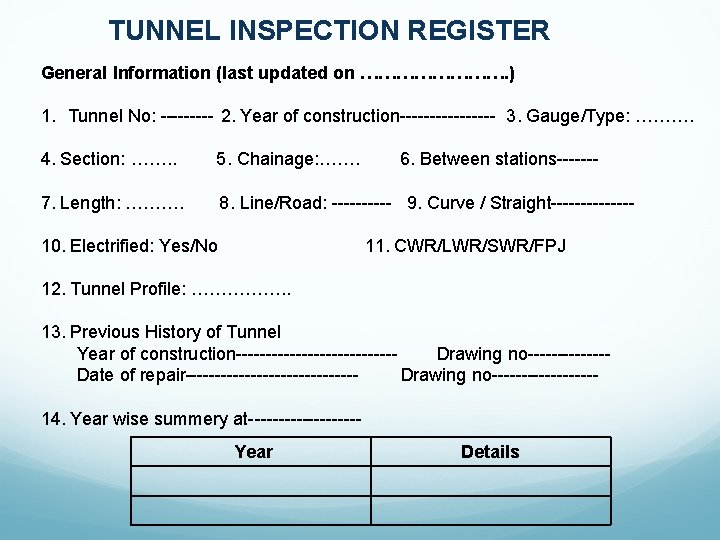
TUNNEL INSPECTION REGISTER General Information (last updated on …………. ) 1. Tunnel No: ----- 2. Year of construction-------- 3. Gauge/Type: ………. 4. Section: ……. . 5. Chainage: ……. 6. Between stations------- 7. Length: ………. 8. Line/Road: ----- 9. Curve / Straight------- 10. Electrified: Yes/No 11. CWR/LWR/SWR/FPJ 12. Tunnel Profile: ……………. . 13. Previous History of Tunnel Year of construction-------------- Drawing no------- Date of repair--------------- Drawing no--------- 14. Year wise summery at--------- Year Details
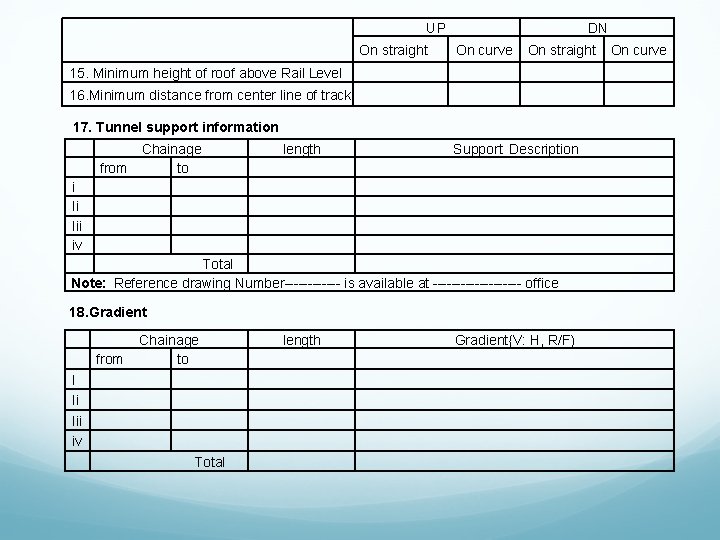
UP On straight DN On curve On straight On curve 15. Minimum height of roof above Rail Level 16. Minimum distance from center line of track 17. Tunnel support information Chainage length Support Description from to i Iii iv Total Note: Reference drawing Number------ is available at ---------- office 18. Gradient Chainage from to I Ii Iii iv Total length Gradient{V: H, R/F)
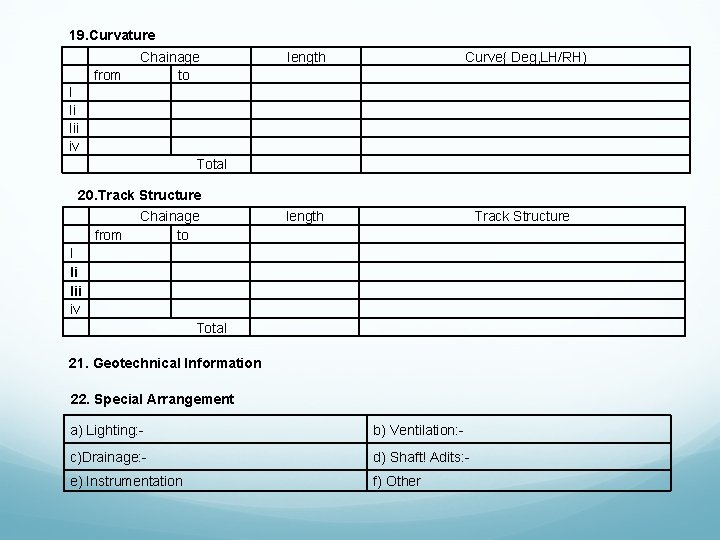
19. Curvature Chainage from to I Ii Iii iv Total length Curve{ Deg, LH/RH) length Track Structure 20. Track Structure Chainage from to I Ii Iii iv Total 21. Geotechnical Information 22. Special Arrangement a) Lighting: - b) Ventilation: - c)Drainage: - d) Shaft! Adits: - e) Instrumentation f) Other
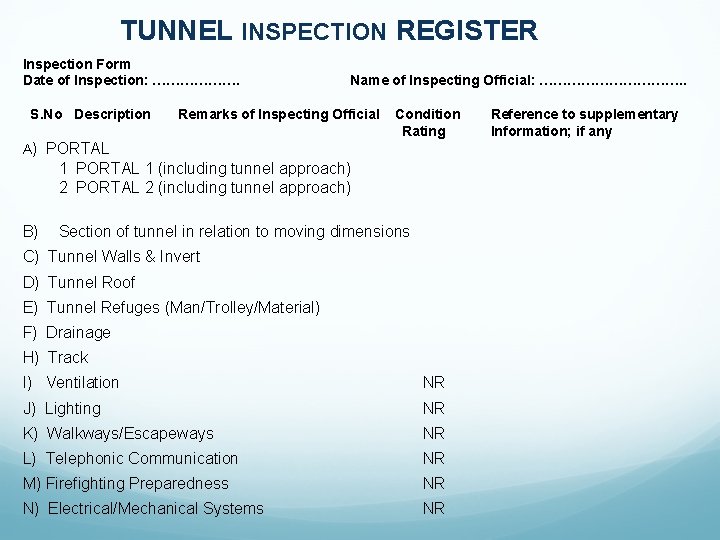
TUNNEL INSPECTION REGISTER Inspection Form Date of Inspection: ………………. S. No Description Name of Inspecting Official: ……………. . Remarks of Inspecting Official Condition Rating A) PORTAL 1 (including tunnel approach) 2 PORTAL 2 (including tunnel approach) B) Section of tunnel in relation to moving dimensions C) Tunnel Walls & Invert D) Tunnel Roof E) Tunnel Refuges (Man/Trolley/Material) F) Drainage H) Track I) Ventilation NR J) Lighting NR K) Walkways/Escapeways NR L) Telephonic Communication NR M) Firefighting Preparedness NR N) Electrical/Mechanical Systems NR Reference to supplementary Information; if any
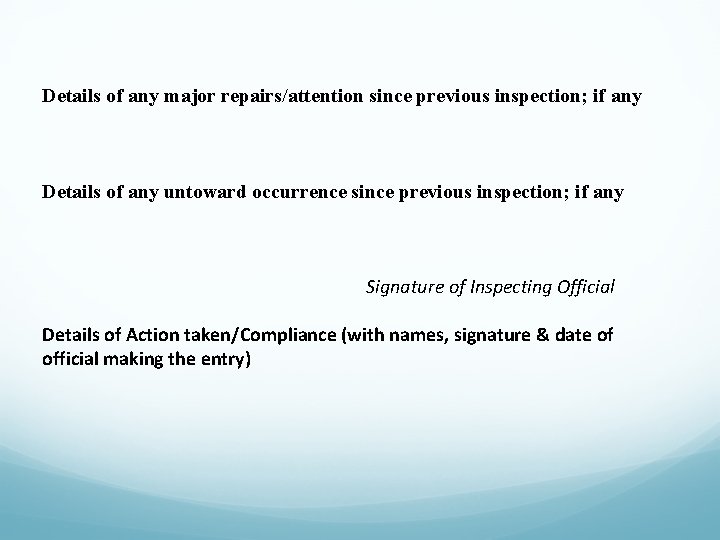
Details of any major repairs/attention since previous inspection; if any Details of any untoward occurrence since previous inspection; if any Signature of Inspecting Official Details of Action taken/Compliance (with names, signature & date of official making the entry)
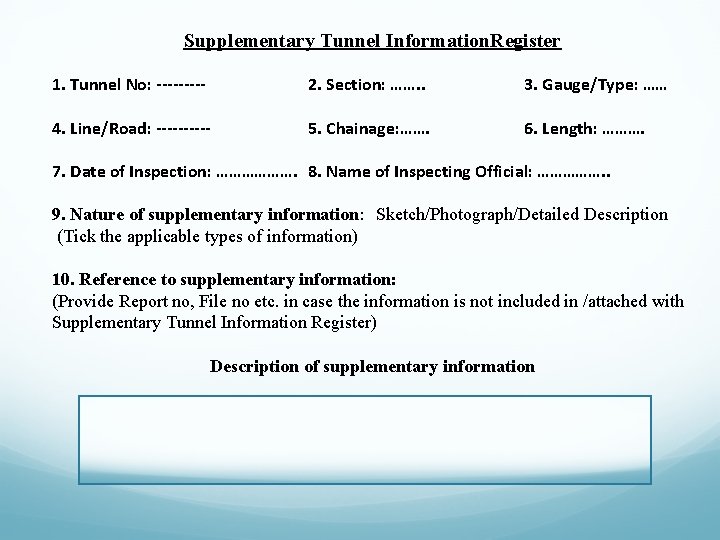
Supplementary Tunnel Information. Register 1. Tunnel No: ----- 2. Section: ……. . 3. Gauge/Type: …… 4. Line/Road: ----- 5. Chainage: ……. 6. Length: ………. 7. Date of Inspection: ………………. 8. Name of Inspecting Official: ……………. . 9. Nature of supplementary information: Sketch/Photograph/Detailed Description (Tick the applicable types of information) 10. Reference to supplementary information: (Provide Report no, File no etc. in case the information is not included in /attached with Supplementary Tunnel Information Register) Description of supplementary information
Maintenance & Repairs of tunnel 1. Portal & approach cuttings Ø Surface Drainage Weed control within surface drains. Removal of debris from other track maintenance activities. Removal of sediment. Re-grading (if required). Ø Catch water drain should be pucca with adequate slope to ensure development of self-cleaning velocity. Catch water drain should not have any weep hole The expansion joints should be sealed Catch water drains should have well designed out fall with protection against tail-end erosion
Maintenance & Repairs of tunnel v Portal & approach cuttings Ø Removal of loose boulders/loose mass & weak trees/ branches: should be removed by loose scaling or by controlled blasting. Where necessary, rock fall and debris diversion or containment features should be constructed to positively ensure that no rocks, rock-slides or other debris such as soil from mountain slopes above the portal area can reach the tracks or damage equipment or structures. Option of constructing false tunnel /cut and cover in tunnel approach should be explored, if required. Weak/leaning trees/branches that may fall on/near the track should be cut.
Maintenance & Repairs of tunnel v Portal & approach cuttings Ø Structural repairs including strengthening in portal structure (concrete/steel/masonry) Structural repairs of supports (like shotcreting, rock bolting etc) used for strengthening/ stabilization/erosion control of slopes/tunnel face. Ø Access Road access to portals (if available) should be fit for desired use particularly for evacuating passengers and for staff/ material access. Ø Weep Holes cleaning of clogged/choked weep holes
Maintenance & Repairs of tunnel v Inside Tunnel Scaling/Sounding of tunnel Removal of unwanted material Cleaning of side drains & sumps Clearing walkways & refuges Cleaning of clogged/choked weep holes Structural maintenance & repairs (including strengthening)
Maintenance & Repairs of tunnel v Inside Tunnel Track Maintenance (with special attention to problematic areas) Scheduled maintenance of mechanical & electrical systems (including ventilation & lighting- by respective departments) Scheduled maintenance of instruments Scheduled maintenance of safety, fire & communication equipment’s & signage).
Maintenance & Repairs of tunnel v Systematic Approach for Repairs The cause of the defect should be determined before remedial works, otherwise the same problem may recur. Systematic approach to tunnel repairs involving Determine the cause(s) of damage Evaluate the extent of damage Evaluate the need to repair Select the repair method Development & approval of detailed repair methodology Execution of repairs
THANKS
- Slides: 64