
Inspection and Maintenance of Points Crossings Inspections IRPWM


- Slides: 33
Inspection and Maintenance of Points & Crossings
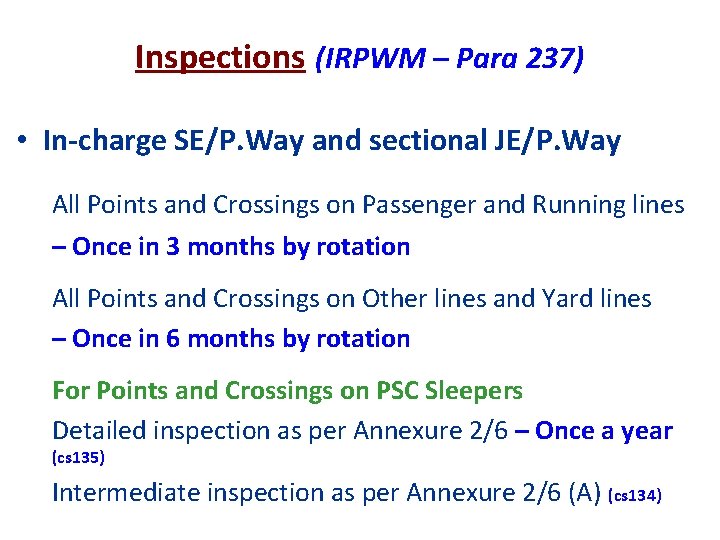
Inspections (IRPWM – Para 237) • In-charge SE/P. Way and sectional JE/P. Way All Points and Crossings on Passenger and Running lines – Once in 3 months by rotation All Points and Crossings on Other lines and Yard lines – Once in 6 months by rotation For Points and Crossings on PSC Sleepers Detailed inspection as per Annexure 2/6 – Once a year (cs 135) Intermediate inspection as per Annexure 2/6 (A) (cs 134)
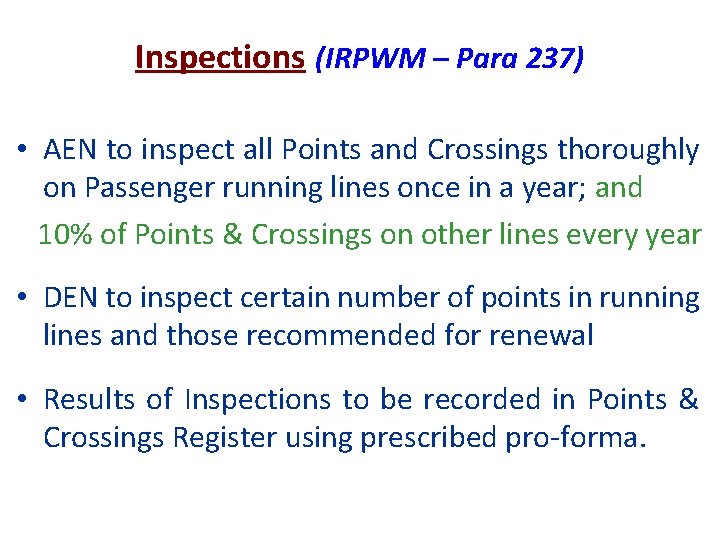
Inspections (IRPWM – Para 237) • AEN to inspect all Points and Crossings thoroughly on Passenger running lines once in a year; and 10% of Points & Crossings on other lines every year • DEN to inspect certain number of points in running lines and those recommended for renewal • Results of Inspections to be recorded in Points & Crossings Register using prescribed pro-forma.
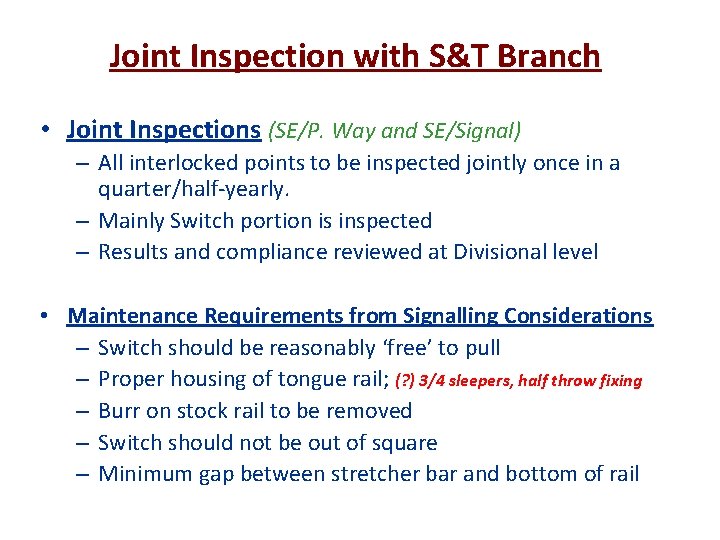
Joint Inspection with S&T Branch • Joint Inspections (SE/P. Way and SE/Signal) – All interlocked points to be inspected jointly once in a quarter/half-yearly. – Mainly Switch portion is inspected – Results and compliance reviewed at Divisional level • Maintenance Requirements from Signalling Considerations – Switch should be reasonably ‘free’ to pull – Proper housing of tongue rail; (? ) 3/4 sleepers, half throw fixing – Burr on stock rail to be removed – Switch should not be out of square – Minimum gap between stretcher bar and bottom of rail
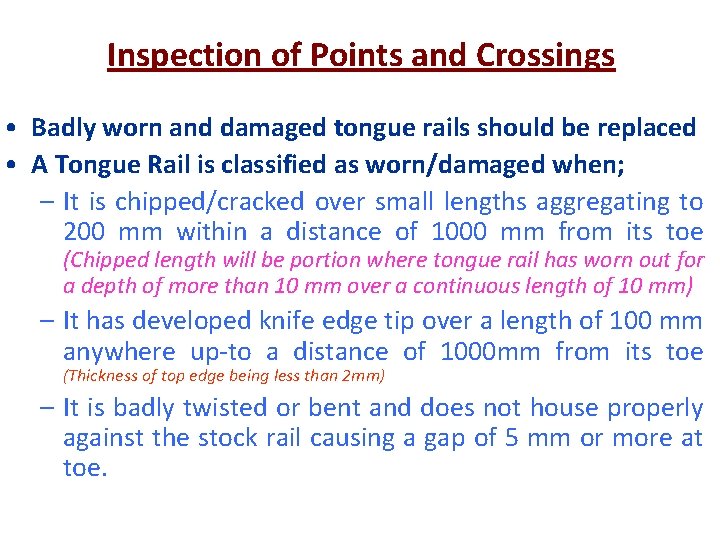
Inspection of Points and Crossings • Badly worn and damaged tongue rails should be replaced • A Tongue Rail is classified as worn/damaged when; – It is chipped/cracked over small lengths aggregating to 200 mm within a distance of 1000 mm from its toe (Chipped length will be portion where tongue rail has worn out for a depth of more than 10 mm over a continuous length of 10 mm) – It has developed knife edge tip over a length of 100 mm anywhere up-to a distance of 1000 mm from its toe (Thickness of top edge being less than 2 mm) – It is badly twisted or bent and does not house properly against the stock rail causing a gap of 5 mm or more at toe.
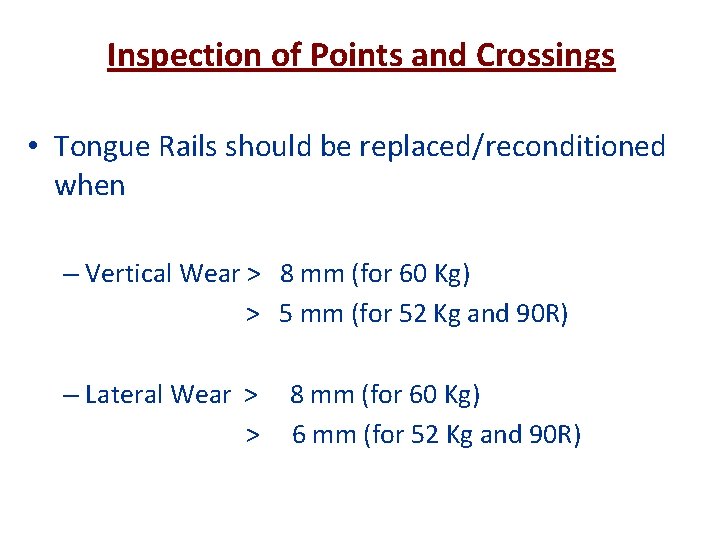
Inspection of Points and Crossings • Tongue Rails should be replaced/reconditioned when – Vertical Wear > 8 mm (for 60 Kg) > 5 mm (for 52 Kg and 90 R) – Lateral Wear > > 8 mm (for 60 Kg) 6 mm (for 52 Kg and 90 R)
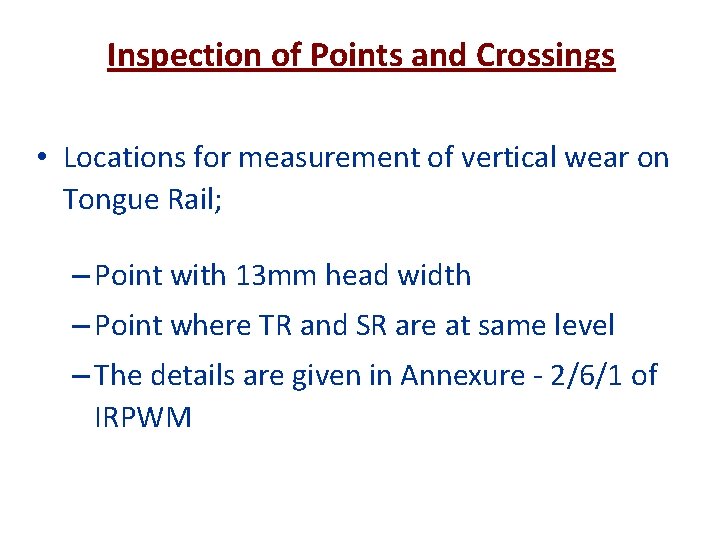
Inspection of Points and Crossings • Locations for measurement of vertical wear on Tongue Rail; – Point with 13 mm head width – Point where TR and SR are at same level – The details are given in Annexure - 2/6/1 of IRPWM
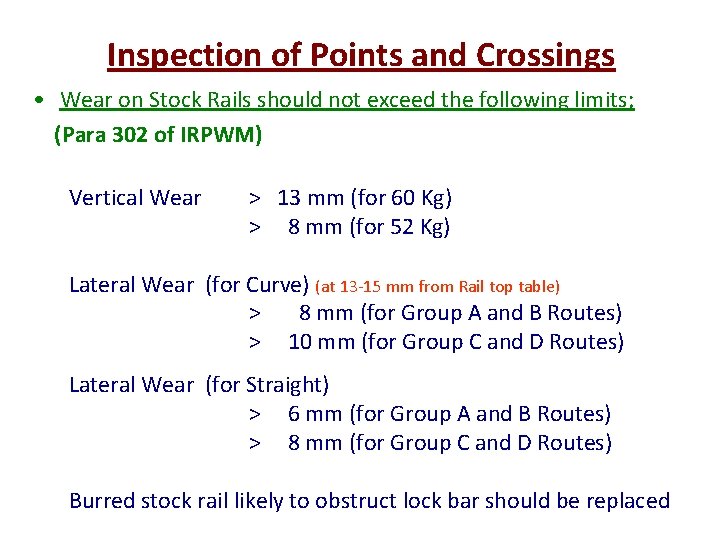
Inspection of Points and Crossings • Wear on Stock Rails should not exceed the following limits; (Para 302 of IRPWM) Vertical Wear > 13 mm (for 60 Kg) > 8 mm (for 52 Kg) Lateral Wear (for Curve) (at 13 -15 mm from Rail top table) > 8 mm (for Group A and B Routes) > 10 mm (for Group C and D Routes) Lateral Wear (for Straight) > 6 mm (for Group A and B Routes) > 8 mm (for Group C and D Routes) Burred stock rail likely to obstruct lock bar should be replaced
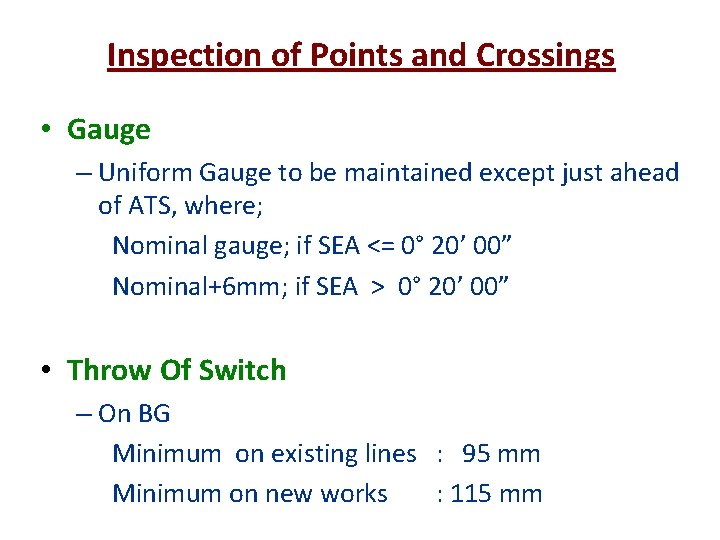
Inspection of Points and Crossings • Gauge – Uniform Gauge to be maintained except just ahead of ATS, where; Nominal gauge; if SEA <= 0° 20’ 00” Nominal+6 mm; if SEA > 0° 20’ 00” • Throw Of Switch – On BG Minimum on existing lines : 95 mm Minimum on new works : 115 mm
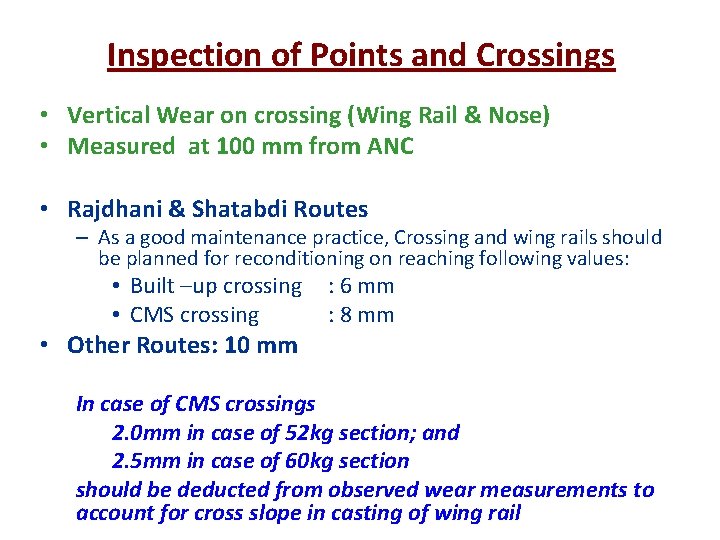
Inspection of Points and Crossings • Vertical Wear on crossing (Wing Rail & Nose) • Measured at 100 mm from ANC • Rajdhani & Shatabdi Routes – As a good maintenance practice, Crossing and wing rails should be planned for reconditioning on reaching following values: • Built –up crossing • CMS crossing • Other Routes: 10 mm : 6 mm : 8 mm In case of CMS crossings 2. 0 mm in case of 52 kg section; and 2. 5 mm in case of 60 kg section should be deducted from observed wear measurements to account for cross slope in casting of wing rail
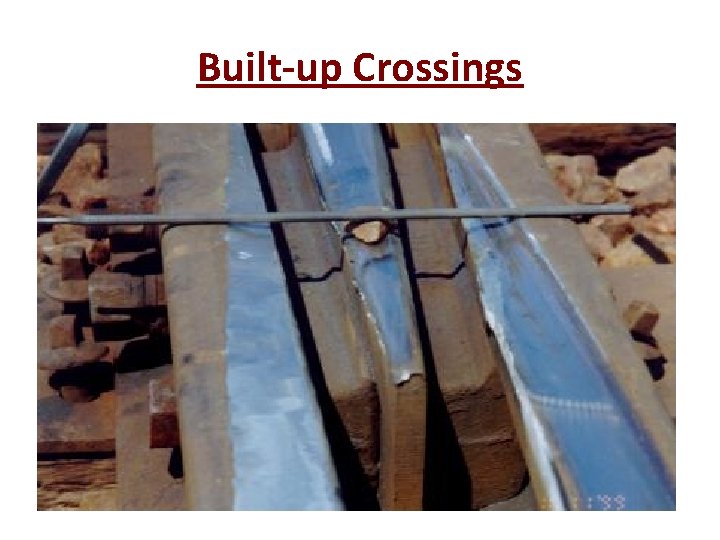
Built-up Crossings
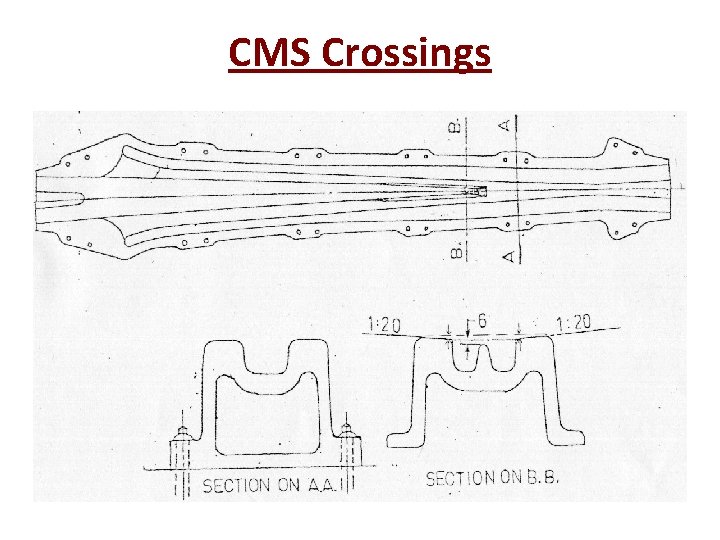
CMS Crossings
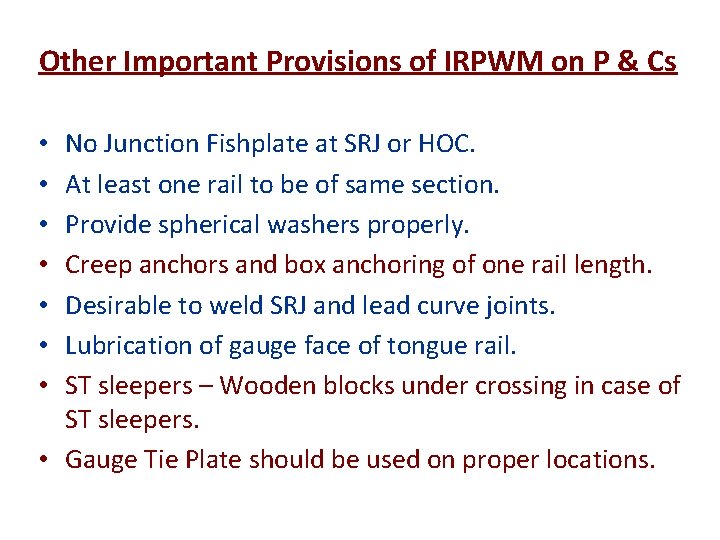
Other Important Provisions of IRPWM on P & Cs No Junction Fishplate at SRJ or HOC. At least one rail to be of same section. Provide spherical washers properly. Creep anchors and box anchoring of one rail length. Desirable to weld SRJ and lead curve joints. Lubrication of gauge face of tongue rail. ST sleepers – Wooden blocks under crossing in case of ST sleepers. • Gauge Tie Plate should be used on proper locations. • •
Other Important Provisions of IRPWM on P & Cs • No change of cant outside ATS and Nose of Crossing for a distance of 18 m on BG and 15 m on MG. • In case of Straight Switches, correct amount of bend should be given to the Stock Rail on the turnout side at TTS. • Tongue rail should bear evenly on all the slide chairs. • When the tongue rail is in closed portion, it must bear evenly against distance studs or slide blocks. • Insertion or removal of P & C in a running line affecting layout must be carried out only after obtaining sanction of CRS.
Check-list for Maintenance of PSC Sleeper Layout • Same track structure for one rail length on the all the three sides. • Weld joints as specified. • Gapless joints as specified. • Grind gauge face of stock rail; if burr exist. • Regular maintenance by UNIMAT. • Proper maintenance of CMS crossing.
Reconditioning of Points and Crossings
Need for Reconditioning • The Point and Crossing components gets worn out due to passage of traffic and the wear reaches permissible limits in due course of time. • It is neither economical nor practical to replace them straight away. • The service life of these components can be prolonged by reconditioning and thus these can be utilized to maximum extent.
System for Reconditioning • In-situ Reconditioning – Carried out on Track; either under line block or under caution order – Advantages • Traffic block; transportation not required • Reconditioning can be done even if spares are not available (Important in case of Special Layouts) – Dis-advantages • Difficult to ensure quality • Not suitable for CMS Crossings
System for Reconditioning • Depot Reconditioning – Components are brought to welding depot and then they are reconditioned – Advantages • Better Quality – Dis-advantages • Spares, traffic block, transportation etc. required. • Cost is more
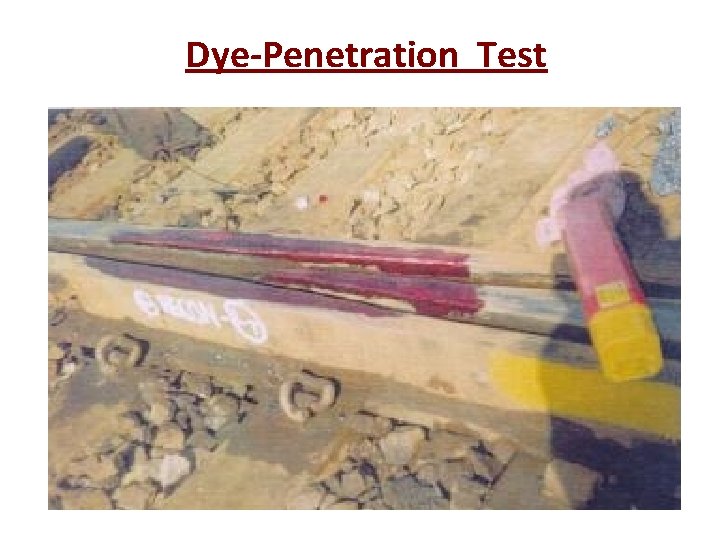
Suitability for Reconditioning • Only suitable components should be taken up for reconditioning • Component should be in sound structural condition • Components containing cracks on the worn-out portion having depths more than 3 mm beyond condemning size should not be taken up for reconditioning • Wear should be within prescribed limit. • DPT should be carried out to check for cracks.
Dye-Penetration Test
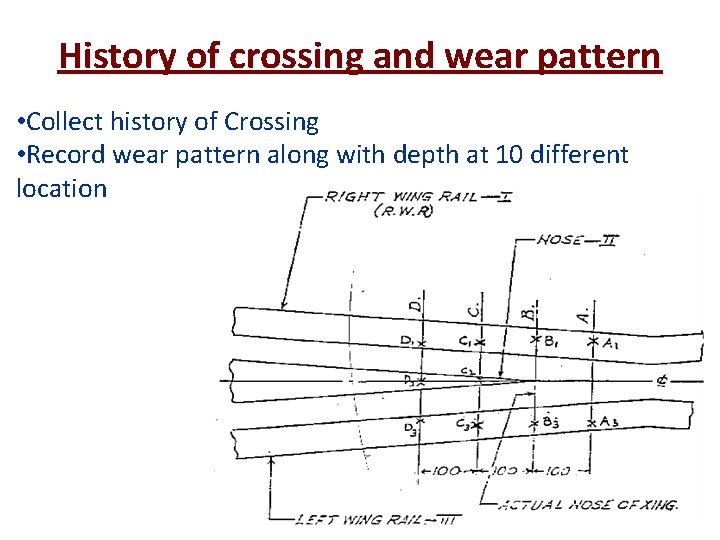
History of crossing and wear pattern • Collect history of Crossing • Record wear pattern along with depth at 10 different location
Welding Electrodes • Only H 3 class of electrodes manufactured by firms approved by RDSO are to be used. RDSO publishes list biannually. • Traffic carrying capacity of electrodes – H 3 – Min. service life of 15 GMT (-/-) – H 3 A – Min. service life of 25 GMT (-/-) – H 3 B – Min. service life of 35 GMT (2/4) – H 3 C – Min. service life of 50 GMT (0/3) • Discard electrodes with cracked / damaged flux covering. • Store electrodes in dry store room. Damp Electrodes not to be used. Packing of electrodes should be absolutely intact. • All the electrodes should be consumed within six hours of opening of pack or electrodes to be dried at 1300 - 1700 for atleast one hour. • 4 mm dia electrodes to be used for welding.
Reconditioning of MM/90 UTS Built-Up Crossings • Surface preparation by cleaning (to ensure freedom from dust, dirt, grease or any other foreign material), remove work hardened, fatigued, loose metal and grinding. • Test after grinding. Visual, DPT, or Magnaflux • Welding to be done in flat position. • Preheating : The component should be preheated on the surface by to and fro play of oxy-acetylene torch to obtain 2500 C to 3000 C. Maintain temperature throughout the process. • Welding to start immediately after preheating. • Use shortest possible arc length.
Reconditioning of MM/90 UTS Built-Up Crossings • Care to be taken to fill the crater to the full weld size before breaking the arc. • At restart arc should be stuck ahead of crater and then drawn back so as to fill the crater. • Inter-pass temperature of 2500 – 3000 C should be maintained. • Each bead should be thoroughly peened with ball- peen hammer. • While depositing the adjacent layer about 50% of previous layer should be covered. • Weld metal to be deposited to provide an excess of 3 mm to be finished by grinding.
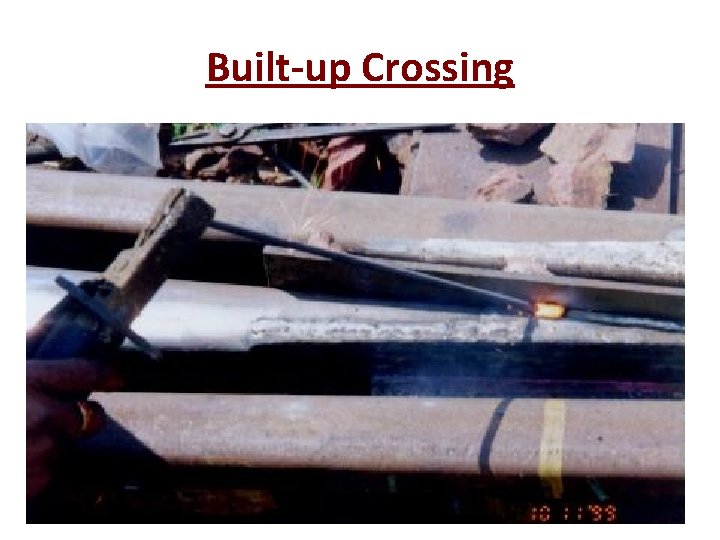
Built-up Crossing
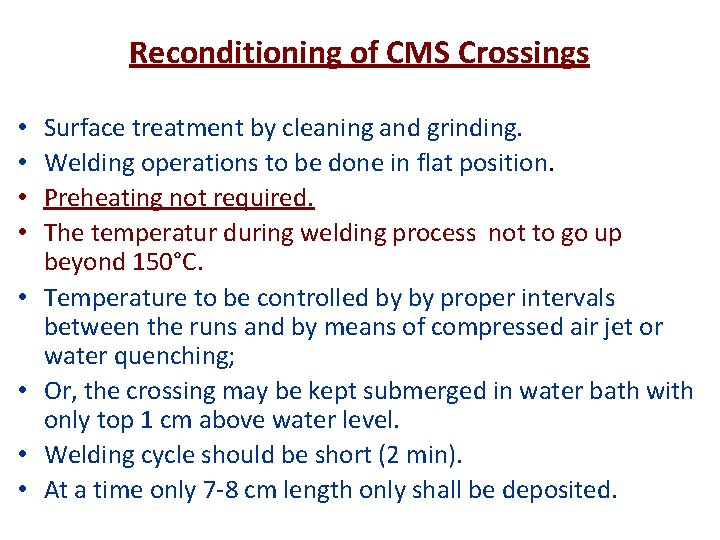
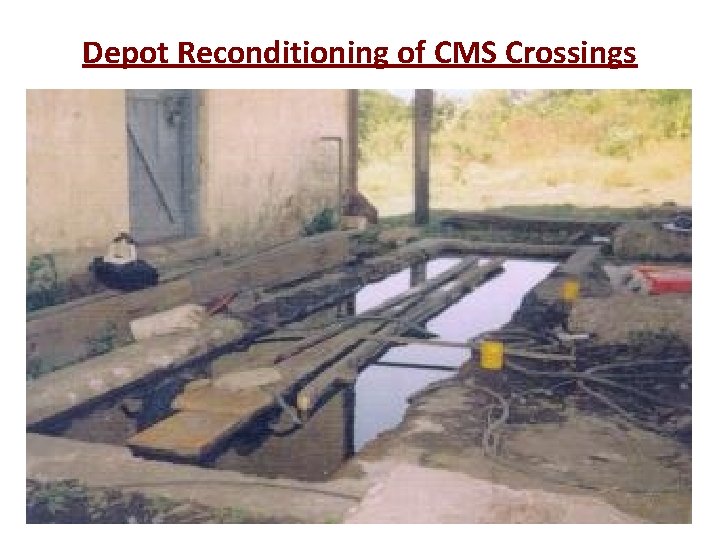
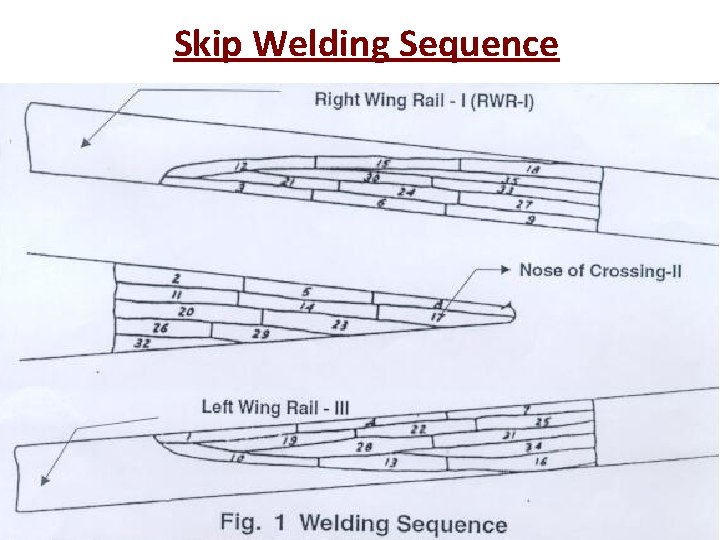
Reconditioning of CMS Crossings • • Surface treatment by cleaning and grinding. Welding operations to be done in flat position. Preheating not required. The temperatur during welding process not to go up beyond 150°C. Temperature to be controlled by by proper intervals between the runs and by means of compressed air jet or water quenching; Or, the crossing may be kept submerged in water bath with only top 1 cm above water level. Welding cycle should be short (2 min). At a time only 7 -8 cm length only shall be deposited.
Depot Reconditioning of CMS Crossings
Skip Welding Sequence
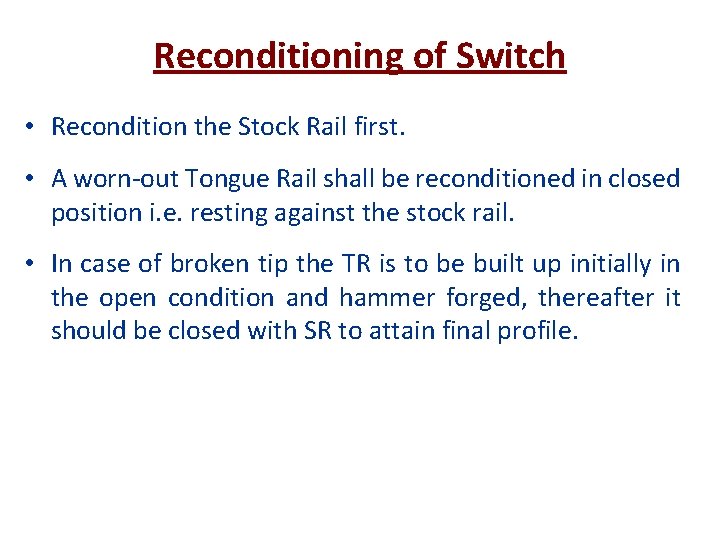
Reconditioning of Switch • Recondition the Stock Rail first. • A worn-out Tongue Rail shall be reconditioned in closed position i. e. resting against the stock rail. • In case of broken tip the TR is to be built up initially in the open condition and hammer forged, thereafter it should be closed with SR to attain final profile.
Important Steps in Reconditioning Process • Testing and Inspection – Visual Inspection • Check for surface defects – undercut, slag inclusion, porosity, crack etc. – Dimensional measurement • By straight-edge and template – DPT or Magnaflux test to detect surface cracks • Rectification – If cracks found, the portion should be gouged either by pneumatic gouging or grinding and remaining portion should be re-examined for crack. – If no cracks are found, the portion should be re-welded, ground and inspected.
Important Steps in Reconditioning Process • Grinding – The reconditioned area should be ground to the original contour. – Grinding wheel should be continuously moved back and forth and not stopped at one location to avoid high localized heating and subsequent cooling. • Passage of Trains – Trains can be passed at normal speed over the weld metal on crossing even before completion of welding. – After passage of train, welding can be restarted. – After passage of train, welding can be started again. However, weld metal should be allowed to cool for 2 to 3 minutes before allowing passage of train.
Thank You