
InSitu Visualization and Analysis of Petascale Molecular Dynamics
- Slides: 16
In-Situ Visualization and Analysis of Petascale Molecular Dynamics Simulations with VMD John Stone Theoretical and Computational Biophysics Group Beckman Institute for Advanced Science and Technology University of Illinois at Urbana-Champaign http: //www. ks. uiuc. edu/Research/vmd/ Accelerated HPC Symposium, San Jose Convention Center, San Jose, CA, May 17, 2012 NIH Resource for Macromolecular Modeling and Bioinformatics http: //www. ks. uiuc. edu/ Beckman Institute, UIUC
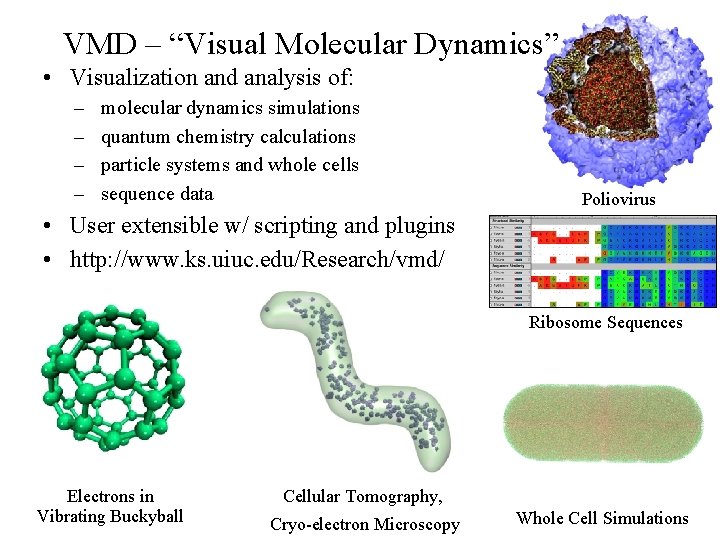
VMD – “Visual Molecular Dynamics” • Visualization and analysis of: – – molecular dynamics simulations quantum chemistry calculations particle systems and whole cells sequence data Poliovirus • User extensible w/ scripting and plugins • http: //www. ks. uiuc. edu/Research/vmd/ Ribosome Sequences Electrons in Vibrating Buckyball Cellular Tomography, NIH Resource for Macromolecular Modeling and Bioinformatics http: //www. ks. uiuc. edu/ Cryo-electron Microscopy Beckman Institute, UIUC Whole Cell Simulations
Molecular Visualization and Analysis Challenges for Petascale Simulations • Very large structures (10 M to over 100 M atoms) – 12 -bytes per atom per trajectory frame – 100 M atom trajectory frame: 1200 MB! • Long-timescale simulations produce huge trajectories – MD integration timesteps are on the femtosecond timescale (10 -15 sec) but many important biological processes occur on microsecond to millisecond timescales – Even storing trajectory frames infrequently, resulting trajectories frequently contain millions of frames • Petabytes of data to analyze, far too large to move • Viz and analysis must be done primarily on the supercomputer where the data already resides NIH Resource for Macromolecular Modeling and Bioinformatics http: //www. ks. uiuc. edu/ Beckman Institute, UIUC
Approaches for Visualization and Analysis of Petascale Molecular Simulations with VMD • Abandon conventional approaches, e. g. bulk download of trajectory data to remote viz/analysis machines – In-place processing of trajectories on the machine running the simulations – Use remote visualization techniques: Split-mode VMD with remote frontend instance, and back-end viz/analysis engine running in parallel on supercomputer • Large-scale parallel analysis and visualization via distributed memory MPI version of VMD • Exploit GPUs and other accelerators to increase per-node analytical capabilities, e. g. NCSA Blue Waters Cray XK 6 • In-situ on-the-fly viz/analysis and event detection through direct communication with running MD simulation NIH Resource for Macromolecular Modeling and Bioinformatics http: //www. ks. uiuc. edu/ Beckman Institute, UIUC
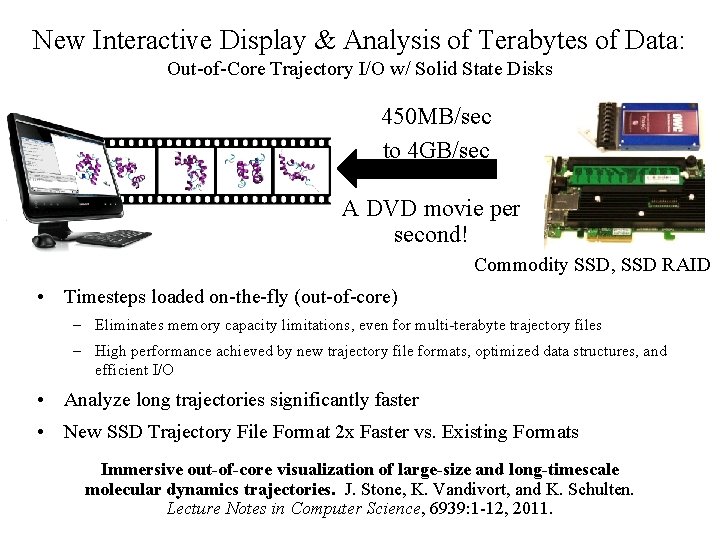
New Interactive Display & Analysis of Terabytes of Data: Out-of-Core Trajectory I/O w/ Solid State Disks 450 MB/sec to 4 GB/sec A DVD movie per second! Commodity SSD, SSD RAID • Timesteps loaded on-the-fly (out-of-core) – Eliminates memory capacity limitations, even for multi-terabyte trajectory files – High performance achieved by new trajectory file formats, optimized data structures, and efficient I/O • Analyze long trajectories significantly faster • New SSD Trajectory File Format 2 x Faster vs. Existing Formats Immersive out-of-core visualization of large-size and long-timescale molecular dynamics trajectories. J. Stone, K. Vandivort, and K. Schulten. Lecture. NIH Resource for Macromolecular Modeling and Bioinformatics Notes in Computer Science, 6939: 1 -12, 2011. Beckman Institute, UIUC http: //www. ks. uiuc. edu/
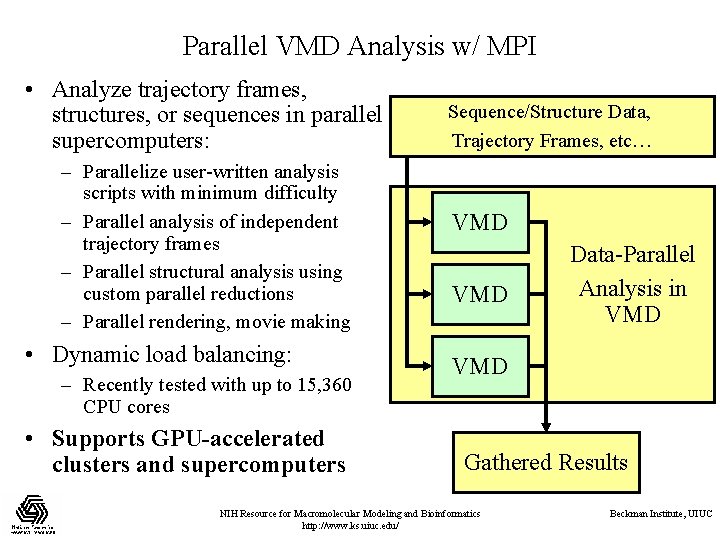
Parallel VMD Analysis w/ MPI • Analyze trajectory frames, structures, or sequences in parallel supercomputers: – Parallelize user-written analysis scripts with minimum difficulty – Parallel analysis of independent trajectory frames – Parallel structural analysis using custom parallel reductions – Parallel rendering, movie making • Dynamic load balancing: – Recently tested with up to 15, 360 CPU cores • Supports GPU-accelerated clusters and supercomputers Sequence/Structure Data, Trajectory Frames, etc… VMD Data-Parallel Analysis in VMD Gathered Results NIH Resource for Macromolecular Modeling and Bioinformatics http: //www. ks. uiuc. edu/ Beckman Institute, UIUC
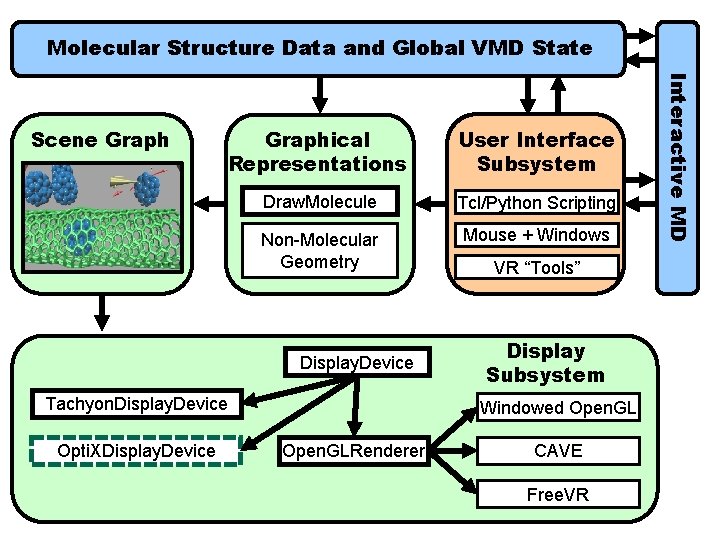
Molecular Structure Data and Global VMD State Graphical Representations User Interface Subsystem Draw. Molecule Tcl/Python Scripting Non-Molecular Geometry Mouse + Windows VR “Tools” Display Subsystem Display. Device Tachyon. Display. Device Opti. XDisplay. Device Interactive MD Scene Graph Windowed Open. GLRenderer CAVE Free. VR NIH Resource for Macromolecular Modeling and Bioinformatics http: //www. ks. uiuc. edu/ Beckman Institute, UIUC
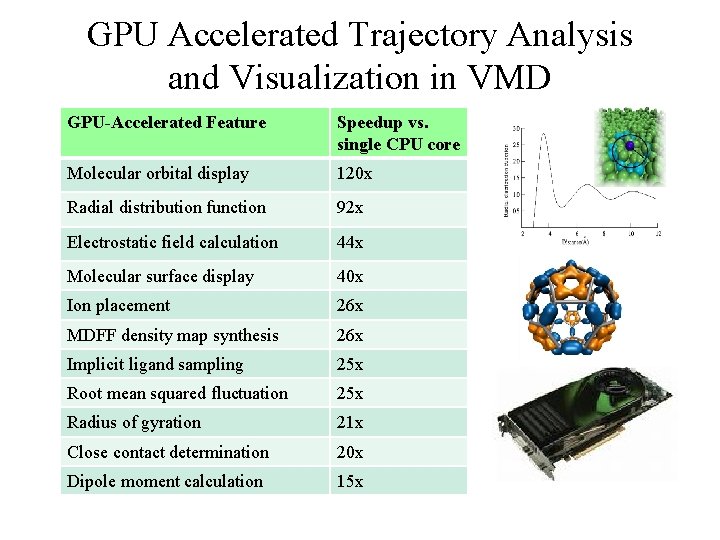
GPU Accelerated Trajectory Analysis and Visualization in VMD GPU-Accelerated Feature Speedup vs. single CPU core Molecular orbital display 120 x Radial distribution function 92 x Electrostatic field calculation 44 x Molecular surface display 40 x Ion placement 26 x MDFF density map synthesis 26 x Implicit ligand sampling 25 x Root mean squared fluctuation 25 x Radius of gyration 21 x Close contact determination 20 x Dipole moment calculation 15 x NIH Resource for Macromolecular Modeling and Bioinformatics http: //www. ks. uiuc. edu/ Beckman Institute, UIUC
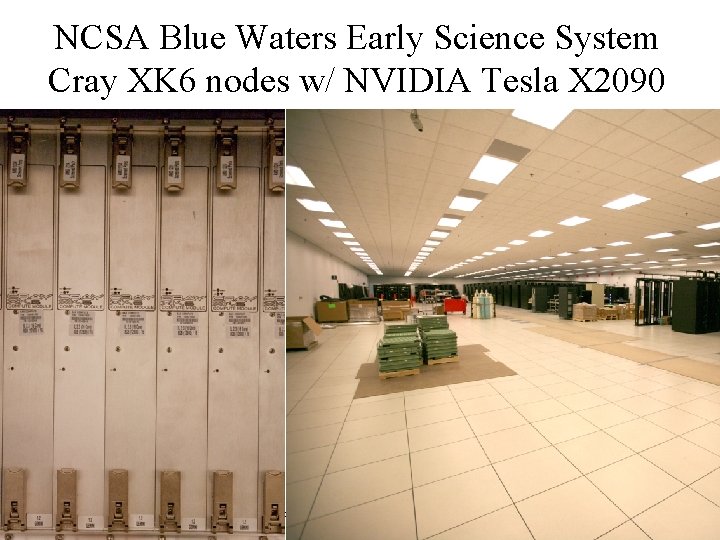
NCSA Blue Waters Early Science System Cray XK 6 nodes w/ NVIDIA Tesla X 2090 NIH Resource for Macromolecular Modeling and Bioinformatics http: //www. ks. uiuc. edu/ Beckman Institute, UIUC
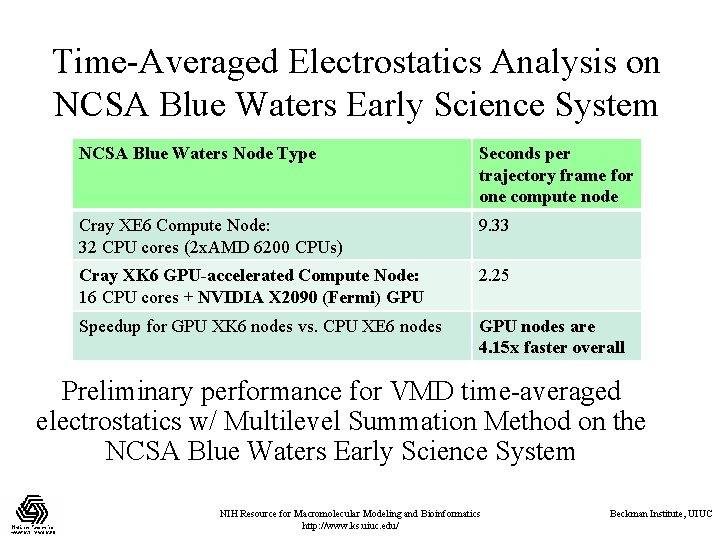
Time-Averaged Electrostatics Analysis on NCSA Blue Waters Early Science System NCSA Blue Waters Node Type Seconds per trajectory frame for one compute node Cray XE 6 Compute Node: 32 CPU cores (2 x. AMD 6200 CPUs) 9. 33 Cray XK 6 GPU-accelerated Compute Node: 16 CPU cores + NVIDIA X 2090 (Fermi) GPU 2. 25 Speedup for GPU XK 6 nodes vs. CPU XE 6 nodes GPU nodes are 4. 15 x faster overall Preliminary performance for VMD time-averaged electrostatics w/ Multilevel Summation Method on the NCSA Blue Waters Early Science System NIH Resource for Macromolecular Modeling and Bioinformatics http: //www. ks. uiuc. edu/ Beckman Institute, UIUC
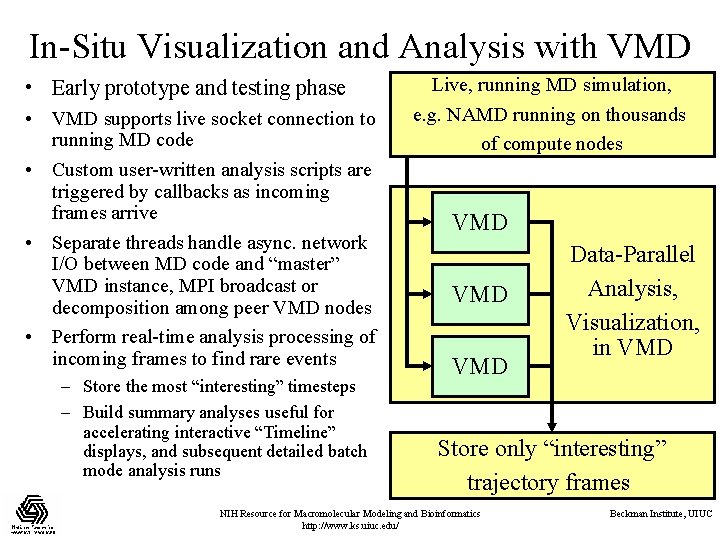
In-Situ Visualization and Analysis with VMD • Early prototype and testing phase • VMD supports live socket connection to running MD code • Custom user-written analysis scripts are triggered by callbacks as incoming frames arrive • Separate threads handle async. network I/O between MD code and “master” VMD instance, MPI broadcast or decomposition among peer VMD nodes • Perform real-time analysis processing of incoming frames to find rare events – Store the most “interesting” timesteps – Build summary analyses useful for accelerating interactive “Timeline” displays, and subsequent detailed batch mode analysis runs Live, running MD simulation, e. g. NAMD running on thousands of compute nodes VMD VMD Data-Parallel Analysis, Visualization, in VMD Store only “interesting” trajectory frames NIH Resource for Macromolecular Modeling and Bioinformatics http: //www. ks. uiuc. edu/ Beckman Institute, UIUC
Acknowledgements • Theoretical and Computational Biophysics Group, University of Illinois at Urbana. Champaign • NCSA Blue Waters Team • NCSA Innovative Systems Lab • NVIDIA CUDA Center of Excellence, University of Illinois at Urbana-Champaign • The CUDA team at NVIDIA • NIH support: P 41 -RR 005969 NIH Resource for Macromolecular Modeling and Bioinformatics http: //www. ks. uiuc. edu/ Beckman Institute, UIUC
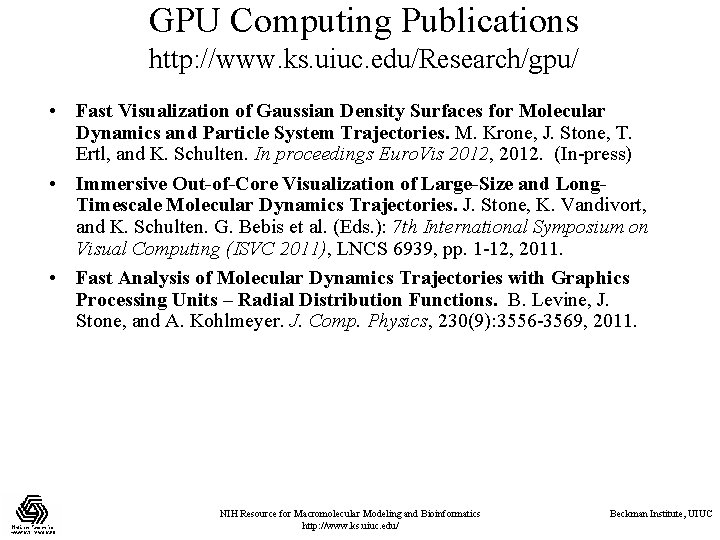
GPU Computing Publications http: //www. ks. uiuc. edu/Research/gpu/ • Fast Visualization of Gaussian Density Surfaces for Molecular Dynamics and Particle System Trajectories. M. Krone, J. Stone, T. Ertl, and K. Schulten. In proceedings Euro. Vis 2012, 2012. (In-press) • Immersive Out-of-Core Visualization of Large-Size and Long. Timescale Molecular Dynamics Trajectories. J. Stone, K. Vandivort, and K. Schulten. G. Bebis et al. (Eds. ): 7 th International Symposium on Visual Computing (ISVC 2011), LNCS 6939, pp. 1 -12, 2011. • Fast Analysis of Molecular Dynamics Trajectories with Graphics Processing Units – Radial Distribution Functions. B. Levine, J. Stone, and A. Kohlmeyer. J. Comp. Physics, 230(9): 3556 -3569, 2011. NIH Resource for Macromolecular Modeling and Bioinformatics http: //www. ks. uiuc. edu/ Beckman Institute, UIUC
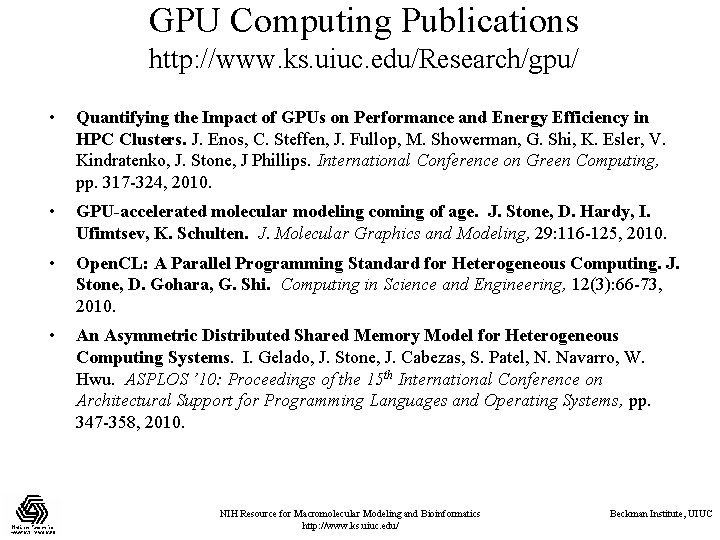
GPU Computing Publications http: //www. ks. uiuc. edu/Research/gpu/ • Quantifying the Impact of GPUs on Performance and Energy Efficiency in HPC Clusters. J. Enos, C. Steffen, J. Fullop, M. Showerman, G. Shi, K. Esler, V. Kindratenko, J. Stone, J Phillips. International Conference on Green Computing, pp. 317 -324, 2010. • GPU-accelerated molecular modeling coming of age. J. Stone, D. Hardy, I. Ufimtsev, K. Schulten. J. Molecular Graphics and Modeling, 29: 116 -125, 2010. • Open. CL: A Parallel Programming Standard for Heterogeneous Computing. J. Stone, D. Gohara, G. Shi. Computing in Science and Engineering, 12(3): 66 -73, 2010. • An Asymmetric Distributed Shared Memory Model for Heterogeneous Computing Systems. I. Gelado, J. Stone, J. Cabezas, S. Patel, N. Navarro, W. Hwu. ASPLOS ’ 10: Proceedings of the 15 th International Conference on Architectural Support for Programming Languages and Operating Systems, pp. 347 -358, 2010. NIH Resource for Macromolecular Modeling and Bioinformatics http: //www. ks. uiuc. edu/ Beckman Institute, UIUC
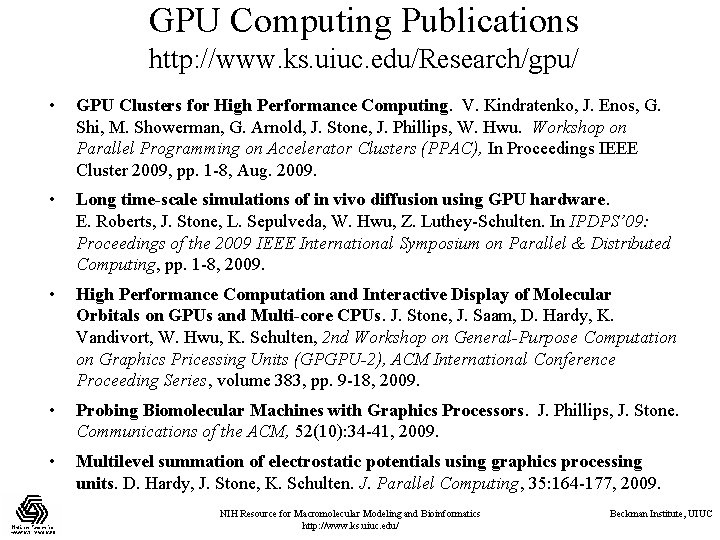
GPU Computing Publications http: //www. ks. uiuc. edu/Research/gpu/ • GPU Clusters for High Performance Computing. V. Kindratenko, J. Enos, G. Shi, M. Showerman, G. Arnold, J. Stone, J. Phillips, W. Hwu. Workshop on Parallel Programming on Accelerator Clusters (PPAC), In Proceedings IEEE Cluster 2009, pp. 1 -8, Aug. 2009. • Long time-scale simulations of in vivo diffusion using GPU hardware. E. Roberts, J. Stone, L. Sepulveda, W. Hwu, Z. Luthey-Schulten. In IPDPS’ 09: Proceedings of the 2009 IEEE International Symposium on Parallel & Distributed Computing, pp. 1 -8, 2009. • High Performance Computation and Interactive Display of Molecular Orbitals on GPUs and Multi-core CPUs. J. Stone, J. Saam, D. Hardy, K. Vandivort, W. Hwu, K. Schulten, 2 nd Workshop on General-Purpose Computation on Graphics Pricessing Units (GPGPU-2), ACM International Conference Proceeding Series, volume 383, pp. 9 -18, 2009. • Probing Biomolecular Machines with Graphics Processors. J. Phillips, J. Stone. Communications of the ACM, 52(10): 34 -41, 2009. • Multilevel summation of electrostatic potentials using graphics processing units. D. Hardy, J. Stone, K. Schulten. J. Parallel Computing, 35: 164 -177, 2009. NIH Resource for Macromolecular Modeling and Bioinformatics http: //www. ks. uiuc. edu/ Beckman Institute, UIUC
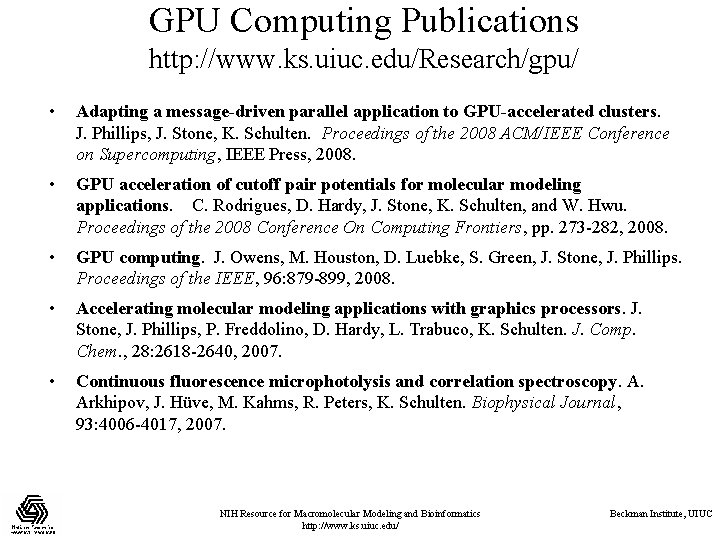
GPU Computing Publications http: //www. ks. uiuc. edu/Research/gpu/ • Adapting a message-driven parallel application to GPU-accelerated clusters. J. Phillips, J. Stone, K. Schulten. Proceedings of the 2008 ACM/IEEE Conference on Supercomputing, IEEE Press, 2008. • GPU acceleration of cutoff pair potentials for molecular modeling applications. C. Rodrigues, D. Hardy, J. Stone, K. Schulten, and W. Hwu. Proceedings of the 2008 Conference On Computing Frontiers, pp. 273 -282, 2008. • GPU computing. J. Owens, M. Houston, D. Luebke, S. Green, J. Stone, J. Phillips. Proceedings of the IEEE, 96: 879 -899, 2008. • Accelerating molecular modeling applications with graphics processors. J. Stone, J. Phillips, P. Freddolino, D. Hardy, L. Trabuco, K. Schulten. J. Comp. Chem. , 28: 2618 -2640, 2007. • Continuous fluorescence microphotolysis and correlation spectroscopy. A. Arkhipov, J. Hüve, M. Kahms, R. Peters, K. Schulten. Biophysical Journal, 93: 4006 -4017, 2007. NIH Resource for Macromolecular Modeling and Bioinformatics http: //www. ks. uiuc. edu/ Beckman Institute, UIUC