
Insitu neutron diffraction and acoustic emission investigation of

- Slides: 21
In-situ neutron diffraction and acoustic emission investigation of twinning activity in cast magnesium Kristián Máthis 1, Přemysl Beran 2, Petr Harcuba 1, Jan Čapek 1, Petr Lukáš 2 1 Department of Physics of Materials, Faculty of Mathematics and Physics, Charles University, Prague, Czech Republic 2 Nuclear Physics Institute, Řež, Czech Republic CHARLES UNIVERSITY PRAGUE Department of Physics of Materials
Motivation • Twinning in magnesium – one of the most important deformation mechanism • Tension – compression asymmetry – different evolution of twinning in tension and compression, respectively • Frequently studied for textured materials – limited number of data for random textured materials Our goal • Study of the loading mode dependence of the twinning evolution in the entire volume of the texture free magnesium CHARLES UNIVERSITY PRAGUE Department of Physics of Materials
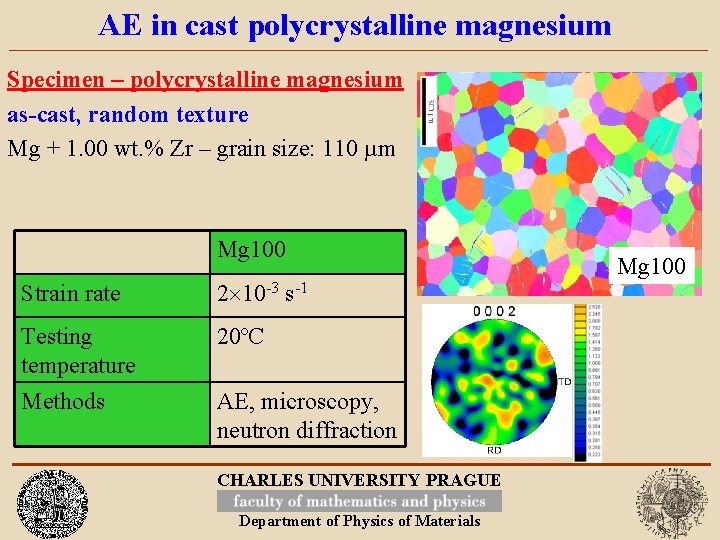
AE in cast polycrystalline magnesium Specimen – polycrystalline magnesium as-cast, random texture Mg + 1. 00 wt. % Zr – grain size: 110 µm Mg 100 Strain rate 2 10 -3 s-1 Testing temperature 20ºC Methods AE, microscopy, neutron diffraction CHARLES UNIVERSITY PRAGUE Department of Physics of Materials Mg 100
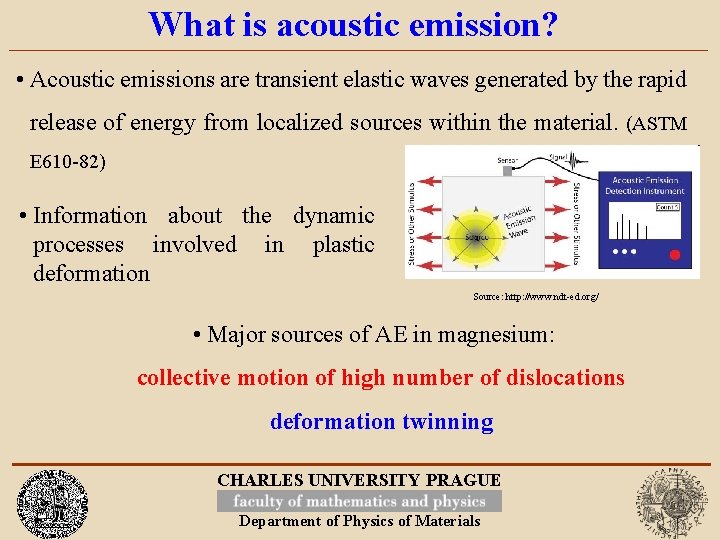
What is acoustic emission? • Acoustic emissions are transient elastic waves generated by the rapid release of energy from localized sources within the material. (ASTM E 610 -82) • Information about the dynamic processes involved in plastic deformation Source: http: //www. ndt-ed. org/ • Major sources of AE in magnesium: collective motion of high number of dislocations deformation twinning CHARLES UNIVERSITY PRAGUE Department of Physics of Materials
Why acoustic emission? Advantages • Real-time, non-destructive method • Suited for global monitoring – information from the entire volume • Detects movement/growth of defects (e. g. dislocations, twins, cracks) • Intimate relationship to material failure Limitations • Dependence on stress history • Unstressed defects will not emit • Wave attenuation and noise CHARLES UNIVERSITY PRAGUE Department of Physics of Materials
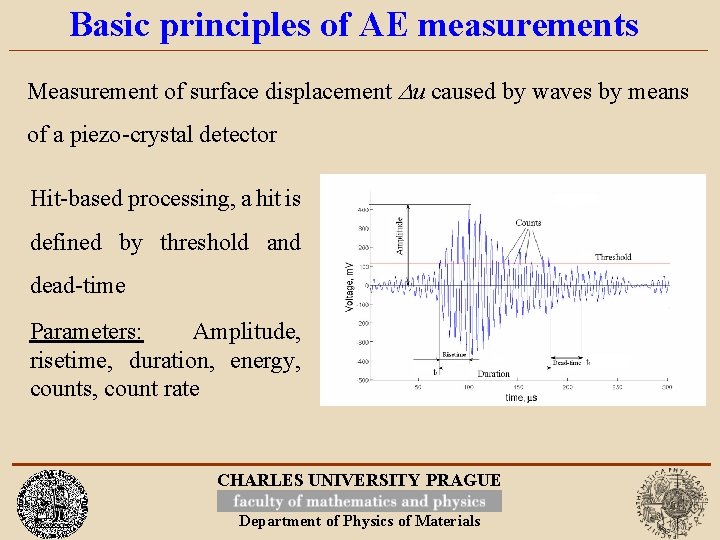
Basic principles of AE measurements Measurement of surface displacement u caused by waves by means of a piezo-crystal detector Hit-based processing, a hit is defined by threshold and dead-time Parameters: Amplitude, risetime, duration, energy, counts, count rate CHARLES UNIVERSITY PRAGUE Department of Physics of Materials
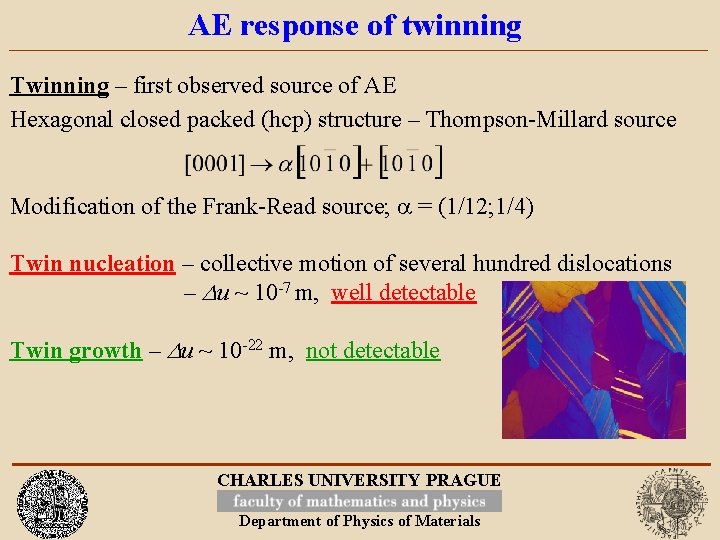
AE response of twinning Twinning – first observed source of AE Hexagonal closed packed (hcp) structure – Thompson-Millard source Modification of the Frank-Read source; = (1/12; 1/4) Twin nucleation – collective motion of several hundred dislocations – u ~ 10 -7 m, well detectable Twin growth – u ~ 10 -22 m, not detectable CHARLES UNIVERSITY PRAGUE Department of Physics of Materials
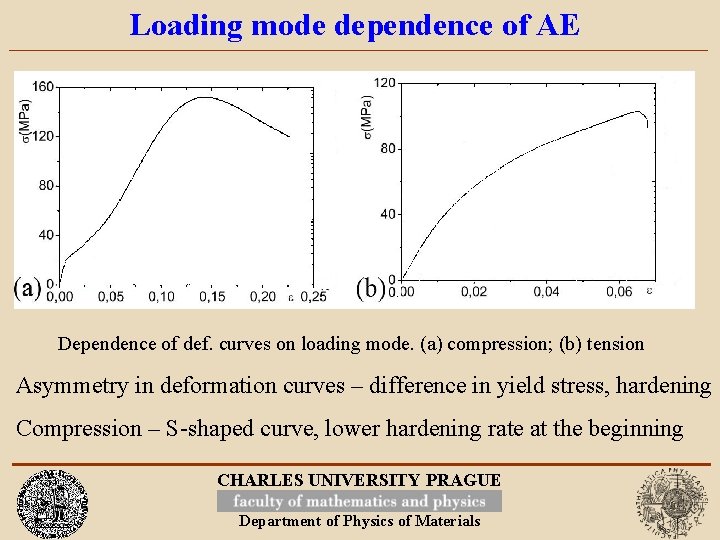
Loading mode dependence of AE Dependence of def. curves on loading mode. (a) compression; (b) tension Asymmetry in deformation curves – difference in yield stress, hardening Compression – S-shaped curve, lower hardening rate at the beginning CHARLES UNIVERSITY PRAGUE Department of Physics of Materials
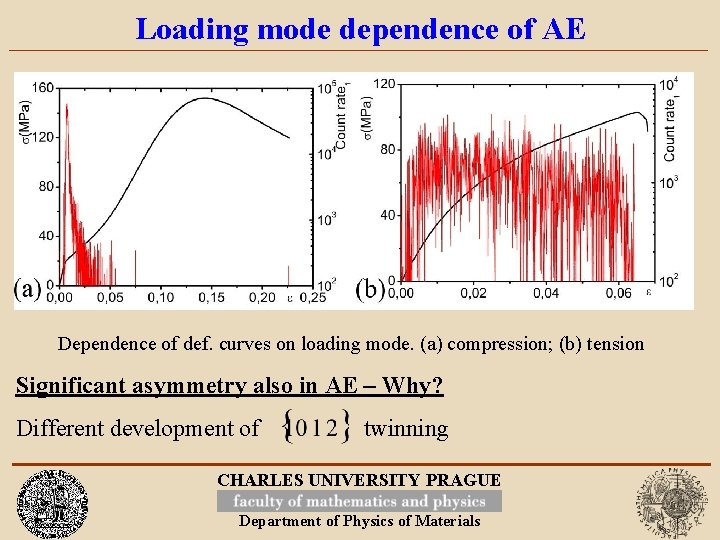
Loading mode dependence of AE Dependence of def. curves on loading mode. (a) compression; (b) tension Significant asymmetry also in AE – Why? Different development of twinning CHARLES UNIVERSITY PRAGUE Department of Physics of Materials
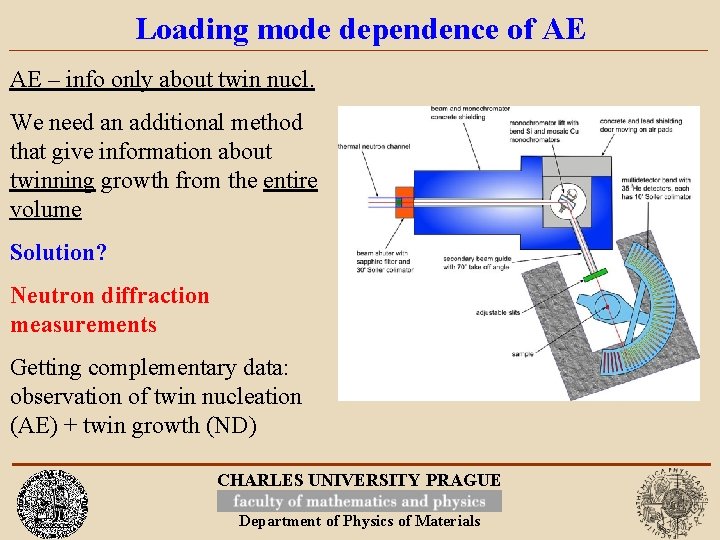
Loading mode dependence of AE AE – info only about twin nucl. We need an additional method that give information about twinning growth from the entire volume Solution? Neutron diffraction measurements Getting complementary data: observation of twin nucleation (AE) + twin growth (ND) CHARLES UNIVERSITY PRAGUE Department of Physics of Materials
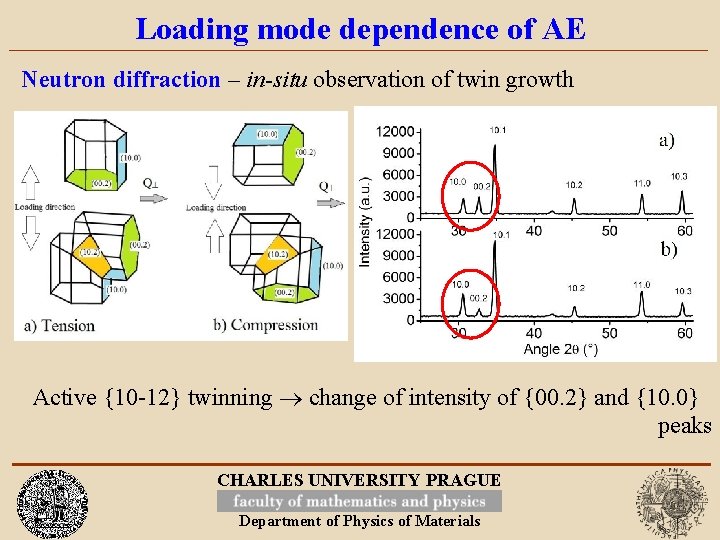
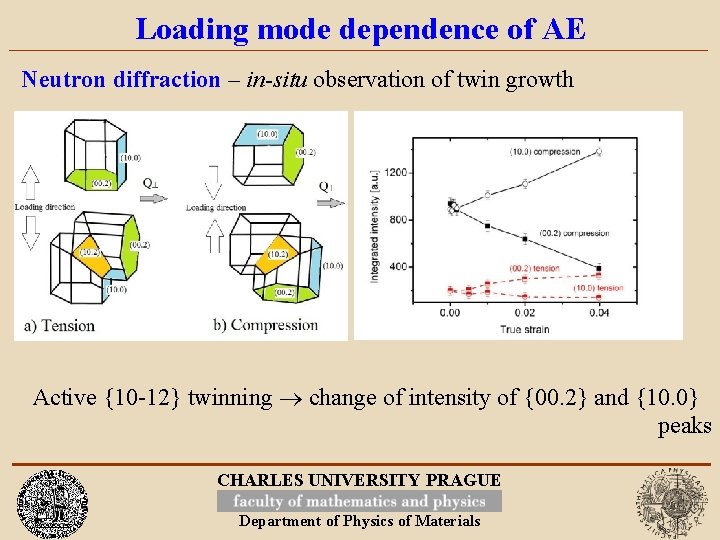
Loading mode dependence of AE Neutron diffraction – in-situ observation of twin growth Active {10 -12} twinning change of intensity of {00. 2} and {10. 0} peaks CHARLES UNIVERSITY PRAGUE Department of Physics of Materials
Loading mode dependence of AE Neutron diffraction – in-situ observation of twin growth Active {10 -12} twinning change of intensity of {00. 2} and {10. 0} peaks CHARLES UNIVERSITY PRAGUE Department of Physics of Materials
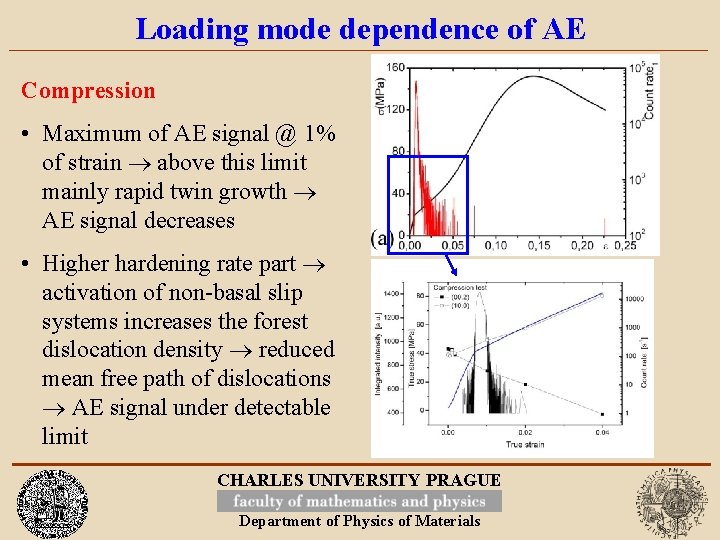
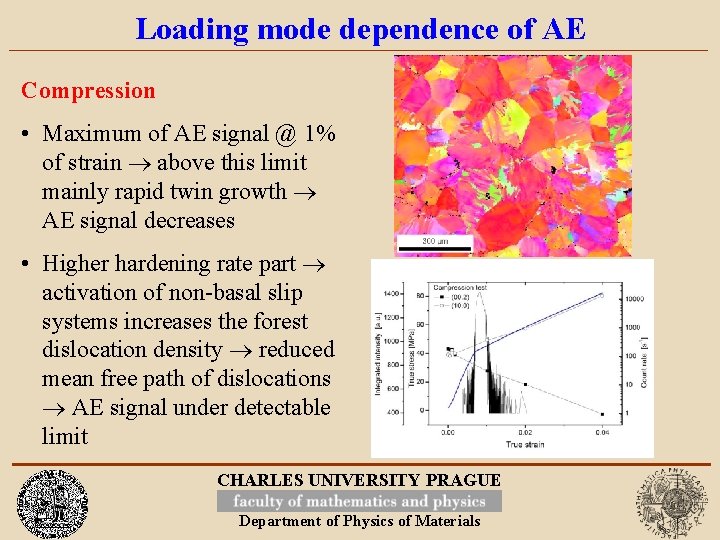
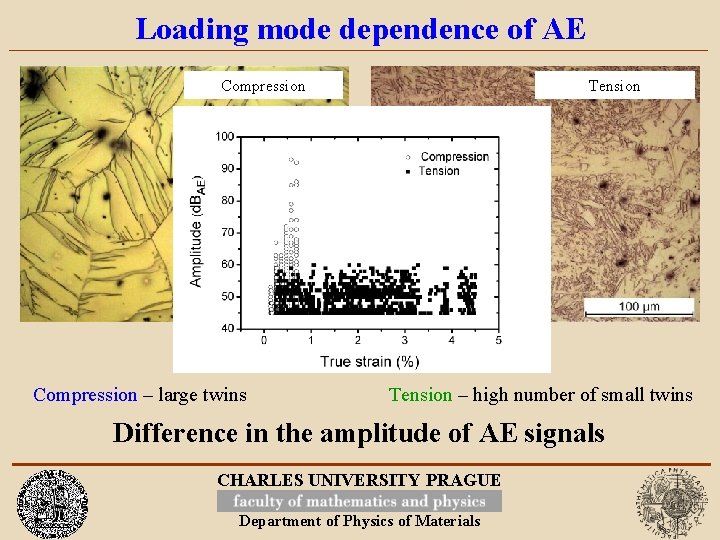
Loading mode dependence of AE Compression • Maximum of AE signal @ 1% of strain above this limit mainly rapid twin growth AE signal decreases • Higher hardening rate part activation of non-basal slip systems increases the forest dislocation density reduced mean free path of dislocations AE signal under detectable limit CHARLES UNIVERSITY PRAGUE Department of Physics of Materials
Loading mode dependence of AE Compression • Maximum of AE signal @ 1% of strain above this limit mainly rapid twin growth AE signal decreases • Higher hardening rate part activation of non-basal slip systems increases the forest dislocation density reduced mean free path of dislocations AE signal under detectable limit CHARLES UNIVERSITY PRAGUE Department of Physics of Materials
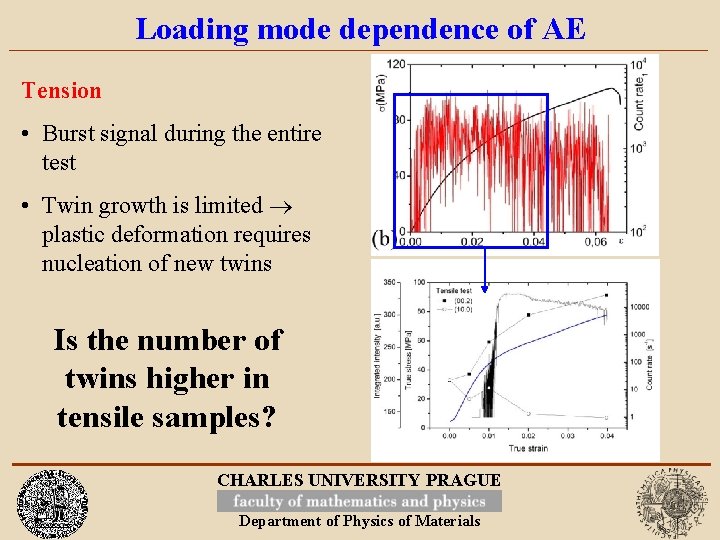
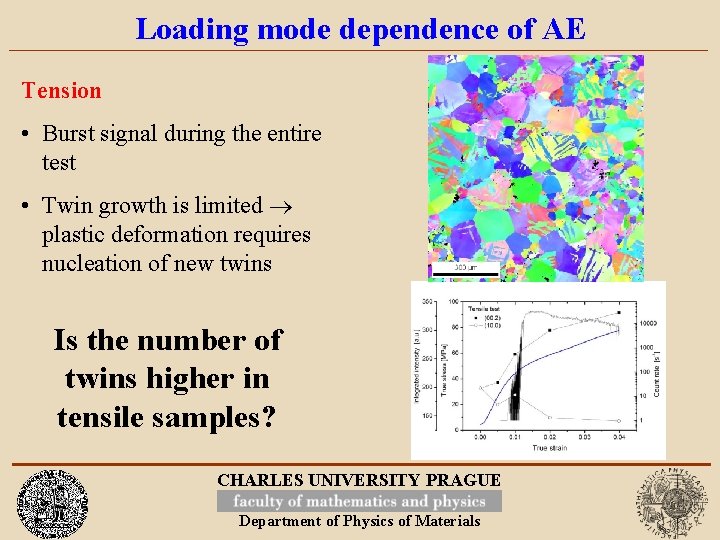
Loading mode dependence of AE Tension • Burst signal during the entire test • Twin growth is limited plastic deformation requires nucleation of new twins Is the number of twins higher in tensile samples? CHARLES UNIVERSITY PRAGUE Department of Physics of Materials
Loading mode dependence of AE Tension • Burst signal during the entire test • Twin growth is limited plastic deformation requires nucleation of new twins Is the number of twins higher in tensile samples? CHARLES UNIVERSITY PRAGUE Department of Physics of Materials
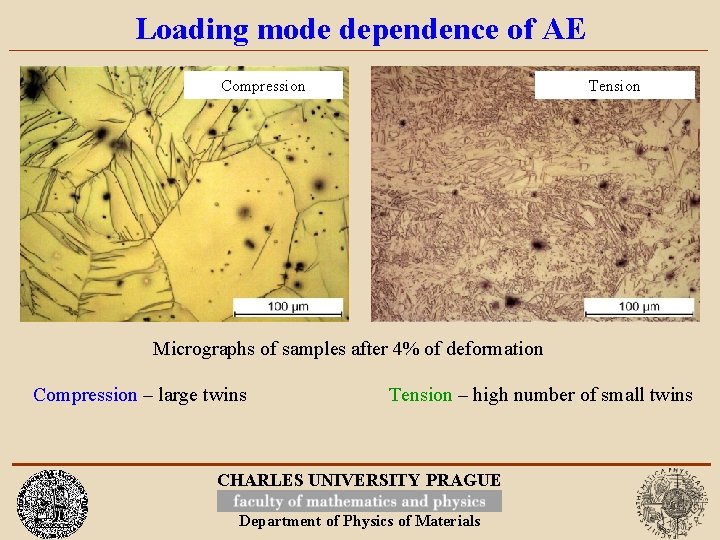
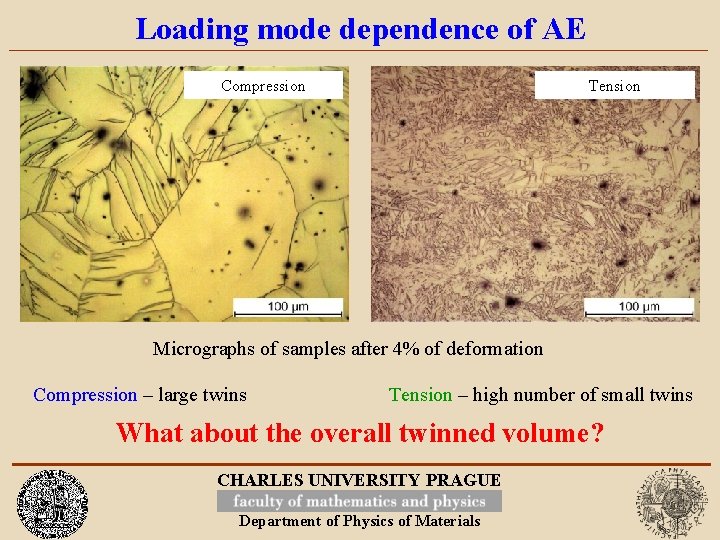
Loading mode dependence of AE Compression Tension Micrographs of samples after 4% of deformation Compression – large twins Tension – high number of small twins CHARLES UNIVERSITY PRAGUE Department of Physics of Materials
Loading mode dependence of AE Compression – large twins Tension – high number of small twins Difference in the amplitude of AE signals CHARLES UNIVERSITY PRAGUE Department of Physics of Materials
Loading mode dependence of AE Compression Tension Micrographs of samples after 4% of deformation Compression – large twins Tension – high number of small twins What about the overall twinned volume? CHARLES UNIVERSITY PRAGUE Department of Physics of Materials
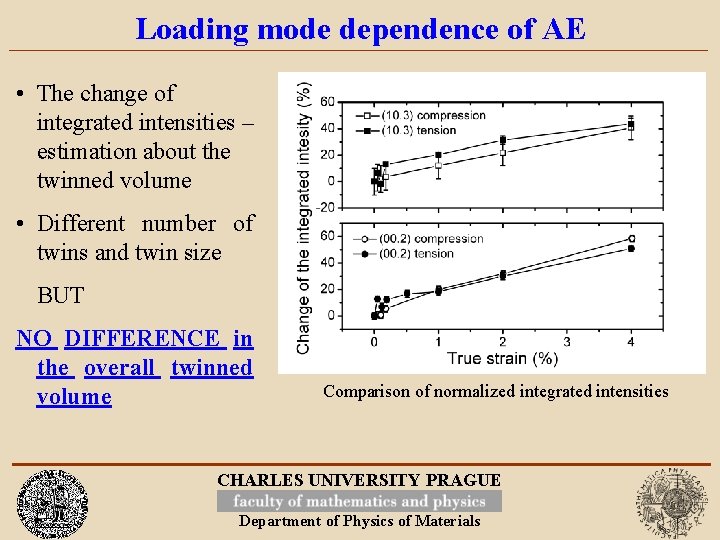
Loading mode dependence of AE • The change of integrated intensities – estimation about the twinned volume • Different number of twins and twin size BUT NO DIFFERENCE in the overall twinned volume Comparison of normalized integrated intensities CHARLES UNIVERSITY PRAGUE Department of Physics of Materials
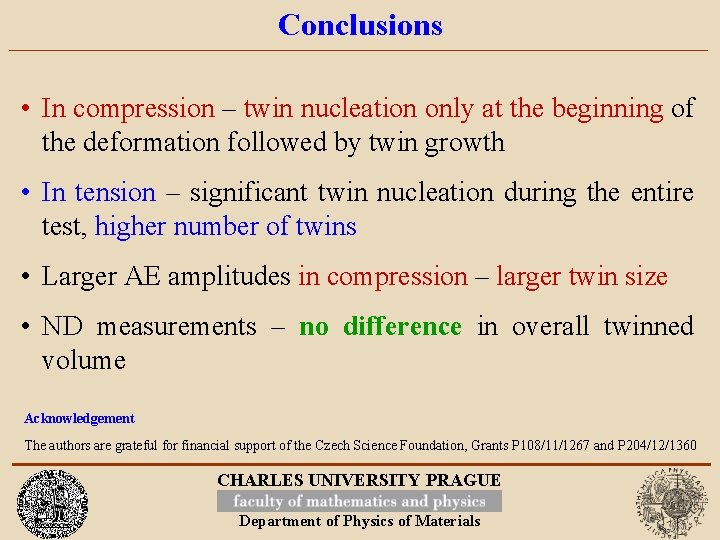
Conclusions • In compression – twin nucleation only at the beginning of the deformation followed by twin growth • In tension – significant twin nucleation during the entire test, higher number of twins • Larger AE amplitudes in compression – larger twin size • ND measurements – no difference in overall twinned volume Acknowledgement The authors are grateful for financial support of the Czech Science Foundation, Grants P 108/11/1267 and P 204/12/1360 CHARLES UNIVERSITY PRAGUE Department of Physics of Materials