
Insider Threat Overview Threat Multipliers Will Mc Ellen



- Slides: 29
Insider Threat Overview Threat Multipliers Will Mc. Ellen
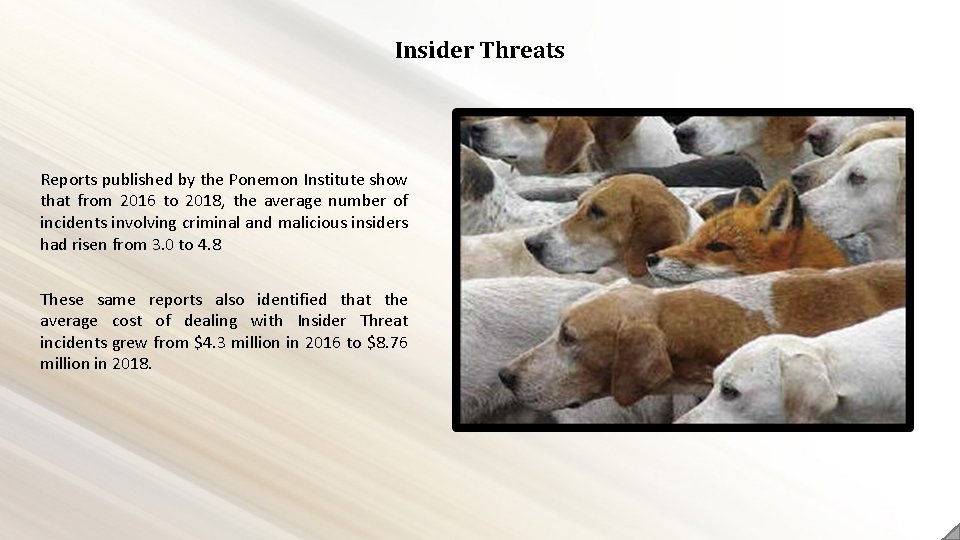
Insider Threats Reports published by the Ponemon Institute show that from 2016 to 2018, the average number of incidents involving criminal and malicious insiders had risen from 3. 0 to 4. 8 These same reports also identified that the average cost of dealing with Insider Threat incidents grew from $4. 3 million in 2016 to $8. 76 million in 2018.
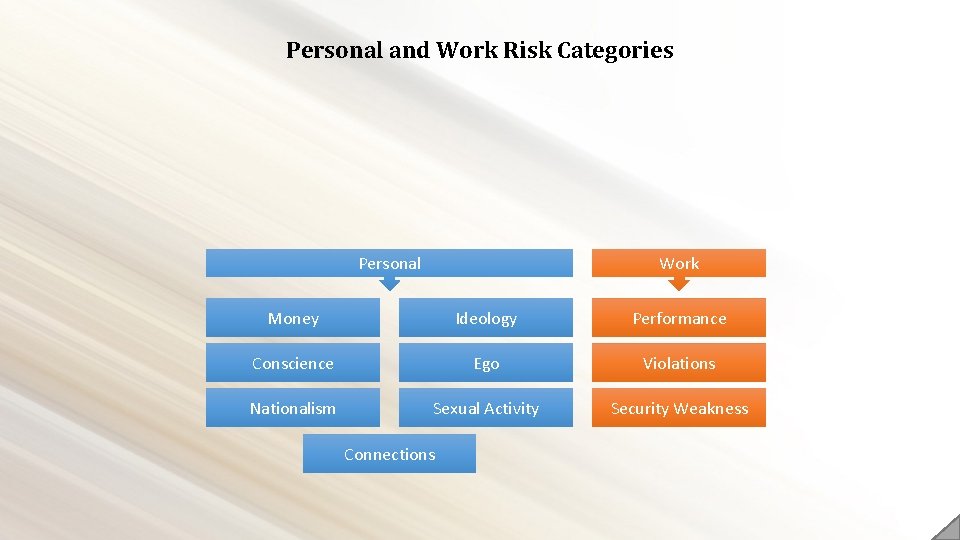
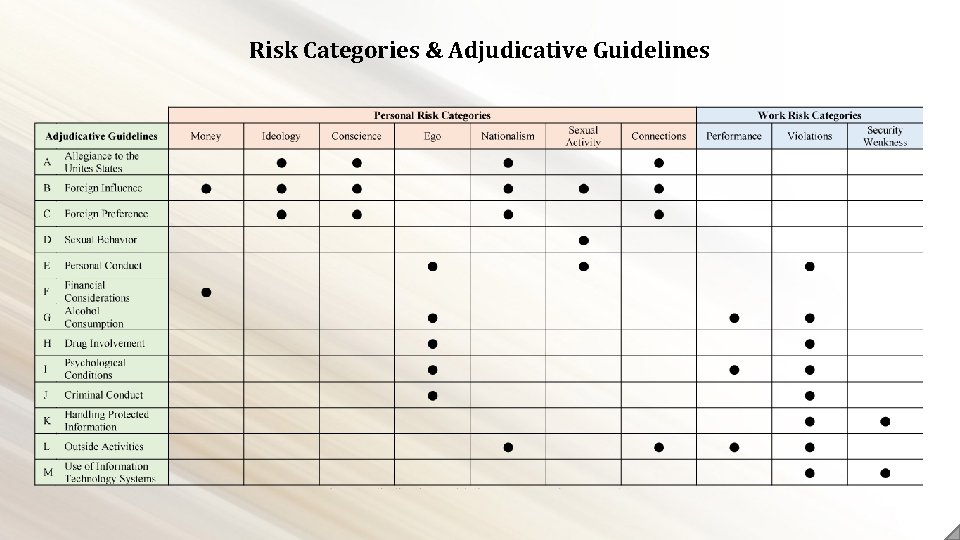
Personal and Work Risk Categories Personal Work Money Ideology Performance Conscience Ego Violations Nationalism Sexual Activity Security Weakness Connections
Personal and Work Risk Categories MONEY. Issues related to financial problems including debts, foreclosures, forced garnishments, or withholdings due to violations. Also includes instances of extravagant spending or purchases beyond current economic ability which could indicate suspicious financial gains. IDEOLOGY. Political, religious, or personal beliefs where there is a potential for conflict between an individual’s ideology and the actions or activities of the organization. CONSCIENCE. Ethical or moral concerns regarding organization activities or products, as well as government contracts the organization may support. EGO. Feelings of self-importance which may lead to issues of an interpersonal or legal nature. This covers individuals that believe that they are superior to other people and should receive favored treatment or the belief that they are above the law or that certain rules should not apply to them. NATIONALISM. Commitment or belief in another country or government which may increase the risk that they could take actions which directly benefit that country.
Personal and Work Risk Categories SEXUAL ACTIVITY. Risk of manipulation or compromise due to their sexual activity or lifestyle; focused on when such activity is concealed or if the individual feels it is of an embarrassing nature. CONNECTIONS. Personal relationships with other individuals that work for competing companies or have ties to foreign countries. WORK PERFORMANCE. Issues which affect an individual’s performance within a organization, such as an inability to complete goals or meet deadlines which could potentially lead to termination. WORK VIOLATIONS. Incidents in which an individual violates organization policies or resentment towards the organization. SECURITY WEAKNESS. Rating of an individual’s knowledge of security safeguards, their ability to employ them, and their willingness to follow those safeguards.
Risk Categories & Adjudicative Guidelines
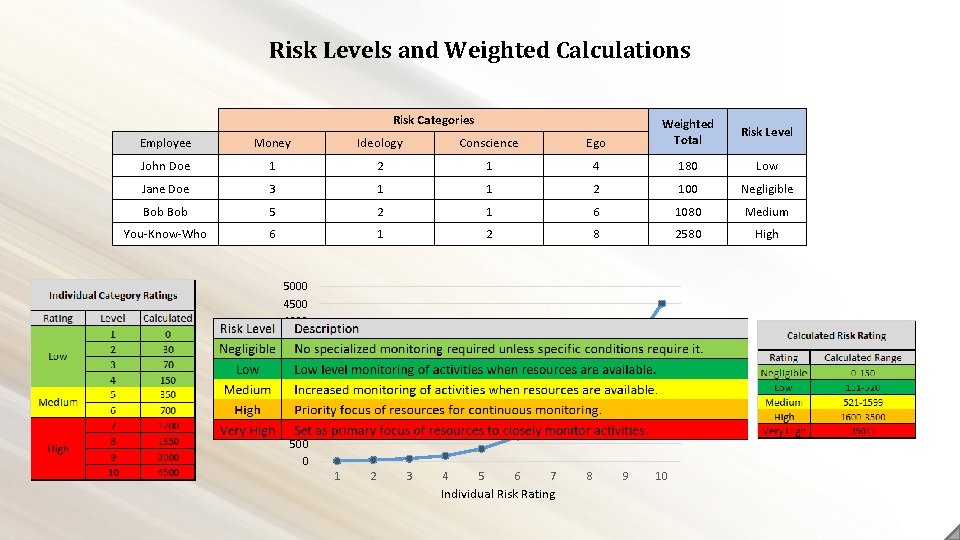
Risk Levels and Weighted Calculations Risk Categories Money Ideology Conscience Ego John Doe 1 2 1 4 180 Low Jane Doe 3 1 1 2 100 Negligible Bob 5 2 1 6 1080 Medium You-Know-Who 6 1 2 8 2580 High Weighted Score Employee Weighted Total 5000 4500 4000 3500 3000 2500 2000 1500 1000 500 0 1 2 3 4 5 6 7 Individual Risk Rating 8 9 10 Risk Level
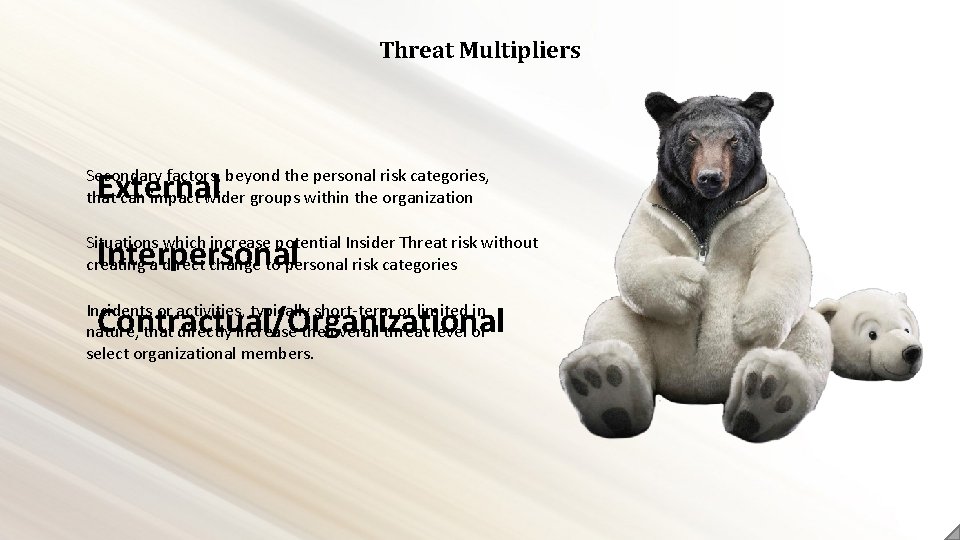
Threat Multipliers External Secondary factors, beyond the personal risk categories, that can impact wider groups within the organization Interpersonal Situations which increase potential Insider Threat risk without creating a direct change to personal risk categories Contractual/Organizational Incidents or activities, typically short-term or limited in nature, that directly increase the overall threat level of select organizational members.
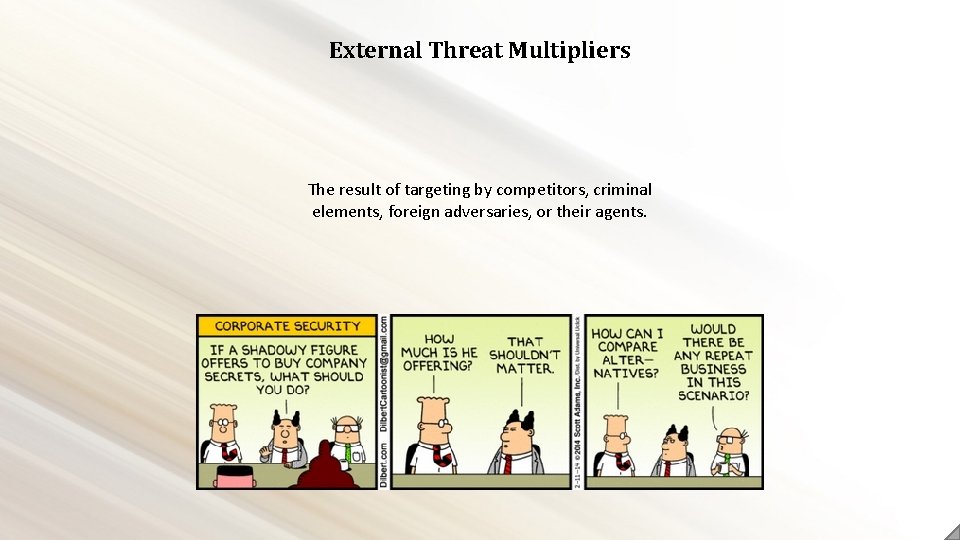
External Threat Multipliers The result of targeting by competitors, criminal elements, foreign adversaries, or their agents.
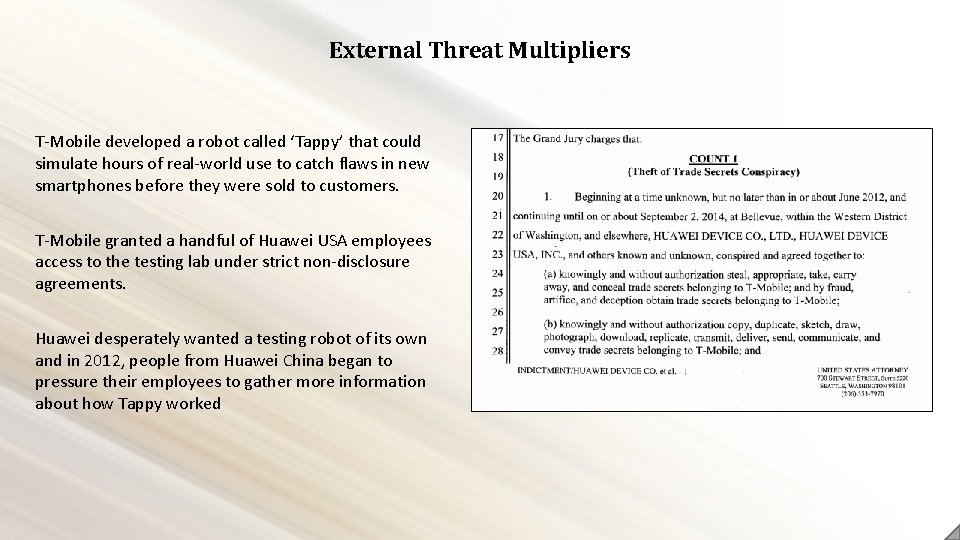
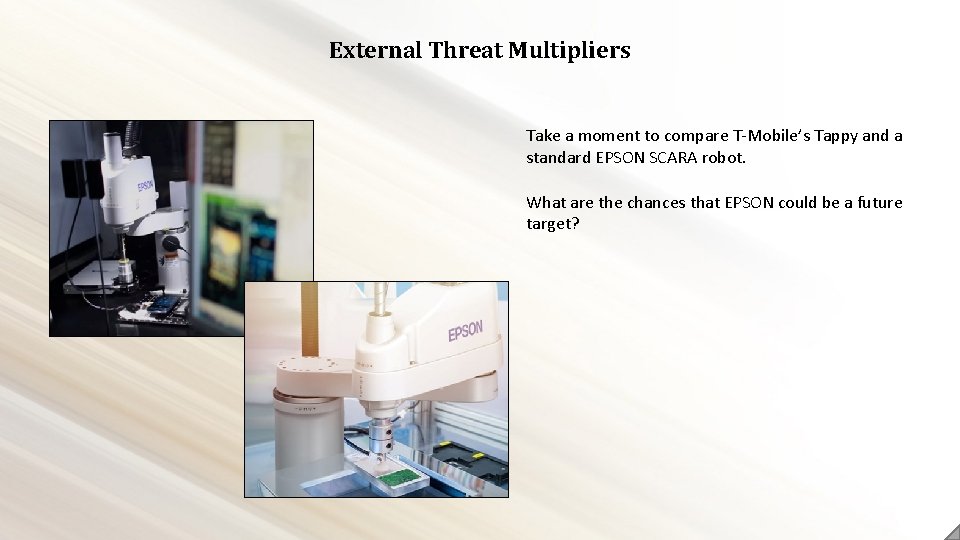
External Threat Multipliers T-Mobile developed a robot called ‘Tappy’ that could simulate hours of real-world use to catch flaws in new smartphones before they were sold to customers. T-Mobile granted a handful of Huawei USA employees access to the testing lab under strict non-disclosure agreements. Huawei desperately wanted a testing robot of its own and in 2012, people from Huawei China began to pressure their employees to gather more information about how Tappy worked
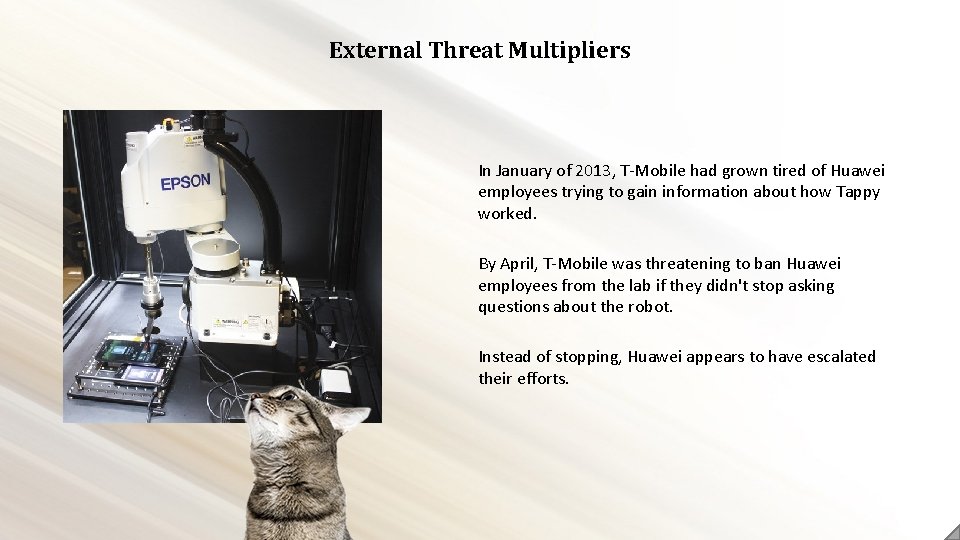
External Threat Multipliers In January of 2013, T-Mobile had grown tired of Huawei employees trying to gain information about how Tappy worked. By April, T-Mobile was threatening to ban Huawei employees from the lab if they didn't stop asking questions about the robot. Instead of stopping, Huawei appears to have escalated their efforts.
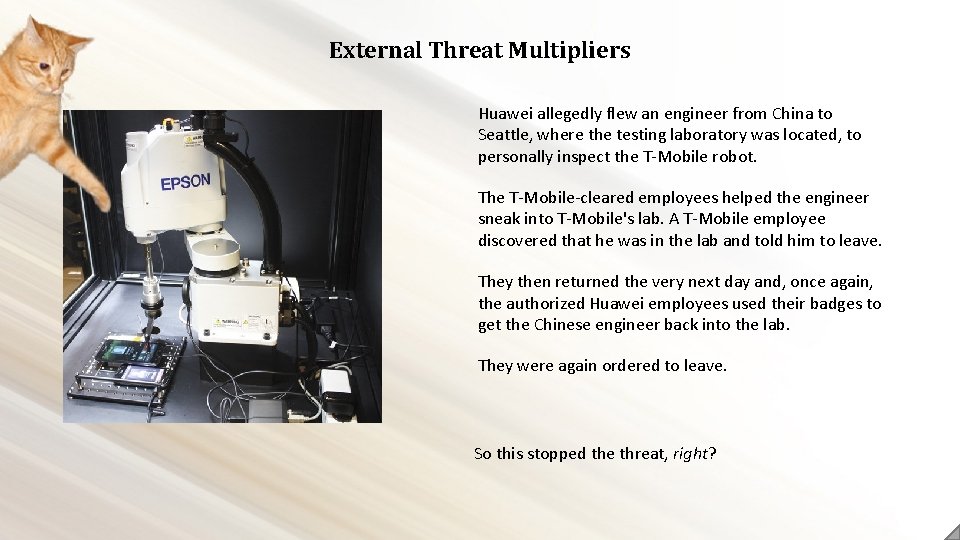
External Threat Multipliers Huawei allegedly flew an engineer from China to Seattle, where the testing laboratory was located, to personally inspect the T-Mobile robot. The T-Mobile-cleared employees helped the engineer sneak into T-Mobile's lab. A T-Mobile employee discovered that he was in the lab and told him to leave. They then returned the very next day and, once again, the authorized Huawei employees used their badges to get the Chinese engineer back into the lab. They were again ordered to leave. So this stopped the threat, right?
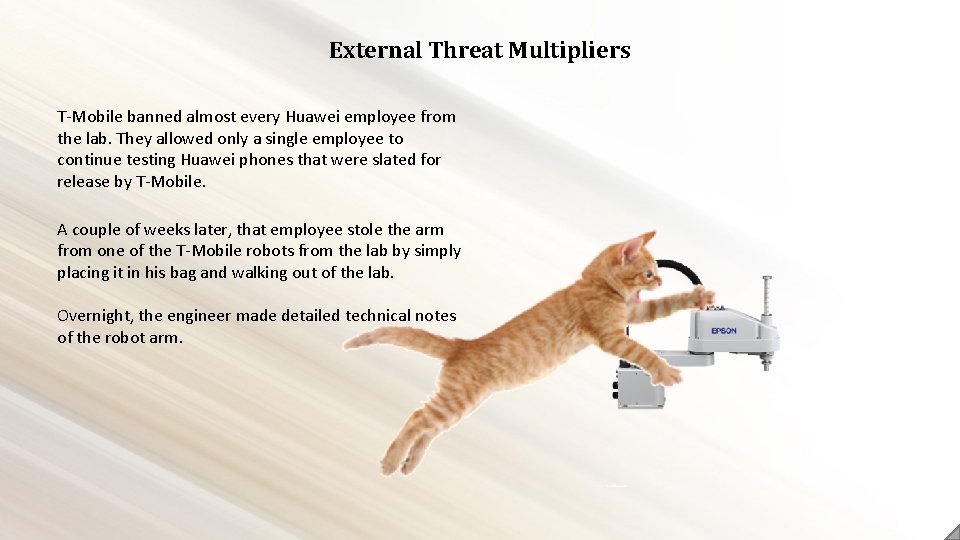
External Threat Multipliers T-Mobile banned almost every Huawei employee from the lab. They allowed only a single employee to continue testing Huawei phones that were slated for release by T-Mobile. A couple of weeks later, that employee stole the arm from one of the T-Mobile robots from the lab by simply placing it in his bag and walking out of the lab. Overnight, the engineer made detailed technical notes of the robot arm.
External Threat Multipliers Take a moment to compare T-Mobile’s Tappy and a standard EPSON SCARA robot. What are the chances that EPSON could be a future target?
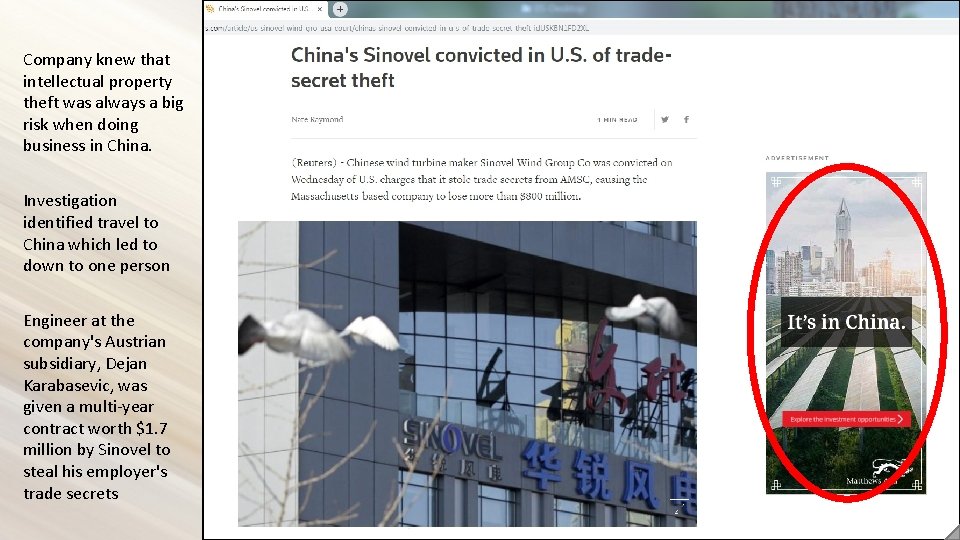
Company knew that intellectual property theft was always a big risk when doing business in China. Investigation identified travel to China which led to down to one person Engineer at the company's Austrian subsidiary, Dejan Karabasevic, was given a multi-year contract worth $1. 7 million by Sinovel to steal his employer's trade secrets External Threat Multipliers
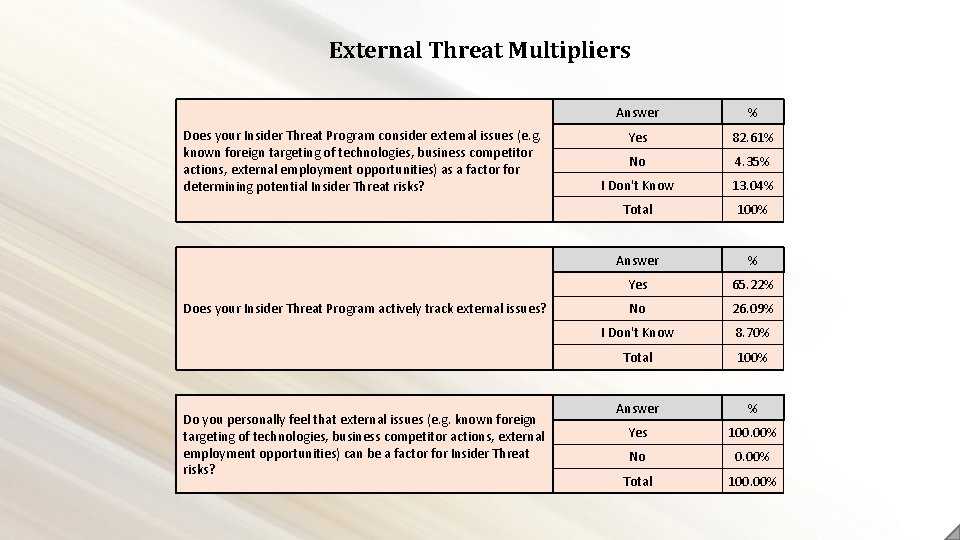
External Threat Multipliers Does your Insider Threat Program consider external issues (e. g. known foreign targeting of technologies, business competitor actions, external employment opportunities) as a factor for determining potential Insider Threat risks? Does your Insider Threat Program actively track external issues? Do you personally feel that external issues (e. g. known foreign targeting of technologies, business competitor actions, external employment opportunities) can be a factor for Insider Threat risks? Answer % Yes 82. 61% No 4. 35% I Don't Know 13. 04% Total 100% Answer % Yes 65. 22% No 26. 09% I Don't Know 8. 70% Total 100% Answer % Yes 100. 00% No 0. 00% Total 100. 00%
Interpersonal Threat Multipliers Issues which develop based on struggles/conflicts between coworkers or other members of the organization. It can also include problems which cause friction between groups or subcultures within an organization if they are, or feel they are, excluded or persecuted in some manner.
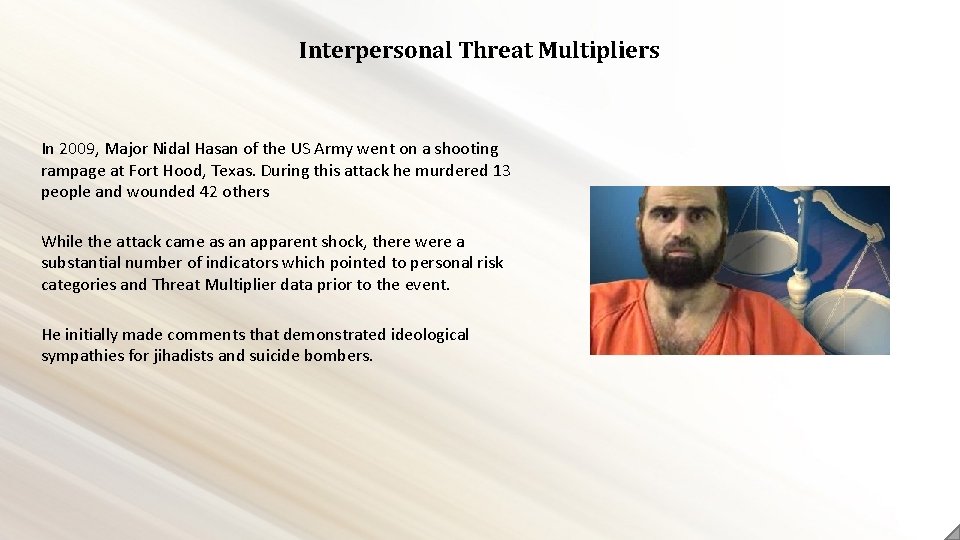
Interpersonal Threat Multipliers In 2009, Major Nidal Hasan of the US Army went on a shooting rampage at Fort Hood, Texas. During this attack he murdered 13 people and wounded 42 others While the attack came as an apparent shock, there were a substantial number of indicators which pointed to personal risk categories and Threat Multiplier data prior to the event. He initially made comments that demonstrated ideological sympathies for jihadists and suicide bombers.
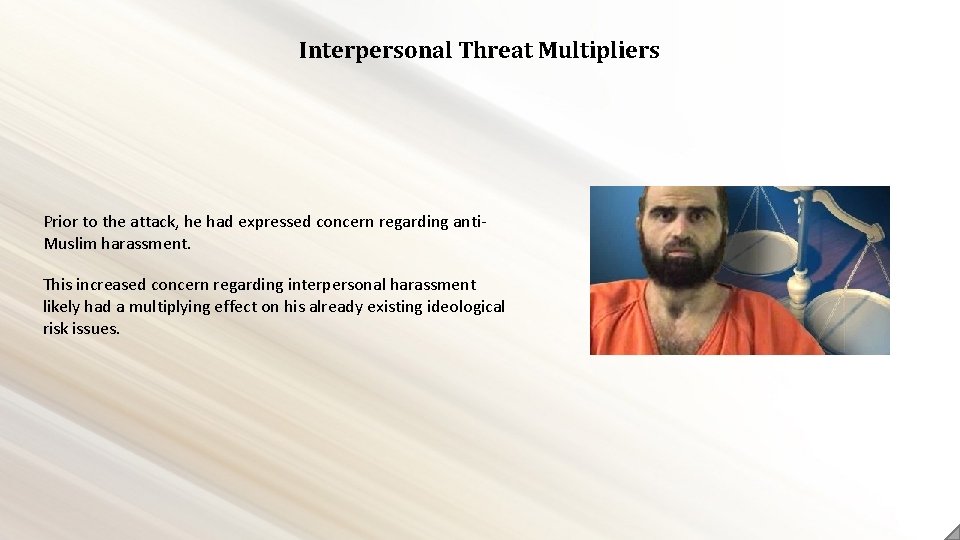
Interpersonal Threat Multipliers Prior to the attack, he had expressed concern regarding anti. Muslim harassment. This increased concern regarding interpersonal harassment likely had a multiplying effect on his already existing ideological risk issues.
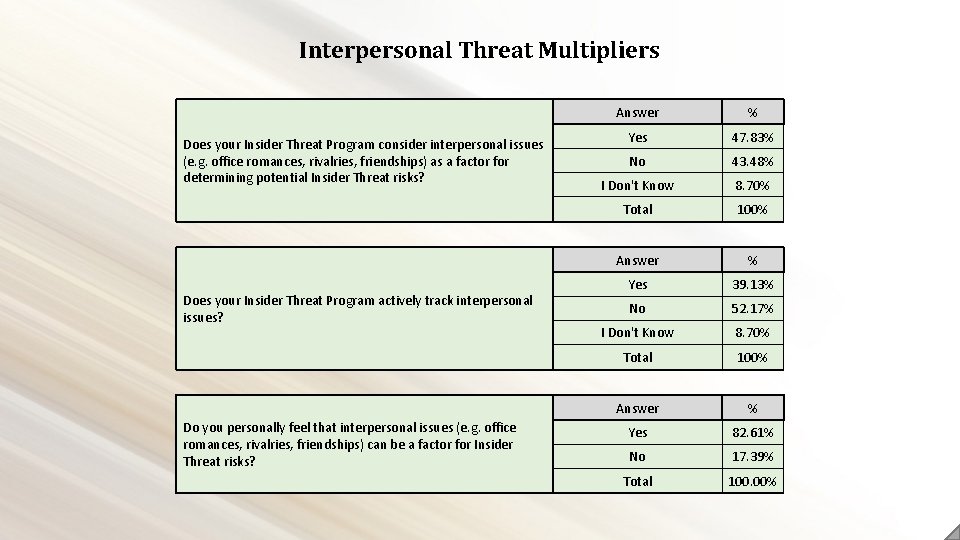
Interpersonal Threat Multipliers Does your Insider Threat Program consider interpersonal issues (e. g. office romances, rivalries, friendships) as a factor for determining potential Insider Threat risks? Does your Insider Threat Program actively track interpersonal issues? Do you personally feel that interpersonal issues (e. g. office romances, rivalries, friendships) can be a factor for Insider Threat risks? Answer % Yes 47. 83% No 43. 48% I Don't Know 8. 70% Total 100% Answer % Yes 39. 13% No 52. 17% I Don't Know 8. 70% Total 100% Answer % Yes 82. 61% No 17. 39% Total 100. 00%
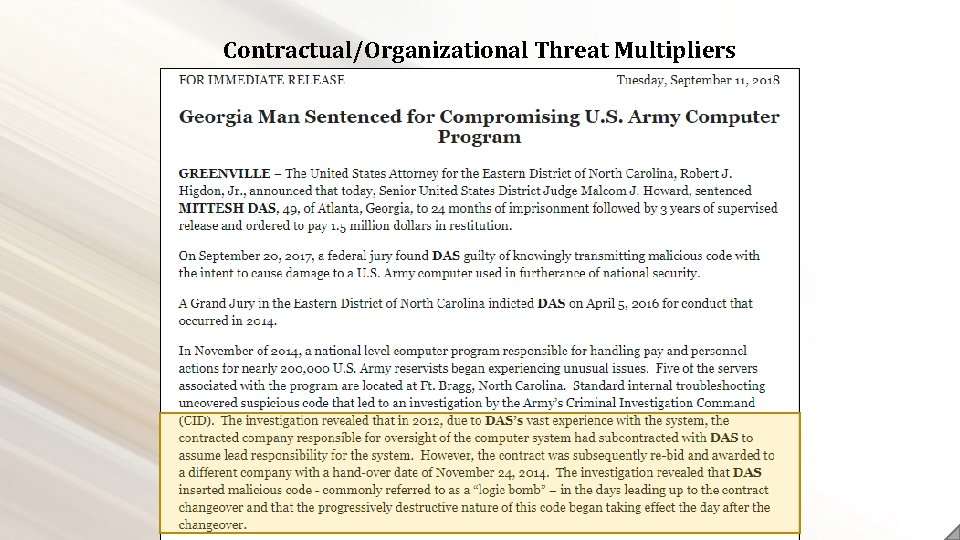
Contractual/Organizational Threat Multipliers Following the understanding that termination periods (specifically the final 30 days of employment) represent an increase in potential theft from an organization, it can be considered that any largescale layoff would present an organization with a broader risk of Insider Threat activity. Comparatively, even smaller organizations may be placed into situation in which factors separate from the individuals themselves, such as a loss of contract, cause stress or harm to those individuals through the termination of their positions. This types of situations increase the potential that individuals, separate from existing risk levels, may be placed in a situation wherein Insider Threat actions became a more acceptable norm.
Contractual/Organizational Threat Multipliers
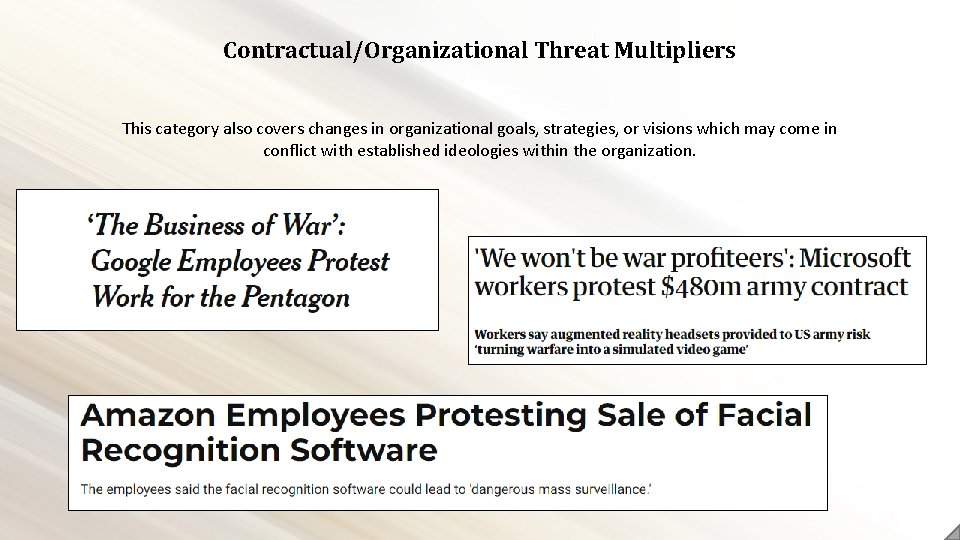
Contractual/Organizational Threat Multipliers This category also covers changes in organizational goals, strategies, or visions which may come in conflict with established ideologies within the organization.
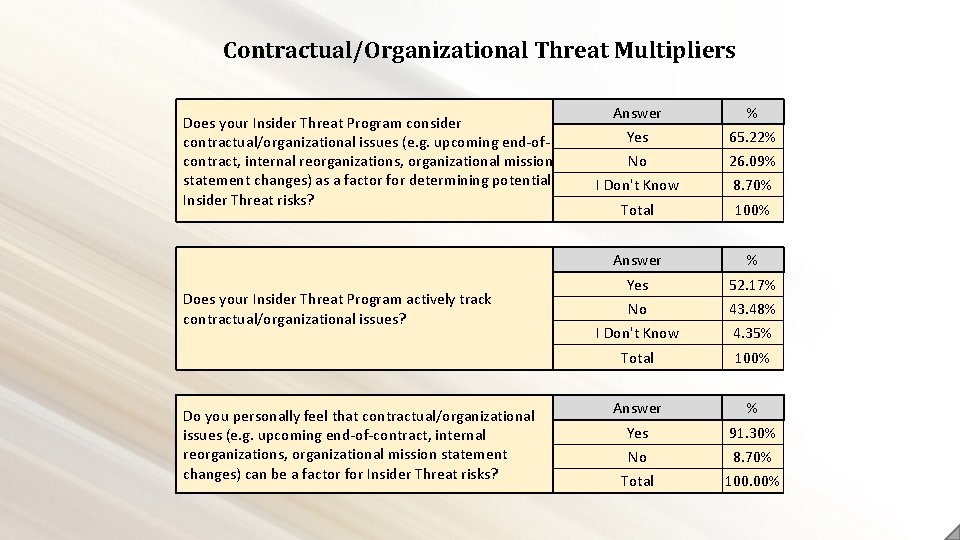
Contractual/Organizational Threat Multipliers Does your Insider Threat Program consider contractual/organizational issues (e. g. upcoming end-ofcontract, internal reorganizations, organizational mission statement changes) as a factor for determining potential Insider Threat risks? Does your Insider Threat Program actively track contractual/organizational issues? Do you personally feel that contractual/organizational issues (e. g. upcoming end-of-contract, internal reorganizations, organizational mission statement changes) can be a factor for Insider Threat risks? Answer % Yes 65. 22% No 26. 09% I Don't Know 8. 70% Total 100% Answer % Yes 52. 17% No 43. 48% I Don't Know 4. 35% Total 100% Answer % Yes 91. 30% No 8. 70% Total 100. 00%
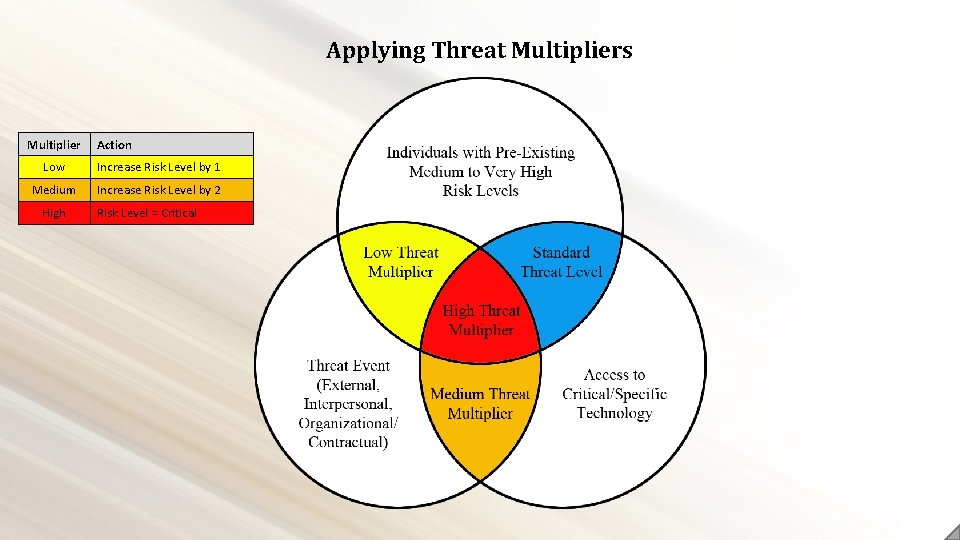
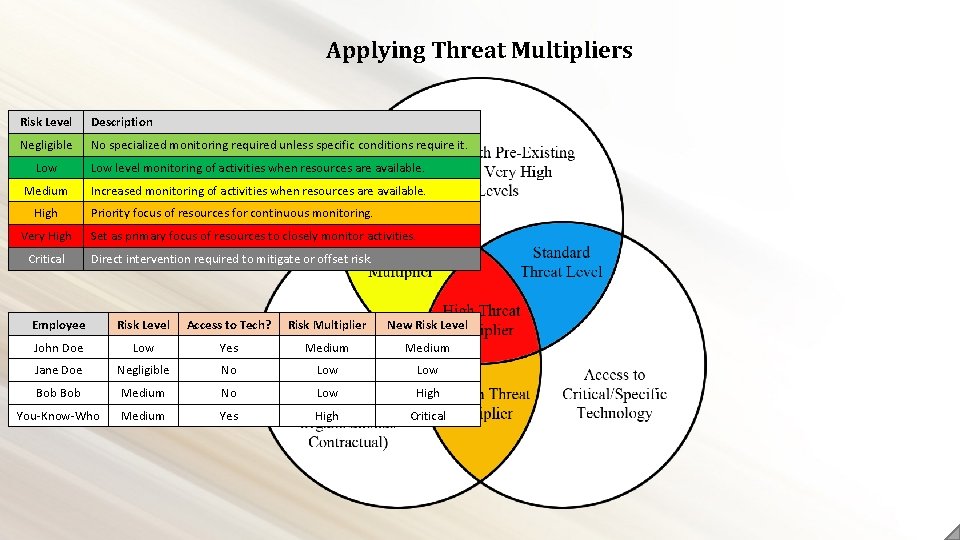
Applying Threat Multipliers Multiplier Action Low Increase Risk Level by 1 Medium Increase Risk Level by 2 High Risk Level = Critical
Applying Threat Multipliers Risk Level Description Negligible No specialized monitoring required unless specific conditions require it. Low level monitoring of activities when resources are available. Medium Increased monitoring of activities when resources are available. High Very High Critical Priority focus of resources for continuous monitoring. Set as primary focus of resources to closely monitor activities. Direct intervention required to mitigate or offset risk. Employee Risk Level Access to Tech? Risk Multiplier New Risk Level John Doe Low Yes Medium Jane Doe Negligible No Low Bob Medium No Low High You-Know-Who Medium Yes High Critical
Recommended Reading Common Sense Guide to Mitigating Insider Threats, Fifth Edition. Link: https: //resources. sei. cmu. edu/asset_files/Technical. Report/2016_005_001_484758. pdf PERSEREC. Espionage and Other Compromises of National Security: Case Summaries Link: https: //www. dhra. mil/perserec/espionage-cases/ Burkett, R. (2013). An Alternative Framework for Agent Recruitment: From MICE to RASCLS. Link: https: //www. cia. gov/library/center-for-the-study-of-intelligence/csi-publications/csi-studies/vol. -57 no. -1 -a/vol. -57 -no. -1 -a-pdfs/Burkett-MICE%20 to%20 RASCALS. pdf PERSEREC (1992). Americans Who Spied Against Their Country Since World War II. Link: http: //www. all. net/books/iw/www. dss. mil/training/tr 92005. pdf United States of America v. Huawei Device Co, Indictment 2: 19 -cr-00010 -RSM (2019). Link: https: //www. documentcloud. org/documents/5698470 -Huawei-Indictment. html Charney, D. (2014). True Psychology of the Insider Spy. Link: https: //noir 4 usa. org/wp-content/uploads/2014/07/NOIR-White-Paper-17 JUL 14. pdf
Anonymous Survey Link: https: //una. co 1. qualtrics. com/jfe/form/SV_e. J 4 c. SUBJe. Ydtz. Ex
The End Any Questions?